Research Methods in Psychology
RESEARCH
METHODS
Lecture 11
PROBLEM
DEFINITION AND
RESEARCH
PROPOSAL
First step
in research process
•
•
•
•
•
•
•
•

No formula for the selection of topic.
Start with a broad area of interest.
Interest from a variety of sources:
Personal experiences.
Mass media.
Developments in knowledge.
Solving problems (Org., family).
Hot issues of daily life.
Broad area of interest
• Family Trends in Pakistani family
• Population Aging population
• Labor Unions Protecting the rights
of members.
• Marketing TV commercials
Narrowing the topic
• Try to get background information
from different sources.
• For example
Examine the literature
• Published articles are excellent sources of ideas
for R. questions.
• Already specific and suggest research questions.
Focus on the following:
• a. Explore unexpected findings discovered in
previous research.
• b. Follow future research suggestions.
• c. Apply existing theory to new topic.
• d. Challenge the previous findings.
• E. Specify the intervening process
Talk over ideas
with others
• Share ideas with knowledgeable people
• Seek out those who differ. Discuss
possible research questions with them.
Apply to a specific context
• Focus onto a specific historical period.
• Narrow the topic to a specific society.
• Consider which subgroups are involved
– expected differences
From research question to
hypotheses
• Tentative answers to questions –
identification of variable (Family,
population, labor unions)
• Argumentation – propositions
• Testable propositions – hypotheses
• Interrelationship of propositions –
framework
Problem Definition
• From broad to specific concern
• Present problem statement in clear and precise
manner. Problem could be
• An existing business problem identified by the
Manager
• Scope for future improvement
• Areas needing conceptual clarity
• Curiosity of the researcher
Sponsored Researches
• Symptoms of issues identified – tip of the
iceberg – underlying factors to be identified.
• Management dilemmas to be translated into
research questions
• Terms of reference
• Some steps may not get emphasis.
• Management’s research decisions based on
the urgency of the study, time available,
existing information, and cost-benefit
equation.
Research Proposal
• Document that presents a plan for a project
to reviewers for evaluation.
• Can be a supervised project or a project
proposed to funding agency.
• Convince the reviewers about the capability
of the researcher.
• For funded projects the researchers need to
show the track record of past success.
Research proposal sections
• Introduction (background, objectives, significance)
• Research design (data collection technique,
population, sample, tools, fieldwork, data
processing and analysis)
• Report writing
• Time schedule
• Research Team
• Budget
RESEARCH
METHODS
Lecture 12
THE RESEARCH
PROCESS
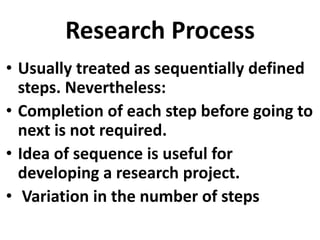
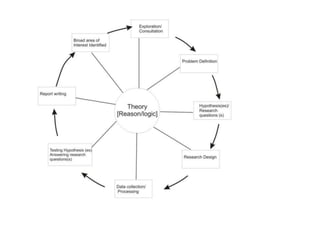
Research Process
• Usually treated as sequentially defined
steps. Nevertheless:
• Completion of each step before going to
next is not required.
• Idea of sequence is useful for
developing a research project.
• Variation in the number of steps
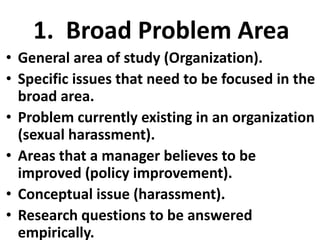
1. Broad Problem Area
• General area of study (Organization).
• Specific issues that need to be focused in the
broad area.
• Problem currently existing in an organization
(sexual harassment).
• Areas that a manager believes to be
improved (policy improvement).
• Conceptual issue (harassment).
• Research questions to be answered
empirically.
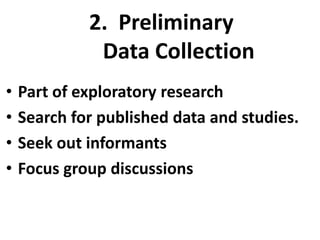
2. Preliminary
Data Collection
•
•
•
•

Part of exploratory research
Search for published data and studies.
Seek out informants
Focus group discussions
3. Problem Definition
• Translate the broad issue into a
research question.
• Management dilemma into
management question – symptoms
of the problem. Productivity
decline. Demand for daycare
facilities
4. Theoretical Framework
• Consultation – identification of
variables, make logical relationships,
delineation of framework.
• Components of theoretical framework
already discussed.
5. Generation of
Hypotheses
• Derive the hypotheses from the
theoretical framework.
6. Research Design
• Master plan for collecting and analyzing the
data.
• Specify the sources of information and the
techniques to be used in the study.
• Broadly 6 methods – surveys, experiments,
observations, communication analysis, case
study, focus group discussions. Secondary
data analysis.
Determine the method to
be used
• Objectives of the research, data
sources, urgency of the decision,
cost of obtaining the data will
determine the method.
Surveys
• The most common method of generating
primary data.
• Sample of people using questionnaire.
• Questionnaire an essential tool.
• Contact the respondents in person, by
telephone, by mail, on the internet.
• Each of these techniques has advantages
and disadvantages.
• Choose the most appropriate one.
Experiments
•
•
•
•

Establish cause and effect relationship.
Manipulating X affects on Y.
Productivity affected by rewards.
Controlled conditions – isolate causal factors
– control external factors.
• Lab experiments and field experiments.
Observation techniques
• Non participant and participant.
Communication analysis
• Analyzing the content of text.
• Content refers to words, meanings, pictures,
symbols, ideas, themes, messages.
• Text is anything written, visual, or spoken
• Books, newspapers, advertisements,
speeches, official documents, photographs,
films, articles of clothing, works of art.
Case study
• In-depth analysis of a unit.
• Clinical analysis in retrospect.
• Multiple sources of information –
history, consulting written records.
Focus group discussions
• Discussion of an issue by 6-12 persons
assisted by a moderator.
• Useful in exploratory research.
Supplements the quantitative
information.
No one method is best
• Researchers evaluate and select the
most appropriate method.
7. Data collection, data
processing and analysis
•
•
•
•

Integral part of research design.
Variety of ways. Field and lab.
Interviews, questionnaires, observation.
Data processing – editing, coding,
computer entries, tabulation.
8. Testing the Hypotheses
• Interpretation of data.
• Testing the hypotheses.
• Finding solutions to problems of
organization or society.
• Making recommendations
9. Report Writing
• Communicating the research findings.
• Report is technical. Managers are
selective readers. Interested only in
recommendations.
• Historical document.
• Academic purpose – dissertations.
Specific format. Writing of research
papers
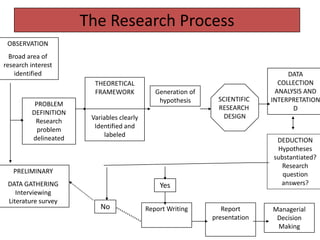
The Research Process
OBSERVATION
Broad area of
research interest
identified

THEORETICAL
FRAMEWORK
PROBLEM
DEFINITION
Research
problem
delineated

Generation of
hypothesis

Variables clearly
Identified and
labeled

SCIENTIFIC
RESEARCH
DESIGN

DEDUCTION
Hypotheses
substantiated?
Research
question
answers?

PRELIMINARY

DATA GATHERING
Interviewing
Literature survey

Yes
No

Report Writing

DATA
COLLECTION
ANALYSIS AND
INTERPRETATION
D

Report
presentation

Managerial
Decision
Making
Research methods in psychology 1

Research methods in psychology 1

  • 1.
  • 2.
  • 3.
  • 4.
    First step in researchprocess • • • • • • • • No formula for the selection of topic. Start with a broad area of interest. Interest from a variety of sources: Personal experiences. Mass media. Developments in knowledge. Solving problems (Org., family). Hot issues of daily life.
  • 5.
    Broad area ofinterest • Family Trends in Pakistani family • Population Aging population • Labor Unions Protecting the rights of members. • Marketing TV commercials
  • 6.
    Narrowing the topic •Try to get background information from different sources. • For example
  • 7.
    Examine the literature •Published articles are excellent sources of ideas for R. questions. • Already specific and suggest research questions. Focus on the following: • a. Explore unexpected findings discovered in previous research. • b. Follow future research suggestions. • c. Apply existing theory to new topic. • d. Challenge the previous findings. • E. Specify the intervening process
  • 8.
    Talk over ideas withothers • Share ideas with knowledgeable people • Seek out those who differ. Discuss possible research questions with them.
  • 9.
    Apply to aspecific context • Focus onto a specific historical period. • Narrow the topic to a specific society. • Consider which subgroups are involved – expected differences
  • 10.
    From research questionto hypotheses • Tentative answers to questions – identification of variable (Family, population, labor unions) • Argumentation – propositions • Testable propositions – hypotheses • Interrelationship of propositions – framework
  • 11.
    Problem Definition • Frombroad to specific concern • Present problem statement in clear and precise manner. Problem could be • An existing business problem identified by the Manager • Scope for future improvement • Areas needing conceptual clarity • Curiosity of the researcher
  • 12.
    Sponsored Researches • Symptomsof issues identified – tip of the iceberg – underlying factors to be identified. • Management dilemmas to be translated into research questions • Terms of reference • Some steps may not get emphasis. • Management’s research decisions based on the urgency of the study, time available, existing information, and cost-benefit equation.
  • 13.
    Research Proposal • Documentthat presents a plan for a project to reviewers for evaluation. • Can be a supervised project or a project proposed to funding agency. • Convince the reviewers about the capability of the researcher. • For funded projects the researchers need to show the track record of past success.
  • 14.
    Research proposal sections •Introduction (background, objectives, significance) • Research design (data collection technique, population, sample, tools, fieldwork, data processing and analysis) • Report writing • Time schedule • Research Team • Budget
  • 15.
  • 16.
  • 17.
    Research Process • Usuallytreated as sequentially defined steps. Nevertheless: • Completion of each step before going to next is not required. • Idea of sequence is useful for developing a research project. • Variation in the number of steps
  • 18.
    1. Broad ProblemArea • General area of study (Organization). • Specific issues that need to be focused in the broad area. • Problem currently existing in an organization (sexual harassment). • Areas that a manager believes to be improved (policy improvement). • Conceptual issue (harassment). • Research questions to be answered empirically.
  • 19.
    2. Preliminary Data Collection • • • • Partof exploratory research Search for published data and studies. Seek out informants Focus group discussions
  • 20.
    3. Problem Definition •Translate the broad issue into a research question. • Management dilemma into management question – symptoms of the problem. Productivity decline. Demand for daycare facilities
  • 21.
    4. Theoretical Framework •Consultation – identification of variables, make logical relationships, delineation of framework. • Components of theoretical framework already discussed.
  • 22.
    5. Generation of Hypotheses •Derive the hypotheses from the theoretical framework.
  • 23.
    6. Research Design •Master plan for collecting and analyzing the data. • Specify the sources of information and the techniques to be used in the study. • Broadly 6 methods – surveys, experiments, observations, communication analysis, case study, focus group discussions. Secondary data analysis.
  • 24.
    Determine the methodto be used • Objectives of the research, data sources, urgency of the decision, cost of obtaining the data will determine the method.
  • 25.
    Surveys • The mostcommon method of generating primary data. • Sample of people using questionnaire. • Questionnaire an essential tool. • Contact the respondents in person, by telephone, by mail, on the internet. • Each of these techniques has advantages and disadvantages. • Choose the most appropriate one.
  • 26.
    Experiments • • • • Establish cause andeffect relationship. Manipulating X affects on Y. Productivity affected by rewards. Controlled conditions – isolate causal factors – control external factors. • Lab experiments and field experiments.
  • 27.
    Observation techniques • Nonparticipant and participant.
  • 28.
    Communication analysis • Analyzingthe content of text. • Content refers to words, meanings, pictures, symbols, ideas, themes, messages. • Text is anything written, visual, or spoken • Books, newspapers, advertisements, speeches, official documents, photographs, films, articles of clothing, works of art.
  • 29.
    Case study • In-depthanalysis of a unit. • Clinical analysis in retrospect. • Multiple sources of information – history, consulting written records.
  • 30.
    Focus group discussions •Discussion of an issue by 6-12 persons assisted by a moderator. • Useful in exploratory research. Supplements the quantitative information.
  • 31.
    No one methodis best • Researchers evaluate and select the most appropriate method.
  • 32.
    7. Data collection,data processing and analysis • • • • Integral part of research design. Variety of ways. Field and lab. Interviews, questionnaires, observation. Data processing – editing, coding, computer entries, tabulation.
  • 33.
    8. Testing theHypotheses • Interpretation of data. • Testing the hypotheses. • Finding solutions to problems of organization or society. • Making recommendations
  • 34.
    9. Report Writing •Communicating the research findings. • Report is technical. Managers are selective readers. Interested only in recommendations. • Historical document. • Academic purpose – dissertations. Specific format. Writing of research papers
  • 35.
    The Research Process OBSERVATION Broadarea of research interest identified THEORETICAL FRAMEWORK PROBLEM DEFINITION Research problem delineated Generation of hypothesis Variables clearly Identified and labeled SCIENTIFIC RESEARCH DESIGN DEDUCTION Hypotheses substantiated? Research question answers? PRELIMINARY DATA GATHERING Interviewing Literature survey Yes No Report Writing DATA COLLECTION ANALYSIS AND INTERPRETATION D Report presentation Managerial Decision Making