Chapter 2

Foundations of Individual Behavior
There are three foundations on which the
behavior of an individual is built.
1). Ability
2). Biographical characteristics
3). Learning leads to behavior
      what management can do to shape the
behaviors of organizational members.
Ability
Ability: An individual’s capacity to perform the
various tasks in a job.
An individuals abilities can be categorized into two
sets:
1. Intellectual Abilities: the capacity to do mental
   activities-thinking, reasoning, and problem
   solving.
2. Physical Abilities: the capacity to do tasks that
   demand stamina, dexterity, strength, and similar
   characteristics.
Intellectual Abilities
there are seven most cited abilities are:
1. Number aptitude- speedy , accurate arithmetic.
2. Verbal Comprehension- understand what is read or heard and
    relationship of words.
3. Perceptual speed- ability to identify visual similarities.
4. Inductive reasoning-Identify logical sequence in a problem and
    solve the problem.

5.   Deductive reasoning- using logic and assess the implications of an
     argument
6.   Spatial Visualization- How object would look if its position in space
     is changed
7.   Memory- ability to retain and recall past experiences.
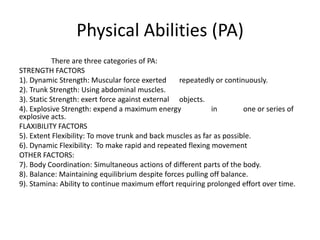
Physical Abilities (PA)
            There are three categories of PA:
STRENGTH FACTORS
1). Dynamic Strength: Muscular force exerted      repeatedly or continuously.
2). Trunk Strength: Using abdominal muscles.
3). Static Strength: exert force against external objects.
4). Explosive Strength: expend a maximum energy              in        one or series of
explosive acts.
FLAXIBILITY FACTORS
5). Extent Flexibility: To move trunk and back muscles as far as possible.
6). Dynamic Flexibility: To make rapid and repeated flexing movement
OTHER FACTORS:
7). Body Coordination: Simultaneous actions of different parts of the body.
8). Balance: Maintaining equilibrium despite forces pulling off balance.
9). Stamina: Ability to continue maximum effort requiring prolonged effort over time.
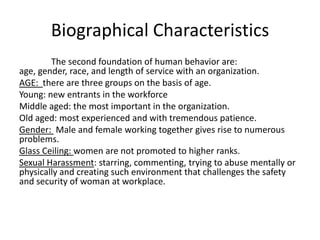
Biographical Characteristics
        The second foundation of human behavior are:
age, gender, race, and length of service with an organization.
AGE: there are three groups on the basis of age.
Young: new entrants in the workforce
Middle aged: the most important in the organization.
Old aged: most experienced and with tremendous patience.
Gender: Male and female working together gives rise to numerous
problems.
Glass Ceiling: women are not promoted to higher ranks.
Sexual Harassment: starring, commenting, trying to abuse mentally or
physically and creating such environment that challenges the safety
and security of woman at workplace.
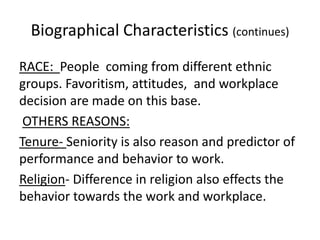
Biographical Characteristics (continues)
RACE: People coming from different ethnic
groups. Favoritism, attitudes, and workplace
decision are made on this base.
 OTHERS REASONS:
Tenure- Seniority is also reason and predictor of
performance and behavior to work.
Religion- Difference in religion also effects the
behavior towards the work and workplace.
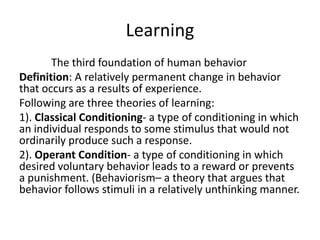
Learning
       The third foundation of human behavior
Definition: A relatively permanent change in behavior
that occurs as a results of experience.
Following are three theories of learning:
1). Classical Conditioning- a type of conditioning in which
an individual responds to some stimulus that would not
ordinarily produce such a response.
2). Operant Condition- a type of conditioning in which
desired voluntary behavior leads to a reward or prevents
a punishment. (Behaviorism– a theory that argues that
behavior follows stimuli in a relatively unthinking manner.
Learning (continues)
3).Social Learning: The view that people can learn
through observation and direct experience: there are
four processes found that influence on an individual.
They are as follows:
a). Intentional processes– people learn when they pay
attention i.e. attractive, important to us, repeatedly
available or similar to us in our estimation.
b). Retention Processes– how well the individual
remembers the model action.
c).Motor reproduction processes– watching must be
converted to doing. Individual can perform modeled
activities

Chapter 2. ob

  • 1.
    Chapter 2 Foundations ofIndividual Behavior
  • 2.
    Foundations of IndividualBehavior There are three foundations on which the behavior of an individual is built. 1). Ability 2). Biographical characteristics 3). Learning leads to behavior what management can do to shape the behaviors of organizational members.
  • 3.
    Ability Ability: An individual’scapacity to perform the various tasks in a job. An individuals abilities can be categorized into two sets: 1. Intellectual Abilities: the capacity to do mental activities-thinking, reasoning, and problem solving. 2. Physical Abilities: the capacity to do tasks that demand stamina, dexterity, strength, and similar characteristics.
  • 4.
    Intellectual Abilities there areseven most cited abilities are: 1. Number aptitude- speedy , accurate arithmetic. 2. Verbal Comprehension- understand what is read or heard and relationship of words. 3. Perceptual speed- ability to identify visual similarities. 4. Inductive reasoning-Identify logical sequence in a problem and solve the problem. 5. Deductive reasoning- using logic and assess the implications of an argument 6. Spatial Visualization- How object would look if its position in space is changed 7. Memory- ability to retain and recall past experiences.
  • 5.
    Physical Abilities (PA) There are three categories of PA: STRENGTH FACTORS 1). Dynamic Strength: Muscular force exerted repeatedly or continuously. 2). Trunk Strength: Using abdominal muscles. 3). Static Strength: exert force against external objects. 4). Explosive Strength: expend a maximum energy in one or series of explosive acts. FLAXIBILITY FACTORS 5). Extent Flexibility: To move trunk and back muscles as far as possible. 6). Dynamic Flexibility: To make rapid and repeated flexing movement OTHER FACTORS: 7). Body Coordination: Simultaneous actions of different parts of the body. 8). Balance: Maintaining equilibrium despite forces pulling off balance. 9). Stamina: Ability to continue maximum effort requiring prolonged effort over time.
  • 6.
    Biographical Characteristics The second foundation of human behavior are: age, gender, race, and length of service with an organization. AGE: there are three groups on the basis of age. Young: new entrants in the workforce Middle aged: the most important in the organization. Old aged: most experienced and with tremendous patience. Gender: Male and female working together gives rise to numerous problems. Glass Ceiling: women are not promoted to higher ranks. Sexual Harassment: starring, commenting, trying to abuse mentally or physically and creating such environment that challenges the safety and security of woman at workplace.
  • 7.
    Biographical Characteristics (continues) RACE:People coming from different ethnic groups. Favoritism, attitudes, and workplace decision are made on this base. OTHERS REASONS: Tenure- Seniority is also reason and predictor of performance and behavior to work. Religion- Difference in religion also effects the behavior towards the work and workplace.
  • 8.
    Learning The third foundation of human behavior Definition: A relatively permanent change in behavior that occurs as a results of experience. Following are three theories of learning: 1). Classical Conditioning- a type of conditioning in which an individual responds to some stimulus that would not ordinarily produce such a response. 2). Operant Condition- a type of conditioning in which desired voluntary behavior leads to a reward or prevents a punishment. (Behaviorism– a theory that argues that behavior follows stimuli in a relatively unthinking manner.
  • 9.
    Learning (continues) 3).Social Learning:The view that people can learn through observation and direct experience: there are four processes found that influence on an individual. They are as follows: a). Intentional processes– people learn when they pay attention i.e. attractive, important to us, repeatedly available or similar to us in our estimation. b). Retention Processes– how well the individual remembers the model action. c).Motor reproduction processes– watching must be converted to doing. Individual can perform modeled activities