Foundations of Individual Behavior
Chapter Two
➢ Biographical characteristics such as age, gender, race,
disability, and length of service are some of the most obvious
ways employees differ.
➢ Age
– Relationship of Age and job performance.
– Older workers?
• experience, judgment, a strong work ethic, and
commitment to quality.
– lacks flexibility and resisting new technology.
– Less adaptable and less open to change
– Based on studies of the age–turnover relationship, the
older you get, the less likely you are to quit your job.
– Age is also inversely related to absenteeism.
– How does age affect productivity?
• Many believe productivity declines with age.
• It is often assumed that skills like speed, agility, strength,
and coordination decay over time and results in reduced
productivity.
➢ Gender
– Women perform well on the job or men?
– No differences in problem-solving ability, analytical
skills, competitive drive, motivation, sociability, or
learning ability.
– Psychological studies have found women are more
agreeable and willing to conform to authority, whereas
men are more aggressive
– women more likely to turn over than men.
– Women also have higher rates of absenteeism than
men do.
➢ Race and ethnicity
– Race refers to a person's physical characteristics, such as
bone structure and skin, hair, or eye colour. E.g Black
people, White people, Asian people etc.
– Ethnicity, is state of belonging to a social group.
– refers to cultural factors, including nationality, regional
culture, and language.
– e.g English people, Americans, Pakistani (Punjabi, pathan,
Balochi, sindhi etc.)
– race----appearance
– Ethnicity-----social and cultural groups you belong to.
– more than one ethnicities------but will have one race.
– People favour colleagues of their own race in performance
evaluations, promotion decisions, and pay raises.
– Uncomfortable when interacting with other racial groups.
– Discrimination in the workplace for race and ethnic
minorities.
– Some research suggests that having a positive climate for
diversity overall can lead to increased sales.
Disability
➢ Mental (mental illnesses, schizophrenia, depression etc)
Physical disability(deaf, mute, deaf-mute, blind etc).
➢ On the one hand, a review of the evidence suggests workers
with disabilities receive higher performance evaluations.
➢ Individuals with disabilities tend to encounter lower performance
expectations and are less likely to be hired.
➢ These negative effects are much stronger for individuals with
mental disabilities,
➢ Other Biographical Characteristics:
➢ Tenure,
– tenure, expressed as work experience, appears to be a
good predictor of employee productivity.
– seniority to be negatively related to absenteeism.
– The longer a person is in a job, the less likely he or she
is to quit.
– Tenure and job satisfaction are positively related.
➢ Religion
– Often people of different religious faiths conflict.
– law prohibits employers from discriminating against
employees based on their religion
– Many Christians do not believe they should work on
Sundays, and
– Religious individuals may also believe they have an
obligation to express their beliefs in the workplace, and
vice versa.
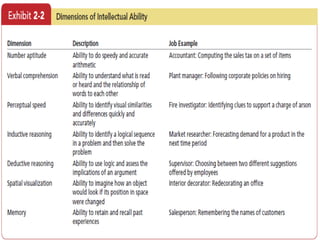
Ability
➢ Like thinking, reasoning and problem solving.
E X H I B I T 2-1
➢ Jobs differ in the demands they place on intellectual abilities.
➢ The more complex a job in terms of information-processing
demands, the more intelligence and verbal abilities will be
necessary to perform successfully
➢ Intelligence is a big help in performing a job well.
➢ The correlation between intelligence and job satisfaction is
about zero. Why?
➢ They are also more critical when evaluating their job conditions,
their expectations are always high.
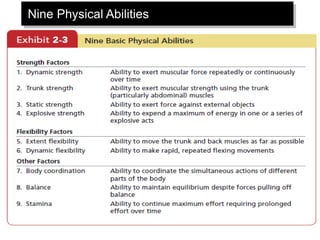
Physical Ability
Nine Physical Abilities
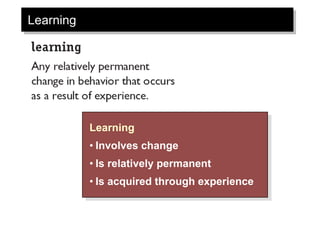
Learning
Learning
• Involves change
• Is relatively permanent
• Is acquired through experience
Theories of learning
Theory of Classical Conditioning
➢ Classical conditioning is a form of learning whereby
a conditioned stimulus becomes associated with an
unrelated unconditioned stimulus, in order to produce
a behavioural response known as a conditioned
response.
➢ Ivan Pavlov, a Russian psychologist developed this
theory.
Classical conditioning: Before conditioning, an unconditioned stimulus (food) produces an
unconditioned response (salivation), and a neutral stimulus (bell) does not have an effect.
During conditioning, the unconditioned stimulus (food) is presented repeatedly just after the
presentation of the neutral stimulus (bell). After conditioning, the neutral stimulus alone
produces a conditioned response (salivation), thus becoming a conditioned stimulus.
➢ Classical conditioning in Humans
➢ The influence of classical conditioning can be seen in
responses such as phobias, disgust, anger, fear etc.
➢ For example, when the sight of a dog has been
associated with a memory of being bitten, the result
may be a conditioned fear of dogs.
➢ Behavioural Therapies
➢ Classical conditioning has been used as a successful
form of treatment in changing or modifying
behaviours, such as smoking.
➢ Some therapies associated with classical conditioning include
aversion therapy, systematic desensitization, and flooding.
➢ Aversion therapy is a type of behaviour therapy designed to
encourage individuals to give up undesirable habits by causing
them to associate the habit with an unpleasant effect.
➢ Desensitizing is a kind of reverse conditioning in which an
individual is repeatedly exposed to the thing that is causing the
anxiety.
➢ Flooding is similar in that it exposes an individual to the thing
causing the anxiety, but it does so in a more intense and
prolonged way.
➢ Classical conditioning in everyday life
➢ By associating the model with the car being
advertised, you come to see the car as being
desirable.
➢ E.g men who viewed a car commercial that included
an attractive model later rated the car as being faster,
more appealing, and better designed than did men
who viewed an advertisement for the same
car without the model.
Theory of Operant conditioning
➢ Operant condition learning theory states that Behaviour is a
function of its consequences.
➢ The developer of operant conditioning, Harvard psychologist B.
F. Skinner, argued that creating pleasing consequences to
follow specific forms of behaviour would increase the frequency
of that behaviour.
➢ Behaviour is likely to be repeated if the consequences are
favourable.
➢ Behaviour is not likely to be repeated if the consequences are
unfavourable.
➢ Assume that your boss tells you that you’ll be compensated at
your next performance appraisal if you will work overtime during
the next three weeks.
➢ However, when performance appraisal time comes, you find that
you are given no positive reinforcement for your overtime work.
➢ The next time your boss asks you to work overtime, what will
you do? You’ll probably decline!
Social learning theory
➢ Individuals can also learn by observing what happens
to other people and just by being told about
something, as well as by direct experiences.
➢ Its an extension of operant conditioning—that is, it
assumes that behaviour is a function of
consequences—it also acknowledges the existence
of observational learning and the importance of
perception in learning.
➢ People respond to how they perceive and define
consequences.
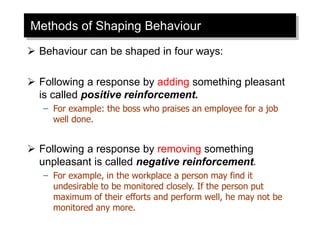
Methods of Shaping Behaviour
➢ Behaviour can be shaped in four ways:
➢ Following a response by adding something pleasant
is called positive reinforcement.
– For example: the boss who praises an employee for a job
well done.
➢ Following a response by removing something
unpleasant is called negative reinforcement.
– For example, in the workplace a person may find it
undesirable to be monitored closely. If the person put
maximum of their efforts and perform well, he may not be
monitored any more.
➢ When a behaviour leads to an unpleasant response (adding),
that’s called punishment, which is an attempt to eliminate an
undesirable behaviour.
– For Example: Giving an employee a two-day suspension
from work without pay for showing up late multiple times is
an example of punishment.
➢ Eliminating (removing) any reinforcement of a behaviour is
called extinction.
– For example, an employee regularly stays late at work to
assist the next shift in catching up after a very busy day.
– No praise or thanks is ever given to the employee by her co-
workers or supervisor, so eventually she/he leaves work on
time and stops assisting the next shift.
– Ignoring her good behaviour caused its extinction.
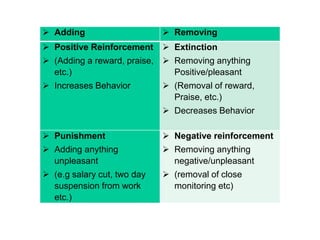
➢ Adding ➢ Removing
➢ Positive Reinforcement
➢ (Adding a reward, praise,
etc.)
➢ Increases Behavior
➢ Extinction
➢ Removing anything
Positive/pleasant
➢ (Removal of reward,
Praise, etc.)
➢ Decreases Behavior
➢ Punishment
➢ Adding anything
unpleasant
➢ (e.g salary cut, two day
suspension from work
etc.)
➢ Negative reinforcement
➢ Removing anything
negative/unpleasant
➢ (removal of close
monitoring etc)
Schedules of Reinforcement
Thank you!

OB Chap 2.pdf

  • 1.
    Foundations of IndividualBehavior Chapter Two
  • 2.
    ➢ Biographical characteristicssuch as age, gender, race, disability, and length of service are some of the most obvious ways employees differ. ➢ Age – Relationship of Age and job performance. – Older workers? • experience, judgment, a strong work ethic, and commitment to quality. – lacks flexibility and resisting new technology. – Less adaptable and less open to change
  • 3.
    – Based onstudies of the age–turnover relationship, the older you get, the less likely you are to quit your job. – Age is also inversely related to absenteeism. – How does age affect productivity? • Many believe productivity declines with age. • It is often assumed that skills like speed, agility, strength, and coordination decay over time and results in reduced productivity.
  • 4.
    ➢ Gender – Womenperform well on the job or men? – No differences in problem-solving ability, analytical skills, competitive drive, motivation, sociability, or learning ability. – Psychological studies have found women are more agreeable and willing to conform to authority, whereas men are more aggressive – women more likely to turn over than men. – Women also have higher rates of absenteeism than men do.
  • 5.
    ➢ Race andethnicity – Race refers to a person's physical characteristics, such as bone structure and skin, hair, or eye colour. E.g Black people, White people, Asian people etc. – Ethnicity, is state of belonging to a social group. – refers to cultural factors, including nationality, regional culture, and language. – e.g English people, Americans, Pakistani (Punjabi, pathan, Balochi, sindhi etc.) – race----appearance – Ethnicity-----social and cultural groups you belong to.
  • 6.
    – more thanone ethnicities------but will have one race. – People favour colleagues of their own race in performance evaluations, promotion decisions, and pay raises. – Uncomfortable when interacting with other racial groups. – Discrimination in the workplace for race and ethnic minorities. – Some research suggests that having a positive climate for diversity overall can lead to increased sales.
  • 7.
    Disability ➢ Mental (mentalillnesses, schizophrenia, depression etc) Physical disability(deaf, mute, deaf-mute, blind etc). ➢ On the one hand, a review of the evidence suggests workers with disabilities receive higher performance evaluations. ➢ Individuals with disabilities tend to encounter lower performance expectations and are less likely to be hired. ➢ These negative effects are much stronger for individuals with mental disabilities,
  • 8.
    ➢ Other BiographicalCharacteristics: ➢ Tenure, – tenure, expressed as work experience, appears to be a good predictor of employee productivity. – seniority to be negatively related to absenteeism. – The longer a person is in a job, the less likely he or she is to quit. – Tenure and job satisfaction are positively related.
  • 9.
    ➢ Religion – Oftenpeople of different religious faiths conflict. – law prohibits employers from discriminating against employees based on their religion – Many Christians do not believe they should work on Sundays, and – Religious individuals may also believe they have an obligation to express their beliefs in the workplace, and vice versa.
  • 10.
    Ability ➢ Like thinking,reasoning and problem solving.
  • 11.
    E X HI B I T 2-1
  • 12.
    ➢ Jobs differin the demands they place on intellectual abilities. ➢ The more complex a job in terms of information-processing demands, the more intelligence and verbal abilities will be necessary to perform successfully ➢ Intelligence is a big help in performing a job well. ➢ The correlation between intelligence and job satisfaction is about zero. Why? ➢ They are also more critical when evaluating their job conditions, their expectations are always high.
  • 13.
  • 14.
  • 15.
    Learning Learning • Involves change •Is relatively permanent • Is acquired through experience
  • 16.
    Theories of learning Theoryof Classical Conditioning ➢ Classical conditioning is a form of learning whereby a conditioned stimulus becomes associated with an unrelated unconditioned stimulus, in order to produce a behavioural response known as a conditioned response. ➢ Ivan Pavlov, a Russian psychologist developed this theory.
  • 17.
    Classical conditioning: Beforeconditioning, an unconditioned stimulus (food) produces an unconditioned response (salivation), and a neutral stimulus (bell) does not have an effect. During conditioning, the unconditioned stimulus (food) is presented repeatedly just after the presentation of the neutral stimulus (bell). After conditioning, the neutral stimulus alone produces a conditioned response (salivation), thus becoming a conditioned stimulus.
  • 18.
    ➢ Classical conditioningin Humans ➢ The influence of classical conditioning can be seen in responses such as phobias, disgust, anger, fear etc. ➢ For example, when the sight of a dog has been associated with a memory of being bitten, the result may be a conditioned fear of dogs. ➢ Behavioural Therapies ➢ Classical conditioning has been used as a successful form of treatment in changing or modifying behaviours, such as smoking.
  • 19.
    ➢ Some therapiesassociated with classical conditioning include aversion therapy, systematic desensitization, and flooding. ➢ Aversion therapy is a type of behaviour therapy designed to encourage individuals to give up undesirable habits by causing them to associate the habit with an unpleasant effect. ➢ Desensitizing is a kind of reverse conditioning in which an individual is repeatedly exposed to the thing that is causing the anxiety. ➢ Flooding is similar in that it exposes an individual to the thing causing the anxiety, but it does so in a more intense and prolonged way.
  • 20.
    ➢ Classical conditioningin everyday life ➢ By associating the model with the car being advertised, you come to see the car as being desirable. ➢ E.g men who viewed a car commercial that included an attractive model later rated the car as being faster, more appealing, and better designed than did men who viewed an advertisement for the same car without the model.
  • 21.
    Theory of Operantconditioning ➢ Operant condition learning theory states that Behaviour is a function of its consequences. ➢ The developer of operant conditioning, Harvard psychologist B. F. Skinner, argued that creating pleasing consequences to follow specific forms of behaviour would increase the frequency of that behaviour. ➢ Behaviour is likely to be repeated if the consequences are favourable. ➢ Behaviour is not likely to be repeated if the consequences are unfavourable.
  • 22.
    ➢ Assume thatyour boss tells you that you’ll be compensated at your next performance appraisal if you will work overtime during the next three weeks. ➢ However, when performance appraisal time comes, you find that you are given no positive reinforcement for your overtime work. ➢ The next time your boss asks you to work overtime, what will you do? You’ll probably decline!
  • 23.
    Social learning theory ➢Individuals can also learn by observing what happens to other people and just by being told about something, as well as by direct experiences. ➢ Its an extension of operant conditioning—that is, it assumes that behaviour is a function of consequences—it also acknowledges the existence of observational learning and the importance of perception in learning. ➢ People respond to how they perceive and define consequences.
  • 24.
    Methods of ShapingBehaviour ➢ Behaviour can be shaped in four ways: ➢ Following a response by adding something pleasant is called positive reinforcement. – For example: the boss who praises an employee for a job well done. ➢ Following a response by removing something unpleasant is called negative reinforcement. – For example, in the workplace a person may find it undesirable to be monitored closely. If the person put maximum of their efforts and perform well, he may not be monitored any more.
  • 25.
    ➢ When abehaviour leads to an unpleasant response (adding), that’s called punishment, which is an attempt to eliminate an undesirable behaviour. – For Example: Giving an employee a two-day suspension from work without pay for showing up late multiple times is an example of punishment. ➢ Eliminating (removing) any reinforcement of a behaviour is called extinction. – For example, an employee regularly stays late at work to assist the next shift in catching up after a very busy day. – No praise or thanks is ever given to the employee by her co- workers or supervisor, so eventually she/he leaves work on time and stops assisting the next shift. – Ignoring her good behaviour caused its extinction.
  • 26.
    ➢ Adding ➢Removing ➢ Positive Reinforcement ➢ (Adding a reward, praise, etc.) ➢ Increases Behavior ➢ Extinction ➢ Removing anything Positive/pleasant ➢ (Removal of reward, Praise, etc.) ➢ Decreases Behavior ➢ Punishment ➢ Adding anything unpleasant ➢ (e.g salary cut, two day suspension from work etc.) ➢ Negative reinforcement ➢ Removing anything negative/unpleasant ➢ (removal of close monitoring etc)
  • 27.
  • 28.
  • 29.