Chapter 3 
The Most Challenging Economy 
in Decades
Learning Goals 
Distinguish between microeconomics and 
macroeconomics. Explain the factors that 
drive supply and demand. 
Describe the four types of market 
structures in a private enterprise system 
and compare the three major types of 
economic systems. 
Identify and describe the four stages of 
the business cycle. Explain how 
productivity, price level changes, and 
employment levels affect the stability of a 
nation’s economy. 
1 
Discuss how monetary policy and 
fiscal policy are used to manage an 
economy’s performance. 
Describe the major global economic 
challenges of the 21st century. 
2 
3 
4 
5
Economics 
 Analysis of the choices people and governments make 
in allocating resources. 
 Supply: Amount of goods and services for sale at 
different prices. 
 Demand: Willingness and ability of consumers to 
purchase goods and services at different prices.
Microeconomics 
 The study of small economic units, such as individual 
consumers, families, and businesses.
Factors Driving Demand 
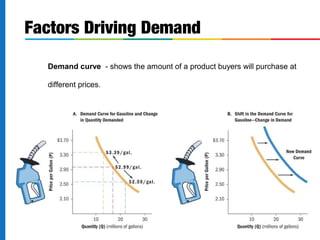
 Demand curve - shows the amount of a product buyers will purchase at 
different prices. 
 Driven by variety of factors such as competition, price, larger economic events, 
and consumer preferences.
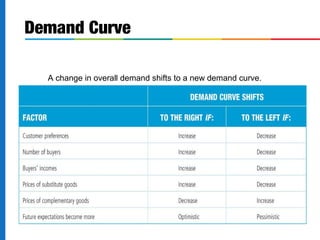
Demand Curve 
 A change in overall demand shifts to a new demand curve.
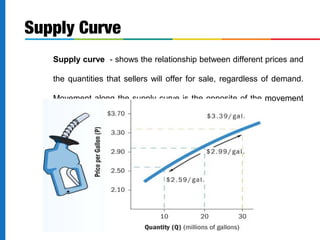
Supply Curve 
Supply curve - shows the relationship between different prices and 
the quantities that sellers will offer for sale, regardless of demand. 
Movement along the supply curve is the opposite of the movement 
along the demand curve.
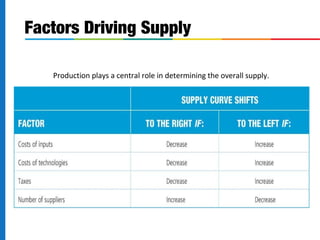
Factors Driving Supply 
 
Production plays a central role in determining the overall supply. of goods 
and services.
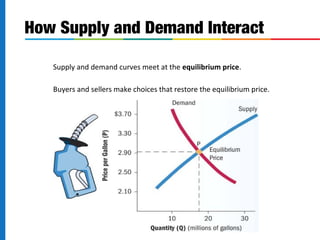
How Supply and Demand Interact 
S 
upply and demand curves meet at the equilibrium price. 
B 
uyers and sellers make choices that restore the equilibrium price. 
 
Changes affect both supply and demand.
Macroeconomics 
Study of a nation’s overall economic issues for the 
Entire Society, such as how an economy maintains 
and allocates resources and how a government’s 
policies affects the standards of living of its citizens. 
Political, social, and legal environments differ in 
every country. 
Economies generally classified in one of three 
categories: 
Private enterprise system: capitalism or market economy 
Planned economies: socialism, communism 
Mixed economies (combinations of the two)
Capitalism 
The Private Enterprise System and 
Competition 
Businesses meet needs of consumers and are 
rewarded through profit. 
Government favors a hands-off approach. 
Marketplace competition regulates economic life. 
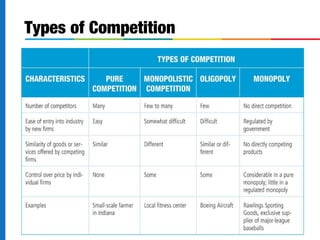
Four degrees of competition: 
Pure competition 
Monopolistic competition 
Oligopoly 
Monopoly
Types of Competition
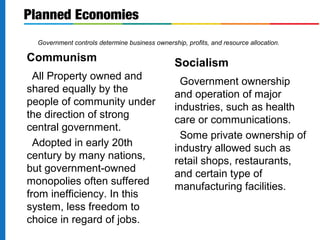
Planned Economies 
Government controls determine business ownership, profits, and resource allocation. 
Communism 
All Property owned and 
shared equally by the 
people of community under 
the direction of strong 
central government. 
Adopted in early 20th 
century by many nations, 
but government-owned 
monopolies often suffered 
from inefficiency. In this 
system, less freedom to 
choice in regard of jobs. 
Socialism 
Government ownership 
and operation of major 
industries, such as health 
care or communications. 
Some private ownership of 
industry allowed such as 
retail shops, restaurants, 
and certain type of 
manufacturing facilities.
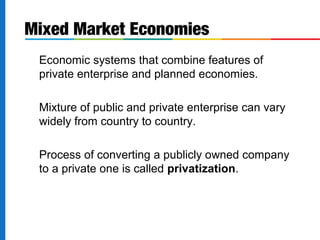
Mixed Market Economies 
Economic systems that combine features of 
private enterprise and planned economies. 
Mixture of public and private enterprise can vary 
widely from country to country. 
Process of converting a publicly owned company 
to a private one is called privatization.
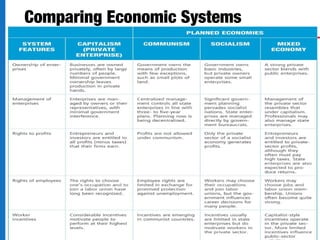
Comparing Economic Systems
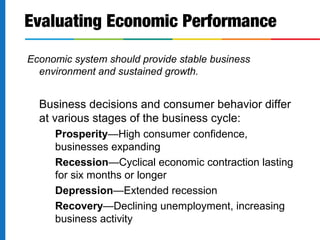
Evaluating Economic Performance 
Economic system should provide stable business 
environment and sustained growth. 
Business decisions and consumer behavior differ 
at various stages of the business cycle: 
Prosperity—High consumer confidence, 
businesses expanding 
Recession—Cyclical economic contraction lasting 
for six months or longer 
Depression—Extended recession 
Recovery—Declining unemployment, increasing 
business activity
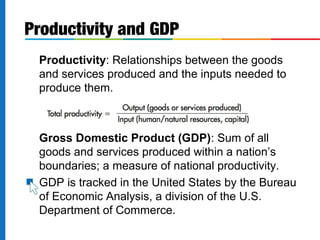
Productivity and GDP 
Productivity: Relationships between the goods 
and services produced and the inputs needed to 
produce them. 
Gross Domestic Product (GDP): Sum of all 
goods and services produced within a nation’s 
boundaries; a measure of national productivity. 
GDP is tracked in the United States by the Bureau 
of Economic Analysis, a division of the U.S. 
Department of Commerce.
Price-Level Changes 
Inflation is rising prices caused by a combination of 
excessive consumer demand and increases in the 
costs of raw materials. 
Core inflation rate measures inflation minus energy 
and food prices. 
Demand-pull inflation - Excessive consumer demand. 
Cost-push inflation - Rises in costs of the factors of 
production. 
Hyperinflation - Soaring consumer prices. 
Inflation devalues money. People can purchase less 
with what they have (decreased purchasing power). 
Deflation is when prices continue to fall. Deflation can 
cause a weakened economy.
Measuring Price-Level Changes 
 Changing prices are tracked by the Consumer 
Price Index (CPI). 
 The monthly average change in prices of goods 
and services. 
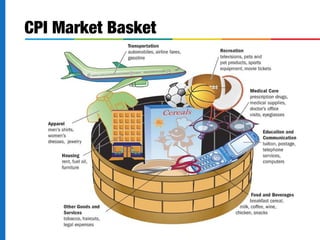
 A multitude of items is priced to compile the data 
included in the “CPI Market Basket.” 
 The Bureau of Labor Statistics calculates the 
CPI monthly along with other economic 
measures.
CPI Market Basket
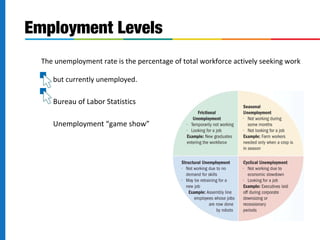
Employment Levels 
The unemployment rate is the percentage of total workforce actively seeking work 
but currently unemployed. 
 
Bureau of Labor Statistics 
 
Unemployment “game show”
Managing the Economy’s 
Performance 
 Monetary Policy - government actions to increase or 
decrease the money supply and change banking 
policy and interest rates to influence consumer 
spending. 
 Expansionary monetary policy: Efforts to increase the money 
supply to reduce costs of borrowing and encourage new 
investment. 
 Restrictive monetary policy: Efforts to decrease the monetary 
supply to curb rising prices and overexpansion. 
 The Federal Reserve System formulates and 
implements monetary policy. 
Government uses monetary and fiscal policy to fight unemployment, 
Government uses monetary and fiscal policy to fight unemployment, increase 
spending, and reduce the duration and severity of economic recession.
Fiscal Policy 
 Fiscal Policy - Government actions to influence economic 
activity through decisions about taxes and spending. 
 The Federal Budget - Annual plan for how the government 
will raise and spend money in the coming year. The primary 
sources of government funds: 
 taxes, borrowing, fees 
 When the government spends more than the amount of 
money it raised, there is a budget deficit. When we borrow 
money to cover the deficit, the national debt is increased. 
(Debt clock) 
 If the government has more money than it spends, there is a 
budget surplus. 
 National debt is tracked by the Government Accountability 
Office.
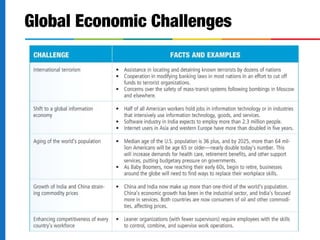
Global Economic Challenges

The Most Challenging economy in Decades

  • 1.
    Chapter 3 TheMost Challenging Economy in Decades
  • 2.
    Learning Goals Distinguishbetween microeconomics and macroeconomics. Explain the factors that drive supply and demand. Describe the four types of market structures in a private enterprise system and compare the three major types of economic systems. Identify and describe the four stages of the business cycle. Explain how productivity, price level changes, and employment levels affect the stability of a nation’s economy. 1 Discuss how monetary policy and fiscal policy are used to manage an economy’s performance. Describe the major global economic challenges of the 21st century. 2 3 4 5
  • 3.
    Economics Analysisof the choices people and governments make in allocating resources. Supply: Amount of goods and services for sale at different prices. Demand: Willingness and ability of consumers to purchase goods and services at different prices.
  • 4.
    Microeconomics Thestudy of small economic units, such as individual consumers, families, and businesses.
  • 5.
    Factors Driving Demand Demand curve - shows the amount of a product buyers will purchase at different prices. Driven by variety of factors such as competition, price, larger economic events, and consumer preferences.
  • 6.
    Demand Curve A change in overall demand shifts to a new demand curve.
  • 7.
    Supply Curve Supplycurve - shows the relationship between different prices and the quantities that sellers will offer for sale, regardless of demand. Movement along the supply curve is the opposite of the movement along the demand curve.
  • 8.
    Factors Driving Supply Production plays a central role in determining the overall supply. of goods and services.
  • 9.
    How Supply andDemand Interact S upply and demand curves meet at the equilibrium price. B uyers and sellers make choices that restore the equilibrium price. Changes affect both supply and demand.
  • 10.
    Macroeconomics Study ofa nation’s overall economic issues for the Entire Society, such as how an economy maintains and allocates resources and how a government’s policies affects the standards of living of its citizens. Political, social, and legal environments differ in every country. Economies generally classified in one of three categories: Private enterprise system: capitalism or market economy Planned economies: socialism, communism Mixed economies (combinations of the two)
  • 11.
    Capitalism The PrivateEnterprise System and Competition Businesses meet needs of consumers and are rewarded through profit. Government favors a hands-off approach. Marketplace competition regulates economic life. Four degrees of competition: Pure competition Monopolistic competition Oligopoly Monopoly
  • 12.
  • 13.
    Planned Economies Governmentcontrols determine business ownership, profits, and resource allocation. Communism All Property owned and shared equally by the people of community under the direction of strong central government. Adopted in early 20th century by many nations, but government-owned monopolies often suffered from inefficiency. In this system, less freedom to choice in regard of jobs. Socialism Government ownership and operation of major industries, such as health care or communications. Some private ownership of industry allowed such as retail shops, restaurants, and certain type of manufacturing facilities.
  • 14.
    Mixed Market Economies Economic systems that combine features of private enterprise and planned economies. Mixture of public and private enterprise can vary widely from country to country. Process of converting a publicly owned company to a private one is called privatization.
  • 15.
  • 16.
    Evaluating Economic Performance Economic system should provide stable business environment and sustained growth. Business decisions and consumer behavior differ at various stages of the business cycle: Prosperity—High consumer confidence, businesses expanding Recession—Cyclical economic contraction lasting for six months or longer Depression—Extended recession Recovery—Declining unemployment, increasing business activity
  • 17.
    Productivity and GDP Productivity: Relationships between the goods and services produced and the inputs needed to produce them. Gross Domestic Product (GDP): Sum of all goods and services produced within a nation’s boundaries; a measure of national productivity. GDP is tracked in the United States by the Bureau of Economic Analysis, a division of the U.S. Department of Commerce.
  • 18.
    Price-Level Changes Inflationis rising prices caused by a combination of excessive consumer demand and increases in the costs of raw materials. Core inflation rate measures inflation minus energy and food prices. Demand-pull inflation - Excessive consumer demand. Cost-push inflation - Rises in costs of the factors of production. Hyperinflation - Soaring consumer prices. Inflation devalues money. People can purchase less with what they have (decreased purchasing power). Deflation is when prices continue to fall. Deflation can cause a weakened economy.
  • 19.
    Measuring Price-Level Changes Changing prices are tracked by the Consumer Price Index (CPI). The monthly average change in prices of goods and services. A multitude of items is priced to compile the data included in the “CPI Market Basket.” The Bureau of Labor Statistics calculates the CPI monthly along with other economic measures.
  • 20.
  • 21.
    Employment Levels Theunemployment rate is the percentage of total workforce actively seeking work but currently unemployed. Bureau of Labor Statistics Unemployment “game show”
  • 22.
    Managing the Economy’s Performance Monetary Policy - government actions to increase or decrease the money supply and change banking policy and interest rates to influence consumer spending. Expansionary monetary policy: Efforts to increase the money supply to reduce costs of borrowing and encourage new investment. Restrictive monetary policy: Efforts to decrease the monetary supply to curb rising prices and overexpansion. The Federal Reserve System formulates and implements monetary policy. Government uses monetary and fiscal policy to fight unemployment, Government uses monetary and fiscal policy to fight unemployment, increase spending, and reduce the duration and severity of economic recession.
  • 23.
    Fiscal Policy Fiscal Policy - Government actions to influence economic activity through decisions about taxes and spending. The Federal Budget - Annual plan for how the government will raise and spend money in the coming year. The primary sources of government funds: taxes, borrowing, fees When the government spends more than the amount of money it raised, there is a budget deficit. When we borrow money to cover the deficit, the national debt is increased. (Debt clock) If the government has more money than it spends, there is a budget surplus. National debt is tracked by the Government Accountability Office.
  • 24.

Editor's Notes

  • #7 Complimentary goods Optimistic pessimistic