Small & Medium Enterprises in 
Pakistan 
SMEDA 
May 10, 2005 
Lahore
SME Sector in Pakistan 
 3.2 million business units in Pakistan 
 Over 99% business units employ less than 99 
persons i.e. 3.16 million SMEs 
 Generate 78% of non-agri sector employment 
 Direct Contribution to GDP over 30% 
 Generate 25% of Manufacturing Export Earnings 
 Contribute 35% in Manufacturing Value addition
Characteristics of SMEs 
 Owner is the manager & few employees 
 Owned & operated independently 
 Relatively small investment, production, sales, 
dealings etc. 
 Inadequate efficiency of business operations - 
no relationship with other firms or parties for 
 IInnvveessttmmeenntt 
 MMaannaaggeemmeenntt,, ffiinnaannccee,, ttaaxx,, aaccccoouunnttiinngg
Classification of SMEs 
 SMEs have been historically classified as: 
IInndduussttrryy 
TTrraaddee;; WWhhoolleessaallee,, RReettaaiill && SSeerrvviicceess 
 Criteria For Definition: The criteria is based 
on; 
FFiixxeedd AAsssseettss 
EEmmppllooyymmeenntt 
TTuurrnnoovveerr//ssaalleess 
 Fixed Assets include Land, Building, 
Machinery 
 Employment: Essence of SMEs is job 
creation. 
 Turnover/Sales: Sales have been 
researched to arrive at the Annual
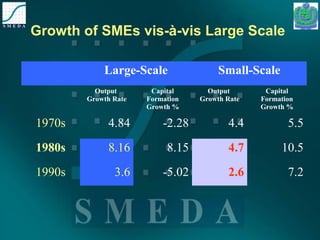
Growth of SMEs vis-à-vis Large Scale 
Large-Scale Small-Scale 
Output 
Growth Rate 
Capital 
Formation 
Growth % 
Output 
Growth Rate 
Capital 
Formation 
Growth % 
1970s 4.84 -2.28 4.4 5.5 
1980s 8.16 8.15 4.7 10.5 
1990s 3.6 -5.02 2.6 7.2
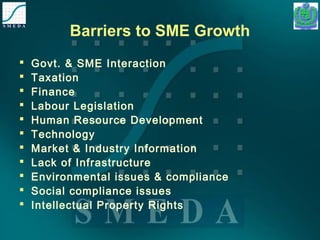
Barriers to SME Growth 
 Govt. & SME Interaction 
 Taxation 
 Finance 
 Labour Legislation 
 Human Resource Development 
 Technology 
 Market & Industry Information 
 Lack of Infrastructure 
 Environmental issues & compliance 
 Social compliance issues 
 Intellectual Property Rights
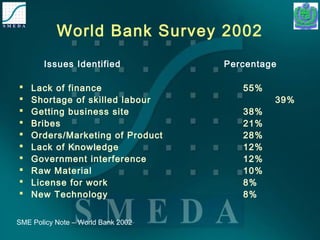
World Bank Survey 2002 
Issues Identified Percentage 
 Lack of finance 55% 
 Shortage of skilled labour 39% 
 Getting business site 38% 
 Bribes 21% 
 Orders/Marketing of Product 28% 
 Lack of Knowledge 12% 
 Government interference 12% 
 Raw Material 10% 
 License for work 8% 
 New Technology 8% 
SME Policy Note – World Bank 2002
Issues in SME 
Financing
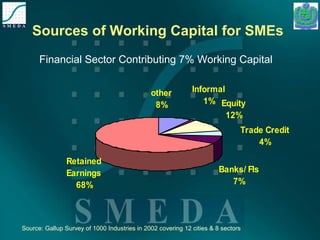
Sources of Working Capital for SMEs 
Financial Sector Contributing 7% Working Capital 
Retained 
Earnings 
68% 
other 
8% 
Informal 
1% Equity 
12% 
Trade Credit 
Banks/ FIs 
7% 
4% 
Source: Gallup Survey of 1000 Industries in 2002 covering 12 cities & 8 sectors
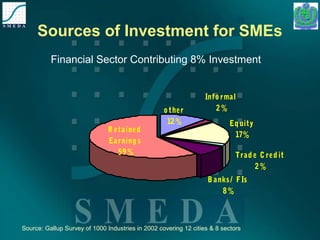
Sources of Investment for SMEs 
Financial Sector Contributing 8% Investment 
Info rmal 
Eq uity 
17% 
Trad e C red it 
2% 
o ther 2% 
12% 
B anks / FIs 
8% 
R etained 
Earning s 
59% 
Source: Gallup Survey of 1000 Industries in 2002 covering 12 cities & 8 sectors
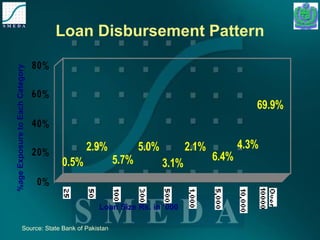
Loan Disbursement Pattern 
0.5% 
2.9% 
5.7% 
5.0% 
3.1% 
2.1% 
6.4% 
69.9% 
4.3% 
80% 
60% 
40% 
20% 
0% 
Loan Size Rs. in ‘000 
%age Exposure to Each Category 
Source: State Bank of Pakistan
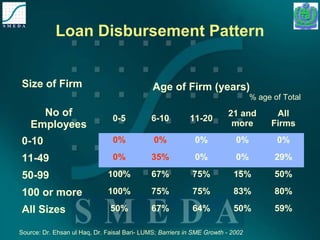
Loan Disbursement Pattern 
Size of Firm Age of Firm (years) 
% age of Total 
No of 
Employees 0-5 6-10 11-20 21 and 
more 
All 
Firms 
0-10 0% 0% 0% 0% 0% 
11-49 0% 35% 0% 0% 29% 
50-99 100% 67% 75% 15% 50% 
100 or more 100% 75% 75% 83% 80% 
All Sizes 50% 67% 64% 50% 59% 
Source: Dr. Ehsan ul Haq, Dr. Faisal Bari- LUMS; Barriers in SME Growth - 2002
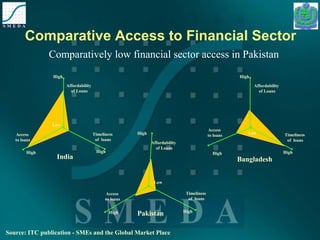
Legal Structure of Business Units 
in Pakistan 
C o rp o ra tes & 
O thers 
8% 
Pro p rieto rs hip 
s & 
Partners hip 
8 5% 
Pub lic Sec to r 
7% 
Source: ILO SMEDA Study 2001
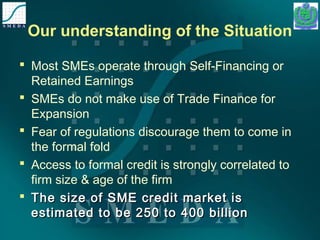
Comparative Access to Financial Sector 
Comparatively low financial sector access in Pakistan 
High 
Low 
High High 
India 
Access 
to loans 
Timeliness 
of loans 
Affordability 
of Loans 
High 
Access 
to loans Low 
Timeliness 
High High 
Bangladesh 
of loans 
Affordability 
of Loans 
High 
Timeliness 
of loans 
High 
Affordability 
of Loans 
Pakistan 
High 
Low 
Access 
to loans 
Source: ITC publication - SMEs and the Global Market Place
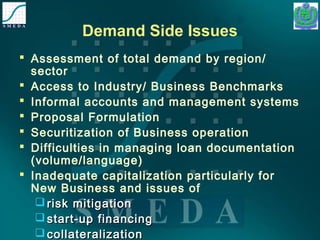
Our understanding of the Situation 
 Most SMEs operate through Self-Financing or 
Retained Earnings 
 SMEs do not make use of Trade Finance for 
Expansion 
 Fear of regulations discourage them to come in 
the formal fold 
 Access to formal credit is strongly correlated to 
firm size & age of the firm 
 The size of SME ccrreeddiitt mmaarrkkeett iiss 
eessttiimmaatteedd ttoo bbee 225500 ttoo 440000 bbiilllliioonn
Demand Side Issues 
 Assessment of total demand by region/ 
sector 
 Access to Industry/ Business Benchmarks 
 Informal accounts and management systems 
 Proposal Formulation 
 Securitization of Business operation 
 Difficulties in managing loan documentation 
(volume/language) 
 Inadequate capitalization particularly for 
New Business and issues of 
rriisskk mmiittiiggaattiioonn 
ssttaarrtt--uupp ffiinnaanncciinngg 
ccoollllaatteerraalliizzaattiioonn
Situational Analysis 1/3 
 SME Business reliant on Support System 
 SMEs are insecure – Quick Response 
Support System absent i.e. Access, 
Timeliness & Legal Support 
 Lack of specialization in Banks 
 Small Enterprises – Lacking attention 
 Characteristics: Little knowledge, inadequate ccoollllaatteerraall,, 
LLeessss aaffffoorrddaabbiilliittyy aanndd lliikkeelliihhoooodd ffoorr ssuucccceessss –– hhiigghh rraattee ooff 
ffaaiilluurreess 
 OOfftteenn ccoonnffuusseedd wwiitthh MMeeddiiuumm EEnntteerrpprriisseess 
 NNoo ssppeecciiaall PPoolliiccyy aatttteennttiioonn oorr SSuuppppoorrtt 
 CCoonnssiiddeerreedd aa ccaassee ffoorr ddiirreecctteedd oorr ssuubbssiiddiizzeedd ccrreeddiitt –– hhaass ttoo 
rreeggaaiinn iittss RReeppuuttaattiioonn
Situational Analysis 2/3 
 Medium Enterprise – Informally formal 
Business Organization formal bbuutt lliittttllee ccuusshhiioonn 
OOfftteenn ssuubbjjeecctt ttoo PPoolliiccyy SShhoocckkss ee..gg.. ppoouullttrryy 
NNoo ffoorrmmaall ffiinnaanncciiaall mmaannaaggeemmeenntt ttoo aannaallyyzzee 
vvuullnneerraabbiilliittyy 
HHaavvee aacccceessss ttoo ffiinnaannccee bbuutt aaddeeqquuaaccyy aanndd ttiimmiinngg 
iiss aann iissssuuee 
IInnccoommee ssttrreeaamm eessttiimmaattiioonn ddiiffffiiccuulltt -- ttaaxxaattiioonn llaawwss 
ddiissccoouurraaggee sshhaarriinngg ooff ooppeerraattiioonnaall ddaattaa
Situational Analysis 3/3 
 Govt. Policy Risk 
 Cushion for Policy shock – Public sector rreessppoonnssiibbiilliittyy 
 International Competition Risk 
 IImmppaacctt ooff gglloobbaalliizzaattiioonn oonn MMaarrkkeettss,, IInnvveessttmmeenntt DDeecciissiioonnss 
 EExxooggeennoouuss ffoorr SSMMEEss –– PPoolliiccyy ssuuppppoorrtt ffoorr ffiinnaanncciinngg 
eeccoonnoommiicc aaccttiivviittyy aaddjjuussttmmeenntt ee..gg.. KKoorreeaann CCoorrppoorraattee 
RReessttrruuccttuurriinngg FFuunndd 
 Commercial/ Management Risk 
 CCaappaacciittyy bbuuiillddiinngg ooff SSMMEEss -- rroolleess ooff ssuuppppoorrtt iinnssttiittuuttiioonnss 
SSMMEEDDAA,, EEPPBB,, PPVVTTCC,, PPIITTAACC,, PPCCSSIIRR eettcc..
Regulatory Framework 
 Missing links between SMEs and the financial 
institutions – Credit Guarantee and Insurance (Laws 
& Institutions) 
 Tax Related Laws – SMEs unwilling to share 
operations related data and information on accounts 
 Inconsistent government policies – S Tax 300 
amendments 
 No policy or legal support for business Start-ups or 
projects backed by only sound business plans
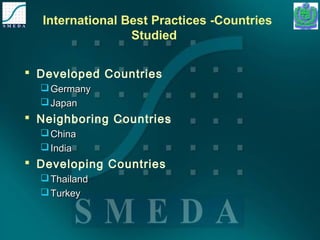
International Best Practices -Countries 
Studied 
 Developed Countries 
GGeerrmmaannyy 
JJaappaann 
 Neighboring Countries 
CChhiinnaa 
IInnddiiaa 
 Developing Countries 
TThhaaiillaanndd 
TTuurrkkeeyy
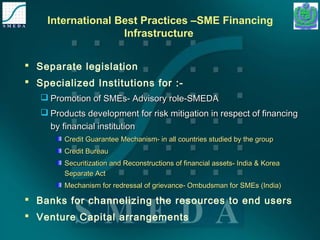
International Best Practices –SME Financing 
Infrastructure 
 Separate legislation 
 Specialized Institutions for :- 
 Promotion of SMEs- AAddvviissoorryy rroollee--SSMMEEDDAA 
 PPrroodduuccttss ddeevveellooppmmeenntt ffoorr rriisskk mmiittiiggaattiioonn iinn rreessppeecctt ooff ffiinnaanncciinngg 
bbyy ffiinnaanncciiaall iinnssttiittuuttiioonn 
CCrreeddiitt GGuuaarraanntteeee MMeecchhaanniissmm-- iinn aallll ccoouunnttrriieess ssttuuddiieedd bbyy tthhee ggrroouupp 
CCrreeddiitt BBuurreeaauu 
SSeeccuurriittiizzaattiioonn aanndd RReeccoonnssttrruuccttiioonnss ooff ffiinnaanncciiaall aasssseettss-- IInnddiiaa && KKoorreeaa 
SSeeppaarraattee AAcctt 
MMeecchhaanniissmm ffoorr rreeddrreessssaall ooff ggrriieevvaannccee-- OOmmbbuuddssmmaann ffoorr SSMMEEss ((IInnddiiaa)) 
 Banks for channelizing the resources to end users 
 Venture Capital arrangements
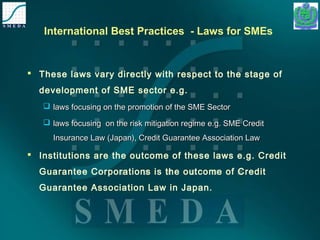
International Best Practices - Laws for SMEs 
 These laws vary directly with respect to the stage of 
development of SME sector e.g. 
 llaawwss ffooccuussiinngg oonn tthhee pprroommoottiioonn ooff tthhee SSMMEE SSeeccttoorr 
 llaawwss ffooccuussiinngg oonn tthhee rriisskk mmiittiiggaattiioonn rreeggiimmee ee..gg.. SSMMEE CCrreeddiitt 
IInnssuurraannccee LLaaww ((JJaappaann)),, CCrreeddiitt GGuuaarraanntteeee AAssssoocciiaattiioonn LLaaww 
 Institutions are the outcome of these laws e.g. Credit 
Guarantee Corporations is the outcome of Credit 
Guarantee Association Law in Japan.
2244 
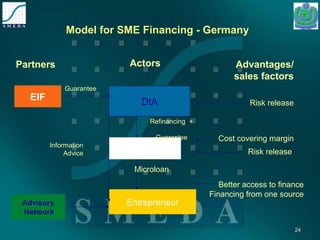
Model for SME Financing - Germany 
Partners Actors Advantages/ 
DtA 
Refinancing + 
Guarantee 
On-lending bank 
„House bank“ 
Entrepreneur 
EIF 
sales factors 
Risk release 
Microloan 
Risk release 
Better access to finance 
Financing from one source 
Guarantee 
Information 
Advice 
Advisory 
Network 
Cost covering margin
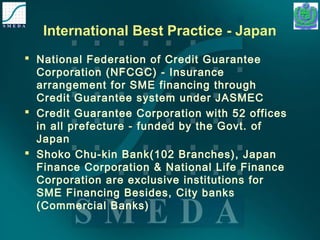
International Best Practice - Japan 
 National Federation of Credit Guarantee 
Corporation (NFCGC) - Insurance 
arrangement for SME financing through 
Credit Guarantee system under JASMEC 
 Credit Guarantee Corporation with 52 offices 
in all prefecture - funded by the Govt. of 
Japan 
 Shoko Chu-kin Bank(102 Branches), Japan 
Finance Corporation & National Life Finance 
Corporation are exclusive institutions for 
SME Financing Besides, City banks 
(Commercial Banks)
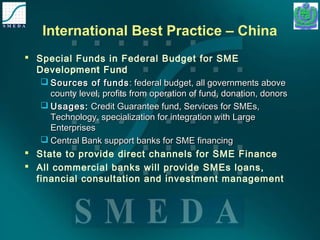
International Best Practice – China 
 Special Funds in Federal Budget for SME 
Development Fund 
 SSoouurrcceess ooff ffuunnddss:: ffeeddeerraall bbuuddggeett,, aallll ggoovveerrnnmmeennttss aabboovvee 
ccoouunnttyy lleevveell,, pprrooffiittss ffrroomm ooppeerraattiioonn ooff ffuunndd,, ddoonnaattiioonn,, ddoonnoorrss 
 UUssaaggeess:: CCrreeddiitt GGuuaarraanntteeee ffuunndd,, SSeerrvviicceess ffoorr SSMMEEss,, 
TTeecchhnnoollooggyy,, ssppeecciiaalliizzaattiioonn ffoorr iinntteeggrraattiioonn wwiitthh LLaarrggee 
EEnntteerrpprriisseess 
 CCeennttrraall BBaannkk ssuuppppoorrtt bbaannkkss ffoorr SSMMEE ffiinnaanncciinngg 
 State to provide direct channels for SME Finance 
 All commercial banks will provide SMEs loans, 
financial consultation and investment management
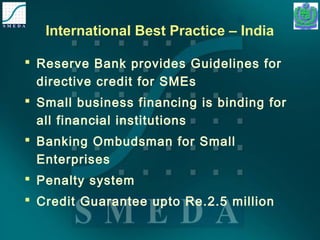
International Best Practice – India 
 Reserve Bank provides Guidelines for 
directive credit for SMEs 
 Small business financing is binding for 
all financial institutions 
 Banking Ombudsman for Small 
Enterprises 
 Penalty system 
 Credit Guarantee upto Re.2.5 million
SMEDA & SME 
Development
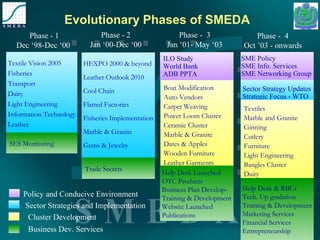
Evolutionary Phases of SMEDA 
Phase - 1 
Dec ‘98-Dec ‘00 
Textile Vision 2005 
Fisheries 
Transport 
Dairy 
Light Engineering 
Information Technology 
Leather 
SES Monitoring 
Phase - 2 
Jan ‘00-Dec ‘00 
HEXPO 2000 & beyond 
Leather Outlook 2010 
Cool Chain 
Flatted Factories 
Fisheries Implementation 
Marble & Granite 
Gems & Jewelry 
Boat Modification 
Auto Vendors 
Carpet Weaving 
Power Loom Cluster 
Ceramic Cluster 
Marble & Granite 
Dates & Apples 
Wooden Furniture 
Leather Garments 
Trade Secrets 
Phase - 3 
Jan ‘01- May ‘03 
Help Desk Launched 
OTC Products 
Business Plan Develop- 
Training & Development 
Website Launched 
Publications 
Sector Strategies and Implementation 
Cluster Development 
Business Dev. Services 
Phase - 4 
Oct ’03 - onwards 
SME Policy 
SME Info. Services 
SME Networking Group 
Sector Strategy Updates 
Strategic Focus - WTO 
Policy and Conducive Environment 
Textiles 
Marble and Granite 
Ginning 
Cutlery 
Furniture 
Light Engineering 
Bangles Cluster 
Dairy 
Help Desk & RBCs 
Tech. Up gradation 
Training & Development 
Marketing Services 
Financial Services 
Entrepreneurship 
ILO Study 
World Bank 
ADB PPTA
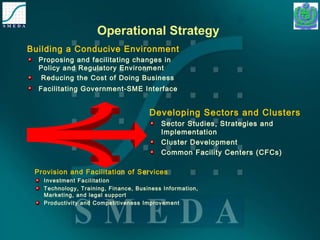
Operational Strategy 
Building a Conducive Environment 
Proposing and facilitating changes in 
Policy and Regulatory Environment 
Reducing the Cost of Doing Business 
Facilitating Government-SME Interface 
Developing Sectors and Clusters 
Sector Studies, Strategies and 
Implementation 
Cluster Development 
Common Facility Centers (CFCs) 
Provision and Facilitation of Services 
Investment Facilitation 
Technology, Training, Finance, Business Information, 
Marketing, and legal support 
Productivity and Competitiveness Improvement
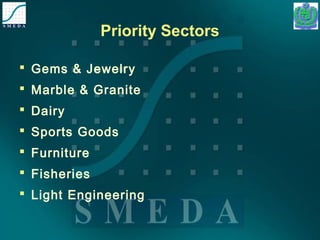
Priority Sectors 
 Gems & Jewelry 
 Marble & Granite 
 Dairy 
 Sports Goods 
 Furniture 
 Fisheries 
 Light Engineering
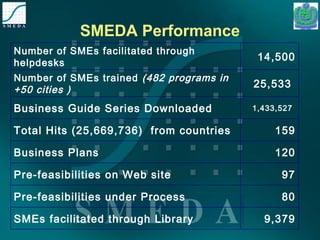
SMEDA Performance 
Number of SMEs facilitated through 14,500 
helpdesks 
Number of SMEs trained (482 programs in 25,533 
+50 cities ) 
Business Guide Series Downloaded 1,433,527 
Total Hits (25,669,736) from countries 159 
Business Plans 120 
Pre-feasibilities on Web site 97 
Pre-feasibilities under Process 80 
SMEs facilitated through Library 9,379
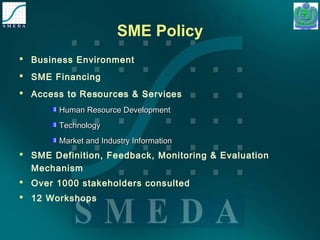
SME Policy 
 Business Environment 
 SME Financing 
 Access to Resources & Services 
HHuummaann RReessoouurrccee DDeevveellooppmmeenntt 
TTeecchhnnoollooggyy 
MMaarrkkeett aanndd IInndduussttrryy IInnffoorrmmaattiioonn 
 SME Definition, Feedback, Monitoring & Evaluation 
Mechanism 
 Over 1000 stakeholders consulted 
 12 Workshops
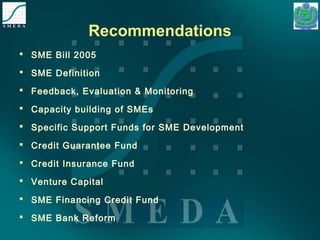
Recommendations 
 SME Bill 2005 
 SME Definition 
 Feedback, Evaluation & Monitoring 
 Capacity building of SMEs 
 Specific Support Funds for SME Development 
 Credit Guarantee Fund 
 Credit Insurance Fund 
 Venture Capital 
 SME Financing Credit Fund 
 SME Bank Reform
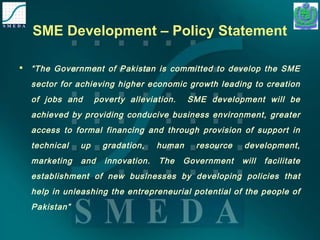
SME Development – Policy Statement 
 “The Government of Pakistan is committed to develop the SME 
sector for achieving higher economic growth leading to creation 
of jobs and poverty alleviation. SME development will be 
achieved by providing conducive business environment, greater 
access to formal financing and through provision of support in 
technical up gradation, human resource development, 
marketing and innovation. The Government will facilitate 
establishment of new businesses by developing policies that 
help in unleashing the entrepreneurial potential of the people of 
Pakistan”
Thank You
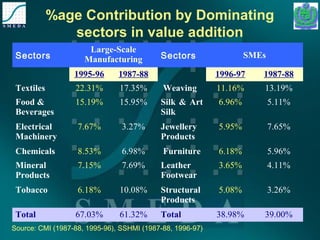
%age Contribution by Dominating 
sectors in value addition 
Sectors Large-Scale 
Manufacturing Sectors SMEs 
1995-96 1987-88 1996-97 1987-88 
Textiles 22.31% 17.35% Weaving 11.16% 13.19% 
Food & 
15.19% 15.95% Silk & Art 
6.96% 5.11% 
Beverages 
Silk 
Electrical 
Machinery 
7.67% 3.27% Jewellery 
Products 
5.95% 7.65% 
Chemicals 8.53% 6.98% Furniture 6.18% 5.96% 
Mineral 
7.15% 7.69% Leather 
3.65% 4.11% 
Products 
Footwear 
Tobacco 6.18% 10.08% Structural 
Products 
5.08% 3.26% 
Total 67.03% 61.32% Total 38.98% 39.00% 
Source: CMI (1987-88, 1995-96), SSHMI (1987-88, 1996-97)

Small Medium Enterprise In Pakistan

  • 1.
    Small & MediumEnterprises in Pakistan SMEDA May 10, 2005 Lahore
  • 2.
    SME Sector inPakistan  3.2 million business units in Pakistan  Over 99% business units employ less than 99 persons i.e. 3.16 million SMEs  Generate 78% of non-agri sector employment  Direct Contribution to GDP over 30%  Generate 25% of Manufacturing Export Earnings  Contribute 35% in Manufacturing Value addition
  • 3.
    Characteristics of SMEs  Owner is the manager & few employees  Owned & operated independently  Relatively small investment, production, sales, dealings etc.  Inadequate efficiency of business operations - no relationship with other firms or parties for  IInnvveessttmmeenntt  MMaannaaggeemmeenntt,, ffiinnaannccee,, ttaaxx,, aaccccoouunnttiinngg
  • 4.
    Classification of SMEs  SMEs have been historically classified as: IInndduussttrryy TTrraaddee;; WWhhoolleessaallee,, RReettaaiill && SSeerrvviicceess  Criteria For Definition: The criteria is based on; FFiixxeedd AAsssseettss EEmmppllooyymmeenntt TTuurrnnoovveerr//ssaalleess  Fixed Assets include Land, Building, Machinery  Employment: Essence of SMEs is job creation.  Turnover/Sales: Sales have been researched to arrive at the Annual
  • 5.
    Growth of SMEsvis-à-vis Large Scale Large-Scale Small-Scale Output Growth Rate Capital Formation Growth % Output Growth Rate Capital Formation Growth % 1970s 4.84 -2.28 4.4 5.5 1980s 8.16 8.15 4.7 10.5 1990s 3.6 -5.02 2.6 7.2
  • 6.
    Barriers to SMEGrowth  Govt. & SME Interaction  Taxation  Finance  Labour Legislation  Human Resource Development  Technology  Market & Industry Information  Lack of Infrastructure  Environmental issues & compliance  Social compliance issues  Intellectual Property Rights
  • 7.
    World Bank Survey2002 Issues Identified Percentage  Lack of finance 55%  Shortage of skilled labour 39%  Getting business site 38%  Bribes 21%  Orders/Marketing of Product 28%  Lack of Knowledge 12%  Government interference 12%  Raw Material 10%  License for work 8%  New Technology 8% SME Policy Note – World Bank 2002
  • 8.
    Issues in SME Financing
  • 9.
    Sources of WorkingCapital for SMEs Financial Sector Contributing 7% Working Capital Retained Earnings 68% other 8% Informal 1% Equity 12% Trade Credit Banks/ FIs 7% 4% Source: Gallup Survey of 1000 Industries in 2002 covering 12 cities & 8 sectors
  • 10.
    Sources of Investmentfor SMEs Financial Sector Contributing 8% Investment Info rmal Eq uity 17% Trad e C red it 2% o ther 2% 12% B anks / FIs 8% R etained Earning s 59% Source: Gallup Survey of 1000 Industries in 2002 covering 12 cities & 8 sectors
  • 11.
    Loan Disbursement Pattern 0.5% 2.9% 5.7% 5.0% 3.1% 2.1% 6.4% 69.9% 4.3% 80% 60% 40% 20% 0% Loan Size Rs. in ‘000 %age Exposure to Each Category Source: State Bank of Pakistan
  • 12.
    Loan Disbursement Pattern Size of Firm Age of Firm (years) % age of Total No of Employees 0-5 6-10 11-20 21 and more All Firms 0-10 0% 0% 0% 0% 0% 11-49 0% 35% 0% 0% 29% 50-99 100% 67% 75% 15% 50% 100 or more 100% 75% 75% 83% 80% All Sizes 50% 67% 64% 50% 59% Source: Dr. Ehsan ul Haq, Dr. Faisal Bari- LUMS; Barriers in SME Growth - 2002
  • 13.
    Legal Structure ofBusiness Units in Pakistan C o rp o ra tes & O thers 8% Pro p rieto rs hip s & Partners hip 8 5% Pub lic Sec to r 7% Source: ILO SMEDA Study 2001
  • 14.
    Comparative Access toFinancial Sector Comparatively low financial sector access in Pakistan High Low High High India Access to loans Timeliness of loans Affordability of Loans High Access to loans Low Timeliness High High Bangladesh of loans Affordability of Loans High Timeliness of loans High Affordability of Loans Pakistan High Low Access to loans Source: ITC publication - SMEs and the Global Market Place
  • 15.
    Our understanding ofthe Situation  Most SMEs operate through Self-Financing or Retained Earnings  SMEs do not make use of Trade Finance for Expansion  Fear of regulations discourage them to come in the formal fold  Access to formal credit is strongly correlated to firm size & age of the firm  The size of SME ccrreeddiitt mmaarrkkeett iiss eessttiimmaatteedd ttoo bbee 225500 ttoo 440000 bbiilllliioonn
  • 16.
    Demand Side Issues  Assessment of total demand by region/ sector  Access to Industry/ Business Benchmarks  Informal accounts and management systems  Proposal Formulation  Securitization of Business operation  Difficulties in managing loan documentation (volume/language)  Inadequate capitalization particularly for New Business and issues of rriisskk mmiittiiggaattiioonn ssttaarrtt--uupp ffiinnaanncciinngg ccoollllaatteerraalliizzaattiioonn
  • 17.
    Situational Analysis 1/3  SME Business reliant on Support System  SMEs are insecure – Quick Response Support System absent i.e. Access, Timeliness & Legal Support  Lack of specialization in Banks  Small Enterprises – Lacking attention  Characteristics: Little knowledge, inadequate ccoollllaatteerraall,, LLeessss aaffffoorrddaabbiilliittyy aanndd lliikkeelliihhoooodd ffoorr ssuucccceessss –– hhiigghh rraattee ooff ffaaiilluurreess  OOfftteenn ccoonnffuusseedd wwiitthh MMeeddiiuumm EEnntteerrpprriisseess  NNoo ssppeecciiaall PPoolliiccyy aatttteennttiioonn oorr SSuuppppoorrtt  CCoonnssiiddeerreedd aa ccaassee ffoorr ddiirreecctteedd oorr ssuubbssiiddiizzeedd ccrreeddiitt –– hhaass ttoo rreeggaaiinn iittss RReeppuuttaattiioonn
  • 18.
    Situational Analysis 2/3  Medium Enterprise – Informally formal Business Organization formal bbuutt lliittttllee ccuusshhiioonn OOfftteenn ssuubbjjeecctt ttoo PPoolliiccyy SShhoocckkss ee..gg.. ppoouullttrryy NNoo ffoorrmmaall ffiinnaanncciiaall mmaannaaggeemmeenntt ttoo aannaallyyzzee vvuullnneerraabbiilliittyy HHaavvee aacccceessss ttoo ffiinnaannccee bbuutt aaddeeqquuaaccyy aanndd ttiimmiinngg iiss aann iissssuuee IInnccoommee ssttrreeaamm eessttiimmaattiioonn ddiiffffiiccuulltt -- ttaaxxaattiioonn llaawwss ddiissccoouurraaggee sshhaarriinngg ooff ooppeerraattiioonnaall ddaattaa
  • 19.
    Situational Analysis 3/3  Govt. Policy Risk  Cushion for Policy shock – Public sector rreessppoonnssiibbiilliittyy  International Competition Risk  IImmppaacctt ooff gglloobbaalliizzaattiioonn oonn MMaarrkkeettss,, IInnvveessttmmeenntt DDeecciissiioonnss  EExxooggeennoouuss ffoorr SSMMEEss –– PPoolliiccyy ssuuppppoorrtt ffoorr ffiinnaanncciinngg eeccoonnoommiicc aaccttiivviittyy aaddjjuussttmmeenntt ee..gg.. KKoorreeaann CCoorrppoorraattee RReessttrruuccttuurriinngg FFuunndd  Commercial/ Management Risk  CCaappaacciittyy bbuuiillddiinngg ooff SSMMEEss -- rroolleess ooff ssuuppppoorrtt iinnssttiittuuttiioonnss SSMMEEDDAA,, EEPPBB,, PPVVTTCC,, PPIITTAACC,, PPCCSSIIRR eettcc..
  • 20.
    Regulatory Framework Missing links between SMEs and the financial institutions – Credit Guarantee and Insurance (Laws & Institutions)  Tax Related Laws – SMEs unwilling to share operations related data and information on accounts  Inconsistent government policies – S Tax 300 amendments  No policy or legal support for business Start-ups or projects backed by only sound business plans
  • 21.
    International Best Practices-Countries Studied  Developed Countries GGeerrmmaannyy JJaappaann  Neighboring Countries CChhiinnaa IInnddiiaa  Developing Countries TThhaaiillaanndd TTuurrkkeeyy
  • 22.
    International Best Practices–SME Financing Infrastructure  Separate legislation  Specialized Institutions for :-  Promotion of SMEs- AAddvviissoorryy rroollee--SSMMEEDDAA  PPrroodduuccttss ddeevveellooppmmeenntt ffoorr rriisskk mmiittiiggaattiioonn iinn rreessppeecctt ooff ffiinnaanncciinngg bbyy ffiinnaanncciiaall iinnssttiittuuttiioonn CCrreeddiitt GGuuaarraanntteeee MMeecchhaanniissmm-- iinn aallll ccoouunnttrriieess ssttuuddiieedd bbyy tthhee ggrroouupp CCrreeddiitt BBuurreeaauu SSeeccuurriittiizzaattiioonn aanndd RReeccoonnssttrruuccttiioonnss ooff ffiinnaanncciiaall aasssseettss-- IInnddiiaa && KKoorreeaa SSeeppaarraattee AAcctt MMeecchhaanniissmm ffoorr rreeddrreessssaall ooff ggrriieevvaannccee-- OOmmbbuuddssmmaann ffoorr SSMMEEss ((IInnddiiaa))  Banks for channelizing the resources to end users  Venture Capital arrangements
  • 23.
    International Best Practices- Laws for SMEs  These laws vary directly with respect to the stage of development of SME sector e.g.  llaawwss ffooccuussiinngg oonn tthhee pprroommoottiioonn ooff tthhee SSMMEE SSeeccttoorr  llaawwss ffooccuussiinngg oonn tthhee rriisskk mmiittiiggaattiioonn rreeggiimmee ee..gg.. SSMMEE CCrreeddiitt IInnssuurraannccee LLaaww ((JJaappaann)),, CCrreeddiitt GGuuaarraanntteeee AAssssoocciiaattiioonn LLaaww  Institutions are the outcome of these laws e.g. Credit Guarantee Corporations is the outcome of Credit Guarantee Association Law in Japan.
  • 24.
    2244 Model forSME Financing - Germany Partners Actors Advantages/ DtA Refinancing + Guarantee On-lending bank „House bank“ Entrepreneur EIF sales factors Risk release Microloan Risk release Better access to finance Financing from one source Guarantee Information Advice Advisory Network Cost covering margin
  • 25.
    International Best Practice- Japan  National Federation of Credit Guarantee Corporation (NFCGC) - Insurance arrangement for SME financing through Credit Guarantee system under JASMEC  Credit Guarantee Corporation with 52 offices in all prefecture - funded by the Govt. of Japan  Shoko Chu-kin Bank(102 Branches), Japan Finance Corporation & National Life Finance Corporation are exclusive institutions for SME Financing Besides, City banks (Commercial Banks)
  • 26.
    International Best Practice– China  Special Funds in Federal Budget for SME Development Fund  SSoouurrcceess ooff ffuunnddss:: ffeeddeerraall bbuuddggeett,, aallll ggoovveerrnnmmeennttss aabboovvee ccoouunnttyy lleevveell,, pprrooffiittss ffrroomm ooppeerraattiioonn ooff ffuunndd,, ddoonnaattiioonn,, ddoonnoorrss  UUssaaggeess:: CCrreeddiitt GGuuaarraanntteeee ffuunndd,, SSeerrvviicceess ffoorr SSMMEEss,, TTeecchhnnoollooggyy,, ssppeecciiaalliizzaattiioonn ffoorr iinntteeggrraattiioonn wwiitthh LLaarrggee EEnntteerrpprriisseess  CCeennttrraall BBaannkk ssuuppppoorrtt bbaannkkss ffoorr SSMMEE ffiinnaanncciinngg  State to provide direct channels for SME Finance  All commercial banks will provide SMEs loans, financial consultation and investment management
  • 27.
    International Best Practice– India  Reserve Bank provides Guidelines for directive credit for SMEs  Small business financing is binding for all financial institutions  Banking Ombudsman for Small Enterprises  Penalty system  Credit Guarantee upto Re.2.5 million
  • 28.
    SMEDA & SME Development
  • 29.
    Evolutionary Phases ofSMEDA Phase - 1 Dec ‘98-Dec ‘00 Textile Vision 2005 Fisheries Transport Dairy Light Engineering Information Technology Leather SES Monitoring Phase - 2 Jan ‘00-Dec ‘00 HEXPO 2000 & beyond Leather Outlook 2010 Cool Chain Flatted Factories Fisheries Implementation Marble & Granite Gems & Jewelry Boat Modification Auto Vendors Carpet Weaving Power Loom Cluster Ceramic Cluster Marble & Granite Dates & Apples Wooden Furniture Leather Garments Trade Secrets Phase - 3 Jan ‘01- May ‘03 Help Desk Launched OTC Products Business Plan Develop- Training & Development Website Launched Publications Sector Strategies and Implementation Cluster Development Business Dev. Services Phase - 4 Oct ’03 - onwards SME Policy SME Info. Services SME Networking Group Sector Strategy Updates Strategic Focus - WTO Policy and Conducive Environment Textiles Marble and Granite Ginning Cutlery Furniture Light Engineering Bangles Cluster Dairy Help Desk & RBCs Tech. Up gradation Training & Development Marketing Services Financial Services Entrepreneurship ILO Study World Bank ADB PPTA
  • 30.
    Operational Strategy Buildinga Conducive Environment Proposing and facilitating changes in Policy and Regulatory Environment Reducing the Cost of Doing Business Facilitating Government-SME Interface Developing Sectors and Clusters Sector Studies, Strategies and Implementation Cluster Development Common Facility Centers (CFCs) Provision and Facilitation of Services Investment Facilitation Technology, Training, Finance, Business Information, Marketing, and legal support Productivity and Competitiveness Improvement
  • 31.
    Priority Sectors Gems & Jewelry  Marble & Granite  Dairy  Sports Goods  Furniture  Fisheries  Light Engineering
  • 32.
    SMEDA Performance Numberof SMEs facilitated through 14,500 helpdesks Number of SMEs trained (482 programs in 25,533 +50 cities ) Business Guide Series Downloaded 1,433,527 Total Hits (25,669,736) from countries 159 Business Plans 120 Pre-feasibilities on Web site 97 Pre-feasibilities under Process 80 SMEs facilitated through Library 9,379
  • 33.
    SME Policy Business Environment  SME Financing  Access to Resources & Services HHuummaann RReessoouurrccee DDeevveellooppmmeenntt TTeecchhnnoollooggyy MMaarrkkeett aanndd IInndduussttrryy IInnffoorrmmaattiioonn  SME Definition, Feedback, Monitoring & Evaluation Mechanism  Over 1000 stakeholders consulted  12 Workshops
  • 34.
    Recommendations  SMEBill 2005  SME Definition  Feedback, Evaluation & Monitoring  Capacity building of SMEs  Specific Support Funds for SME Development  Credit Guarantee Fund  Credit Insurance Fund  Venture Capital  SME Financing Credit Fund  SME Bank Reform
  • 35.
    SME Development –Policy Statement  “The Government of Pakistan is committed to develop the SME sector for achieving higher economic growth leading to creation of jobs and poverty alleviation. SME development will be achieved by providing conducive business environment, greater access to formal financing and through provision of support in technical up gradation, human resource development, marketing and innovation. The Government will facilitate establishment of new businesses by developing policies that help in unleashing the entrepreneurial potential of the people of Pakistan”
  • 36.
  • 37.
    %age Contribution byDominating sectors in value addition Sectors Large-Scale Manufacturing Sectors SMEs 1995-96 1987-88 1996-97 1987-88 Textiles 22.31% 17.35% Weaving 11.16% 13.19% Food & 15.19% 15.95% Silk & Art 6.96% 5.11% Beverages Silk Electrical Machinery 7.67% 3.27% Jewellery Products 5.95% 7.65% Chemicals 8.53% 6.98% Furniture 6.18% 5.96% Mineral 7.15% 7.69% Leather 3.65% 4.11% Products Footwear Tobacco 6.18% 10.08% Structural Products 5.08% 3.26% Total 67.03% 61.32% Total 38.98% 39.00% Source: CMI (1987-88, 1995-96), SSHMI (1987-88, 1996-97)

Editor's Notes

  • #3 It is fair to say that our economy is an economy of SME. Enterprises employing up to 99 persons constitute about 90 %[1] of all private enterprises in the industrial sector and SME employ some 78 % of non-agriculture labour force. [2] They contribute over 30 % to GDP, PKR 140 billion to exports, and 25 % of manufacturing export earnings besides sharing 35 % in manufacturing value added.[3] [1] Pakistan Country Assistance Strategy, World Bank Report, Annex II, Page 3 [2] Census of Establishments-1998 [3] Economic Survey of Pakistan 2002-03
  • #6 As against the general impression the growth rate of SME sector has been lagging behind the large scale sector growth for last three decades. In contrast it is coupled with high Gross Capital Formation Rate which highlights that this sector is plagued with inefficiencies. (Reference Dr. Faisal Bari, Dr. Ali Chema and Dr. Ehsan ul Haq, “BARRIERS TO SME GROWTH IN PAKISTAN: AN ANALYSIS OF CONSTRAINTS” 2002)
  • #9 Coverage by support programs limited due to large size of the SME sector. Absence of a specialized, uniform legal framework for the development of SME hampers SME operations. Relationship between Government and SME seems to be fundamentally weak. In many cases this extends also to other large organizations and their interaction with smaller clients as SME.
  • #18 Credit Management - Can we find our customer through Small Business (Relationship through thick & Thin)
  • #19 Medium Enterprise - informally formal Timely availability of finance is crucial - formal lending procedures do not help rather impede Income stream estimation difficult - taxation laws discourage sharing of credible operational data
  • #20 Objective : Provide small and medium size companies with equity capital to restructure short term debt and to finance growth. Four funds established Three equity-oriented @ US$330 million each One debt-only @ US$ 1 billion Target small and medium sized enterprises No investments in large chaebol permitted New equity issues only Both listed and unlisted companies Unique Characteristics: Initial capital raised from Korean financial institutions International fund managers hired to manage investments according to international best practice Foreign managers “partnered” with Korean firms for investment technology transfer
  • #25 DtA has no regional offices. It channels its StartGeld via the commercial banking system to micro-enterprises. The entrepreneur has to file his application to the house bank, which assesses the project, checks the available collateral and forwards the documents to the DtA. DtA checks whether the project is eligible for promotion by StartGeld. The house bank receives the loan commitment including the risk release of 80%. This risk is taken by DtA together with the EIF. The risk release enhances the willingness of the commercial banking sector to finance small enterprises.
  • #30 Phase I (Dec 98 - Oct 99): SMEDA in the initial stage started working on a few priority sectors. The objective was to develop comprehensive strategies followed by implementation with the collaboration of the relevant Government departments. Case in point is the marine fisheries sector where a detailed strategy was developed and implemented through various regulatory authorities. However, the Business Development Services (BDS) during that phase were only limited to the monitoring of the Prime Minister’s Self-Employment Scheme. Phase II (Jan 00 - Dec 00): During this period SMEDA worked on different sectoral studies including the Textile Vision 2005, Hexpo 2000 & beyond, etc. These assignments of long term strategy development were successfully completed and later on submitted to the Ministry of Commerce for implementation and follow-up. Even during this phase limited resources were allocated towards the development of BDS. Phase III (Jan 01 - Nov 01): SMEDA was restructured from being a sector driven organisation to a functional support body. Emphasis shifted from macro level strategy formulation towards provision of business development services to SMEs and physical intervention in SME clusters. During this period lending programmes tailored to meet the credit requirements of specific clusters were also formulated. A wide array of Over the Counter (OTC) products were produced to facilitate SMEs through Help-Desks. SMEDA also launched its B2B portal to provide market connect to the SME sector.
  • #31 Building a Conducive Environment Proposing and facilitating changes in Policy and Regulatory Environment SME Policy Budgetary & Trade Policies recommendations Participating in Industrial Policy Exercise Reducing the Cost of Doing Business Formal Lending Cost: Development of Program Lending models for Power Loom, Fisheries, Cutlery, Auto parts Vendors, Schools etc. Taxation policy & Procedure e.g. Income tax & Sales tax Major policy shake up on import tariffs for Raw Materials Utilities next target: Power Tariff, Telephone etc. Facilitating Government-SME Interface Public Private Dialogue; Policy Consultative Processes in Fiscal, Trade & Monetary Developing Clusters and Sectors Sector Studies, Strategies and Implementation Marble & Granite, Dairy strategy, Poultry Sector Strategy, Leather, Garments, Horticulture, Fisheries, Textiles, Transport Cluster Development Ceramic Pottery, Fans, Surgical, Garments, Cutlery, Leather, Furniture, Gems & Jewelry, Ginning, Handloom etc. Common Facility Centers
  • #38 Reference Dr. Faisal Bari, Dr. Ali Chema and Dr. Ehsan ul Haq, “BARRIERS TO SME GROWTH IN PAKISTAN: AN ANALYSIS OF CONSTRAINTS” 2002