MICROSCOPY
INTRODUCTION
Size:
 Bacteria- 0.2–1.5 μm in diameter; 3–5 μm in length
 Viruses- 20–300 nm in diameter
 Parasites- Protozoans measured in µm; helminths - few mm to meters.
 Fungi- Grow as hyphae - thread-like structures 2–10 µm in diameter and up
to several cm in length
2
Different types of Microscopes
 Bright-field or light microscope
 Dark field (or dark ground) microscope
 Phase contrast microscope
 Fluorescence microscope
 Electron microscope.
3
PROPERTIES OF A MICROSCOPE
1. Good resolution: ability to produce separate images of closely placed objects -
distinguished as two separate entities.
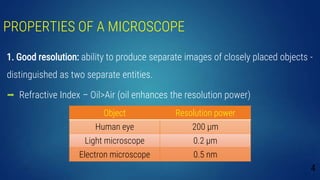
 Refractive Index – Oil>Air (oil enhances the resolution power)
4
Object Resolution power
Human eye 200 µm
Light microscope 0.2 µm
Electron microscope 0.5 nm
PROPERTIES OF A MICROSCOPE (Cont..)
2. Good contrast:
 Improved by staining the specimen.
 When stains bind to the cells, the contrast is increased
5
PROPERTIES OF A MICROSCOPE (Cont..)
3. Good magnification: Achieved by use of lenses.
 Ocular lens - magnification power of 10x
 Objective lens-scanning (4x), low power (10x), high power (40x) and oil
immersion (100x)
 Total magnification = magnification of objective lens * ocular lens.
6
BRIGHT-FIELD OR LIGHT
MICROSCOPE
7
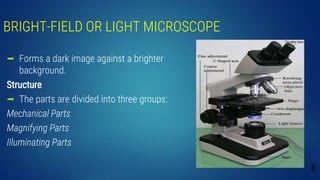
BRIGHT-FIELD OR LIGHT MICROSCOPE
 Forms a dark image against a brighter
background.
Structure
 The parts are divided into three groups:
Mechanical Parts
Magnifying Parts
Illuminating Parts
8
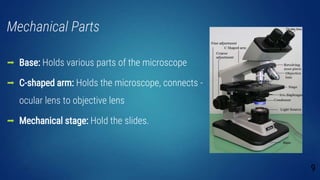
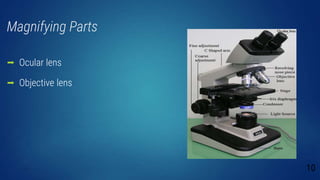
Mechanical Parts
 Base: Holds various parts of the microscope
 C-shaped arm: Holds the microscope, connects -
ocular lens to objective lens
 Mechanical stage: Hold the slides.
9
Magnifying Parts
 Ocular lens
 Objective lens
10
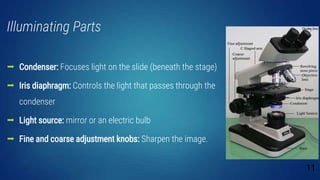
Illuminating Parts
 Condenser: Focuses light on the slide (beneath the stage)
 Iris diaphragm: Controls the light that passes through the
condenser
 Light source: mirror or an electric bulb
 Fine and coarse adjustment knobs: Sharpen the image.
11
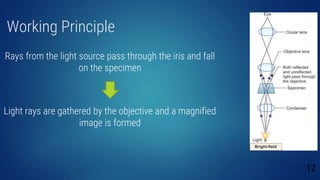
Working Principle
Rays from the light source pass through the iris and fall
on the specimen
Light rays are gathered by the objective and a magnified
image is formed
12
DARK FIELD
MICROSCOPE
13
Essentials of Medical Microbiology by Apurba S Sastry © Jaypee Brothers Medical Publishers
History
 In the 1840’s the ultimate test objects for light
microscopes were diatoms
 Navicula Spencerii was named after Charles
Spencer, the New York lens maker whose lenses
could resolve this diatom’s striae.
 Oblique illumination was the first step toward
dark field microscopy.
 Schaudinn discovered Treponema pallidum- the
syphilis spirochete- in 1905 using dark field
microscopy
14
Essentials of Medical Microbiology by Apurba S Sastry © Jaypee Brothers Medical Publishers
15
Essentials of Medical Microbiology by Apurba S Sastry © Jaypee Brothers Medical Publishers
16
Essentials of Medical Microbiology by Apurba S Sastry © Jaypee Brothers Medical Publishers
17
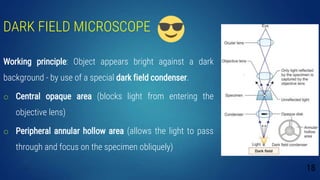
DARK FIELD MICROSCOPE
Working principle: Object appears bright against a dark
background - by use of a special dark field condenser.
o Central opaque area (blocks light from entering the
objective lens)
o Peripheral annular hollow area (allows the light to pass
through and focus on the specimen obliquely)
18
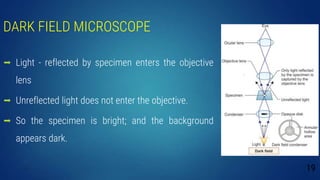
DARK FIELD MICROSCOPE
 Light - reflected by specimen enters the objective
lens
 Unreflected light does not enter the objective.
 So the specimen is bright; and the background
appears dark.
19
Applications
 Used to identify the living, unstained cells and thin bacteria like spirochetes
which cannot be visualized by light microscopy.
20
PHASE CONTRAST
MICROSCOPE
21
PHASE CONTRAST MICROSCOPE
 Contrast is enhanced.
 Visualizes the unstained living cells by creating difference in contrast
between cells and water.
22
Working principle
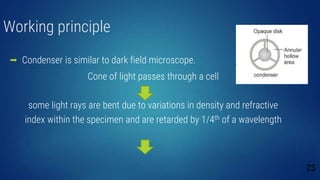
 Condenser is similar to dark field microscope.
Cone of light passes through a cell
some light rays are bent due to variations in density and refractive
index within the specimen and are retarded by 1/4th of a wavelength
23
Working principle (Cont..)
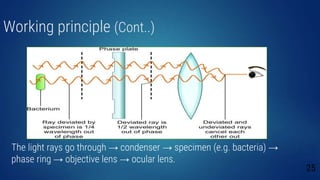
Undeviated light rays strike a phase ring
Deviated rays miss the ring and pass through the rest of the plate
Background is bright, while the unstained object appears dark
24
Working principle (Cont..)
The light rays go through → condenser → specimen (e.g. bacteria) →
phase ring → objective lens → ocular lens.
25
Applications
For studying:
 Microbial motility
 Determining the shape of living cells
 Detecting microbial internal cellular components
26
FLUORESCENCE
MICROSCOPE
27
FLUORESCENCE MICROSCOPE
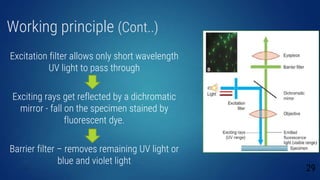
Working principle:
Fluorescent dyes - exposed to UV rays, become excited and fluoresce
i.e. they convert short wavelength rays into longer wavelengths
Mercury lamp emits rays that pass through an excitation filter
28
Working principle (Cont..)
Excitation filter allows only short wavelength
UV light to pass through
Exciting rays get reflected by a dichromatic
mirror - fall on the specimen stained by
fluorescent dye.
Barrier filter – removes remaining UV light or
blue and violet light
29
Applications
Epifluorescence microscope: Simplest form of fluorescence microscope. Has
following applications:
 Auto fluorescence (eg. Cyclospora)
 Microbes coated with fluorescent dye (eg. Acridine orange dye)
 Immunofluorescence
30
Applications (Cont..)
Confocal microscope: Advanced design, uses optical sectioning to get better
resolution of the fluorescent image.
31
ELECTRON MICROSCOPE
32
ELECTRON MICROSCOPE
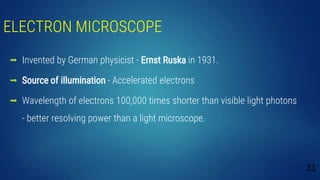
 Invented by German physicist - Ernst Ruska in 1931.
 Source of illumination - Accelerated electrons
 Wavelength of electrons 100,000 times shorter than visible light photons
- better resolving power than a light microscope.
33
ELECTRON MICROSCOPE (Cont..)
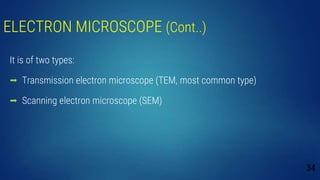
It is of two types:
 Transmission electron microscope (TEM, most common type)
 Scanning electron microscope (SEM)
34
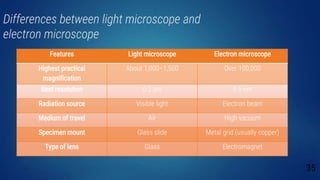
Differences between light microscope and
electron microscope
35
Features Light microscope Electron microscope
Highest practical
magnification
About 1,000–1,500 Over 100,000
Best resolution 0.2 µm 0.5 nm
Radiation source Visible light Electron beam
Medium of travel Air High vacuum
Specimen mount Glass slide Metal grid (usually copper)
Type of lens Glass Electromagnet
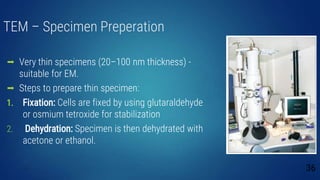
TEM – Specimen Preperation
 Very thin specimens (20–100 nm thickness) -
suitable for EM.
 Steps to prepare thin specimen:
1. Fixation: Cells are fixed by using glutaraldehyde
or osmium tetroxide for stabilization
2. Dehydration: Specimen is then dehydrated with
acetone or ethanol.
36
Transmission Electron Microscope
(Cont..)
3. Embedding: Specimen is embedded in plastic polymer.
4. Slicing: Specimen is then cut into thin slices by an ultramicrotome knife.
Such thin slices of the specimen are mounted on a metal slide (copper).
37
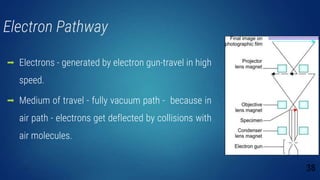
Electron Pathway
 Electrons - generated by electron gun-travel in high
speed.
 Medium of travel - fully vacuum path - because in
air path - electrons get deflected by collisions with
air molecules.
38
Applications and Modifications of EM
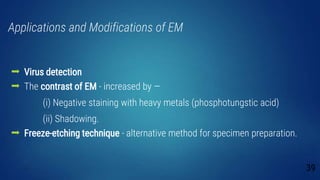
 Virus detection
 The contrast of EM - increased by —
(i) Negative staining with heavy metals (phosphotungstic acid)
(ii) Shadowing.
 Freeze-etching technique - alternative method for specimen preparation.
39
Scanning Electron Microscope
 Examine the surfaces of microorganisms in detail.
 Resolution of 7 nm or less.
 Produces image from electrons emitted by object’s surface.
40
ATOMIC FORCE
MICROSCOPY
41
ATOMIC FORCE MICROSCOPY
 Advanced microscope - uses scanning probe technology to study the
cellular structure.
 Has a resolution power in fraction of nanometer.
42
Questions:
Q1. Electrons are used as a source of illumination in?
a. Light microscope
b. Phase contrast microscope
c. Electron microscope
d. Fluorescence microscope
43
Questions (Cont..) :
Q2. Scanning probe technology is used in ?
a. Light microscope
b. Phase contrast microscope
c. Electron microscope
d. Atomic force microscope
44
Questions (Cont..) :
Q3. Microscope used for studying microbial motility?
a. Light microscope
b. Phase contrast microscope
c. Electron microscope
d. Atomic force microscope
45
Questions (Cont..) :
Q4.Resolution power of microscope is improved by using?
a. Oil
b. Stain
c. Lenses
d. Condenser
46

chapter 2- Microscopy.pptx Microscopy related with medicine

  • 1.
  • 2.
    INTRODUCTION Size:  Bacteria- 0.2–1.5μm in diameter; 3–5 μm in length  Viruses- 20–300 nm in diameter  Parasites- Protozoans measured in µm; helminths - few mm to meters.  Fungi- Grow as hyphae - thread-like structures 2–10 µm in diameter and up to several cm in length 2
  • 3.
    Different types ofMicroscopes  Bright-field or light microscope  Dark field (or dark ground) microscope  Phase contrast microscope  Fluorescence microscope  Electron microscope. 3
  • 4.
    PROPERTIES OF AMICROSCOPE 1. Good resolution: ability to produce separate images of closely placed objects - distinguished as two separate entities.  Refractive Index – Oil>Air (oil enhances the resolution power) 4 Object Resolution power Human eye 200 µm Light microscope 0.2 µm Electron microscope 0.5 nm
  • 5.
    PROPERTIES OF AMICROSCOPE (Cont..) 2. Good contrast:  Improved by staining the specimen.  When stains bind to the cells, the contrast is increased 5
  • 6.
    PROPERTIES OF AMICROSCOPE (Cont..) 3. Good magnification: Achieved by use of lenses.  Ocular lens - magnification power of 10x  Objective lens-scanning (4x), low power (10x), high power (40x) and oil immersion (100x)  Total magnification = magnification of objective lens * ocular lens. 6
  • 7.
  • 8.
    BRIGHT-FIELD OR LIGHTMICROSCOPE  Forms a dark image against a brighter background. Structure  The parts are divided into three groups: Mechanical Parts Magnifying Parts Illuminating Parts 8
  • 9.
    Mechanical Parts  Base:Holds various parts of the microscope  C-shaped arm: Holds the microscope, connects - ocular lens to objective lens  Mechanical stage: Hold the slides. 9
  • 10.
    Magnifying Parts  Ocularlens  Objective lens 10
  • 11.
    Illuminating Parts  Condenser:Focuses light on the slide (beneath the stage)  Iris diaphragm: Controls the light that passes through the condenser  Light source: mirror or an electric bulb  Fine and coarse adjustment knobs: Sharpen the image. 11
  • 12.
    Working Principle Rays fromthe light source pass through the iris and fall on the specimen Light rays are gathered by the objective and a magnified image is formed 12
  • 13.
  • 14.
    Essentials of MedicalMicrobiology by Apurba S Sastry © Jaypee Brothers Medical Publishers History  In the 1840’s the ultimate test objects for light microscopes were diatoms  Navicula Spencerii was named after Charles Spencer, the New York lens maker whose lenses could resolve this diatom’s striae.  Oblique illumination was the first step toward dark field microscopy.  Schaudinn discovered Treponema pallidum- the syphilis spirochete- in 1905 using dark field microscopy 14
  • 15.
    Essentials of MedicalMicrobiology by Apurba S Sastry © Jaypee Brothers Medical Publishers 15
  • 16.
    Essentials of MedicalMicrobiology by Apurba S Sastry © Jaypee Brothers Medical Publishers 16
  • 17.
    Essentials of MedicalMicrobiology by Apurba S Sastry © Jaypee Brothers Medical Publishers 17
  • 18.
    DARK FIELD MICROSCOPE Workingprinciple: Object appears bright against a dark background - by use of a special dark field condenser. o Central opaque area (blocks light from entering the objective lens) o Peripheral annular hollow area (allows the light to pass through and focus on the specimen obliquely) 18
  • 19.
    DARK FIELD MICROSCOPE Light - reflected by specimen enters the objective lens  Unreflected light does not enter the objective.  So the specimen is bright; and the background appears dark. 19
  • 20.
    Applications  Used toidentify the living, unstained cells and thin bacteria like spirochetes which cannot be visualized by light microscopy. 20
  • 21.
  • 22.
    PHASE CONTRAST MICROSCOPE Contrast is enhanced.  Visualizes the unstained living cells by creating difference in contrast between cells and water. 22
  • 23.
    Working principle  Condenseris similar to dark field microscope. Cone of light passes through a cell some light rays are bent due to variations in density and refractive index within the specimen and are retarded by 1/4th of a wavelength 23
  • 24.
    Working principle (Cont..) Undeviatedlight rays strike a phase ring Deviated rays miss the ring and pass through the rest of the plate Background is bright, while the unstained object appears dark 24
  • 25.
    Working principle (Cont..) Thelight rays go through → condenser → specimen (e.g. bacteria) → phase ring → objective lens → ocular lens. 25
  • 26.
    Applications For studying:  Microbialmotility  Determining the shape of living cells  Detecting microbial internal cellular components 26
  • 27.
  • 28.
    FLUORESCENCE MICROSCOPE Working principle: Fluorescentdyes - exposed to UV rays, become excited and fluoresce i.e. they convert short wavelength rays into longer wavelengths Mercury lamp emits rays that pass through an excitation filter 28
  • 29.
    Working principle (Cont..) Excitationfilter allows only short wavelength UV light to pass through Exciting rays get reflected by a dichromatic mirror - fall on the specimen stained by fluorescent dye. Barrier filter – removes remaining UV light or blue and violet light 29
  • 30.
    Applications Epifluorescence microscope: Simplestform of fluorescence microscope. Has following applications:  Auto fluorescence (eg. Cyclospora)  Microbes coated with fluorescent dye (eg. Acridine orange dye)  Immunofluorescence 30
  • 31.
    Applications (Cont..) Confocal microscope:Advanced design, uses optical sectioning to get better resolution of the fluorescent image. 31
  • 32.
  • 33.
    ELECTRON MICROSCOPE  Inventedby German physicist - Ernst Ruska in 1931.  Source of illumination - Accelerated electrons  Wavelength of electrons 100,000 times shorter than visible light photons - better resolving power than a light microscope. 33
  • 34.
    ELECTRON MICROSCOPE (Cont..) Itis of two types:  Transmission electron microscope (TEM, most common type)  Scanning electron microscope (SEM) 34
  • 35.
    Differences between lightmicroscope and electron microscope 35 Features Light microscope Electron microscope Highest practical magnification About 1,000–1,500 Over 100,000 Best resolution 0.2 µm 0.5 nm Radiation source Visible light Electron beam Medium of travel Air High vacuum Specimen mount Glass slide Metal grid (usually copper) Type of lens Glass Electromagnet
  • 36.
    TEM – SpecimenPreperation  Very thin specimens (20–100 nm thickness) - suitable for EM.  Steps to prepare thin specimen: 1. Fixation: Cells are fixed by using glutaraldehyde or osmium tetroxide for stabilization 2. Dehydration: Specimen is then dehydrated with acetone or ethanol. 36
  • 37.
    Transmission Electron Microscope (Cont..) 3.Embedding: Specimen is embedded in plastic polymer. 4. Slicing: Specimen is then cut into thin slices by an ultramicrotome knife. Such thin slices of the specimen are mounted on a metal slide (copper). 37
  • 38.
    Electron Pathway  Electrons- generated by electron gun-travel in high speed.  Medium of travel - fully vacuum path - because in air path - electrons get deflected by collisions with air molecules. 38
  • 39.
    Applications and Modificationsof EM  Virus detection  The contrast of EM - increased by — (i) Negative staining with heavy metals (phosphotungstic acid) (ii) Shadowing.  Freeze-etching technique - alternative method for specimen preparation. 39
  • 40.
    Scanning Electron Microscope Examine the surfaces of microorganisms in detail.  Resolution of 7 nm or less.  Produces image from electrons emitted by object’s surface. 40
  • 41.
  • 42.
    ATOMIC FORCE MICROSCOPY Advanced microscope - uses scanning probe technology to study the cellular structure.  Has a resolution power in fraction of nanometer. 42
  • 43.
    Questions: Q1. Electrons areused as a source of illumination in? a. Light microscope b. Phase contrast microscope c. Electron microscope d. Fluorescence microscope 43
  • 44.
    Questions (Cont..) : Q2.Scanning probe technology is used in ? a. Light microscope b. Phase contrast microscope c. Electron microscope d. Atomic force microscope 44
  • 45.
    Questions (Cont..) : Q3.Microscope used for studying microbial motility? a. Light microscope b. Phase contrast microscope c. Electron microscope d. Atomic force microscope 45
  • 46.
    Questions (Cont..) : Q4.Resolutionpower of microscope is improved by using? a. Oil b. Stain c. Lenses d. Condenser 46