International Marketing
15th edition
Philip R. Cateora, Mary C. Gilly, and John L. Graham
Copyright © 2011 by The McGraw-Hill Companies, Inc. All rights reserved.McGraw-Hill/Irwin
1
International Marketing
• International marketing is defined as the
performance of business activities designed to
plan, price, promote, and direct the flow
of a company’s goods and services to
consumers or users in more than one nations
for a profit.
• The difference is the “environment”
– Competition, legal restraints, government controls,
weather, fickle consumers, economic conditions,
technological constraints, infrastructure concerns,
culture, and political situations.
Roy Philip 1-2
1
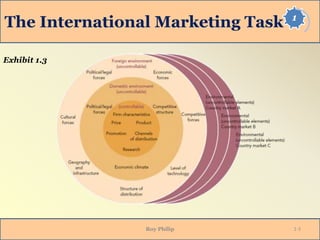
The International Marketing Task
Exhibit 1.3
Roy Philip 1-3
1
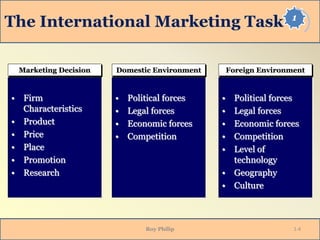
The International Marketing Task
Roy Philip
Marketing Decision Domestic Environment Foreign Environment
• Firm
Characteristics
• Product
• Price
• Place
• Promotion
• Research
• Political forces
• Legal forces
• Economic forces
• Competition
• Political forces
• Legal forces
• Economic forces
• Competition
• Level of
technology
• Geography
• Culture
1-4
1
Environmental Adaptation
• The most challenging and important adaptation
international marketers must make is cultural
adjustments.
• Must establish a frame of reference
– Time-conscious Americans vs. Time-is-not-an-
asset thinking Latin Americans
– Hand gestures vary between countries
• “Cultural Conditioning” – be aware of home
cultural references before making decisions
Roy Philip 1-5
1
Obstacles to Adaptation
• Adaptation is a conscious effort on the part of
the international marketer to anticipate the
influences of both the foreign and domestic
uncontrollable factors on a marketing mix and
then to adjust the marketing mix to minimize
the effects.
• Two primary obstacles are:
– Self-Reference Criterion (SRC)
– Ethnocentrism
Roy Philip 1-6
1Self-Reference Criterion
(SRC)
• Self-Reference Criterion (SRC) is an
unconscious reference to one’s own cultural
values, experiences, and knowledge as a basis
for decision.
• Risk of SRC:
– Prevent you from becoming aware of cultural
differences
– Influence the evaluation of the appropriateness
of a domestically designed marketing mix for a
foreign market
Roy Philip 1-7
1
Ethnocentrism
• The notion that people in one’s own company,
culture, or country know best how to do things.
• Risk of Ethnocentrism:
– Impedes the ability to assess a foreign market in
its true light
Roy Philip 1-8
1
Beyond Obstacles
to Adaptation
• The most effective way to control the influence
of SRC and Ethnocentrism is:
– To recognize the effects on our behavior
– To recognize that there may be more similarities
than differences between countries
– To conduct cross-cultural analysis
Roy Philip 1-9
1
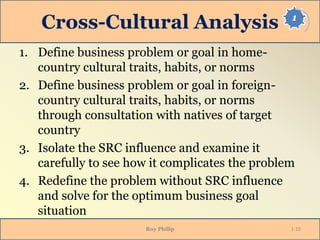
Cross-Cultural Analysis
1. Define business problem or goal in home-
country cultural traits, habits, or norms
2. Define business problem or goal in foreign-
country cultural traits, habits, or norms
through consultation with natives of target
country
3. Isolate the SRC influence and examine it
carefully to see how it complicates the problem
4. Redefine the problem without SRC influence
and solve for the optimum business goal
situation
Roy Philip 1-10
1Developing
Global Awareness
• Tolerance of cultural differences
– You do not have to accept as your own the
cultural ways of another, but you must allow
others to be different and equal
• Knowledge of cultures, history, world market
potential, and global economic, social, and
political trends
Roy Philip 1-11
1Approaches to
Global Awareness
• Select individual managers that express a
global awareness orientation
• Develop personal relationships in foreign
countries
• Must have the support of a culturally diverse
senior executive staff or board of directors
Roy Philip 1-12
1
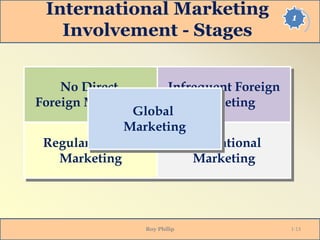
International Marketing
Involvement - Stages
No Direct
Foreign Marketing
Infrequent Foreign
Marketing
Regular Foreign
Marketing
International
Marketing
Global
Marketing
Roy Philip 1-13
1No Direct Foreign
Marketing – Reactive
• Products “indirectly” reach foreign markets
• Trading companies
• Foreign customers who contact firm
• Domestic wholesalers/distributors
• Web orders
• Foreign orders stimulate a company’s interest
to seek additional international sales
Roy Philip 1-14
1Infrequent Foreign
Marketing – Reactive
• Caused by temporary surpluses
– Sales to foreign markets are made as goods
become available
• Firm has little or no intention of maintaining
continuous market representation
• Foreign sales activity declines and is
withdrawn when domestic demand increases
Roy Philip 1-15
1Regular Foreign
Marketing – Proactive
• Dedicated production capacity for foreign
markets
• Strategy:
– Firm employs domestic or foreign intermediaries
– Uses its own sales force or sales subsidiaries
• Products are adapted for foreign markets as
domestic demand grows
• Firms depend on profits from foreign markets
Roy Philip 1-16
1International Marketing –
Proactive
• Fully committed and involved in foreign markets
and international activities
• Production takes place on foreign soil earning
firms the MNC (Multinational Corporation) title
Roy Philip 1-17
1Global Marketing –
Proactive
• The firm sees the world as one market!
• Market segmentation is now defined by income
levels, usage patterns, or other factors that span
the globe
• More than half of its revenues come from abroad
• The firm has a global perspective
Roy Philip 1-18
1
Global Market Orientation
• This orientation entails operating as if all the
country markets in a company’s scope of operations
(including the domestic market) were approachable
as a single global market and standardizing the
marketing mix where culturally feasible and cost
effective.
Roy Philip 1-19

International Marketing Chapter 1

  • 1.
    International Marketing 15th edition PhilipR. Cateora, Mary C. Gilly, and John L. Graham Copyright © 2011 by The McGraw-Hill Companies, Inc. All rights reserved.McGraw-Hill/Irwin
  • 2.
    1 International Marketing • Internationalmarketing is defined as the performance of business activities designed to plan, price, promote, and direct the flow of a company’s goods and services to consumers or users in more than one nations for a profit. • The difference is the “environment” – Competition, legal restraints, government controls, weather, fickle consumers, economic conditions, technological constraints, infrastructure concerns, culture, and political situations. Roy Philip 1-2
  • 3.
    1 The International MarketingTask Exhibit 1.3 Roy Philip 1-3
  • 4.
    1 The International MarketingTask Roy Philip Marketing Decision Domestic Environment Foreign Environment • Firm Characteristics • Product • Price • Place • Promotion • Research • Political forces • Legal forces • Economic forces • Competition • Political forces • Legal forces • Economic forces • Competition • Level of technology • Geography • Culture 1-4
  • 5.
    1 Environmental Adaptation • Themost challenging and important adaptation international marketers must make is cultural adjustments. • Must establish a frame of reference – Time-conscious Americans vs. Time-is-not-an- asset thinking Latin Americans – Hand gestures vary between countries • “Cultural Conditioning” – be aware of home cultural references before making decisions Roy Philip 1-5
  • 6.
    1 Obstacles to Adaptation •Adaptation is a conscious effort on the part of the international marketer to anticipate the influences of both the foreign and domestic uncontrollable factors on a marketing mix and then to adjust the marketing mix to minimize the effects. • Two primary obstacles are: – Self-Reference Criterion (SRC) – Ethnocentrism Roy Philip 1-6
  • 7.
    1Self-Reference Criterion (SRC) • Self-ReferenceCriterion (SRC) is an unconscious reference to one’s own cultural values, experiences, and knowledge as a basis for decision. • Risk of SRC: – Prevent you from becoming aware of cultural differences – Influence the evaluation of the appropriateness of a domestically designed marketing mix for a foreign market Roy Philip 1-7
  • 8.
    1 Ethnocentrism • The notionthat people in one’s own company, culture, or country know best how to do things. • Risk of Ethnocentrism: – Impedes the ability to assess a foreign market in its true light Roy Philip 1-8
  • 9.
    1 Beyond Obstacles to Adaptation •The most effective way to control the influence of SRC and Ethnocentrism is: – To recognize the effects on our behavior – To recognize that there may be more similarities than differences between countries – To conduct cross-cultural analysis Roy Philip 1-9
  • 10.
    1 Cross-Cultural Analysis 1. Definebusiness problem or goal in home- country cultural traits, habits, or norms 2. Define business problem or goal in foreign- country cultural traits, habits, or norms through consultation with natives of target country 3. Isolate the SRC influence and examine it carefully to see how it complicates the problem 4. Redefine the problem without SRC influence and solve for the optimum business goal situation Roy Philip 1-10
  • 11.
    1Developing Global Awareness • Toleranceof cultural differences – You do not have to accept as your own the cultural ways of another, but you must allow others to be different and equal • Knowledge of cultures, history, world market potential, and global economic, social, and political trends Roy Philip 1-11
  • 12.
    1Approaches to Global Awareness •Select individual managers that express a global awareness orientation • Develop personal relationships in foreign countries • Must have the support of a culturally diverse senior executive staff or board of directors Roy Philip 1-12
  • 13.
    1 International Marketing Involvement -Stages No Direct Foreign Marketing Infrequent Foreign Marketing Regular Foreign Marketing International Marketing Global Marketing Roy Philip 1-13
  • 14.
    1No Direct Foreign Marketing– Reactive • Products “indirectly” reach foreign markets • Trading companies • Foreign customers who contact firm • Domestic wholesalers/distributors • Web orders • Foreign orders stimulate a company’s interest to seek additional international sales Roy Philip 1-14
  • 15.
    1Infrequent Foreign Marketing –Reactive • Caused by temporary surpluses – Sales to foreign markets are made as goods become available • Firm has little or no intention of maintaining continuous market representation • Foreign sales activity declines and is withdrawn when domestic demand increases Roy Philip 1-15
  • 16.
    1Regular Foreign Marketing –Proactive • Dedicated production capacity for foreign markets • Strategy: – Firm employs domestic or foreign intermediaries – Uses its own sales force or sales subsidiaries • Products are adapted for foreign markets as domestic demand grows • Firms depend on profits from foreign markets Roy Philip 1-16
  • 17.
    1International Marketing – Proactive •Fully committed and involved in foreign markets and international activities • Production takes place on foreign soil earning firms the MNC (Multinational Corporation) title Roy Philip 1-17
  • 18.
    1Global Marketing – Proactive •The firm sees the world as one market! • Market segmentation is now defined by income levels, usage patterns, or other factors that span the globe • More than half of its revenues come from abroad • The firm has a global perspective Roy Philip 1-18
  • 19.
    1 Global Market Orientation •This orientation entails operating as if all the country markets in a company’s scope of operations (including the domestic market) were approachable as a single global market and standardizing the marketing mix where culturally feasible and cost effective. Roy Philip 1-19