CHAPTER 4

  Cultural Dynamics in
Assessing Global Markets
What is international business?
 Wide range of activities involved in conducting business
  transactions across national boundaries. These are
  heterogeneous, universal and sequential

 Comprehensive approach to operations of both large and small
  firms engaged in business abroad.

 Concerns all activities of the firm
  (selling, procurement, outsourcing…). About seizing global
  opportunities (market expansion or diversification)

 Driving forces (regional economic agreements, converging
  needs and wants, communication
  improvements, quality, leverage…) and restraining forces
  (management myopia, corporate culture, national
  controls, globaphobia…)
EPRG Model
• Ethnocentric: everything is centered on the
  domestic market.

• Polycentric: several important foreign markets
  exist.

• Regiocentric: the market is composed of several
  large economic regions.

• Geocentric: the world is one large global market.
WHAT IS MARKETING?

 “Marketing is a social and managerial process
 by which individuals and groups obtain what
 they need and want through
 creating, offering, and exchanging products of
 value with others.” (Kotler)


                 Process, exchange, value
 What is international marketing?
 “International marketing is the process of planning and
  conducting transactions across national borders to create
  exchanges that satisfy the objectives of individuals and
  organizations” (Czinkota and Ronkainen)

 “International marketing focuses its resources on global
  market opportunities and threats” (Keegan and Green)

 It is a tool used to obtain improvement of the firm’s
  position in the global market

               Strategy and action:
                 global and local
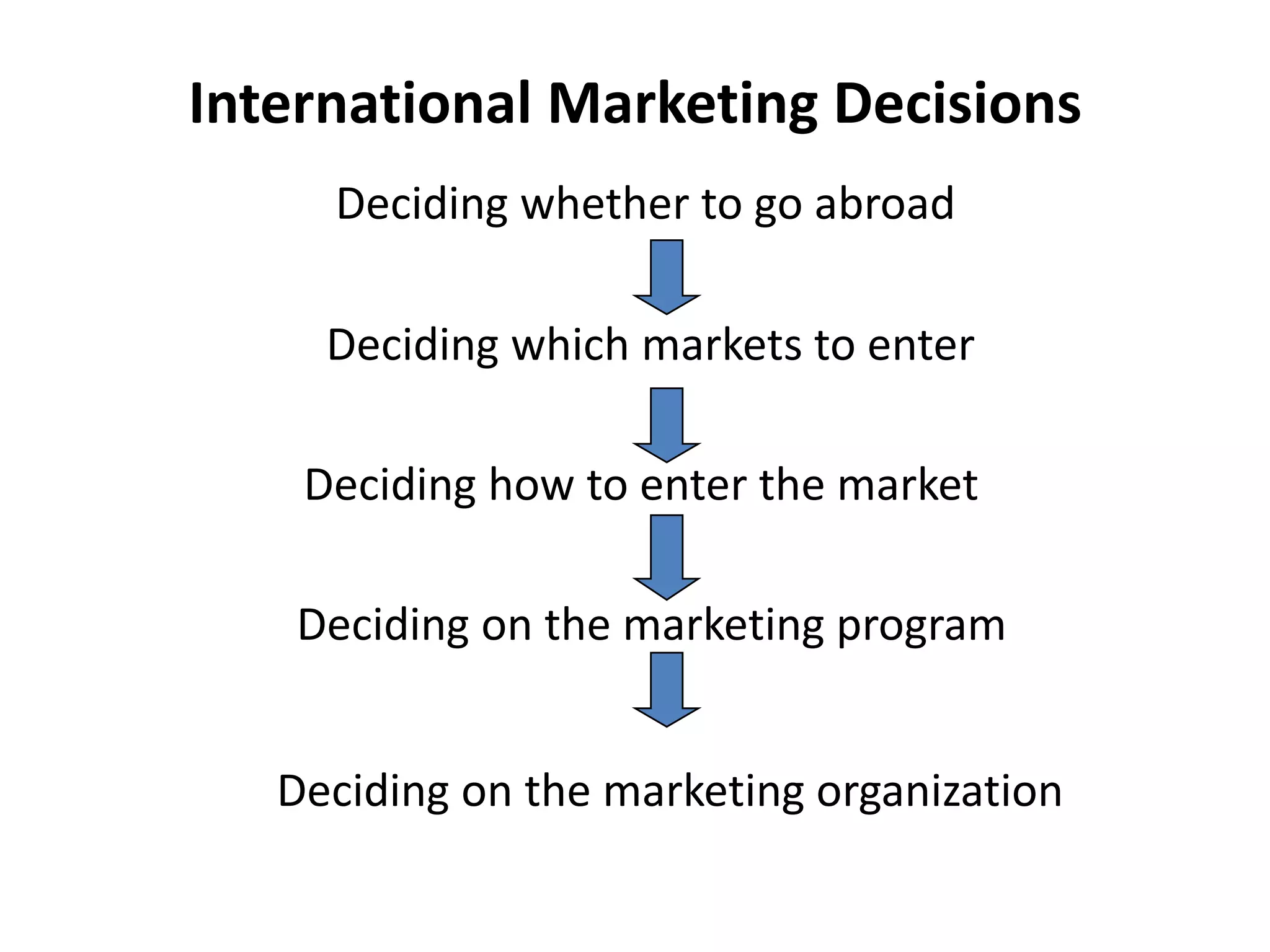
International Marketing Decisions
     Deciding whether to go abroad

     Deciding which markets to enter

    Deciding how to enter the market

   Deciding on the marketing program


   Deciding on the marketing organization
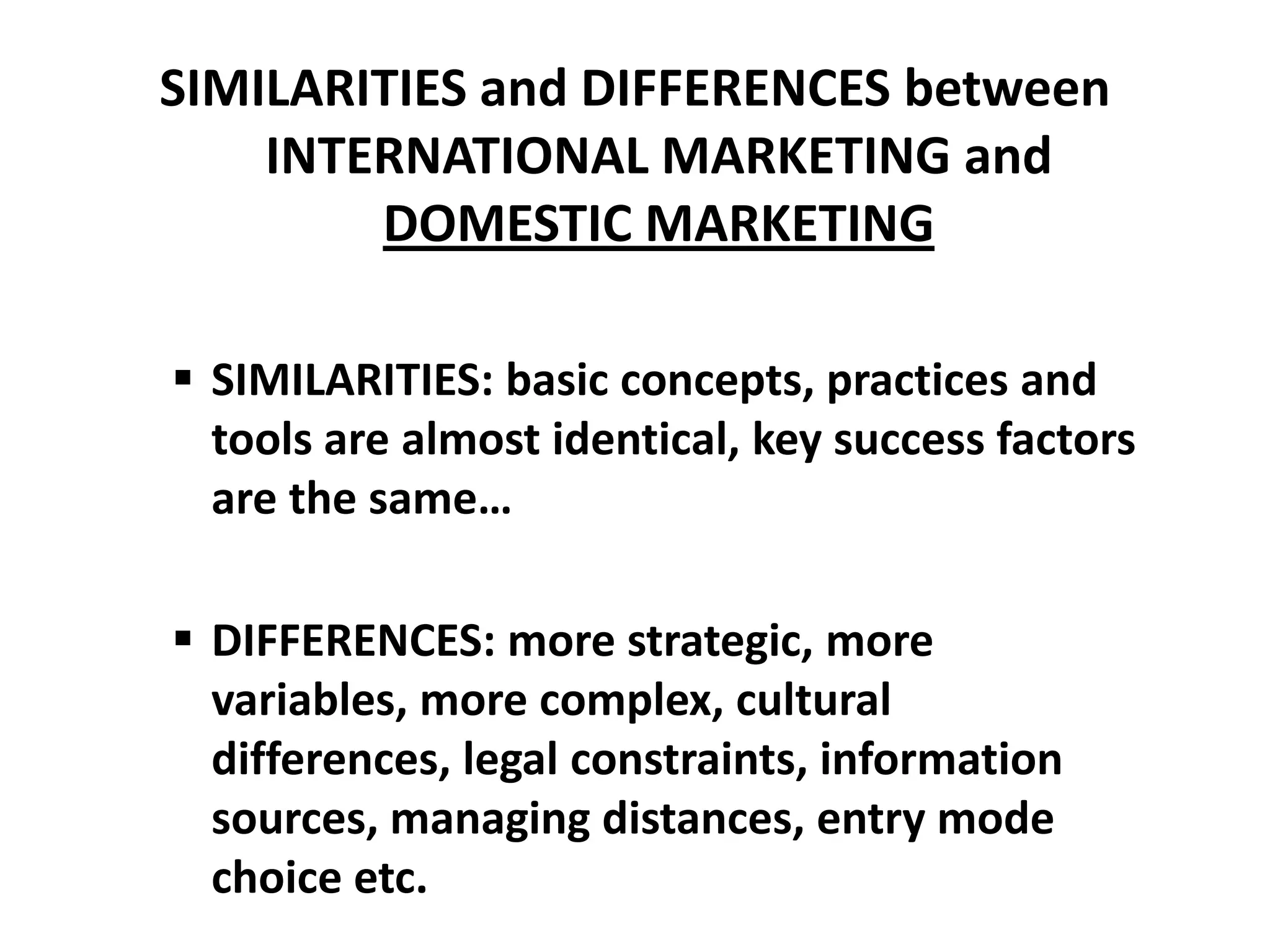
SIMILARITIES and DIFFERENCES between
    INTERNATIONAL MARKETING and
        DOMESTIC MARKETING

 SIMILARITIES: basic concepts, practices and
  tools are almost identical, key success factors
  are the same…

 DIFFERENCES: more strategic, more
  variables, more complex, cultural
  differences, legal constraints, information
  sources, managing distances, entry mode
  choice etc.
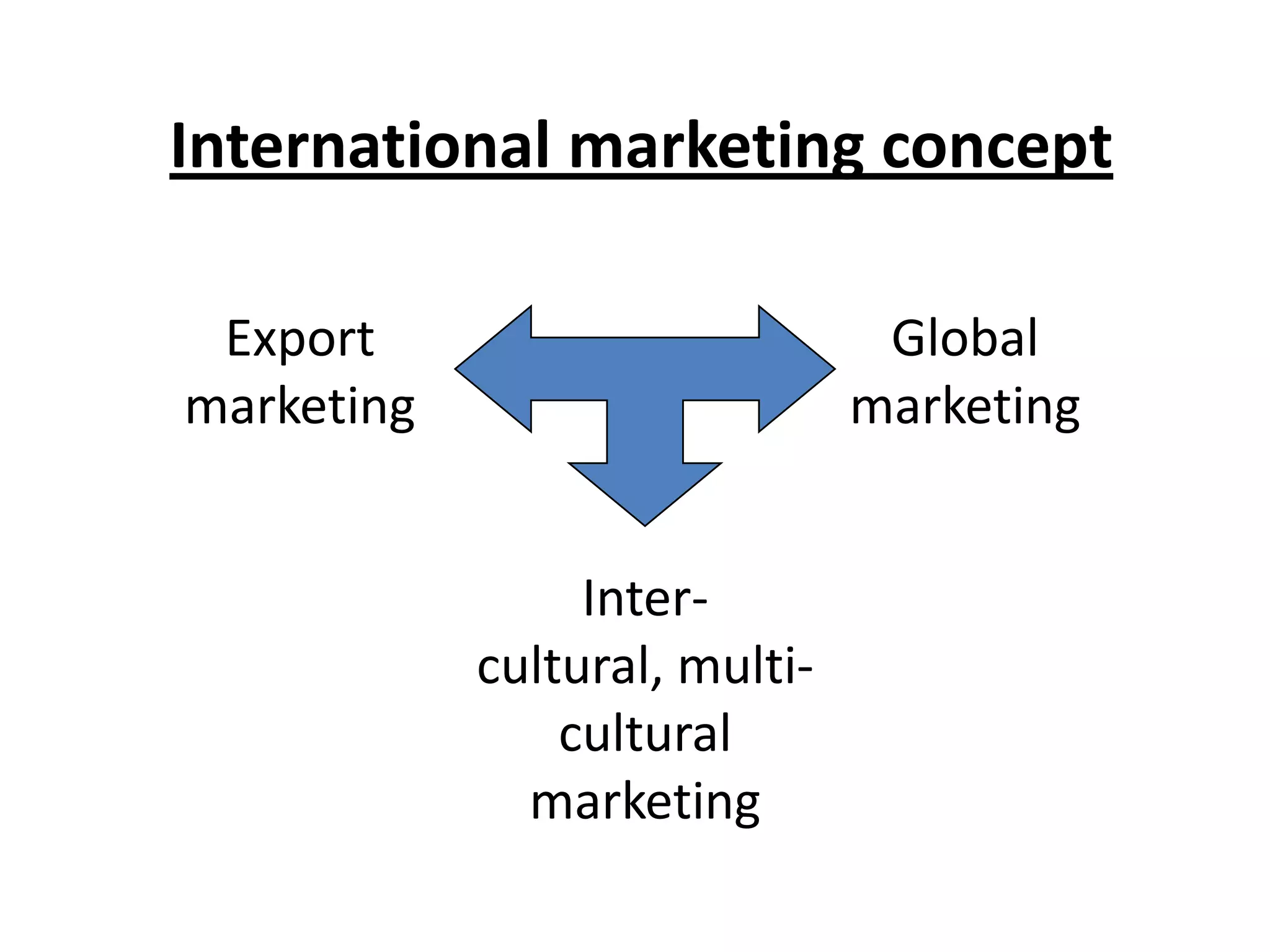
International marketing concept

 Export                         Global
marketing                      marketing


                 Inter-
            cultural, multi-
                cultural
              marketing
Culture and international marketing
• Concepts of culture

• Dimensions and models of culture

• Examples and international marketing
  consequences
What is culture?
• “Culture is the integrated sum total of
  learned behavioral traits that are shared by
  members of a society” (Hoebel)

• “Culture is the entirety of societal
  knowledge, norms and values” (Antonides
  and Van Raaij)

  Culture both affects and describes human
  behavior, it is essential in international
  marketing
Fundamentals of culture
 Culture is a total pattern of behavior that is
  consistent and compatible in its components. It
  is not a collection of random behaviors…

 Culture is a learned behavior. It is not
  biologically transmitted. It depends on
  environment, not heredity.

 Culture is behavior that is shared by a group of
  people, a society. It is a distinctive way of life.
Culture vs. personality
• Personality is the individual’s unique
  personal set of mental programs that
  he/she does not share with any other
  human being.

• Culture is what members of a group have
  in common. “It is the glue that binds
  groups together” (De Mooij)


Ideas, values, acts, emotions… are cultural
products. They help people to live together
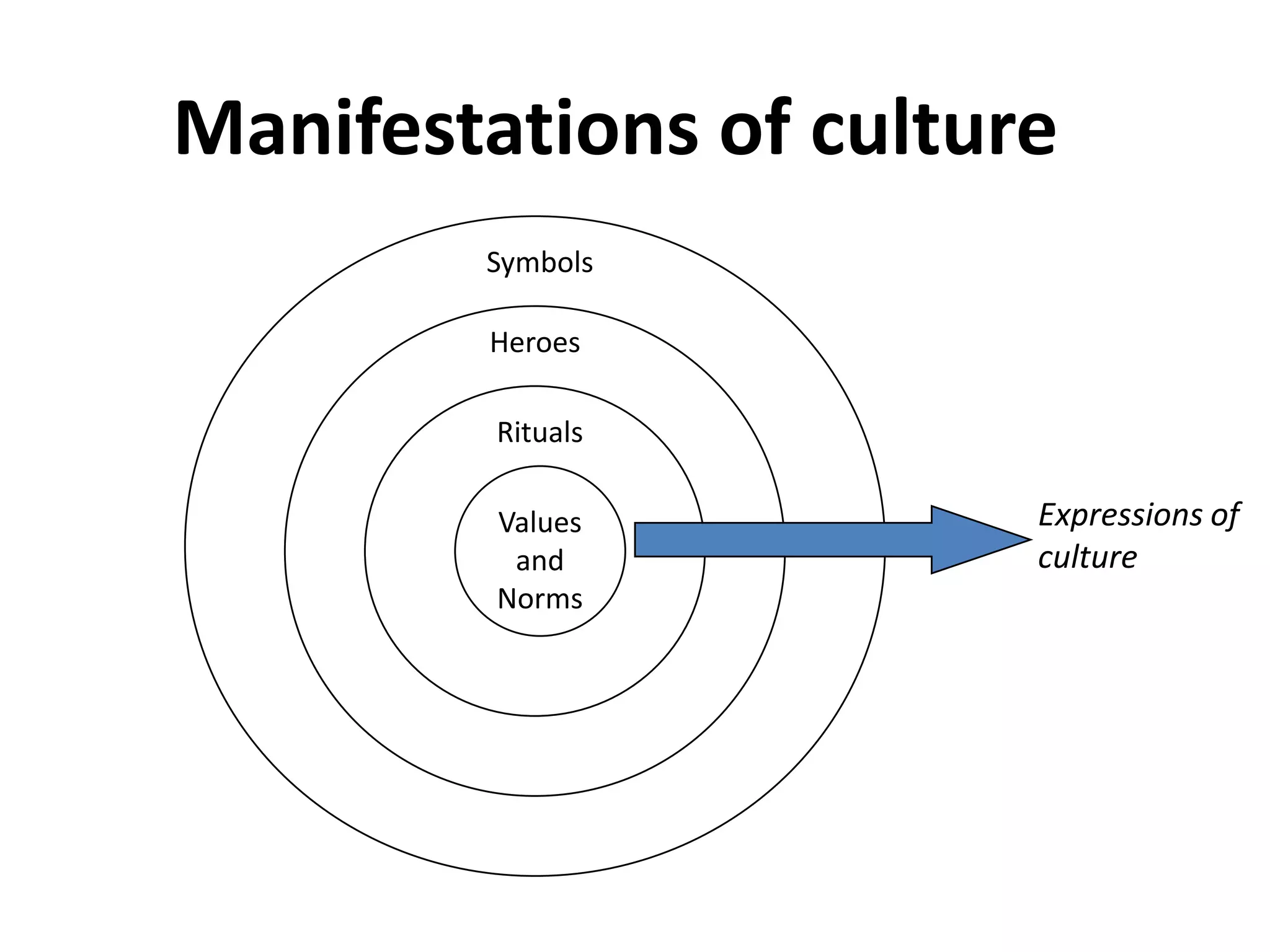
Manifestations of culture
        Symbols

        Heroes

         Rituals

         Values         Expressions of
          and           culture
         Norms
Symbols
• Symbols are words, gestures, pictures, or objects
  that carry a particular meaning recognized only by
  those who share a culture.

• This is the most superficial manifestation of culture.

• New symbols are easily developed and old ones
  quickly disappear.

• Symbols from one cultural group are regularly
  copied by others.
Heroes
• Heroes are people, alive or dead, real or
  imaginary, who possess characteristics
  that are highly prized in a society.

• They serve as role models for behavior.

• They can become globally known, but
  their stories often become local.
Rituals
 Rituals are the collective activities
  considered socially essential within a
  culture.

 They are carried out for their own sake.

 They are easily observed, but not always
  understood.
Values
• Values are at the core of culture. Values are stable beliefs
  regarding desired behavior or end states.

• They often have a religious, ideological or humanistic
  background.

• Goals are derived from values.

• Values are among the first things children learn, not
  consciously but implicitly.

• Core values are resistant to globalization; they vary across
  cultures and are not likely to change frequently.
Norms
• Norms and values are part of the “non-material”
  culture.

• Norms are beliefs regarding how to behave and
  how not to behave (do’s and don’ts).

• People differ in the extent to which they accept
  and comply with norms.

• They create expectations and criteria regarding
  the conduct of others.
Explicit vs. implicit culture

• Explicit culture:
  languages, behavior, know-
  how, institutions (directly observable)

• Implicit culture: moral values, learning
  process, beliefs and representations
  (subconscious)
Two levels of cultural diversity in Intl business

 External cultural diversity
   Cultural determinants influencing purchasing and
    consumption behaviors (Who buys? What? Where? How? Why?)


   Cultural determinants influencing negotiations
    (relationships with suppliers, buyers, partners)
 Internal cultural diversity
    Observed within all MNCs (identity and
     corporate culture)
    Cultural differences that affect the way
     subsidiaries work together
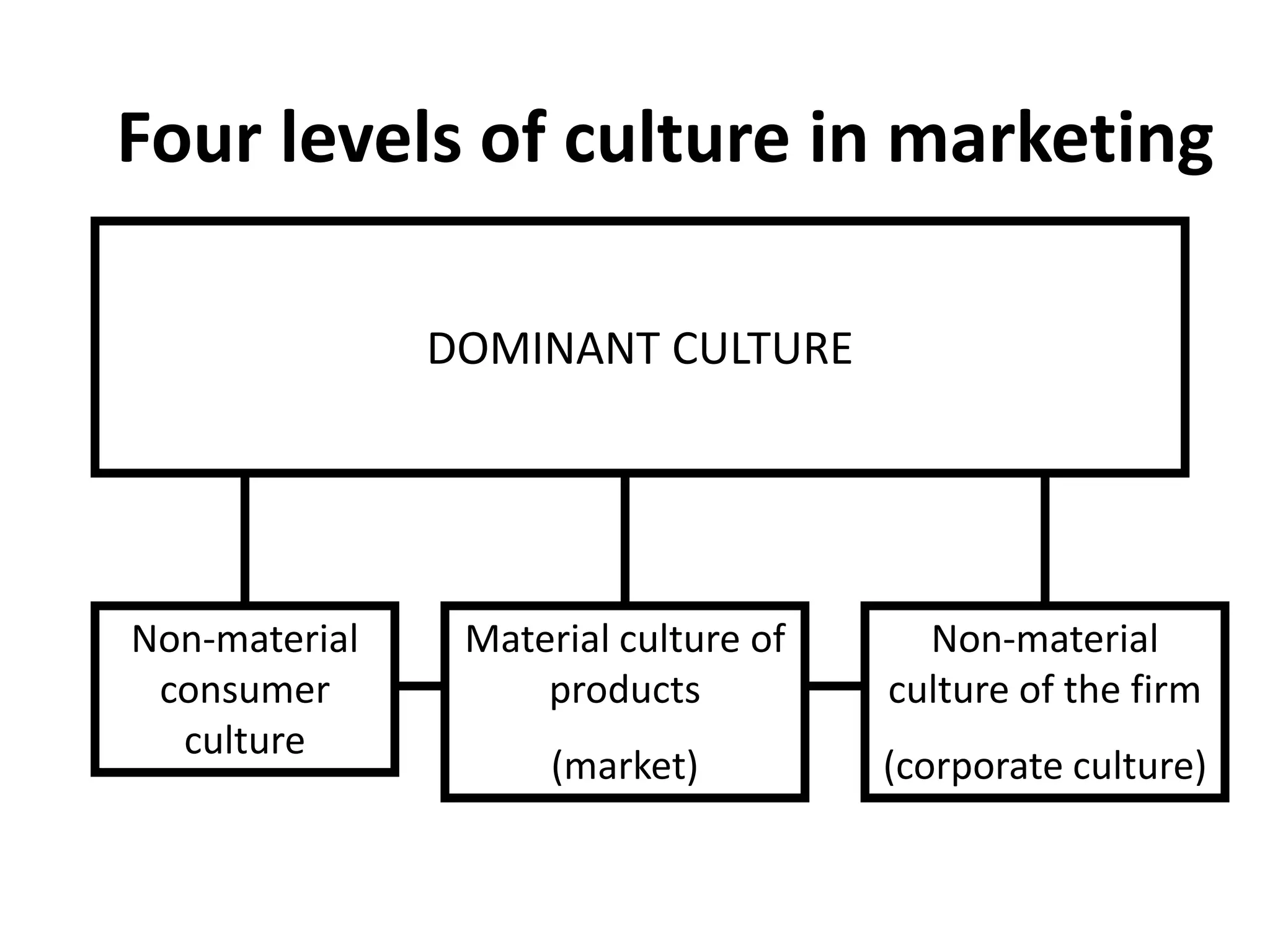
Four levels of culture in marketing

               DOMINANT CULTURE


Non-material    Material culture of     Non-material
 consumer           products          culture of the firm
  culture
                     (market)         (corporate culture)
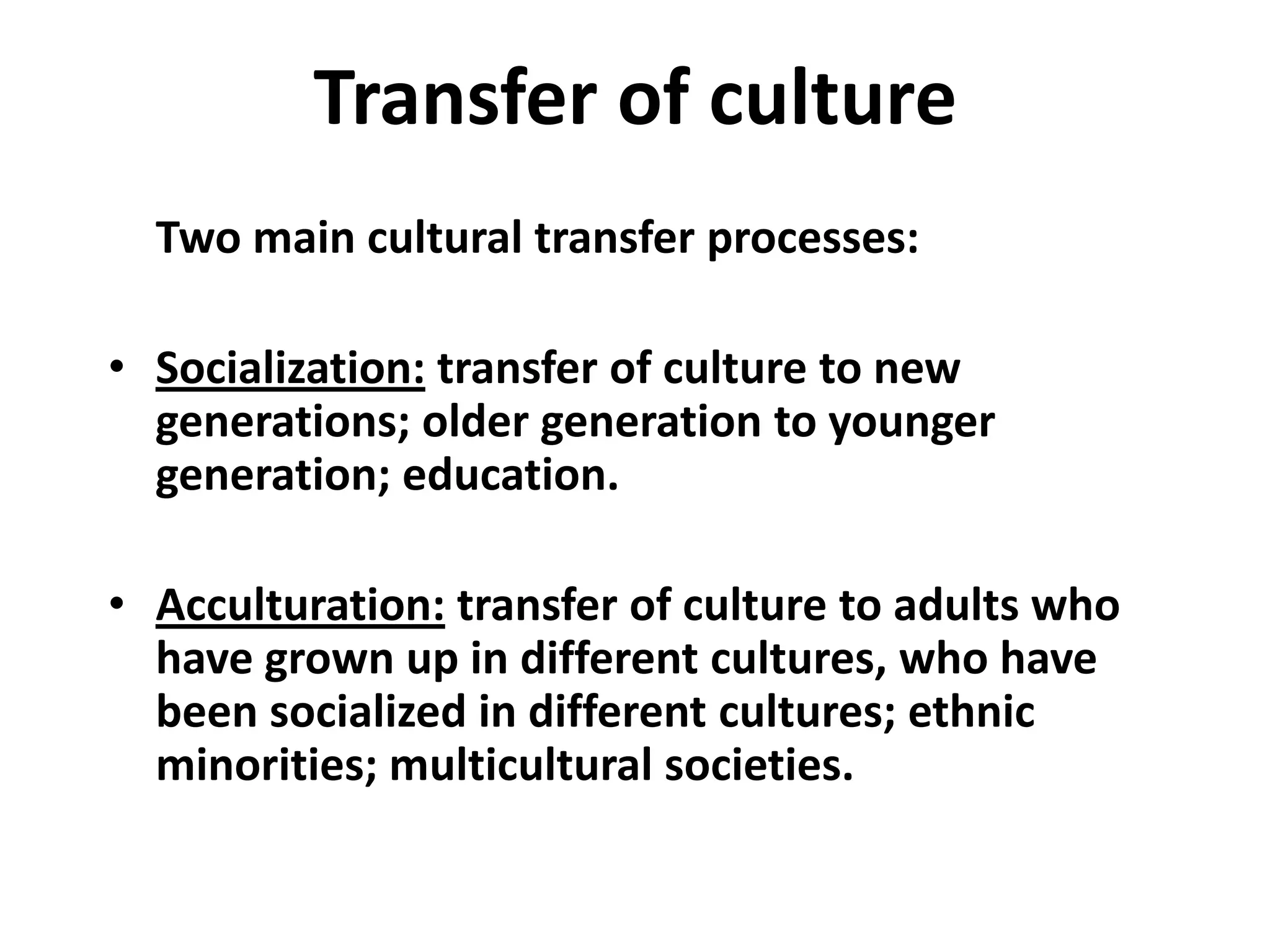
Transfer of culture
  Two main cultural transfer processes:

• Socialization: transfer of culture to new
  generations; older generation to younger
  generation; education.

• Acculturation: transfer of culture to adults who
  have grown up in different cultures, who have
  been socialized in different cultures; ethnic
  minorities; multicultural societies.
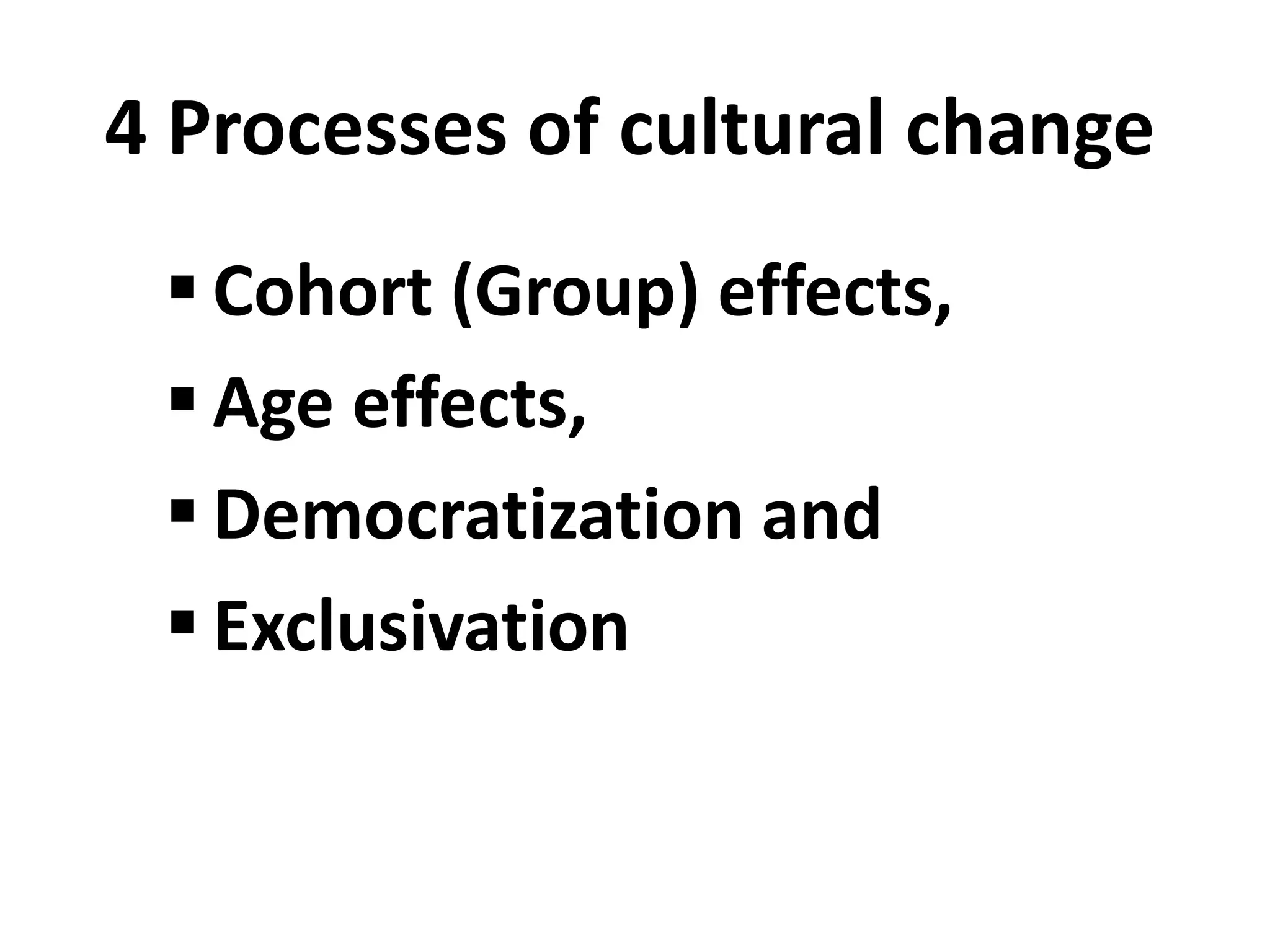
4 Processes of cultural change
  Cohort (Group) effects,
  Age effects,
  Democratization and
  Exclusivation
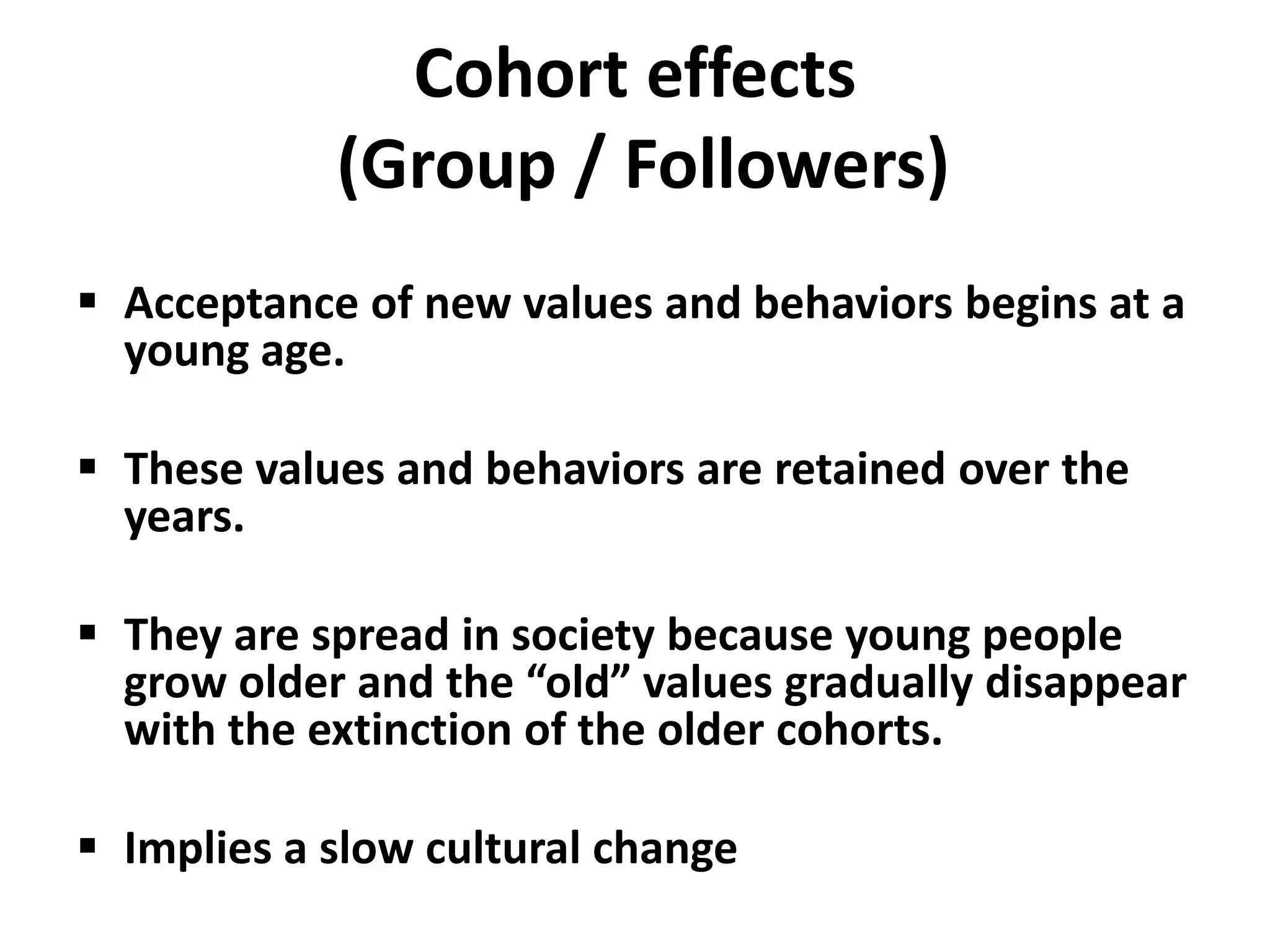
Cohort effects
            (Group / Followers)
 Acceptance of new values and behaviors begins at a
  young age.

 These values and behaviors are retained over the
  years.

 They are spread in society because young people
  grow older and the “old” values gradually disappear
  with the extinction of the older cohorts.

 Implies a slow cultural change
Age effect
 Certain values or behaviors are associated
  with a particular age group.

 Behaviors are modified as age groups
  change.

 Age-bound consumer behavior.

 Possible reverse socialization.
Democratization
• Cultural “leveling” or “spreading”

• Cultural differences across social classes
  decrease.

• Results from an increasing level of general
  welfare, the influence of mass media and the
  stress on the equality ideal.

• Mechanisms of democratization: trickle-
  down, trickle-up, trickle-across.
Exclusivation
 Reverse of democratization

 Occurs less frequently

 Implies limited social spreading of values, goods
  and behavior.

 Cultural change is limited to a certain group
  (“elite”, “leading edge”).
Dimensions of culture
• What makes one culture different from another
  culture?
• How can we compare cultures or cluster cultures
  according to behavioral characteristics?


• Stereotypes vs. cultural dimensions
• Different cultures have different stereotypes of other
  cultures.
CULTURE BY GENDER
• Masculine vs. Feminine

• “the dominant values in a masculine society are achievement
  and success; the dominant values in a feminine society are
  caring for others and quality of life”

• Focuses on the degree the society reinforces, or does not
  reinforce, the traditional masculine work role model of male
  achievement, performance, control and power
CULTURE BY GENDER
• Shows the importance of status in societies

• Indicates the degree of gender differentiation
  and the importance of masculine values
  (assertiveness, money, material
  goods, success…)
Long-term orientation (LTO)
• Long-term vs. Short-term orientation

• “the extent to which a society exhibits a pragmatic future-
  oriented perspective rather than a conventional historic or
  short-term point of view”

• High LTO = perseverance, ordering relationships by
  status, thrift, sense of shame, family ties, long-term
  thinking, paternalism
Long-term orientation (LTO)
• Focuses on the degree the society
  embraces, or does not embrace, long-term
  devotion to traditional, forward thinking
  values

• Indicates whether the country prescribes to
  the values of long-term commitments and
  respect for tradition

INTERNATIONAL BUSINESS Chapter 4

  • 1.
    CHAPTER 4 Cultural Dynamics in Assessing Global Markets
  • 2.
    What is internationalbusiness?  Wide range of activities involved in conducting business transactions across national boundaries. These are heterogeneous, universal and sequential  Comprehensive approach to operations of both large and small firms engaged in business abroad.  Concerns all activities of the firm (selling, procurement, outsourcing…). About seizing global opportunities (market expansion or diversification)  Driving forces (regional economic agreements, converging needs and wants, communication improvements, quality, leverage…) and restraining forces (management myopia, corporate culture, national controls, globaphobia…)
  • 3.
    EPRG Model • Ethnocentric:everything is centered on the domestic market. • Polycentric: several important foreign markets exist. • Regiocentric: the market is composed of several large economic regions. • Geocentric: the world is one large global market.
  • 4.
    WHAT IS MARKETING? “Marketing is a social and managerial process by which individuals and groups obtain what they need and want through creating, offering, and exchanging products of value with others.” (Kotler) Process, exchange, value
  • 5.
     What isinternational marketing?  “International marketing is the process of planning and conducting transactions across national borders to create exchanges that satisfy the objectives of individuals and organizations” (Czinkota and Ronkainen)  “International marketing focuses its resources on global market opportunities and threats” (Keegan and Green)  It is a tool used to obtain improvement of the firm’s position in the global market Strategy and action: global and local
  • 6.
    International Marketing Decisions Deciding whether to go abroad Deciding which markets to enter Deciding how to enter the market Deciding on the marketing program Deciding on the marketing organization
  • 7.
    SIMILARITIES and DIFFERENCESbetween INTERNATIONAL MARKETING and DOMESTIC MARKETING  SIMILARITIES: basic concepts, practices and tools are almost identical, key success factors are the same…  DIFFERENCES: more strategic, more variables, more complex, cultural differences, legal constraints, information sources, managing distances, entry mode choice etc.
  • 8.
    International marketing concept Export Global marketing marketing Inter- cultural, multi- cultural marketing
  • 9.
    Culture and internationalmarketing • Concepts of culture • Dimensions and models of culture • Examples and international marketing consequences
  • 10.
    What is culture? •“Culture is the integrated sum total of learned behavioral traits that are shared by members of a society” (Hoebel) • “Culture is the entirety of societal knowledge, norms and values” (Antonides and Van Raaij) Culture both affects and describes human behavior, it is essential in international marketing
  • 11.
    Fundamentals of culture Culture is a total pattern of behavior that is consistent and compatible in its components. It is not a collection of random behaviors…  Culture is a learned behavior. It is not biologically transmitted. It depends on environment, not heredity.  Culture is behavior that is shared by a group of people, a society. It is a distinctive way of life.
  • 12.
    Culture vs. personality •Personality is the individual’s unique personal set of mental programs that he/she does not share with any other human being. • Culture is what members of a group have in common. “It is the glue that binds groups together” (De Mooij) Ideas, values, acts, emotions… are cultural products. They help people to live together
  • 13.
    Manifestations of culture Symbols Heroes Rituals Values Expressions of and culture Norms
  • 14.
    Symbols • Symbols arewords, gestures, pictures, or objects that carry a particular meaning recognized only by those who share a culture. • This is the most superficial manifestation of culture. • New symbols are easily developed and old ones quickly disappear. • Symbols from one cultural group are regularly copied by others.
  • 15.
    Heroes • Heroes arepeople, alive or dead, real or imaginary, who possess characteristics that are highly prized in a society. • They serve as role models for behavior. • They can become globally known, but their stories often become local.
  • 16.
    Rituals  Rituals arethe collective activities considered socially essential within a culture.  They are carried out for their own sake.  They are easily observed, but not always understood.
  • 17.
    Values • Values areat the core of culture. Values are stable beliefs regarding desired behavior or end states. • They often have a religious, ideological or humanistic background. • Goals are derived from values. • Values are among the first things children learn, not consciously but implicitly. • Core values are resistant to globalization; they vary across cultures and are not likely to change frequently.
  • 18.
    Norms • Norms andvalues are part of the “non-material” culture. • Norms are beliefs regarding how to behave and how not to behave (do’s and don’ts). • People differ in the extent to which they accept and comply with norms. • They create expectations and criteria regarding the conduct of others.
  • 19.
    Explicit vs. implicitculture • Explicit culture: languages, behavior, know- how, institutions (directly observable) • Implicit culture: moral values, learning process, beliefs and representations (subconscious)
  • 20.
    Two levels ofcultural diversity in Intl business  External cultural diversity  Cultural determinants influencing purchasing and consumption behaviors (Who buys? What? Where? How? Why?)  Cultural determinants influencing negotiations (relationships with suppliers, buyers, partners)  Internal cultural diversity  Observed within all MNCs (identity and corporate culture)  Cultural differences that affect the way subsidiaries work together
  • 21.
    Four levels ofculture in marketing DOMINANT CULTURE Non-material Material culture of Non-material consumer products culture of the firm culture (market) (corporate culture)
  • 22.
    Transfer of culture Two main cultural transfer processes: • Socialization: transfer of culture to new generations; older generation to younger generation; education. • Acculturation: transfer of culture to adults who have grown up in different cultures, who have been socialized in different cultures; ethnic minorities; multicultural societies.
  • 23.
    4 Processes ofcultural change  Cohort (Group) effects,  Age effects,  Democratization and  Exclusivation
  • 24.
    Cohort effects (Group / Followers)  Acceptance of new values and behaviors begins at a young age.  These values and behaviors are retained over the years.  They are spread in society because young people grow older and the “old” values gradually disappear with the extinction of the older cohorts.  Implies a slow cultural change
  • 25.
    Age effect  Certainvalues or behaviors are associated with a particular age group.  Behaviors are modified as age groups change.  Age-bound consumer behavior.  Possible reverse socialization.
  • 26.
    Democratization • Cultural “leveling”or “spreading” • Cultural differences across social classes decrease. • Results from an increasing level of general welfare, the influence of mass media and the stress on the equality ideal. • Mechanisms of democratization: trickle- down, trickle-up, trickle-across.
  • 27.
    Exclusivation  Reverse ofdemocratization  Occurs less frequently  Implies limited social spreading of values, goods and behavior.  Cultural change is limited to a certain group (“elite”, “leading edge”).
  • 28.
    Dimensions of culture •What makes one culture different from another culture? • How can we compare cultures or cluster cultures according to behavioral characteristics? • Stereotypes vs. cultural dimensions • Different cultures have different stereotypes of other cultures.
  • 29.
    CULTURE BY GENDER •Masculine vs. Feminine • “the dominant values in a masculine society are achievement and success; the dominant values in a feminine society are caring for others and quality of life” • Focuses on the degree the society reinforces, or does not reinforce, the traditional masculine work role model of male achievement, performance, control and power
  • 30.
    CULTURE BY GENDER •Shows the importance of status in societies • Indicates the degree of gender differentiation and the importance of masculine values (assertiveness, money, material goods, success…)
  • 31.
    Long-term orientation (LTO) •Long-term vs. Short-term orientation • “the extent to which a society exhibits a pragmatic future- oriented perspective rather than a conventional historic or short-term point of view” • High LTO = perseverance, ordering relationships by status, thrift, sense of shame, family ties, long-term thinking, paternalism
  • 32.
    Long-term orientation (LTO) •Focuses on the degree the society embraces, or does not embrace, long-term devotion to traditional, forward thinking values • Indicates whether the country prescribes to the values of long-term commitments and respect for tradition