International Marketing
15th edition
Philip R. Cateora, Mary C. Gilly, and John L. Graham
18Pricing Policy
Parallel Imports
• Parallel imports
– Develop when importers buy products from
distributors in one country and sell them in
another to distributors who are not part of the
manufacturer’s regular distribution system
• Occur whenever price differences are greater
than cost of transportation between two markets
• Major problem for pharmaceutical companies
• Exclusive distribution
.
Roy Philip 2
18
• Variable-cost pricing
– Firm is concerned only with the marginal or
incremental cost of producing goods to be sold in
overseas markets
• Full-cost pricing
– Companies insist that no unit of a similar product
is different
from any other unit in terms of cost
– Each unit must bear full share of the total fixed
and variable cost
Full-Cost Versus
Variable-Cost Pricing
Roy Philip 3
18Skimming Versus
Penetration Pricing
• Skimming
– Used by a company when the objective is to reach
a segment of the market that is relatively price
insensitive
– Market is willing to pay a premium price for the
value received
• Penetration pricing policy
– Used to stimulate market and sales growth by
deliberately offering products at low prices
Roy Philip 4
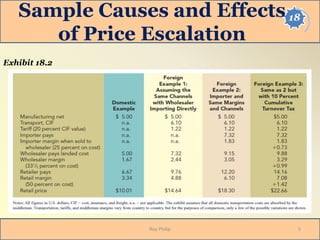
18Sample Causes and Effects
of Price Escalation
Roy Philip 5
Exhibit 18.2
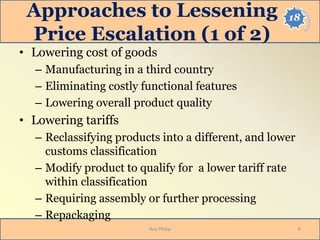
18Approaches to Lessening
Price Escalation (1 of 2)
• Lowering cost of goods
– Manufacturing in a third country
– Eliminating costly functional features
– Lowering overall product quality
• Lowering tariffs
– Reclassifying products into a different, and lower
customs classification
– Modify product to qualify for a lower tariff rate
within classification
– Requiring assembly or further processing
– Repackaging
Roy Philip 6
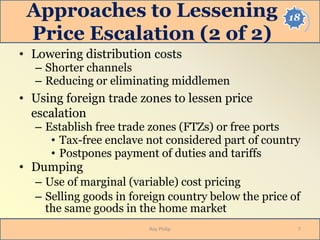
18Approaches to Lessening
Price Escalation (2 of 2)
• Lowering distribution costs
– Shorter channels
– Reducing or eliminating middlemen
• Using foreign trade zones to lessen price
escalation
– Establish free trade zones (FTZs) or free ports
• Tax-free enclave not considered part of country
• Postpones payment of duties and tariffs
• Dumping
– Use of marginal (variable) cost pricing
– Selling goods in foreign country below the price of
the same goods in the home market
Roy Philip 7
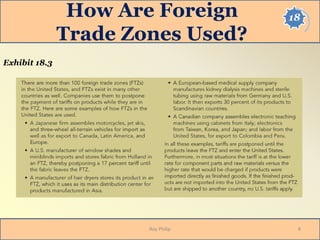
18How Are Foreign
Trade Zones Used?
Roy Philip 8
Exhibit 18.3
18Leasing in International
Markets(1 of 2)
• Selling technique that alleviates high prices and
capital shortages
• Opens the door to a large segment of nominally
financed foreign firms
– Firms can be sold on a lease option but might be
unable to buy for cash
• Can ease the problems of selling new,
experimental equipment
– Because less risk is involved for the users
9Roy Philip
18Leasing in International
Markets(2 of 2)
• Helps guarantee better maintenance and service
on overseas equipment
• Helps to sell other companies in that country
• Revenue tends to be more stable over a period of
time than direct sales
• Leasing disadvantages
– Inflation may lead to heavy losses at end of
contract period
– Currency devaluation, expropriation and political
risks
10Roy Philip
18
Countertrade as a Pricing Tool
• Types of countertrade
– Barter
– Compensation deals
– Counterpurchase or offset trade
– Product buyback agreement
11Roy Philip
18
Countertrade as a Pricing Tool
• Problems of countertrading
– Determining the value of and potential demand
for the goods offered
– Barter houses
• The Internet and countertrading
– Electronic trade dollars
– Universal Currency/IRTA
• Proactive countertrade strategy
– Included as part of an overall market strategy
– Effective for exchange-poor countries
12Roy Philip
18Transfer Pricing Strategy
(1 of 2)
• Prices of goods transferred from a company’s
operations or sales units in one country to its
units elsewhere
– May be adjusted to enhance the ultimate profit of
company
• Benefits
– Lowering duty costs
– Reducing income taxes in high-tax countries
– Facilitating dividend repatriation when dividend
repatriation is curtailed by government policy
13Roy Philip
18Transfer Pricing Strategy
(2 of 2)
• Objectives
– Maximizing profits for corporation
– Facilitating parent-company control
– Providing all levels of management control over profitability
• Arrangements for pricing goods for intracompany transfer
– Sales at the local manufacturing cost plus a standard markup
– Sales at the cost of the most efficient producer in the company
plus a standard markup
– Sales at negotiated prices
– Arm’s-length sales using the same prices as quoted to
independent customers
14Roy Philip

Chapter 18 pricing_international_marketing_15th

  • 1.
    International Marketing 15th edition PhilipR. Cateora, Mary C. Gilly, and John L. Graham
  • 2.
    18Pricing Policy Parallel Imports •Parallel imports – Develop when importers buy products from distributors in one country and sell them in another to distributors who are not part of the manufacturer’s regular distribution system • Occur whenever price differences are greater than cost of transportation between two markets • Major problem for pharmaceutical companies • Exclusive distribution . Roy Philip 2
  • 3.
    18 • Variable-cost pricing –Firm is concerned only with the marginal or incremental cost of producing goods to be sold in overseas markets • Full-cost pricing – Companies insist that no unit of a similar product is different from any other unit in terms of cost – Each unit must bear full share of the total fixed and variable cost Full-Cost Versus Variable-Cost Pricing Roy Philip 3
  • 4.
    18Skimming Versus Penetration Pricing •Skimming – Used by a company when the objective is to reach a segment of the market that is relatively price insensitive – Market is willing to pay a premium price for the value received • Penetration pricing policy – Used to stimulate market and sales growth by deliberately offering products at low prices Roy Philip 4
  • 5.
    18Sample Causes andEffects of Price Escalation Roy Philip 5 Exhibit 18.2
  • 6.
    18Approaches to Lessening PriceEscalation (1 of 2) • Lowering cost of goods – Manufacturing in a third country – Eliminating costly functional features – Lowering overall product quality • Lowering tariffs – Reclassifying products into a different, and lower customs classification – Modify product to qualify for a lower tariff rate within classification – Requiring assembly or further processing – Repackaging Roy Philip 6
  • 7.
    18Approaches to Lessening PriceEscalation (2 of 2) • Lowering distribution costs – Shorter channels – Reducing or eliminating middlemen • Using foreign trade zones to lessen price escalation – Establish free trade zones (FTZs) or free ports • Tax-free enclave not considered part of country • Postpones payment of duties and tariffs • Dumping – Use of marginal (variable) cost pricing – Selling goods in foreign country below the price of the same goods in the home market Roy Philip 7
  • 8.
    18How Are Foreign TradeZones Used? Roy Philip 8 Exhibit 18.3
  • 9.
    18Leasing in International Markets(1of 2) • Selling technique that alleviates high prices and capital shortages • Opens the door to a large segment of nominally financed foreign firms – Firms can be sold on a lease option but might be unable to buy for cash • Can ease the problems of selling new, experimental equipment – Because less risk is involved for the users 9Roy Philip
  • 10.
    18Leasing in International Markets(2of 2) • Helps guarantee better maintenance and service on overseas equipment • Helps to sell other companies in that country • Revenue tends to be more stable over a period of time than direct sales • Leasing disadvantages – Inflation may lead to heavy losses at end of contract period – Currency devaluation, expropriation and political risks 10Roy Philip
  • 11.
    18 Countertrade as aPricing Tool • Types of countertrade – Barter – Compensation deals – Counterpurchase or offset trade – Product buyback agreement 11Roy Philip
  • 12.
    18 Countertrade as aPricing Tool • Problems of countertrading – Determining the value of and potential demand for the goods offered – Barter houses • The Internet and countertrading – Electronic trade dollars – Universal Currency/IRTA • Proactive countertrade strategy – Included as part of an overall market strategy – Effective for exchange-poor countries 12Roy Philip
  • 13.
    18Transfer Pricing Strategy (1of 2) • Prices of goods transferred from a company’s operations or sales units in one country to its units elsewhere – May be adjusted to enhance the ultimate profit of company • Benefits – Lowering duty costs – Reducing income taxes in high-tax countries – Facilitating dividend repatriation when dividend repatriation is curtailed by government policy 13Roy Philip
  • 14.
    18Transfer Pricing Strategy (2of 2) • Objectives – Maximizing profits for corporation – Facilitating parent-company control – Providing all levels of management control over profitability • Arrangements for pricing goods for intracompany transfer – Sales at the local manufacturing cost plus a standard markup – Sales at the cost of the most efficient producer in the company plus a standard markup – Sales at negotiated prices – Arm’s-length sales using the same prices as quoted to independent customers 14Roy Philip