Chapter 19
Inventive Negotiations
with International
Customers, Partners,
and Regulators
Copyright © 2016 McGraw-Hill Education. All rights reserved. No reproduction or
distribution without the prior written consent of McGraw-Hill Education.
Learning Objectives (1 of 2)
LO1 The problems associated with cultural stereotypes
LO2 How culture influences behaviors at the
negotiation table
LO3 Common kinds of problems that crop up during
international business negotiations
LO4 The similarities and differences in communication
behaviors in several countries
LO5 How differences in values and thinking processes
affect international negotiations
2
Copyright © 2016 McGraw-Hill Education. All rights reserved. No reproduction or
distribution without the prior written consent of McGraw-Hill Education.
Learning Objectives (2 of 2)
LO6 Important factors in selecting a negotiation team
LO7 How to prepare for international negotiations
LO8 Managing all aspects of the negotiation process
LO9 The importance of follow-up communications and
procedures
LO10 The basics of inventive international negotiations
3
Copyright © 2016 McGraw-Hill Education. All rights reserved. No reproduction or
distribution without the prior written consent of McGraw-Hill Education.
International Negotiations
 Face-to-face negotiations are an omnipresent activity in
international commerce
 Plans are usually implemented through face-to-face
negotiations with business partners and customers from
foreign countries
 Executives must also negotiate with representatives of foreign
governments
 In many countries, governmental officials may also be joint
venture partners and, in some cases, vendors
4
Copyright © 2016 McGraw-Hill Education. All rights reserved. No reproduction or
distribution without the prior written consent of McGraw-Hill Education.
The Dangers of Stereotypes
 Negotiations are not conducted between national
stereotypes; negotiations are conducted between
people, and cultural factors often make huge differences
 For example, we might expect substantial differences in
negotiation styles between English-speaking and French-
speaking Canadians
 In addition to the influence of culture, individual
personalities and backgrounds and a variety of
situational factors also heavily influence behavior at the
negotiation table.
5
Copyright © 2016 McGraw-Hill Education. All rights reserved. No reproduction or
distribution without the prior written consent of McGraw-Hill Education.
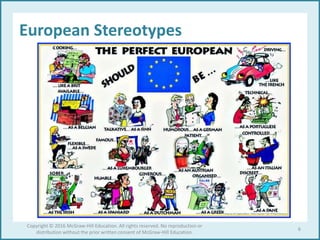
European Stereotypes
6
Copyright © 2016 McGraw-Hill Education. All rights reserved. No reproduction or
distribution without the prior written consent of McGraw-Hill Education.
The Pervasive Impact of Culture on
Negotiation Behavior (1 of 2)
 Looking broadly across the several cultures, two
important lessons stand out:
• Regional generalizations very often are not correct. For
example, Japanese and Korean negotiation styles are quite
similar in some ways, but in other ways, they could not be
more different.
• Japan is an exceptional place: On almost every dimension
of negotiation style considered, the Japanese are on or
near the end of the scale (high).
7
Copyright © 2016 McGraw-Hill Education. All rights reserved. No reproduction or
distribution without the prior written consent of McGraw-Hill Education.
The Pervasive Impact of Culture on
Negotiation Behavior (2 of 2)
 Cultural differences cause four kinds of problems in
international business negotiations at the levels of:
1. Language
2. Nonverbal behaviors
3. Values
4. Thinking and decision-making processes
8
Copyright © 2016 McGraw-Hill Education. All rights reserved. No reproduction or
distribution without the prior written consent of McGraw-Hill Education.
Differences in Language and Nonverbal
Behaviors (1 of 5)
 The variation across cultures is greater when comparing
linguistic aspects of language and nonverbal behaviors than
when the verbal content of negotiations is considered.
 The language advantages of the Japanese executive in the
description of the aisatsu that opened the chapter were quite
clear.
 However, the most common complaint heard from American
managers regards foreign clients and partners breaking into
side conversations in their native languages.
 This perception is a frequent American mistake. The usual
purpose of such side conversations is to straighten out a
translation problem.
9
Copyright © 2016 McGraw-Hill Education. All rights reserved. No reproduction or
distribution without the prior written consent of McGraw-Hill Education.
Differences in Language and Nonverbal
Behaviors (2 of 5)
 Consistent with most descriptions of Japanese negotiation
behavior, the results of this analysis suggest their style of
interaction is among the least aggressive (or most polite).
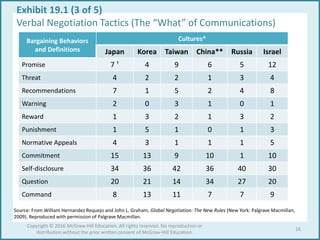
 Korean negotiators used considerably more punishments and
commands than did the Japanese.
 The behaviors of the negotiators from northern China were
most remarkable in the emphasis on asking questions (34
percent).
 The behavior of the businesspeople in Taiwan was quite
different from that in China and Japan but similar to that in
Korea.
10
Copyright © 2016 McGraw-Hill Education. All rights reserved. No reproduction or
distribution without the prior written consent of McGraw-Hill Education.
Differences in Language and Nonverbal
Behaviors (3 of 5)
 The Russians’ style was quite different from that of any other
European group, and, indeed, was quite similar in many
respects to the style of the Japanese.
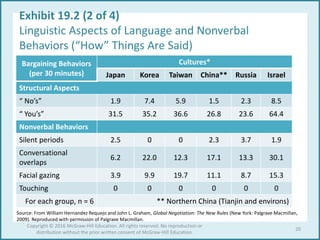
 The Israeli negotiators interrupted one another much more
frequently than negotiators from any other group.
 The behaviors of the Germans are difficult to characterize
because they fell toward the center of almost all the continua.
 The behaviors of the British negotiators were remarkably
similar to those of the Americans in all respects.
11
Copyright © 2016 McGraw-Hill Education. All rights reserved. No reproduction or
distribution without the prior written consent of McGraw-Hill Education.
Differences in Language and Nonverbal
Behaviors (4 of 5)
 Diga is perhaps a good metaphor for the Spanish approach to
negotiations evinced in our data. When you make a phone call
in Madrid, the usual greeting on the other end is not hola
(“hello”) but instead diga (“speak”).
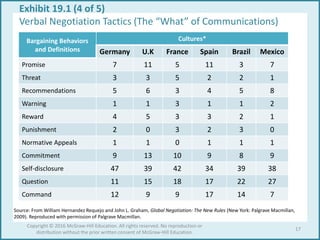
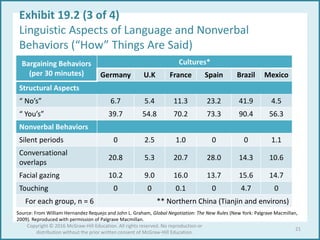
 The style of the French negotiators was perhaps the most
aggressive of all the groups. In particular, they used the
highest percentage of threats and warnings.
 The Brazilian businesspeople, like the French and Spanish,
were quite aggressive.
 The patterns of Mexican behavior in our negotiations are
good reminders of the dangers of regional or language-group
generalizations.
12
Copyright © 2016 McGraw-Hill Education. All rights reserved. No reproduction or
distribution without the prior written consent of McGraw-Hill Education.
Differences in Language and Nonverbal
Behaviors (5 of 5)
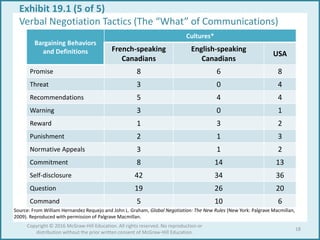
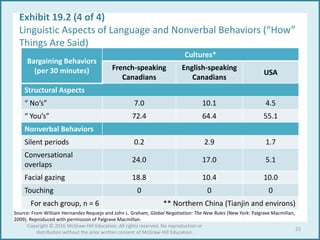
 Like the negotiators from France, French-speaking Canadians
too used high percentages of threats and warnings and even
more interruptions and eye contact.
 The Canadians who speak English as their first language used
the lowest percentage of aggressive persuasive tactics of all
15 groups.
 Like the Germans and the British, the Americans fell in the
middle of most continua. They did interrupt one another less
frequently than all the others, but that was their sole
distinction.
13
Copyright © 2016 McGraw-Hill Education. All rights reserved. No reproduction or
distribution without the prior written consent of McGraw-Hill Education.
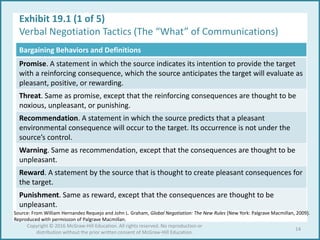
Exhibit 19.1 (1 of 5)
Verbal Negotiation Tactics (The “What” of Communications)
Source: From William Hernandez Requejo and John L. Graham, Global Negotiation: The New Rules (New York: Palgrave Macmillan, 2009).
Reproduced with permission of Palgrave Macmillan.
Bargaining Behaviors and Definitions
Promise. A statement in which the source indicates its intention to provide the target
with a reinforcing consequence, which the source anticipates the target will evaluate as
pleasant, positive, or rewarding.
Threat. Same as promise, except that the reinforcing consequences are thought to be
noxious, unpleasant, or punishing.
Recommendation. A statement in which the source predicts that a pleasant
environmental consequence will occur to the target. Its occurrence is not under the
source’s control.
Warning. Same as recommendation, except that the consequences are thought to be
unpleasant.
Reward. A statement by the source that is thought to create pleasant consequences for
the target.
Punishment. Same as reward, except that the consequences are thought to be
unpleasant.
14
Copyright © 2016 McGraw-Hill Education. All rights reserved. No reproduction or
distribution without the prior written consent of McGraw-Hill Education.
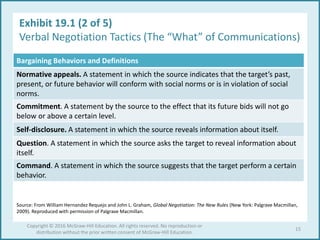
Exhibit 19.1 (2 of 5)
Verbal Negotiation Tactics (The “What” of Communications)
Source: From William Hernandez Requejo and John L. Graham, Global Negotiation: The New Rules (New York: Palgrave Macmillan,
2009). Reproduced with permission of Palgrave Macmillan.
Bargaining Behaviors and Definitions
Normative appeals. A statement in which the source indicates that the target’s past,
present, or future behavior will conform with social norms or is in violation of social
norms.
Commitment. A statement by the source to the effect that its future bids will not go
below or above a certain level.
Self-disclosure. A statement in which the source reveals information about itself.
Question. A statement in which the source asks the target to reveal information about
itself.
Command. A statement in which the source suggests that the target perform a certain
behavior.
15
Copyright © 2016 McGraw-Hill Education. All rights reserved. No reproduction or
distribution without the prior written consent of McGraw-Hill Education.
Exhibit 19.1 (3 of 5)
Verbal Negotiation Tactics (The “What” of Communications)
Bargaining Behaviors
and Definitions
Cultures*
Japan Korea Taiwan China** Russia Israel
Promise 7 † 4 9 6 5 12
Threat 4 2 2 1 3 4
Recommendations 7 1 5 2 4 8
Warning 2 0 3 1 0 1
Reward 1 3 2 1 3 2
Punishment 1 5 1 0 1 3
Normative Appeals 4 3 1 1 1 5
Commitment 15 13 9 10 1 10
Self-disclosure 34 36 42 36 40 30
Question 20 21 14 34 27 20
Command 8 13 11 7 7 9
Source: From William Hernandez Requejo and John L. Graham, Global Negotiation: The New Rules (New York: Palgrave Macmillan,
2009). Reproduced with permission of Palgrave Macmillan.
16
Copyright © 2016 McGraw-Hill Education. All rights reserved. No reproduction or
distribution without the prior written consent of McGraw-Hill Education.
Exhibit 19.1 (4 of 5)
Verbal Negotiation Tactics (The “What” of Communications)
Bargaining Behaviors
and Definitions
Cultures*
Germany U.K France Spain Brazil Mexico
Promise 7 11 5 11 3 7
Threat 3 3 5 2 2 1
Recommendations 5 6 3 4 5 8
Warning 1 1 3 1 1 2
Reward 4 5 3 3 2 1
Punishment 2 0 3 2 3 0
Normative Appeals 1 1 0 1 1 1
Commitment 9 13 10 9 8 9
Self-disclosure 47 39 42 34 39 38
Question 11 15 18 17 22 27
Command 12 9 9 17 14 7
Source: From William Hernandez Requejo and John L. Graham, Global Negotiation: The New Rules (New York: Palgrave Macmillan,
2009). Reproduced with permission of Palgrave Macmillan.
17
Copyright © 2016 McGraw-Hill Education. All rights reserved. No reproduction or
distribution without the prior written consent of McGraw-Hill Education.
Exhibit 19.1 (5 of 5)
Verbal Negotiation Tactics (The “What” of Communications)
Bargaining Behaviors
and Definitions
Cultures*
French-speaking
Canadians
English-speaking
Canadians
USA
Promise 8 6 8
Threat 3 0 4
Recommendations 5 4 4
Warning 3 0 1
Reward 1 3 2
Punishment 2 1 3
Normative Appeals 3 1 2
Commitment 8 14 13
Self-disclosure 42 34 36
Question 19 26 20
Command 5 10 6
Source: From William Hernandez Requejo and John L. Graham, Global Negotiation: The New Rules (New York: Palgrave Macmillan,
2009). Reproduced with permission of Palgrave Macmillan.
18
Copyright © 2016 McGraw-Hill Education. All rights reserved. No reproduction or
distribution without the prior written consent of McGraw-Hill Education.
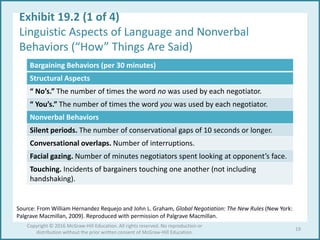
Exhibit 19.2 (1 of 4)
Linguistic Aspects of Language and Nonverbal
Behaviors (“How” Things Are Said)
Bargaining Behaviors (per 30 minutes)
Structural Aspects
“ No’s.” The number of times the word no was used by each negotiator.
“ You’s.” The number of times the word you was used by each negotiator.
Nonverbal Behaviors
Silent periods. The number of conservational gaps of 10 seconds or longer.
Conversational overlaps. Number of interruptions.
Facial gazing. Number of minutes negotiators spent looking at opponent’s face.
Touching. Incidents of bargainers touching one another (not including
handshaking).
Source: From William Hernandez Requejo and John L. Graham, Global Negotiation: The New Rules (New York:
Palgrave Macmillan, 2009). Reproduced with permission of Palgrave Macmillan.
19
Copyright © 2016 McGraw-Hill Education. All rights reserved. No reproduction or
distribution without the prior written consent of McGraw-Hill Education.
Exhibit 19.2 (2 of 4)
Linguistic Aspects of Language and Nonverbal
Behaviors (“How” Things Are Said)
Source: From William Hernandez Requejo and John L. Graham, Global Negotiation: The New Rules (New York: Palgrave Macmillan,
2009). Reproduced with permission of Palgrave Macmillan.
Bargaining Behaviors
(per 30 minutes)
Cultures*
Japan Korea Taiwan China** Russia Israel
Structural Aspects
“ No’s” 1.9 7.4 5.9 1.5 2.3 8.5
“ You’s” 31.5 35.2 36.6 26.8 23.6 64.4
Nonverbal Behaviors
Silent periods 2.5 0 0 2.3 3.7 1.9
Conversational
overlaps
6.2 22.0 12.3 17.1 13.3 30.1
Facial gazing 3.9 9.9 19.7 11.1 8.7 15.3
Touching 0 0 0 0 0 0
For each group, n = 6 ** Northern China (Tianjin and environs)
20
Copyright © 2016 McGraw-Hill Education. All rights reserved. No reproduction or
distribution without the prior written consent of McGraw-Hill Education.
Exhibit 19.2 (3 of 4)
Linguistic Aspects of Language and Nonverbal
Behaviors (“How” Things Are Said)
Source: From William Hernandez Requejo and John L. Graham, Global Negotiation: The New Rules (New York: Palgrave Macmillan,
2009). Reproduced with permission of Palgrave Macmillan.
Bargaining Behaviors
(per 30 minutes)
Cultures*
Germany U.K France Spain Brazil Mexico
Structural Aspects
“ No’s” 6.7 5.4 11.3 23.2 41.9 4.5
“ You’s” 39.7 54.8 70.2 73.3 90.4 56.3
Nonverbal Behaviors
Silent periods 0 2.5 1.0 0 0 1.1
Conversational
overlaps
20.8 5.3 20.7 28.0 14.3 10.6
Facial gazing 10.2 9.0 16.0 13.7 15.6 14.7
Touching 0 0 0.1 0 4.7 0
For each group, n = 6 ** Northern China (Tianjin and environs)
21
Copyright © 2016 McGraw-Hill Education. All rights reserved. No reproduction or
distribution without the prior written consent of McGraw-Hill Education.
Exhibit 19.2 (4 of 4)
Linguistic Aspects of Language and Nonverbal Behaviors (“How”
Things Are Said)
Source: From William Hernandez Requejo and John L. Graham, Global Negotiation: The New Rules (New York: Palgrave Macmillan,
2009). Reproduced with permission of Palgrave Macmillan.
Bargaining Behaviors
(per 30 minutes)
Cultures*
French-speaking
Canadians
English-speaking
Canadians
USA
Structural Aspects
“ No’s” 7.0 10.1 4.5
“ You’s” 72.4 64.4 55.1
Nonverbal Behaviors
Silent periods 0.2 2.9 1.7
Conversational
overlaps
24.0 17.0 5.1
Facial gazing 18.8 10.4 10.0
Touching 0 0 0
For each group, n = 6 ** Northern China (Tianjin and environs)
22
Copyright © 2016 McGraw-Hill Education. All rights reserved. No reproduction or
distribution without the prior written consent of McGraw-Hill Education.
Differences in Values
 Four values held strongly and deeply by most
Americans seem to frequently cause misunderstandings
and bad feelings in international business negotiations:
• Objectivity—reflects the importance of objectivity in the
American culture
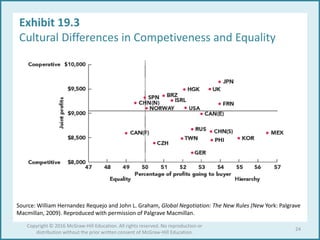
• Competitiveness and equality—values of each participating
cultural group are roughly reflected in the economic outcomes
• Punctuality—passage of time is viewed differently across
cultures and how these differences most often hurt Americans
23
Copyright © 2016 McGraw-Hill Education. All rights reserved. No reproduction or
distribution without the prior written consent of McGraw-Hill Education.
Exhibit 19.3
Cultural Differences in Competiveness and Equality
Source: William Hernandez Requejo and John L. Graham, Global Negotiation: The New Rules (New York: Palgrave
Macmillan, 2009). Reproduced with permission of Palgrave Macmillan.
24
Copyright © 2016 McGraw-Hill Education. All rights reserved. No reproduction or
distribution without the prior written consent of McGraw-Hill Education.
Differences in Thinking and
Decision-Making Processes (1 of 3)
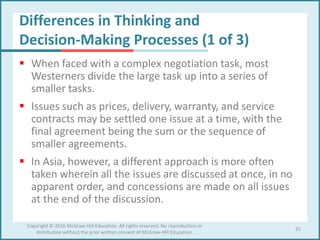
 When faced with a complex negotiation task, most
Westerners divide the large task up into a series of
smaller tasks.
 Issues such as prices, delivery, warranty, and service
contracts may be settled one issue at a time, with the
final agreement being the sum or the sequence of
smaller agreements.
 In Asia, however, a different approach is more often
taken wherein all the issues are discussed at once, in no
apparent order, and concessions are made on all issues
at the end of the discussion.
25
Copyright © 2016 McGraw-Hill Education. All rights reserved. No reproduction or
distribution without the prior written consent of McGraw-Hill Education.
Differences in Thinking and
Decision-Making Processes (2 of 3)
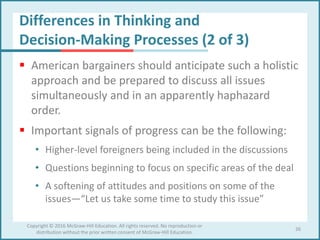
 American bargainers should anticipate such a holistic
approach and be prepared to discuss all issues
simultaneously and in an apparently haphazard
order.
 Important signals of progress can be the following:
• Higher-level foreigners being included in the discussions
• Questions beginning to focus on specific areas of the deal
• A softening of attitudes and positions on some of the
issues—“Let us take some time to study this issue”
26
Copyright © 2016 McGraw-Hill Education. All rights reserved. No reproduction or
distribution without the prior written consent of McGraw-Hill Education.
Differences in Thinking and
Decision-Making Processes (3 of 3)
• At the negotiation table, increased talk among themselves
in their own language, which may often mean they’re
trying to decide something
• Increased bargaining and use of the lower-level, informal,
and other channels of communication
27
Copyright © 2016 McGraw-Hill Education. All rights reserved. No reproduction or
distribution without the prior written consent of McGraw-Hill Education.
Implications for Managers
and Negotiators
 Four steps lead to more efficient and effective
international business negotiations:
1. selection of the appropriate negotiation team
2. management of preliminaries including training,
preparations, and manipulation of negotiation settings
3. management of the process of negotiations, that is, what
happens at the negotiation table
4. appropriate follow-up procedures and practices
28
Copyright © 2016 McGraw-Hill Education. All rights reserved. No reproduction or
distribution without the prior written consent of McGraw-Hill Education.
Negotiation Teams
 One reason for global business successes is the large
numbers of skillful international negotiators.
 More business schools are beginning to reemphasize
language training and visits abroad.
 Willingness to use team assistance is particularly
important for American negotiators.
 The single most important activity of negotiations is
listening.
 Gender should not be used as a selection criterion for
international negotiation teams, despite the great
differences in the roles of women across cultures.
29
Copyright © 2016 McGraw-Hill Education. All rights reserved. No reproduction or
distribution without the prior written consent of McGraw-Hill Education.
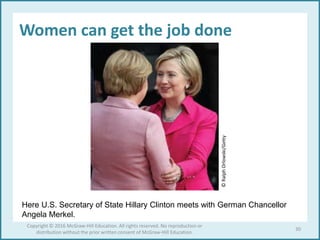
Women can get the job done
Here U.S. Secretary of State Hillary Clinton meets with German Chancellor
Angela Merkel.
©RalphOrlowski/Getty
30
Copyright © 2016 McGraw-Hill Education. All rights reserved. No reproduction or
distribution without the prior written consent of McGraw-Hill Education.
Negotiation Preliminaries (1 of 2)
 Many companies in the United States provide
employees with negotiations training.
 However, very few companies provide training for
negotiations with managers from other countries.
 Negotiators need information specific to the cultures
in which they work.
 Any experienced business negotiator will tell you
that there is never enough time to get ready.
31
Copyright © 2016 McGraw-Hill Education. All rights reserved. No reproduction or
distribution without the prior written consent of McGraw-Hill Education.
Negotiation Preliminaries (2 of 2)
 We recommend the following checklist to ensure
proper preparation and planning for international
negotiations:
1. Assessment of the situation and the people
2. Facts to confirm during the negotiation
3. Agenda
4. Best alternative to a negotiated agreement (BATNA)
5. Concession strategies
6. Team assignments
32
Copyright © 2016 McGraw-Hill Education. All rights reserved. No reproduction or
distribution without the prior written consent of McGraw-Hill Education.
Chester Karrass’ Spanish advertisement
UsedbypermissionofKARRASS,LTD.BeverlyHills,CA. 33
Copyright © 2016 McGraw-Hill Education. All rights reserved. No reproduction or
distribution without the prior written consent of McGraw-Hill Education.
1
2
3
4
5
6
7
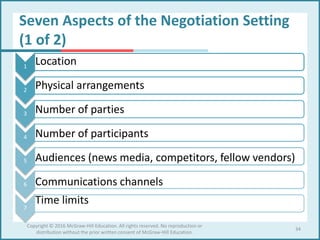
Seven Aspects of the Negotiation Setting
(1 of 2)
Location
Physical arrangements
Number of parties
Number of participants
Audiences (news media, competitors, fellow vendors)
Communications channels
Time limits
34
Copyright © 2016 McGraw-Hill Education. All rights reserved. No reproduction or
distribution without the prior written consent of McGraw-Hill Education.
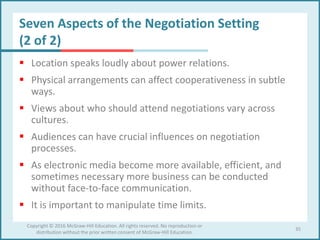
Seven Aspects of the Negotiation Setting
(2 of 2)
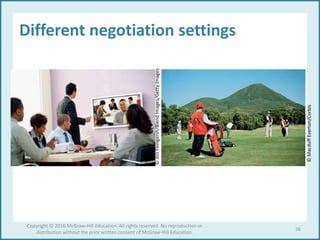
 Location speaks loudly about power relations.
 Physical arrangements can affect cooperativeness in subtle
ways.
 Views about who should attend negotiations vary across
cultures.
 Audiences can have crucial influences on negotiation
processes.
 As electronic media become more available, efficient, and
sometimes necessary more business can be conducted
without face-to-face communication.
 It is important to manipulate time limits.
35
Copyright © 2016 McGraw-Hill Education. All rights reserved. No reproduction or
distribution without the prior written consent of McGraw-Hill Education.
Different negotiation settings
©JonFeingersh/BlendImages/GettyImages
©MacduffEverton/Corbis
36
Copyright © 2016 McGraw-Hill Education. All rights reserved. No reproduction or
distribution without the prior written consent of McGraw-Hill Education.
At the Negotiations Table
 Going into a business negotiation, most people have
expectations about the “proper” or normal process
of such a meeting—the ritual, so to speak.
 Everywhere around the world we have found that
business negotiations proceed through four stages:
• Nontask sounding
• Task-related exchange of information
• Persuasion
• Concessions and agreement
37
Copyright © 2016 McGraw-Hill Education. All rights reserved. No reproduction or
distribution without the prior written consent of McGraw-Hill Education.
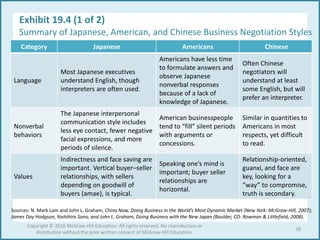
Exhibit 19.4 (1 of 2)
Summary of Japanese, American, and Chinese Business Negotiation Styles
Category Japanese Americans Chinese
Language
Most Japanese executives
understand English, though
interpreters are often used.
Americans have less time
to formulate answers and
observe Japanese
nonverbal responses
because of a lack of
knowledge of Japanese.
Often Chinese
negotiators will
understand at least
some English, but will
prefer an interpreter.
Nonverbal
behaviors
The Japanese interpersonal
communication style includes
less eye contact, fewer negative
facial expressions, and more
periods of silence.
American businesspeople
tend to “fill” silent periods
with arguments or
concessions.
Similar in quantities to
Americans in most
respects, yet difficult
to read.
Values
Indirectness and face saving are
important. Vertical buyer–seller
relationships, with sellers
depending on goodwill of
buyers (amae), is typical.
Speaking one’s mind is
important; buyer seller
relationships are
horizontal.
Relationship-oriented,
guanxi, and face are
key, looking for a
“way” to compromise,
truth is secondary.
Sources: N. Mark Lam and John L. Graham, China Now, Doing Business in the World’s Most Dynamic Market (New York: McGraw-Hill, 2007);
James Day Hodgson, Yoshihiro Sano, and John L. Graham, Doing Business with the New Japan (Boulder, CO: Rowman & Littlefield, 2008).
38
Copyright © 2016 McGraw-Hill Education. All rights reserved. No reproduction or
distribution without the prior written consent of McGraw-Hill Education.
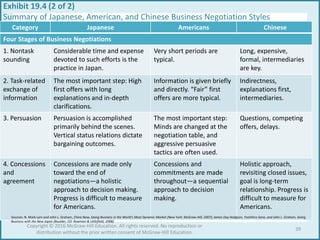
Exhibit 19.4 (2 of 2)
Summary of Japanese, American, and Chinese Business Negotiation Styles
Category Japanese Americans Chinese
Four Stages of Business Negotiations
1. Nontask
sounding
Considerable time and expense
devoted to such efforts is the
practice in Japan.
Very short periods are
typical.
Long, expensive,
formal, intermediaries
are key.
2. Task-related
exchange of
information
The most important step: High
first offers with long
explanations and in-depth
clarifications.
Information is given briefly
and directly. “Fair” first
offers are more typical.
Indirectness,
explanations first,
intermediaries.
3. Persuasion Persuasion is accomplished
primarily behind the scenes.
Vertical status relations dictate
bargaining outcomes.
The most important step:
Minds are changed at the
negotiation table, and
aggressive persuasive
tactics are often used.
Questions, competing
offers, delays.
4. Concessions
and
agreement
Concessions are made only
toward the end of
negotiations—a holistic
approach to decision making.
Progress is difficult to measure
for Americans.
Concessions and
commitments are made
throughout—a sequential
approach to decision
making.
Holistic approach,
revisiting closed issues,
goal is long-term
relationship. Progress is
difficult to measure for
Americans.
Sources: N. Mark Lam and John L. Graham, China Now, Doing Business in the World’s Most Dynamic Market (New York: McGraw-Hill, 2007); James Day Hodgson, Yoshihiro Sano, and John L. Graham, Doing
Business with the New Japan (Boulder, CO: Rowman & Littlefield, 2008).
39
Copyright © 2016 McGraw-Hill Education. All rights reserved. No reproduction or
distribution without the prior written consent of McGraw-Hill Education.
Nontask Sounding
 Americans always discuss topics other than business at the
negotiation table (e.g., the weather, family, sports, politics,
business conditions in general) but not for long.
 Such preliminary talk, known as nontask sounding, is much
more than just friendly or polite; it helps negotiators learn
how the other side feels that particular day.
 Learning about a client’s background and interests also
provides important cues about appropriate communication
styles.
40
Copyright © 2016 McGraw-Hill Education. All rights reserved. No reproduction or
distribution without the prior written consent of McGraw-Hill Education.
Task-Related Exchange of Information
 A task-related information exchange implies a two-
way communication process.
 An excellent negotiation tactic is to “drain”
information from one’s negotiation counterparts.
 Exchanging information across language barriers can
be quite difficult as well.
 In many cultures, negative feedback is very difficult
to obtain.
 Aggressive first offers made by foreigners should be
met with questions, not anger.
41
Copyright © 2016 McGraw-Hill Education. All rights reserved. No reproduction or
distribution without the prior written consent of McGraw-Hill Education.
Persuasion
 In Japan, a clear separation does not exist between
task-related information exchange and persuasion.
 A key aspect of sales training in the United States is
“handling objections.”
 The most powerful persuasive tactic is actually asking
more questions.
 Third parties and informal channels of
communication are the indispensable media of
persuasion in many countries, particularly the more
relationship-oriented ones.
42
Copyright © 2016 McGraw-Hill Education. All rights reserved. No reproduction or
distribution without the prior written consent of McGraw-Hill Education.
Negotiation skills
©JohnGraham
43
Copyright © 2016 McGraw-Hill Education. All rights reserved. No reproduction or
distribution without the prior written consent of McGraw-Hill Education.
Concessions and Agreement
 Americans often make concessions early, expecting
foreign counterparts to reciprocate.
 However, in many cultures no concessions are made
until the end of the negotiations.
 Americans often get frustrated and express anger
when foreign clients and partners are simply
following a different approach to concession making,
one that can also work quite well when both sides
understand what is going on.
44
Copyright © 2016 McGraw-Hill Education. All rights reserved. No reproduction or
distribution without the prior written consent of McGraw-Hill Education.
After Negotiations
 In most other countries, particularly the relationship-oriented ones,
legal systems are not depended upon to settle disputes.
 Indeed, the term disputes does not reflect how a business
relationship should work.
 Each side should be concerned about mutual benefits of the
relationship and therefore should consider the interests of the
other.
 Consequently, in places like Japan written contracts are very short—
two to three pages—are purposely loosely written, and primarily
contain comments on principles of the relationship.
 Follow-up communications are an important part of business
negotiations with partners and clients from most foreign countries.
45
Copyright © 2016 McGraw-Hill Education. All rights reserved. No reproduction or
distribution without the prior written consent of McGraw-Hill Education.
Tung Chee Hwa with Mickey Mouse
©AnatGivon/APImages
46
Copyright © 2016 McGraw-Hill Education. All rights reserved. No reproduction or
distribution without the prior written consent of McGraw-Hill Education.
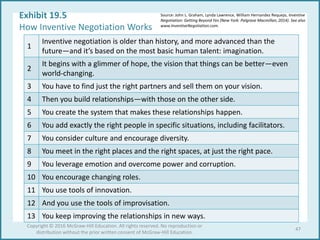
Exhibit 19.5
How Inventive Negotiation Works
1
Inventive negotiation is older than history, and more advanced than the
future—and it’s based on the most basic human talent: imagination.
2
It begins with a glimmer of hope, the vision that things can be better—even
world-changing.
3 You have to find just the right partners and sell them on your vision.
4 Then you build relationships—with those on the other side.
5 You create the system that makes these relationships happen.
6 You add exactly the right people in specific situations, including facilitators.
7 You consider culture and encourage diversity.
8 You meet in the right places and the right spaces, at just the right pace.
9 You leverage emotion and overcome power and corruption.
10 You encourage changing roles.
11 You use tools of innovation.
12 And you use the tools of improvisation.
13 You keep improving the relationships in new ways.
Source: John L. Graham, Lynda Lawrence, William Hernandez Requejo, Inventive
Negotiation: Getting Beyond Yes (New York: Palgrave Macmillan, 2014). See also
www.InventiveNegotiation.com.
47
Copyright © 2016 McGraw-Hill Education. All rights reserved. No reproduction or
distribution without the prior written consent of McGraw-Hill Education.
Conclusions
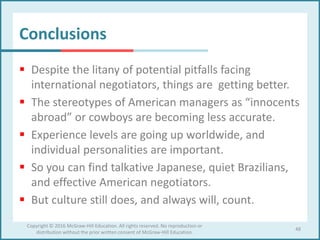
 Despite the litany of potential pitfalls facing
international negotiators, things are getting better.
 The stereotypes of American managers as “innocents
abroad” or cowboys are becoming less accurate.
 Experience levels are going up worldwide, and
individual personalities are important.
 So you can find talkative Japanese, quiet Brazilians,
and effective American negotiators.
 But culture still does, and always will, count.
48
Copyright © 2016 McGraw-Hill Education. All rights reserved. No reproduction or
distribution without the prior written consent of McGraw-Hill Education.
Summary
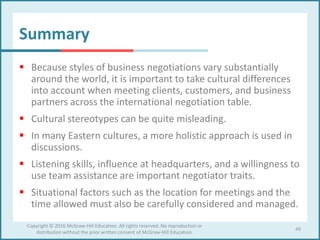
 Because styles of business negotiations vary substantially
around the world, it is important to take cultural differences
into account when meeting clients, customers, and business
partners across the international negotiation table.
 Cultural stereotypes can be quite misleading.
 In many Eastern cultures, a more holistic approach is used in
discussions.
 Listening skills, influence at headquarters, and a willingness to
use team assistance are important negotiator traits.
 Situational factors such as the location for meetings and the
time allowed must also be carefully considered and managed.
49
Copyright © 2016 McGraw-Hill Education. All rights reserved. No reproduction or
distribution without the prior written consent of McGraw-Hill Education.

Chapter 19 PowerPoint

  • 1.
    Chapter 19 Inventive Negotiations withInternational Customers, Partners, and Regulators Copyright © 2016 McGraw-Hill Education. All rights reserved. No reproduction or distribution without the prior written consent of McGraw-Hill Education.
  • 2.
    Learning Objectives (1of 2) LO1 The problems associated with cultural stereotypes LO2 How culture influences behaviors at the negotiation table LO3 Common kinds of problems that crop up during international business negotiations LO4 The similarities and differences in communication behaviors in several countries LO5 How differences in values and thinking processes affect international negotiations 2 Copyright © 2016 McGraw-Hill Education. All rights reserved. No reproduction or distribution without the prior written consent of McGraw-Hill Education.
  • 3.
    Learning Objectives (2of 2) LO6 Important factors in selecting a negotiation team LO7 How to prepare for international negotiations LO8 Managing all aspects of the negotiation process LO9 The importance of follow-up communications and procedures LO10 The basics of inventive international negotiations 3 Copyright © 2016 McGraw-Hill Education. All rights reserved. No reproduction or distribution without the prior written consent of McGraw-Hill Education.
  • 4.
    International Negotiations  Face-to-facenegotiations are an omnipresent activity in international commerce  Plans are usually implemented through face-to-face negotiations with business partners and customers from foreign countries  Executives must also negotiate with representatives of foreign governments  In many countries, governmental officials may also be joint venture partners and, in some cases, vendors 4 Copyright © 2016 McGraw-Hill Education. All rights reserved. No reproduction or distribution without the prior written consent of McGraw-Hill Education.
  • 5.
    The Dangers ofStereotypes  Negotiations are not conducted between national stereotypes; negotiations are conducted between people, and cultural factors often make huge differences  For example, we might expect substantial differences in negotiation styles between English-speaking and French- speaking Canadians  In addition to the influence of culture, individual personalities and backgrounds and a variety of situational factors also heavily influence behavior at the negotiation table. 5 Copyright © 2016 McGraw-Hill Education. All rights reserved. No reproduction or distribution without the prior written consent of McGraw-Hill Education.
  • 6.
    European Stereotypes 6 Copyright ©2016 McGraw-Hill Education. All rights reserved. No reproduction or distribution without the prior written consent of McGraw-Hill Education.
  • 7.
    The Pervasive Impactof Culture on Negotiation Behavior (1 of 2)  Looking broadly across the several cultures, two important lessons stand out: • Regional generalizations very often are not correct. For example, Japanese and Korean negotiation styles are quite similar in some ways, but in other ways, they could not be more different. • Japan is an exceptional place: On almost every dimension of negotiation style considered, the Japanese are on or near the end of the scale (high). 7 Copyright © 2016 McGraw-Hill Education. All rights reserved. No reproduction or distribution without the prior written consent of McGraw-Hill Education.
  • 8.
    The Pervasive Impactof Culture on Negotiation Behavior (2 of 2)  Cultural differences cause four kinds of problems in international business negotiations at the levels of: 1. Language 2. Nonverbal behaviors 3. Values 4. Thinking and decision-making processes 8 Copyright © 2016 McGraw-Hill Education. All rights reserved. No reproduction or distribution without the prior written consent of McGraw-Hill Education.
  • 9.
    Differences in Languageand Nonverbal Behaviors (1 of 5)  The variation across cultures is greater when comparing linguistic aspects of language and nonverbal behaviors than when the verbal content of negotiations is considered.  The language advantages of the Japanese executive in the description of the aisatsu that opened the chapter were quite clear.  However, the most common complaint heard from American managers regards foreign clients and partners breaking into side conversations in their native languages.  This perception is a frequent American mistake. The usual purpose of such side conversations is to straighten out a translation problem. 9 Copyright © 2016 McGraw-Hill Education. All rights reserved. No reproduction or distribution without the prior written consent of McGraw-Hill Education.
  • 10.
    Differences in Languageand Nonverbal Behaviors (2 of 5)  Consistent with most descriptions of Japanese negotiation behavior, the results of this analysis suggest their style of interaction is among the least aggressive (or most polite).  Korean negotiators used considerably more punishments and commands than did the Japanese.  The behaviors of the negotiators from northern China were most remarkable in the emphasis on asking questions (34 percent).  The behavior of the businesspeople in Taiwan was quite different from that in China and Japan but similar to that in Korea. 10 Copyright © 2016 McGraw-Hill Education. All rights reserved. No reproduction or distribution without the prior written consent of McGraw-Hill Education.
  • 11.
    Differences in Languageand Nonverbal Behaviors (3 of 5)  The Russians’ style was quite different from that of any other European group, and, indeed, was quite similar in many respects to the style of the Japanese.  The Israeli negotiators interrupted one another much more frequently than negotiators from any other group.  The behaviors of the Germans are difficult to characterize because they fell toward the center of almost all the continua.  The behaviors of the British negotiators were remarkably similar to those of the Americans in all respects. 11 Copyright © 2016 McGraw-Hill Education. All rights reserved. No reproduction or distribution without the prior written consent of McGraw-Hill Education.
  • 12.
    Differences in Languageand Nonverbal Behaviors (4 of 5)  Diga is perhaps a good metaphor for the Spanish approach to negotiations evinced in our data. When you make a phone call in Madrid, the usual greeting on the other end is not hola (“hello”) but instead diga (“speak”).  The style of the French negotiators was perhaps the most aggressive of all the groups. In particular, they used the highest percentage of threats and warnings.  The Brazilian businesspeople, like the French and Spanish, were quite aggressive.  The patterns of Mexican behavior in our negotiations are good reminders of the dangers of regional or language-group generalizations. 12 Copyright © 2016 McGraw-Hill Education. All rights reserved. No reproduction or distribution without the prior written consent of McGraw-Hill Education.
  • 13.
    Differences in Languageand Nonverbal Behaviors (5 of 5)  Like the negotiators from France, French-speaking Canadians too used high percentages of threats and warnings and even more interruptions and eye contact.  The Canadians who speak English as their first language used the lowest percentage of aggressive persuasive tactics of all 15 groups.  Like the Germans and the British, the Americans fell in the middle of most continua. They did interrupt one another less frequently than all the others, but that was their sole distinction. 13 Copyright © 2016 McGraw-Hill Education. All rights reserved. No reproduction or distribution without the prior written consent of McGraw-Hill Education.
  • 14.
    Exhibit 19.1 (1of 5) Verbal Negotiation Tactics (The “What” of Communications) Source: From William Hernandez Requejo and John L. Graham, Global Negotiation: The New Rules (New York: Palgrave Macmillan, 2009). Reproduced with permission of Palgrave Macmillan. Bargaining Behaviors and Definitions Promise. A statement in which the source indicates its intention to provide the target with a reinforcing consequence, which the source anticipates the target will evaluate as pleasant, positive, or rewarding. Threat. Same as promise, except that the reinforcing consequences are thought to be noxious, unpleasant, or punishing. Recommendation. A statement in which the source predicts that a pleasant environmental consequence will occur to the target. Its occurrence is not under the source’s control. Warning. Same as recommendation, except that the consequences are thought to be unpleasant. Reward. A statement by the source that is thought to create pleasant consequences for the target. Punishment. Same as reward, except that the consequences are thought to be unpleasant. 14 Copyright © 2016 McGraw-Hill Education. All rights reserved. No reproduction or distribution without the prior written consent of McGraw-Hill Education.
  • 15.
    Exhibit 19.1 (2of 5) Verbal Negotiation Tactics (The “What” of Communications) Source: From William Hernandez Requejo and John L. Graham, Global Negotiation: The New Rules (New York: Palgrave Macmillan, 2009). Reproduced with permission of Palgrave Macmillan. Bargaining Behaviors and Definitions Normative appeals. A statement in which the source indicates that the target’s past, present, or future behavior will conform with social norms or is in violation of social norms. Commitment. A statement by the source to the effect that its future bids will not go below or above a certain level. Self-disclosure. A statement in which the source reveals information about itself. Question. A statement in which the source asks the target to reveal information about itself. Command. A statement in which the source suggests that the target perform a certain behavior. 15 Copyright © 2016 McGraw-Hill Education. All rights reserved. No reproduction or distribution without the prior written consent of McGraw-Hill Education.
  • 16.
    Exhibit 19.1 (3of 5) Verbal Negotiation Tactics (The “What” of Communications) Bargaining Behaviors and Definitions Cultures* Japan Korea Taiwan China** Russia Israel Promise 7 † 4 9 6 5 12 Threat 4 2 2 1 3 4 Recommendations 7 1 5 2 4 8 Warning 2 0 3 1 0 1 Reward 1 3 2 1 3 2 Punishment 1 5 1 0 1 3 Normative Appeals 4 3 1 1 1 5 Commitment 15 13 9 10 1 10 Self-disclosure 34 36 42 36 40 30 Question 20 21 14 34 27 20 Command 8 13 11 7 7 9 Source: From William Hernandez Requejo and John L. Graham, Global Negotiation: The New Rules (New York: Palgrave Macmillan, 2009). Reproduced with permission of Palgrave Macmillan. 16 Copyright © 2016 McGraw-Hill Education. All rights reserved. No reproduction or distribution without the prior written consent of McGraw-Hill Education.
  • 17.
    Exhibit 19.1 (4of 5) Verbal Negotiation Tactics (The “What” of Communications) Bargaining Behaviors and Definitions Cultures* Germany U.K France Spain Brazil Mexico Promise 7 11 5 11 3 7 Threat 3 3 5 2 2 1 Recommendations 5 6 3 4 5 8 Warning 1 1 3 1 1 2 Reward 4 5 3 3 2 1 Punishment 2 0 3 2 3 0 Normative Appeals 1 1 0 1 1 1 Commitment 9 13 10 9 8 9 Self-disclosure 47 39 42 34 39 38 Question 11 15 18 17 22 27 Command 12 9 9 17 14 7 Source: From William Hernandez Requejo and John L. Graham, Global Negotiation: The New Rules (New York: Palgrave Macmillan, 2009). Reproduced with permission of Palgrave Macmillan. 17 Copyright © 2016 McGraw-Hill Education. All rights reserved. No reproduction or distribution without the prior written consent of McGraw-Hill Education.
  • 18.
    Exhibit 19.1 (5of 5) Verbal Negotiation Tactics (The “What” of Communications) Bargaining Behaviors and Definitions Cultures* French-speaking Canadians English-speaking Canadians USA Promise 8 6 8 Threat 3 0 4 Recommendations 5 4 4 Warning 3 0 1 Reward 1 3 2 Punishment 2 1 3 Normative Appeals 3 1 2 Commitment 8 14 13 Self-disclosure 42 34 36 Question 19 26 20 Command 5 10 6 Source: From William Hernandez Requejo and John L. Graham, Global Negotiation: The New Rules (New York: Palgrave Macmillan, 2009). Reproduced with permission of Palgrave Macmillan. 18 Copyright © 2016 McGraw-Hill Education. All rights reserved. No reproduction or distribution without the prior written consent of McGraw-Hill Education.
  • 19.
    Exhibit 19.2 (1of 4) Linguistic Aspects of Language and Nonverbal Behaviors (“How” Things Are Said) Bargaining Behaviors (per 30 minutes) Structural Aspects “ No’s.” The number of times the word no was used by each negotiator. “ You’s.” The number of times the word you was used by each negotiator. Nonverbal Behaviors Silent periods. The number of conservational gaps of 10 seconds or longer. Conversational overlaps. Number of interruptions. Facial gazing. Number of minutes negotiators spent looking at opponent’s face. Touching. Incidents of bargainers touching one another (not including handshaking). Source: From William Hernandez Requejo and John L. Graham, Global Negotiation: The New Rules (New York: Palgrave Macmillan, 2009). Reproduced with permission of Palgrave Macmillan. 19 Copyright © 2016 McGraw-Hill Education. All rights reserved. No reproduction or distribution without the prior written consent of McGraw-Hill Education.
  • 20.
    Exhibit 19.2 (2of 4) Linguistic Aspects of Language and Nonverbal Behaviors (“How” Things Are Said) Source: From William Hernandez Requejo and John L. Graham, Global Negotiation: The New Rules (New York: Palgrave Macmillan, 2009). Reproduced with permission of Palgrave Macmillan. Bargaining Behaviors (per 30 minutes) Cultures* Japan Korea Taiwan China** Russia Israel Structural Aspects “ No’s” 1.9 7.4 5.9 1.5 2.3 8.5 “ You’s” 31.5 35.2 36.6 26.8 23.6 64.4 Nonverbal Behaviors Silent periods 2.5 0 0 2.3 3.7 1.9 Conversational overlaps 6.2 22.0 12.3 17.1 13.3 30.1 Facial gazing 3.9 9.9 19.7 11.1 8.7 15.3 Touching 0 0 0 0 0 0 For each group, n = 6 ** Northern China (Tianjin and environs) 20 Copyright © 2016 McGraw-Hill Education. All rights reserved. No reproduction or distribution without the prior written consent of McGraw-Hill Education.
  • 21.
    Exhibit 19.2 (3of 4) Linguistic Aspects of Language and Nonverbal Behaviors (“How” Things Are Said) Source: From William Hernandez Requejo and John L. Graham, Global Negotiation: The New Rules (New York: Palgrave Macmillan, 2009). Reproduced with permission of Palgrave Macmillan. Bargaining Behaviors (per 30 minutes) Cultures* Germany U.K France Spain Brazil Mexico Structural Aspects “ No’s” 6.7 5.4 11.3 23.2 41.9 4.5 “ You’s” 39.7 54.8 70.2 73.3 90.4 56.3 Nonverbal Behaviors Silent periods 0 2.5 1.0 0 0 1.1 Conversational overlaps 20.8 5.3 20.7 28.0 14.3 10.6 Facial gazing 10.2 9.0 16.0 13.7 15.6 14.7 Touching 0 0 0.1 0 4.7 0 For each group, n = 6 ** Northern China (Tianjin and environs) 21 Copyright © 2016 McGraw-Hill Education. All rights reserved. No reproduction or distribution without the prior written consent of McGraw-Hill Education.
  • 22.
    Exhibit 19.2 (4of 4) Linguistic Aspects of Language and Nonverbal Behaviors (“How” Things Are Said) Source: From William Hernandez Requejo and John L. Graham, Global Negotiation: The New Rules (New York: Palgrave Macmillan, 2009). Reproduced with permission of Palgrave Macmillan. Bargaining Behaviors (per 30 minutes) Cultures* French-speaking Canadians English-speaking Canadians USA Structural Aspects “ No’s” 7.0 10.1 4.5 “ You’s” 72.4 64.4 55.1 Nonverbal Behaviors Silent periods 0.2 2.9 1.7 Conversational overlaps 24.0 17.0 5.1 Facial gazing 18.8 10.4 10.0 Touching 0 0 0 For each group, n = 6 ** Northern China (Tianjin and environs) 22 Copyright © 2016 McGraw-Hill Education. All rights reserved. No reproduction or distribution without the prior written consent of McGraw-Hill Education.
  • 23.
    Differences in Values Four values held strongly and deeply by most Americans seem to frequently cause misunderstandings and bad feelings in international business negotiations: • Objectivity—reflects the importance of objectivity in the American culture • Competitiveness and equality—values of each participating cultural group are roughly reflected in the economic outcomes • Punctuality—passage of time is viewed differently across cultures and how these differences most often hurt Americans 23 Copyright © 2016 McGraw-Hill Education. All rights reserved. No reproduction or distribution without the prior written consent of McGraw-Hill Education.
  • 24.
    Exhibit 19.3 Cultural Differencesin Competiveness and Equality Source: William Hernandez Requejo and John L. Graham, Global Negotiation: The New Rules (New York: Palgrave Macmillan, 2009). Reproduced with permission of Palgrave Macmillan. 24 Copyright © 2016 McGraw-Hill Education. All rights reserved. No reproduction or distribution without the prior written consent of McGraw-Hill Education.
  • 25.
    Differences in Thinkingand Decision-Making Processes (1 of 3)  When faced with a complex negotiation task, most Westerners divide the large task up into a series of smaller tasks.  Issues such as prices, delivery, warranty, and service contracts may be settled one issue at a time, with the final agreement being the sum or the sequence of smaller agreements.  In Asia, however, a different approach is more often taken wherein all the issues are discussed at once, in no apparent order, and concessions are made on all issues at the end of the discussion. 25 Copyright © 2016 McGraw-Hill Education. All rights reserved. No reproduction or distribution without the prior written consent of McGraw-Hill Education.
  • 26.
    Differences in Thinkingand Decision-Making Processes (2 of 3)  American bargainers should anticipate such a holistic approach and be prepared to discuss all issues simultaneously and in an apparently haphazard order.  Important signals of progress can be the following: • Higher-level foreigners being included in the discussions • Questions beginning to focus on specific areas of the deal • A softening of attitudes and positions on some of the issues—“Let us take some time to study this issue” 26 Copyright © 2016 McGraw-Hill Education. All rights reserved. No reproduction or distribution without the prior written consent of McGraw-Hill Education.
  • 27.
    Differences in Thinkingand Decision-Making Processes (3 of 3) • At the negotiation table, increased talk among themselves in their own language, which may often mean they’re trying to decide something • Increased bargaining and use of the lower-level, informal, and other channels of communication 27 Copyright © 2016 McGraw-Hill Education. All rights reserved. No reproduction or distribution without the prior written consent of McGraw-Hill Education.
  • 28.
    Implications for Managers andNegotiators  Four steps lead to more efficient and effective international business negotiations: 1. selection of the appropriate negotiation team 2. management of preliminaries including training, preparations, and manipulation of negotiation settings 3. management of the process of negotiations, that is, what happens at the negotiation table 4. appropriate follow-up procedures and practices 28 Copyright © 2016 McGraw-Hill Education. All rights reserved. No reproduction or distribution without the prior written consent of McGraw-Hill Education.
  • 29.
    Negotiation Teams  Onereason for global business successes is the large numbers of skillful international negotiators.  More business schools are beginning to reemphasize language training and visits abroad.  Willingness to use team assistance is particularly important for American negotiators.  The single most important activity of negotiations is listening.  Gender should not be used as a selection criterion for international negotiation teams, despite the great differences in the roles of women across cultures. 29 Copyright © 2016 McGraw-Hill Education. All rights reserved. No reproduction or distribution without the prior written consent of McGraw-Hill Education.
  • 30.
    Women can getthe job done Here U.S. Secretary of State Hillary Clinton meets with German Chancellor Angela Merkel. ©RalphOrlowski/Getty 30 Copyright © 2016 McGraw-Hill Education. All rights reserved. No reproduction or distribution without the prior written consent of McGraw-Hill Education.
  • 31.
    Negotiation Preliminaries (1of 2)  Many companies in the United States provide employees with negotiations training.  However, very few companies provide training for negotiations with managers from other countries.  Negotiators need information specific to the cultures in which they work.  Any experienced business negotiator will tell you that there is never enough time to get ready. 31 Copyright © 2016 McGraw-Hill Education. All rights reserved. No reproduction or distribution without the prior written consent of McGraw-Hill Education.
  • 32.
    Negotiation Preliminaries (2of 2)  We recommend the following checklist to ensure proper preparation and planning for international negotiations: 1. Assessment of the situation and the people 2. Facts to confirm during the negotiation 3. Agenda 4. Best alternative to a negotiated agreement (BATNA) 5. Concession strategies 6. Team assignments 32 Copyright © 2016 McGraw-Hill Education. All rights reserved. No reproduction or distribution without the prior written consent of McGraw-Hill Education.
  • 33.
    Chester Karrass’ Spanishadvertisement UsedbypermissionofKARRASS,LTD.BeverlyHills,CA. 33 Copyright © 2016 McGraw-Hill Education. All rights reserved. No reproduction or distribution without the prior written consent of McGraw-Hill Education.
  • 34.
    1 2 3 4 5 6 7 Seven Aspects ofthe Negotiation Setting (1 of 2) Location Physical arrangements Number of parties Number of participants Audiences (news media, competitors, fellow vendors) Communications channels Time limits 34 Copyright © 2016 McGraw-Hill Education. All rights reserved. No reproduction or distribution without the prior written consent of McGraw-Hill Education.
  • 35.
    Seven Aspects ofthe Negotiation Setting (2 of 2)  Location speaks loudly about power relations.  Physical arrangements can affect cooperativeness in subtle ways.  Views about who should attend negotiations vary across cultures.  Audiences can have crucial influences on negotiation processes.  As electronic media become more available, efficient, and sometimes necessary more business can be conducted without face-to-face communication.  It is important to manipulate time limits. 35 Copyright © 2016 McGraw-Hill Education. All rights reserved. No reproduction or distribution without the prior written consent of McGraw-Hill Education.
  • 36.
    Different negotiation settings ©JonFeingersh/BlendImages/GettyImages ©MacduffEverton/Corbis 36 Copyright© 2016 McGraw-Hill Education. All rights reserved. No reproduction or distribution without the prior written consent of McGraw-Hill Education.
  • 37.
    At the NegotiationsTable  Going into a business negotiation, most people have expectations about the “proper” or normal process of such a meeting—the ritual, so to speak.  Everywhere around the world we have found that business negotiations proceed through four stages: • Nontask sounding • Task-related exchange of information • Persuasion • Concessions and agreement 37 Copyright © 2016 McGraw-Hill Education. All rights reserved. No reproduction or distribution without the prior written consent of McGraw-Hill Education.
  • 38.
    Exhibit 19.4 (1of 2) Summary of Japanese, American, and Chinese Business Negotiation Styles Category Japanese Americans Chinese Language Most Japanese executives understand English, though interpreters are often used. Americans have less time to formulate answers and observe Japanese nonverbal responses because of a lack of knowledge of Japanese. Often Chinese negotiators will understand at least some English, but will prefer an interpreter. Nonverbal behaviors The Japanese interpersonal communication style includes less eye contact, fewer negative facial expressions, and more periods of silence. American businesspeople tend to “fill” silent periods with arguments or concessions. Similar in quantities to Americans in most respects, yet difficult to read. Values Indirectness and face saving are important. Vertical buyer–seller relationships, with sellers depending on goodwill of buyers (amae), is typical. Speaking one’s mind is important; buyer seller relationships are horizontal. Relationship-oriented, guanxi, and face are key, looking for a “way” to compromise, truth is secondary. Sources: N. Mark Lam and John L. Graham, China Now, Doing Business in the World’s Most Dynamic Market (New York: McGraw-Hill, 2007); James Day Hodgson, Yoshihiro Sano, and John L. Graham, Doing Business with the New Japan (Boulder, CO: Rowman & Littlefield, 2008). 38 Copyright © 2016 McGraw-Hill Education. All rights reserved. No reproduction or distribution without the prior written consent of McGraw-Hill Education.
  • 39.
    Exhibit 19.4 (2of 2) Summary of Japanese, American, and Chinese Business Negotiation Styles Category Japanese Americans Chinese Four Stages of Business Negotiations 1. Nontask sounding Considerable time and expense devoted to such efforts is the practice in Japan. Very short periods are typical. Long, expensive, formal, intermediaries are key. 2. Task-related exchange of information The most important step: High first offers with long explanations and in-depth clarifications. Information is given briefly and directly. “Fair” first offers are more typical. Indirectness, explanations first, intermediaries. 3. Persuasion Persuasion is accomplished primarily behind the scenes. Vertical status relations dictate bargaining outcomes. The most important step: Minds are changed at the negotiation table, and aggressive persuasive tactics are often used. Questions, competing offers, delays. 4. Concessions and agreement Concessions are made only toward the end of negotiations—a holistic approach to decision making. Progress is difficult to measure for Americans. Concessions and commitments are made throughout—a sequential approach to decision making. Holistic approach, revisiting closed issues, goal is long-term relationship. Progress is difficult to measure for Americans. Sources: N. Mark Lam and John L. Graham, China Now, Doing Business in the World’s Most Dynamic Market (New York: McGraw-Hill, 2007); James Day Hodgson, Yoshihiro Sano, and John L. Graham, Doing Business with the New Japan (Boulder, CO: Rowman & Littlefield, 2008). 39 Copyright © 2016 McGraw-Hill Education. All rights reserved. No reproduction or distribution without the prior written consent of McGraw-Hill Education.
  • 40.
    Nontask Sounding  Americansalways discuss topics other than business at the negotiation table (e.g., the weather, family, sports, politics, business conditions in general) but not for long.  Such preliminary talk, known as nontask sounding, is much more than just friendly or polite; it helps negotiators learn how the other side feels that particular day.  Learning about a client’s background and interests also provides important cues about appropriate communication styles. 40 Copyright © 2016 McGraw-Hill Education. All rights reserved. No reproduction or distribution without the prior written consent of McGraw-Hill Education.
  • 41.
    Task-Related Exchange ofInformation  A task-related information exchange implies a two- way communication process.  An excellent negotiation tactic is to “drain” information from one’s negotiation counterparts.  Exchanging information across language barriers can be quite difficult as well.  In many cultures, negative feedback is very difficult to obtain.  Aggressive first offers made by foreigners should be met with questions, not anger. 41 Copyright © 2016 McGraw-Hill Education. All rights reserved. No reproduction or distribution without the prior written consent of McGraw-Hill Education.
  • 42.
    Persuasion  In Japan,a clear separation does not exist between task-related information exchange and persuasion.  A key aspect of sales training in the United States is “handling objections.”  The most powerful persuasive tactic is actually asking more questions.  Third parties and informal channels of communication are the indispensable media of persuasion in many countries, particularly the more relationship-oriented ones. 42 Copyright © 2016 McGraw-Hill Education. All rights reserved. No reproduction or distribution without the prior written consent of McGraw-Hill Education.
  • 43.
    Negotiation skills ©JohnGraham 43 Copyright ©2016 McGraw-Hill Education. All rights reserved. No reproduction or distribution without the prior written consent of McGraw-Hill Education.
  • 44.
    Concessions and Agreement Americans often make concessions early, expecting foreign counterparts to reciprocate.  However, in many cultures no concessions are made until the end of the negotiations.  Americans often get frustrated and express anger when foreign clients and partners are simply following a different approach to concession making, one that can also work quite well when both sides understand what is going on. 44 Copyright © 2016 McGraw-Hill Education. All rights reserved. No reproduction or distribution without the prior written consent of McGraw-Hill Education.
  • 45.
    After Negotiations  Inmost other countries, particularly the relationship-oriented ones, legal systems are not depended upon to settle disputes.  Indeed, the term disputes does not reflect how a business relationship should work.  Each side should be concerned about mutual benefits of the relationship and therefore should consider the interests of the other.  Consequently, in places like Japan written contracts are very short— two to three pages—are purposely loosely written, and primarily contain comments on principles of the relationship.  Follow-up communications are an important part of business negotiations with partners and clients from most foreign countries. 45 Copyright © 2016 McGraw-Hill Education. All rights reserved. No reproduction or distribution without the prior written consent of McGraw-Hill Education.
  • 46.
    Tung Chee Hwawith Mickey Mouse ©AnatGivon/APImages 46 Copyright © 2016 McGraw-Hill Education. All rights reserved. No reproduction or distribution without the prior written consent of McGraw-Hill Education.
  • 47.
    Exhibit 19.5 How InventiveNegotiation Works 1 Inventive negotiation is older than history, and more advanced than the future—and it’s based on the most basic human talent: imagination. 2 It begins with a glimmer of hope, the vision that things can be better—even world-changing. 3 You have to find just the right partners and sell them on your vision. 4 Then you build relationships—with those on the other side. 5 You create the system that makes these relationships happen. 6 You add exactly the right people in specific situations, including facilitators. 7 You consider culture and encourage diversity. 8 You meet in the right places and the right spaces, at just the right pace. 9 You leverage emotion and overcome power and corruption. 10 You encourage changing roles. 11 You use tools of innovation. 12 And you use the tools of improvisation. 13 You keep improving the relationships in new ways. Source: John L. Graham, Lynda Lawrence, William Hernandez Requejo, Inventive Negotiation: Getting Beyond Yes (New York: Palgrave Macmillan, 2014). See also www.InventiveNegotiation.com. 47 Copyright © 2016 McGraw-Hill Education. All rights reserved. No reproduction or distribution without the prior written consent of McGraw-Hill Education.
  • 48.
    Conclusions  Despite thelitany of potential pitfalls facing international negotiators, things are getting better.  The stereotypes of American managers as “innocents abroad” or cowboys are becoming less accurate.  Experience levels are going up worldwide, and individual personalities are important.  So you can find talkative Japanese, quiet Brazilians, and effective American negotiators.  But culture still does, and always will, count. 48 Copyright © 2016 McGraw-Hill Education. All rights reserved. No reproduction or distribution without the prior written consent of McGraw-Hill Education.
  • 49.
    Summary  Because stylesof business negotiations vary substantially around the world, it is important to take cultural differences into account when meeting clients, customers, and business partners across the international negotiation table.  Cultural stereotypes can be quite misleading.  In many Eastern cultures, a more holistic approach is used in discussions.  Listening skills, influence at headquarters, and a willingness to use team assistance are important negotiator traits.  Situational factors such as the location for meetings and the time allowed must also be carefully considered and managed. 49 Copyright © 2016 McGraw-Hill Education. All rights reserved. No reproduction or distribution without the prior written consent of McGraw-Hill Education.

Editor's Notes

  • #5 For example, negotiations for the television broadcast rights for the 2012 Summer Olympics in London included NBC, the International Olympic Committee, and United Kingdom governmental officials. Some of these negotiations can become quite complex, involving several governments, companies, and cultures.
  • #6 There are stereotypes of American businesspeople typified as “dealmakers,” and the Japanese as being very patient.
  • #7 The Europeans stereotype themselves. This postcard was purchased at the European Parliament gift store in Brussels. Of course, not all Dutch are cheap; there are sober Irish, and so on. Now that the European Union has expanded to 27 countries, a larger card will be required. But we’re fairly certain they’ll have a humorous perspective on all the new entrants.
  • #9 The order is important; the problems lower on the list are more serious because they are more subtle. For example, two negotiators would notice immediately if one were speaking Japanese and the other German. Cultural differences in nonverbal behaviors, in contrast, are almost always hidden below our awareness. Differences in values and thinking and decision-making processes are hidden even deeper and therefore are even harder to cure.
  • #15 A broader examination of the data in Exhibits 19.1 and 19.2 reveals a more meaningful conclusion: The variation across cultures is greater when comparing linguistic aspects of language and nonverbal behaviors than when the verbal content of negotiations is considered. For example, notice the great differences between Japanese and Brazilians in Exhibit 19.1 vis-à-vis Exhibit 19.2.
  • #17 *For each group, n = 6. **Northern China (Tianjin and environs). † Read “7 percent of the statements made by Japanese negotiators were promises.” Source: From William Hernandez Requejo and John L. Graham, Global Negotiation: The New Rules (New York: Palgrave Macmillan, 2009). Reproduced with permission of Palgrave Macmillan.
  • #18 *For each group, n = 6. **Northern China (Tianjin and environs). † Read “7 percent of the statements made by Japanese negotiators were promises.” Source: From William Hernandez Requejo and John L. Graham, Global Negotiation: The New Rules (New York: Palgrave Macmillan, 2009). Reproduced with permission of Palgrave Macmillan.
  • #19 *For each group, n = 6. **Northern China (Tianjin and environs). † Read “7 percent of the statements made by Japanese negotiators were promises.” Source: From William Hernandez Requejo and John L. Graham, Global Negotiation: The New Rules (New York: Palgrave Macmillan, 2009). Reproduced with permission of Palgrave Macmillan.
  • #20 *For each group, n = 6. **Northern China (Tianjin and environs). † Read “7 percent of the statements made by Japanese negotiators were promises.” Source: From William Hernandez Requejo and John L. Graham, Global Negotiation: The New Rules (New York: Palgrave Macmillan, 2009). Reproduced with permission of Palgrave Macmillan.
  • #21 *For each group, n = 6. **Northern China (Tianjin and environs). † Read “7 percent of the statements made by Japanese negotiators were promises.” Source: From William Hernandez Requejo and John L. Graham, Global Negotiation: The New Rules (New York: Palgrave Macmillan, 2009). Reproduced with permission of Palgrave Macmillan.
  • #22 *For each group, n = 6. **Northern China (Tianjin and environs). † Read “7 percent of the statements made by Japanese negotiators were promises.” Source: From William Hernandez Requejo and John L. Graham, Global Negotiation: The New Rules (New York: Palgrave Macmillan, 2009). Reproduced with permission of Palgrave Macmillan.
  • #23 *For each group, n = 6. **Northern China (Tianjin and environs). † Read “7 percent of the statements made by Japanese negotiators were promises.” Source: From William Hernandez Requejo and John L. Graham, Global Negotiation: The New Rules (New York: Palgrave Macmillan, 2009). Reproduced with permission of Palgrave Macmillan.
  • #25 Note: Based on at least 40 businesspeople in each cultural group.
  • #26 The Western sequential approach and the Eastern holistic approach do not mix well.
  • #31 In general, women are more comfortable talking one-on-one. The situation of speaking up in a meeting is a lot closer to boys’ experience of using language to establish their position in a large group than it is to girls’ experience of using language to maintain intimacy. That’s something that can be exploited. Don’t wait for the meeting; try to make your point in advance, one-to-one. This is what the Japanese do, and in many ways American women’s style is a lot closer to the Japanese style than to American men’s.
  • #34 Through his books and training courses, Chester Karrass has taught more people to negotiate than anyone else in the world. His firm offers seminars in dozens of countries and advertises in in-flight magazines, here in Spanish.
  • #37 Different negotiation settings have different advantages and disadvantages. Of course, teleconferencing saves money, but meetings tend to be rushed. Golf course negotiations are perhaps the most leisurely, but thoughtful responses are more likely as golfers can consider reactions to statements made at the tee as they chase down their errant shots. E-mail also allows for thoughtful reactions in a similar way. Here an executive “negotiates” a putt at China’s first golf course, the Chuan Shan Hot Spring Golf Club.
  • #39 Sources: N. Mark Lam and John L. Graham, China Now, Doing Business in the World’s Most Dynamic Market (New York: McGraw-Hill, 2007); James Day Hodgson, Yoshihiro Sano, and John L. Graham, Doing Business with the New Japan (Boulder, CO: Rowman & Littlefield, 2008).
  • #40 Sources: N. Mark Lam and John L. Graham, China Now, Doing Business in the World’s Most Dynamic Market (New York: McGraw-Hill, 2007); James Day Hodgson, Yoshihiro Sano, and John L. Graham, Doing Business with the New Japan (Boulder, CO: Rowman & Littlefield, 2008).
  • #44 You want him on your side! Banana salespeople such as this fellow in Agra, India, are known worldwide for their negotiation skills—they’re hawking a perishable product that shows the wear. In Japan they even have a negotiation strategy named for them: Outrageously high first offers are derogated as “banana no tataki uri,” the banana sale approach.
  • #46 Informality being a way of life in the United States, even the largest contracts between companies are often sent through the mail for signature. In America, ceremony is considered a waste ceremony involving CEOs of the respective companies. American companies are wise to accommodate such expectations.
  • #47 Tung Chee Hwa, at the time Chief Executive of the Hong Kong Special Administrative Region, consummated the deal with the Mouse for Asia’s new Hong Kong Disneyland, which opened in 2005.
  • #48 Source: John L. Graham, Lynda Lawrence, William Hernandez Requejo, Inventive Negotiation: Getting Beyond Yes (New York: Palgrave Macmillan, 2014). See also www.InventiveNegotiation.com.