2 Money Management Skills
• Money management = Day-to-day
financial activities necessary to manage
current personal economic resources, while
working toward long-term financial security
• Daily spending and saving decisions =
central to financial planning
– Must be coordinated with needs, goals, and
personal situation
2-1
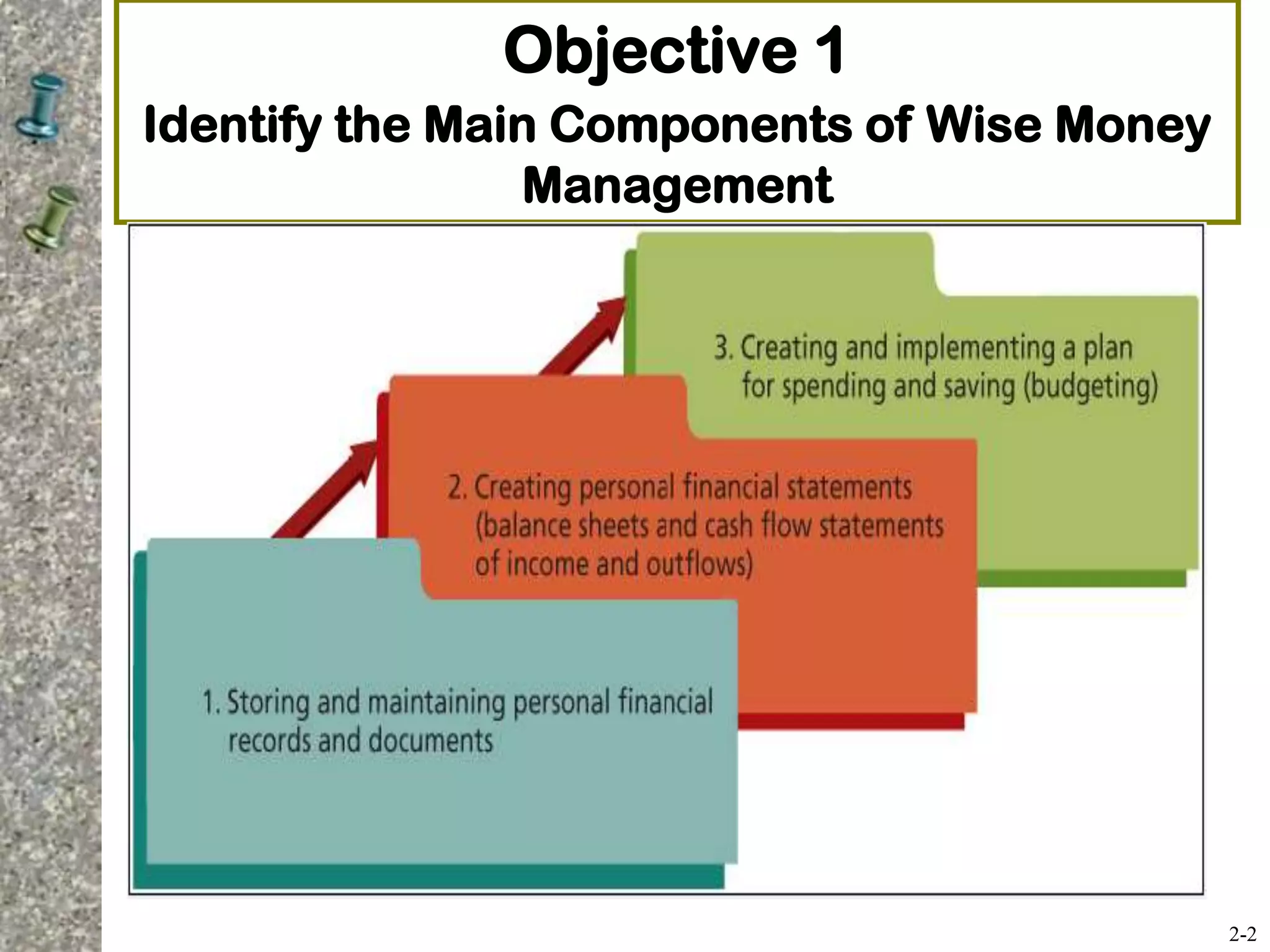
Objective 1
Identify the Main Components of Wise Money
Management
2-2
An Organized Personal Financial
Records System
Provides a basis for:
• Handling daily business affairs, such as bill
paying
• Planning and measuring financial
progress
• Completing required tax reports
• Making effective investment decisions
• Determining available resources for current
and future buying
2-3
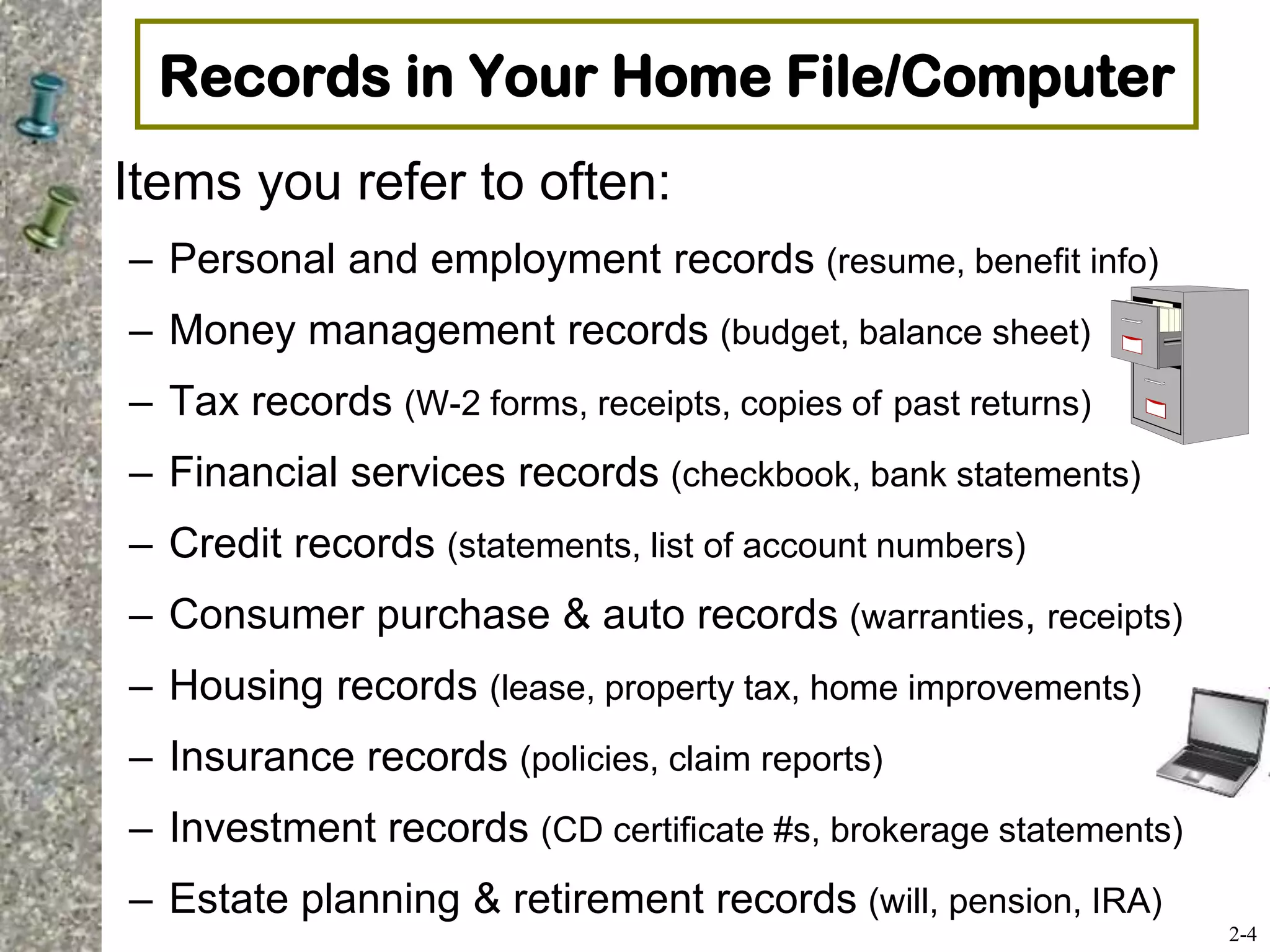
Records in Your Home File/Computer
Items you refer to often:
– Personal and employment records (resume, benefit info)
– Money management records (budget, balance sheet)
– Tax records (W-2 forms, receipts, copies of past returns)
– Financial services records (checkbook, bank statements)
– Credit records (statements, list of account numbers)
– Consumer purchase & auto records (warranties, receipts)
– Housing records (lease, property tax, home improvements)
– Insurance records (policies, claim reports)
– Investment records (CD certificate #s, brokerage statements)
– Estate planning & retirement records (will, pension, IRA)
2-4
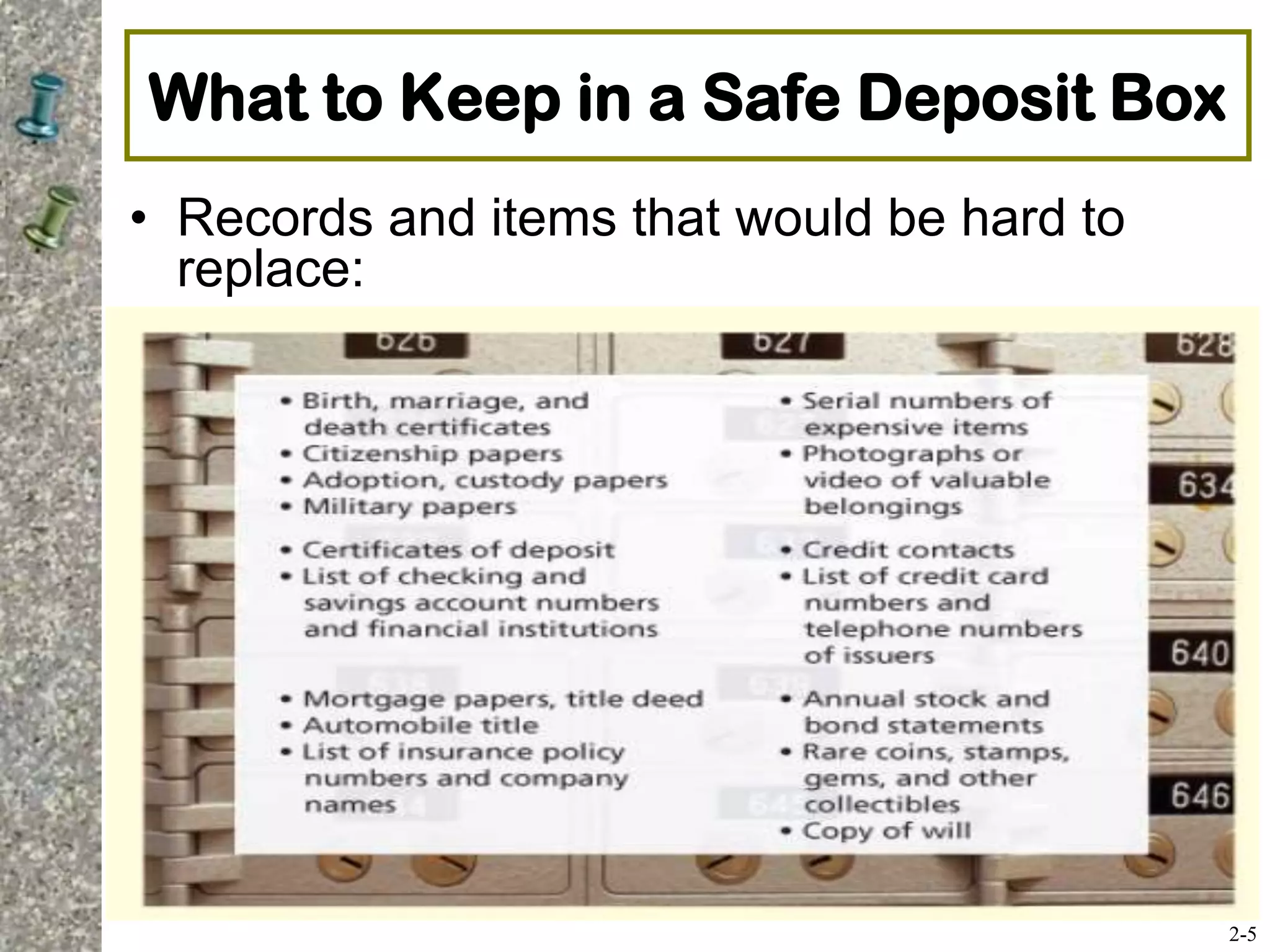
What to Keep in a Safe Deposit Box
• Records and items that would be hard to
replace:
– Birth, marriage and death certificates
– List of checking, savings and financial institution
account numbers
– Citizenship and military papers
– Adoption and custody papers
– Serial numbers and photos of valuables
– CDs and credit and banking account numbers
– Mortgage papers and titles
– List of insurance policy numbers
– Stock and bond certificates
– Coins and other collectibles
– Copy of will
2-5
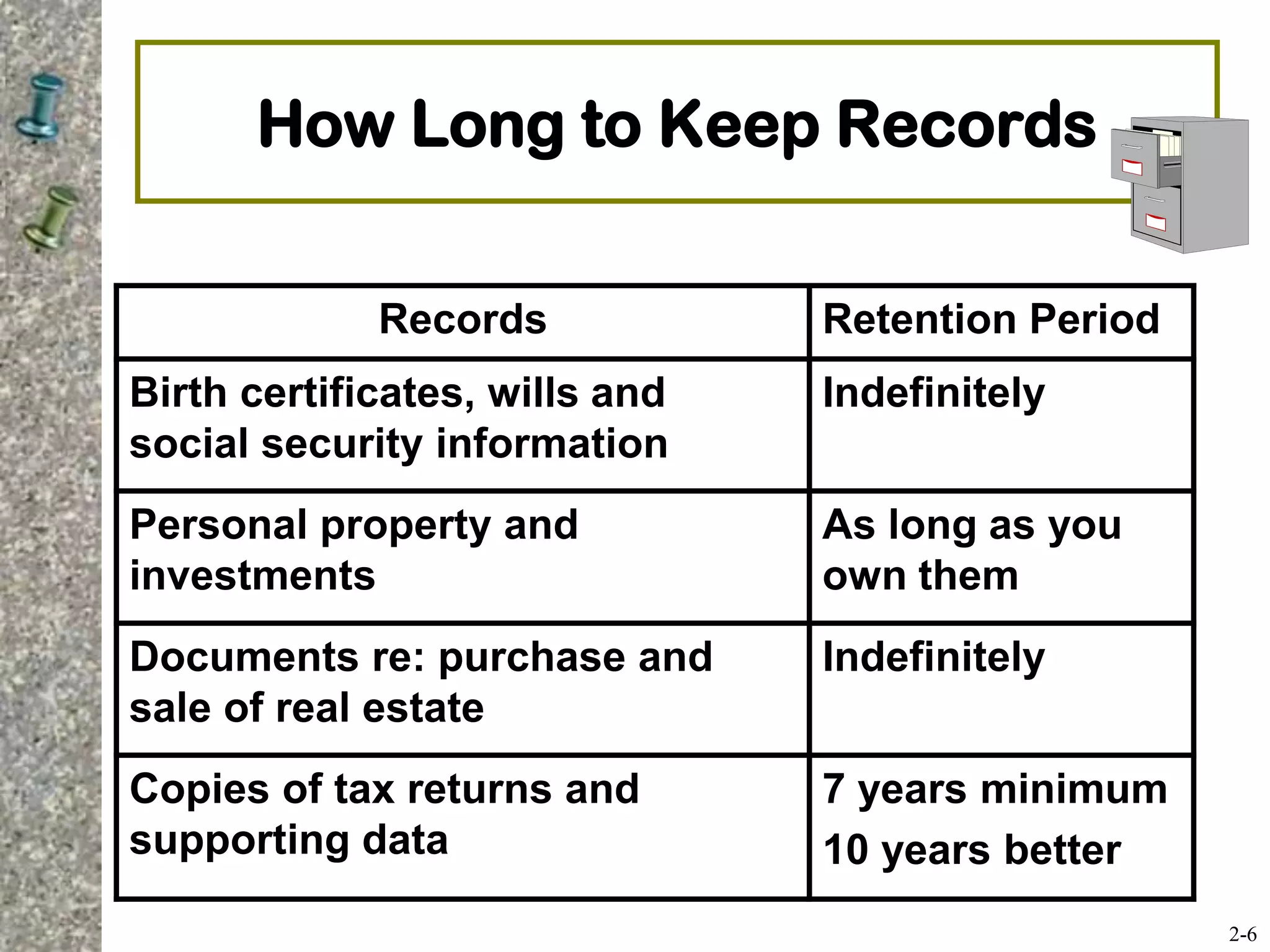
How Long to Keep Records
Records Retention Period
Birth certificates, wills and
social security information
Indefinitely
Personal property and
investments
As long as you
own them
Documents re: purchase and
sale of real estate
Indefinitely
Copies of tax returns and
supporting data
7 years minimum
10 years better
2-6
Objective 2
Create a Personal Balance Sheet
and Cash Flow Statement
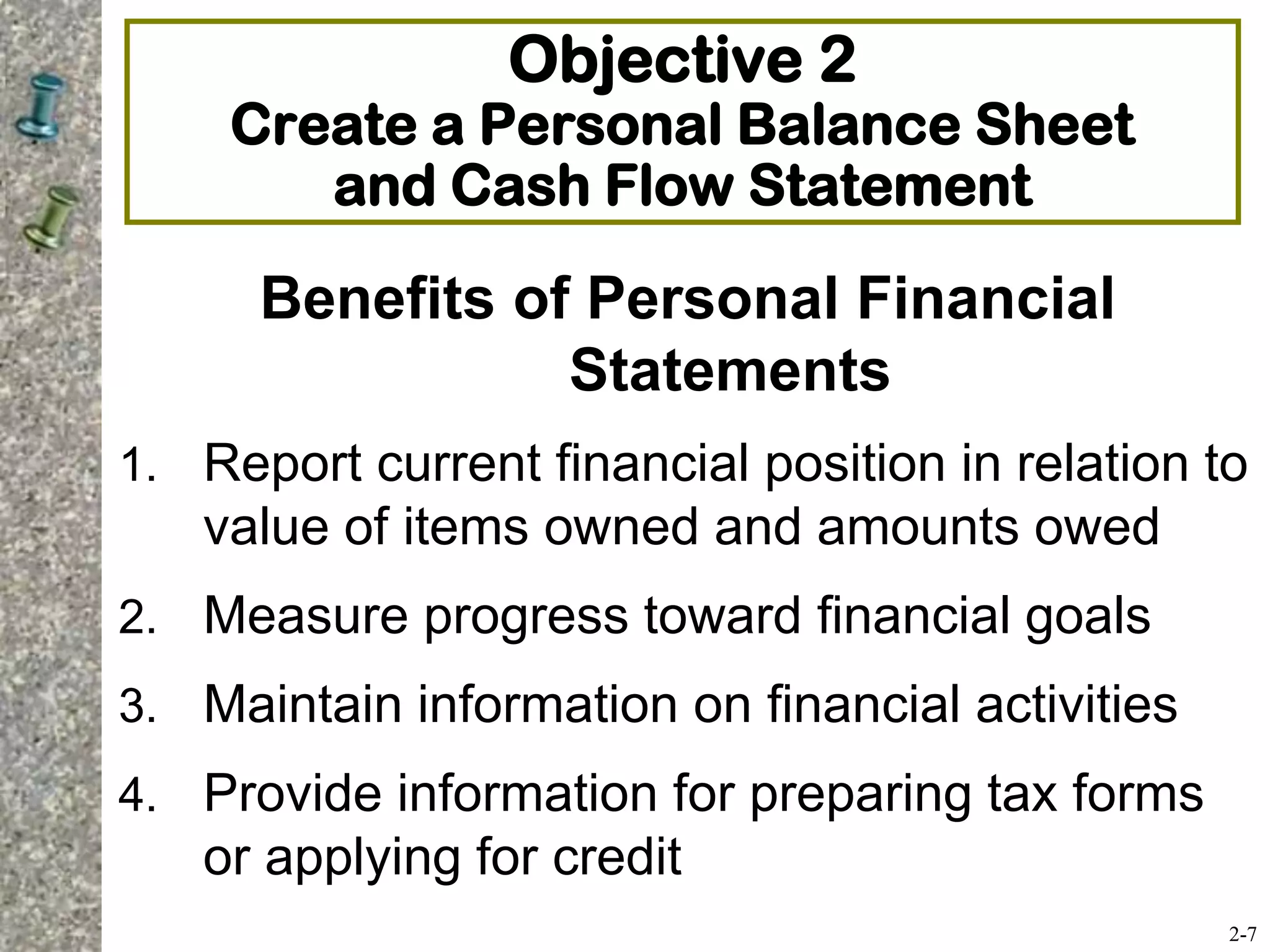
Benefits of Personal Financial
Statements
1. Report current financial position in relation to
value of items owned and amounts owed
2. Measure progress toward financial goals
3. Maintain information on financial activities
4. Provide information for preparing tax forms
or applying for credit
2-7
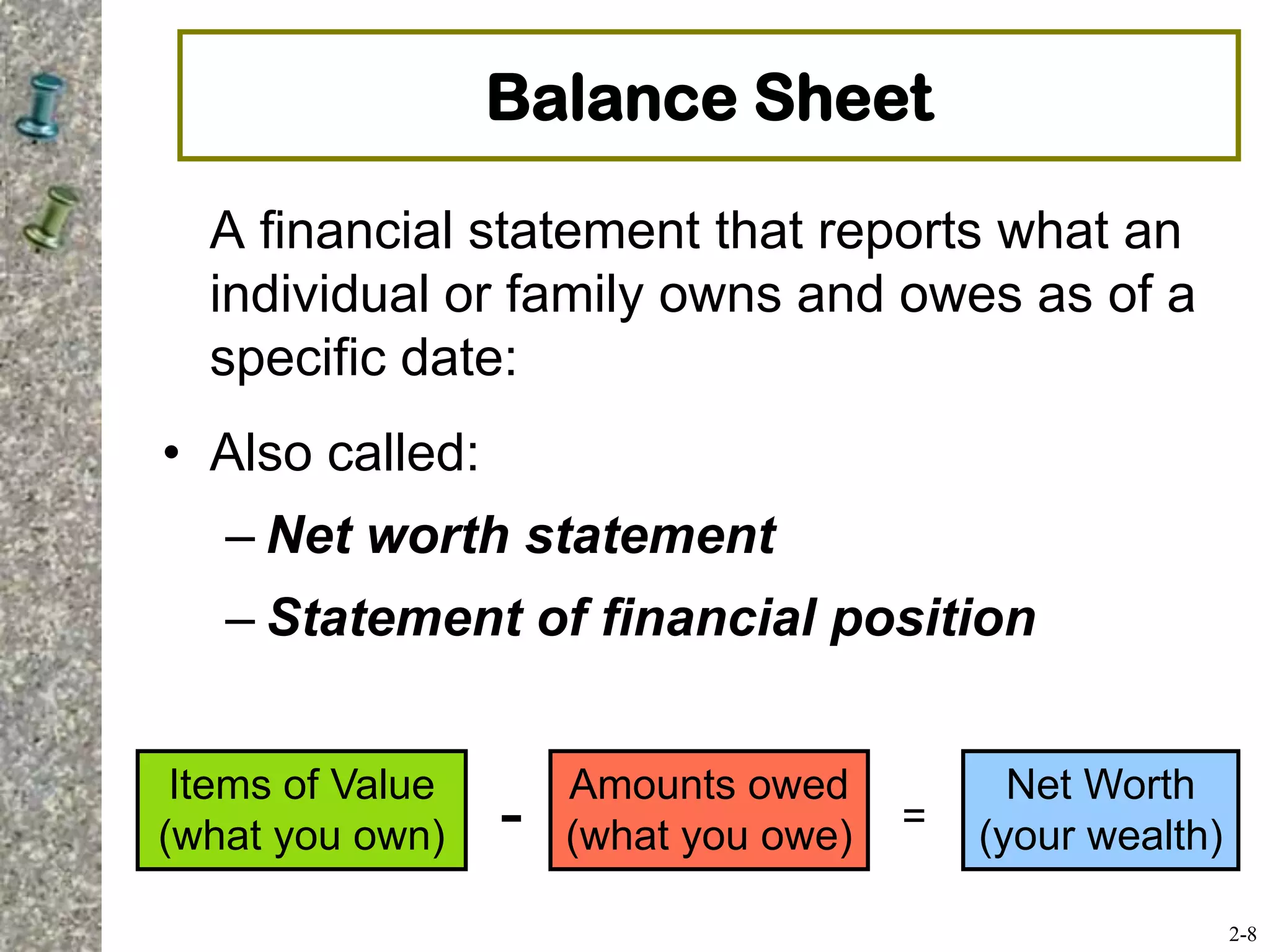
Balance Sheet
A financial statement that reports what an
individual or family owns and owes as of a
specific date:
• Also called:
– Net worth statement
– Statement of financial position
Items of Value
(what you own) -
Amounts owed
(what you owe)
Net Worth
(your wealth)=
2-8
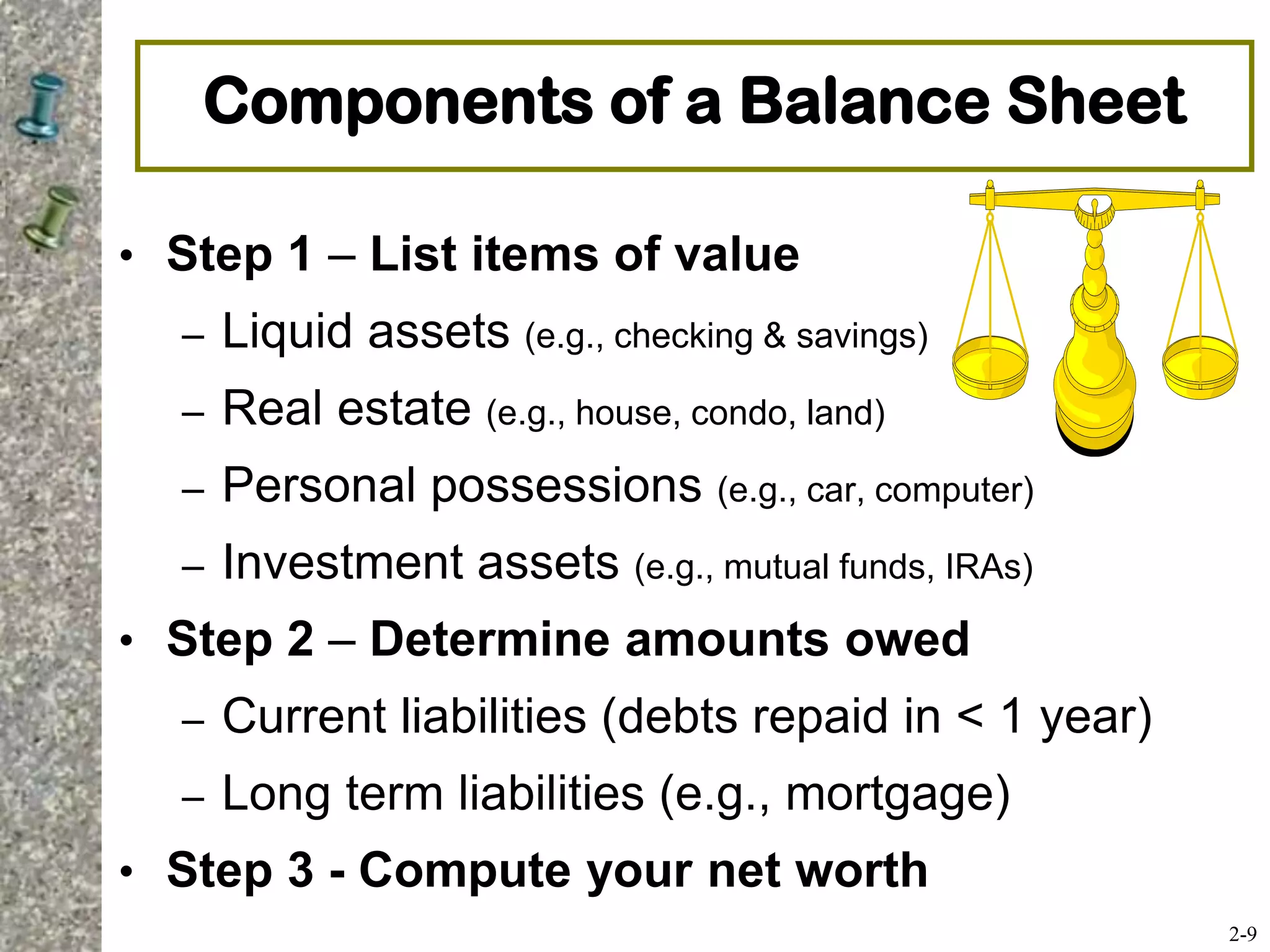
Components of a Balance Sheet
• Step 1 – List items of value
– Liquid assets (e.g., checking & savings)
– Real estate (e.g., house, condo, land)
– Personal possessions (e.g., car, computer)
– Investment assets (e.g., mutual funds, IRAs)
• Step 2 – Determine amounts owed
– Current liabilities (debts repaid in < 1 year)
– Long term liabilities (e.g., mortgage)
• Step 3 - Compute your net worth
2-9
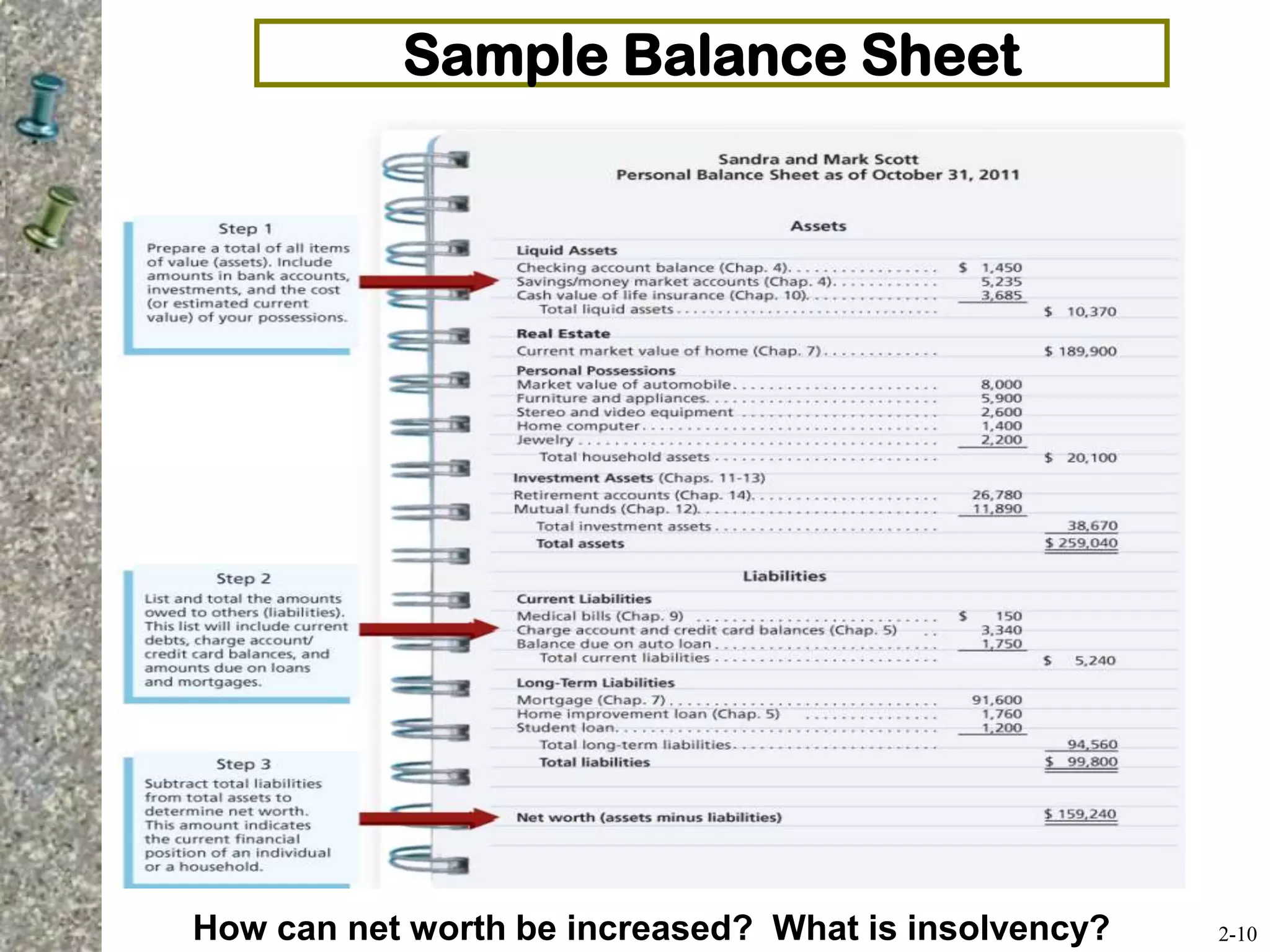
Sample Balance Sheet
2-10How can net worth be increased? What is insolvency?
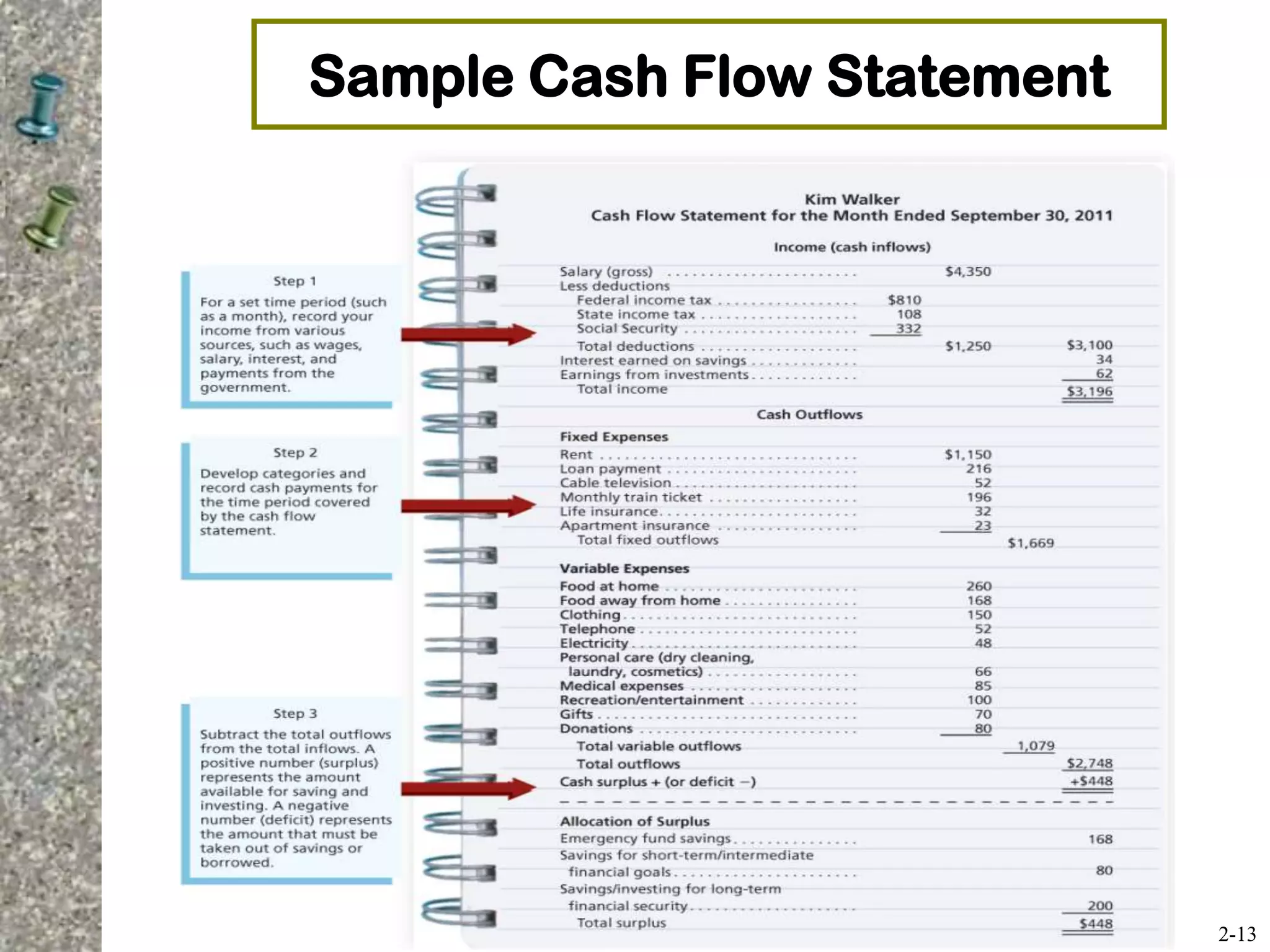
The Cash Flow Statement
Inflows and Outflows
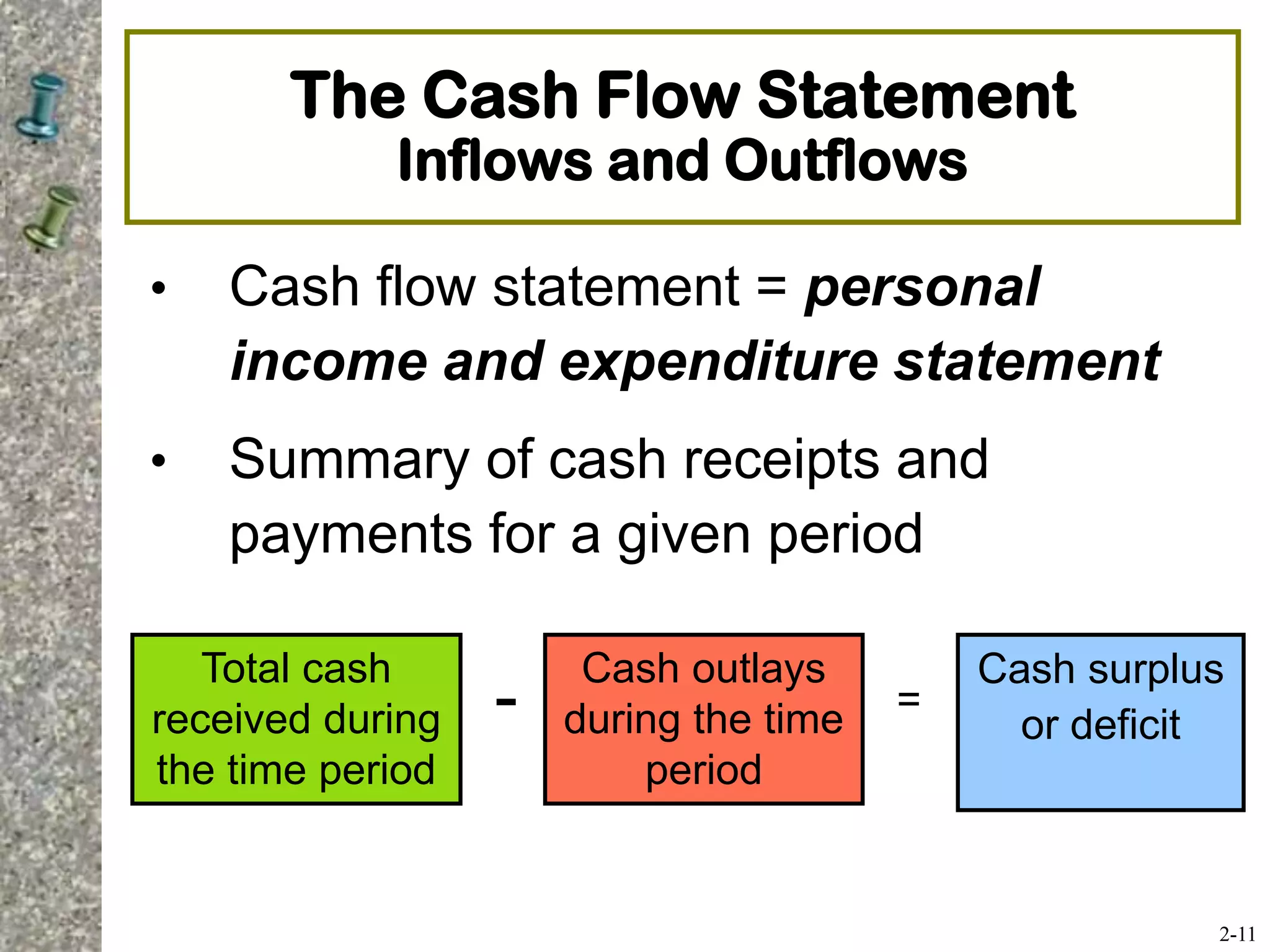
• Cash flow statement = personal
income and expenditure statement
• Summary of cash receipts and
payments for a given period
Total cash
received during
the time period
-
Cash outlays
during the time
period
Cash surplus
or deficit
=
2-11
The Cash Flow Statement
Inflows and Outflows
Step 1 - Record Income
– Net income from employment (Net Pay)
– Savings and investment income
– Other sources
Step 2 - Record cash outflows
– Fixed and variable expenses
Step 3 - Determine Cash Flow (Surplus or Deficit)
– Use this statement as a basis for creating a
spending, saving, and investment plan
2-12
Sample Cash Flow Statement
2-13
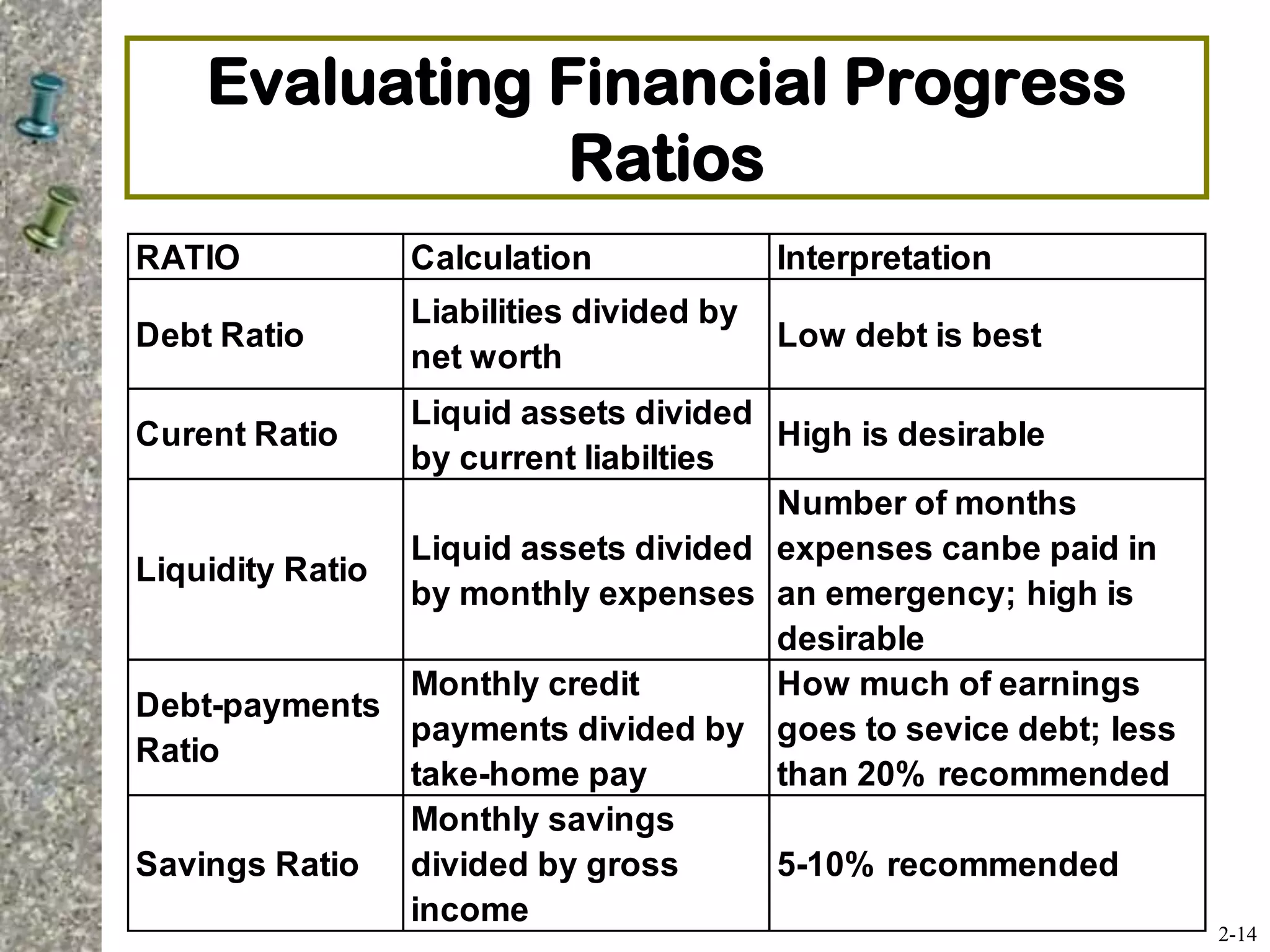
Evaluating Financial Progress
Ratios
RATIO Calculation Interpretation
Debt Ratio
Liabilities divided by
net worth
Low debt is best
Curent Ratio
Liquid assets divided
by current liabilties
High is desirable
Liquidity Ratio
Liquid assets divided
by monthly expenses
Number of months
expenses canbe paid in
an emergency; high is
desirable
Debt-payments
Ratio
Monthly credit
payments divided by
take-home pay
How much of earnings
goes to sevice debt; less
than 20% recommended
Savings Ratio
Monthly savings
divided by gross
income
5-10% recommended
2-14
Objective 3
Develop and Implement a Personal
Budget
• Budget = Spending Plan
• Helps you:
– Live within your income
– Spend money wisely
– Reach financial goals
– Prepare for financial emergencies
– Develop wise financial management habits
2-15
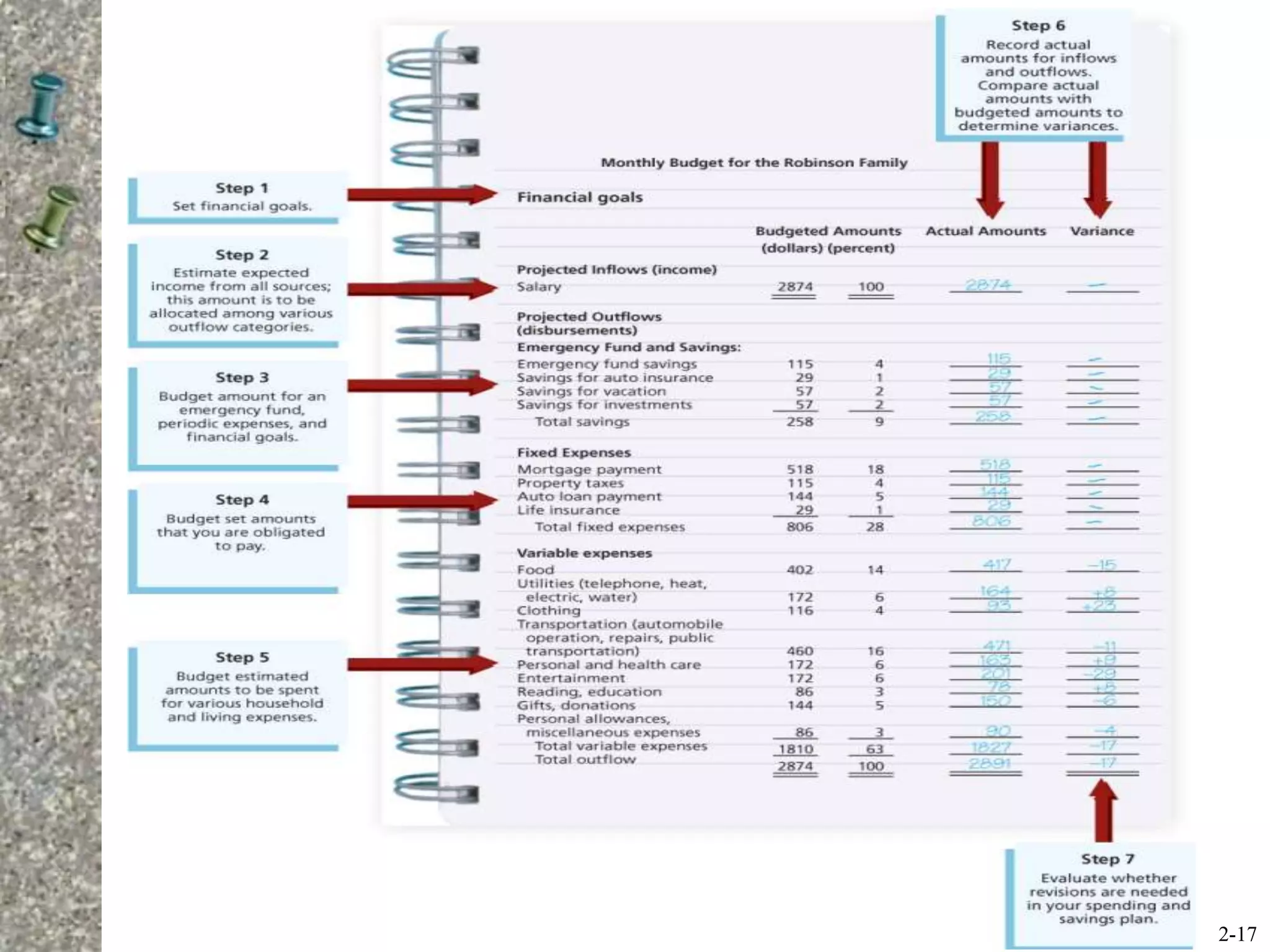
The 7 Steps in Budgeting Process
1. Set financial goals
2. Estimate income from all sources
3. Budget an emergency fund and savings
4. Budget fixed expenses (include 1/12 occasional expenses)
5. Budget variable expenses
6. Record spending amounts
7. Review spending and saving patterns
 Review financial progress
 Revise goals and budget allocations 2-16
2-17
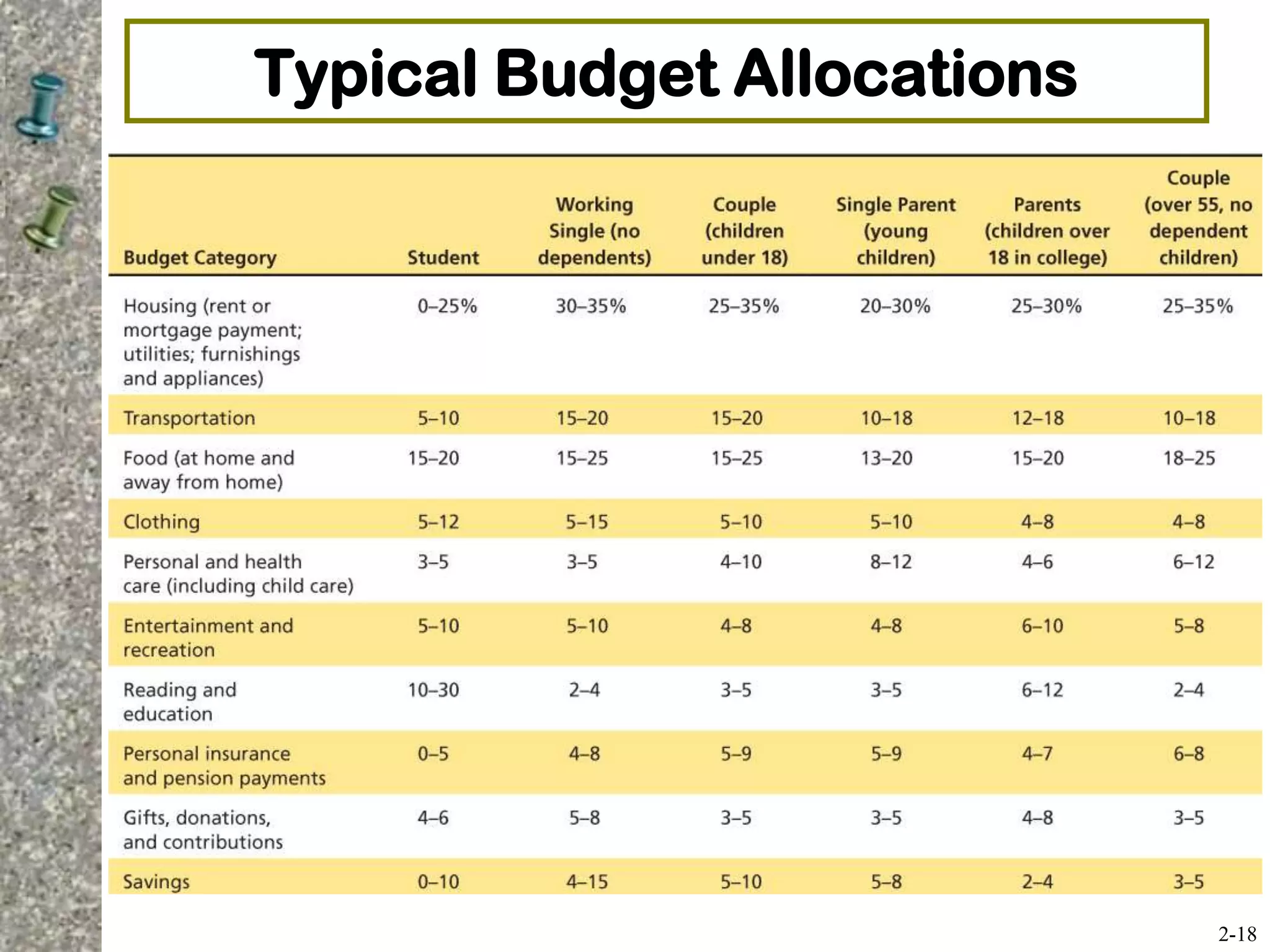
Typical Budget Allocations
2-18
Budgeting Systems
• Mental budget
– Appropriate if financial resources and
responsibilities are limited
• Physical Budget
– Envelopes, folders or containers
• Written Budget
– On notebook paper
• Computerized Budget
– Spreadsheet or specialized software
2-19
Pros and Cons of each system? Who might use them?
Objective 4
Connect Money Management Activities with
Savings for Personal Financial Goals
1. Your Balance Sheet (Net Worth):
• Snapshot of where you are now
2. Your Cash Flow Statement:
• What you received and spent over a specific
period
3. Your Budget (Spending Plan):
• Planning spending and saving to achieve
financial goals
2-20
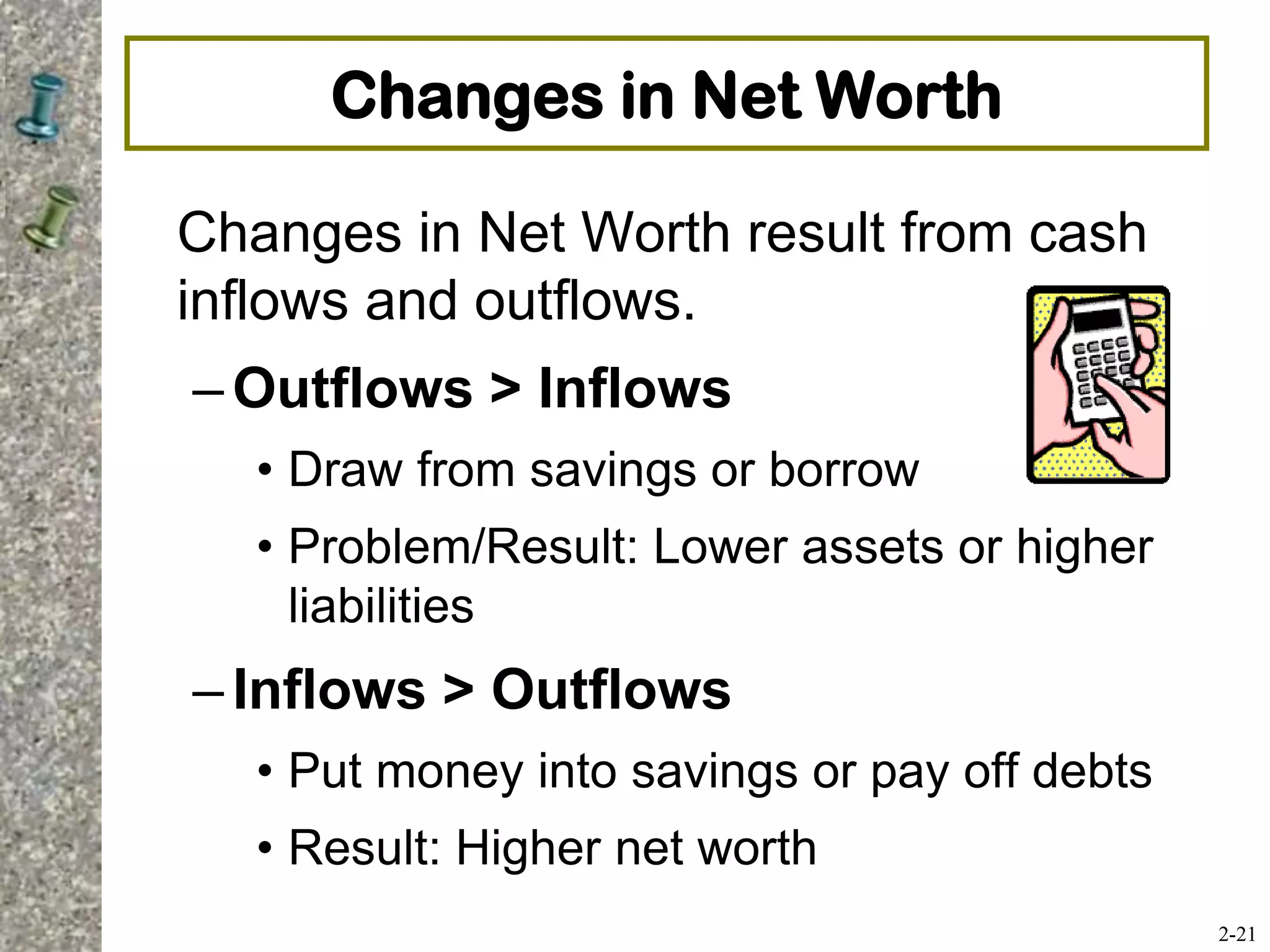
Changes in Net Worth
Changes in Net Worth result from cash
inflows and outflows.
–Outflows > Inflows
• Draw from savings or borrow
• Problem/Result: Lower assets or higher
liabilities
–Inflows > Outflows
• Put money into savings or pay off debts
• Result: Higher net worth
2-21
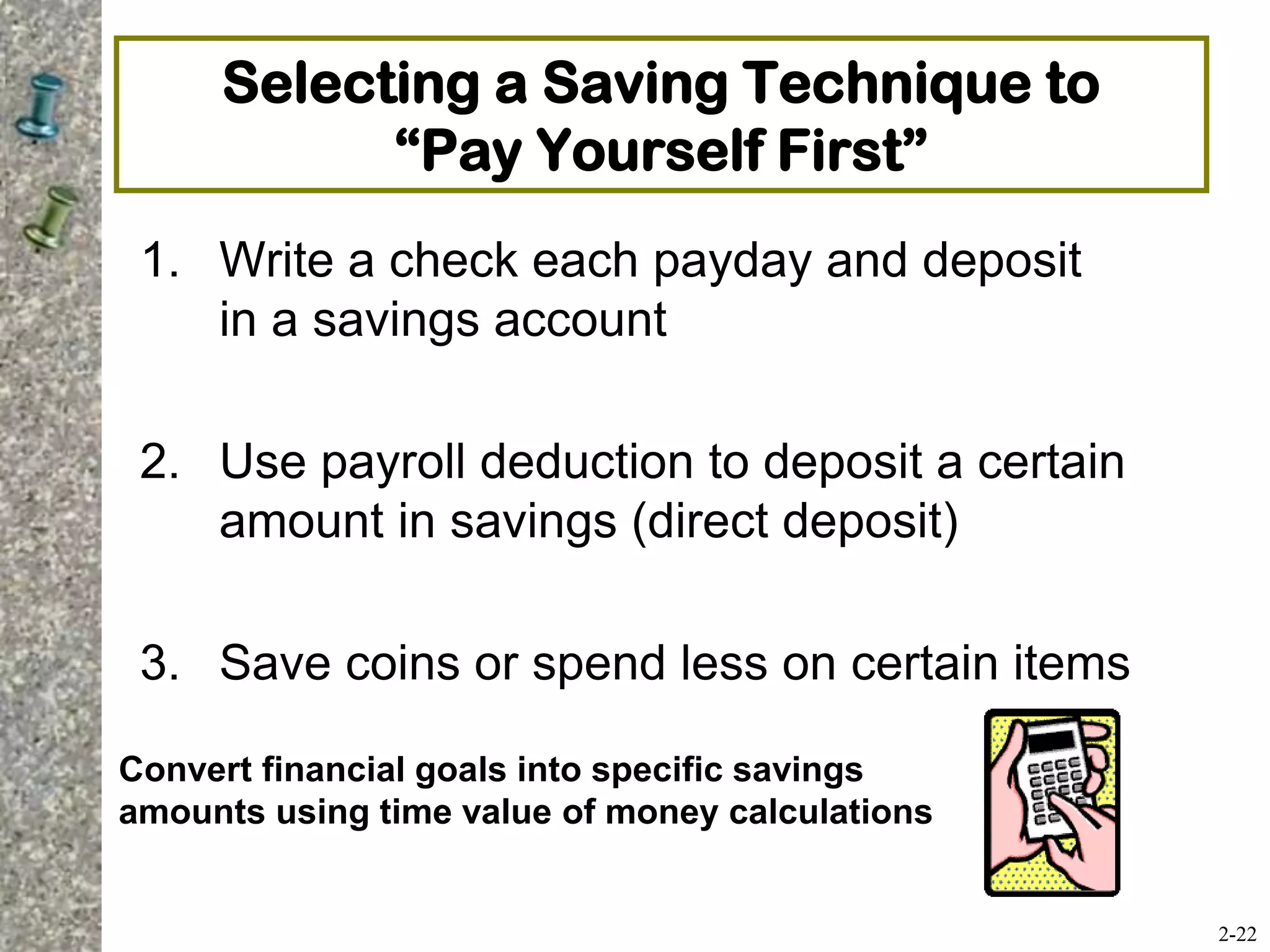
Selecting a Saving Technique to
“Pay Yourself First”
1. Write a check each payday and deposit
in a savings account
2. Use payroll deduction to deposit a certain
amount in savings (direct deposit)
3. Save coins or spend less on certain items
2-22
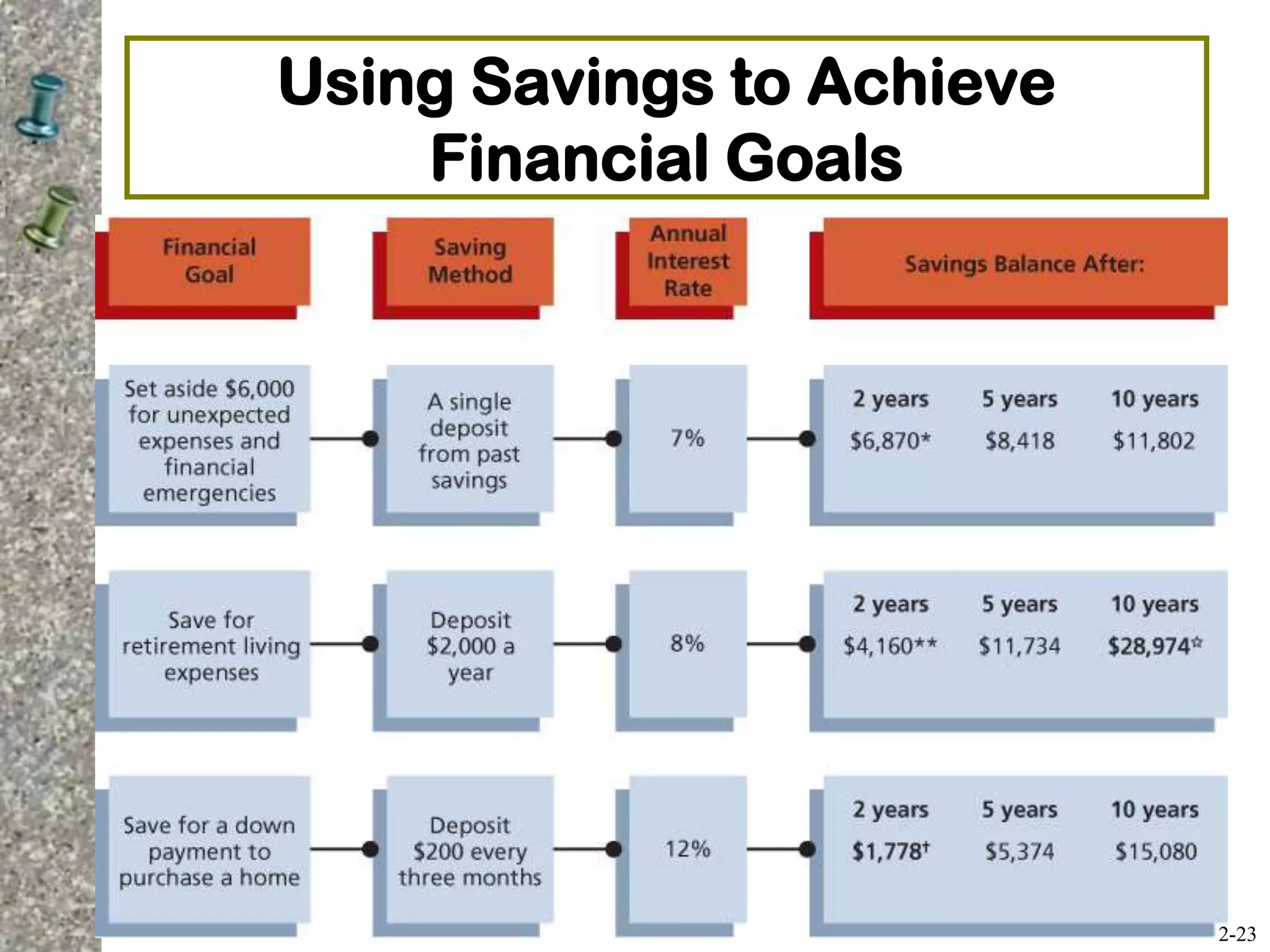
Convert financial goals into specific savings
amounts using time value of money calculations
Using Savings to Achieve
Financial Goals
2-23
Wrap Up
• Chapter Quiz
• Concept Check 2-1- How Long Should Items Be
Kept?
– Credit card statements, mortgage documents,
receipts, retirement account info, will
• Concept Check 2-2- Identify items in financial
statements
• Concept Check 2-3- Identify types of expenses
• Concept Check 2-4- Which financial statement?

Chapter 2

  • 1.
    2 Money ManagementSkills • Money management = Day-to-day financial activities necessary to manage current personal economic resources, while working toward long-term financial security • Daily spending and saving decisions = central to financial planning – Must be coordinated with needs, goals, and personal situation 2-1
  • 2.
    Objective 1 Identify theMain Components of Wise Money Management 2-2
  • 3.
    An Organized PersonalFinancial Records System Provides a basis for: • Handling daily business affairs, such as bill paying • Planning and measuring financial progress • Completing required tax reports • Making effective investment decisions • Determining available resources for current and future buying 2-3
  • 4.
    Records in YourHome File/Computer Items you refer to often: – Personal and employment records (resume, benefit info) – Money management records (budget, balance sheet) – Tax records (W-2 forms, receipts, copies of past returns) – Financial services records (checkbook, bank statements) – Credit records (statements, list of account numbers) – Consumer purchase & auto records (warranties, receipts) – Housing records (lease, property tax, home improvements) – Insurance records (policies, claim reports) – Investment records (CD certificate #s, brokerage statements) – Estate planning & retirement records (will, pension, IRA) 2-4
  • 5.
    What to Keepin a Safe Deposit Box • Records and items that would be hard to replace: – Birth, marriage and death certificates – List of checking, savings and financial institution account numbers – Citizenship and military papers – Adoption and custody papers – Serial numbers and photos of valuables – CDs and credit and banking account numbers – Mortgage papers and titles – List of insurance policy numbers – Stock and bond certificates – Coins and other collectibles – Copy of will 2-5
  • 6.
    How Long toKeep Records Records Retention Period Birth certificates, wills and social security information Indefinitely Personal property and investments As long as you own them Documents re: purchase and sale of real estate Indefinitely Copies of tax returns and supporting data 7 years minimum 10 years better 2-6
  • 7.
    Objective 2 Create aPersonal Balance Sheet and Cash Flow Statement Benefits of Personal Financial Statements 1. Report current financial position in relation to value of items owned and amounts owed 2. Measure progress toward financial goals 3. Maintain information on financial activities 4. Provide information for preparing tax forms or applying for credit 2-7
  • 8.
    Balance Sheet A financialstatement that reports what an individual or family owns and owes as of a specific date: • Also called: – Net worth statement – Statement of financial position Items of Value (what you own) - Amounts owed (what you owe) Net Worth (your wealth)= 2-8
  • 9.
    Components of aBalance Sheet • Step 1 – List items of value – Liquid assets (e.g., checking & savings) – Real estate (e.g., house, condo, land) – Personal possessions (e.g., car, computer) – Investment assets (e.g., mutual funds, IRAs) • Step 2 – Determine amounts owed – Current liabilities (debts repaid in < 1 year) – Long term liabilities (e.g., mortgage) • Step 3 - Compute your net worth 2-9
  • 10.
    Sample Balance Sheet 2-10Howcan net worth be increased? What is insolvency?
  • 11.
    The Cash FlowStatement Inflows and Outflows • Cash flow statement = personal income and expenditure statement • Summary of cash receipts and payments for a given period Total cash received during the time period - Cash outlays during the time period Cash surplus or deficit = 2-11
  • 12.
    The Cash FlowStatement Inflows and Outflows Step 1 - Record Income – Net income from employment (Net Pay) – Savings and investment income – Other sources Step 2 - Record cash outflows – Fixed and variable expenses Step 3 - Determine Cash Flow (Surplus or Deficit) – Use this statement as a basis for creating a spending, saving, and investment plan 2-12
  • 13.
    Sample Cash FlowStatement 2-13
  • 14.
    Evaluating Financial Progress Ratios RATIOCalculation Interpretation Debt Ratio Liabilities divided by net worth Low debt is best Curent Ratio Liquid assets divided by current liabilties High is desirable Liquidity Ratio Liquid assets divided by monthly expenses Number of months expenses canbe paid in an emergency; high is desirable Debt-payments Ratio Monthly credit payments divided by take-home pay How much of earnings goes to sevice debt; less than 20% recommended Savings Ratio Monthly savings divided by gross income 5-10% recommended 2-14
  • 15.
    Objective 3 Develop andImplement a Personal Budget • Budget = Spending Plan • Helps you: – Live within your income – Spend money wisely – Reach financial goals – Prepare for financial emergencies – Develop wise financial management habits 2-15
  • 16.
    The 7 Stepsin Budgeting Process 1. Set financial goals 2. Estimate income from all sources 3. Budget an emergency fund and savings 4. Budget fixed expenses (include 1/12 occasional expenses) 5. Budget variable expenses 6. Record spending amounts 7. Review spending and saving patterns  Review financial progress  Revise goals and budget allocations 2-16
  • 17.
  • 18.
  • 19.
    Budgeting Systems • Mentalbudget – Appropriate if financial resources and responsibilities are limited • Physical Budget – Envelopes, folders or containers • Written Budget – On notebook paper • Computerized Budget – Spreadsheet or specialized software 2-19 Pros and Cons of each system? Who might use them?
  • 20.
    Objective 4 Connect MoneyManagement Activities with Savings for Personal Financial Goals 1. Your Balance Sheet (Net Worth): • Snapshot of where you are now 2. Your Cash Flow Statement: • What you received and spent over a specific period 3. Your Budget (Spending Plan): • Planning spending and saving to achieve financial goals 2-20
  • 21.
    Changes in NetWorth Changes in Net Worth result from cash inflows and outflows. –Outflows > Inflows • Draw from savings or borrow • Problem/Result: Lower assets or higher liabilities –Inflows > Outflows • Put money into savings or pay off debts • Result: Higher net worth 2-21
  • 22.
    Selecting a SavingTechnique to “Pay Yourself First” 1. Write a check each payday and deposit in a savings account 2. Use payroll deduction to deposit a certain amount in savings (direct deposit) 3. Save coins or spend less on certain items 2-22 Convert financial goals into specific savings amounts using time value of money calculations
  • 23.
    Using Savings toAchieve Financial Goals 2-23
  • 24.
    Wrap Up • ChapterQuiz • Concept Check 2-1- How Long Should Items Be Kept? – Credit card statements, mortgage documents, receipts, retirement account info, will • Concept Check 2-2- Identify items in financial statements • Concept Check 2-3- Identify types of expenses • Concept Check 2-4- Which financial statement?