International Financial Reporting Standards
The views expressed in this presentation are those of the presenter,
not necessarily those of the IASB or IFRS Foundation.
July 25, 2013
Conceptual Framework
for Financial Reporting
A Discussion session with SBOTS 18
@
National Institute of Banking & Finance (NIBAF)
KThe views expressed in this presentation are those of the
presenter, not necessarily those of the IASB or IFRS Foundation.
By:
Sajjad Ahmed
FCA (Eng & Wales), PMP, MBA (Harvard Business
School), BS (University of Oxford)
Sajjad Ahmed, FCA (Eng & Wales), MBA (Harvard Business School), BS
(University of Oxford), PMP
2Points to Ponder upon… ‘The Direction’
What is Financial Reporting????
How does the Financial Reporting impact the stakeholders and
in-turn the business itself???
Need for Regulator in Financial reporting ‘business’ ????
Globalization of businesses and its relevance to the Financial Reporting
mechanism????
Relevance to your job????
Sajjad Ahmed, FCA (Eng & Wales), MBA (Harvard Business School), BS
(University of Oxford), PMP
Role of the Conceptual Framework
• Conceptual Framework sets out agreed concepts that
underlie financial reporting
– objective, qualitative characteristics, element definitions, …
• IASB uses Conceptual Framework to set standards
– enhances consistency across standards
– enhances consistency over time as Board members change
– provides benchmark for judgments
• Preparers use Conceptual Framework to develop
accounting policies in the absence of specific standard or
interpretation
3
Sajjad Ahmed, FCA (Eng & Wales), MBA (Harvard Business School), BS
(University of Oxford), PMP
4
Does the Framework help me understand
IFRSs? 4
• Yes, the starting point for understanding all IFRS information is
the objective and the concepts that flow logically from that
objective:
– IASB uses Framework to set IFRSs
– Teachers/Trainers use Framework-based teaching to
prepare students to make judgements that are necessary to
apply IFRSs
– Preparers use Framework to make the judgements that are
necessary to apply IFRSs
– Auditors and regulators assess those judgements
– Investors, lenders and others consider those judgements
when using IFRS financial information to inform their
decisions
Sajjad Ahmed, FCA (Eng & Wales), MBA (Harvard Business School), BS
(University of Oxford), PMP
55Objective of financial reporting
“Provide financial information about the reporting entity
that is useful to existing and potential investors, lenders
and other creditors in making decisions about providing
resources to the entity”
Note:
• other aspects of the Conceptual Framework flow
logically from the objective (CF.OB1)
• Conceptual Framework sets out the concepts that
underlie IFRS financial statements and assist the
IASB in the development of future IFRSs and in its
review of existing IFRSs (CF.Purpose and Status)
Sajjad Ahmed, FCA (Eng & Wales), MBA (Harvard Business School), BS
(University of Oxford), PMP
66Objective of financial reporting
• Investors’, lenders’ and other creditors’ expectations
about returns depend on their assessment of the
amount, timing and uncertainty of (the prospects
for) future net cash inflows to the entity.
– Decisions by investors about buying, selling or holding equity
and debt instruments depend on the returns that they expect
from an investment in those instruments, eg dividends,
principal and interest payments or market price increases.
– Decisions by lenders about providing or settling loans and
other forms of credit depend on the principal and interest
payments or other returns that they expect.
Sajjad Ahmed, FCA (Eng & Wales), MBA (Harvard Business School), BS
(University of Oxford), PMP
77Objective of financial reporting
• To assess an entity’s prospects for future net cash
inflows, existing and potential investors, lenders and
other creditors need information about:
– the resources of the entity;
– claims against the entity; and
– how efficiently and effectively the entity's management
and governing board have discharged their
responsibilities to use the entity's resources
– eg protecting the entity's resources from
unfavourable effects of economic factors such as
price and technological changes
Sajjad Ahmed, FCA (Eng & Wales), MBA (Harvard Business School), BS
(University of Oxford), PMP
88Qualitative characteristics
• If financial information is to be useful, it must be
relevant and faithfully represent what it purports to
represent (ie fundamental qualities).
– Financial information without both relevance and faithful
representation is not useful, and it cannot be made useful by
being more comparable, verifiable, timely or understandable.
• The usefulness of financial information is enhanced
if it is comparable, verifiable, timely and
understandable (ie enhancing qualities—less critical
but still highly desirable)
– Financial information that is relevant and faithfully
represented may still be useful even if it does not have any of
the enhancing qualitative characteristics.
Sajjad Ahmed, FCA (Eng & Wales), MBA (Harvard Business School), BS
(University of Oxford), PMP
99Fundamental qualitative characteristics
• Relevance: capable of making a difference in users’
decisions
– predictive value
– confirmatory value
– materiality (entity-specific)
• Faithful representation: faithfully represents the
phenomena it purports to represent
– completeness (depiction including numbers and words)
– neutrality (unbiased)
– free from error (ideally)
Note: faithful representation replaces reliability
Sajjad Ahmed, FCA (Eng & Wales), MBA (Harvard Business School), BS
(University of Oxford), PMP
1010Enhancing Qualitative Characteristics
• Comparability: like things look alike; different things look
different
• Verifiability: knowledgeable and independent observers
could reach consensus, but not necessarily complete
agreement, that a depiction is a faithful representation
• Timeliness: having information available to decision-makers
in time to be capable of influencing their decisions
• Understandability: Classify, characterize, and present
information clearly and concisely
Sajjad Ahmed, FCA (Eng & Wales), MBA (Harvard Business School), BS
(University of Oxford), PMP
111111Pervasive constraint
• Reporting financial information imposes costs, and it is
important that those costs are justified by the benefits of
reporting that information.
• Benefits include more efficient functioning of capital markets and a
lower cost of capital for the economy.
• Costs include collecting, processing, verifying and disseminating
financial information and the costs of analysing and interpreting the
information provided.
• In applying the cost constraint, the IASB assesses whether
the benefits of reporting particular information are likely to
justify the costs incurred to provide and use that information.
Those assessments are usually based on a combination of
quantitative and qualitative information.
Sajjad Ahmed, FCA (Eng & Wales), MBA (Harvard Business School), BS
(University of Oxford), PMP
121212Summary
• Reporting financial information that is relevant and faithfully
represents what it purports to represent helps users to make
decisions with more confidence (ie financial information must
possess the fundamental qualitative characteristics).
• IFRS requirements must be cost-beneficial
• Applying the enhancing qualitative characteristics is an
iterative process that does not follow a prescribed order.
Sometimes, one enhancing qualitative characteristic
may have to be diminished to maximise another
qualitative characteristic.
Sajjad Ahmed, FCA (Eng & Wales), MBA (Harvard Business School), BS
(University of Oxford), PMP
1313Elements
• Asset: Resource controlled as a result of past events and
from which future economic benefits are expected to flow
• Liability: Present obligation arising from past events, the
settlement of which is expected to result in outflow of
resources embodying economic benefits
• Equity: Assets minus liabilities
• Income (expense): Increases (decreases) in economic
benefits during period from inflows or enhancements
(outflows or depletions) of assets (liabilities) or decreases
(incurrences) of liabilities from in increases (decreases) in
equity, other than contributions from (distributions to) equity
Sajjad Ahmed, FCA (Eng & Wales), MBA (Harvard Business School), BS
(University of Oxford), PMP
14Elements, examples
• Asset?
• an oil explorer’s exploration rig
• a fish farmer’s breeding stock
• fish in the sea (from a fish harvester’s perspective)
• own shares held by an entity
• firm order to acquire gold, settle net in cash
• firm order to acquire gold, cannot settle net
• expenditure on major inspection (a condition of
continuing to operate an item of PPE)
• ‘right’ to recover past costs incurred increased future
prices in a rate regulated activity
14
Sajjad Ahmed, FCA (Eng & Wales), MBA (Harvard Business School), BS
(University of Oxford), PMP
15Elements, examples
• Liability?
• defending a lawsuit
• promise to make good environmental damage (no legal
obligation to do so)
• law requires smoke filters be fitted to factory
• lessee—short-term car rental agreement
• participant in a cap and trade emission trading scheme
15
Sajjad Ahmed, FCA (Eng & Wales), MBA (Harvard Business School), BS
(University of Oxford), PMP
16Elements, examples
• Liability or equity?
• issue ordinary share
• issue compulsorily redeemable debt (fixed interest,
fixed redemption)
• issue convertible debt instrument (holder has option to
convert)
• non-controlling interest
16
Sajjad Ahmed, FCA (Eng & Wales), MBA (Harvard Business School), BS
(University of Oxford), PMP
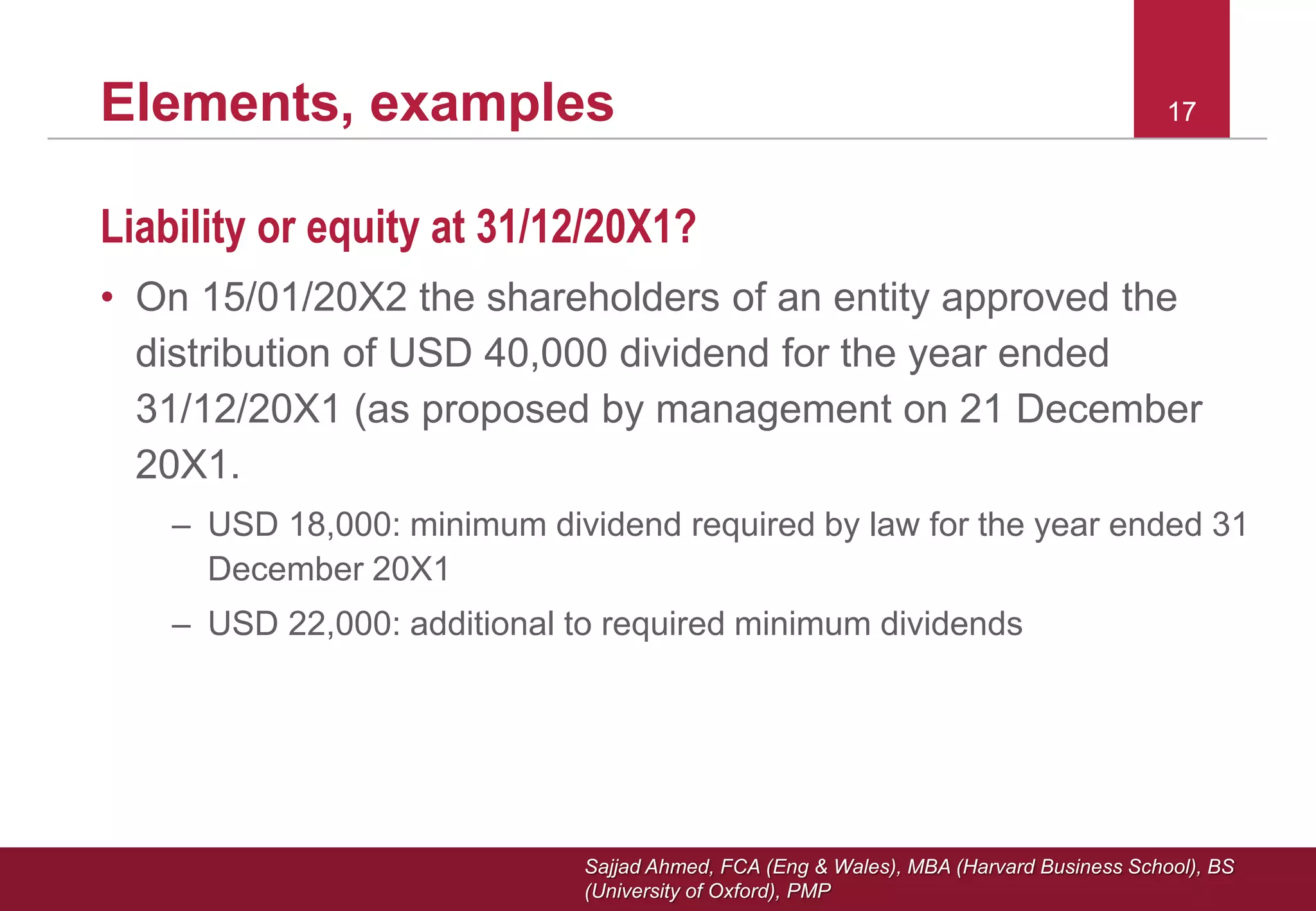
17Elements, examples 17
Liability or equity at 31/12/20X1?
• On 15/01/20X2 the shareholders of an entity approved the
distribution of USD 40,000 dividend for the year ended
31/12/20X1 (as proposed by management on 21 December
20X1.
– USD 18,000: minimum dividend required by law for the year ended 31
December 20X1
– USD 22,000: additional to required minimum dividends
Sajjad Ahmed, FCA (Eng & Wales), MBA (Harvard Business School), BS
(University of Oxford), PMP
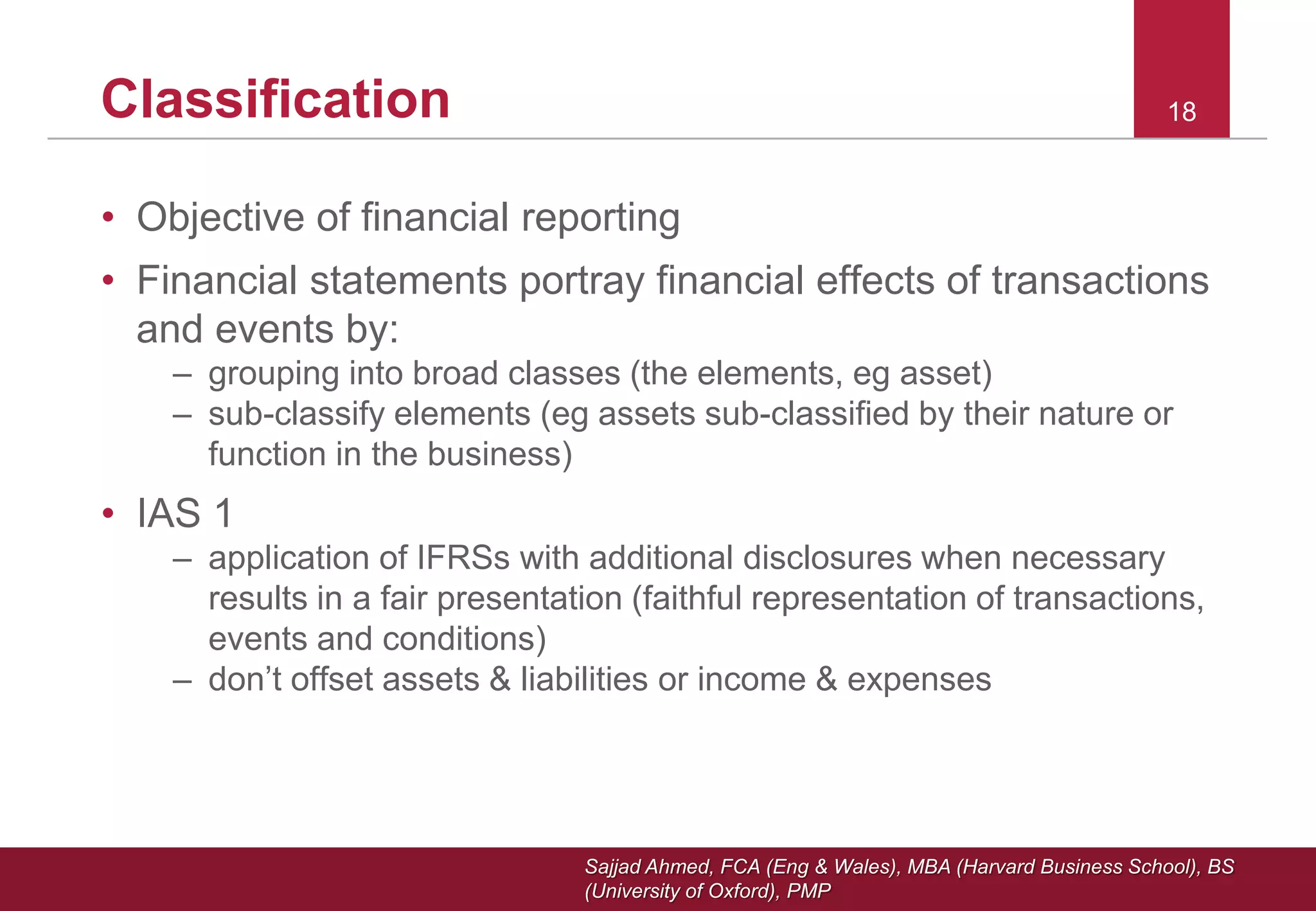
18Classification
• Objective of financial reporting
• Financial statements portray financial effects of transactions
and events by:
– grouping into broad classes (the elements, eg asset)
– sub-classify elements (eg assets sub-classified by their nature or
function in the business)
• IAS 1
– application of IFRSs with additional disclosures when necessary
results in a fair presentation (faithful representation of transactions,
events and conditions)
– don’t offset assets & liabilities or income & expenses
Sajjad Ahmed, FCA (Eng & Wales), MBA (Harvard Business School), BS
(University of Oxford), PMP
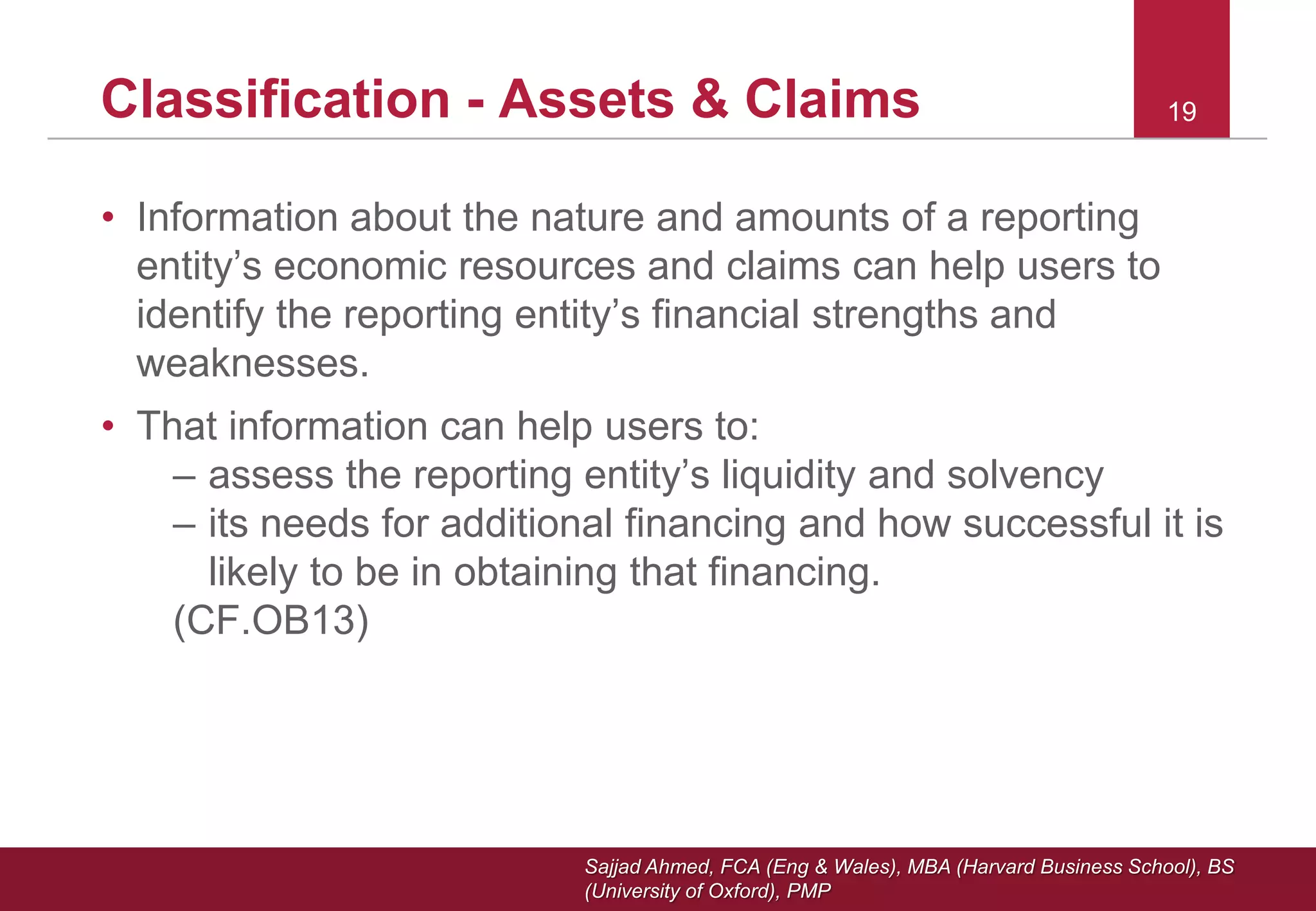
19Classification - Assets & Claims
• Information about the nature and amounts of a reporting
entity’s economic resources and claims can help users to
identify the reporting entity’s financial strengths and
weaknesses.
• That information can help users to:
– assess the reporting entity’s liquidity and solvency
– its needs for additional financing and how successful it is
likely to be in obtaining that financing.
(CF.OB13)
Sajjad Ahmed, FCA (Eng & Wales), MBA (Harvard Business School), BS
(University of Oxford), PMP
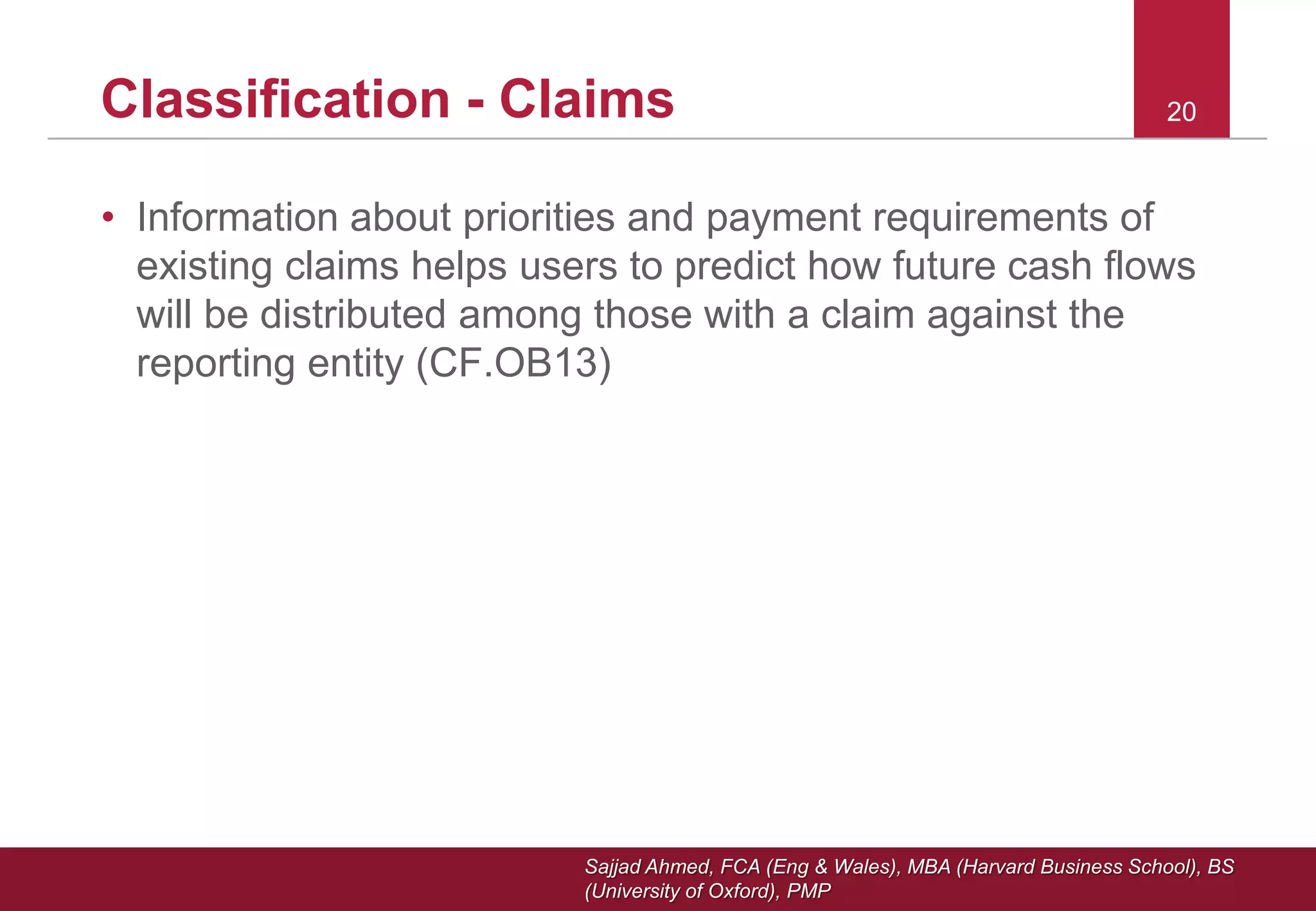
20Classification - Claims
• Information about priorities and payment requirements of
existing claims helps users to predict how future cash flows
will be distributed among those with a claim against the
reporting entity (CF.OB13)
Sajjad Ahmed, FCA (Eng & Wales), MBA (Harvard Business School), BS
(University of Oxford), PMP
21Classification - Liability
• Examples
• obligation to pay current tax
• metered power used but not yet billed by supplier
• ‘normal’ warrantee obligation to make good
manufacturing defect
• warrantee obligation to compensate for manufacturing
defects by settling in compensation in cash
• extended warrantee obligation
21
Sajjad Ahmed, FCA (Eng & Wales), MBA (Harvard Business School), BS
(University of Oxford), PMP
22Classification, assets
• Different types of economic resources affect a user’s
assessment of the reporting entity's prospects for future cash
flows differently.
– Some future cash flows result directly from existing economic
resources (eg accounts receivable and investment property).
– Other cash flows result from using several resources in combination
to produce and market goods or services to customers (eg PPE and
intangible assets). Although those cash flows cannot be identified
with individual economic resources (or claims), users of financial
reports need to know the nature and amount of the resources
available for use in a reporting entity’s operations. (CF.OB14)
Sajjad Ahmed, FCA (Eng & Wales), MBA (Harvard Business School), BS
(University of Oxford), PMP
23Classification - Assets
• Examples
• investment in ordinary shares
• gold
• land
• land planted with plantation
• farm implements
• bird breeder’s birds
• birds in a zoological garden
• birds in a bird breeding zoo
• owner-occupied building held for sale
• owner-occupied building decided to abandon
23
Sajjad Ahmed, FCA (Eng & Wales), MBA (Harvard Business School), BS
(University of Oxford), PMP
24The Concepts: ‘Financial position’ 24
The concepts
• Information about the nature and amounts of an entity’s
economic resources and claims against the reporting entity help
users identify the reporting entity’s financial strengths and
weaknesses (OB12–OB14).
– help assess entity’s prospects for future cash flows, its
liquidity and solvency, its needs for additional financing and
how successful it is likely to be in obtaining financing.
Sajjad Ahmed, FCA (Eng & Wales), MBA (Harvard Business School), BS
(University of Oxford), PMP
25The Concepts: ‘Financial performance’ 25
• Financial performance during a period, reflected by changes in
its economic resources and claims (other than by obtaining
additional resources directly from investors and creditors), is
useful in assessing the entity’s past and future ability to
generate net cash inflows (OB18)
• Accrual basis of accounting (depicts the effects of transactions
and other events and circumstances on a reporting entity’s
economic resources and claims in the periods in which those
effects occur (see ¶OB17)
Sajjad Ahmed, FCA (Eng & Wales), MBA (Harvard Business School), BS
(University of Oxford), PMP
26Recognition
• Accrual basis of accounting
– recognise element (eg asset) when satisfy definition and
recognition criteria
• Recognise item that meets element definition when
– probable that benefits will flow to/from the entity
– has cost or value that can measured reliably
Sajjad Ahmed, FCA (Eng & Wales), MBA (Harvard Business School), BS
(University of Oxford), PMP
27Recognition
What does probable mean?
The meaning of probable is determined at the standards level.
Therefore, inconsistent use across IFRSs
What does measure reliably mean?
To a large extent, financial reports are based on estimates,
judgements and models rather than exact depictions.
Sajjad Ahmed, FCA (Eng & Wales), MBA (Harvard Business School), BS
(University of Oxford), PMP
28Recognition – Examples
• Recognise the asset?
• a hospital’s backup backup generator (expect never to
use it)
• an oil explorer’s exploration rig
• an oil extractor’s unproven reserves
• an oil extractor’s proven reserves
• advertising expenditure
• research and development expenditure
• internally generated brand
• lessee—short-term car rental agreement
• firm order to acquire gold, cannot settle net
Sajjad Ahmed, FCA (Eng & Wales), MBA (Harvard Business School), BS
(University of Oxford), PMP
29Measurement concepts
• Measurement is the process of determining monetary amounts
at which elements are recognised and carried. (CF.4.54)
• To a large extent, financial reports are based on estimates,
judgements and models rather than exact depictions. The
Framework establishes the concepts that underlie those
estimates, judgements and models (CF.OB11)
• IASB guided by objective and qualitative characteristics when
specifying measurements.
29
Sajjad Ahmed, FCA (Eng & Wales), MBA (Harvard Business School), BS
(University of Oxford), PMP
30Measurement ‘concepts’ 30
• Measurement part of Conceptual Framework is weak
• A number of different measurement bases are employed to
different degrees and in varying combinations in financial
statements, including
– historical cost
– current cost
– realisable (settlement) value
– present value (CF.4.55)
• IASB guided by objective and qualitative characteristics when
specifying measurements.
Sajjad Ahmed, FCA (Eng & Wales), MBA (Harvard Business School), BS
(University of Oxford), PMP
The concept, defined in IFRS 13
• Fair value is the price that would be received to sell an asset
or paid to transfer a liability (exit price) in an orderly
transaction (not a forced sale) between market participants
(market-based view) at the measurement date (current
price).
• Fair value is a market-based measurement (it is not an
entity-specific measurement)
• consequently, the entity’s intention to hold an asset or to
settle or otherwise fulfil a liability is not relevant when
measuring fair value.
31Fair value measurement concept
Sajjad Ahmed, FCA (Eng & Wales), MBA (Harvard Business School), BS
(University of Oxford), PMP
32Fair value measurement concept 32
• Information about an entity’s financial performance in a period,
reflected by changes in economic resources is useful in
assessing the entity’s past and future ability to generate net
cash inflows (see CF.OB18)
• Income (expenses) are increases (decreases) in economic
benefits during an accounting period in the form of
enhancements (depletions) of assets (CF.4.25)
• Measure element at fair value with changes in fair value
recognised as income or expense for the period in which it
arises
Sajjad Ahmed, FCA (Eng & Wales), MBA (Harvard Business School), BS
(University of Oxford), PMP
© 2010
IFRS
Found
ation.
30
Canno
n
Street
|
London
EC4M
6XH |
UK.
www.ia
sb.org
33
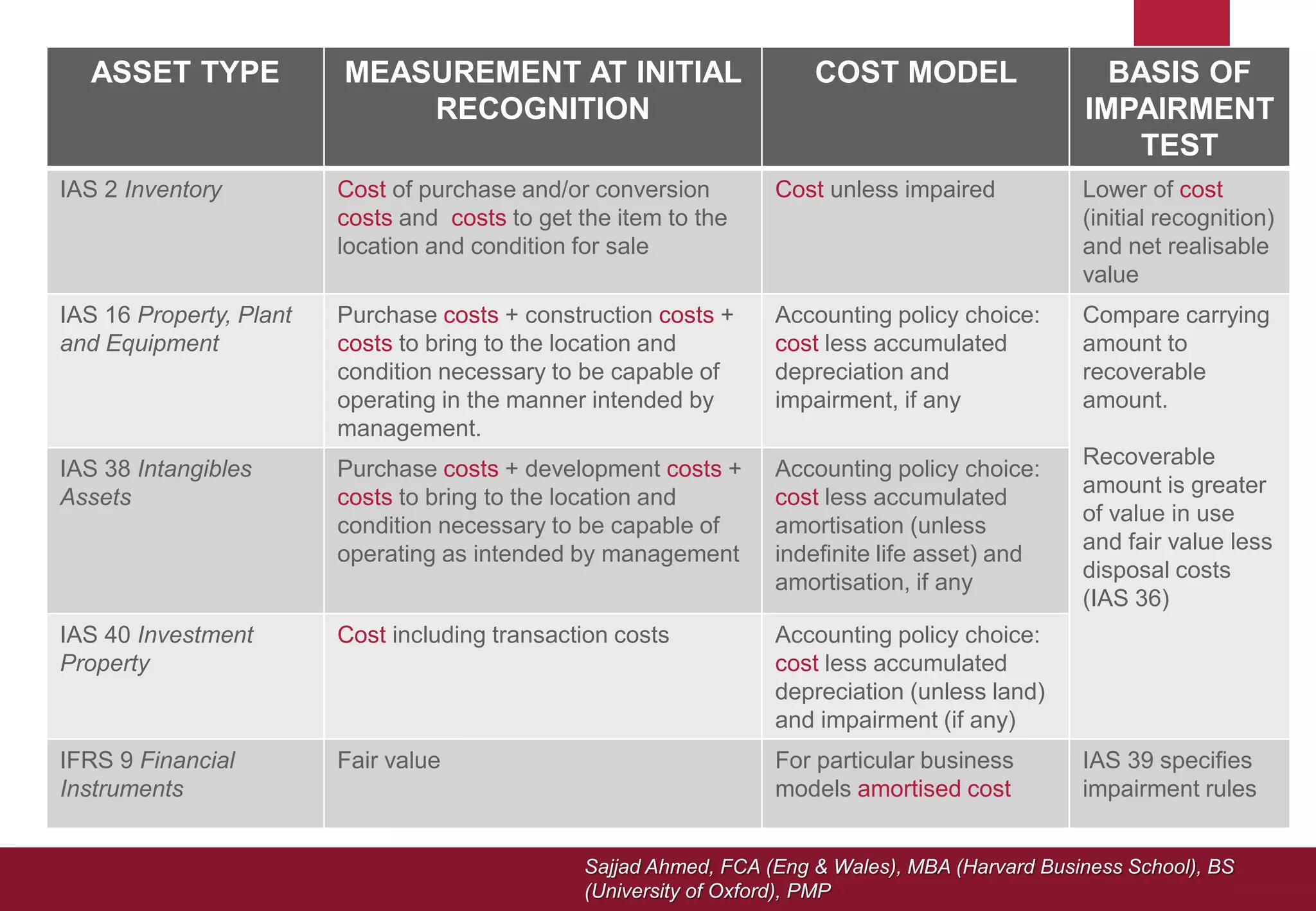
ASSET TYPE MEASUREMENT AT INITIAL
RECOGNITION
COST MODEL BASIS OF
IMPAIRMENT
TEST
IAS 2 Inventory Cost of purchase and/or conversion
costs and costs to get the item to the
location and condition for sale
Cost unless impaired Lower of cost
(initial recognition)
and net realisable
value
IAS 16 Property, Plant
and Equipment
Purchase costs + construction costs +
costs to bring to the location and
condition necessary to be capable of
operating in the manner intended by
management.
Accounting policy choice:
cost less accumulated
depreciation and
impairment, if any
Compare carrying
amount to
recoverable
amount.
Recoverable
amount is greater
of value in use
and fair value less
disposal costs
(IAS 36)
IAS 38 Intangibles
Assets
Purchase costs + development costs +
costs to bring to the location and
condition necessary to be capable of
operating as intended by management
Accounting policy choice:
cost less accumulated
amortisation (unless
indefinite life asset) and
amortisation, if any
IAS 40 Investment
Property
Cost including transaction costs Accounting policy choice:
cost less accumulated
depreciation (unless land)
and impairment (if any)
IFRS 9 Financial
Instruments
Fair value For particular business
models amortised cost
IAS 39 specifies
impairment rules
Sajjad Ahmed, FCA (Eng & Wales), MBA (Harvard Business School), BS
(University of Oxford), PMP
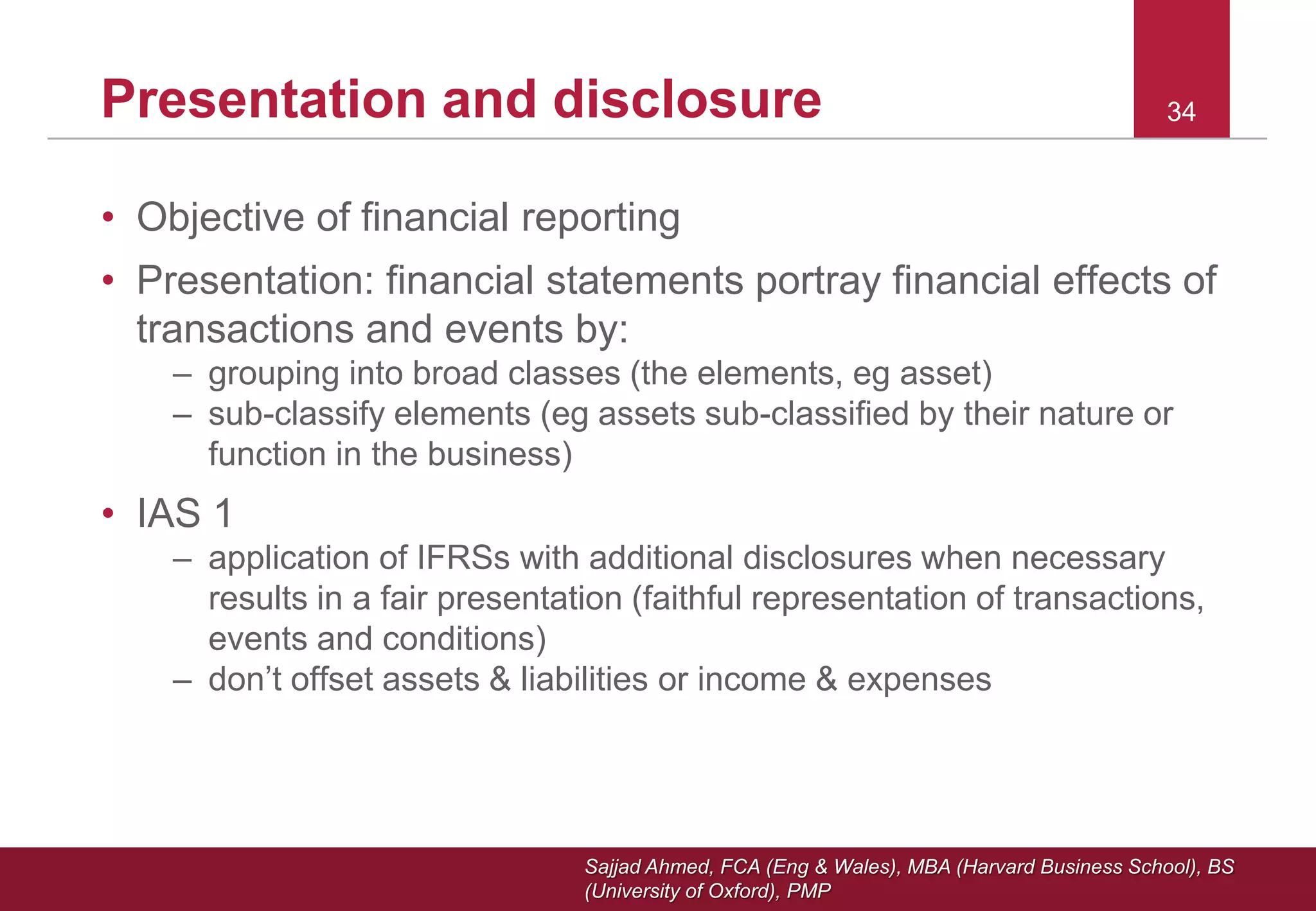
Presentation and disclosure
• Objective of financial reporting
• Presentation: financial statements portray financial effects of
transactions and events by:
– grouping into broad classes (the elements, eg asset)
– sub-classify elements (eg assets sub-classified by their nature or
function in the business)
• IAS 1
– application of IFRSs with additional disclosures when necessary
results in a fair presentation (faithful representation of transactions,
events and conditions)
– don’t offset assets & liabilities or income & expenses
34
Sajjad Ahmed, FCA (Eng & Wales), MBA (Harvard Business School), BS
(University of Oxford), PMP
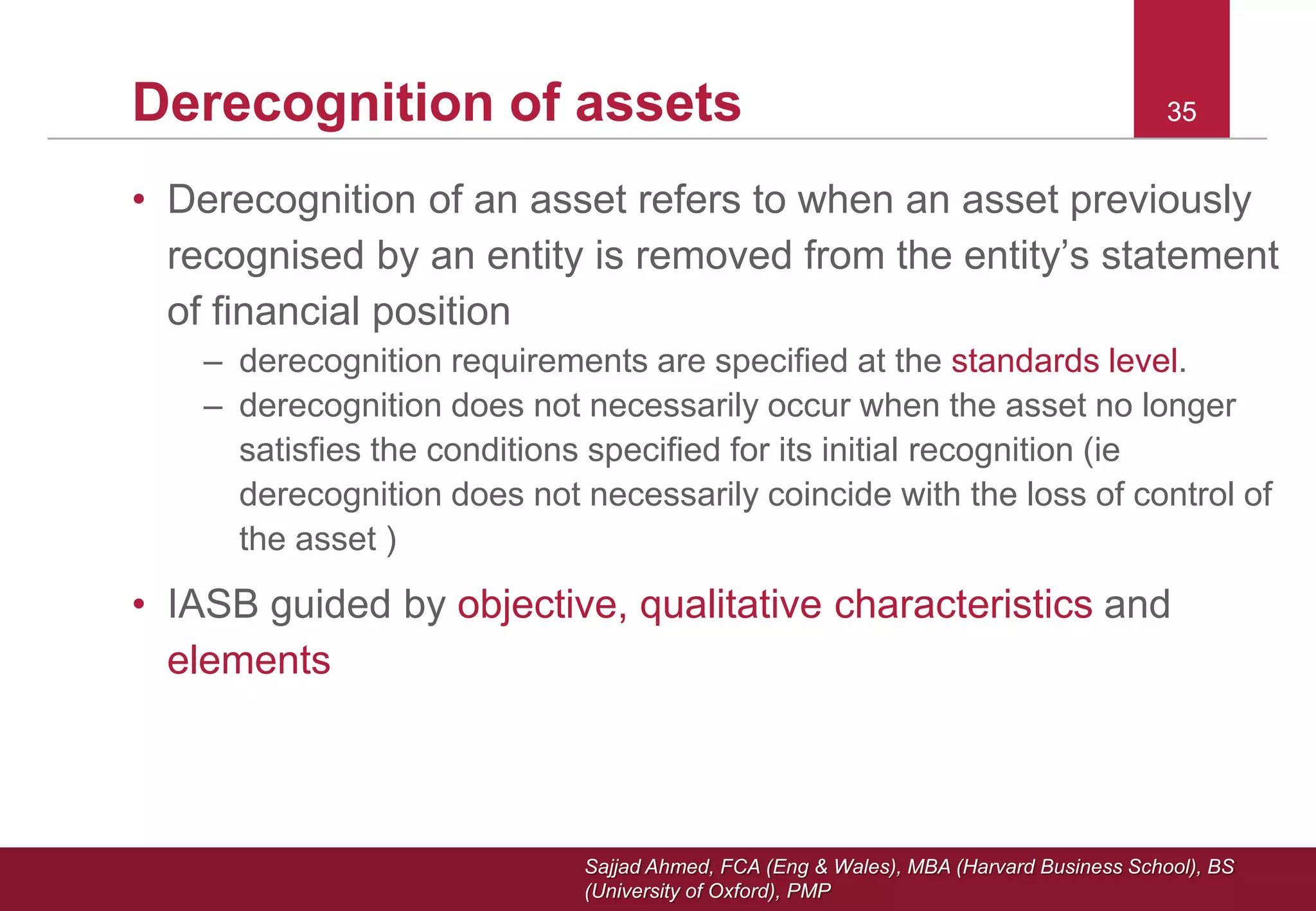
35Derecognition of assets
• Derecognition of an asset refers to when an asset previously
recognised by an entity is removed from the entity’s statement
of financial position
– derecognition requirements are specified at the standards level.
– derecognition does not necessarily occur when the asset no longer
satisfies the conditions specified for its initial recognition (ie
derecognition does not necessarily coincide with the loss of control of
the asset )
• IASB guided by objective, qualitative characteristics and
elements
35
Sajjad Ahmed, FCA (Eng & Wales), MBA (Harvard Business School), BS
(University of Oxford), PMP
36
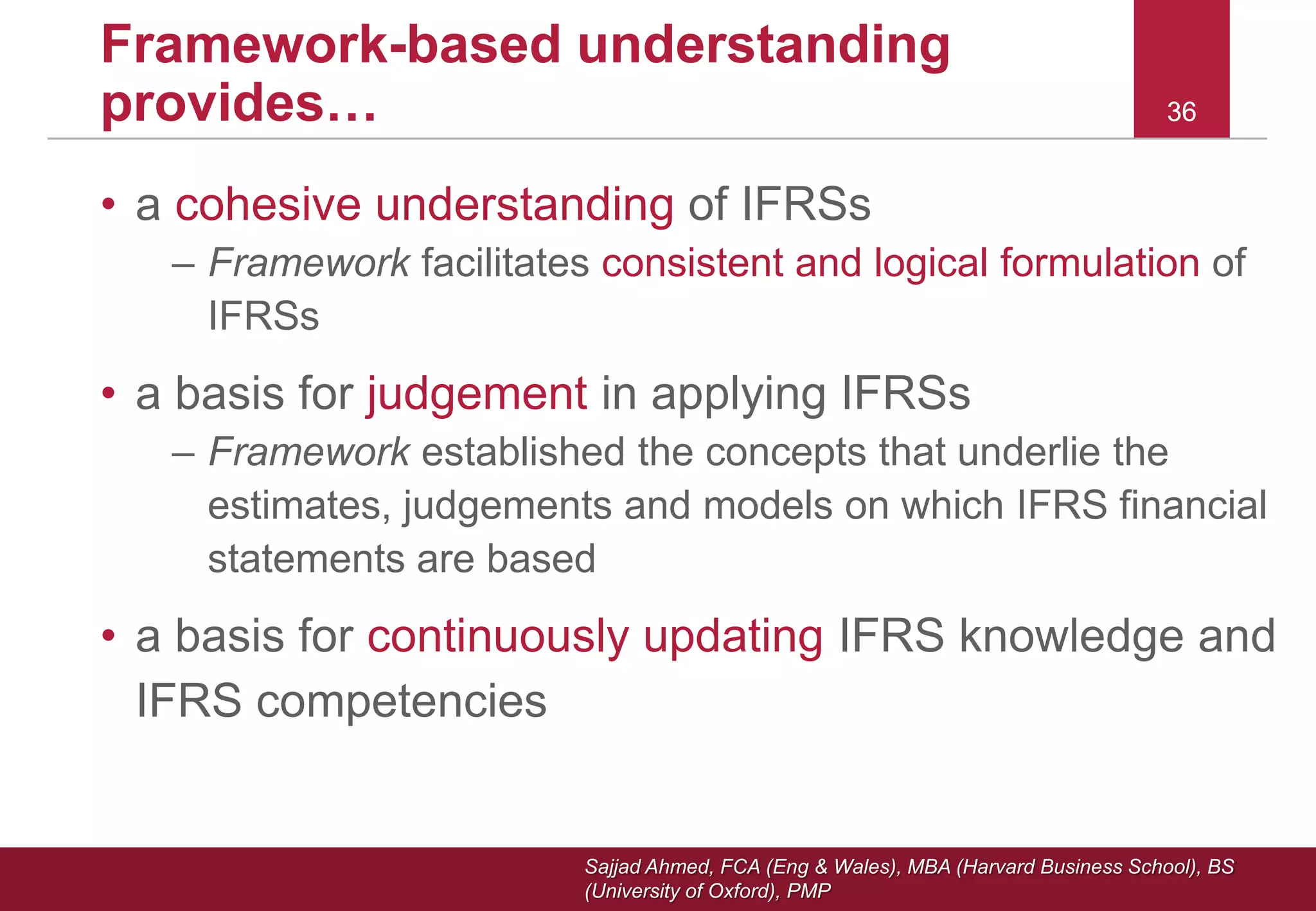
Framework-based understanding
provides… 36
• a cohesive understanding of IFRSs
– Framework facilitates consistent and logical formulation of
IFRSs
• a basis for judgement in applying IFRSs
– Framework established the concepts that underlie the
estimates, judgements and models on which IFRS financial
statements are based
• a basis for continuously updating IFRS knowledge and
IFRS competencies
Sajjad Ahmed, FCA (Eng & Wales), MBA (Harvard Business School), BS
(University of Oxford), PMP
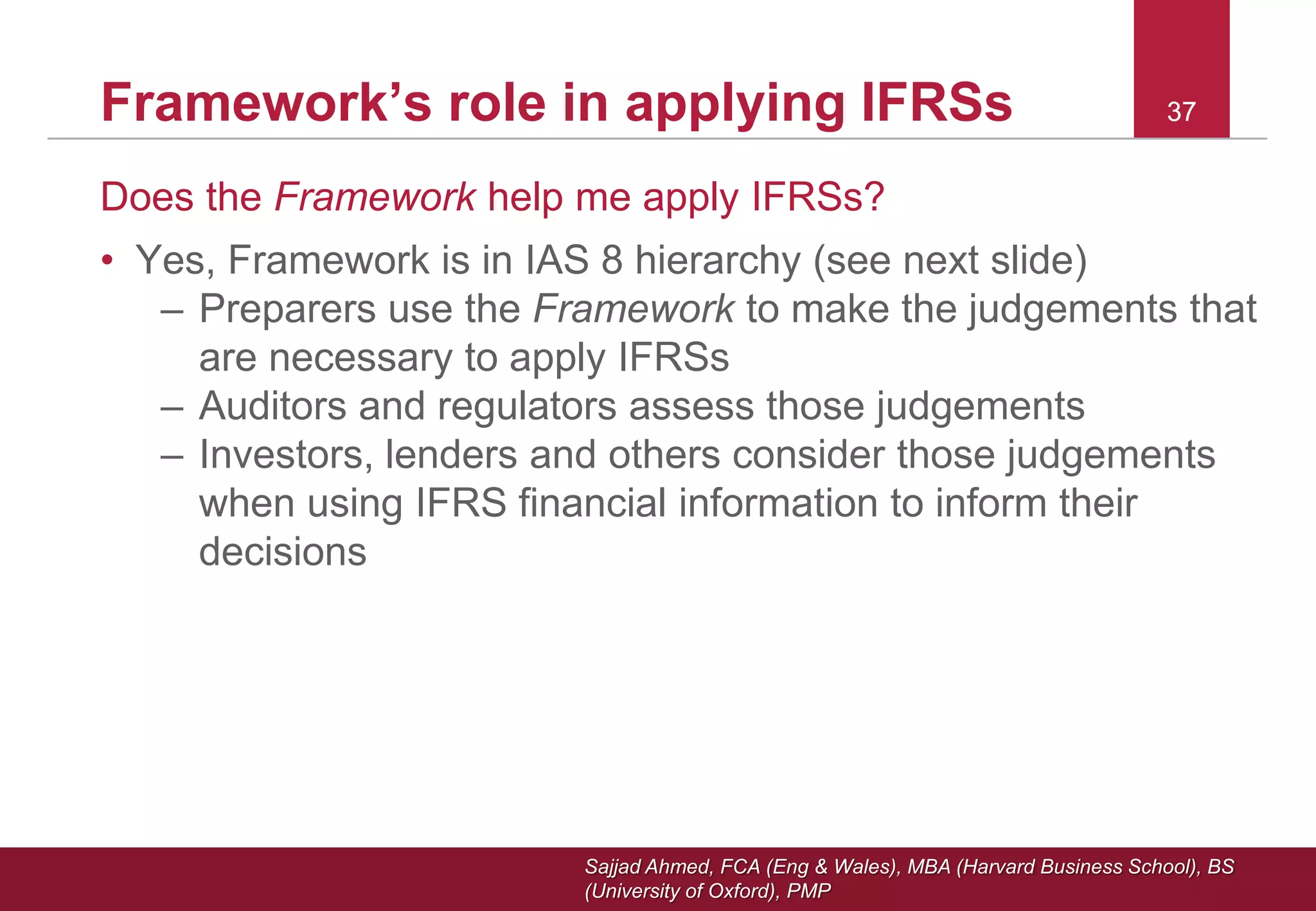
37Framework’s role in applying IFRSs 37
Does the Framework help me apply IFRSs?
• Yes, Framework is in IAS 8 hierarchy (see next slide)
– Preparers use the Framework to make the judgements that
are necessary to apply IFRSs
– Auditors and regulators assess those judgements
– Investors, lenders and others consider those judgements
when using IFRS financial information to inform their
decisions
Sajjad Ahmed, FCA (Eng & Wales), MBA (Harvard Business School), BS
(University of Oxford), PMP
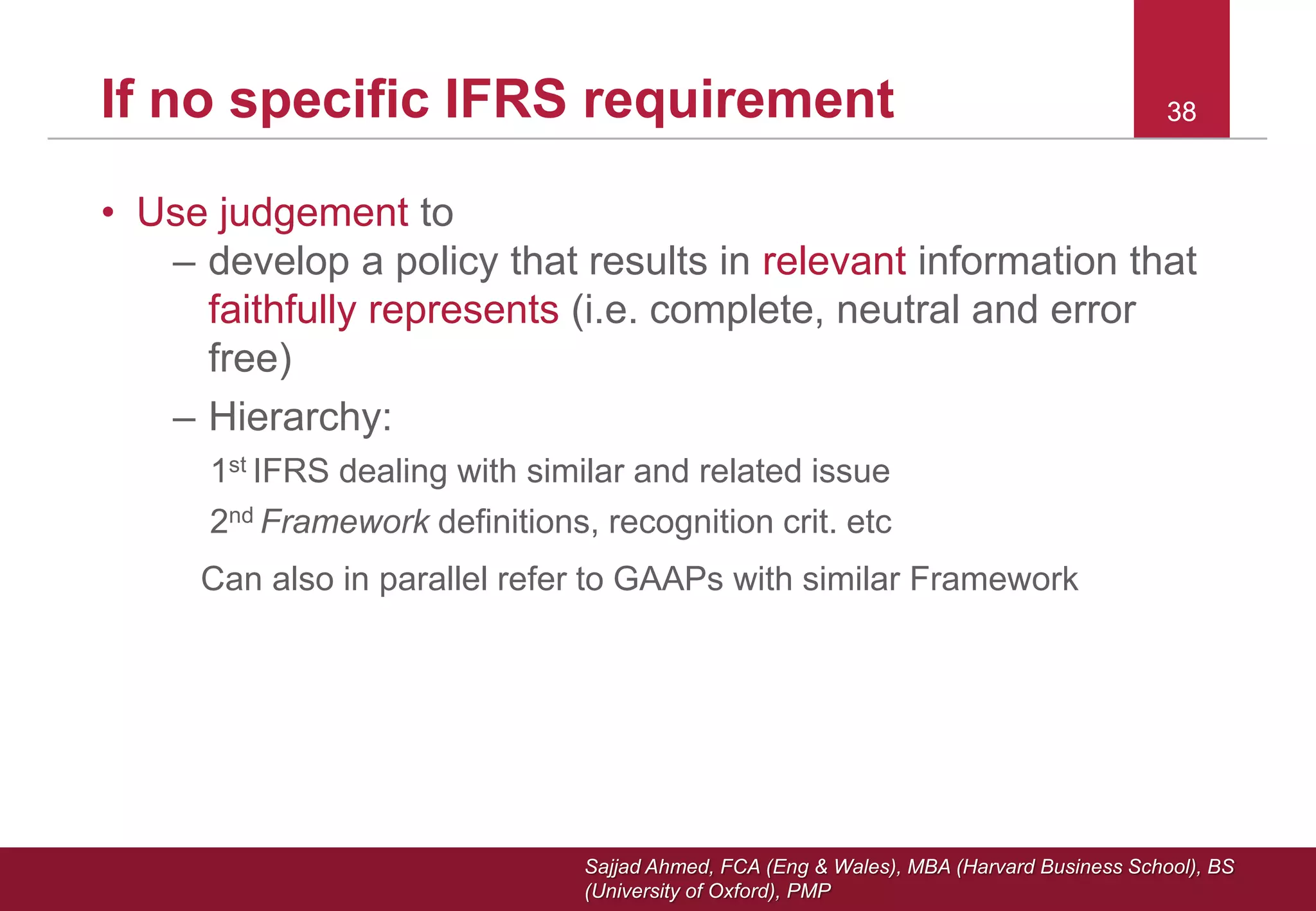
38If no specific IFRS requirement
• Use judgement to
– develop a policy that results in relevant information that
faithfully represents (i.e. complete, neutral and error
free)
– Hierarchy:
1st IFRS dealing with similar and related issue
2nd Framework definitions, recognition crit. etc
Can also in parallel refer to GAAPs with similar Framework
38
Sajjad Ahmed, FCA (Eng & Wales), MBA (Harvard Business School), BS
(University of Oxford), PMP
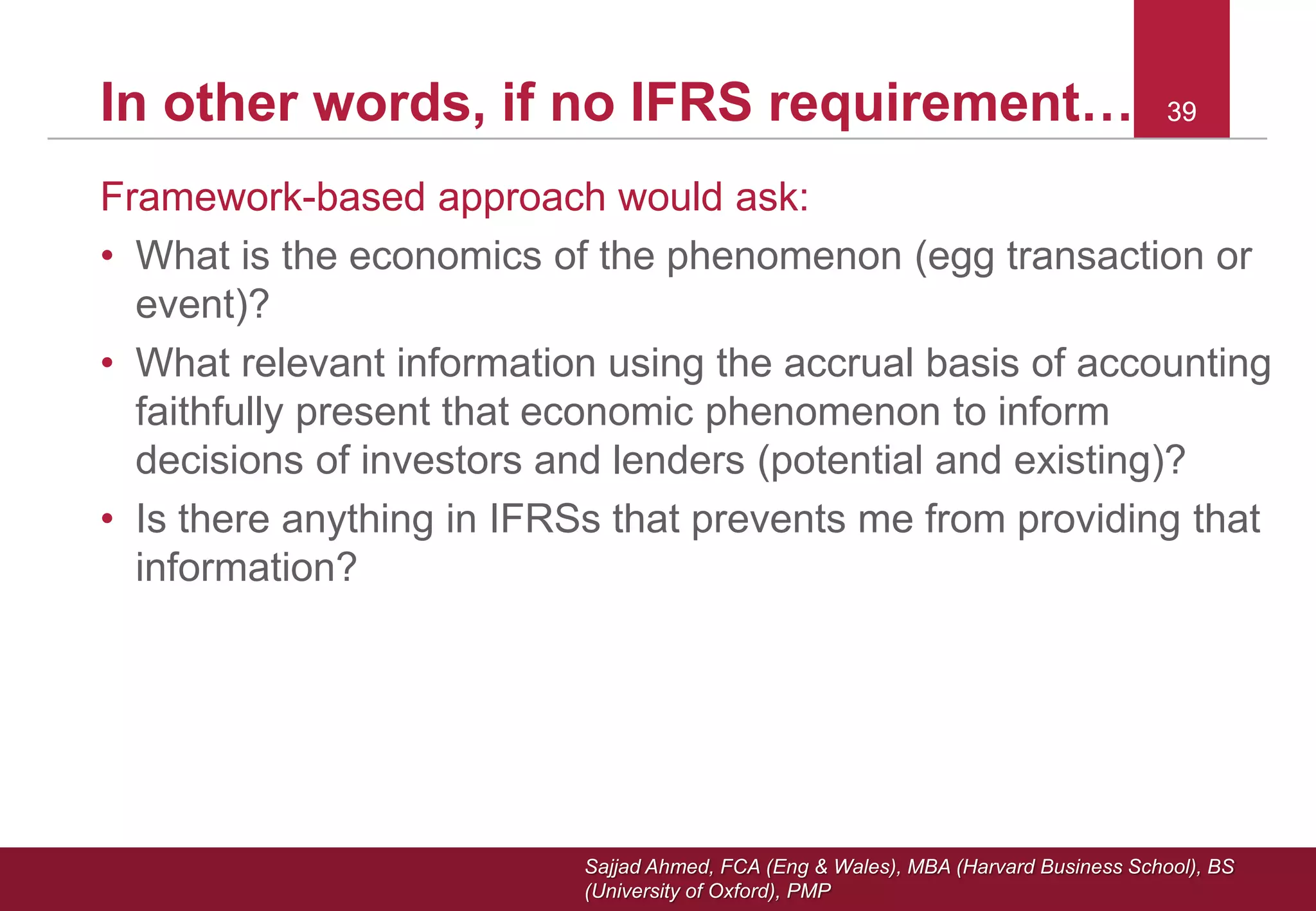
39In other words, if no IFRS requirement… 39
Framework-based approach would ask:
• What is the economics of the phenomenon (egg transaction or
event)?
• What relevant information using the accrual basis of accounting
faithfully present that economic phenomenon to inform
decisions of investors and lenders (potential and existing)?
• Is there anything in IFRSs that prevents me from providing that
information?
Sajjad Ahmed, FCA (Eng & Wales), MBA (Harvard Business School), BS
(University of Oxford), PMP
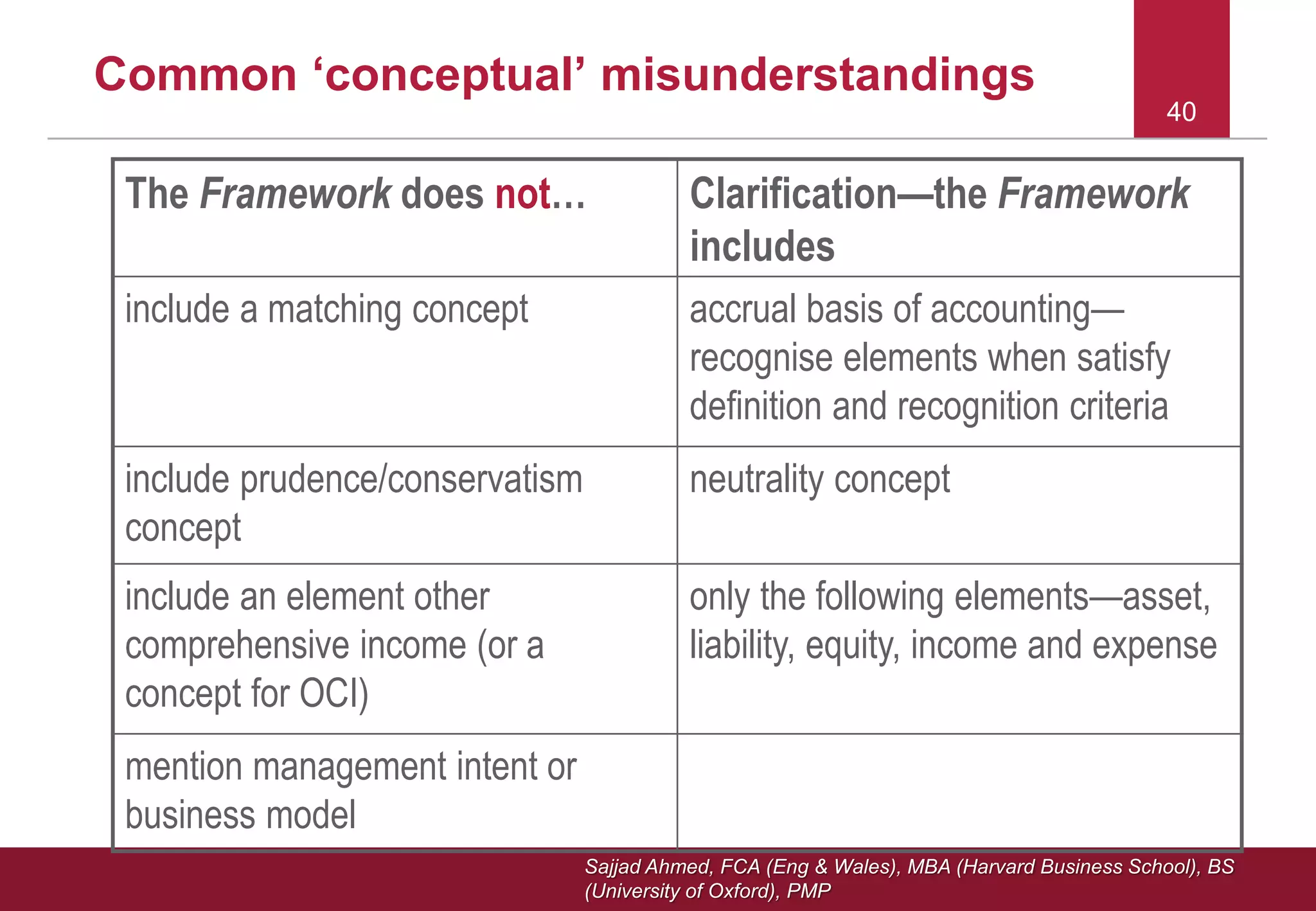
Common ‘conceptual’ misunderstandings
The Framework does not… Clarification—the Framework
includes
include a matching concept accrual basis of accounting—
recognise elements when satisfy
definition and recognition criteria
include prudence/conservatism
concept
neutrality concept
include an element other
comprehensive income (or a
concept for OCI)
only the following elements—asset,
liability, equity, income and expense
mention management intent or
business model
40
Sajjad Ahmed, FCA (Eng & Wales), MBA (Harvard Business School), BS
(University of Oxford), PMP
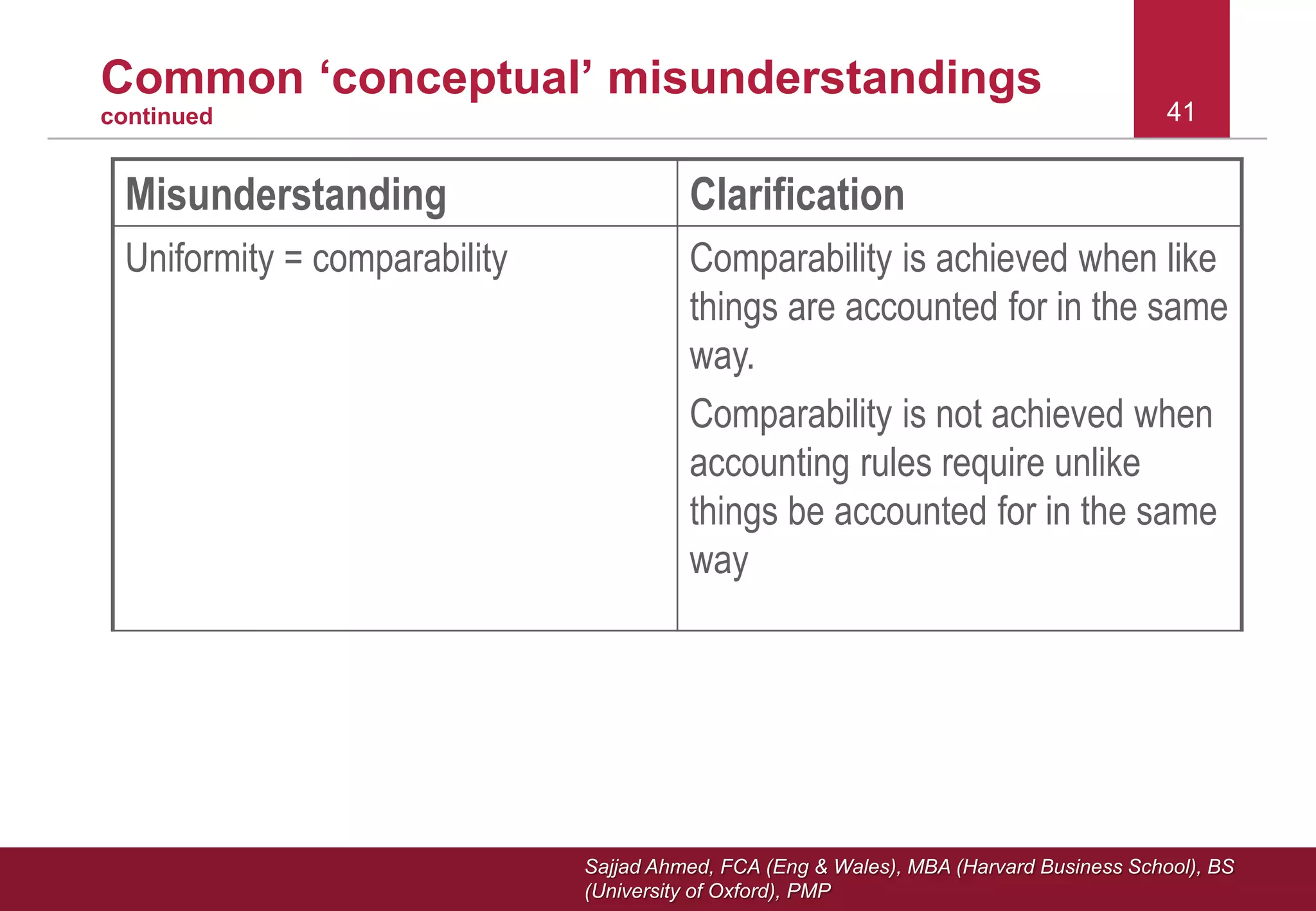
Common ‘conceptual’ misunderstandings
continued
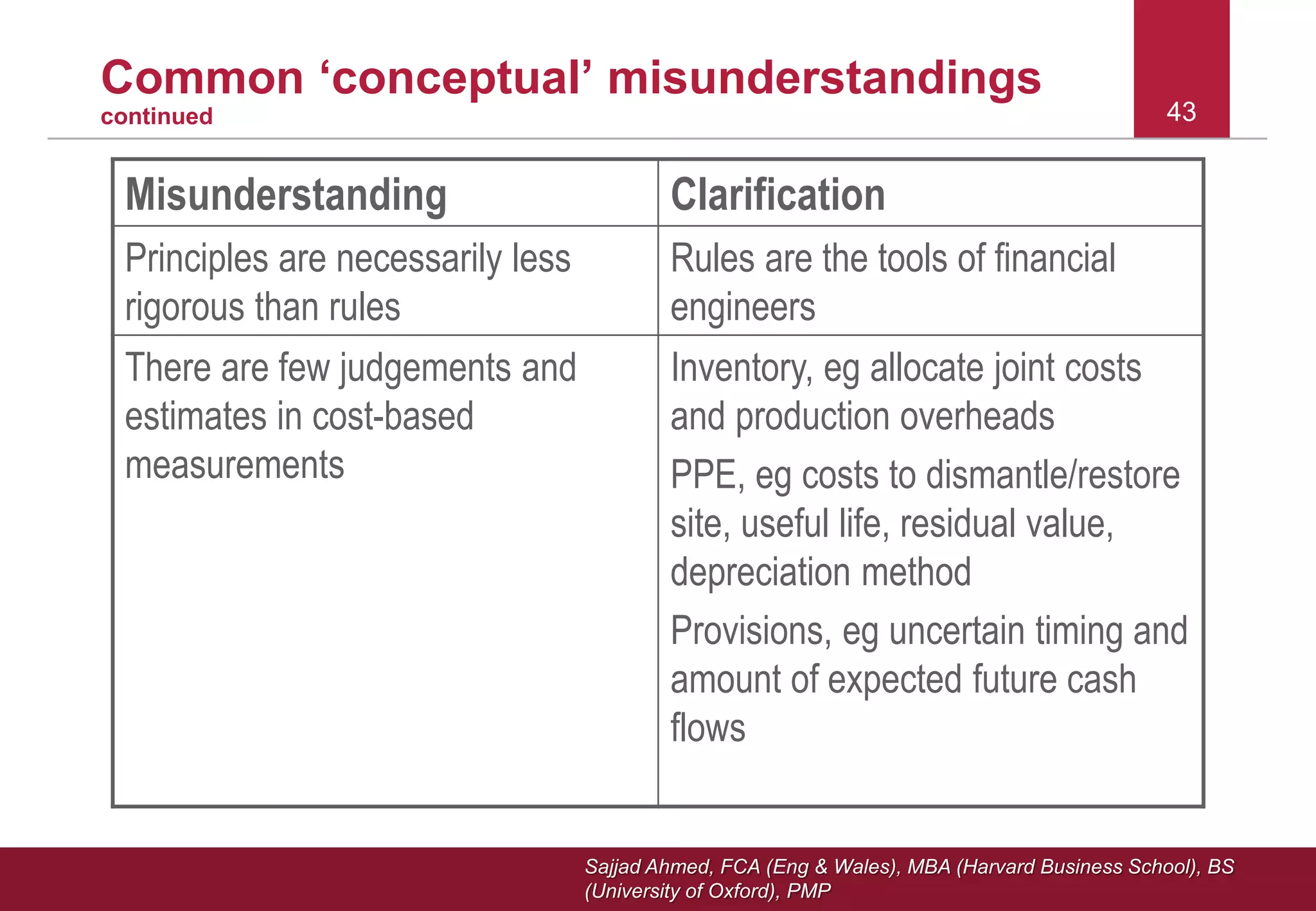
Misunderstanding Clarification
Uniformity = comparability Comparability is achieved when like
things are accounted for in the same
way.
Comparability is not achieved when
accounting rules require unlike
things be accounted for in the same
way
41
Sajjad Ahmed, FCA (Eng & Wales), MBA (Harvard Business School), BS
(University of Oxford), PMP
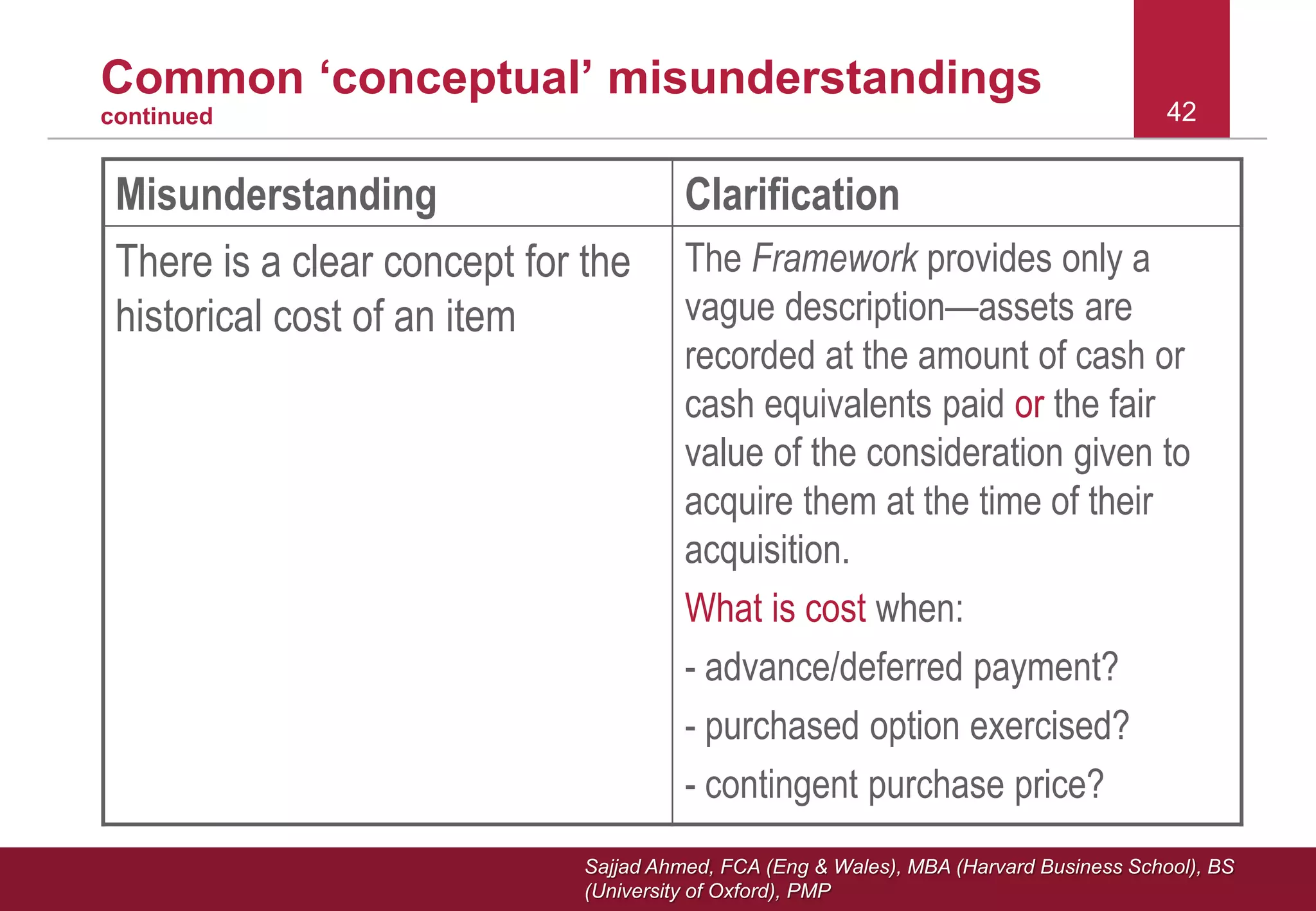
Common ‘conceptual’ misunderstandings
continued
Misunderstanding Clarification
There is a clear concept for the
historical cost of an item
The Framework provides only a
vague description—assets are
recorded at the amount of cash or
cash equivalents paid or the fair
value of the consideration given to
acquire them at the time of their
acquisition.
What is cost when:
- advance/deferred payment?
- purchased option exercised?
- contingent purchase price?
42
Sajjad Ahmed, FCA (Eng & Wales), MBA (Harvard Business School), BS
(University of Oxford), PMP
Common ‘conceptual’ misunderstandings
continued
Misunderstanding Clarification
Principles are necessarily less
rigorous than rules
Rules are the tools of financial
engineers
There are few judgements and
estimates in cost-based
measurements
Inventory, eg allocate joint costs
and production overheads
PPE, eg costs to dismantle/restore
site, useful life, residual value,
depreciation method
Provisions, eg uncertain timing and
amount of expected future cash
flows
43
Sajjad Ahmed, FCA (Eng & Wales), MBA (Harvard Business School), BS
(University of Oxford), PMP
44
Questions or comments?
4444

IFRS - Conceptual framework

  • 1.
    International Financial ReportingStandards The views expressed in this presentation are those of the presenter, not necessarily those of the IASB or IFRS Foundation. July 25, 2013 Conceptual Framework for Financial Reporting A Discussion session with SBOTS 18 @ National Institute of Banking & Finance (NIBAF) KThe views expressed in this presentation are those of the presenter, not necessarily those of the IASB or IFRS Foundation. By: Sajjad Ahmed FCA (Eng & Wales), PMP, MBA (Harvard Business School), BS (University of Oxford)
  • 2.
    Sajjad Ahmed, FCA(Eng & Wales), MBA (Harvard Business School), BS (University of Oxford), PMP 2Points to Ponder upon… ‘The Direction’ What is Financial Reporting???? How does the Financial Reporting impact the stakeholders and in-turn the business itself??? Need for Regulator in Financial reporting ‘business’ ???? Globalization of businesses and its relevance to the Financial Reporting mechanism???? Relevance to your job????
  • 3.
    Sajjad Ahmed, FCA(Eng & Wales), MBA (Harvard Business School), BS (University of Oxford), PMP Role of the Conceptual Framework • Conceptual Framework sets out agreed concepts that underlie financial reporting – objective, qualitative characteristics, element definitions, … • IASB uses Conceptual Framework to set standards – enhances consistency across standards – enhances consistency over time as Board members change – provides benchmark for judgments • Preparers use Conceptual Framework to develop accounting policies in the absence of specific standard or interpretation 3
  • 4.
    Sajjad Ahmed, FCA(Eng & Wales), MBA (Harvard Business School), BS (University of Oxford), PMP 4 Does the Framework help me understand IFRSs? 4 • Yes, the starting point for understanding all IFRS information is the objective and the concepts that flow logically from that objective: – IASB uses Framework to set IFRSs – Teachers/Trainers use Framework-based teaching to prepare students to make judgements that are necessary to apply IFRSs – Preparers use Framework to make the judgements that are necessary to apply IFRSs – Auditors and regulators assess those judgements – Investors, lenders and others consider those judgements when using IFRS financial information to inform their decisions
  • 5.
    Sajjad Ahmed, FCA(Eng & Wales), MBA (Harvard Business School), BS (University of Oxford), PMP 55Objective of financial reporting “Provide financial information about the reporting entity that is useful to existing and potential investors, lenders and other creditors in making decisions about providing resources to the entity” Note: • other aspects of the Conceptual Framework flow logically from the objective (CF.OB1) • Conceptual Framework sets out the concepts that underlie IFRS financial statements and assist the IASB in the development of future IFRSs and in its review of existing IFRSs (CF.Purpose and Status)
  • 6.
    Sajjad Ahmed, FCA(Eng & Wales), MBA (Harvard Business School), BS (University of Oxford), PMP 66Objective of financial reporting • Investors’, lenders’ and other creditors’ expectations about returns depend on their assessment of the amount, timing and uncertainty of (the prospects for) future net cash inflows to the entity. – Decisions by investors about buying, selling or holding equity and debt instruments depend on the returns that they expect from an investment in those instruments, eg dividends, principal and interest payments or market price increases. – Decisions by lenders about providing or settling loans and other forms of credit depend on the principal and interest payments or other returns that they expect.
  • 7.
    Sajjad Ahmed, FCA(Eng & Wales), MBA (Harvard Business School), BS (University of Oxford), PMP 77Objective of financial reporting • To assess an entity’s prospects for future net cash inflows, existing and potential investors, lenders and other creditors need information about: – the resources of the entity; – claims against the entity; and – how efficiently and effectively the entity's management and governing board have discharged their responsibilities to use the entity's resources – eg protecting the entity's resources from unfavourable effects of economic factors such as price and technological changes
  • 8.
    Sajjad Ahmed, FCA(Eng & Wales), MBA (Harvard Business School), BS (University of Oxford), PMP 88Qualitative characteristics • If financial information is to be useful, it must be relevant and faithfully represent what it purports to represent (ie fundamental qualities). – Financial information without both relevance and faithful representation is not useful, and it cannot be made useful by being more comparable, verifiable, timely or understandable. • The usefulness of financial information is enhanced if it is comparable, verifiable, timely and understandable (ie enhancing qualities—less critical but still highly desirable) – Financial information that is relevant and faithfully represented may still be useful even if it does not have any of the enhancing qualitative characteristics.
  • 9.
    Sajjad Ahmed, FCA(Eng & Wales), MBA (Harvard Business School), BS (University of Oxford), PMP 99Fundamental qualitative characteristics • Relevance: capable of making a difference in users’ decisions – predictive value – confirmatory value – materiality (entity-specific) • Faithful representation: faithfully represents the phenomena it purports to represent – completeness (depiction including numbers and words) – neutrality (unbiased) – free from error (ideally) Note: faithful representation replaces reliability
  • 10.
    Sajjad Ahmed, FCA(Eng & Wales), MBA (Harvard Business School), BS (University of Oxford), PMP 1010Enhancing Qualitative Characteristics • Comparability: like things look alike; different things look different • Verifiability: knowledgeable and independent observers could reach consensus, but not necessarily complete agreement, that a depiction is a faithful representation • Timeliness: having information available to decision-makers in time to be capable of influencing their decisions • Understandability: Classify, characterize, and present information clearly and concisely
  • 11.
    Sajjad Ahmed, FCA(Eng & Wales), MBA (Harvard Business School), BS (University of Oxford), PMP 111111Pervasive constraint • Reporting financial information imposes costs, and it is important that those costs are justified by the benefits of reporting that information. • Benefits include more efficient functioning of capital markets and a lower cost of capital for the economy. • Costs include collecting, processing, verifying and disseminating financial information and the costs of analysing and interpreting the information provided. • In applying the cost constraint, the IASB assesses whether the benefits of reporting particular information are likely to justify the costs incurred to provide and use that information. Those assessments are usually based on a combination of quantitative and qualitative information.
  • 12.
    Sajjad Ahmed, FCA(Eng & Wales), MBA (Harvard Business School), BS (University of Oxford), PMP 121212Summary • Reporting financial information that is relevant and faithfully represents what it purports to represent helps users to make decisions with more confidence (ie financial information must possess the fundamental qualitative characteristics). • IFRS requirements must be cost-beneficial • Applying the enhancing qualitative characteristics is an iterative process that does not follow a prescribed order. Sometimes, one enhancing qualitative characteristic may have to be diminished to maximise another qualitative characteristic.
  • 13.
    Sajjad Ahmed, FCA(Eng & Wales), MBA (Harvard Business School), BS (University of Oxford), PMP 1313Elements • Asset: Resource controlled as a result of past events and from which future economic benefits are expected to flow • Liability: Present obligation arising from past events, the settlement of which is expected to result in outflow of resources embodying economic benefits • Equity: Assets minus liabilities • Income (expense): Increases (decreases) in economic benefits during period from inflows or enhancements (outflows or depletions) of assets (liabilities) or decreases (incurrences) of liabilities from in increases (decreases) in equity, other than contributions from (distributions to) equity
  • 14.
    Sajjad Ahmed, FCA(Eng & Wales), MBA (Harvard Business School), BS (University of Oxford), PMP 14Elements, examples • Asset? • an oil explorer’s exploration rig • a fish farmer’s breeding stock • fish in the sea (from a fish harvester’s perspective) • own shares held by an entity • firm order to acquire gold, settle net in cash • firm order to acquire gold, cannot settle net • expenditure on major inspection (a condition of continuing to operate an item of PPE) • ‘right’ to recover past costs incurred increased future prices in a rate regulated activity 14
  • 15.
    Sajjad Ahmed, FCA(Eng & Wales), MBA (Harvard Business School), BS (University of Oxford), PMP 15Elements, examples • Liability? • defending a lawsuit • promise to make good environmental damage (no legal obligation to do so) • law requires smoke filters be fitted to factory • lessee—short-term car rental agreement • participant in a cap and trade emission trading scheme 15
  • 16.
    Sajjad Ahmed, FCA(Eng & Wales), MBA (Harvard Business School), BS (University of Oxford), PMP 16Elements, examples • Liability or equity? • issue ordinary share • issue compulsorily redeemable debt (fixed interest, fixed redemption) • issue convertible debt instrument (holder has option to convert) • non-controlling interest 16
  • 17.
    Sajjad Ahmed, FCA(Eng & Wales), MBA (Harvard Business School), BS (University of Oxford), PMP 17Elements, examples 17 Liability or equity at 31/12/20X1? • On 15/01/20X2 the shareholders of an entity approved the distribution of USD 40,000 dividend for the year ended 31/12/20X1 (as proposed by management on 21 December 20X1. – USD 18,000: minimum dividend required by law for the year ended 31 December 20X1 – USD 22,000: additional to required minimum dividends
  • 18.
    Sajjad Ahmed, FCA(Eng & Wales), MBA (Harvard Business School), BS (University of Oxford), PMP 18Classification • Objective of financial reporting • Financial statements portray financial effects of transactions and events by: – grouping into broad classes (the elements, eg asset) – sub-classify elements (eg assets sub-classified by their nature or function in the business) • IAS 1 – application of IFRSs with additional disclosures when necessary results in a fair presentation (faithful representation of transactions, events and conditions) – don’t offset assets & liabilities or income & expenses
  • 19.
    Sajjad Ahmed, FCA(Eng & Wales), MBA (Harvard Business School), BS (University of Oxford), PMP 19Classification - Assets & Claims • Information about the nature and amounts of a reporting entity’s economic resources and claims can help users to identify the reporting entity’s financial strengths and weaknesses. • That information can help users to: – assess the reporting entity’s liquidity and solvency – its needs for additional financing and how successful it is likely to be in obtaining that financing. (CF.OB13)
  • 20.
    Sajjad Ahmed, FCA(Eng & Wales), MBA (Harvard Business School), BS (University of Oxford), PMP 20Classification - Claims • Information about priorities and payment requirements of existing claims helps users to predict how future cash flows will be distributed among those with a claim against the reporting entity (CF.OB13)
  • 21.
    Sajjad Ahmed, FCA(Eng & Wales), MBA (Harvard Business School), BS (University of Oxford), PMP 21Classification - Liability • Examples • obligation to pay current tax • metered power used but not yet billed by supplier • ‘normal’ warrantee obligation to make good manufacturing defect • warrantee obligation to compensate for manufacturing defects by settling in compensation in cash • extended warrantee obligation 21
  • 22.
    Sajjad Ahmed, FCA(Eng & Wales), MBA (Harvard Business School), BS (University of Oxford), PMP 22Classification, assets • Different types of economic resources affect a user’s assessment of the reporting entity's prospects for future cash flows differently. – Some future cash flows result directly from existing economic resources (eg accounts receivable and investment property). – Other cash flows result from using several resources in combination to produce and market goods or services to customers (eg PPE and intangible assets). Although those cash flows cannot be identified with individual economic resources (or claims), users of financial reports need to know the nature and amount of the resources available for use in a reporting entity’s operations. (CF.OB14)
  • 23.
    Sajjad Ahmed, FCA(Eng & Wales), MBA (Harvard Business School), BS (University of Oxford), PMP 23Classification - Assets • Examples • investment in ordinary shares • gold • land • land planted with plantation • farm implements • bird breeder’s birds • birds in a zoological garden • birds in a bird breeding zoo • owner-occupied building held for sale • owner-occupied building decided to abandon 23
  • 24.
    Sajjad Ahmed, FCA(Eng & Wales), MBA (Harvard Business School), BS (University of Oxford), PMP 24The Concepts: ‘Financial position’ 24 The concepts • Information about the nature and amounts of an entity’s economic resources and claims against the reporting entity help users identify the reporting entity’s financial strengths and weaknesses (OB12–OB14). – help assess entity’s prospects for future cash flows, its liquidity and solvency, its needs for additional financing and how successful it is likely to be in obtaining financing.
  • 25.
    Sajjad Ahmed, FCA(Eng & Wales), MBA (Harvard Business School), BS (University of Oxford), PMP 25The Concepts: ‘Financial performance’ 25 • Financial performance during a period, reflected by changes in its economic resources and claims (other than by obtaining additional resources directly from investors and creditors), is useful in assessing the entity’s past and future ability to generate net cash inflows (OB18) • Accrual basis of accounting (depicts the effects of transactions and other events and circumstances on a reporting entity’s economic resources and claims in the periods in which those effects occur (see ¶OB17)
  • 26.
    Sajjad Ahmed, FCA(Eng & Wales), MBA (Harvard Business School), BS (University of Oxford), PMP 26Recognition • Accrual basis of accounting – recognise element (eg asset) when satisfy definition and recognition criteria • Recognise item that meets element definition when – probable that benefits will flow to/from the entity – has cost or value that can measured reliably
  • 27.
    Sajjad Ahmed, FCA(Eng & Wales), MBA (Harvard Business School), BS (University of Oxford), PMP 27Recognition What does probable mean? The meaning of probable is determined at the standards level. Therefore, inconsistent use across IFRSs What does measure reliably mean? To a large extent, financial reports are based on estimates, judgements and models rather than exact depictions.
  • 28.
    Sajjad Ahmed, FCA(Eng & Wales), MBA (Harvard Business School), BS (University of Oxford), PMP 28Recognition – Examples • Recognise the asset? • a hospital’s backup backup generator (expect never to use it) • an oil explorer’s exploration rig • an oil extractor’s unproven reserves • an oil extractor’s proven reserves • advertising expenditure • research and development expenditure • internally generated brand • lessee—short-term car rental agreement • firm order to acquire gold, cannot settle net
  • 29.
    Sajjad Ahmed, FCA(Eng & Wales), MBA (Harvard Business School), BS (University of Oxford), PMP 29Measurement concepts • Measurement is the process of determining monetary amounts at which elements are recognised and carried. (CF.4.54) • To a large extent, financial reports are based on estimates, judgements and models rather than exact depictions. The Framework establishes the concepts that underlie those estimates, judgements and models (CF.OB11) • IASB guided by objective and qualitative characteristics when specifying measurements. 29
  • 30.
    Sajjad Ahmed, FCA(Eng & Wales), MBA (Harvard Business School), BS (University of Oxford), PMP 30Measurement ‘concepts’ 30 • Measurement part of Conceptual Framework is weak • A number of different measurement bases are employed to different degrees and in varying combinations in financial statements, including – historical cost – current cost – realisable (settlement) value – present value (CF.4.55) • IASB guided by objective and qualitative characteristics when specifying measurements.
  • 31.
    Sajjad Ahmed, FCA(Eng & Wales), MBA (Harvard Business School), BS (University of Oxford), PMP The concept, defined in IFRS 13 • Fair value is the price that would be received to sell an asset or paid to transfer a liability (exit price) in an orderly transaction (not a forced sale) between market participants (market-based view) at the measurement date (current price). • Fair value is a market-based measurement (it is not an entity-specific measurement) • consequently, the entity’s intention to hold an asset or to settle or otherwise fulfil a liability is not relevant when measuring fair value. 31Fair value measurement concept
  • 32.
    Sajjad Ahmed, FCA(Eng & Wales), MBA (Harvard Business School), BS (University of Oxford), PMP 32Fair value measurement concept 32 • Information about an entity’s financial performance in a period, reflected by changes in economic resources is useful in assessing the entity’s past and future ability to generate net cash inflows (see CF.OB18) • Income (expenses) are increases (decreases) in economic benefits during an accounting period in the form of enhancements (depletions) of assets (CF.4.25) • Measure element at fair value with changes in fair value recognised as income or expense for the period in which it arises
  • 33.
    Sajjad Ahmed, FCA(Eng & Wales), MBA (Harvard Business School), BS (University of Oxford), PMP © 2010 IFRS Found ation. 30 Canno n Street | London EC4M 6XH | UK. www.ia sb.org 33 ASSET TYPE MEASUREMENT AT INITIAL RECOGNITION COST MODEL BASIS OF IMPAIRMENT TEST IAS 2 Inventory Cost of purchase and/or conversion costs and costs to get the item to the location and condition for sale Cost unless impaired Lower of cost (initial recognition) and net realisable value IAS 16 Property, Plant and Equipment Purchase costs + construction costs + costs to bring to the location and condition necessary to be capable of operating in the manner intended by management. Accounting policy choice: cost less accumulated depreciation and impairment, if any Compare carrying amount to recoverable amount. Recoverable amount is greater of value in use and fair value less disposal costs (IAS 36) IAS 38 Intangibles Assets Purchase costs + development costs + costs to bring to the location and condition necessary to be capable of operating as intended by management Accounting policy choice: cost less accumulated amortisation (unless indefinite life asset) and amortisation, if any IAS 40 Investment Property Cost including transaction costs Accounting policy choice: cost less accumulated depreciation (unless land) and impairment (if any) IFRS 9 Financial Instruments Fair value For particular business models amortised cost IAS 39 specifies impairment rules
  • 34.
    Sajjad Ahmed, FCA(Eng & Wales), MBA (Harvard Business School), BS (University of Oxford), PMP Presentation and disclosure • Objective of financial reporting • Presentation: financial statements portray financial effects of transactions and events by: – grouping into broad classes (the elements, eg asset) – sub-classify elements (eg assets sub-classified by their nature or function in the business) • IAS 1 – application of IFRSs with additional disclosures when necessary results in a fair presentation (faithful representation of transactions, events and conditions) – don’t offset assets & liabilities or income & expenses 34
  • 35.
    Sajjad Ahmed, FCA(Eng & Wales), MBA (Harvard Business School), BS (University of Oxford), PMP 35Derecognition of assets • Derecognition of an asset refers to when an asset previously recognised by an entity is removed from the entity’s statement of financial position – derecognition requirements are specified at the standards level. – derecognition does not necessarily occur when the asset no longer satisfies the conditions specified for its initial recognition (ie derecognition does not necessarily coincide with the loss of control of the asset ) • IASB guided by objective, qualitative characteristics and elements 35
  • 36.
    Sajjad Ahmed, FCA(Eng & Wales), MBA (Harvard Business School), BS (University of Oxford), PMP 36 Framework-based understanding provides… 36 • a cohesive understanding of IFRSs – Framework facilitates consistent and logical formulation of IFRSs • a basis for judgement in applying IFRSs – Framework established the concepts that underlie the estimates, judgements and models on which IFRS financial statements are based • a basis for continuously updating IFRS knowledge and IFRS competencies
  • 37.
    Sajjad Ahmed, FCA(Eng & Wales), MBA (Harvard Business School), BS (University of Oxford), PMP 37Framework’s role in applying IFRSs 37 Does the Framework help me apply IFRSs? • Yes, Framework is in IAS 8 hierarchy (see next slide) – Preparers use the Framework to make the judgements that are necessary to apply IFRSs – Auditors and regulators assess those judgements – Investors, lenders and others consider those judgements when using IFRS financial information to inform their decisions
  • 38.
    Sajjad Ahmed, FCA(Eng & Wales), MBA (Harvard Business School), BS (University of Oxford), PMP 38If no specific IFRS requirement • Use judgement to – develop a policy that results in relevant information that faithfully represents (i.e. complete, neutral and error free) – Hierarchy: 1st IFRS dealing with similar and related issue 2nd Framework definitions, recognition crit. etc Can also in parallel refer to GAAPs with similar Framework 38
  • 39.
    Sajjad Ahmed, FCA(Eng & Wales), MBA (Harvard Business School), BS (University of Oxford), PMP 39In other words, if no IFRS requirement… 39 Framework-based approach would ask: • What is the economics of the phenomenon (egg transaction or event)? • What relevant information using the accrual basis of accounting faithfully present that economic phenomenon to inform decisions of investors and lenders (potential and existing)? • Is there anything in IFRSs that prevents me from providing that information?
  • 40.
    Sajjad Ahmed, FCA(Eng & Wales), MBA (Harvard Business School), BS (University of Oxford), PMP Common ‘conceptual’ misunderstandings The Framework does not… Clarification—the Framework includes include a matching concept accrual basis of accounting— recognise elements when satisfy definition and recognition criteria include prudence/conservatism concept neutrality concept include an element other comprehensive income (or a concept for OCI) only the following elements—asset, liability, equity, income and expense mention management intent or business model 40
  • 41.
    Sajjad Ahmed, FCA(Eng & Wales), MBA (Harvard Business School), BS (University of Oxford), PMP Common ‘conceptual’ misunderstandings continued Misunderstanding Clarification Uniformity = comparability Comparability is achieved when like things are accounted for in the same way. Comparability is not achieved when accounting rules require unlike things be accounted for in the same way 41
  • 42.
    Sajjad Ahmed, FCA(Eng & Wales), MBA (Harvard Business School), BS (University of Oxford), PMP Common ‘conceptual’ misunderstandings continued Misunderstanding Clarification There is a clear concept for the historical cost of an item The Framework provides only a vague description—assets are recorded at the amount of cash or cash equivalents paid or the fair value of the consideration given to acquire them at the time of their acquisition. What is cost when: - advance/deferred payment? - purchased option exercised? - contingent purchase price? 42
  • 43.
    Sajjad Ahmed, FCA(Eng & Wales), MBA (Harvard Business School), BS (University of Oxford), PMP Common ‘conceptual’ misunderstandings continued Misunderstanding Clarification Principles are necessarily less rigorous than rules Rules are the tools of financial engineers There are few judgements and estimates in cost-based measurements Inventory, eg allocate joint costs and production overheads PPE, eg costs to dismantle/restore site, useful life, residual value, depreciation method Provisions, eg uncertain timing and amount of expected future cash flows 43
  • 44.
    Sajjad Ahmed, FCA(Eng & Wales), MBA (Harvard Business School), BS (University of Oxford), PMP 44 Questions or comments? 4444