McGraw-Hill/Irwin Copyright © 2012 by The McGraw-Hill Companies, Inc. All rights reserved.
23-2 
Options 
The right but not the obligation… 
This chapter explores various options and 
their payoff structure.
The right to buy an asset at a specified exercise price on or 
23-3 
Basic Options 
Call Option 
before the exercise date 
Put Option 
The right to sell an asset at a specified exercise price on or 
before the exercise date
Option Obligations 
Buyer Seller 
Call option Right to buy asset Obligation to sell asset 
Put option Right to sell asset Obligation to buy asset 
Does the seller of a call option hope the price of the 
underlying security moves up or down? 
Does the buyer of a put option hope the price of the 
underlying security moves up or down? 
23-4
23-5 
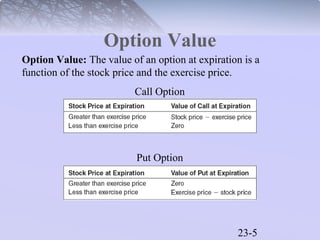
Option Value 
Option Value: The value of an option at expiration is a 
function of the stock price and the exercise price. 
Call Option 
Put Option
Option Value: Example 
Option values given an exercise price of $720 
23-6 
Stock Price $600 660 720 780 840 
Call Value $0 0 0 60 120 
Put Value $120 60 0 0 0 
What are the payoff limits for call option buyers? 
Sellers? 
What are the payoff limits for put option buyers? Sellers?
Call Option Value 
Call option value (buyer) given a $720 exercise price. 
23-7 
Share Price 
Call option value 
720 840 
$120
Call Option Profit 
Profit (buyer): Current Price - Exercise Price - Cost of Call 
$20 call option (buyer) given a $720 exercise price 
23-8 
Share Price 
Call option value 
720 840 
$100 
Profit = ($840 -$720) -$20 = $100
Call Option Value 
Call option payoff (seller) given a $720 exercise price. 
23-9 
Share Price 
Call option $ payoff 
720 840 
$-120
Call Option Profit 
Profit (Seller): Exercise Price - Current Price + Cost of Call 
$20 call option (seller) given a $720 exercise price: 
23-10 
Share Price 
Call option $ payoff 
720 840 
$-100 
$-120 
Profit = $720 -$840 + $20 = -$100
Call Option: Example 
How much must the stock be worth at expiration in order for a call 
holder to break even if the exercise price is $50 and the call premium 
23-11 
was $4?
23-12 
Put Option Value 
Put option value (buyer) given a $720 exercise price: 
Share Price 
Put option value 
600 720 
$120
Profit (buyer): Exercise Price - Current Price - Cost of Put 
23-13 
Put Option Profit 
$30 put option (buyer) given a $720 exercise price: 
Share Price 
Put option value 
600 720 
$90 
Profit = $720 - $600 - $30 = $90
23-14 
Put Option Value 
Put option payoff (seller) given a $720 exercise price. 
Share Price 
Put option $ payoff 600 720 
-$120
Put Option Profit 
Profit (Seller): Current Price - Exercise Price + Cost of Put 
$30 put option (seller) given a $720 exercise price. 
Share Price 
23-15 
Put option $ payoff 600 720 
-$90 
Profit = $600 - $720 + $30 = -$90
Put Options: Example 
What is your return on exercising a put option which was purchased 
for $10 with an exercise price of $85? The stock price at expiration is 
23-16 
$81.
Option Hedging Strategy 
23-17 
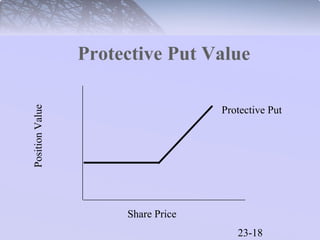
Protective Put: 
Share Price 
Position Value 
Protective Put 
Long Put 
Long Stock
Protective Put Value 
23-18 
Share Price 
Position Value 
Protective Put
Call Option Value: 
Upper and Lower Limits 
23-19 
Stock Price 
Upper Limit 
Lower Limit 
(Stock price - exercise price) or 0 
whichever is higher
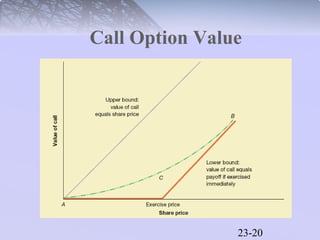
Call Option Value 
23-20
Call Option Value 
23-21
Black-Scholes Option 
23-22 
Pricing Model 
OptionC = Ps[N(d1)] - S[N(d2)]e-rt
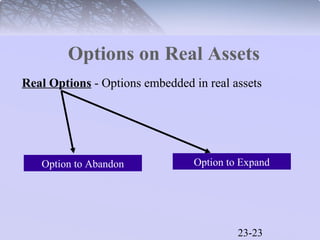
Options on Real Assets 
Real Options - Options embedded in real assets 
Option to Abandon Option to Expand 
23-23
Options on Financial Assets 
23-24 
Executive Stock Options 
Warrants 
Convertible Bonds 
Callable Bonds

Chap023

  • 1.
    McGraw-Hill/Irwin Copyright ©2012 by The McGraw-Hill Companies, Inc. All rights reserved.
  • 2.
    23-2 Options Theright but not the obligation… This chapter explores various options and their payoff structure.
  • 3.
    The right tobuy an asset at a specified exercise price on or 23-3 Basic Options Call Option before the exercise date Put Option The right to sell an asset at a specified exercise price on or before the exercise date
  • 4.
    Option Obligations BuyerSeller Call option Right to buy asset Obligation to sell asset Put option Right to sell asset Obligation to buy asset Does the seller of a call option hope the price of the underlying security moves up or down? Does the buyer of a put option hope the price of the underlying security moves up or down? 23-4
  • 5.
    23-5 Option Value Option Value: The value of an option at expiration is a function of the stock price and the exercise price. Call Option Put Option
  • 6.
    Option Value: Example Option values given an exercise price of $720 23-6 Stock Price $600 660 720 780 840 Call Value $0 0 0 60 120 Put Value $120 60 0 0 0 What are the payoff limits for call option buyers? Sellers? What are the payoff limits for put option buyers? Sellers?
  • 7.
    Call Option Value Call option value (buyer) given a $720 exercise price. 23-7 Share Price Call option value 720 840 $120
  • 8.
    Call Option Profit Profit (buyer): Current Price - Exercise Price - Cost of Call $20 call option (buyer) given a $720 exercise price 23-8 Share Price Call option value 720 840 $100 Profit = ($840 -$720) -$20 = $100
  • 9.
    Call Option Value Call option payoff (seller) given a $720 exercise price. 23-9 Share Price Call option $ payoff 720 840 $-120
  • 10.
    Call Option Profit Profit (Seller): Exercise Price - Current Price + Cost of Call $20 call option (seller) given a $720 exercise price: 23-10 Share Price Call option $ payoff 720 840 $-100 $-120 Profit = $720 -$840 + $20 = -$100
  • 11.
    Call Option: Example How much must the stock be worth at expiration in order for a call holder to break even if the exercise price is $50 and the call premium 23-11 was $4?
  • 12.
    23-12 Put OptionValue Put option value (buyer) given a $720 exercise price: Share Price Put option value 600 720 $120
  • 13.
    Profit (buyer): ExercisePrice - Current Price - Cost of Put 23-13 Put Option Profit $30 put option (buyer) given a $720 exercise price: Share Price Put option value 600 720 $90 Profit = $720 - $600 - $30 = $90
  • 14.
    23-14 Put OptionValue Put option payoff (seller) given a $720 exercise price. Share Price Put option $ payoff 600 720 -$120
  • 15.
    Put Option Profit Profit (Seller): Current Price - Exercise Price + Cost of Put $30 put option (seller) given a $720 exercise price. Share Price 23-15 Put option $ payoff 600 720 -$90 Profit = $600 - $720 + $30 = -$90
  • 16.
    Put Options: Example What is your return on exercising a put option which was purchased for $10 with an exercise price of $85? The stock price at expiration is 23-16 $81.
  • 17.
    Option Hedging Strategy 23-17 Protective Put: Share Price Position Value Protective Put Long Put Long Stock
  • 18.
    Protective Put Value 23-18 Share Price Position Value Protective Put
  • 19.
    Call Option Value: Upper and Lower Limits 23-19 Stock Price Upper Limit Lower Limit (Stock price - exercise price) or 0 whichever is higher
  • 20.
  • 21.
  • 22.
    Black-Scholes Option 23-22 Pricing Model OptionC = Ps[N(d1)] - S[N(d2)]e-rt
  • 23.
    Options on RealAssets Real Options - Options embedded in real assets Option to Abandon Option to Expand 23-23
  • 24.
    Options on FinancialAssets 23-24 Executive Stock Options Warrants Convertible Bonds Callable Bonds

Editor's Notes

  • #2 Chapter 23 Learning Objectives 1. Calculate the payoff to buyers and sellers of call and put options. 2. Understand the determinants of option values. 3. Recognize options in capital investment proposals. 4. Identify options that are provided in financial securities.
  • #3 Chapter 23 PPT Outline Calls and Puts Option Values and Profit Real Options Black-Scholes Pricing Model
  • #4 Call Option – Right to buy an asset at a specified exercise price on or before the exercise date. Put Option – Right to sell an asset at a specified exercise price on or before the exercise date.
  • #6 Option Value: The value of an option at expiration is a function of the stock price and the exercise price.
  • #7 Exercise Price – The price at which the underlying security can be purchased (call option) or sold (put option). The exercise price is determined at the time the option contract is formed. Also known as the strike price.
  • #18 Protective Put - Long stock and long put Note: Explore other option strategies such as covered calls, straddles and strangles.
  • #21 Point A -When the stock is worthless, the option is worthless. Why? Point B -When the stock price becomes very high, the option price approaches the stock price less the present value of the exercise price. Point C -The option price always exceeds its minimum value (except at maturity or when stock price is zero). Note: The value of an option increases with both the variability of the share price and the time to expiration.
  • #23 Note: See Spreadsheet Solutions: Using Black-Scholes Formula for a detailed description and example of this option pricing formula.
  • #24 Real Options – Options embedded in real assets
  • #25 Executive Stock Options – Long term call options given to executives as part of their compensation package. Warrants - Right to buy shares from a company at a stipulated price before a set date. Convertible Bond - Bond that the holder may exchange for a specific number of shares. Callable Bond - Bond that may be repurchased by the issuer before maturity at specified call price.