


Effective Credit Policy Management for Profits – Consumer Lending & Cards Sriram Natarajan Head of Risk Management – MENA American Express Middle East
Agenda Glance at market trends Role of Credit Policy Transforming Credit Risk Landscape It’s all in the implementation!
Glance at market trends
Regional Trends Consumer lending and cards developing rapidly Portfolios & Receivables growing at rates of 15% to 30%  annually!! Booming economic growth fuelled by high oil prices High degree of convergence within  retail lending ‘ Copy/paste’ sales/marketing  Low consumer ability handling credit War of the freebies!!!
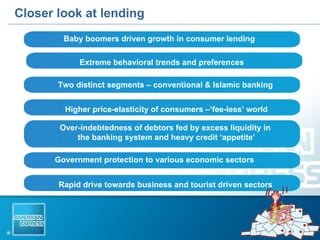
Closer look at lending Baby boomers driven growth in consumer lending Extreme behavioral trends and preferences   Rapid drive towards business and tourist driven sectors Higher price-elasticity of consumers –‘fee-less’ world Government protection to various economic sectors Two distinct segments – conventional & Islamic banking Over-indebtedness of debtors fed by excess liquidity in  the banking system and heavy credit ‘appetite’
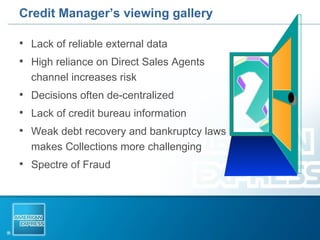
Credit Manager’s viewing gallery Lack of reliable external data High reliance on Direct Sales Agents channel increases risk Decisions often de-centralized Lack of credit bureau information Weak debt recovery and bankruptcy laws makes Collections more challenging  Spectre of Fraud
Role of Credit Policy
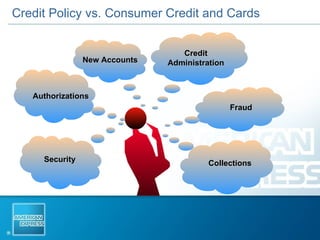
Collections New Accounts   Authorizations Fraud Credit Administration Security Credit Policy vs. Consumer Credit and Cards
Credit Policy vs. Sound Credit Policy Basic role:  Maximise revenue Minimize credit and fraud losses Sound Credit Policy:   -up to date -simple, easy to use, practicable -staff can relate to the policy -flexible to changing needs -aligned to the overall goals of the business
Optimized decision structure  Internal Control   New applications optimal decision for most profitable prospects Creditworthiness based lending  Operational Risk managed across the credit cycle to  minimize fraud losses Application scorecards and Behavioral scorecards  backed by strong policy rules  Robust recovery plans for overdue and over limit accounts Strong collections infrastructure
Optimized decision structure (contd.) Credit Policy must be aligned to the overall business goals and other functional units  External Control  External linkages (e.g. Credit Bureaus, Public databases) for more informed decisions  There are solid rules and regulations to manage external relationships effectively (e.g. collection agencies, database companies, etc) Regulatory requirements (i.e. Central Bank, Consumer regulations, Sarbanes-Oxley) are incorporated when formulating the risk policy
Transforming Credit Risk Landscape
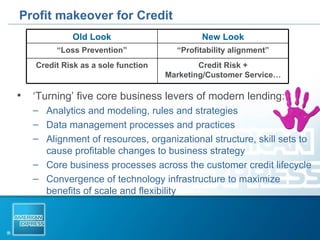
Profit makeover for Credit ‘Turning’ five core business levers of modern lending: Analytics and modeling, rules and strategies Data management processes and practices Alignment of resources, organizational structure, skill sets to cause profitable changes to business strategy Core business processes across the customer credit lifecycle Convergence of technology infrastructure to maximize benefits of scale and flexibility Credit Risk + Marketing/Customer Service… Credit Risk as a sole function “ Profitability alignment” “ Loss Prevention” New Look Old Look
Benefits of risk-driven profits Risk Mgt – Marketing Alignment: Support in optimizing solicitation, account  origination, account management, cross-sell/ retention and collections More control over decisions with flexibility and automation Improved quality of decisions based on analysis  More effective strategies through data mining, simulation, regression and modeling Speed of implementation - decision strategies are linked with the enterprise data to enable smarter, more consistent decisions in real-time environment
Implementation
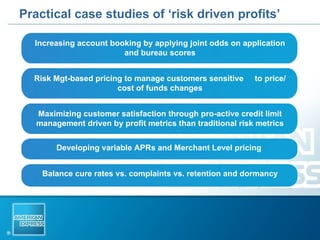
Practical case studies of ‘risk driven profits’ Increasing account booking by applying joint odds on application and bureau scores Risk Mgt-based pricing to manage customers sensitive  to price/cost of funds changes Maximizing customer satisfaction through pro-active credit limit management driven by profit metrics than traditional risk metrics Developing variable APRs and Merchant Level pricing  Balance cure rates vs. complaints vs. retention and dormancy
True game changer! Customer retention by combined usage of varied forms  of data: Generic consumer data Interaction-based data Research-based data Upgrading customer to more profitable segments by  offering more profitable products Champion/Challenger strategies to marketing programs Cross selling by improved modeling and customer management strategies targeting ‘at risk’ customers Managing overall administrative costs by enhancing the number of meaningful & quality customer interactions
Principles of Operations Optimize Risk / Reward equation Balance between maximizing profits and minimizing losses Accurate planning and forecasting Synchronized front end and back end operations Manage by exception   Facilitates techniques to manage predictably Promulgate timely analysis of information   Good MIS is read, analyzed and used to make sound business decisions Assign responsibility for managing risk  Pin responsibility on the right levels at the right degree
Maintenance and Communication CRO seeks inputs from functional  heads and the key staff in Risk Management Policy must be mandatory reading  for all executives and officers  involved in the credit cycle CCO to ensure policy is up to date  Formalize credit policy by seeking high level approvals and aligned to the overall organizational goals
In summary… Integrate Credit Policy with processes across the enterprise Sound Credit Policy impacts profitability  Credit / Risk Management cannot be considered in a ‘vacuum’ A sound Credit Policy may often be a key differentiator!
World Class Service. Personal Recognition.

Effective Credit Policy Consumer Credit

  • 1.
    Effective Credit PolicyManagement for Profits – Consumer Lending & Cards Sriram Natarajan Head of Risk Management – MENA American Express Middle East
  • 2.
    Agenda Glance atmarket trends Role of Credit Policy Transforming Credit Risk Landscape It’s all in the implementation!
  • 3.
  • 4.
    Regional Trends Consumerlending and cards developing rapidly Portfolios & Receivables growing at rates of 15% to 30% annually!! Booming economic growth fuelled by high oil prices High degree of convergence within retail lending ‘ Copy/paste’ sales/marketing Low consumer ability handling credit War of the freebies!!!
  • 5.
    Closer look atlending Baby boomers driven growth in consumer lending Extreme behavioral trends and preferences Rapid drive towards business and tourist driven sectors Higher price-elasticity of consumers –‘fee-less’ world Government protection to various economic sectors Two distinct segments – conventional & Islamic banking Over-indebtedness of debtors fed by excess liquidity in the banking system and heavy credit ‘appetite’
  • 6.
    Credit Manager’s viewinggallery Lack of reliable external data High reliance on Direct Sales Agents channel increases risk Decisions often de-centralized Lack of credit bureau information Weak debt recovery and bankruptcy laws makes Collections more challenging Spectre of Fraud
  • 7.
  • 8.
    Collections New Accounts Authorizations Fraud Credit Administration Security Credit Policy vs. Consumer Credit and Cards
  • 9.
    Credit Policy vs.Sound Credit Policy Basic role: Maximise revenue Minimize credit and fraud losses Sound Credit Policy: -up to date -simple, easy to use, practicable -staff can relate to the policy -flexible to changing needs -aligned to the overall goals of the business
  • 10.
    Optimized decision structure Internal Control New applications optimal decision for most profitable prospects Creditworthiness based lending Operational Risk managed across the credit cycle to minimize fraud losses Application scorecards and Behavioral scorecards backed by strong policy rules Robust recovery plans for overdue and over limit accounts Strong collections infrastructure
  • 11.
    Optimized decision structure(contd.) Credit Policy must be aligned to the overall business goals and other functional units External Control External linkages (e.g. Credit Bureaus, Public databases) for more informed decisions There are solid rules and regulations to manage external relationships effectively (e.g. collection agencies, database companies, etc) Regulatory requirements (i.e. Central Bank, Consumer regulations, Sarbanes-Oxley) are incorporated when formulating the risk policy
  • 12.
  • 13.
    Profit makeover forCredit ‘Turning’ five core business levers of modern lending: Analytics and modeling, rules and strategies Data management processes and practices Alignment of resources, organizational structure, skill sets to cause profitable changes to business strategy Core business processes across the customer credit lifecycle Convergence of technology infrastructure to maximize benefits of scale and flexibility Credit Risk + Marketing/Customer Service… Credit Risk as a sole function “ Profitability alignment” “ Loss Prevention” New Look Old Look
  • 14.
    Benefits of risk-drivenprofits Risk Mgt – Marketing Alignment: Support in optimizing solicitation, account origination, account management, cross-sell/ retention and collections More control over decisions with flexibility and automation Improved quality of decisions based on analysis More effective strategies through data mining, simulation, regression and modeling Speed of implementation - decision strategies are linked with the enterprise data to enable smarter, more consistent decisions in real-time environment
  • 15.
  • 16.
    Practical case studiesof ‘risk driven profits’ Increasing account booking by applying joint odds on application and bureau scores Risk Mgt-based pricing to manage customers sensitive to price/cost of funds changes Maximizing customer satisfaction through pro-active credit limit management driven by profit metrics than traditional risk metrics Developing variable APRs and Merchant Level pricing Balance cure rates vs. complaints vs. retention and dormancy
  • 17.
    True game changer!Customer retention by combined usage of varied forms of data: Generic consumer data Interaction-based data Research-based data Upgrading customer to more profitable segments by offering more profitable products Champion/Challenger strategies to marketing programs Cross selling by improved modeling and customer management strategies targeting ‘at risk’ customers Managing overall administrative costs by enhancing the number of meaningful & quality customer interactions
  • 18.
    Principles of OperationsOptimize Risk / Reward equation Balance between maximizing profits and minimizing losses Accurate planning and forecasting Synchronized front end and back end operations Manage by exception Facilitates techniques to manage predictably Promulgate timely analysis of information Good MIS is read, analyzed and used to make sound business decisions Assign responsibility for managing risk Pin responsibility on the right levels at the right degree
  • 19.
    Maintenance and CommunicationCRO seeks inputs from functional heads and the key staff in Risk Management Policy must be mandatory reading for all executives and officers involved in the credit cycle CCO to ensure policy is up to date Formalize credit policy by seeking high level approvals and aligned to the overall organizational goals
  • 20.
    In summary… IntegrateCredit Policy with processes across the enterprise Sound Credit Policy impacts profitability Credit / Risk Management cannot be considered in a ‘vacuum’ A sound Credit Policy may often be a key differentiator!
  • 21.
    World Class Service.Personal Recognition.

Editor's Notes

  • #5 High degree of convergence within retail lending –key driver being personal loans and cards, but mostly without proper ‘cross selling’ synergies ‘ Copy/paste’ sales/marketing prevails with little product differentiation amongst lenders Lack of knowledge amongst consumers leading to ‘inability' in handling credit War of the freebies!!! Huge dependence on foreign/expatriate workers
  • #7 Emerging markets are often submerging markets!
  • #11 The markers by which a Credit Policy should be judged and should reflect the best practices known at the time of development: New applications are decided optimally to ensure that the front end books the most profitable prospects. Customers are allotted credit limits/loans that reflect their worth and allow adequate space to spend profitably. Operational Risk (i.e. Fraud) is managed across the credit cycle to keep fraud losses at the minimum. Application scorecards and Behavioral scorecards are developed by specialists and supplemented by strong policy rules. Overdue and over limit accounts are accorded due attention and followed up in a timely manner. There is a strong collections infrastructure that places high premium on debt recoveries.
  • #12 External linkages (e.g. Credit Bureaus, Public databases, etc) are used effectively to obviate ‘internal’ errors. There are solid rules and regulations to manage external relationships (e.g. collection agencies, database companies, etc) effectively. Due care is taken of regulatory requirements (i.e. Central Bank, Consumer regulations, Sarbanes-Oxley, etc) in formulating the risk policy. Last but not least, the credit policy is aligned to the overall business goals and has strong links to other units in the business like Marketing, Sales, Operations, Compliance and Customer services.
  • #15 Supports marketing in optimising business goals in solicitation, account origination, account management, cross-sell/retention and collections More control over decisions. Rules and strategies are more flexible and automated Improved quality of decisions. Modeling results in more insightful, data driven and predictive analysis of customer behavior. Create more effective strategies. Marketing strategies can be refined and improved through data mining, simulation, regression and modeling. Speed of implementation. Decision strategies are linked with the enterprise data to enable smarter, more consistent decisions in real-time environment.
  • #19 Any policy is only as effective as it is administrated and communicated to the relevant staff. To be classified as a sound Credit Policy implementation, it must enable the business to incorporate the following five principles: Optimize the Risk / Reward equation – By implementing the policy, the business is able to arrive at an appropriate balance between maximizing profits and minimizing losses. Accurate planning and forecasting – The policy enables both the front end (issuing and acquiring) and the back end (collections, customer services) to be in synchrony and complement each other. Manage by exception – The policy facilitates techniques to allow risks to be managed predictably. Promulgates timely analysis of information – Good MIS is read, analyzed, and used to make sound business decisions. Assign responsibility for managing risk – The policy pins responsibility on the right levels at the right degree.
  • #20 The Credit Policy must be drafted by the Chief Credit Officer or his/her equivalent, who is responsible for managing credit and risk for the business. In this respect, the CRO should seek inputs for the policy from the functional heads and the key staff in Risk Management. The policy must be mandatory reading for all executives and officers involved in the credit cycle. All staff in Credit who have direct responsibility for credit and fraud must be thorough with the Policy before they take up their assignments. Must ensure that the readers initial the flysheet in front of each volume; indicating the sections read. The CCO is also responsible for revising the Credit Policy to ensure it is an up to date and relevant document. Hence, the CRO must regularly consider whether statements of policy, operational procedures or controls, reports, systems and parameters require updates due to changes in the business. If so, proposed text, or amendments to established text must be duly re-written. The CCO must also formalize the Credit Policy by seeking approvals of the Credit Committee, CEO and Chief Risk Officer (in case of a bank). This ensures that the cards risk policy is integrated into the enterprise credit/risk policy and is aligned to the overall organizational goals
  • #21 They help achieve consistency and superiority of Service Levels. Successful companies differentiate themselves not just with superior products but also by how they behave towards their Customers.