McGraw-Hill/Irwin Copyright © 2012 by The McGraw-Hill Companies, Inc. All rights reserved.
Mergers, Acquisitions and 
Corporate Control 
The Number of Mergers in the United States 
21-2 
(1962-2009)
Types of Mergers 
Horizontal Merger 
A merger between two firms in the same line of business 
(former competitors) 
Vertical Merger 
A merger between companies at different stages of 
production 
Conglomerate Merger 
A merger between companies in unrelated lines of business 
21-3
Sensible Reasons for Mergers 
21-4 
Economies of Scale 
Economies of Vertical Integration 
Combining Complementary Resources 
Mergers as a Use for Surplus Funds
Economies of Scale 
With economies of scale, a larger firm may be 
able to reduce its per unit cost. 
21-5 
How?
Economies of Vertical 
21-6 
Integration 
 Control over suppliers “may” reduce costs. 
 Over-integration can cause the opposite effect. 
Pre-integration 
(less efficient) 
Company 
S 
S 
S 
S 
S 
S 
S 
Post-integration 
(more efficient) 
Company 
S
Combining Complementary 
21-7 
Resources 
Merging may result in each firm filling in the “missing pieces” 
of their firm with pieces from the other firm. 
Firm A 
Firm B 
Example: A small firm may have a valuable patent, but lack the engineering and 
sales organization necessary to produce and market it on a large scale. It could be 
acquired by a larger firm with those capacities already in place.
Use for Surplus Funds 
If your firm is in a mature industry with few, if any, 
positive NPV projects available, acquisition may be 
the best use of your funds. 
What might this imply about the pre- and post-acquisition 
21-8 
PVGO?
Dubious Reasons for Mergers 
21-9 
Diversification 
The Bootstrap Game
21-10 
Diversification 
 Diversification 
 Investors should not pay a premium for 
diversification since they can do it themselves.
The Bootstrap Game 
21-11 
Acquiring Firm has high P/E ratio 
Selling firm has low P/E ratio (due to low 
number of shares) 
After merger, acquiring firm has short term 
EPS rise 
Long term, acquirer will have slower than 
normal EPS growth due to share dilution.
The Bootstrap Game: Example 
21-12 
World Enterprises 
(before merger) Muck and Slurry 
World Enterprises 
(after buying Muck 
and Slurry) 
EPS $2.00 $2.00 $2.67 
Price per share $40.00 $20.00 $40.00 
P/E Ratio 20 10 15 
Number of shares 100,000 100,000 150,000 
Total earnings $200,000 $200,000 $400,000 
Total market value $4,000,000 $2,000,000 $6,000,000 
Current earnings 
per dollar invested 
in stock $0.05 $0.10 $0.067
The Form of the Acquisition 
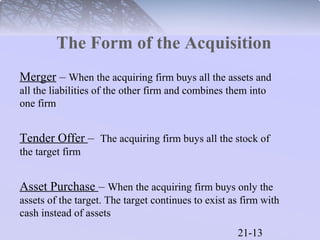
Merger – When the acquiring firm buys all the assets and 
all the liabilities of the other firm and combines them into 
one firm 
Tender Offer – The acquiring firm buys all the stock of 
the target firm 
Asset Purchase – When the acquiring firm buys only the 
assets of the target. The target continues to exist as firm with 
cash instead of assets 
21-13
Evaluating Mergers 
21-14 
 Ask: 
 Is there an overall economic gain to the merger? 
 Do the terms of the merger make the company 
and its shareholders better off? 
PV (A+ B) > PV (A) + PV (B) 
Synergy
Financing Mergers 
21-15 
Mergers Financed by Cash 
Mergers Financed by Stock
Evaluating Mergers 
Economic Gain = PV(increased earnings) 
21-16 
= 
New cash flows from synergies 
discount rate
Evaluating Mergers: Example 
Given a 20% cost of funds, what is the economic gain, if any, of 
the merger listed below? (GenPharm acquires Biotex) 
GenPharm Biotex Combined Company 
Revenues 200 25 225 (+0) 
Operating Costs 110 17 120 (- 7) 
Earnings 90 8 105 (+7) 
21-17 
Economic Gain= 7 $35 
.20 
= 
Which of the “sensible reasons” for a merger is this merger 
most likely based on?
The Market for Corporate 
21-18 
Control 
1. Proxy Contests 
2. Takeovers 
3. Leveraged Buyouts 
4. Divestures, Spin-Offs or Carve-Outs
21-19 
Proxy Contests 
Proxy 
The right to vote another shareholder’s shares 
Proxy Contests 
Takeover attempt in which outsiders compete with 
management for shareholders’ votes 
Proxy Access (2010) 
Problem with Proxy Contests?
21-20 
Takeovers 
Tender Offer: a direct offer of purchase to 
current shareholders, without consulting with 
management 
How can management react to a tender 
offer?
Takeover Defensive Tactics 
21-21 
White Knight 
Shark Repellent 
Poison Pill
Leveraged Buy-Outs (LBO) 
21-22 
Large portion of buy-out 
financed by debt 
Shares of the LBO no longer 
trade on the open market 
Leveraged Buyout vs. Management Buyout
Potential Gains from an LBO 
21-23 
Junk bond market 
Leverage and taxes 
Other stakeholders 
Leverage and incentives 
Free cash flow
Divestitures, Spin-Offs, and Carve-Outs 
Divestiture 
When a firm sells some of the assets to another entity as 
a going concern 
21-24 
Spin-Off 
The process of a business separating the ongoing 
operations of a unit of that business and giving the 
shareholders of the parent firm shares of the unit 
Carve-Outs 
Similar to a spin-off, but issues shares of the new firm to 
the public
Benefits and Cost of Mergers 
Who usually benefits from a merger? 
21-25 
Who usually loses in a merger?

Chap021

  • 1.
    McGraw-Hill/Irwin Copyright ©2012 by The McGraw-Hill Companies, Inc. All rights reserved.
  • 2.
    Mergers, Acquisitions and Corporate Control The Number of Mergers in the United States 21-2 (1962-2009)
  • 3.
    Types of Mergers Horizontal Merger A merger between two firms in the same line of business (former competitors) Vertical Merger A merger between companies at different stages of production Conglomerate Merger A merger between companies in unrelated lines of business 21-3
  • 4.
    Sensible Reasons forMergers 21-4 Economies of Scale Economies of Vertical Integration Combining Complementary Resources Mergers as a Use for Surplus Funds
  • 5.
    Economies of Scale With economies of scale, a larger firm may be able to reduce its per unit cost. 21-5 How?
  • 6.
    Economies of Vertical 21-6 Integration  Control over suppliers “may” reduce costs.  Over-integration can cause the opposite effect. Pre-integration (less efficient) Company S S S S S S S Post-integration (more efficient) Company S
  • 7.
    Combining Complementary 21-7 Resources Merging may result in each firm filling in the “missing pieces” of their firm with pieces from the other firm. Firm A Firm B Example: A small firm may have a valuable patent, but lack the engineering and sales organization necessary to produce and market it on a large scale. It could be acquired by a larger firm with those capacities already in place.
  • 8.
    Use for SurplusFunds If your firm is in a mature industry with few, if any, positive NPV projects available, acquisition may be the best use of your funds. What might this imply about the pre- and post-acquisition 21-8 PVGO?
  • 9.
    Dubious Reasons forMergers 21-9 Diversification The Bootstrap Game
  • 10.
    21-10 Diversification Diversification  Investors should not pay a premium for diversification since they can do it themselves.
  • 11.
    The Bootstrap Game 21-11 Acquiring Firm has high P/E ratio Selling firm has low P/E ratio (due to low number of shares) After merger, acquiring firm has short term EPS rise Long term, acquirer will have slower than normal EPS growth due to share dilution.
  • 12.
    The Bootstrap Game:Example 21-12 World Enterprises (before merger) Muck and Slurry World Enterprises (after buying Muck and Slurry) EPS $2.00 $2.00 $2.67 Price per share $40.00 $20.00 $40.00 P/E Ratio 20 10 15 Number of shares 100,000 100,000 150,000 Total earnings $200,000 $200,000 $400,000 Total market value $4,000,000 $2,000,000 $6,000,000 Current earnings per dollar invested in stock $0.05 $0.10 $0.067
  • 13.
    The Form ofthe Acquisition Merger – When the acquiring firm buys all the assets and all the liabilities of the other firm and combines them into one firm Tender Offer – The acquiring firm buys all the stock of the target firm Asset Purchase – When the acquiring firm buys only the assets of the target. The target continues to exist as firm with cash instead of assets 21-13
  • 14.
    Evaluating Mergers 21-14  Ask:  Is there an overall economic gain to the merger?  Do the terms of the merger make the company and its shareholders better off? PV (A+ B) > PV (A) + PV (B) Synergy
  • 15.
    Financing Mergers 21-15 Mergers Financed by Cash Mergers Financed by Stock
  • 16.
    Evaluating Mergers EconomicGain = PV(increased earnings) 21-16 = New cash flows from synergies discount rate
  • 17.
    Evaluating Mergers: Example Given a 20% cost of funds, what is the economic gain, if any, of the merger listed below? (GenPharm acquires Biotex) GenPharm Biotex Combined Company Revenues 200 25 225 (+0) Operating Costs 110 17 120 (- 7) Earnings 90 8 105 (+7) 21-17 Economic Gain= 7 $35 .20 = Which of the “sensible reasons” for a merger is this merger most likely based on?
  • 18.
    The Market forCorporate 21-18 Control 1. Proxy Contests 2. Takeovers 3. Leveraged Buyouts 4. Divestures, Spin-Offs or Carve-Outs
  • 19.
    21-19 Proxy Contests Proxy The right to vote another shareholder’s shares Proxy Contests Takeover attempt in which outsiders compete with management for shareholders’ votes Proxy Access (2010) Problem with Proxy Contests?
  • 20.
    21-20 Takeovers TenderOffer: a direct offer of purchase to current shareholders, without consulting with management How can management react to a tender offer?
  • 21.
    Takeover Defensive Tactics 21-21 White Knight Shark Repellent Poison Pill
  • 22.
    Leveraged Buy-Outs (LBO) 21-22 Large portion of buy-out financed by debt Shares of the LBO no longer trade on the open market Leveraged Buyout vs. Management Buyout
  • 23.
    Potential Gains froman LBO 21-23 Junk bond market Leverage and taxes Other stakeholders Leverage and incentives Free cash flow
  • 24.
    Divestitures, Spin-Offs, andCarve-Outs Divestiture When a firm sells some of the assets to another entity as a going concern 21-24 Spin-Off The process of a business separating the ongoing operations of a unit of that business and giving the shareholders of the parent firm shares of the unit Carve-Outs Similar to a spin-off, but issues shares of the new firm to the public
  • 25.
    Benefits and Costof Mergers Who usually benefits from a merger? 21-25 Who usually loses in a merger?

Editor's Notes

  • #2 Chapter 21 Learning Objectives 1. Explain why it may make sense for companies to merge. 2. Estimate the gains and costs of mergers to the acquiring firm. 3. Describe ways that companies change their ownership or management. 4. Describe takeover defenses. 5. Explain some of the motivations for leveraged and management buyouts of the firm. 6. Summarize the evidence on whether mergers increase efficiency and on how the gains from mergers are distributed between shareholders of the acquired and acquiring firms.
  • #3 Chapter 21 PPT Outline Types of Mergers Sensible Motives for Mergers Dubious Reasons for Mergers The Mechanics of a Merger Evaluating Mergers The Market for Corporate Control Proxy Contests Takeovers Leveraged Buyouts Divestitures, Spin-Offs and Carve-Outs The Benefits and Costs of Mergers
  • #4 Horizontal Merger – A merger between two firms in the same line of business (former competitors). Vertical Merger – A merger between companies at different stages of production. Conglomerate Merger – A merger between companies in unrelated lines of business.
  • #6 Note: A larger firm may be able to reduce its per unit cost by using excess capacity or spreading fixed costs across more units.
  • #14 Merger – When the acquiring firm buys all the assets and all the liabilities of the other firm and combines them into one firm. Tender Offer – The acquiring firm buys all the stock of the target firm. Asset Purchase – When the acquiring firm buys only the assets of the target. The target continues to exist as firm with cash instead of assets.
  • #15 Synergies – Occurs when two firms are worth more together than when apart.
  • #16 Note: The key distinction: If cash is offered, the cost of the merger is not affected by the size of the merger gains. If stock is offered, the cost depends on the gains because the gains show up in the post-merger share price, and these shares are used to pay for the acquired firm.
  • #18 Note: Operating Costs: 110 + 17 > 120. This suggests that the combined company can achieve economies of scale.
  • #20 Proxy – The right to vote another shareholder’s shares Proxy Contest – Takeover attempt in which outsiders compete with management for shareholders’ votes. Also called a proxy fight. Dissident shareholders attempt to gain enough proxies to elect their own slate of directors. Proxy Access – In 2010 the SEC adopted a new rule, called proxy access, which allows large investors (those holding a 3% ownership stake in the firm for at least 3 years) to nominate their own candidates for the board of directors. The rule would have greatly reduced the cost of a proxy contest by allowing these dissident shareholders to place their own nominations next to those of the company. Proxy access was rejected by a federal appeals court in late July, 2011.
  • #22 White Knight - Friendly potential acquirer sought by a target company threatened by an unwelcome suitor. Shark Repellent - Amendments to a company charter made to forestall takeover attempts. Poison Pill - Measure taken by a target firm to avoid acquisition; for example, the right for existing shareholders to buy additional shares at an attractive price if a bidder acquires a large holding.
  • #23 Leveraged Buyout (LBO) – Acquisition of the firm by a private group using substantial borrowed funds. Management Buyout (MBO) – Acquisition of the firm by its own management in a leveraged buyout.
  • #25 Divestiture – When a firm sells some of the assets to another entity as a going concern. Spin Off – The process of a business separating the ongoing operations of a unit of that business and giving the shareholders of the parent firm shares of the unit. The unit and parent function as separate entities. Carve Outs – Similar to a spin off, but the carve out issues shares of the new firm to the public.
  • #26 Typical Winners in a Merger Shareholders of the target Lawyers & Brokers The executives of the acquiring firm Typical Losers in a Merger Shareholders of the acquirer due to overpayment Executives at the target firm Many employees lost due to restructuring