Personal financial statements and
budgeting,
Planning tax strategy with examples
Group 2
Aravind A
Aravind R
Ashna Qaiyum
Barjesh Kohli
Bineesh KS
Keerthana B
Melwin Jebaraj
1
MB 771 Personal Finance
Personal Balance sheet
● A personal balance sheet provides an overall snapshot of your wealth at a
specific period in time.
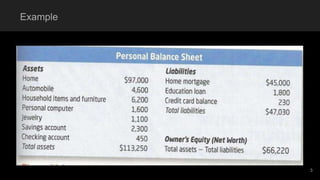
● It is a summary of your assets (what you own), your liabilities (what you owe),
and your net worth (assets minus liabilities).
● It’s the way to organize your finances and make sure you’re aware of where
all of your money is and that you’re staying on top of all of your debt
2
Example
3
Assets and Liabilities
● Personal assets - items of value that you own
○ Examples : money in bank accounts, investments, furniture, clothing, automobiles, jewelry etc
○ Liquid Assets: Liquid assets are those things you own that can easily be sold or turned into
cash without losing value. These include checking accounts, money market accounts, savings
accounts, and cash.
○ Large Assets: Large assets include things like houses, cars, boats, artwork, and furniture.
When creating a personal balance sheet, make sure to use the market value of these items.
○ Investments: Investments include bonds, stocks, CDs, mutual funds, and real estate. You
should record investments at their current market values as well.
● Liabilities - Amounts owed to others
○ Examples : credit card balances, car loans, home mortgage, personal loans etc
○ Liabilities are the second item on the balance sheet
4
Net worth
● The difference between a person's assets and liabilities.
● This figure is your measure of wealth because it represents what you own
after everything you owe has been paid off.
● If you have a negative net worth, this means that you owe more than you
own.
● Two ways to increase your net worth are to increase your assets or decrease
your liabilities.
● Financial independence is when you have a high enough net worth to live
your life without having to rely on any income.That’s why net worth is primarily
what matters for financial independence.
5
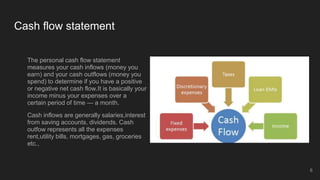
Cash flow statement
The personal cash flow statement
measures your cash inflows (money you
earn) and your cash outflows (money you
spend) to determine if you have a positive
or negative net cash flow.It is basically your
income minus your expenses over a
certain period of time — a month.
Cash inflows are generally salaries,interest
from saving accounts, dividends. Cash
outfow represents all the expenses
rent,utility bills, mortgages, gas, groceries
etc.,
6
Cash flow (Continuation)
If the result is a negative cash flow, that is, if you spend more than you earn, you'll
need to look for ways to cut back on your expenses.
Similarly, if the result is a positive cash flow, but your spending nearly equals your
earnings, it might be too soon to start investing right now.
The most significant difference between the three categories of cash flows—
operating
Investing
financing
7
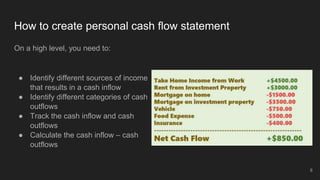
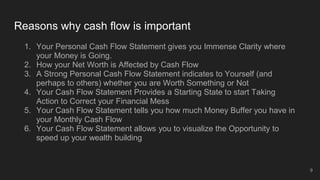
How to create personal cash flow statement
On a high level, you need to:
● Identify different sources of income
that results in a cash inflow
● Identify different categories of cash
outflows
● Track the cash inflow and cash
outflows
● Calculate the cash inflow – cash
outflows
8
Reasons why cash flow is important
1. Your Personal Cash Flow Statement gives you Immense Clarity where
your Money is Going.
2. How your Net Worth is Affected by Cash Flow
3. A Strong Personal Cash Flow Statement indicates to Yourself (and
perhaps to others) whether you are Worth Something or Not
4. Your Cash Flow Statement Provides a Starting State to start Taking
Action to Correct your Financial Mess
5. Your Cash Flow Statement tells you how much Money Buffer you have in
your Monthly Cash Flow
6. Your Cash Flow Statement allows you to visualize the Opportunity to
speed up your wealth building
9
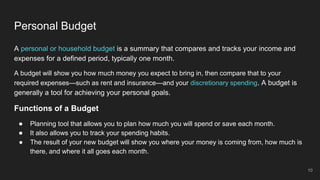
Personal Budget
A personal or household budget is a summary that compares and tracks your income and
expenses for a defined period, typically one month.
A budget will show you how much money you expect to bring in, then compare that to your
required expenses—such as rent and insurance—and your discretionary spending. A budget is
generally a tool for achieving your personal goals.
Functions of a Budget
● Planning tool that allows you to plan how much you will spend or save each month.
● It also allows you to track your spending habits.
● The result of your new budget will show you where your money is coming from, how much is
there, and where it all goes each month.
10
How to Create a Personal Budget
● Gather Your Financial Paperwork
● Calculate Your Income
● Create a List of Monthly Expenses
● Determine Fixed and Variable Expenses
● Total Your Monthly Income and Expenses
● Make Adjustments to Expenses
11
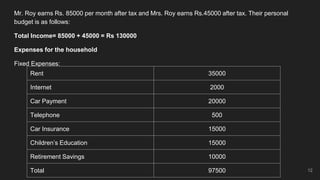
Mr. Roy earns Rs. 85000 per month after tax and Mrs. Roy earns Rs.45000 after tax. Their personal
budget is as follows:
Total Income= 85000 + 45000 = Rs 130000
Expenses for the household
Fixed Expenses:
Rent 35000
Internet 2000
Car Payment 20000
Telephone 500
Car Insurance 15000
Children’s Education 15000
Retirement Savings 10000
Total 97500 12
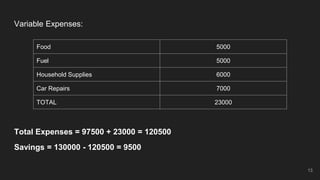
Variable Expenses:
Total Expenses = 97500 + 23000 = 120500
Savings = 130000 - 120500 = 9500
Food 5000
Fuel 5000
Household Supplies 6000
Car Repairs 7000
TOTAL 23000
13
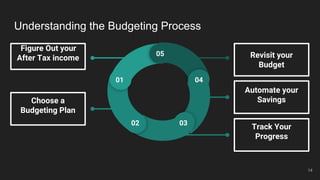
Understanding the Budgeting Process
Choose a
Budgeting Plan
Track Your
Progress
.Figure Out your
After Tax income Revisit your
Budget
Automate your
Savings
05
01
02 03
04
14
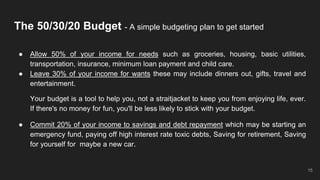
The 50/30/20 Budget - A simple budgeting plan to get started
● Allow 50% of your income for needs such as groceries, housing, basic utilities,
transportation, insurance, minimum loan payment and child care.
● Leave 30% of your income for wants these may include dinners out, gifts, travel and
entertainment.
Your budget is a tool to help you, not a straitjacket to keep you from enjoying life, ever.
If there's no money for fun, you'll be less likely to stick with your budget.
● Commit 20% of your income to savings and debt repayment which may be starting an
emergency fund, paying off high interest rate toxic debts, Saving for retirement, Saving
for yourself for maybe a new car.
15
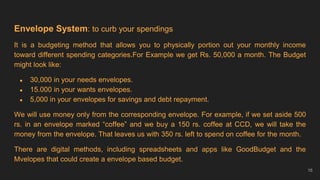
Envelope System: to curb your spendings
It is a budgeting method that allows you to physically portion out your monthly income
toward different spending categories.For Example we get Rs. 50,000 a month. The Budget
might look like:
● 30,000 in your needs envelopes.
● 15.000 in your wants envelopes.
● 5,000 in your envelopes for savings and debt repayment.
We will use money only from the corresponding envelope. For example, if we set aside 500
rs. in an envelope marked “coffee” and we buy a 150 rs. coffee at CCD, we will take the
money from the envelope. That leaves us with 350 rs. left to spend on coffee for the month.
There are digital methods, including spreadsheets and apps like GoodBudget and the
Mvelopes that could create a envelope based budget.
16
Zero-based Budgeting: The idea is to give every rupee of income a purpose
here , Income - Expenditures = Zero
Also known as Zero-sum budgeting method in which we allocate all of our money to
expenses, savings and debt payments.
If we come in under budget in a certain category at the end of the month, add the remaining
amount to next month’s budget or move it to another category, such as your Emergency
fund.
The zero-based budget keeps us aware of how much money flows in and out. This can
prevent us from spending what we don’t have. It might be problematic for people with
irregular incomes as a freelancer.
Apps which can be used are You Need a Budget or Everydollar or a spreadsheet or pen and
paper.
17
Investment
Money Management in Financial Markets:
In financial markets, money management also refers to investment management
or portfolio management. Investment companies manage a pool of capital from
their individual and institutional clients.
Money managers invest the capital in different asset classes to generate returns.
18
The assets include:
1. Stocks
2. Bonds
3. Private Equities
4. Real Estate
5. Commodities
Other investments:
1. Brokerage
2. Mutual Funds
3. ETFs
4. Venture capitals
19
Factors affecting Investment Strategy:
1. Investment philosophy (Economic Growth, Confidence, Govt Policies)
2. Client risk preference
3. Size of the fund
4. Interest rates
20
Investment risk is proportional to the return in an efficient portfolio. The main idea
of money management is to balance the risk and return to maximize investors’
utility.
21
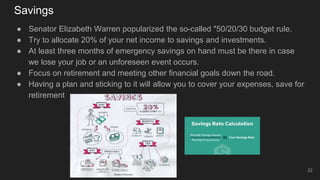
Savings
● Senator Elizabeth Warren popularized the so-called "50/20/30 budget rule.
● Try to allocate 20% of your net income to savings and investments.
● At least three months of emergency savings on hand must be there in case
we lose your job or an unforeseen event occurs.
● Focus on retirement and meeting other financial goals down the road.
● Having a plan and sticking to it will allow you to cover your expenses, save for
retirement
22
Continued….
● National Savings Certificate
● Involves a savings bond that proves to be tax-efficient for the investor.
● It is best suited mainly for small to mid-income investors with a low risk appetite.
● This is similar to other fixed income investments like PPF (Public Provident Fund)
and Post Office Fixed Deposits.
● Kisan Vikas Patra (KVP), launched in the year 1988,.
● The applicant to this savings scheme is that the principal amount doubles in 124
months at an interest rate of 6.9.
● Sukanya Samriddhi Yojana.
● Atal Pension Yojana.
● Employees Provident Fund
● Pradhan Mantri Jan Dhan Yojana
23
Taxes and Financial Planning
● Direct Tax
○ Imposed directly on the taxpayer and paid directly to
the government
○ Eg. Income Tax, Corporation Tax, Property Tax, Inheritance Tax, Gift Tax
● Indirect Tax
○ Collected by an intermediary (such as a retail store)
from the person who bears the ultimate economic
burden of the tax (such as the customer)
○ Eg. Customs Duty, Sales Tax, Service Tax, Value Added Tax, Central Excise
Duty, Securities Transaction Tax
24
Tax Planning - Goals
● Knowing the current tax laws and regulations that affect you.
● Maintaining complete and appropriate tax records.
● Making purchase and investment decisions that can reduce your tax liability.
25
26
Example
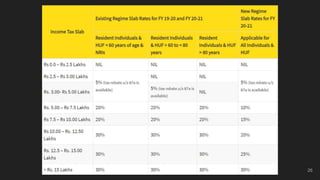
Assume your taxable income is Rs. 8 lakhs per annum (We’ll be in 15% slab)
Technically, we will have to pay Rs. 1,20,000 as income tax.
WAIT!
27
Scan the above QR or click on link in the chat.
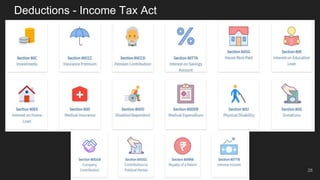
Deductions - Income Tax Act
28
Income Tax Act of India
Reducing the amount which we pay as income tax
- Section 80C of the Income Tax Act of India
- a clause that points to various expenditures and investments that are exempted from Income Tax
- Maximum deduction of up to Rs.1.5 lakh every year (applicable only for individual taxpayers and Hindu Undivided Families)
- Investments in Provident Funds, payment made towards life insurance premiums,
National Saving Certificate, principal repayment towards home loan. (Assume you have utilised full
amount under 80C)
- Section 80D - Medical Insurance (deduction of Rs.25,000 for self)
- Section 80E - interest paid on education loan (no upper limit, but available for only 8 years from the start of repayment)
- Section 80GG - House Rent (Assuming Rs.10,000 per month)
Reducing all the amount Rs. 8 lakhs - (1.5 lakhs + 25,000 + 25,000 + 1,20,000)
= Rs. 5,80,000 (Now it comes in 10% slab and have to pay only Rs.58,000 as compared
to Rs. 1.2 lakhs before)
29
Filing Returns
Tax Filing Services
30
Thank you!
31
MB 771 Personal Finance

Personal Financial Statements and Budgeting

  • 1.
    Personal financial statementsand budgeting, Planning tax strategy with examples Group 2 Aravind A Aravind R Ashna Qaiyum Barjesh Kohli Bineesh KS Keerthana B Melwin Jebaraj 1 MB 771 Personal Finance
  • 2.
    Personal Balance sheet ●A personal balance sheet provides an overall snapshot of your wealth at a specific period in time. ● It is a summary of your assets (what you own), your liabilities (what you owe), and your net worth (assets minus liabilities). ● It’s the way to organize your finances and make sure you’re aware of where all of your money is and that you’re staying on top of all of your debt 2
  • 3.
  • 4.
    Assets and Liabilities ●Personal assets - items of value that you own ○ Examples : money in bank accounts, investments, furniture, clothing, automobiles, jewelry etc ○ Liquid Assets: Liquid assets are those things you own that can easily be sold or turned into cash without losing value. These include checking accounts, money market accounts, savings accounts, and cash. ○ Large Assets: Large assets include things like houses, cars, boats, artwork, and furniture. When creating a personal balance sheet, make sure to use the market value of these items. ○ Investments: Investments include bonds, stocks, CDs, mutual funds, and real estate. You should record investments at their current market values as well. ● Liabilities - Amounts owed to others ○ Examples : credit card balances, car loans, home mortgage, personal loans etc ○ Liabilities are the second item on the balance sheet 4
  • 5.
    Net worth ● Thedifference between a person's assets and liabilities. ● This figure is your measure of wealth because it represents what you own after everything you owe has been paid off. ● If you have a negative net worth, this means that you owe more than you own. ● Two ways to increase your net worth are to increase your assets or decrease your liabilities. ● Financial independence is when you have a high enough net worth to live your life without having to rely on any income.That’s why net worth is primarily what matters for financial independence. 5
  • 6.
    Cash flow statement Thepersonal cash flow statement measures your cash inflows (money you earn) and your cash outflows (money you spend) to determine if you have a positive or negative net cash flow.It is basically your income minus your expenses over a certain period of time — a month. Cash inflows are generally salaries,interest from saving accounts, dividends. Cash outfow represents all the expenses rent,utility bills, mortgages, gas, groceries etc., 6
  • 7.
    Cash flow (Continuation) Ifthe result is a negative cash flow, that is, if you spend more than you earn, you'll need to look for ways to cut back on your expenses. Similarly, if the result is a positive cash flow, but your spending nearly equals your earnings, it might be too soon to start investing right now. The most significant difference between the three categories of cash flows— operating Investing financing 7
  • 8.
    How to createpersonal cash flow statement On a high level, you need to: ● Identify different sources of income that results in a cash inflow ● Identify different categories of cash outflows ● Track the cash inflow and cash outflows ● Calculate the cash inflow – cash outflows 8
  • 9.
    Reasons why cashflow is important 1. Your Personal Cash Flow Statement gives you Immense Clarity where your Money is Going. 2. How your Net Worth is Affected by Cash Flow 3. A Strong Personal Cash Flow Statement indicates to Yourself (and perhaps to others) whether you are Worth Something or Not 4. Your Cash Flow Statement Provides a Starting State to start Taking Action to Correct your Financial Mess 5. Your Cash Flow Statement tells you how much Money Buffer you have in your Monthly Cash Flow 6. Your Cash Flow Statement allows you to visualize the Opportunity to speed up your wealth building 9
  • 10.
    Personal Budget A personalor household budget is a summary that compares and tracks your income and expenses for a defined period, typically one month. A budget will show you how much money you expect to bring in, then compare that to your required expenses—such as rent and insurance—and your discretionary spending. A budget is generally a tool for achieving your personal goals. Functions of a Budget ● Planning tool that allows you to plan how much you will spend or save each month. ● It also allows you to track your spending habits. ● The result of your new budget will show you where your money is coming from, how much is there, and where it all goes each month. 10
  • 11.
    How to Createa Personal Budget ● Gather Your Financial Paperwork ● Calculate Your Income ● Create a List of Monthly Expenses ● Determine Fixed and Variable Expenses ● Total Your Monthly Income and Expenses ● Make Adjustments to Expenses 11
  • 12.
    Mr. Roy earnsRs. 85000 per month after tax and Mrs. Roy earns Rs.45000 after tax. Their personal budget is as follows: Total Income= 85000 + 45000 = Rs 130000 Expenses for the household Fixed Expenses: Rent 35000 Internet 2000 Car Payment 20000 Telephone 500 Car Insurance 15000 Children’s Education 15000 Retirement Savings 10000 Total 97500 12
  • 13.
    Variable Expenses: Total Expenses= 97500 + 23000 = 120500 Savings = 130000 - 120500 = 9500 Food 5000 Fuel 5000 Household Supplies 6000 Car Repairs 7000 TOTAL 23000 13
  • 14.
    Understanding the BudgetingProcess Choose a Budgeting Plan Track Your Progress .Figure Out your After Tax income Revisit your Budget Automate your Savings 05 01 02 03 04 14
  • 15.
    The 50/30/20 Budget- A simple budgeting plan to get started ● Allow 50% of your income for needs such as groceries, housing, basic utilities, transportation, insurance, minimum loan payment and child care. ● Leave 30% of your income for wants these may include dinners out, gifts, travel and entertainment. Your budget is a tool to help you, not a straitjacket to keep you from enjoying life, ever. If there's no money for fun, you'll be less likely to stick with your budget. ● Commit 20% of your income to savings and debt repayment which may be starting an emergency fund, paying off high interest rate toxic debts, Saving for retirement, Saving for yourself for maybe a new car. 15
  • 16.
    Envelope System: tocurb your spendings It is a budgeting method that allows you to physically portion out your monthly income toward different spending categories.For Example we get Rs. 50,000 a month. The Budget might look like: ● 30,000 in your needs envelopes. ● 15.000 in your wants envelopes. ● 5,000 in your envelopes for savings and debt repayment. We will use money only from the corresponding envelope. For example, if we set aside 500 rs. in an envelope marked “coffee” and we buy a 150 rs. coffee at CCD, we will take the money from the envelope. That leaves us with 350 rs. left to spend on coffee for the month. There are digital methods, including spreadsheets and apps like GoodBudget and the Mvelopes that could create a envelope based budget. 16
  • 17.
    Zero-based Budgeting: Theidea is to give every rupee of income a purpose here , Income - Expenditures = Zero Also known as Zero-sum budgeting method in which we allocate all of our money to expenses, savings and debt payments. If we come in under budget in a certain category at the end of the month, add the remaining amount to next month’s budget or move it to another category, such as your Emergency fund. The zero-based budget keeps us aware of how much money flows in and out. This can prevent us from spending what we don’t have. It might be problematic for people with irregular incomes as a freelancer. Apps which can be used are You Need a Budget or Everydollar or a spreadsheet or pen and paper. 17
  • 18.
    Investment Money Management inFinancial Markets: In financial markets, money management also refers to investment management or portfolio management. Investment companies manage a pool of capital from their individual and institutional clients. Money managers invest the capital in different asset classes to generate returns. 18
  • 19.
    The assets include: 1.Stocks 2. Bonds 3. Private Equities 4. Real Estate 5. Commodities Other investments: 1. Brokerage 2. Mutual Funds 3. ETFs 4. Venture capitals 19
  • 20.
    Factors affecting InvestmentStrategy: 1. Investment philosophy (Economic Growth, Confidence, Govt Policies) 2. Client risk preference 3. Size of the fund 4. Interest rates 20
  • 21.
    Investment risk isproportional to the return in an efficient portfolio. The main idea of money management is to balance the risk and return to maximize investors’ utility. 21
  • 22.
    Savings ● Senator ElizabethWarren popularized the so-called "50/20/30 budget rule. ● Try to allocate 20% of your net income to savings and investments. ● At least three months of emergency savings on hand must be there in case we lose your job or an unforeseen event occurs. ● Focus on retirement and meeting other financial goals down the road. ● Having a plan and sticking to it will allow you to cover your expenses, save for retirement 22
  • 23.
    Continued…. ● National SavingsCertificate ● Involves a savings bond that proves to be tax-efficient for the investor. ● It is best suited mainly for small to mid-income investors with a low risk appetite. ● This is similar to other fixed income investments like PPF (Public Provident Fund) and Post Office Fixed Deposits. ● Kisan Vikas Patra (KVP), launched in the year 1988,. ● The applicant to this savings scheme is that the principal amount doubles in 124 months at an interest rate of 6.9. ● Sukanya Samriddhi Yojana. ● Atal Pension Yojana. ● Employees Provident Fund ● Pradhan Mantri Jan Dhan Yojana 23
  • 24.
    Taxes and FinancialPlanning ● Direct Tax ○ Imposed directly on the taxpayer and paid directly to the government ○ Eg. Income Tax, Corporation Tax, Property Tax, Inheritance Tax, Gift Tax ● Indirect Tax ○ Collected by an intermediary (such as a retail store) from the person who bears the ultimate economic burden of the tax (such as the customer) ○ Eg. Customs Duty, Sales Tax, Service Tax, Value Added Tax, Central Excise Duty, Securities Transaction Tax 24
  • 25.
    Tax Planning -Goals ● Knowing the current tax laws and regulations that affect you. ● Maintaining complete and appropriate tax records. ● Making purchase and investment decisions that can reduce your tax liability. 25
  • 26.
  • 27.
    Example Assume your taxableincome is Rs. 8 lakhs per annum (We’ll be in 15% slab) Technically, we will have to pay Rs. 1,20,000 as income tax. WAIT! 27 Scan the above QR or click on link in the chat.
  • 28.
  • 29.
    Income Tax Actof India Reducing the amount which we pay as income tax - Section 80C of the Income Tax Act of India - a clause that points to various expenditures and investments that are exempted from Income Tax - Maximum deduction of up to Rs.1.5 lakh every year (applicable only for individual taxpayers and Hindu Undivided Families) - Investments in Provident Funds, payment made towards life insurance premiums, National Saving Certificate, principal repayment towards home loan. (Assume you have utilised full amount under 80C) - Section 80D - Medical Insurance (deduction of Rs.25,000 for self) - Section 80E - interest paid on education loan (no upper limit, but available for only 8 years from the start of repayment) - Section 80GG - House Rent (Assuming Rs.10,000 per month) Reducing all the amount Rs. 8 lakhs - (1.5 lakhs + 25,000 + 25,000 + 1,20,000) = Rs. 5,80,000 (Now it comes in 10% slab and have to pay only Rs.58,000 as compared to Rs. 1.2 lakhs before) 29
  • 30.
  • 31.
    Thank you! 31 MB 771Personal Finance

Editor's Notes

  • #25 Aravind
  • #28 https://www.mentimeter.com/s/fb8e4aaff8a1a1b4a71a884068d8a0e7/611bc6c39285