McGraw-Hill/Irwin Copyright © 2012 by The McGraw-Hill Companies, Inc. All rights reserved.
24-2 
Risk Management 
Political Risk 
The Financial Manager 
Faces Multiple Sources 
of Risk 
Exchange Rate Risk 
Environmental Risk 
Market Risk 
Interest Rate Risk 
Competition 
Industry Changes
Why Hedge: To Add Value? 
24-3 
 Reason 1: Hedging is a zero-sum game. 
 Reason 2: Investors’ do-it-yourself alternative. 
How should a financial manager approach hedging?
A Sensible Approach to Hedging 
Note: Any sensible risk strategy must answer the same five questions. 
1) What are the major risks that the company faces and what are the 
possible consequences? 
2) Is the company being paid for taking these risks? 
3) Can the company take any measures to reduce the probability of a 
bad outcome or to limit its impact? 
4) Can fairly priced insurance to offset any losses? 
5) Can derivatives, such as options or futures, hedge the risk? 
24-4
24-5 
Why Hedge? 
What is a cereal company in the business of 
doing? 
A. Producing a product efficiently and selling it for 
a profit. 
B. Speculating on the price of sugar, wheat, and other 
inputs for its product. 
Answer: Both. The company does A by choice and B 
because it has no choice.
Risk Management Strategies 
There are three principal ways to manage risk. 
24-6 
Increasing Flexibility 
Insurance Policies 
Investments in Derivatives
Reducing Risk With Options: 
24-7 
Example 
Abramovic, Inc. sells crude oil. Since its costs are 
relatively fixed, fluctuations in the sale price of 
crude oil can cause unexpected profits or losses. 
How might Abramovic, Inc. hedge this risk?
Reducing Risk With Options 
Abramovic, Inc. sells crude oil. How does the price of oil 
influence revenues? 
Price per barrel 
24-8 
Abramovic, Inc. 
loses money when 
prices drop. 
Revenues
Reducing Risk With Options: 
Example (continued) 
24-9 
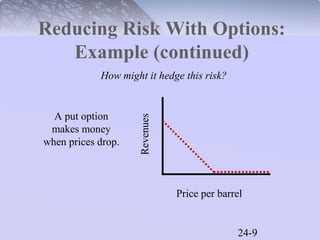
How might it hedge this risk? 
Price per barrel 
A put option 
makes money 
when prices drop. 
Revenues
Reducing Risk With Options: 
Example (continued) 
What are the results of this strategy? 
Price per barrel 
24-10 
Abramovic, Inc.’s 
natural risk, plus a put 
option, provides a 
HEDGE against price 
declines. 
Revenues 
Revenues
Futures Contracts 
In order to account for price fluctuations, investors 
sometimes manage risk by investing in futures contracts. 
24-11 
Profit to seller 
= initial futures price - ultimate market price 
Profit to buyer 
= ultimate market price - initial futures price
Future Contracts: Example 
Farmer Tom owns a wheat farm and wishes to hedge 
against a drop in the future price of wheat. 
What are the positions involved in this hedge? 
24-12
Farmer Tom owns a wheat farm. How does the price of wheat 
influence revenues? 
24-13 
Future Contracts: 
Price of Wheat 
The farmer loses 
money when the 
price drops 
Price per bushel 
Value of wheat
Future Contracts: Example 
24-14 
(Continued) 
How might Farmer Tom hedge against this risk? 
The futures 
contract profits 
when prices drop. 
Price per bushel 
Value of wheat
Future Contracts: Example 
What are the results of this strategy? 
24-15 
(continued) 
With a futures 
contract, the 
farmer locks in a 
price. 
Price per bushel 
Value of wheat 
Value of Wheat
24-16 
Financial Futures 
Financial futures can be used to hedge against interest rate 
risk, exchange rate risk, and price fluctuations. 
 Commodity Futures 
 Financial Futures
Forward Contracts 
If the terms of a generic futures contract do not fit the investor’s 
needs, he can instead buy or sell a forward contract. 
Forward contracts are “custom-designed” futures 
contracts. They have specific amounts and expiration 
dates to meet the buyers’ needs. 
24-17
Forward Contracts: Example 
You enter into a forward contract to take delivery of one million 
Euros three months from now. What happens to the price you 
will pay at expiration if Euros depreciate during the contract? 
The price for the Euros will not change; it was fixed at 
24-18 
the onset of the contract.
Example: Funding a variable-rate obligation with a fixed-rate payment. 
24-19 
Swaps 
One common way for firms to hedge against risk is to 
enter into a swap. 
Swap: Arrangement by two counterparties to exchange one 
stream of cash flows for another. 
Fixed rate payment 
Company Swap Dealer 
LIBOR payment 
LIBOR obligation
Interest Rate Swaps: Floating 
Rate to Synthetic Fixed Rate 
In the previous example, the swapped rates cancel out any changes 
in LIBOR and the total payment from the company is fixed. 
24-20
24-21 
Currency Swaps 
Currency swaps are a subset of interest rate swaps; the 
loans are priced in different currencies. 
Why would a firm engage in a currency swap?
Currency Swaps: Example 
Suppose you have invested in a project in Japan that is 
24-22 
financed with US bonds. 
How would a currency swap be useful? 
You might enter into a currency swap so that you can 
emulate holding Japanese bonds.
Currency Swaps: Example 
Coca-Cola wishes to borrow yen (¥) to finance its Japanese operations. Coca-Cola 
believes the terms of the loan will be more favorable in the United States. It 
borrows $50,000,000 for 4 years at 3%. It arranges, through a swap dealer, to 
trade its future dollar liability for yen (the rate of the loan for yen is 4%). 
Suppose the spot exchange rate is $1 = ¥80. Below are the cash flows (in 
000,000s) which occur as a result of the swap. 
Year 0 Years 1-3 Year 4 
$ ¥ $ ¥ $ ¥ 
Coca-Cola Dollar Loan + 50 - 1.5 - 51.5 
Arrange Currency Swap 
a. Coca-Cola receives $ - 50 + 1.5 + 51.5 
b. Coca-Cola pays ¥ + 400 - 16 - 416 
Net Cash Flow (000,000s) $0 + ¥400 $0 - ¥16 $0 - ¥416 
24-23
Hedging vs. Speculating 
Hedgers reduce risk; speculators do little more than 
24-24 
gamble. 
Uninformed investors should use derivatives for 
hedging, not speculation.
Derivative Innovations 
Derivatives can be created to hedge against any risk 
a firm faces. The potential varieties are infinite. 
Example: A TV network may want to hedge the risk of a World 
Series game being rained out, foregoing advertising income. 
Who might the counterparty be to such a contract? 
24-25
Appendix A: Worldwide 
Turnover in Futures Contracts 
24-26
Contract Exchange 
US Treasury notes CBT 
US Treasury bonds CBT 
Eurodollar deposits IMM 
Standard and Poor's Index IMM 
Euro IMM 
Yen IMM 
24-27 
Appendix B: 
Financial Futures / Forwards 
German Govt. Bond Eurex

Chap024

  • 1.
    McGraw-Hill/Irwin Copyright ©2012 by The McGraw-Hill Companies, Inc. All rights reserved.
  • 2.
    24-2 Risk Management Political Risk The Financial Manager Faces Multiple Sources of Risk Exchange Rate Risk Environmental Risk Market Risk Interest Rate Risk Competition Industry Changes
  • 3.
    Why Hedge: ToAdd Value? 24-3  Reason 1: Hedging is a zero-sum game.  Reason 2: Investors’ do-it-yourself alternative. How should a financial manager approach hedging?
  • 4.
    A Sensible Approachto Hedging Note: Any sensible risk strategy must answer the same five questions. 1) What are the major risks that the company faces and what are the possible consequences? 2) Is the company being paid for taking these risks? 3) Can the company take any measures to reduce the probability of a bad outcome or to limit its impact? 4) Can fairly priced insurance to offset any losses? 5) Can derivatives, such as options or futures, hedge the risk? 24-4
  • 5.
    24-5 Why Hedge? What is a cereal company in the business of doing? A. Producing a product efficiently and selling it for a profit. B. Speculating on the price of sugar, wheat, and other inputs for its product. Answer: Both. The company does A by choice and B because it has no choice.
  • 6.
    Risk Management Strategies There are three principal ways to manage risk. 24-6 Increasing Flexibility Insurance Policies Investments in Derivatives
  • 7.
    Reducing Risk WithOptions: 24-7 Example Abramovic, Inc. sells crude oil. Since its costs are relatively fixed, fluctuations in the sale price of crude oil can cause unexpected profits or losses. How might Abramovic, Inc. hedge this risk?
  • 8.
    Reducing Risk WithOptions Abramovic, Inc. sells crude oil. How does the price of oil influence revenues? Price per barrel 24-8 Abramovic, Inc. loses money when prices drop. Revenues
  • 9.
    Reducing Risk WithOptions: Example (continued) 24-9 How might it hedge this risk? Price per barrel A put option makes money when prices drop. Revenues
  • 10.
    Reducing Risk WithOptions: Example (continued) What are the results of this strategy? Price per barrel 24-10 Abramovic, Inc.’s natural risk, plus a put option, provides a HEDGE against price declines. Revenues Revenues
  • 11.
    Futures Contracts Inorder to account for price fluctuations, investors sometimes manage risk by investing in futures contracts. 24-11 Profit to seller = initial futures price - ultimate market price Profit to buyer = ultimate market price - initial futures price
  • 12.
    Future Contracts: Example Farmer Tom owns a wheat farm and wishes to hedge against a drop in the future price of wheat. What are the positions involved in this hedge? 24-12
  • 13.
    Farmer Tom ownsa wheat farm. How does the price of wheat influence revenues? 24-13 Future Contracts: Price of Wheat The farmer loses money when the price drops Price per bushel Value of wheat
  • 14.
    Future Contracts: Example 24-14 (Continued) How might Farmer Tom hedge against this risk? The futures contract profits when prices drop. Price per bushel Value of wheat
  • 15.
    Future Contracts: Example What are the results of this strategy? 24-15 (continued) With a futures contract, the farmer locks in a price. Price per bushel Value of wheat Value of Wheat
  • 16.
    24-16 Financial Futures Financial futures can be used to hedge against interest rate risk, exchange rate risk, and price fluctuations.  Commodity Futures  Financial Futures
  • 17.
    Forward Contracts Ifthe terms of a generic futures contract do not fit the investor’s needs, he can instead buy or sell a forward contract. Forward contracts are “custom-designed” futures contracts. They have specific amounts and expiration dates to meet the buyers’ needs. 24-17
  • 18.
    Forward Contracts: Example You enter into a forward contract to take delivery of one million Euros three months from now. What happens to the price you will pay at expiration if Euros depreciate during the contract? The price for the Euros will not change; it was fixed at 24-18 the onset of the contract.
  • 19.
    Example: Funding avariable-rate obligation with a fixed-rate payment. 24-19 Swaps One common way for firms to hedge against risk is to enter into a swap. Swap: Arrangement by two counterparties to exchange one stream of cash flows for another. Fixed rate payment Company Swap Dealer LIBOR payment LIBOR obligation
  • 20.
    Interest Rate Swaps:Floating Rate to Synthetic Fixed Rate In the previous example, the swapped rates cancel out any changes in LIBOR and the total payment from the company is fixed. 24-20
  • 21.
    24-21 Currency Swaps Currency swaps are a subset of interest rate swaps; the loans are priced in different currencies. Why would a firm engage in a currency swap?
  • 22.
    Currency Swaps: Example Suppose you have invested in a project in Japan that is 24-22 financed with US bonds. How would a currency swap be useful? You might enter into a currency swap so that you can emulate holding Japanese bonds.
  • 23.
    Currency Swaps: Example Coca-Cola wishes to borrow yen (¥) to finance its Japanese operations. Coca-Cola believes the terms of the loan will be more favorable in the United States. It borrows $50,000,000 for 4 years at 3%. It arranges, through a swap dealer, to trade its future dollar liability for yen (the rate of the loan for yen is 4%). Suppose the spot exchange rate is $1 = ¥80. Below are the cash flows (in 000,000s) which occur as a result of the swap. Year 0 Years 1-3 Year 4 $ ¥ $ ¥ $ ¥ Coca-Cola Dollar Loan + 50 - 1.5 - 51.5 Arrange Currency Swap a. Coca-Cola receives $ - 50 + 1.5 + 51.5 b. Coca-Cola pays ¥ + 400 - 16 - 416 Net Cash Flow (000,000s) $0 + ¥400 $0 - ¥16 $0 - ¥416 24-23
  • 24.
    Hedging vs. Speculating Hedgers reduce risk; speculators do little more than 24-24 gamble. Uninformed investors should use derivatives for hedging, not speculation.
  • 25.
    Derivative Innovations Derivativescan be created to hedge against any risk a firm faces. The potential varieties are infinite. Example: A TV network may want to hedge the risk of a World Series game being rained out, foregoing advertising income. Who might the counterparty be to such a contract? 24-25
  • 26.
    Appendix A: Worldwide Turnover in Futures Contracts 24-26
  • 27.
    Contract Exchange USTreasury notes CBT US Treasury bonds CBT Eurodollar deposits IMM Standard and Poor's Index IMM Euro IMM Yen IMM 24-27 Appendix B: Financial Futures / Forwards German Govt. Bond Eurex

Editor's Notes

  • #2 Chapter 24 Learning Objectives 1. Understand why companies hedge to reduce risk. 2. Use options, futures, and forward contracts to devise simple hedging strategies. 3. Explain how companies can use swaps to change the risk of securities that they have issued.
  • #3 Chapter 24 PPT Outline Why Hedge? Reducing Risk with Options Futures Contracts Forward Contracts Swaps Innovation in the Derivatives Market Is “Derivative” a Four-Letter Word? Note: This list not exhaustive, risk can take many forms.
  • #5 A sensible risk strategy needs answers to the following questions: What are the major risks that the company faces and what are the possible consequences? Is the company being paid for taking these risks? Can the company take any measures to reduce the probability of a bad outcome or to limit its impact? Can the company purchase fairly priced insurance to offset any losses? Can the company use derivatives, such as options or futures, to hedge the risk?
  • #6 Note: The company can eliminate B through hedging.
  • #7 Derivatives – Securities whose payoffs are determined by the values of other financial variables such as prices, exchange rates, or interest rates.
  • #8 Recall: An investor profits on a call when prices rise and an investor profits on a put when prices fall.
  • #11 Note: For simplicity, we have ignored the cost of the put. What is the graphical representation of including the cost of the put?
  • #12 Futures Contracts – Exchange-traded promise to buy or sell an asset in the future at a pre-specified price. Note: No money changes hands when a futures contract is entered into. The contract is a binding obligation to buy or sell at a fixed price at contract maturity.
  • #17 Note: The goal of hedging is to create an exactly opposite reaction in price changes from your cash position. Hedging with commodity futures tends to be easier than hedging with financial futures since there are a finite quantity of commodities but an infinite variety of financial futures.
  • #18 Forward Contract – Agreement to buy or sell an asset in the future at an agreed price.
  • #20 Swap – Arrangement by two counterparties to exchange one stream of cash flows for another. Recall: LIBOR = London InterBank Overnight Rate is the interest rate at which banks borrow from each other in the eurodollar market. Note: The swap dealer charges a bid-ask spread which is ignored here for simplicity
  • #22 Note: Currency swaps allow firms to exchange a series of payments in dollars (which may be tied to a fixed or floating rate) for a series of payments in another currency (which also may be tied to a fixed or floating rate).
  • #25 Speculation is foolish unless the investor has reason to believe that the odds are stacked in his favor.
  • #26 The possible varieties of derivatives is infinite. For example, even weather derivatives have become popular as of late.