McGraw-Hill/Irwin Copyright © 2012 by The McGraw-Hill Companies, Inc. All rights reserved.
15 
-2 
How Corporations Raise Venture 
Capital and Issue Securities 
Young firms often require venture capital to 
finance growth. 
The issuance of securities is a complex process that 
the successful financier must comprehend.
15 
-3 
Company Growth 
Venture Capital provides entrepreneurs with 
financing to grow their firms. 
Firms issue securities to further finance their 
growth.
15 
-4 
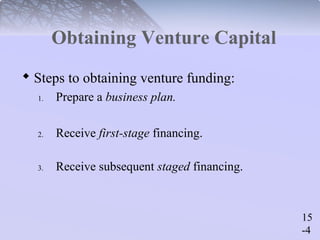
Obtaining Venture Capital 
 Steps to obtaining venture funding: 
1. Prepare a business plan. 
2. Receive first-stage financing. 
3. Receive subsequent staged financing.
15 
-5 
Venture Capital Ownership: 
Example 
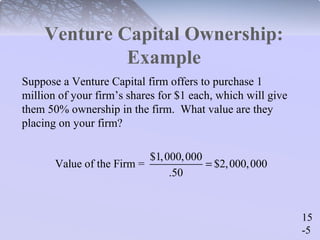
Suppose a Venture Capital firm offers to purchase 1 
million of your firm’s shares for $1 each, which will give 
them 50% ownership in the firm. What value are they 
placing on your firm? 
Value of the Firm = $1,000,000 $2,000,000 
.50 
=
15 
-6 
Types of Venture Investors 
 Angel Investors 
• Investors who finance companies in their earliest stages of 
growth 
 Corporate Venturers 
• Corporations that offer venture assistance to finance young, 
promising companies. 
 Private Equity Investing 
• Investors who offer funds to finance firms that do not trade on 
public stock exchanges such as the NYSE or NASDAQ.
15 
-7 
Venture Capital Management 
Venture Capitalist are not passive investors. 
What do they provide beyond financing?
15 
-8 
The Initial Public Offering 
When a firm requires more capital than private investors can 
provide, it can choose to go public through an Initial Public 
Offering, or IPO. 
 Primary Offering 
– when new shares are sold to raise additional cash 
for the company 
 Secondary Offering 
– when the company’s founders and venture 
capitalists cash in on some of their gains by selling 
shares. 
Does a secondary offering provide additional capital to the 
firm?
15 
-9 
Benefits of Going Public 
 Ability to raise new capital 
 Stock price provides performance measure 
 Information more widely available
15 
- 
10 
Benefits of Going Public 
 Diversified sources of finance 
 Reduced borrowing costs
15 
- 
11 
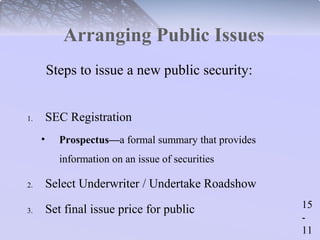
Arranging Public Issues 
Steps to issue a new public security: 
1. SEC Registration 
• Prospectus—a formal summary that provides 
information on an issue of securities 
2. Select Underwriter / Undertake Roadshow 
3. Set final issue price for public
15 
- 
12 
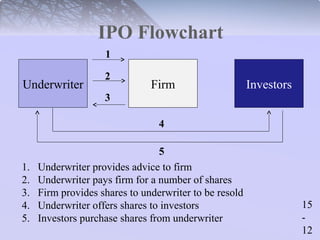
IPO Flowchart 
1 
2 
Underwriter Firm Investors 
4 
3 
5 
1. Underwriter provides advice to firm 
2. Underwriter pays firm for a number of shares 
3. Firm provides shares to underwriter to be resold 
4. Underwriter offers shares to investors 
5. Investors purchase shares from underwriter
15 
- 
13 
Underwriter Spread 
Spread - the difference between the public offer 
price and the price paid by underwriter 
Assume the issuing company incurs $1 million in expenses to sell 3 
million shares at $40 each to an underwriter; the underwriter sells 
the shares at $43 each. What is the spread for this deal?
15 
- 
14 
Underwriting Arrangements 
Firm Commitment: 
Underwriters buy the securities from the firm and then 
resell them to the public. 
Best Efforts Commitment: 
Underwriters agree to sell as much of the issue as possible 
but do not guarantee the sale of the entire issue.
15 
- 
15 
Underwriting Arrangements: 
Capital To Firm 
How much will a firm receive in net funding from a firm commitment 
underwriting of 250,000 shares priced to the public at $40 if a 10% 
underwriting spread has been added to the price paid by the underwriter? 
Additionally, the firm pays $600,000 in legal fees.
15 
- 
16 
Underpricing of an IPO 
Underpricing: Issuing securities at an offering price set below 
the true value of the security. 
Example: Assume the issuer incurs $1 million in other expenses to sell 3 
million shares at $40 each to an underwriter and the underwriter sells the 
shares at $43 each. By the end of the first day’s trading, the issuing company’s 
stock price had risen to $70. What is the total cost of underpricing? 
Cost of Underpricing:
15 
- 
17 
Flotation Costs 
Flotation Costs: The costs incurred when a firm 
issues new securities to the public. 
What are some of the specific costs incurred when a firm 
issues new securities?
15 
- 
18 
Types of Offerings 
After the IPO, successful firms may issue additional 
equity or debt. 
Seasoned Offering 
 Rights Issue 
Issue of securities offered only to current stockholders. 
 General Cash Offer 
Sale of securities open to all investors by an already-public 
company.
15 
- 
19 
Rights Issue: Example 
An investor exercises his right to buy one additional share at 
$20 for every five shares held. How much should each share be 
worth after the rights issue if they previously sold for $50 each? 
Pre-Rights Issue: 
Post-Rights Issue: 
+
15 
- 
20 
General Cash Offer and 
Shelf Registration 
Shelf Registration: A procedure that allows firms to file one 
registration statement for several issues of the same security. 
Benefits of Shelf Registration: 
1. Security issuance without excessive costs 
2. Security issuance on very short notice 
3. Timed issuance to capitalize on favorable market 
conditions 
4. Additional underwriter competition
15 
- 
21 
Private Placements 
In order to avoid registering with the SEC, a 
company can issue a security privately. 
Private Placement: The sale of securities to a limited 
number of investors without a public offering
15 
- 
22 
Private Placements-Advantages 
 Do not have to register with SEC 
 Private placements cost less than public issues 
 Contracts can be customized for each investor
15 
- 
23 
Private Placements- 
Disadvantages 
 Difficult for investors to resell security 
 Lenders often require higher return to compensate 
for higher risk. 
• Private placements typically yield .5% higher than 
public issues

Chap015

  • 1.
    McGraw-Hill/Irwin Copyright ©2012 by The McGraw-Hill Companies, Inc. All rights reserved.
  • 2.
    15 -2 HowCorporations Raise Venture Capital and Issue Securities Young firms often require venture capital to finance growth. The issuance of securities is a complex process that the successful financier must comprehend.
  • 3.
    15 -3 CompanyGrowth Venture Capital provides entrepreneurs with financing to grow their firms. Firms issue securities to further finance their growth.
  • 4.
    15 -4 ObtainingVenture Capital  Steps to obtaining venture funding: 1. Prepare a business plan. 2. Receive first-stage financing. 3. Receive subsequent staged financing.
  • 5.
    15 -5 VentureCapital Ownership: Example Suppose a Venture Capital firm offers to purchase 1 million of your firm’s shares for $1 each, which will give them 50% ownership in the firm. What value are they placing on your firm? Value of the Firm = $1,000,000 $2,000,000 .50 =
  • 6.
    15 -6 Typesof Venture Investors  Angel Investors • Investors who finance companies in their earliest stages of growth  Corporate Venturers • Corporations that offer venture assistance to finance young, promising companies.  Private Equity Investing • Investors who offer funds to finance firms that do not trade on public stock exchanges such as the NYSE or NASDAQ.
  • 7.
    15 -7 VentureCapital Management Venture Capitalist are not passive investors. What do they provide beyond financing?
  • 8.
    15 -8 TheInitial Public Offering When a firm requires more capital than private investors can provide, it can choose to go public through an Initial Public Offering, or IPO.  Primary Offering – when new shares are sold to raise additional cash for the company  Secondary Offering – when the company’s founders and venture capitalists cash in on some of their gains by selling shares. Does a secondary offering provide additional capital to the firm?
  • 9.
    15 -9 Benefitsof Going Public  Ability to raise new capital  Stock price provides performance measure  Information more widely available
  • 10.
    15 - 10 Benefits of Going Public  Diversified sources of finance  Reduced borrowing costs
  • 11.
    15 - 11 Arranging Public Issues Steps to issue a new public security: 1. SEC Registration • Prospectus—a formal summary that provides information on an issue of securities 2. Select Underwriter / Undertake Roadshow 3. Set final issue price for public
  • 12.
    15 - 12 IPO Flowchart 1 2 Underwriter Firm Investors 4 3 5 1. Underwriter provides advice to firm 2. Underwriter pays firm for a number of shares 3. Firm provides shares to underwriter to be resold 4. Underwriter offers shares to investors 5. Investors purchase shares from underwriter
  • 13.
    15 - 13 Underwriter Spread Spread - the difference between the public offer price and the price paid by underwriter Assume the issuing company incurs $1 million in expenses to sell 3 million shares at $40 each to an underwriter; the underwriter sells the shares at $43 each. What is the spread for this deal?
  • 14.
    15 - 14 Underwriting Arrangements Firm Commitment: Underwriters buy the securities from the firm and then resell them to the public. Best Efforts Commitment: Underwriters agree to sell as much of the issue as possible but do not guarantee the sale of the entire issue.
  • 15.
    15 - 15 Underwriting Arrangements: Capital To Firm How much will a firm receive in net funding from a firm commitment underwriting of 250,000 shares priced to the public at $40 if a 10% underwriting spread has been added to the price paid by the underwriter? Additionally, the firm pays $600,000 in legal fees.
  • 16.
    15 - 16 Underpricing of an IPO Underpricing: Issuing securities at an offering price set below the true value of the security. Example: Assume the issuer incurs $1 million in other expenses to sell 3 million shares at $40 each to an underwriter and the underwriter sells the shares at $43 each. By the end of the first day’s trading, the issuing company’s stock price had risen to $70. What is the total cost of underpricing? Cost of Underpricing:
  • 17.
    15 - 17 Flotation Costs Flotation Costs: The costs incurred when a firm issues new securities to the public. What are some of the specific costs incurred when a firm issues new securities?
  • 18.
    15 - 18 Types of Offerings After the IPO, successful firms may issue additional equity or debt. Seasoned Offering  Rights Issue Issue of securities offered only to current stockholders.  General Cash Offer Sale of securities open to all investors by an already-public company.
  • 19.
    15 - 19 Rights Issue: Example An investor exercises his right to buy one additional share at $20 for every five shares held. How much should each share be worth after the rights issue if they previously sold for $50 each? Pre-Rights Issue: Post-Rights Issue: +
  • 20.
    15 - 20 General Cash Offer and Shelf Registration Shelf Registration: A procedure that allows firms to file one registration statement for several issues of the same security. Benefits of Shelf Registration: 1. Security issuance without excessive costs 2. Security issuance on very short notice 3. Timed issuance to capitalize on favorable market conditions 4. Additional underwriter competition
  • 21.
    15 - 21 Private Placements In order to avoid registering with the SEC, a company can issue a security privately. Private Placement: The sale of securities to a limited number of investors without a public offering
  • 22.
    15 - 22 Private Placements-Advantages  Do not have to register with SEC  Private placements cost less than public issues  Contracts can be customized for each investor
  • 23.
    15 - 23 Private Placements- Disadvantages  Difficult for investors to resell security  Lenders often require higher return to compensate for higher risk. • Private placements typically yield .5% higher than public issues

Editor's Notes

  • #2 Chapter 15 Learning Objectives Understand how venture capital firms design successful deals. Understand how firms make initial public offerings and the costs of such offerings. Know what is involved when established firms make a general cash offer or a private placement of securities. Explain the role of the underwriter in an issue of securities. Describe the terms of a rights issue.
  • #3 Chapter 15 Outline Venture Capital Capital Acquisition Process Types of Venture Investors The Initial Public Offering Benefits of Going Public Structure of Public Issues Types of Offerings Rights Issues General Cash Offerings Private Placements
  • #4 Venture Capital – Money invested to finance a new firm.
  • #5 Business Plan – A description of a firm’s products, market, production methods, and resources needed for success. Staged Financing – Venture capital is rarely disbursed in one large lump sum payment, but instead is paid to the firm in stages. Each stage is usually just enough to guide the firm towards its next major checkpoint.
  • #7 Angel Investors – Investors who finance companies in their earliest stages of growth. Typically wealthy individual investors. Corporate Venturers – Corporations sometimes offer venture assistance to finance young, promising companies. Example: Firms such as Intel and Johnson & Johnson often provide capital to new innovative companies. Private Equity Investing – Venture capital is a subset of the larger class of private equity investing. Private equity investors offer funds to finance firms that do not trade on public stock exchanges such as the NYSE or NASDAQ.
  • #9 Initial Public Offering (IPO) – First offering of stock to the general public. Primary Offering – An offering when new shares are sold to raise additional cash for the company. Secondary Offering – An offering when the company’s founders and venture capitalists cash in on some of their gains by selling shares.
  • #12 Companies must prepare a prospectus and register with the Securities and Exchange Commission before they can sell any new stock to the public. Prospectus – Formal summary that provides information on an issue of securities. The roadshow attempts to gauge the interest that potential investors would have in purchasing the new securities. If enough public interest, the underwriters issue shares to the public. Typically underwriters underprice shares upon issue. Underpricing – Issuing securities at an offering price set below the true value of the security.
  • #13 Underwriter – Firm that buys an issue of securities from a company and resells it to the public. Underwriters serve three roles: Provide firm with procedural and financial advice. Buy the firm’s stock. Resell the stock to the public. Note: Underwriters do not simply help the company make its IPO; they are called in whenever a company wishes to raise cash by selling securities to the public.
  • #14 Spread – Difference between public offer price and price paid by underwriter.
  • #15 Firm commitment – Underwriters buy the securities from the firm and then resell them to the public. Underwriter pays for any shares they cannot resell to the public. Best efforts basis commitment – Underwriter agrees to sell as much of the issue as possible but does not guarantee the sale of the entire issue.
  • #17 Underpricing — Issuing securities at an offering price set below the true value of the security.
  • #18 Flotation Costs – The costs incurred when a firm issues new securities to the public.
  • #19 Seasoned Offering – Sale of securities by a firm that is already publicly traded. Rights Issue – Issue of securities offered only to current stockholders. General Cash Offer – Sale of securities open to all investors by an already-public company.
  • #21 Shelf Registration – A procedure that allows firms to file one registration statement for several issues of the same security.
  • #22 Private Placement – Sale of securities to a limited number of investors without a public offering.