Presentation Overview
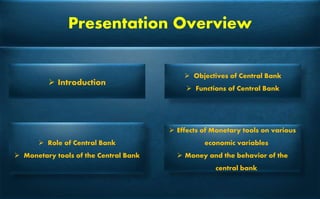
 Introduction
 Objectives of Central Bank
 Functions of Central Bank
 Role of Central Bank
 Monetary tools of the Central Bank
 Effects of Monetary tools on various
economic variables
 Money and the behavior of the
central bank
Introduction
 Central bank, also known as reserve bank, or monetary authority, or “father of all
banks”.
 Provides financial and banking services for the government of a country and its
commercial banking system as well as implementing the government’s monetary
policy.
 Nepal Rastra Bank established in 1956, is a central bank of Nepal.
Objectives of Central Bank
 Regulating the economic activities- facilitate flow of funds to promote economic
activities.
 Formulate and conduct monetary policy to generate maximum economic benefits.
 Retain balanced growth, stabilize the price level and control inflation.
 Enhance foreign exchange earnings through favorable promotion of foreign trade.
Functions of Central Bank
 Issue of bank notes.
 Monetary policy maker.
 Banker for banks.
 Banker for the government.
 Advisor to the government.
 Regulator of the banks and financial institutions.
Roles of Central Bank
 Measuring leading economic variables.
 Money supply and creation.
 Foreign currency management.
 Effective debt management.
 Valuable advise to the government.
 Control and supervisions of financial institutions.
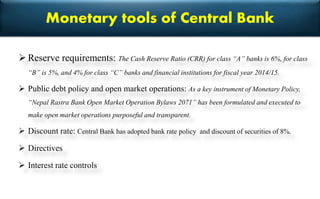
Monetary tools of Central Bank
 Reserve requirements: The Cash Reserve Ratio (CRR) for class “A” banks is 6%, for class
“B” is 5%, and 4% for class “C” banks and financial institutions for fiscal year 2014/15.
 Public debt policy and open market operations: As a key instrument of Monetary Policy,
“Nepal Rastra Bank Open Market Operation Bylaws 2071” has been formulated and executed to
make open market operations purposeful and transparent.
 Discount rate: Central Bank has adopted bank rate policy and discount of securities of 8%.
 Directives
 Interest rate controls
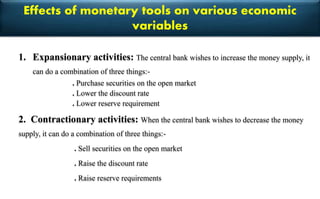
Effects of monetary tools on various economic
variables
1. Expansionary activities: The central bank wishes to increase the money supply, it
can do a combination of three things:-
. Purchase securities on the open market
. Lower the discount rate
. Lower reserve requirement
2. Contractionary activities: When the central bank wishes to decrease the money
supply, it can do a combination of three things:-
. Sell securities on the open market
. Raise the discount rate
. Raise reserve requirements
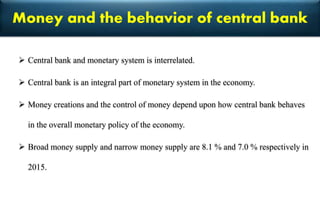
Money and the behavior of central bank
 Central bank and monetary system is interrelated.
 Central bank is an integral part of monetary system in the economy.
 Money creations and the control of money depend upon how central bank behaves
in the overall monetary policy of the economy.
 Broad money supply and narrow money supply are 8.1 % and 7.0 % respectively in
2015.
Central banking

Central banking

  • 2.
    Presentation Overview  Introduction Objectives of Central Bank  Functions of Central Bank  Role of Central Bank  Monetary tools of the Central Bank  Effects of Monetary tools on various economic variables  Money and the behavior of the central bank
  • 3.
    Introduction  Central bank,also known as reserve bank, or monetary authority, or “father of all banks”.  Provides financial and banking services for the government of a country and its commercial banking system as well as implementing the government’s monetary policy.  Nepal Rastra Bank established in 1956, is a central bank of Nepal.
  • 4.
    Objectives of CentralBank  Regulating the economic activities- facilitate flow of funds to promote economic activities.  Formulate and conduct monetary policy to generate maximum economic benefits.  Retain balanced growth, stabilize the price level and control inflation.  Enhance foreign exchange earnings through favorable promotion of foreign trade.
  • 5.
    Functions of CentralBank  Issue of bank notes.  Monetary policy maker.  Banker for banks.  Banker for the government.  Advisor to the government.  Regulator of the banks and financial institutions.
  • 6.
    Roles of CentralBank  Measuring leading economic variables.  Money supply and creation.  Foreign currency management.  Effective debt management.  Valuable advise to the government.  Control and supervisions of financial institutions.
  • 7.
    Monetary tools ofCentral Bank  Reserve requirements: The Cash Reserve Ratio (CRR) for class “A” banks is 6%, for class “B” is 5%, and 4% for class “C” banks and financial institutions for fiscal year 2014/15.  Public debt policy and open market operations: As a key instrument of Monetary Policy, “Nepal Rastra Bank Open Market Operation Bylaws 2071” has been formulated and executed to make open market operations purposeful and transparent.  Discount rate: Central Bank has adopted bank rate policy and discount of securities of 8%.  Directives  Interest rate controls
  • 8.
    Effects of monetarytools on various economic variables 1. Expansionary activities: The central bank wishes to increase the money supply, it can do a combination of three things:- . Purchase securities on the open market . Lower the discount rate . Lower reserve requirement 2. Contractionary activities: When the central bank wishes to decrease the money supply, it can do a combination of three things:- . Sell securities on the open market . Raise the discount rate . Raise reserve requirements
  • 9.
    Money and thebehavior of central bank  Central bank and monetary system is interrelated.  Central bank is an integral part of monetary system in the economy.  Money creations and the control of money depend upon how central bank behaves in the overall monetary policy of the economy.  Broad money supply and narrow money supply are 8.1 % and 7.0 % respectively in 2015.