Persuasion in Advertising
Why study persuasion?

Once you know how the advertisers do it, you will
be more aware of why certain products are
persuasive!
Why study persuasion?

If you know why you are persuaded by something,
you will be able to make a less-biased decision
and form your own opinion. You can also use it
to fight for a cause you believe in.
How do they do it?

There are three basic categories that persuasive
techniques fall into. Those are...
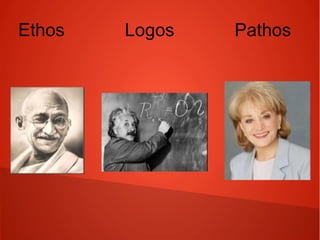
Ethos

Logos

Pathos
Ethos
Credible

Logos
Logical

Pathos
Emotional
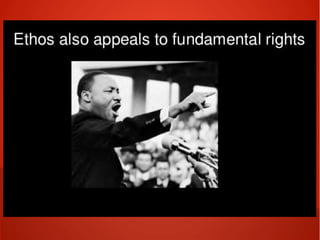
Ethos: Credible or Ethical Appeal
Means convincing by the
character of the author
●

Someone who has
authority, someone who is
likable or respected
●

Goal is to convince people
you are someone worth
listening to
●

People tend to believe
people whom they respect.
●
Logos: Logical or Fact-Based Appeal

Means persuading by
the use of reasoning.
●

Often uses things such
as Statistics.
●

Focus on facts,
recorded evidence,
historical data
●

Mentions things like
studies, surveys, and
research.
●

●
Buzz Words: Logos words that
really “mean” nothing, but sound
factually important
Examples:
●
“Pure”
●
“Natural”
●
“Freedom”
●
“Tasty”

●

Words that end in -er
●
Better, Cleaner, Longer, Faster
●
Technically not the best, but better than it was!

●
Buzz Words:

Sometimes they are
complete nonsense
words associated with
a fun statistic for
logos humor.
Pathos: Emotional Appeal
Persuading by appealing
to the audience's
emotions
●

Language choice affects
the audience's emotional
response
●
Can be positive
(Love, excitement)
●
Can be negative
(Jealousy, hatred)
●
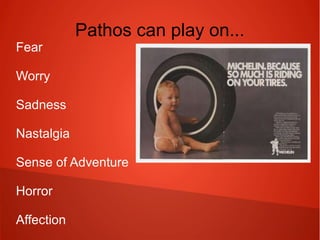
Fear

Pathos can play on...

Worry
Sadness
Nastalgia
Sense of Adventure
Horror
Affection
Which One Will You Use?

Look for these while exploring your persuasive
techniques!
Original Slide:

Knoll, D. (2013). Logos, ethos, and pathos in
advertising. Slideshare. Retrieved from
http://www.slideshare.net/dianaknoll/logosethos-and-pathos-in-advertising

Ethos logos pathos ppt

  • 1.
  • 2.
    Why study persuasion? Onceyou know how the advertisers do it, you will be more aware of why certain products are persuasive!
  • 3.
    Why study persuasion? Ifyou know why you are persuaded by something, you will be able to make a less-biased decision and form your own opinion. You can also use it to fight for a cause you believe in.
  • 4.
    How do theydo it? There are three basic categories that persuasive techniques fall into. Those are...
  • 5.
  • 6.
  • 7.
    Ethos: Credible orEthical Appeal Means convincing by the character of the author ● Someone who has authority, someone who is likable or respected ● Goal is to convince people you are someone worth listening to ● People tend to believe people whom they respect. ●
  • 10.
    Logos: Logical orFact-Based Appeal Means persuading by the use of reasoning. ● Often uses things such as Statistics. ● Focus on facts, recorded evidence, historical data ● Mentions things like studies, surveys, and research. ● ●
  • 11.
    Buzz Words: Logoswords that really “mean” nothing, but sound factually important Examples: ● “Pure” ● “Natural” ● “Freedom” ● “Tasty” ● Words that end in -er ● Better, Cleaner, Longer, Faster ● Technically not the best, but better than it was! ●
  • 12.
    Buzz Words: Sometimes theyare complete nonsense words associated with a fun statistic for logos humor.
  • 14.
    Pathos: Emotional Appeal Persuadingby appealing to the audience's emotions ● Language choice affects the audience's emotional response ● Can be positive (Love, excitement) ● Can be negative (Jealousy, hatred) ●
  • 15.
    Fear Pathos can playon... Worry Sadness Nastalgia Sense of Adventure Horror Affection
  • 16.
    Which One WillYou Use? Look for these while exploring your persuasive techniques!
  • 17.
    Original Slide: Knoll, D.(2013). Logos, ethos, and pathos in advertising. Slideshare. Retrieved from http://www.slideshare.net/dianaknoll/logosethos-and-pathos-in-advertising