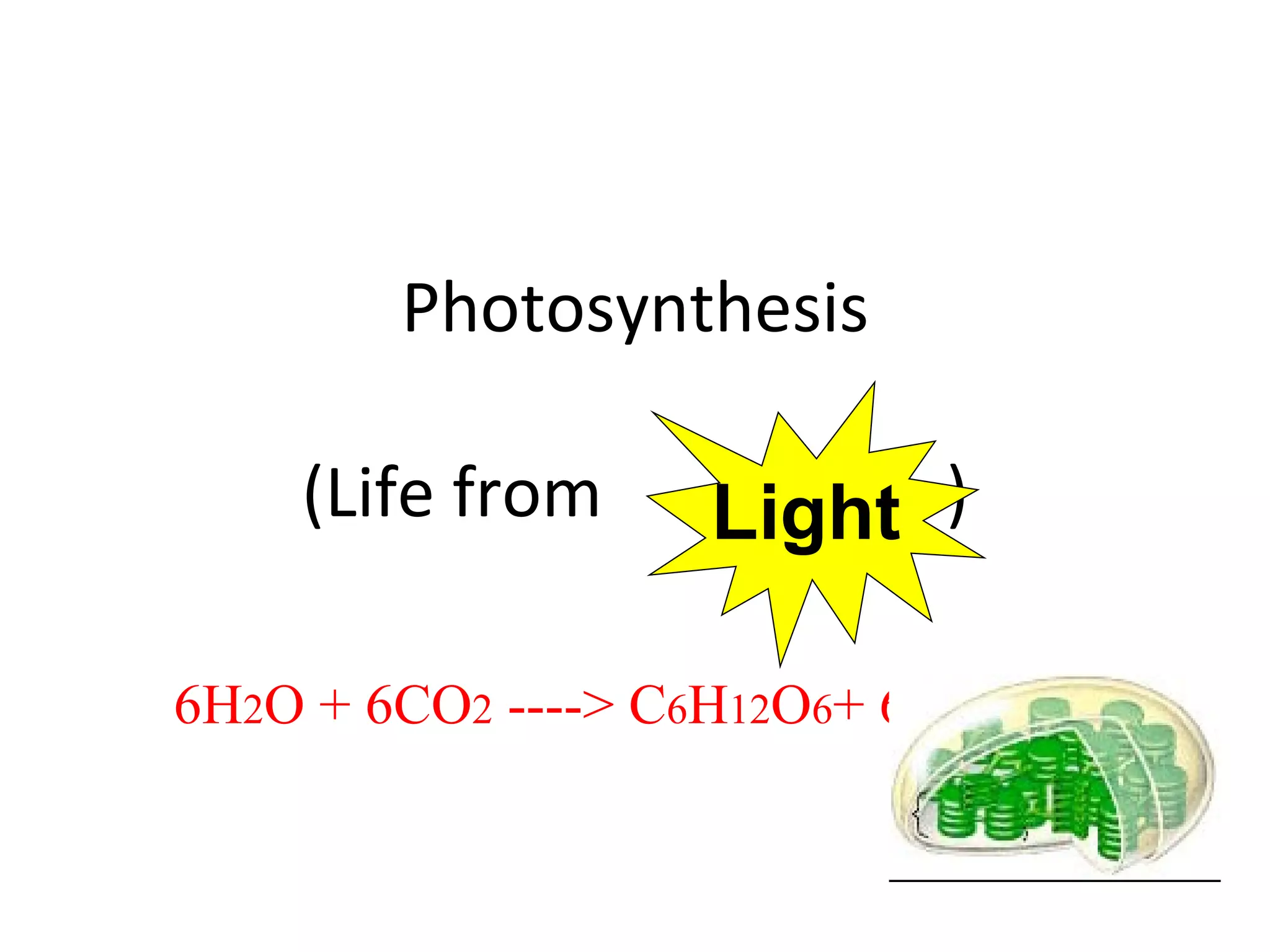
Photosynthesis (Life from  ) 6H 2 O + 6CO 2  ----> C 6 H 12 O 6 + 6O 2 Light
A little background Grass    Caterpillar    Bird Autotroph   Heterotroph    Heterotroph All energy originates with Autotrophs  Organisms autotrophs heterotrophs Make own food Obtain food from others
The fuel of living things ATP- Adenosine triphosphate Consists of  Adenine 5-carbon sugar called ribose Three phosphate groups Key to ATP’s ability to release energy Adenine Ribose P P P
ADP ADP is a cousin of ATP  Main differences ADP has 2 phosphates ATP has 3 ADP has less energy then ATP This is where The bond breaks To turn ATP into ADP  ADP
The photosynthesis equation The process by which light energy is converted into chemical energy and stored in organic compounds Referred to as  biochemical pathway 6H 2 O + 6CO 2      energy   C 6 H 12 O 6  + 6O 2 Reactants Products
Energy needs of Life All life needs a constant input of energy Heterotrophs (animals, fungi, most bacteria) get their energy from “eating others” consumers of other organisms consume  organic molecules Autotrophs (plants, some bacteria) get their energy from “self” use sunlight energy to synthesize  organic molecules
We will be looking at how autotrophs and how they synthesize these organic molecules through photosynthesis
Where does photosynthesis occur?  In the chloroplasts! absorb sunlight & CO 2 make energy & sugar CO 2
Light: absorption spectrum Light reaction can perform work with wavelengths of light that are absorbed chlorophyll  a  — the dominant pigment — absorbs best in red & blue wavelengths & least in green other pigments with different structures have different absorption spectra
Chloroplasts Green because absorb light wavelengths in  red  &  blue  and reflect  green  back out THAT IS WHY PLANTS LOOK GREEN TO US! WE SEE WHAT IS RELFECTED.
Photosynthesis:  Overall Equation This is the equation you are used to seeing, but this is not the whole story…  +  water  +  energy    glucose  +  oxygen carbon dioxide 6CO 2 6H 2 O C 6 H 12 O 6 6O 2 light energy  + + +
Photosynthesis Actually two separate reactions Energy building use sunlight make energy (ATP) Sugar building use ATP use CO 2 make sugars (C 6 H 12 O 6 ) Energy building  reactions Sugar building  reactions ATP ADP sugar sun CO 2
Energy Building Reactions O 2 H 2 O Energy Building Reactions sunlight ATP H 2 O ATP O 2 light energy  + + makes ATP energy releases oxygen as a waste product
Sugar Building Reactions sugars C 6 H 12 O 6 CO 2 Sugar Building Reactions ATP CO 2 C 6 H 12 O 6 ADP ATP  + + ADP builds sugars uses ATP cycles ADP back to make more ATP
Putting it all together sugars C 6 H 12 O 6 CO 2 ATP ADP H 2 O O 2 sunlight Sugar Building Reactions Energy  Building Reactions Plants make both: ATP sugars CO 2 H 2 O C 6 H 12 O 6 O 2 light energy  + + +
So what does a plant need? Takes in CO 2 H 2 O light Releases O 2 Produced and moved around sugars roots shoot leaves
How can a leaf do this?  Let’s briefly examine the leaf structure H 2 O CO 2 CO 2 O 2 H 2 O phloem (sugar) O 2 xylem (water) Stoma (pore/hole)
Stomata  Function of stomata CO 2  in O 2  out  H 2 O out guard cell Stomata (pore or hole)
Xylem carry water up from roots
Phloem: food-conducting cells carry sugars around the plant wherever they are needed  new leaves fruit seeds
Putting it all together  Making a living… sunlight leaves = solar collectors photosynthesis gases: CO 2  in & O 2  out   stomata = gases in & out H 2 O roots take in water from soil pulled up by leaf evaporation nutrients roots take in from soil
How are cellular respiration and photosynthesis connected? Respiration Photosynthesis glucose  +  oxygen    carbon  +  water  +  energy dioxide C 6 H 12 O 6 6O 2 6CO 2 6H 2 O ATP  + + + +  water  +  energy    glucose  +  oxygen carbon dioxide 6CO 2 6H 2 O C 6 H 12 O 6 6O 2 light energy  + + +
Energy cycle Photosynthesis Cellular Respiration O 2 CO 2 plants animals, plants ATP H 2 O sun The Great Circle of Life! glucose
Resources www.bio.kimunity.com Miller, Ken and Joe Levine.  Prentice hall Biology . Pearson Education Inc. New Jersey, 2005.

Module 6, lesson 1 photosynthesis

  • 1.
    Photosynthesis (Life from ) 6H 2 O + 6CO 2 ----> C 6 H 12 O 6 + 6O 2 Light
  • 2.
    A little backgroundGrass  Caterpillar  Bird Autotroph  Heterotroph  Heterotroph All energy originates with Autotrophs Organisms autotrophs heterotrophs Make own food Obtain food from others
  • 3.
    The fuel ofliving things ATP- Adenosine triphosphate Consists of Adenine 5-carbon sugar called ribose Three phosphate groups Key to ATP’s ability to release energy Adenine Ribose P P P
  • 4.
    ADP ADP isa cousin of ATP Main differences ADP has 2 phosphates ATP has 3 ADP has less energy then ATP This is where The bond breaks To turn ATP into ADP ADP
  • 5.
    The photosynthesis equationThe process by which light energy is converted into chemical energy and stored in organic compounds Referred to as biochemical pathway 6H 2 O + 6CO 2  energy  C 6 H 12 O 6 + 6O 2 Reactants Products
  • 6.
    Energy needs ofLife All life needs a constant input of energy Heterotrophs (animals, fungi, most bacteria) get their energy from “eating others” consumers of other organisms consume organic molecules Autotrophs (plants, some bacteria) get their energy from “self” use sunlight energy to synthesize organic molecules
  • 7.
    We will belooking at how autotrophs and how they synthesize these organic molecules through photosynthesis
  • 8.
    Where does photosynthesisoccur? In the chloroplasts! absorb sunlight & CO 2 make energy & sugar CO 2
  • 9.
    Light: absorption spectrumLight reaction can perform work with wavelengths of light that are absorbed chlorophyll a — the dominant pigment — absorbs best in red & blue wavelengths & least in green other pigments with different structures have different absorption spectra
  • 10.
    Chloroplasts Green becauseabsorb light wavelengths in red & blue and reflect green back out THAT IS WHY PLANTS LOOK GREEN TO US! WE SEE WHAT IS RELFECTED.
  • 11.
    Photosynthesis: OverallEquation This is the equation you are used to seeing, but this is not the whole story… + water + energy  glucose + oxygen carbon dioxide 6CO 2 6H 2 O C 6 H 12 O 6 6O 2 light energy  + + +
  • 12.
    Photosynthesis Actually twoseparate reactions Energy building use sunlight make energy (ATP) Sugar building use ATP use CO 2 make sugars (C 6 H 12 O 6 ) Energy building reactions Sugar building reactions ATP ADP sugar sun CO 2
  • 13.
    Energy Building ReactionsO 2 H 2 O Energy Building Reactions sunlight ATP H 2 O ATP O 2 light energy  + + makes ATP energy releases oxygen as a waste product
  • 14.
    Sugar Building Reactionssugars C 6 H 12 O 6 CO 2 Sugar Building Reactions ATP CO 2 C 6 H 12 O 6 ADP ATP  + + ADP builds sugars uses ATP cycles ADP back to make more ATP
  • 15.
    Putting it alltogether sugars C 6 H 12 O 6 CO 2 ATP ADP H 2 O O 2 sunlight Sugar Building Reactions Energy Building Reactions Plants make both: ATP sugars CO 2 H 2 O C 6 H 12 O 6 O 2 light energy  + + +
  • 16.
    So what doesa plant need? Takes in CO 2 H 2 O light Releases O 2 Produced and moved around sugars roots shoot leaves
  • 17.
    How can aleaf do this? Let’s briefly examine the leaf structure H 2 O CO 2 CO 2 O 2 H 2 O phloem (sugar) O 2 xylem (water) Stoma (pore/hole)
  • 18.
    Stomata Functionof stomata CO 2 in O 2 out H 2 O out guard cell Stomata (pore or hole)
  • 19.
    Xylem carry waterup from roots
  • 20.
    Phloem: food-conducting cellscarry sugars around the plant wherever they are needed new leaves fruit seeds
  • 21.
    Putting it alltogether Making a living… sunlight leaves = solar collectors photosynthesis gases: CO 2 in & O 2 out stomata = gases in & out H 2 O roots take in water from soil pulled up by leaf evaporation nutrients roots take in from soil
  • 22.
    How are cellularrespiration and photosynthesis connected? Respiration Photosynthesis glucose + oxygen  carbon + water + energy dioxide C 6 H 12 O 6 6O 2 6CO 2 6H 2 O ATP  + + + + water + energy  glucose + oxygen carbon dioxide 6CO 2 6H 2 O C 6 H 12 O 6 6O 2 light energy  + + +
  • 23.
    Energy cycle PhotosynthesisCellular Respiration O 2 CO 2 plants animals, plants ATP H 2 O sun The Great Circle of Life! glucose
  • 24.
    Resources www.bio.kimunity.com Miller,Ken and Joe Levine. Prentice hall Biology . Pearson Education Inc. New Jersey, 2005.

Editor's Notes

  • #23 So, in effect, photosynthesis is respiration run backwards powered by light. Cellular Respiration oxidize C 6 H 12 O 6  CO 2 & produce H 2 O fall of electrons downhill to O 2 exergonic Photosynthesis reduce CO 2  C 6 H 12 O 6 & produce O 2 boost electrons uphill by splitting H 2 O endergonic