
17.
PHOTOSYNTHBy: NADIA, SYAFIQA,
SYAFIQAH,AZIRA,AYATI
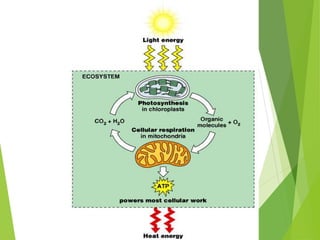
 The process where by light energy is
converted to chemical energy that is store
in glucose or other organic compounds.
 In the presence of light, green plant
produce organic compound and oxygen
from carbon dioxide and water.
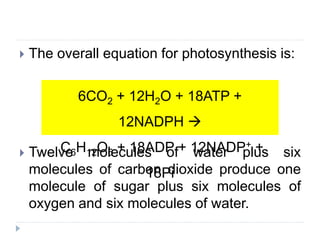
 The overall equation for photosynthesis is:
 Twelve molecules of water plus six
molecules of carbon dioxide produce one
molecule of sugar plus six molecules of
oxygen and six molecules of water.
6CO2 + 12H2O + 18ATP +
12NADPH 
C6H12O6 + 18ADP + 12NADP+ +
18Pi
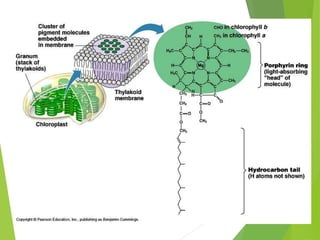
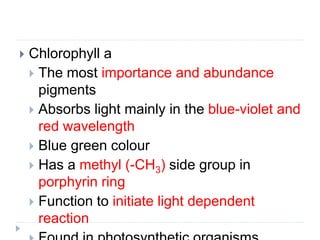
 Chlorophyll a
 The most importance and abundance
pigments
 Absorbs light mainly in the blue-violet and
red wavelength
 Blue green colour
 Has a methyl (-CH3) side group in
porphyrin ring
 Function to initiate light dependent
reaction
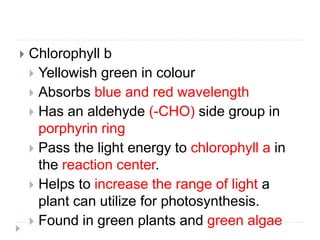
 Chlorophyll b
 Yellowish green in colour
 Absorbs blue and red wavelength
 Has an aldehyde (-CHO) side group in
porphyrin ring
 Pass the light energy to chlorophyll a in
the reaction center.
 Helps to increase the range of light a
plant can utilize for photosynthesis.
 Found in green plants and green algae
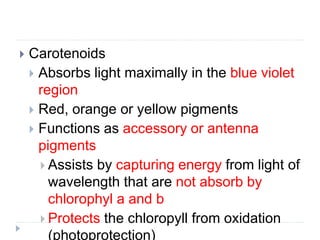
 Carotenoids
 Absorbs light maximally in the blue violet
region
 Red, orange or yellow pigments
 Functions as accessory or antenna
pigments
 Assists by capturing energy from light of
wavelength that are not absorb by
chlorophyl a and b
 Protects the chloropyll from oxidation
(photoprotection)
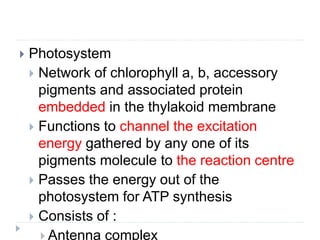
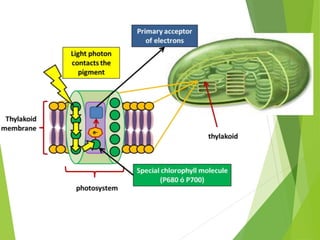
 Photosystem
 Network of chlorophyll a, b, accessory
pigments and associated protein
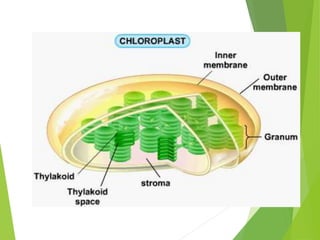
embedded in the thylakoid membrane
 Functions to channel the excitation
energy gathered by any one of its
pigments molecule to the reaction centre
 Passes the energy out of the
photosystem for ATP synthesis
 Consists of :
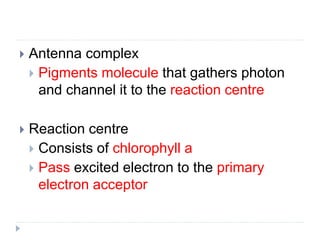
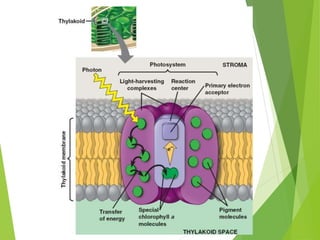
 Antenna complex
 Antenna complex
 Pigments molecule that gathers photon
and channel it to the reaction centre
 Reaction centre
 Consists of chlorophyll a
 Pass excited electron to the primary
electron acceptor
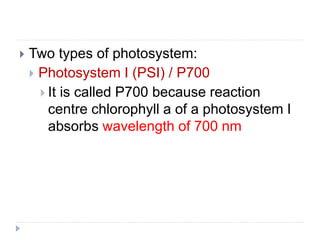
 Two types of photosystem:
 Photosystem I (PSI) / P700
 It is called P700 because reaction
centre chlorophyll a of a photosystem I
absorbs wavelength of 700 nm
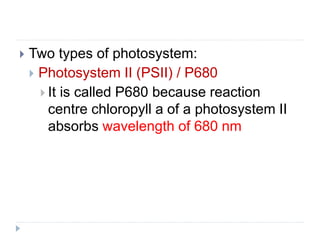
 Two types of photosystem:
 Photosystem II (PSII) / P680
 It is called P680 because reaction
centre chloropyll a of a photosystem II
absorbs wavelength of 680 nm
 Photosynthesis occurs in two main stages:
 the first stage being towards light
dependent reaction
 the second stage being the light
independent reaction (Calvin Benson
Cycle)
 In short the light reactions capture the light
energy and utilize it to make high-energy
molecule (ATP)
 ATP are used by the Calvin-Benson Cycle
to capture carbon dioxide and make the
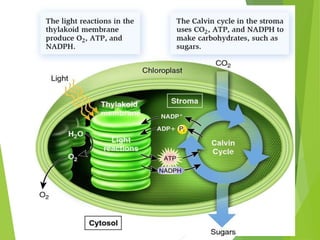
 The light reaction convert solar energy to
chemical energy.
 In the light reaction, light energy absorbed
by chlorophyll in the thylakoid drives the
transfer of electrons and hydrogen from
water to NADP+ (nicotinemide adenine
dinucleotide phosphate), forming NADPH.
 The light reaction also generate ATP by
photophosphorylation for the Calvin Cycle.
Photophosphorylation
 Photophosphorylation is the process of
creating ATP using a proton gradient
created by the energy gathered from
sunlight.
 The process of creating the proton gradient
resembles that of the electron transport
chain of cellular respiration.
 But since formation of this proton gradient
is light-dependent, the process is called
photophosphorylation.
 Two types of photophosporylation:
 Non-cyclic photophosphorylation
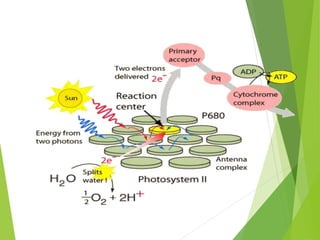
 Light energy is absorbed by accessory
(antenna) pigments of PS II / P680
 Then transferred to reaction centre
(chlorophyll a)
 Electron is photoactivated / excited and
released
 This creates an electron deficiency
 P680 oxidized to P680+
 Photolysis of water molecule to form 2
electrons, 2H+ and 1 oxygen atom
 There are 2H+ released into the thylakoid
lumen
 The oxygen atom immediately combined
with an oxygen atom generated by the
splitting of another water molecule
forming oxygen molecule (O2)
 Electron from photolysis of water replace
the electrons released from PS II
 The P680 /PS II molecule returns to its
reduced / stabilized state
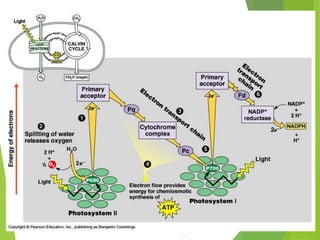
 The electrons released from PS II are
accepted by primary electron acceptor/
pheophytin
 And pass along the ETC; consists of
plastoquinone/ Pq, cyctochrome
complex, plastocyanin/ Pc and then
toP700/ PS I
 As the electron passed through the
cytochrome complex, energy is released
through redox reaction.
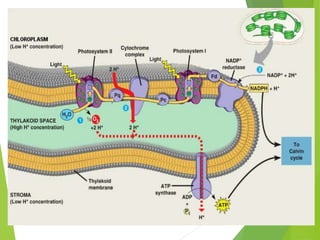
 The energy is used to pump H+ from the
stroma (low concentration of H+ ) into the
thylakoid lumen (high concentration of H+ )
 Creating a proton gradient between the
stroma and thylakoid lumen that is used in
chemiosmosis
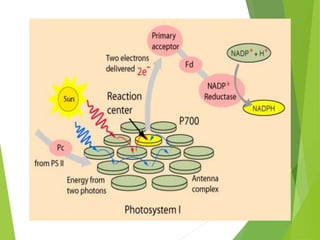
 At the same time, high energy electrons
in P700 / PS I are ejected and accepted by
primary electron acceptor
 This creates an electron deficiency
 P700 oxidized to P700+
 PSI functions as electron acceptor,
accepting electron from PSII
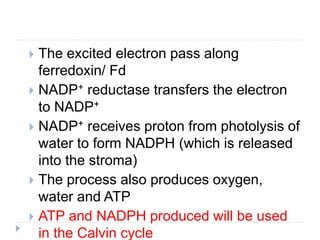
 The excited electron pass along
ferredoxin/ Fd
 NADP+ reductase transfers the electron
to NADP+
 NADP+ receives proton from photolysis of
water to form NADPH (which is released
into the stroma)
 The process also produces oxygen,
water and ATP
 ATP and NADPH produced will be used
in the Calvin cycle
chemiosmosis
 Production of ATP is by chemiosmosis
 High concentration of H+ in the thylakoid
space
 Low concentration of H+ in the stroma
 H+ diffuse from the thylakoid space back
into the stroma through ATP synthase
 The energy release is used to
phosphorylate ADP to form ATP (in the
stroma)
 ATP and NADPH produced by non-cyclic
photophosphorylation will be used in the
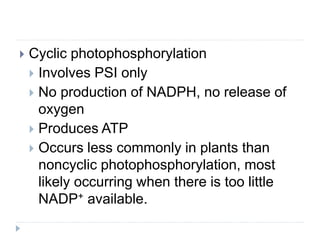
 Cyclic photophosphorylation
 Involves PSI only
 No production of NADPH, no release of
oxygen
 Produces ATP
 Occurs less commonly in plants than
noncyclic photophosphorylation, most
likely occurring when there is too little
NADP+ available.
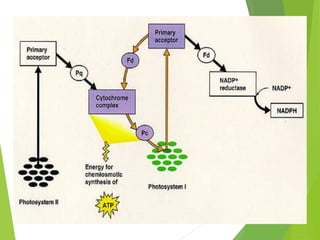
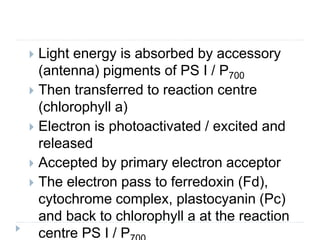
 Light energy is absorbed by accessory
(antenna) pigments of PS I / P700
 Then transferred to reaction centre
(chlorophyll a)
 Electron is photoactivated / excited and
released
 Accepted by primary electron acceptor
 The electron pass to ferredoxin (Fd),
cytochrome complex, plastocyanin (Pc)
and back to chlorophyll a at the reaction
centre PS I / P
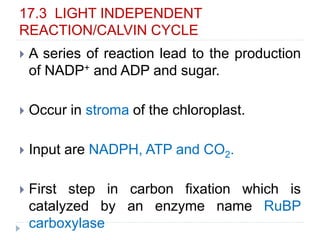
17.3 LIGHT INDEPENDENT
REACTION/CALVIN CYCLE
 A series of reaction lead to the production
of NADP+ and ADP and sugar.
 Occur in stroma of the chloroplast.
 Input are NADPH, ATP and CO2.
 First step in carbon fixation which is
catalyzed by an enzyme name RuBP
carboxylase
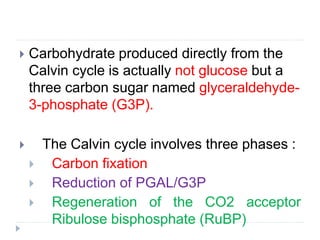
 Carbohydrate produced directly from the
Calvin cycle is actually not glucose but a
three carbon sugar named glyceraldehyde-
3-phosphate (G3P).
 The Calvin cycle involves three phases :
 Carbon fixation
 Reduction of PGAL/G3P
 Regeneration of the CO2 acceptor
Ribulose bisphosphate (RuBP)
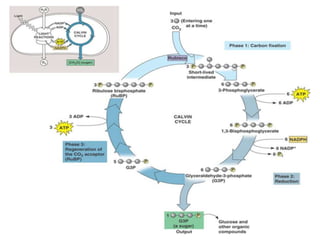
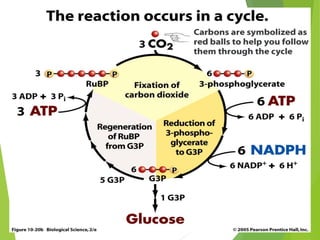
I) CARBON FIXATION
 The Calvin cycle incorporates each CO2
molecule one at the time by attaching it to
a five carbon sugar named ribulose
biphosphate (RuBP).
 The enzyme that catalyze this first step is
RuBP carboxylase
 The product of the reaction is a six-carbon
intermediately split in half forming two
molecules of 3-phosphoglycerate (for each
II) REDUCTION
 Each molecules of 3-phosphoglycerate
receives an additional phosphate from ATP
becoming 1,3-biphosphoglycerate
 A pair of electron donated from NADPH
reduces 1,3-biphosphoglycerate to G3P ,
which store more potential energy.
 G3P is a sugar ,the same three carbon
sugar formed by splitting of glucose
(glycolysis)
 Every 3 molecules of CO2 that enter the
cycle, there are six molecules of G3P
formed.
 But only one molecule of G3P will exit the
cycle become the starting material for
metabolic pathway that synthesize other
organic compound (lipid , amino acid)
including glucose and other carbohydrate.
III) REGENERATION OF THE CARBON
DIOXIDE ACCEPTOR (RuBP)
 In the complex series of reaction, the
carbon skeletons of five molecules of G3P
are rearranged by the last step of the
Calvin cycle into three molecules of RuBP.
 To accomplish this, the cycle spend three
more molecules of ATP.
 The RuBP is now prepared to receive CO2
again and the cycle continues.
 For the net synthesis of one G3P
molecule, the Calvin cycle requires a total
of nine molecules of ATP, and six molecule
 Plants which use only the Calvin cycle for
fixing the carbon dioxide from the air are
known as C3 plants.
 About 85% of plant species are C3 plants.
They include the cereal grains: wheat, rice,
barley, oats. Peanuts, cotton, sugar beets,
tobacco, spinach, soybeans, and most
trees are C3 plants.
 C3 plants have the disadvantage that in
17.5 Alternative Mechanism Of Carbon Fixation:
Hatch-Slack(C4) And Crassulacean Acid
Metabolism (CAM) Pathways
PHOTORESPIRATION
 Photorespiration occurs when the CO2
levels inside a leaf become low.
 This happens on hot dry days when a plant
is forced to close its stomata to prevent
excess water loss.
 If the plant continues to attempt to fix CO2
when its stomata are closed, the CO2 will
get used up and the O2 ratio in the leaf will
increase relative to CO concentrations.
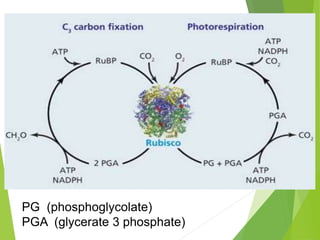
PG (phosphoglycolate)
PGA (glycerate 3 phosphate)
 When the CO2 levels inside the leaf drop to
around 50 ppm(part per million), RuBP
carboxylase starts to combine O2 with
RuBP instead of CO2.
 Photorespiration uses the ATP and NADPH
produced in the light reaction.
 The process result in the loss of fixed
carbon dioxide from the plant, reducing
photosynthetic efficiency and plant growth.
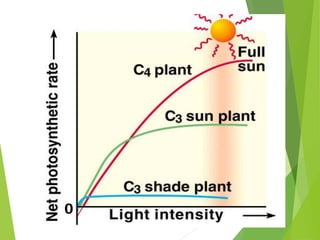
Hatch-Slack(C4) pathway
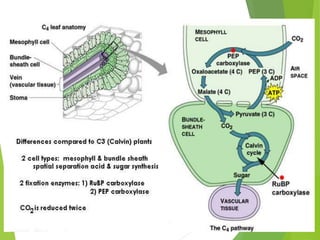
C4 plant such as sugarcane ,maize and
other tropical grasses have evolved a
special metabolic adaptation which reduce
photorespiration.
The metabolic adaptation to reduce
photorespiration is Hatch-Slack pathway.
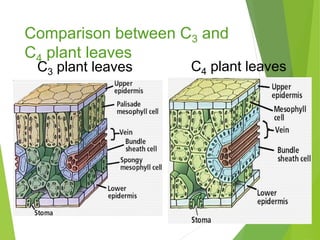
Comparison between C3 and
C4 plant leaves
C3 plant leaves C4 plant leaves
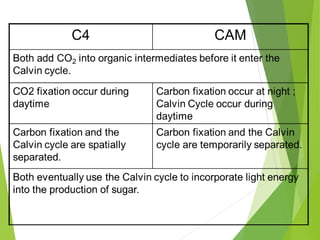
 C4 plants have Krantz anatomy //
mesophyll cells are arranged concentrically
around the bundle sheath cells
 Plants conduct C4 pathway in the
mesophyll cell and Calvin cycle in the
bundle sheath cells
 Use PEP carboxylase to fix CO2 in the
mesophyll cells
 With phosphoenolpyruvate (PEP) forming
oxaloacetate (OAA)
 PEP carboxylase has very a high affinity
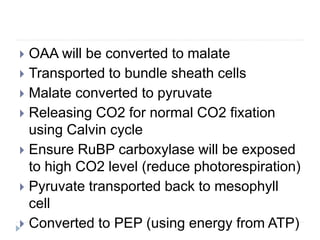
 OAA will be converted to malate
 Transported to bundle sheath cells
 Malate converted to pyruvate
 Releasing CO2 for normal CO2 fixation
using Calvin cycle
 Ensure RuBP carboxylase will be exposed
to high CO2 level (reduce photorespiration)
 Pyruvate transported back to mesophyll
cell
 Converted to PEP (using energy from ATP)
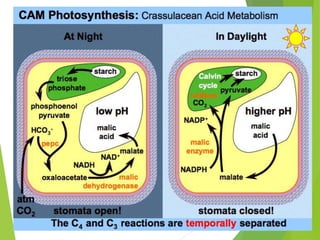
Crassulacean Acid Metabolism (CAM)
Pathway
 A second strategy to minimize
photorespiration is found in succulent
plants, cacti, pineapples and several other
plant families.
 Open stomata during the night and close
them during the day.
 During the night, stomata are open.
 CO2 enters the leaf tissue.
 CO2 combine with PEP to form
oxaloacetate.
 Oxaloacetate converted into malate.
 Malate is transported into the vacuole for
storage.
 During the day, stomata are close.
 Malate is moved into the chloroplasts.
 Malate converted into pyruvate and
Photosynthesis presentation

Photosynthesis presentation

  • 1.
  • 4.
     The processwhere by light energy is converted to chemical energy that is store in glucose or other organic compounds.  In the presence of light, green plant produce organic compound and oxygen from carbon dioxide and water.
  • 5.
     The overallequation for photosynthesis is:  Twelve molecules of water plus six molecules of carbon dioxide produce one molecule of sugar plus six molecules of oxygen and six molecules of water. 6CO2 + 12H2O + 18ATP + 12NADPH  C6H12O6 + 18ADP + 12NADP+ + 18Pi
  • 7.
     Chlorophyll a The most importance and abundance pigments  Absorbs light mainly in the blue-violet and red wavelength  Blue green colour  Has a methyl (-CH3) side group in porphyrin ring  Function to initiate light dependent reaction
  • 8.
     Chlorophyll b Yellowish green in colour  Absorbs blue and red wavelength  Has an aldehyde (-CHO) side group in porphyrin ring  Pass the light energy to chlorophyll a in the reaction center.  Helps to increase the range of light a plant can utilize for photosynthesis.  Found in green plants and green algae
  • 9.
     Carotenoids  Absorbslight maximally in the blue violet region  Red, orange or yellow pigments  Functions as accessory or antenna pigments  Assists by capturing energy from light of wavelength that are not absorb by chlorophyl a and b  Protects the chloropyll from oxidation (photoprotection)
  • 10.
     Photosystem  Networkof chlorophyll a, b, accessory pigments and associated protein embedded in the thylakoid membrane  Functions to channel the excitation energy gathered by any one of its pigments molecule to the reaction centre  Passes the energy out of the photosystem for ATP synthesis  Consists of :  Antenna complex
  • 12.
     Antenna complex Pigments molecule that gathers photon and channel it to the reaction centre  Reaction centre  Consists of chlorophyll a  Pass excited electron to the primary electron acceptor
  • 14.
     Two typesof photosystem:  Photosystem I (PSI) / P700  It is called P700 because reaction centre chlorophyll a of a photosystem I absorbs wavelength of 700 nm
  • 16.
     Two typesof photosystem:  Photosystem II (PSII) / P680  It is called P680 because reaction centre chloropyll a of a photosystem II absorbs wavelength of 680 nm
  • 18.
     Photosynthesis occursin two main stages:  the first stage being towards light dependent reaction  the second stage being the light independent reaction (Calvin Benson Cycle)  In short the light reactions capture the light energy and utilize it to make high-energy molecule (ATP)  ATP are used by the Calvin-Benson Cycle to capture carbon dioxide and make the
  • 19.
     The lightreaction convert solar energy to chemical energy.  In the light reaction, light energy absorbed by chlorophyll in the thylakoid drives the transfer of electrons and hydrogen from water to NADP+ (nicotinemide adenine dinucleotide phosphate), forming NADPH.  The light reaction also generate ATP by photophosphorylation for the Calvin Cycle.
  • 20.
    Photophosphorylation  Photophosphorylation isthe process of creating ATP using a proton gradient created by the energy gathered from sunlight.  The process of creating the proton gradient resembles that of the electron transport chain of cellular respiration.  But since formation of this proton gradient is light-dependent, the process is called photophosphorylation.  Two types of photophosporylation:
  • 21.
     Non-cyclic photophosphorylation Light energy is absorbed by accessory (antenna) pigments of PS II / P680  Then transferred to reaction centre (chlorophyll a)  Electron is photoactivated / excited and released  This creates an electron deficiency  P680 oxidized to P680+  Photolysis of water molecule to form 2 electrons, 2H+ and 1 oxygen atom
  • 22.
     There are2H+ released into the thylakoid lumen  The oxygen atom immediately combined with an oxygen atom generated by the splitting of another water molecule forming oxygen molecule (O2)  Electron from photolysis of water replace the electrons released from PS II  The P680 /PS II molecule returns to its reduced / stabilized state
  • 23.
     The electronsreleased from PS II are accepted by primary electron acceptor/ pheophytin  And pass along the ETC; consists of plastoquinone/ Pq, cyctochrome complex, plastocyanin/ Pc and then toP700/ PS I
  • 24.
     As theelectron passed through the cytochrome complex, energy is released through redox reaction.  The energy is used to pump H+ from the stroma (low concentration of H+ ) into the thylakoid lumen (high concentration of H+ )  Creating a proton gradient between the stroma and thylakoid lumen that is used in chemiosmosis
  • 25.
     At thesame time, high energy electrons in P700 / PS I are ejected and accepted by primary electron acceptor  This creates an electron deficiency  P700 oxidized to P700+  PSI functions as electron acceptor, accepting electron from PSII
  • 26.
     The excitedelectron pass along ferredoxin/ Fd  NADP+ reductase transfers the electron to NADP+  NADP+ receives proton from photolysis of water to form NADPH (which is released into the stroma)  The process also produces oxygen, water and ATP  ATP and NADPH produced will be used in the Calvin cycle
  • 29.
    chemiosmosis  Production ofATP is by chemiosmosis  High concentration of H+ in the thylakoid space  Low concentration of H+ in the stroma  H+ diffuse from the thylakoid space back into the stroma through ATP synthase  The energy release is used to phosphorylate ADP to form ATP (in the stroma)  ATP and NADPH produced by non-cyclic photophosphorylation will be used in the
  • 30.
     Cyclic photophosphorylation Involves PSI only  No production of NADPH, no release of oxygen  Produces ATP  Occurs less commonly in plants than noncyclic photophosphorylation, most likely occurring when there is too little NADP+ available.
  • 32.
     Light energyis absorbed by accessory (antenna) pigments of PS I / P700  Then transferred to reaction centre (chlorophyll a)  Electron is photoactivated / excited and released  Accepted by primary electron acceptor  The electron pass to ferredoxin (Fd), cytochrome complex, plastocyanin (Pc) and back to chlorophyll a at the reaction centre PS I / P
  • 34.
    17.3 LIGHT INDEPENDENT REACTION/CALVINCYCLE  A series of reaction lead to the production of NADP+ and ADP and sugar.  Occur in stroma of the chloroplast.  Input are NADPH, ATP and CO2.  First step in carbon fixation which is catalyzed by an enzyme name RuBP carboxylase
  • 35.
     Carbohydrate produceddirectly from the Calvin cycle is actually not glucose but a three carbon sugar named glyceraldehyde- 3-phosphate (G3P).  The Calvin cycle involves three phases :  Carbon fixation  Reduction of PGAL/G3P  Regeneration of the CO2 acceptor Ribulose bisphosphate (RuBP)
  • 38.
    I) CARBON FIXATION The Calvin cycle incorporates each CO2 molecule one at the time by attaching it to a five carbon sugar named ribulose biphosphate (RuBP).  The enzyme that catalyze this first step is RuBP carboxylase  The product of the reaction is a six-carbon intermediately split in half forming two molecules of 3-phosphoglycerate (for each
  • 39.
    II) REDUCTION  Eachmolecules of 3-phosphoglycerate receives an additional phosphate from ATP becoming 1,3-biphosphoglycerate  A pair of electron donated from NADPH reduces 1,3-biphosphoglycerate to G3P , which store more potential energy.  G3P is a sugar ,the same three carbon sugar formed by splitting of glucose (glycolysis)
  • 40.
     Every 3molecules of CO2 that enter the cycle, there are six molecules of G3P formed.  But only one molecule of G3P will exit the cycle become the starting material for metabolic pathway that synthesize other organic compound (lipid , amino acid) including glucose and other carbohydrate.
  • 41.
    III) REGENERATION OFTHE CARBON DIOXIDE ACCEPTOR (RuBP)  In the complex series of reaction, the carbon skeletons of five molecules of G3P are rearranged by the last step of the Calvin cycle into three molecules of RuBP.  To accomplish this, the cycle spend three more molecules of ATP.  The RuBP is now prepared to receive CO2 again and the cycle continues.  For the net synthesis of one G3P molecule, the Calvin cycle requires a total of nine molecules of ATP, and six molecule
  • 42.
     Plants whichuse only the Calvin cycle for fixing the carbon dioxide from the air are known as C3 plants.  About 85% of plant species are C3 plants. They include the cereal grains: wheat, rice, barley, oats. Peanuts, cotton, sugar beets, tobacco, spinach, soybeans, and most trees are C3 plants.  C3 plants have the disadvantage that in 17.5 Alternative Mechanism Of Carbon Fixation: Hatch-Slack(C4) And Crassulacean Acid Metabolism (CAM) Pathways
  • 43.
    PHOTORESPIRATION  Photorespiration occurswhen the CO2 levels inside a leaf become low.  This happens on hot dry days when a plant is forced to close its stomata to prevent excess water loss.  If the plant continues to attempt to fix CO2 when its stomata are closed, the CO2 will get used up and the O2 ratio in the leaf will increase relative to CO concentrations.
  • 44.
  • 46.
     When theCO2 levels inside the leaf drop to around 50 ppm(part per million), RuBP carboxylase starts to combine O2 with RuBP instead of CO2.  Photorespiration uses the ATP and NADPH produced in the light reaction.  The process result in the loss of fixed carbon dioxide from the plant, reducing photosynthetic efficiency and plant growth.
  • 47.
    Hatch-Slack(C4) pathway C4 plantsuch as sugarcane ,maize and other tropical grasses have evolved a special metabolic adaptation which reduce photorespiration. The metabolic adaptation to reduce photorespiration is Hatch-Slack pathway.
  • 48.
    Comparison between C3and C4 plant leaves C3 plant leaves C4 plant leaves
  • 49.
     C4 plantshave Krantz anatomy // mesophyll cells are arranged concentrically around the bundle sheath cells  Plants conduct C4 pathway in the mesophyll cell and Calvin cycle in the bundle sheath cells  Use PEP carboxylase to fix CO2 in the mesophyll cells  With phosphoenolpyruvate (PEP) forming oxaloacetate (OAA)  PEP carboxylase has very a high affinity
  • 51.
     OAA willbe converted to malate  Transported to bundle sheath cells  Malate converted to pyruvate  Releasing CO2 for normal CO2 fixation using Calvin cycle  Ensure RuBP carboxylase will be exposed to high CO2 level (reduce photorespiration)  Pyruvate transported back to mesophyll cell  Converted to PEP (using energy from ATP)
  • 52.
    Crassulacean Acid Metabolism(CAM) Pathway  A second strategy to minimize photorespiration is found in succulent plants, cacti, pineapples and several other plant families.  Open stomata during the night and close them during the day.
  • 53.
     During thenight, stomata are open.  CO2 enters the leaf tissue.  CO2 combine with PEP to form oxaloacetate.  Oxaloacetate converted into malate.  Malate is transported into the vacuole for storage.  During the day, stomata are close.  Malate is moved into the chloroplasts.  Malate converted into pyruvate and