RETAILING
                     AND MULTICHANNEL
                     MARKETING


    M marketing 15
                    GREWAL / LEVY


McGraw-Hill/Irwin                   Copyright © 2011 by The McGraw-Hill Companies, Inc. All rights reserved.
Learning Objectives
    LEARNING OBJECTIVES

   What are the issues manufacturers consider when choosing
    retail partners?
   What types of retailers are available for distributing
    products?
   How do manufacturers and retailers work together to
    develop a strategy?
   Why is multichannel marketing becoming such a prevalent
    channel strategy?


                                                               15-2
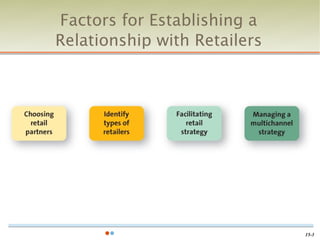
Factors for Establishing a
Relationship with Retailers


                              15-3
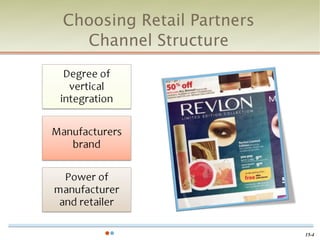
Choosing Retail Partners
  Channel Structure


                           15-4
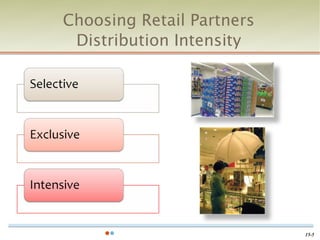
Choosing Retail Partners
 Distribution Intensity


                           15-5
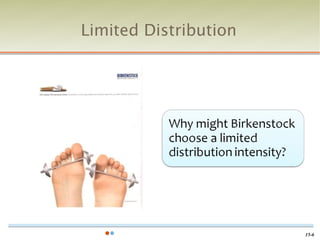
Limited Distribution


                       15-6
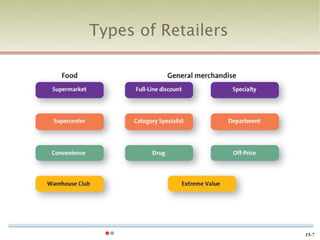
Types of Retailers


                     15-7
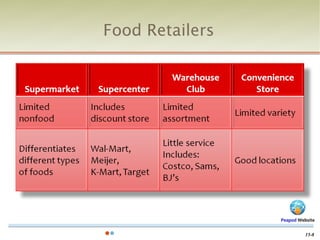
Food Retailers


                 Peapod Website


                           15-8
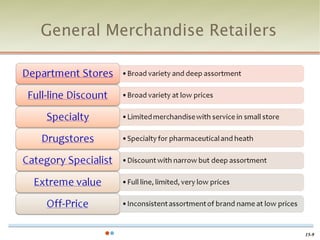
General Merchandise Retailers


                                15-9
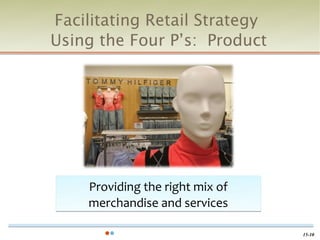
Facilitating Retail Strategy
Using the Four P’s: Product


    Providing the right mix of
    merchandise and services

                                 15-10
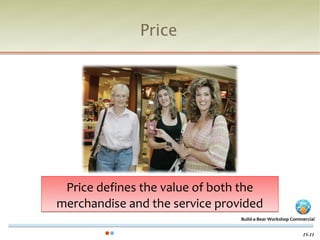
Price


 Price defines the value of both the
merchandise and the service provided
                                Build-a-Bear Workshop Commercial


                                                          15-11
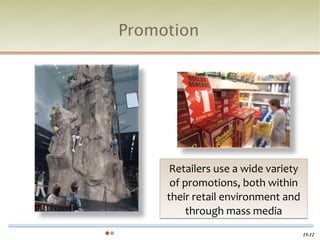
Promotion


      Retailers use a wide variety
      of promotions, both within
     their retail environment and
          through mass media
                                     15-12
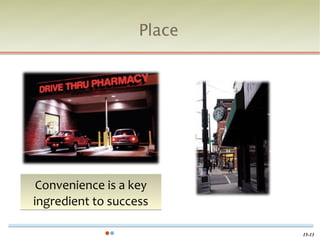
Place


 Convenience is a key
ingredient to success

                           15-13
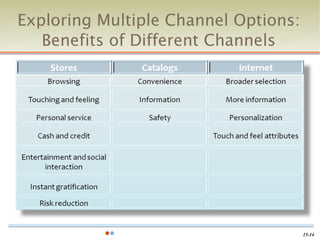
Exploring Multiple Channel Options:
   Benefits of Different Channels


                                      15-14
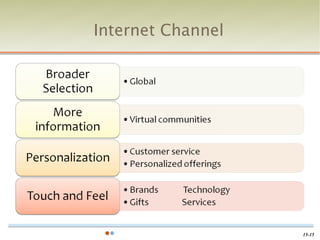
Internet Channel


                   15-15
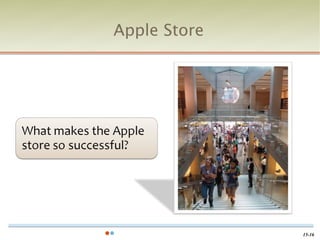
Apple Store


              15-16
Which of the following is NOT a factor to consider
     when establishing a relationship with retailers?


A.    Choosing retail partners
B.    Facilitating retail strategy
C.    Managing a multichannel strategy
D.    Identifying types of retailers
E.    All of the above


                                                      15-17
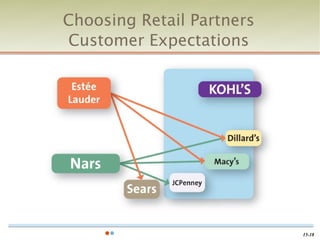
Choosing Retail Partners
Customer Expectations


                           15-18
Red Bull is sold at convenience stores,
supermarkets and warehouse clubs. Red Bull has
             _________ distribution

  A.   selective
  B.   exclusive
  C.   intermediate
  D.   intensive
  E.   limited


                                            15-19
Check Yourself


1.   What issues should manufacturers
     consider when choosing retail partners?
2.   What is the difference between intensive,
     exclusive, and selective levels of
     distribution intensity?


                                                 15-20
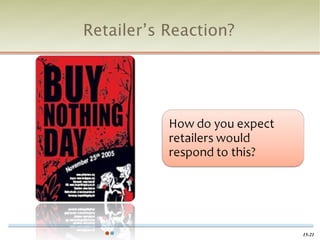
Retailer’s Reaction?


                       15-21
A ________ is a retailer with such an extensive assortment in a particular
category that would-be competitors do not bother carrying that category of
      products and instead, simply refer customers to the other firm.


  A.   specialty retailer
  B.   house breaker
  C.   market mammoth
  D.   revolutionary
  E.   category killer


                                                                            15-22
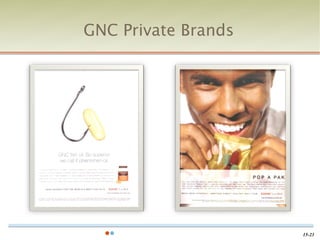
GNC Private Brands


                     15-23
Check Yourself


1.   What are the different types of food
     retailers? What differences mark their
     strategies?
2.   What are the different types of general
     merchandise retailers? What differences
     mark their strategies?


                                               15-24
Coupons, rebates, and online discounts are
   types of ________ used by retailers.

  A.   pricing promotions
  B.   specialty product displays
  C.   in-store promotions
  D.   off-price wholesaling
  E.   mass media advertising


                                        15-25
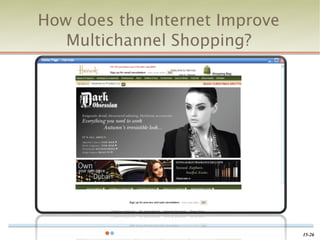
How does the Internet Improve
   Multichannel Shopping?


                                15-26
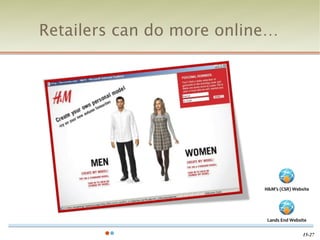
Retailers can do more online…


                           H&M’s (CSR) Website


                            Lands End Website


                                           15-27
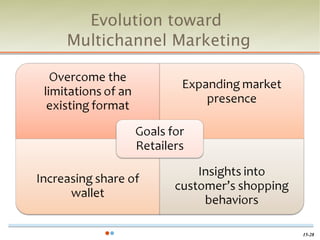
Evolution toward
Multichannel Marketing


                         15-28
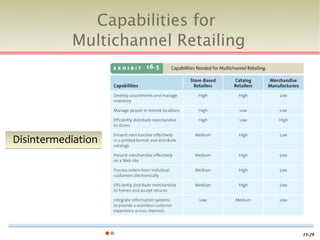
Capabilities for
           Multichannel Retailing


Disintermediation


                                    15-29
Glossary

Category specialists are discount stores that offer a
  narrow but deep assortment of merchandise.


                                                 Return to slide


                                                              15-30
Glossary

Convenience stores provide a limited variety and
 assortment of merchandise at a convenient
 location in 2,000-3,000 square foot stores with
 speedy checkout.


                                               Return to slide


                                                            15-31
Glossary

A conventional supermarket is a self-service food
  store offering groceries, meat, and produce with
  limited sales of nonfood items, such as health and
  beauty aids and general merchandise.


                                                Return to slide


                                                             15-32
Glossary

Department stores are retailers that carry a broad
 variety and deep assortment, offer customer
 services, and organize their stores into distinct
 departments for displaying merchandise.


                                                Return to slide


                                                             15-33
Glossary

Disintermediation occurs when a manufacturer
  sells directly to consumers, bypassing retailers.


                                                  Return to slide


                                                               15-34
Glossary

Drugstores are specialty stores that concentrate on
 pharmaceuticals and health and personal
 grooming merchandise.


                                               Return to slide


                                                            15-35
Glossary

An exclusive distribution policy is when
 manufacturers grant exclusive geographic
 territories to one or very few retail customers so
 no other customers in the territory can sell a
 particular brand.


                                                 Return to slide


                                                              15-36
Glossary

Extreme value retailers are small, full-line discount
  stores that offer a limited merchandise
  assortment at very low prices.


                                                  Return to slide


                                                               15-37
Glossary

Full-line discount stores are retailers that offer a
  broad variety of merchandise, limited service, and
  low prices.


                                                Return to slide


                                                             15-38
Glossary

An intensive distribution strategy is designed to get
 products into as many outlets as possible.


                                                 Return to slide


                                                              15-39
Glossary

Multichannel retailers are retailers that use some
 combination of stores, catalogs, and the Internet
 to sell merchandise.


                                               Return to slide


                                                            15-40
Glossary

Off-price retailers offer an inconsistent assortment
 of brand name merchandise at low prices.


                                                 Return to slide


                                                              15-41
Glossary

Selective distribution uses a few selected
  customers in a territory.


                                             Return to slide


                                                          15-42
Glossary

Specialty stores concentrate on a limited number of
 complementary merchandise categories and
 provide a high level of service in relatively small
 stores.


                                                Return to slide


                                                             15-43
Glossary

Supercenters are large stores that combine a
  supermarket with a full-line discount store.


                                                 Return to slide


                                                              15-44
Glossary

Warehouse clubs are large retailers that offer a
 limited and irregular assortment of food and
 general merchandise with little service at low
 prices for ultimate consumers and small
 businesses.


                                                   Return to slide


                                                                15-45

Chapter 15 MKT120 Retail

  • 1.
    RETAILING AND MULTICHANNEL MARKETING M marketing 15 GREWAL / LEVY McGraw-Hill/Irwin Copyright © 2011 by The McGraw-Hill Companies, Inc. All rights reserved.
  • 2.
    Learning Objectives LEARNING OBJECTIVES  What are the issues manufacturers consider when choosing retail partners?  What types of retailers are available for distributing products?  How do manufacturers and retailers work together to develop a strategy?  Why is multichannel marketing becoming such a prevalent channel strategy? 15-2
  • 3.
    Factors for Establishinga Relationship with Retailers 15-3
  • 4.
    Choosing Retail Partners Channel Structure 15-4
  • 5.
    Choosing Retail Partners Distribution Intensity 15-5
  • 6.
  • 7.
  • 8.
    Food Retailers Peapod Website 15-8
  • 9.
  • 10.
    Facilitating Retail Strategy Usingthe Four P’s: Product Providing the right mix of merchandise and services 15-10
  • 11.
    Price Price definesthe value of both the merchandise and the service provided Build-a-Bear Workshop Commercial 15-11
  • 12.
    Promotion Retailers use a wide variety of promotions, both within their retail environment and through mass media 15-12
  • 13.
    Place Convenience isa key ingredient to success 15-13
  • 14.
    Exploring Multiple ChannelOptions: Benefits of Different Channels 15-14
  • 15.
  • 16.
  • 17.
    Which of thefollowing is NOT a factor to consider when establishing a relationship with retailers? A. Choosing retail partners B. Facilitating retail strategy C. Managing a multichannel strategy D. Identifying types of retailers E. All of the above 15-17
  • 18.
  • 19.
    Red Bull issold at convenience stores, supermarkets and warehouse clubs. Red Bull has _________ distribution A. selective B. exclusive C. intermediate D. intensive E. limited 15-19
  • 20.
    Check Yourself 1. What issues should manufacturers consider when choosing retail partners? 2. What is the difference between intensive, exclusive, and selective levels of distribution intensity? 15-20
  • 21.
  • 22.
    A ________ isa retailer with such an extensive assortment in a particular category that would-be competitors do not bother carrying that category of products and instead, simply refer customers to the other firm. A. specialty retailer B. house breaker C. market mammoth D. revolutionary E. category killer 15-22
  • 23.
  • 24.
    Check Yourself 1. What are the different types of food retailers? What differences mark their strategies? 2. What are the different types of general merchandise retailers? What differences mark their strategies? 15-24
  • 25.
    Coupons, rebates, andonline discounts are types of ________ used by retailers. A. pricing promotions B. specialty product displays C. in-store promotions D. off-price wholesaling E. mass media advertising 15-25
  • 26.
    How does theInternet Improve Multichannel Shopping? 15-26
  • 27.
    Retailers can domore online… H&M’s (CSR) Website Lands End Website 15-27
  • 28.
  • 29.
    Capabilities for Multichannel Retailing Disintermediation 15-29
  • 30.
    Glossary Category specialists arediscount stores that offer a narrow but deep assortment of merchandise. Return to slide 15-30
  • 31.
    Glossary Convenience stores providea limited variety and assortment of merchandise at a convenient location in 2,000-3,000 square foot stores with speedy checkout. Return to slide 15-31
  • 32.
    Glossary A conventional supermarketis a self-service food store offering groceries, meat, and produce with limited sales of nonfood items, such as health and beauty aids and general merchandise. Return to slide 15-32
  • 33.
    Glossary Department stores areretailers that carry a broad variety and deep assortment, offer customer services, and organize their stores into distinct departments for displaying merchandise. Return to slide 15-33
  • 34.
    Glossary Disintermediation occurs whena manufacturer sells directly to consumers, bypassing retailers. Return to slide 15-34
  • 35.
    Glossary Drugstores are specialtystores that concentrate on pharmaceuticals and health and personal grooming merchandise. Return to slide 15-35
  • 36.
    Glossary An exclusive distributionpolicy is when manufacturers grant exclusive geographic territories to one or very few retail customers so no other customers in the territory can sell a particular brand. Return to slide 15-36
  • 37.
    Glossary Extreme value retailersare small, full-line discount stores that offer a limited merchandise assortment at very low prices. Return to slide 15-37
  • 38.
    Glossary Full-line discount storesare retailers that offer a broad variety of merchandise, limited service, and low prices. Return to slide 15-38
  • 39.
    Glossary An intensive distributionstrategy is designed to get products into as many outlets as possible. Return to slide 15-39
  • 40.
    Glossary Multichannel retailers areretailers that use some combination of stores, catalogs, and the Internet to sell merchandise. Return to slide 15-40
  • 41.
    Glossary Off-price retailers offeran inconsistent assortment of brand name merchandise at low prices. Return to slide 15-41
  • 42.
    Glossary Selective distribution usesa few selected customers in a territory. Return to slide 15-42
  • 43.
    Glossary Specialty stores concentrateon a limited number of complementary merchandise categories and provide a high level of service in relatively small stores. Return to slide 15-43
  • 44.
    Glossary Supercenters are largestores that combine a supermarket with a full-line discount store. Return to slide 15-44
  • 45.
    Glossary Warehouse clubs arelarge retailers that offer a limited and irregular assortment of food and general merchandise with little service at low prices for ultimate consumers and small businesses. Return to slide 15-45