McGraw-Hill/Irwin Copyright © 2009 by The McGraw-Hill Companies, Inc.  All rights reserved.
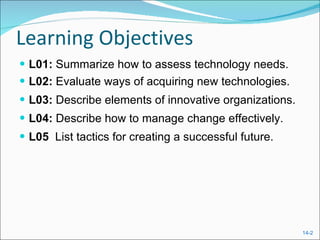
Learning Objectives L01:  Summarize how to assess technology needs. L02:  Evaluate ways of acquiring new technologies. L03:  Describe elements of innovative organizations. L04:  Describe how to manage change effectively. L05  List tactics for creating a successful future.
Forces Driving Technological Development A need or demand  exists  for the technology. Meeting need must be  theoretically possible Knowledge must be  available  from basic science. Convert the  scientific knowledge into practice  in engineering and economic terms. Funding, skilled labor, time, space, and other  resources  must be available. Entrepreneurial initiative  must identify and pull all the necessary elements together.
Assessing Organizational Needs for Technologies Internal Technology Audit Measure current technologies vis-à-vis emerging trends Determine if new technologies will advance competitive goals External Benchmarking  Comparing organization’s technologies with other organizations Environmental scanning Identifying/monitoring sources of new technology for an industry
Relevant Criteria on which to Base Technology Decisions Anticipated market receptiveness In short run, new technology should have immediate, valuable application. In long run, technology must be able to satisfy market needs. Technological feasibility Economic viability Organizational suitability Anticipated Competency Development
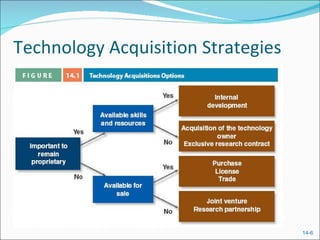
Technology Acquisition Strategies
Technological Innovation Roles Chief Information Officer (CIO) or Chief Technology Officer (CTO) Information Technology Group Entrepreneur Technical Innovator Product Champion Executive Champion
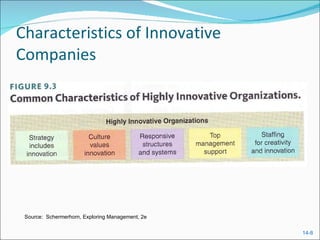
Characteristics of Innovative Companies Source:  Schermerhorn, Exploring Management, 2e
Experts Speak on Innovation A Refined View A Rogue View
Organizational Development Organizational development (OD) application of  behavioral science  knowledge to develop, improve, and reinforce strategies, structure, and processes that lead to  organizational effectiveness . Four basic types of OD techniques: Strategic interventions Technostructural interventions Human resources management interventions Human processes intervention
What is Change All About? Thinking Out of the Box
Managing Change Shared leadership and change agents needed. Motivate people to change. Reasons for resistance to change: Inertia Timing Surprise Peer pressure Self-interest Misunderstanding Different assessments Management tactics
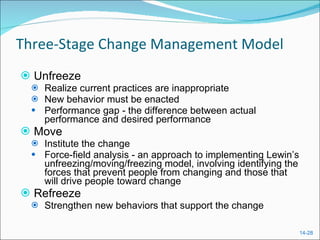
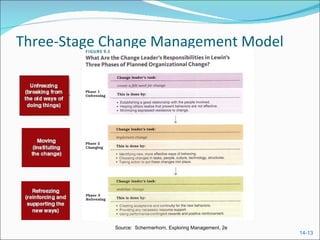
Three-Stage Change Management Model  Source:  Schermerhorn, Exploring Management, 2e
Approaches to Encourage Cooperation Education and communication Participation and involvement Facilitation and support Negotiation and rewards Manipulation and cooptation Explicit and implicit coercion Managers must lead change.
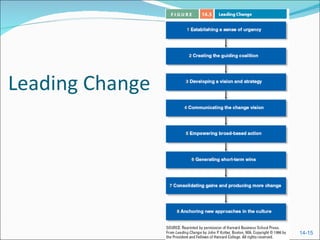
Leading Change
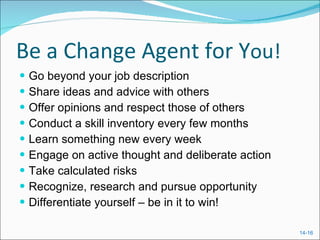
Be a Change Agent for Y ou! Go beyond your job description Share ideas and advice with others Offer opinions and respect those of others Conduct a skill inventory every few months Learn something new every week Engage on active thought and deliberate action Take calculated risks Recognize, research and pursue opportunity Differentiate yourself – be in it to win!
Wrap-up The Essence of Innovation –  I have not failed.  I’ve just found 10,000 ways that don’t work. -- Thomas Edison The Challenge of Change  Almost everyone is more enthusiastic about change when [it’s] their idea, and less enthusiastic if they feel the change is being imposed on them. -- Maggie Bayless, managing partner, Zing Train
For Review Only
YOU should be able to L01: Summarize how to assess technology needs. L02: Identify the criteria on which to base technology decisions. L03: Evaluate key ways of acquiring new technologies. L04: Describe the elements of an innovative organization.
YOU should be able to L05: List characteristics of successful development projects. L06: Discuss what it takes to be world class. L07: Describe how to manage change effectively. L08: List tactics for creating a successful future.
 
Test your knowledge ______ tells whether there is a good financial incentive for “pulling off” a technological innovation.  A) Technological feasibility  B) Market receptiveness  C) Economic viability  D) Organizational suitability  E) Competency development
Test your knowledge It was recently announced that the state university had agreed to develop (or try to develop) a new hybrid seed  or northern climates.  The company that has provided the funding for this project hopes to sell the hybrid in the former Soviet Union.  The company seems to be attempting to acquire technology through:  A) state funding.  B) internal development.  C) technology trading.  D) licensing.  E) contracted development.
Test your knowledge Identify and explain the elements of an innovative organization.
Test your knowledge Read the story on page 318 How does Nau carry out the two basic kinds of innovation—exploiting existing capabilities and exploring new knowledge? Creativity is part of the organizational culture at Nau. How might Chris Van Dyke and Mark Galbraith encourage employees to make the most of failures?
Test your knowledge The system-wide application of behavioral science to organizational effectiveness is called:  A) organization development  B) organization strategy  C) organization systems  D) leadership  E) none of the above
Test your knowledge Describe the six specific approaches to enlisting cooperation in the change process.  In what situations would each be used?
Three-Stage Change Management Model  Unfreeze Realize current practices are inappropriate New behavior must be enacted Performance gap - the difference between actual performance and desired performance Move Institute the change Force-field analysis - an approach to implementing Lewin’s unfreezing/moving/freezing model, involving identifying the forces that prevent people from changing and those that will drive people toward change Refreeze  Strengthen new behaviors that support the change

BUS137 Chapter 14

  • 1.
    McGraw-Hill/Irwin Copyright ©2009 by The McGraw-Hill Companies, Inc. All rights reserved.
  • 2.
    Learning Objectives L01: Summarize how to assess technology needs. L02: Evaluate ways of acquiring new technologies. L03: Describe elements of innovative organizations. L04: Describe how to manage change effectively. L05 List tactics for creating a successful future.
  • 3.
    Forces Driving TechnologicalDevelopment A need or demand exists for the technology. Meeting need must be theoretically possible Knowledge must be available from basic science. Convert the scientific knowledge into practice in engineering and economic terms. Funding, skilled labor, time, space, and other resources must be available. Entrepreneurial initiative must identify and pull all the necessary elements together.
  • 4.
    Assessing Organizational Needsfor Technologies Internal Technology Audit Measure current technologies vis-à-vis emerging trends Determine if new technologies will advance competitive goals External Benchmarking Comparing organization’s technologies with other organizations Environmental scanning Identifying/monitoring sources of new technology for an industry
  • 5.
    Relevant Criteria onwhich to Base Technology Decisions Anticipated market receptiveness In short run, new technology should have immediate, valuable application. In long run, technology must be able to satisfy market needs. Technological feasibility Economic viability Organizational suitability Anticipated Competency Development
  • 6.
  • 7.
    Technological Innovation RolesChief Information Officer (CIO) or Chief Technology Officer (CTO) Information Technology Group Entrepreneur Technical Innovator Product Champion Executive Champion
  • 8.
    Characteristics of InnovativeCompanies Source: Schermerhorn, Exploring Management, 2e
  • 9.
    Experts Speak onInnovation A Refined View A Rogue View
  • 10.
    Organizational Development Organizationaldevelopment (OD) application of behavioral science knowledge to develop, improve, and reinforce strategies, structure, and processes that lead to organizational effectiveness . Four basic types of OD techniques: Strategic interventions Technostructural interventions Human resources management interventions Human processes intervention
  • 11.
    What is ChangeAll About? Thinking Out of the Box
  • 12.
    Managing Change Sharedleadership and change agents needed. Motivate people to change. Reasons for resistance to change: Inertia Timing Surprise Peer pressure Self-interest Misunderstanding Different assessments Management tactics
  • 13.
    Three-Stage Change ManagementModel Source: Schermerhorn, Exploring Management, 2e
  • 14.
    Approaches to EncourageCooperation Education and communication Participation and involvement Facilitation and support Negotiation and rewards Manipulation and cooptation Explicit and implicit coercion Managers must lead change.
  • 15.
  • 16.
    Be a ChangeAgent for Y ou! Go beyond your job description Share ideas and advice with others Offer opinions and respect those of others Conduct a skill inventory every few months Learn something new every week Engage on active thought and deliberate action Take calculated risks Recognize, research and pursue opportunity Differentiate yourself – be in it to win!
  • 17.
    Wrap-up The Essenceof Innovation – I have not failed. I’ve just found 10,000 ways that don’t work. -- Thomas Edison The Challenge of Change Almost everyone is more enthusiastic about change when [it’s] their idea, and less enthusiastic if they feel the change is being imposed on them. -- Maggie Bayless, managing partner, Zing Train
  • 18.
  • 19.
    YOU should beable to L01: Summarize how to assess technology needs. L02: Identify the criteria on which to base technology decisions. L03: Evaluate key ways of acquiring new technologies. L04: Describe the elements of an innovative organization.
  • 20.
    YOU should beable to L05: List characteristics of successful development projects. L06: Discuss what it takes to be world class. L07: Describe how to manage change effectively. L08: List tactics for creating a successful future.
  • 21.
  • 22.
    Test your knowledge______ tells whether there is a good financial incentive for “pulling off” a technological innovation. A) Technological feasibility B) Market receptiveness C) Economic viability D) Organizational suitability E) Competency development
  • 23.
    Test your knowledgeIt was recently announced that the state university had agreed to develop (or try to develop) a new hybrid seed or northern climates. The company that has provided the funding for this project hopes to sell the hybrid in the former Soviet Union. The company seems to be attempting to acquire technology through: A) state funding. B) internal development. C) technology trading. D) licensing. E) contracted development.
  • 24.
    Test your knowledgeIdentify and explain the elements of an innovative organization.
  • 25.
    Test your knowledgeRead the story on page 318 How does Nau carry out the two basic kinds of innovation—exploiting existing capabilities and exploring new knowledge? Creativity is part of the organizational culture at Nau. How might Chris Van Dyke and Mark Galbraith encourage employees to make the most of failures?
  • 26.
    Test your knowledgeThe system-wide application of behavioral science to organizational effectiveness is called: A) organization development B) organization strategy C) organization systems D) leadership E) none of the above
  • 27.
    Test your knowledgeDescribe the six specific approaches to enlisting cooperation in the change process. In what situations would each be used?
  • 28.
    Three-Stage Change ManagementModel Unfreeze Realize current practices are inappropriate New behavior must be enacted Performance gap - the difference between actual performance and desired performance Move Institute the change Force-field analysis - an approach to implementing Lewin’s unfreezing/moving/freezing model, involving identifying the forces that prevent people from changing and those that will drive people toward change Refreeze Strengthen new behaviors that support the change