

McGraw-Hill/Irwin   Copyright ยฉ 2009 by The McGraw-Hill Companies, Inc. All rights reserved.
Learning Objectives
๏‚— L01: Behaviors managers need to motivate people
๏‚— L02: Principles for setting goals that motivate employees
๏‚— L03: How to reward good performance effectively
๏‚— L04: Key beliefs that affect peopleโ€™s motivation
๏‚— L05: Ways in which peopleโ€™s individual needs affect their
  behavior.
๏‚— L06: Ways to create jobs that motivate.
๏‚— L07: How people assess fairness and how to achieve
  fairness.
๏‚— L08: Identify causes and consequences of a satisfied
  workforce.

                                                              10-2
Motivating for Performance
๏‚— Motivation
  ๏‚— forces that energize, direct and sustain a personโ€™s
    efforts.
๏‚— Organizations want to motivate people to:
  ๏‚— Join the organization, and stay
  ๏‚— Come to work regularly
  ๏‚— Work hard to achieve high output and high quality
  ๏‚— Exhibit good citizenship
    ๏‚—   be committed and perform above and beyond the call of
        duty to help the company


                                                                10-3
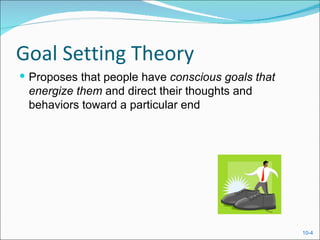
Goal Setting Theory
๏‚— Proposes that people have conscious goals that
 energize them and direct their thoughts and
 behaviors toward a particular end


                                                   10-4
Well-crafted goals are highly motivating
๏‚— Meaningful
๏‚— Acceptable
๏‚— Challenging but Attainable
๏‚— Specific and quantifiable


                                       10-5
Stretch Goals
๏‚— Targets that are exceptionally demanding, and that
 some people would never even think of.
  ๏‚— Vertical stretch goals are aligned with current activities
    including productivity and financial results
  ๏‚— Horizontal stretch goals involve peopleโ€™s professional
    development, such as attempting and learning new,
    difficult things


                                                                 10-6
Reinforcing Performance
๏‚— Law of effect
   ๏‚— Law formulated by Edward Thorndike in 1911
   ๏‚— Behavior that is followed by positive consequences will
     likely be repeated
๏‚— Reinforcers
   ๏‚— Positive consequences that motivate behavior
๏‚— Organizational behavior modification (OB mod)
   ๏‚— Application of reinforcement theory in organizational
     settings


                                                           10-7
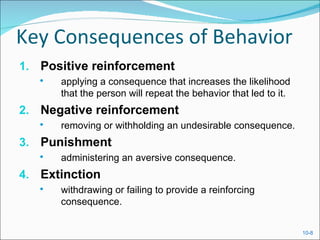
Key Consequences of Behavior
1. Positive reinforcement
   ๏‚—   applying a consequence that increases the likelihood
       that the person will repeat the behavior that led to it.
2. Negative reinforcement
   ๏‚—   removing or withholding an undesirable consequence.
3. Punishment
   ๏‚—   administering an aversive consequence.
4. Extinction
   ๏‚—   withdrawing or failing to provide a reinforcing
       consequence.


                                                                  10-8
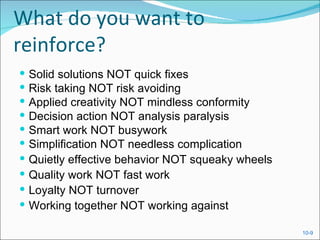
What do you want to
reinforce?
๏‚—   Solid solutions NOT quick fixes
๏‚—   Risk taking NOT risk avoiding
๏‚—   Applied creativity NOT mindless conformity
๏‚—   Decision action NOT analysis paralysis
๏‚—   Smart work NOT busywork
๏‚—   Simplification NOT needless complication
๏‚—   Quietly effective behavior NOT squeaky wheels
๏‚—   Quality work NOT fast work
๏‚—   Loyalty NOT turnover
๏‚—   Working together NOT working against

                                                    10-9
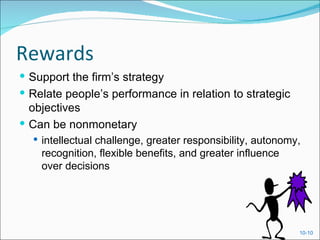
Rewards
๏‚— Support the firmโ€™s strategy
๏‚— Relate peopleโ€™s performance in relation to strategic
  objectives
๏‚— Can be nonmonetary
  ๏‚— intellectual challenge, greater responsibility, autonomy,
    recognition, flexible benefits, and greater influence
    over decisions


                                                            10-10
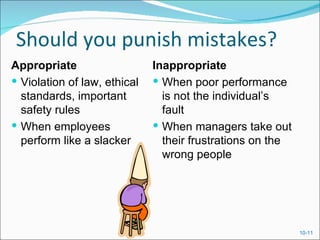
Should you punish mistakes?
Appropriate                   Inappropriate
๏‚— Violation of law, ethical   ๏‚— When poor performance
  standards, important          is not the individualโ€™s
  safety rules                  fault
๏‚— When employees              ๏‚— When managers take out
  perform like a slacker        their frustrations on the
                                wrong people


                                                            10-11
How to Manage Mistakes
๏‚— Recognize that everyone makes mistakes
  ๏‚— Handle constructively by discussing and learning from
    them
๏‚— Praise people who deliver based news to their
  bosses
๏‚— Donโ€™t punish, unsuccessful good-faith efforts
๏‚— Encourage people to try new things and donโ€™t
  punish them if what they try doesnโ€™t work out.


                                                            10-12
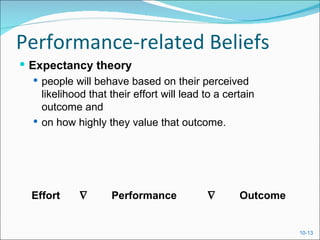
Performance-related Beliefs
๏‚— Expectancy theory
   ๏‚— people will behave based on their perceived
     likelihood that their effort will lead to a certain
     outcome and
   ๏‚— on how highly they value that outcome.


  Effort      โˆ‡      Performance            โˆ‡       Outcome


                                                              10-13
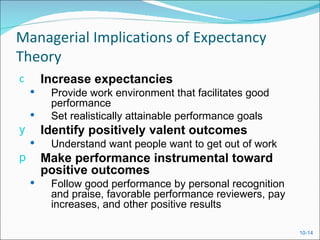
Managerial Implications of Expectancy
Theory
c       Increase expectancies
    ๏‚—    Provide work environment that facilitates good
         performance
    ๏‚—    Set realistically attainable performance goals
y       Identify positively valent outcomes
    ๏‚—    Understand want people want to get out of work
p       Make performance instrumental toward
        positive outcomes
    ๏‚—    Follow good performance by personal recognition
         and praise, favorable performance reviewers, pay
         increases, and other positive results

                                                            10-14
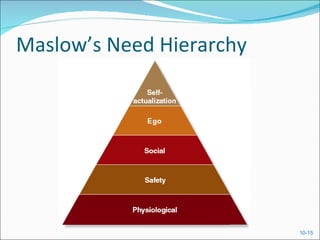
Maslowโ€™s Need Hierarchy


                          10-15
Types of Motivation
๏‚— Extrinsic motivation
   ๏‚— rewards given to a person by the boss, the company
     or some other person - EXTERNAL
๏‚— Intrinsic motivation
  ๏‚— rewards a worker derives directly from performing the
    job itself - INTERNAL


                                                            10-16
Designing Motivating Jobs
๏‚— Job rotation
   ๏‚— changing from one routine task to another to alleviate
     boredom
๏‚— Job enlargement
  ๏‚— Giving people additional tasks at the same time to
    alleviate boredom
๏‚— Job enrichment
   ๏‚— Changing a task to make it inherently more rewarding,
     motivating, and satisfying


                                                              10-17
Herzbergโ€™s two-factor theory
๏‚— Proposed two broad categories of factors that affect
 people working on their jobs
  ๏‚— Hygiene factor
    ๏‚— Workplace characteristics that can make people dissatisfied
    ๏‚— Company policies, working conditions, pay, and supervision

  ๏‚— Motivators
    ๏‚—   Factors that make a job more motivating
    ๏‚—    Additional job responsibilities, opportunities for personal
        growth and recognition, and feelings of achievement


                                                                       10-18
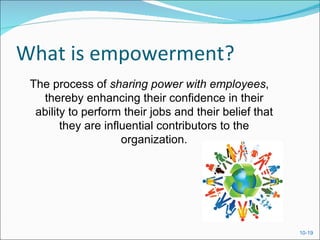
What is empowerment?
 The process of sharing power with employees,
   thereby enhancing their confidence in their
  ability to perform their jobs and their belief that
        they are influential contributors to the
                     organization.


                                                        10-19
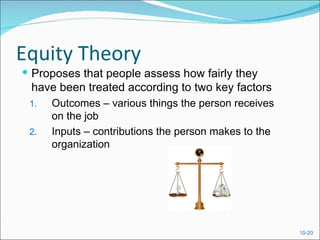
Equity Theory
๏‚— Proposes that people assess how fairly they
 have been treated according to two key factors
 1.   Outcomes โ€“ various things the person receives
      on the job
 2.   Inputs โ€“ contributions the person makes to the
      organization


                                                       10-20
How people restore equity
๏‚— Reducing their inputs
๏‚— Increase their outcomes
๏‚— Decrease othersโ€™ outcomes
๏‚— Increase othersโ€™ inputs


                              10-21
Quality of work life programs
Create workplace that enhances employee well-being
 and satisfaction
Satisfy the full range of employee needs


                                                     10-22
Feedback shouldโ€ฆ
๏‚— Be useful
๏‚— Address your employeeโ€™s request for feedback


                                                 10-24
YOU should be able to
๏‚— L01: Identify the kinds of behaviors managers need
  to motivate people
๏‚— L02: List principles for setting goals that motivate
  employees
๏‚— L03: Summarize how to reward good performance
  effectively
๏‚— L04: Describe the key beliefs that affect peopleโ€™s
  motivation


                                                         10-25
YOU should be able to
๏‚— L05: Discuss ways in which peopleโ€™s individual
  needs affect their behavior.
๏‚— L06: Define ways to create jobs that motivate.
๏‚— L07: Summarize how people assess fairness and
  how to achieve fairness.
๏‚— L08: Identify causes and consequences of a
  satisfied workforce.


                                                   10-26
10-27
Test Your Knowledge

๏‚— Describe the characteristics of goals that most
 effectively motivate people.


                                                    10-28
Test Your Knowledge


Identify four examples of people advertently
     reinforcing the wrong behaviors, or
 punishing or extinguishing good behaviors


                                               10-29
Test Your Knowledge


  Discuss the managerial implications of
expectancy theory. Relate them specifically
          to expectancy theory.


                                              10-30
Test Your Knowledge

A difference between Maslow's Need Hierarchy and
  Alderfer's ERG Theory is that
  A) ERG theory states that various needs operate
  simultaneously.
  B) Maslow's hierarchy has more scientific validity.
  C) Maslow's hierarchy reminds managers that even if
  one need seems to motivate people, other needs may
  still need attention.
  D) ERG theory focuses on five levels of need.
  E) only Maslow's theory serves to remind managers of
  the types of reinforcers that can be used to motivate
  people.                                                 10-31
Test Your Knowledge

 Compare and contrast job enlargement, job
enrichment, and job rotation. Give an example
                  of each.


                                                10-32
Procedural Justice making and
Using a fair process in decision
 making sure others know that the process was
 as fair as possible.


                                                10-33
Test Your Knowledge


Describe a time when you felt unfairly treated and
    explain why. How did you respond to the
  inequity? What other options might you have
                     had?


                                                     10-34
Test Your Knowledge


๏‚— Identify the cause and consequences of a
 satisfied workforce.


                                             10-35

Chap010 BUS137

  • 1.
    McGraw-Hill/Irwin Copyright ยฉ 2009 by The McGraw-Hill Companies, Inc. All rights reserved.
  • 2.
    Learning Objectives ๏‚— L01:Behaviors managers need to motivate people ๏‚— L02: Principles for setting goals that motivate employees ๏‚— L03: How to reward good performance effectively ๏‚— L04: Key beliefs that affect peopleโ€™s motivation ๏‚— L05: Ways in which peopleโ€™s individual needs affect their behavior. ๏‚— L06: Ways to create jobs that motivate. ๏‚— L07: How people assess fairness and how to achieve fairness. ๏‚— L08: Identify causes and consequences of a satisfied workforce. 10-2
  • 3.
    Motivating for Performance ๏‚—Motivation ๏‚— forces that energize, direct and sustain a personโ€™s efforts. ๏‚— Organizations want to motivate people to: ๏‚— Join the organization, and stay ๏‚— Come to work regularly ๏‚— Work hard to achieve high output and high quality ๏‚— Exhibit good citizenship ๏‚— be committed and perform above and beyond the call of duty to help the company 10-3
  • 4.
    Goal Setting Theory ๏‚—Proposes that people have conscious goals that energize them and direct their thoughts and behaviors toward a particular end 10-4
  • 5.
    Well-crafted goals arehighly motivating ๏‚— Meaningful ๏‚— Acceptable ๏‚— Challenging but Attainable ๏‚— Specific and quantifiable 10-5
  • 6.
    Stretch Goals ๏‚— Targetsthat are exceptionally demanding, and that some people would never even think of. ๏‚— Vertical stretch goals are aligned with current activities including productivity and financial results ๏‚— Horizontal stretch goals involve peopleโ€™s professional development, such as attempting and learning new, difficult things 10-6
  • 7.
    Reinforcing Performance ๏‚— Lawof effect ๏‚— Law formulated by Edward Thorndike in 1911 ๏‚— Behavior that is followed by positive consequences will likely be repeated ๏‚— Reinforcers ๏‚— Positive consequences that motivate behavior ๏‚— Organizational behavior modification (OB mod) ๏‚— Application of reinforcement theory in organizational settings 10-7
  • 8.
    Key Consequences ofBehavior 1. Positive reinforcement ๏‚— applying a consequence that increases the likelihood that the person will repeat the behavior that led to it. 2. Negative reinforcement ๏‚— removing or withholding an undesirable consequence. 3. Punishment ๏‚— administering an aversive consequence. 4. Extinction ๏‚— withdrawing or failing to provide a reinforcing consequence. 10-8
  • 9.
    What do youwant to reinforce? ๏‚— Solid solutions NOT quick fixes ๏‚— Risk taking NOT risk avoiding ๏‚— Applied creativity NOT mindless conformity ๏‚— Decision action NOT analysis paralysis ๏‚— Smart work NOT busywork ๏‚— Simplification NOT needless complication ๏‚— Quietly effective behavior NOT squeaky wheels ๏‚— Quality work NOT fast work ๏‚— Loyalty NOT turnover ๏‚— Working together NOT working against 10-9
  • 10.
    Rewards ๏‚— Support thefirmโ€™s strategy ๏‚— Relate peopleโ€™s performance in relation to strategic objectives ๏‚— Can be nonmonetary ๏‚— intellectual challenge, greater responsibility, autonomy, recognition, flexible benefits, and greater influence over decisions 10-10
  • 11.
    Should you punishmistakes? Appropriate Inappropriate ๏‚— Violation of law, ethical ๏‚— When poor performance standards, important is not the individualโ€™s safety rules fault ๏‚— When employees ๏‚— When managers take out perform like a slacker their frustrations on the wrong people 10-11
  • 12.
    How to ManageMistakes ๏‚— Recognize that everyone makes mistakes ๏‚— Handle constructively by discussing and learning from them ๏‚— Praise people who deliver based news to their bosses ๏‚— Donโ€™t punish, unsuccessful good-faith efforts ๏‚— Encourage people to try new things and donโ€™t punish them if what they try doesnโ€™t work out. 10-12
  • 13.
    Performance-related Beliefs ๏‚— Expectancytheory ๏‚— people will behave based on their perceived likelihood that their effort will lead to a certain outcome and ๏‚— on how highly they value that outcome. Effort โˆ‡ Performance โˆ‡ Outcome 10-13
  • 14.
    Managerial Implications ofExpectancy Theory c Increase expectancies ๏‚— Provide work environment that facilitates good performance ๏‚— Set realistically attainable performance goals y Identify positively valent outcomes ๏‚— Understand want people want to get out of work p Make performance instrumental toward positive outcomes ๏‚— Follow good performance by personal recognition and praise, favorable performance reviewers, pay increases, and other positive results 10-14
  • 15.
  • 16.
    Types of Motivation ๏‚—Extrinsic motivation ๏‚— rewards given to a person by the boss, the company or some other person - EXTERNAL ๏‚— Intrinsic motivation ๏‚— rewards a worker derives directly from performing the job itself - INTERNAL 10-16
  • 17.
    Designing Motivating Jobs ๏‚—Job rotation ๏‚— changing from one routine task to another to alleviate boredom ๏‚— Job enlargement ๏‚— Giving people additional tasks at the same time to alleviate boredom ๏‚— Job enrichment ๏‚— Changing a task to make it inherently more rewarding, motivating, and satisfying 10-17
  • 18.
    Herzbergโ€™s two-factor theory ๏‚—Proposed two broad categories of factors that affect people working on their jobs ๏‚— Hygiene factor ๏‚— Workplace characteristics that can make people dissatisfied ๏‚— Company policies, working conditions, pay, and supervision ๏‚— Motivators ๏‚— Factors that make a job more motivating ๏‚— Additional job responsibilities, opportunities for personal growth and recognition, and feelings of achievement 10-18
  • 19.
    What is empowerment? The process of sharing power with employees, thereby enhancing their confidence in their ability to perform their jobs and their belief that they are influential contributors to the organization. 10-19
  • 20.
    Equity Theory ๏‚— Proposesthat people assess how fairly they have been treated according to two key factors 1. Outcomes โ€“ various things the person receives on the job 2. Inputs โ€“ contributions the person makes to the organization 10-20
  • 21.
    How people restoreequity ๏‚— Reducing their inputs ๏‚— Increase their outcomes ๏‚— Decrease othersโ€™ outcomes ๏‚— Increase othersโ€™ inputs 10-21
  • 22.
    Quality of worklife programs Create workplace that enhances employee well-being and satisfaction Satisfy the full range of employee needs 10-22
  • 24.
    Feedback shouldโ€ฆ ๏‚— Beuseful ๏‚— Address your employeeโ€™s request for feedback 10-24
  • 25.
    YOU should beable to ๏‚— L01: Identify the kinds of behaviors managers need to motivate people ๏‚— L02: List principles for setting goals that motivate employees ๏‚— L03: Summarize how to reward good performance effectively ๏‚— L04: Describe the key beliefs that affect peopleโ€™s motivation 10-25
  • 26.
    YOU should beable to ๏‚— L05: Discuss ways in which peopleโ€™s individual needs affect their behavior. ๏‚— L06: Define ways to create jobs that motivate. ๏‚— L07: Summarize how people assess fairness and how to achieve fairness. ๏‚— L08: Identify causes and consequences of a satisfied workforce. 10-26
  • 27.
  • 28.
    Test Your Knowledge ๏‚—Describe the characteristics of goals that most effectively motivate people. 10-28
  • 29.
    Test Your Knowledge Identifyfour examples of people advertently reinforcing the wrong behaviors, or punishing or extinguishing good behaviors 10-29
  • 30.
    Test Your Knowledge Discuss the managerial implications of expectancy theory. Relate them specifically to expectancy theory. 10-30
  • 31.
    Test Your Knowledge Adifference between Maslow's Need Hierarchy and Alderfer's ERG Theory is that A) ERG theory states that various needs operate simultaneously. B) Maslow's hierarchy has more scientific validity. C) Maslow's hierarchy reminds managers that even if one need seems to motivate people, other needs may still need attention. D) ERG theory focuses on five levels of need. E) only Maslow's theory serves to remind managers of the types of reinforcers that can be used to motivate people. 10-31
  • 32.
    Test Your Knowledge Compare and contrast job enlargement, job enrichment, and job rotation. Give an example of each. 10-32
  • 33.
    Procedural Justice makingand Using a fair process in decision making sure others know that the process was as fair as possible. 10-33
  • 34.
    Test Your Knowledge Describea time when you felt unfairly treated and explain why. How did you respond to the inequity? What other options might you have had? 10-34
  • 35.
    Test Your Knowledge ๏‚—Identify the cause and consequences of a satisfied workforce. 10-35