
An Overview on
Retail Industry


       Bibin M Abraham
What is Retailing???....
•All activities involved in selling, renting, and providing
goods and services to ultimate customers for
personal, family or household use.


•In the channel of distribution, retailing is where the
customer meets the product.
Retail is usually classified by type of products as
 follows:
• Food products
• Hard goods or durable goods (Goods that do
  not quickly wear out and provide utility over
  time)-
  Appliances, Electronics, Furniture, Sporting
  goods, etc..
• Soft goods or consumables -
  clothing, apparel, and other fabrics. Goods that
  have a limited period of utility (typically under
  three years) in which you may use them.
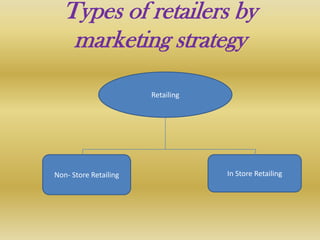
Types of retailers by
   marketing strategy
                       Retailing


Non- Store Retailing               In Store Retailing
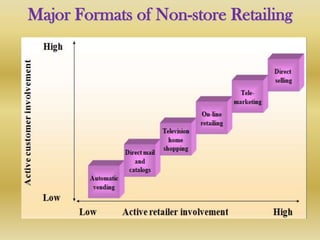
Major Formats of Non-store Retailing
Automatic Vending
• Non-store retailing that makes it possible to serve
  customers where stores cannot.
Direct Mail & Catalogs
• Marketing efficiency is improved through segmentation and
  targeting.
• Customer value is enhance by providing a fast and
  convenient means of making a purchase.
Television Home Shopping
• TV home shopping is possible when consumers watch a
  shopping channel on which products are displayed;
  orders are placed over the telephone.
• TV home shopping programs traditionally attract 40-50
  year old females.
Online Retailing
• Online retailing allows consumers to search
  for, evaluate, and order products through the
  Internet.
• The advantages of online retailing are:
  –   ability to compare different shops
  –   privacy
  –   Variety
Telemarketing
Telemarketing involves using the telephone to
  interact with and sell directly to consumers.
Direct Selling
• Direct selling involves direct sales of goods and
  services to consumers through personal
  interactions and demonstrations in their home
  or office.
• Many direct selling retailers are expanding into
  international markets to offset the decline in
  domestic sales.
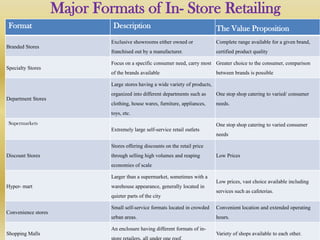
Major Formats of In- Store Retailing
 Format                        Description                                      The Value Proposition
                              Exclusive showrooms either owned or               Complete range available for a given brand,
Branded Stores
                              franchised out by a manufacturer.                 certified product quality

                              Focus on a specific consumer need, carry most Greater choice to the consumer, comparison
Specialty Stores
                              of the brands available                           between brands is possible

                              Large stores having a wide variety of products,
                              organized into different departments such as      One stop shop catering to varied/ consumer
Department Stores
                              clothing, house wares, furniture, appliances,     needs.
                              toys, etc.
 Supermarkets                                                                   One stop shop catering to varied consumer
                              Extremely large self-service retail outlets
                                                                                needs

                              Stores offering discounts on the retail price
Discount Stores               through selling high volumes and reaping          Low Prices
                              economies of scale

                              Larger than a supermarket, sometimes with a
                                                                                Low prices, vast choice available including
Hyper- mart                   warehouse appearance, generally located in
                                                                                services such as cafeterias.
                              quieter parts of the city

                              Small self-service formats located in crowded     Convenient location and extended operating
Convenience stores
                              urban areas.                                      hours.

                              An enclosure having different formats of in-
Shopping Malls                                                                  Variety of shops available to each other.
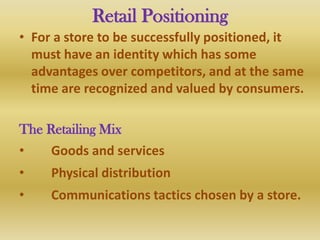
Retail Positioning
• For a store to be successfully positioned, it
  must have an identity which has some
  advantages over competitors, and at the same
  time are recognized and valued by consumers.

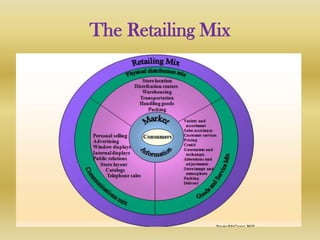
The Retailing Mix
•    Goods and services
•    Physical distribution
•    Communications tactics chosen by a store.
The Retailing Mix
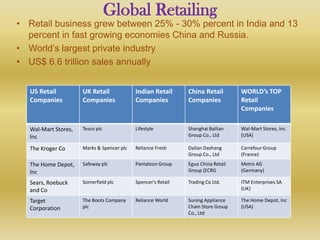
Global Retailing
• Retail business grew between 25% - 30% percent in India and 13
  percent in fast growing economies China and Russia.
• World’s largest private industry
• US$ 6.6 trillion sales annually


   US Retail          UK Retail             Indian Retail      China Retail        WORLD’s TOP
   Companies          Companies             Companies          Companies           Retail
                                                                                   Companies

   Wal-Mart Stores,   Tesco plc             Lifestyle          Shanghai Bailian    Wal-Mart Stores, Inc.
   lnc                                                         Group Co., Ltd      (USA)

   The Kroger Co      Marks & Spencer plc   Reliance Fresh     Dalian Dashang      Carrefour Group
                                                               Group Co., Ltd      (France)
   The Home Depot,    Safeway plc           Pantaloon Group    Eguo China Retail   Metro AG
   lnc                                                         Group (ECRG         (Germany)

   Sears, Roebuck     Somerfield plc        Spencer's Retail   Trading Co Ltd.     ITM Enterprises SA
   and Co                                                                          (UK)

   Target             The Boots Company     Reliance World     Suning Appliance    The Home Depot, Inc
   Corporation        plc                                      Chain Store Group   (USA)
                                                               Co., Ltd
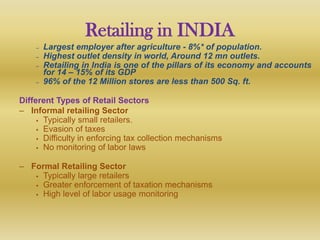
Retailing in INDIA
    –   Largest employer after agriculture - 8%* of population.
    –   Highest outlet density in world, Around 12 mn outlets.
    –   Retailing in India is one of the pillars of its economy and accounts
        for 14 – 15% of its GDP
    –   96% of the 12 Million stores are less than 500 Sq. ft.

Different Types of Retail Sectors
– Informal retailing Sector
      Typically small retailers.
      Evasion of taxes
      Difficulty in enforcing tax collection mechanisms
      No monitoring of labor laws


– Formal Retailing Sector
    Typically large retailers
    Greater enforcement of taxation mechanisms
    High level of labor usage monitoring
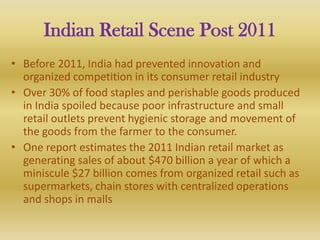
Indian Retail Scene Post 2011
• Before 2011, India had prevented innovation and
  organized competition in its consumer retail industry
• Over 30% of food staples and perishable goods produced
  in India spoiled because poor infrastructure and small
  retail outlets prevent hygienic storage and movement of
  the goods from the farmer to the consumer.
• One report estimates the 2011 Indian retail market as
  generating sales of about $470 billion a year of which a
  miniscule $27 billion comes from organized retail such as
  supermarkets, chain stores with centralized operations
  and shops in malls
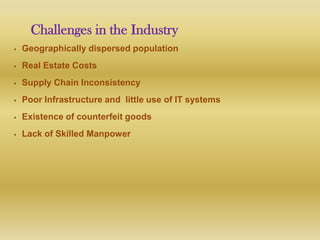
Challenges in the Industry
   Geographically dispersed population
   Real Estate Costs
   Supply Chain Inconsistency
   Poor Infrastructure and little use of IT systems
   Existence of counterfeit goods
   Lack of Skilled Manpower
Thank You

Retail Industry

  • 1.
    An Overview on RetailIndustry Bibin M Abraham
  • 2.
    What is Retailing???.... •Allactivities involved in selling, renting, and providing goods and services to ultimate customers for personal, family or household use. •In the channel of distribution, retailing is where the customer meets the product.
  • 3.
    Retail is usuallyclassified by type of products as follows: • Food products • Hard goods or durable goods (Goods that do not quickly wear out and provide utility over time)- Appliances, Electronics, Furniture, Sporting goods, etc.. • Soft goods or consumables - clothing, apparel, and other fabrics. Goods that have a limited period of utility (typically under three years) in which you may use them.
  • 4.
    Types of retailersby marketing strategy Retailing Non- Store Retailing In Store Retailing
  • 5.
    Major Formats ofNon-store Retailing
  • 6.
    Automatic Vending • Non-storeretailing that makes it possible to serve customers where stores cannot. Direct Mail & Catalogs • Marketing efficiency is improved through segmentation and targeting. • Customer value is enhance by providing a fast and convenient means of making a purchase. Television Home Shopping • TV home shopping is possible when consumers watch a shopping channel on which products are displayed; orders are placed over the telephone. • TV home shopping programs traditionally attract 40-50 year old females.
  • 7.
    Online Retailing • Onlineretailing allows consumers to search for, evaluate, and order products through the Internet. • The advantages of online retailing are: – ability to compare different shops – privacy – Variety Telemarketing Telemarketing involves using the telephone to interact with and sell directly to consumers.
  • 8.
    Direct Selling • Directselling involves direct sales of goods and services to consumers through personal interactions and demonstrations in their home or office. • Many direct selling retailers are expanding into international markets to offset the decline in domestic sales.
  • 9.
    Major Formats ofIn- Store Retailing Format Description The Value Proposition Exclusive showrooms either owned or Complete range available for a given brand, Branded Stores franchised out by a manufacturer. certified product quality Focus on a specific consumer need, carry most Greater choice to the consumer, comparison Specialty Stores of the brands available between brands is possible Large stores having a wide variety of products, organized into different departments such as One stop shop catering to varied/ consumer Department Stores clothing, house wares, furniture, appliances, needs. toys, etc. Supermarkets One stop shop catering to varied consumer Extremely large self-service retail outlets needs Stores offering discounts on the retail price Discount Stores through selling high volumes and reaping Low Prices economies of scale Larger than a supermarket, sometimes with a Low prices, vast choice available including Hyper- mart warehouse appearance, generally located in services such as cafeterias. quieter parts of the city Small self-service formats located in crowded Convenient location and extended operating Convenience stores urban areas. hours. An enclosure having different formats of in- Shopping Malls Variety of shops available to each other.
  • 10.
    Retail Positioning • Fora store to be successfully positioned, it must have an identity which has some advantages over competitors, and at the same time are recognized and valued by consumers. The Retailing Mix • Goods and services • Physical distribution • Communications tactics chosen by a store.
  • 11.
  • 12.
    Global Retailing • Retailbusiness grew between 25% - 30% percent in India and 13 percent in fast growing economies China and Russia. • World’s largest private industry • US$ 6.6 trillion sales annually US Retail UK Retail Indian Retail China Retail WORLD’s TOP Companies Companies Companies Companies Retail Companies Wal-Mart Stores, Tesco plc Lifestyle Shanghai Bailian Wal-Mart Stores, Inc. lnc Group Co., Ltd (USA) The Kroger Co Marks & Spencer plc Reliance Fresh Dalian Dashang Carrefour Group Group Co., Ltd (France) The Home Depot, Safeway plc Pantaloon Group Eguo China Retail Metro AG lnc Group (ECRG (Germany) Sears, Roebuck Somerfield plc Spencer's Retail Trading Co Ltd. ITM Enterprises SA and Co (UK) Target The Boots Company Reliance World Suning Appliance The Home Depot, Inc Corporation plc Chain Store Group (USA) Co., Ltd
  • 13.
    Retailing in INDIA – Largest employer after agriculture - 8%* of population. – Highest outlet density in world, Around 12 mn outlets. – Retailing in India is one of the pillars of its economy and accounts for 14 – 15% of its GDP – 96% of the 12 Million stores are less than 500 Sq. ft. Different Types of Retail Sectors – Informal retailing Sector  Typically small retailers.  Evasion of taxes  Difficulty in enforcing tax collection mechanisms  No monitoring of labor laws – Formal Retailing Sector  Typically large retailers  Greater enforcement of taxation mechanisms  High level of labor usage monitoring
  • 14.
    Indian Retail ScenePost 2011 • Before 2011, India had prevented innovation and organized competition in its consumer retail industry • Over 30% of food staples and perishable goods produced in India spoiled because poor infrastructure and small retail outlets prevent hygienic storage and movement of the goods from the farmer to the consumer. • One report estimates the 2011 Indian retail market as generating sales of about $470 billion a year of which a miniscule $27 billion comes from organized retail such as supermarkets, chain stores with centralized operations and shops in malls
  • 15.
    Challenges in theIndustry  Geographically dispersed population  Real Estate Costs  Supply Chain Inconsistency  Poor Infrastructure and little use of IT systems  Existence of counterfeit goods  Lack of Skilled Manpower
  • 16.