McGraw-Hill/Irwin                                                                         3-1
                    Copyright © 2009 by The McGraw-Hill Companies, Inc. All rights reserved.
Learning Objectives
 L01: Describe how different ethical perspectives
  guide decision making.
 L02: Explain how companies influence their ethics
  environment.
 L03: Outline a process for making ethical decisions.


                                                         3-2
Learning Objectives
 L04: Summarize the important issues surrounding
  corporate social responsibility.
 L05: Discuss reasons for businesses’ growing
  interest in the natural environment.
 L06: Identify actions managers can take to manage
  with the environment in mind.


                                                      3-3
Ethics
 The system of rules that governs the ordering of
 values.


                                                     3-4
Things to Ponder…
 What kind of manager do you want to be?
 What reputation do you hope to have?
 How would you like others to describe your behavior
 as a manager?


                                                        3-5
•Is it legal?

•Is it balanced?

•How will I feel about myself
 (OR what would my mother say if she knew?)


                                              3-6
Ethics…it’s a big issue
 In a recent survey, more than 1/3 of U.S. adults have
  observed unethical conduct at work.
 In another survey, top justification for unethical
  behavior was “pressure to meet unrealistic goals and
  deadlines.”


                                                          3-7
Ethics…it’s a personal issue
 Most of us think we are good ethical decision
  makers, but the fact is, most people are not.
 People lie or commit ethical transgressions
  without realizing the consequences.
 Managers often hire people who are like them,
  think they are immune to conflicts of interest,
  take more credit than they deserve, and
  blame others when they deserve some blame
  themselves
                                                    3-8
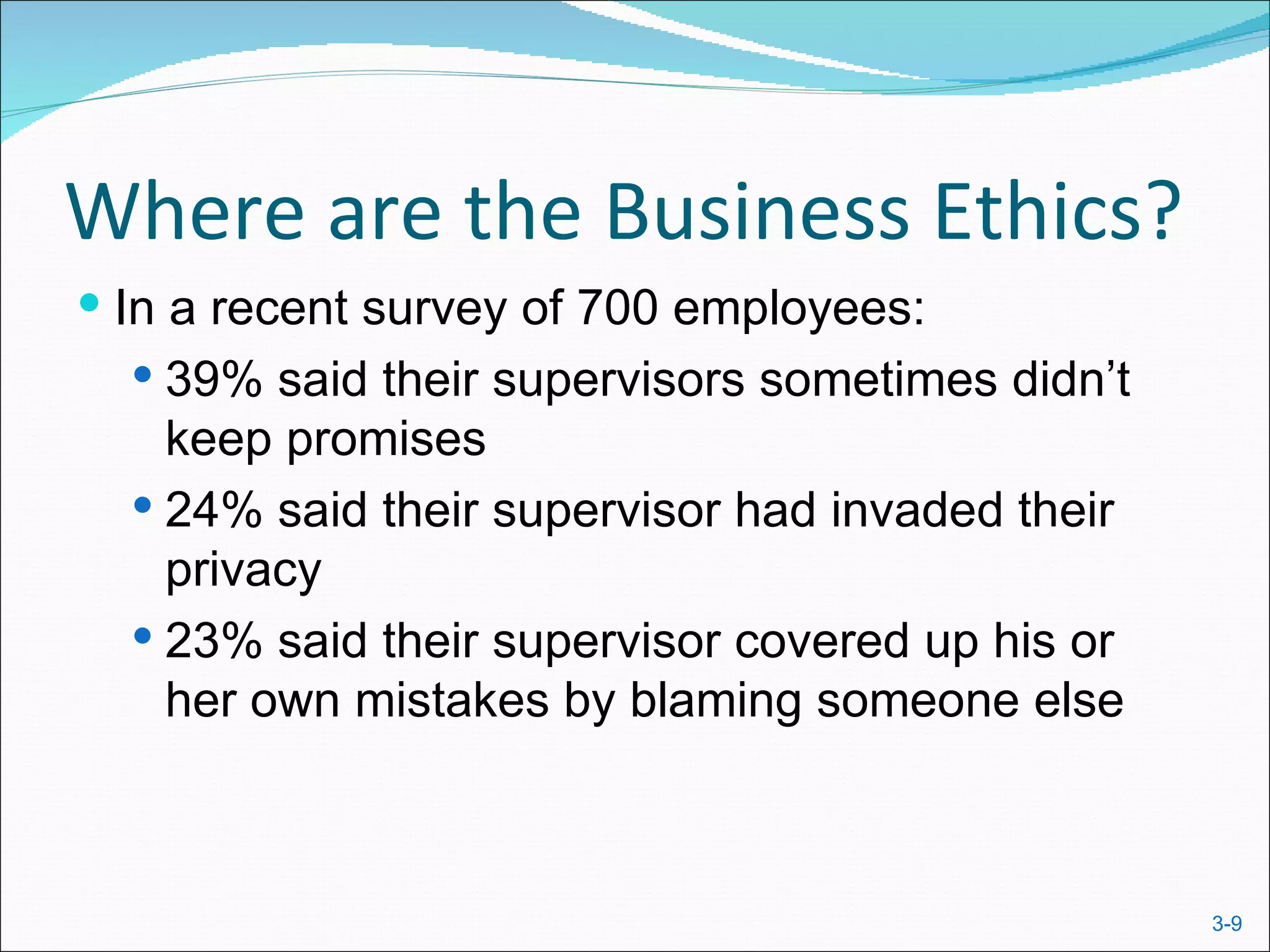
Where are the Business Ethics?
 In a recent survey of 700 employees:
   39% said their supervisors sometimes didn’t
    keep promises
   24% said their supervisor had invaded their
    privacy
   23% said their supervisor covered up his or
    her own mistakes by blaming someone else


                                                  3-9
Ethical Dilemmas YOU may face
 CEO pay
 Commercialism in schools
 Religion at work
 Sweatshops
 Wages
 Brands

                                3-10
Sarbanes-Oxley Act
 An act that established strict accounting and
  reporting rules to make senior managers more
  accountable and to improve and maintain
  investor confidence.
 Requires that organizations
   Have more independent board directors, not just
    company insiders
   Adhere strictly to accounting rules
   Have senior managers personally sign off on
    financial results
                                                      3-11
Compliance with Sarbanes-Oxley Act
 Establish written standards of ethical conduct and
    controls for enforcing them
   Assign responsibility to top managers to ensure that the
    program is working as intended
   Exclude anyone who violates the standards from holding
    management positions
   Provide training in ethics to all employees
   Monitor compliance
   Give employees incentives for complying and
    consequences for violating the standards
   Respond with consequences and additional preventive
    measures if criminal conduct comes to light

                                                               3-12
Downside of Sarbanes-Oxley
 Distracts from real work
 Makes executives more risk averse
 Costly time and money expenditures for compliance


                                                      3-13
The GE example of an ethical climate
 Top executives are committed to promoting high
  levels of integrity without sacrificing the
  commitment to business results.
 Established global standards for behavior to
  prevent ethical problems.
 Managers are expected to consider legal and
  ethical developments as they monitor the external
  environment.


                                                      3-14
Ethical Criteria for making decisions
 Why do it?
 Good or bad motives?
 My responsibility or someone else’s?
 Who gets the credit or the blame?


                                         3-15
What would you do?
You are international vice president of a multinational
chemical corporation. Your company is the sole producer
of an insecticide that will effectively combat a recent
infestation of West African crops. The minister of
agriculture in a small, developing African country has put in
a large order for your product. Your insecticide is highly
toxic and is banned in the United States. You inform the
minister of the risks of using your product, but he insists on
using it and claims it will be used “intelligently.” The
president of your company believes you should fill the
order, but decision is ultimately yours.

                                                                 3-16
Danger signs
 Excessive emphasis on short-term revenues over
  longer-term considerations
 Failure to establish a written code of ethics
 Desire for simple, “quick fix” solutions to ethical
  problems
 Unwillingness to take an ethical stand that may
  impose financial costs


                                                        3-17
Danger signs (cont’d)
 Consideration of ethics solely as a legal issue or a
  public relations tool
 Lack of clear procedures for handling ethical
  problems
 Responsiveness to the demands of shareholders at
  the expense of other constituencies


                                                         3-18
Corporate Ethical Standards
 Managers formally and informally shape employees’
  behavior with money, approval, good job
  assignments, a positive work environment
 Managers must be ethical and lead others to behave
  ethically
 “Set a goal for yourself to be seen by others as both
  a “moral person” and also as a “moral manager.”


                                                          3-19
Ethical Leader
 One who is both a moral person and a moral
  manager influencing others to behave ethically.
 Imagine how you would feel if you saw your decision
  and its consequences on the front page of the
  newspaper.


                                                        3-20
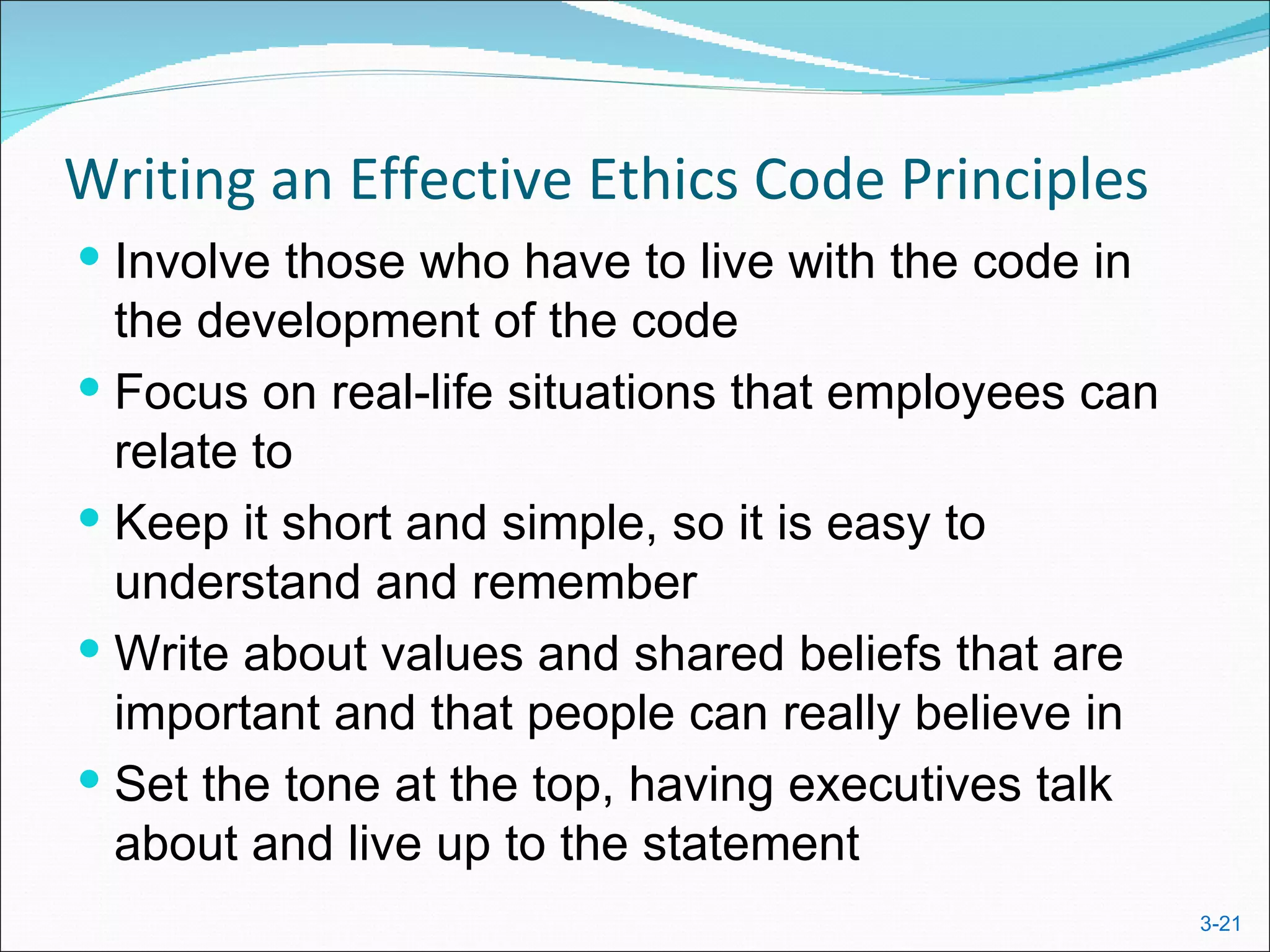
Writing an Effective Ethics Code Principles
 Involve those who have to live with the code in
  the development of the code
 Focus on real-life situations that employees can
  relate to
 Keep it short and simple, so it is easy to
  understand and remember
 Write about values and shared beliefs that are
  important and that people can really believe in
 Set the tone at the top, having executives talk
  about and live up to the statement
                                                     3-21
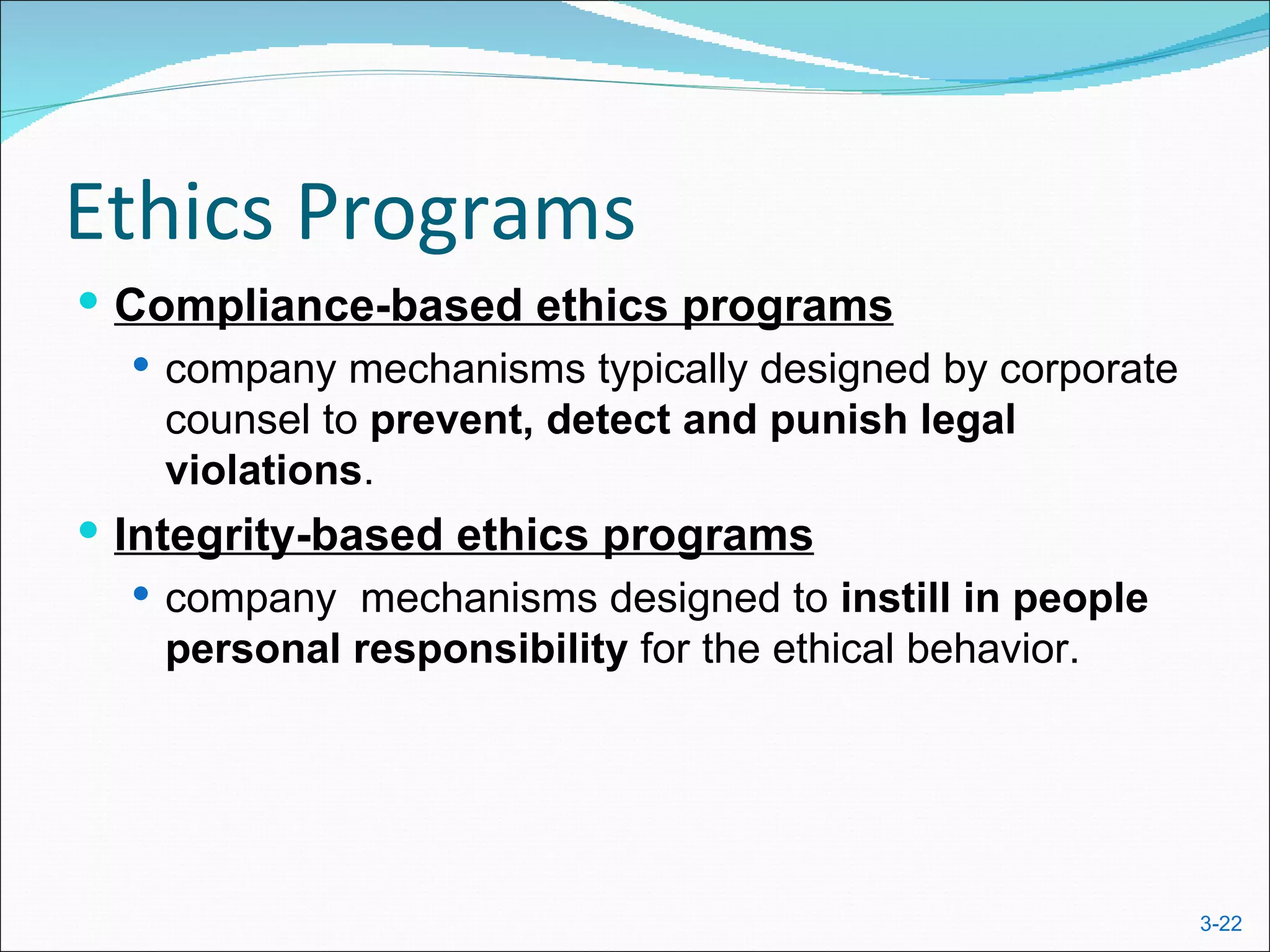
Ethics Programs
 Compliance-based ethics programs
    company mechanisms typically designed by corporate
     counsel to prevent, detect and punish legal
     violations.
 Integrity-based ethics programs
   company mechanisms designed to instill in people
    personal responsibility for the ethical behavior.


                                                          3-22
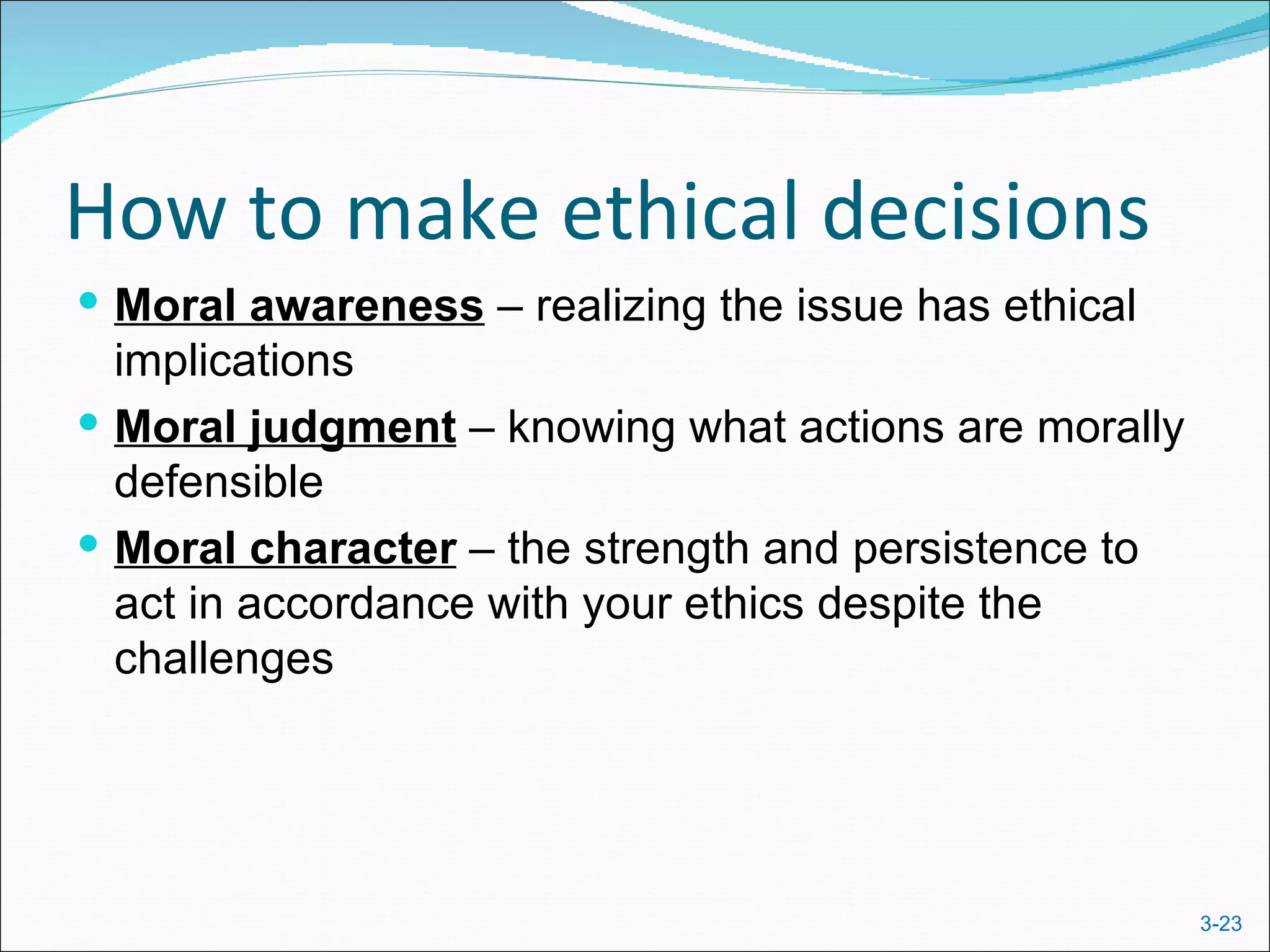
How to make ethical decisions
 Moral awareness – realizing the issue has ethical
  implications
 Moral judgment – knowing what actions are morally
  defensible
 Moral character – the strength and persistence to
  act in accordance with your ethics despite the
  challenges


                                                      3-23
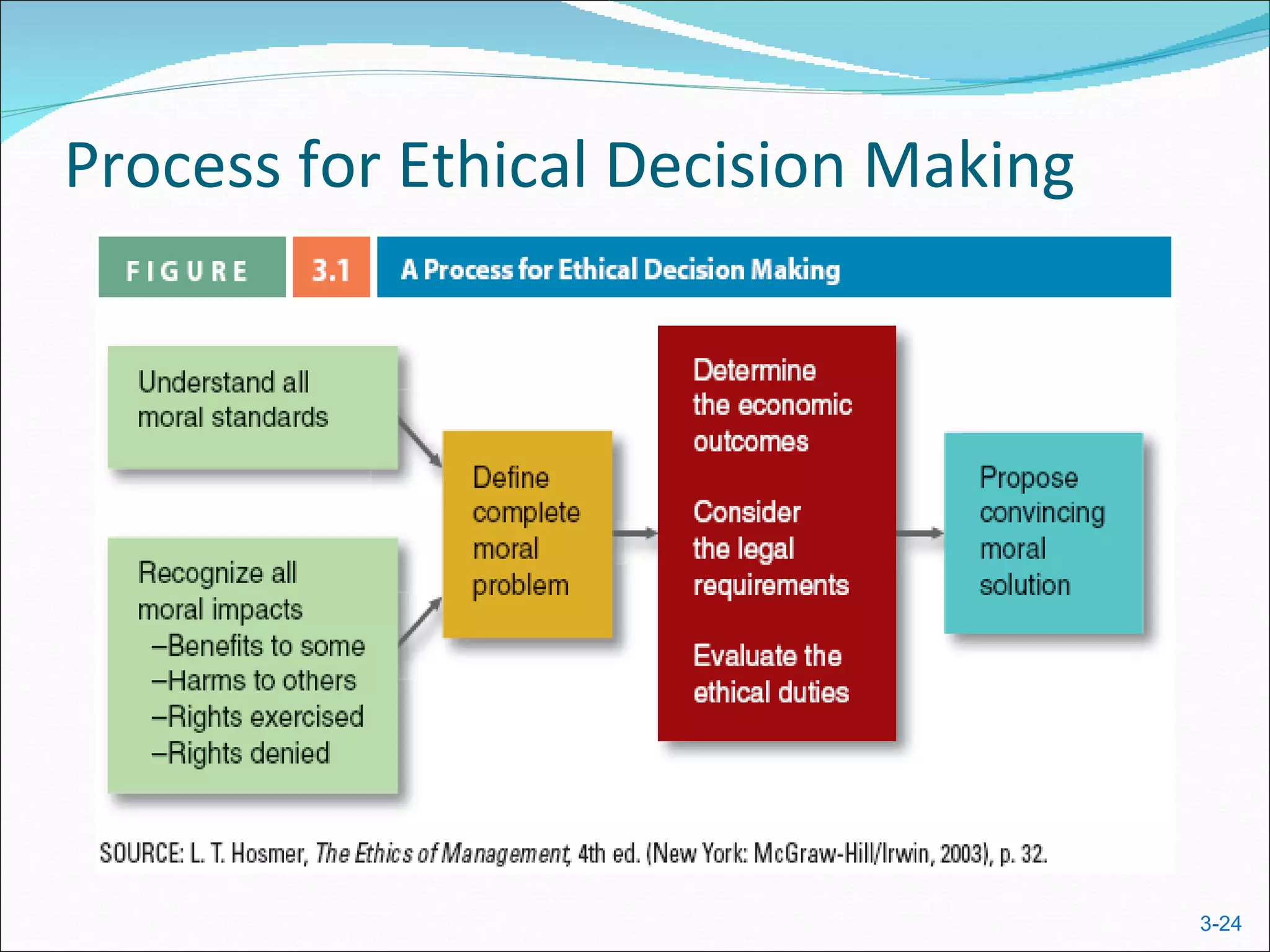
Process for Ethical Decision Making


                                      3-24
Excuses for Unethical Behavior
 Denying responsibility
 Denying injury
 Denying the victim
 Social weighting
 Appealing to higher loyalties


                                  3-25
Evaluate your Ethical Duties
1.   Would you be proud to see the action widely
     reported in newspapers?
2.   Would it build a sense of community among those
     involved?
3.   Would it generate the greatest social good?
4.   Would you be willing to see others take the same
     action when you might be the victim?
5.   Does it harm the “least among us”?
6.   Does it interfere with the right of all others to
     develop their skills to the fullest?

                                                         3-26
Whistleblowing
 Telling others, inside or outside the organization, of
  wrongdoing.
 People decide whether to whistleblow based on their
  perceptions of the wrongful act, their emotions, and
  a cost-benefit analysis
 Can be either an asset or a threat to an
  organizations depending on the situation
 Letter of the Law, WSJ 04 SEP 2008


                                                           3-27
Corporate Social Responsibility
Obligation toward society assumed by business


                                                3-28
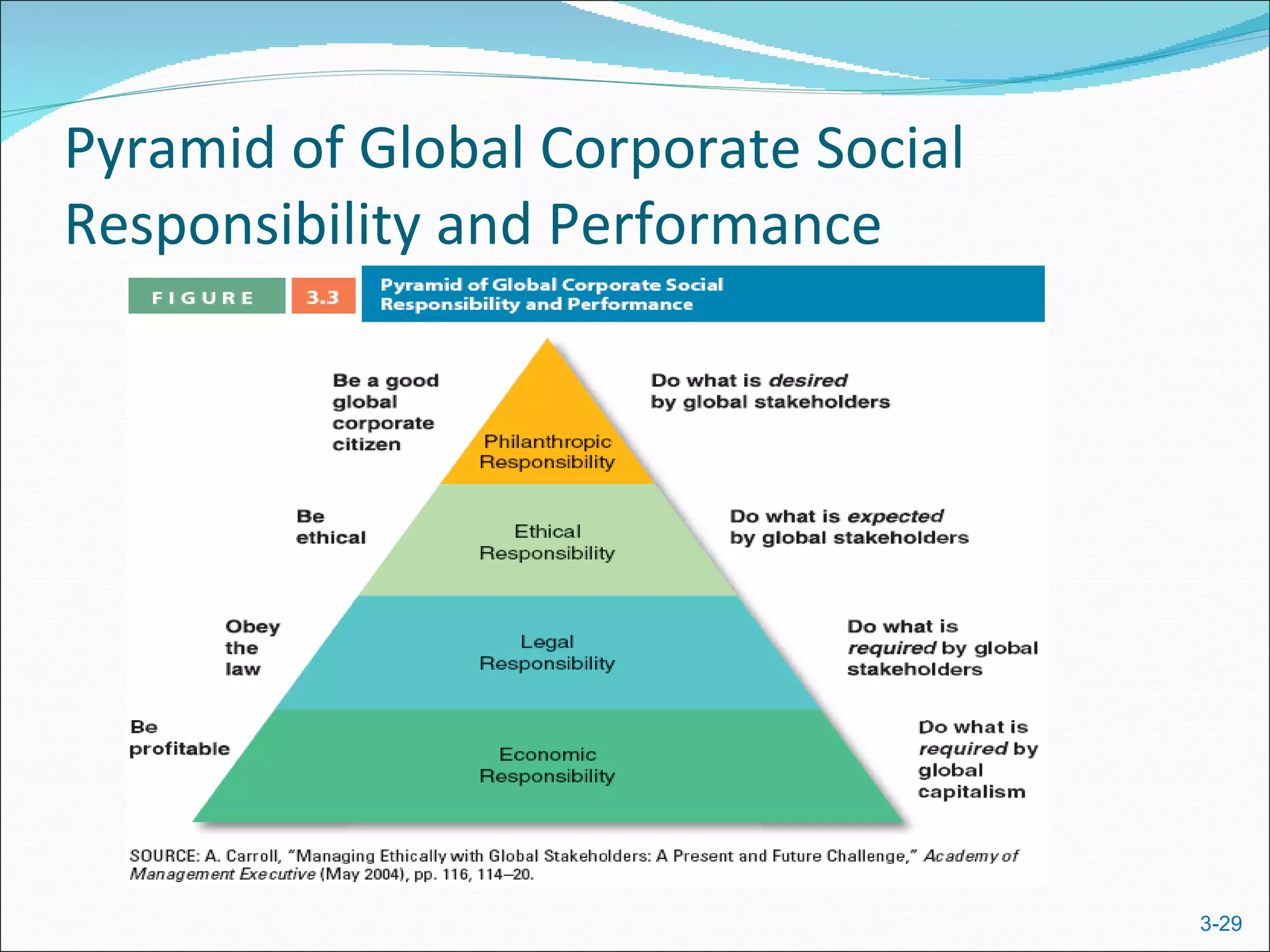
Pyramid of Global Corporate Social
Responsibility and Performance


                                     3-29
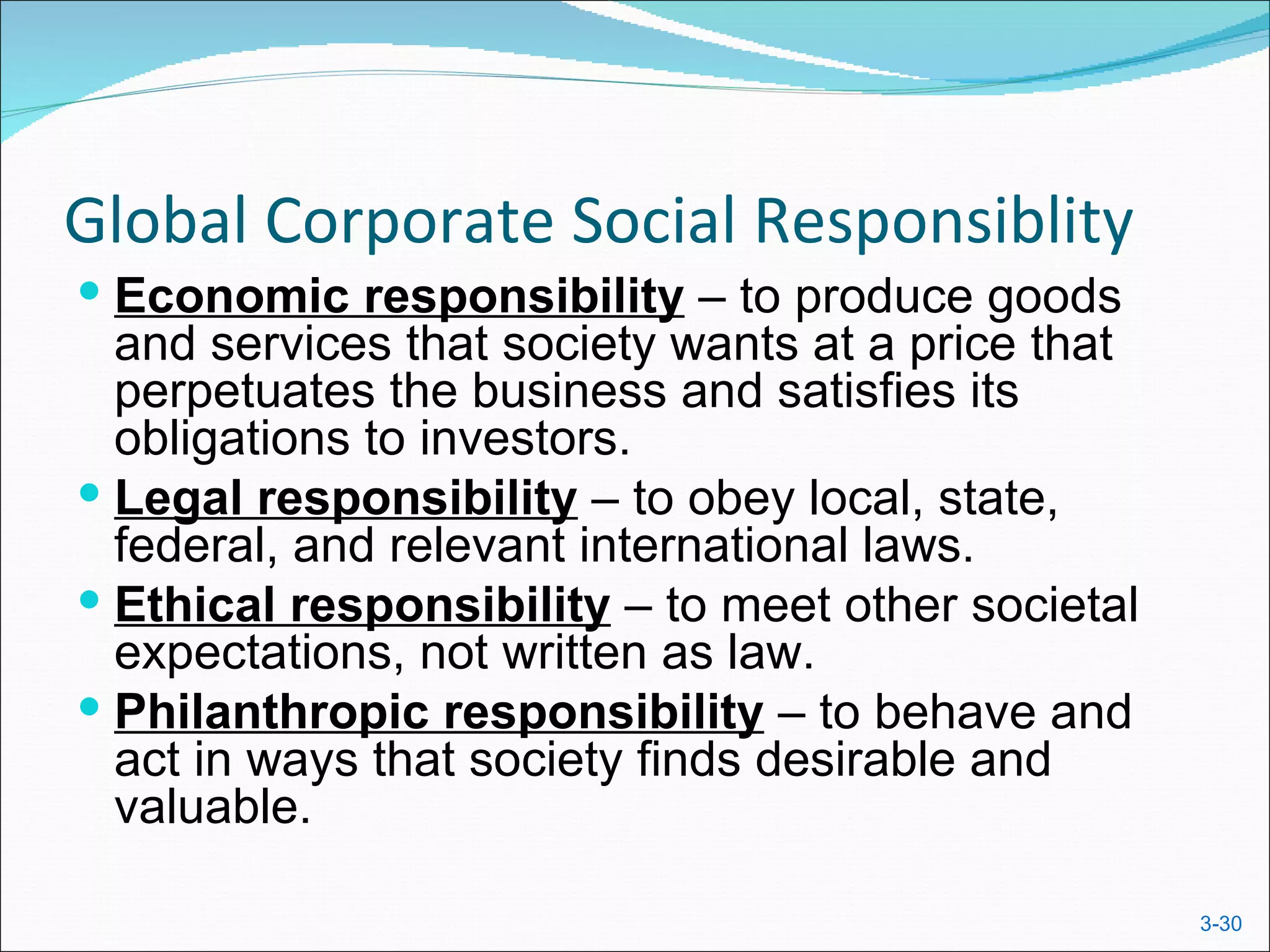
Global Corporate Social Responsiblity
 Economic responsibility – to produce goods
  and services that society wants at a price that
  perpetuates the business and satisfies its
  obligations to investors.
 Legal responsibility – to obey local, state,
  federal, and relevant international laws.
 Ethical responsibility – to meet other societal
  expectations, not written as law.
 Philanthropic responsibility – to behave and
  act in ways that society finds desirable and
  valuable.

                                                    3-30
Do businesses really have a social
responsibility?agents
  Managers act as      Managers should be
  for shareholders and are      motivated by principled
  obligated to maximize         moral reasoning
  the present value of the     Adam Smith defined
  firm                          sympathy as proper
 Unethical for business        regard for others and the
  leaders to decide what is     basis for a civilized
  best for society              society
 Unethical for business       Organizations have a
  leaders to spend              wider range of
  shareholders’ money on        responsibilities beyond
  projects unconnected to       profitability
  key business interests.
                                                            3-31
Doing well by doing good
 Companies can maximize profits as well as act as
  good corporate citizens.
 Corporate social responsibility can be used as a
  competitive advantage.
 The effects of corporate social responsibility on the
  bottom line depends on the corporate strategy


                                                          3-32
Environmental consequences of economic
activity
 Air pollution      Toxic waste sites
 Smog               Nuclear hazards
 Global warming     Obsolete weapons
 Ozone depletion     arsenals
 Acid rain          Industrial accidents
                     Hazardous products


                                             3-33
Biodynamic Wine
Discussion Questions
2.  Describe how Benziger Family Winery represents
    sustainable growth practices
3. Review the description of life-cycle analysis in the
    text. Based on what you know, what are the total
    inputs and outputs for Benziger Family Winery?
For more information visit www.benziger.com


                                                          3-34
YOU should be able to:
 L01: Describe how different ethical perspectives
  guide decision making
 L02: Explain how companies influence their ethics
  environment.
 L03: Outline a process for making ethical decisions


                                                        3-35
YOU should be able to:
 L04: Summarize the important issues surrounding
  corporate social responsibility
 L05: Discuss reasons for businesses’ growing
  interest in the natural environment
 L06: Identify actions managers can take to manage
  with the environment in mind.


                                                      3-36
The Nuts and Bolts of Ethics

Read Sam Colt’s ethical dilemma on page 53.


If you were Sam, what would you do?


                                              3-37
Test Your Knowledge


 How do the five different ethical perspectives
 guide decision making?


                                                   3-38
Test Your Knowledge

NovaCare and Wetherill Associates are
  examples of companies with:
  A) strong integrity-based ethics programs
  B) strong compliance-based ethics programs
  C) weak integrity-based ethics programs
  D) weak compliance-based ethics programs
  E) none of the above is correct


                                               3-39
Test your knowledge


 Outline the process for ethical decision making


                                                    3-40
Test Your Knowledge

 All About U (AAU) Salon believes in and
engages in meeting societal expectations
whether or not written as law. AAU can be
described as operating at which level of the
pyramid of corporate social responsibility?
A) Preconventional
B) Conventional
C) Economic
D) Ethical
E) Legal                                       3-41
The Natural Environment
 Then: industrial-age systems took a “take-make-
  waste” approach to the natural environment
 Now: organizations are incorporating environmental
  values into competitive strategies and into the
  design and manufacturing of products


                                                       3-42
Test Your Knowledge


What are the reasons for businesses’ growing
 interest in the natural environment?


                                               3-43
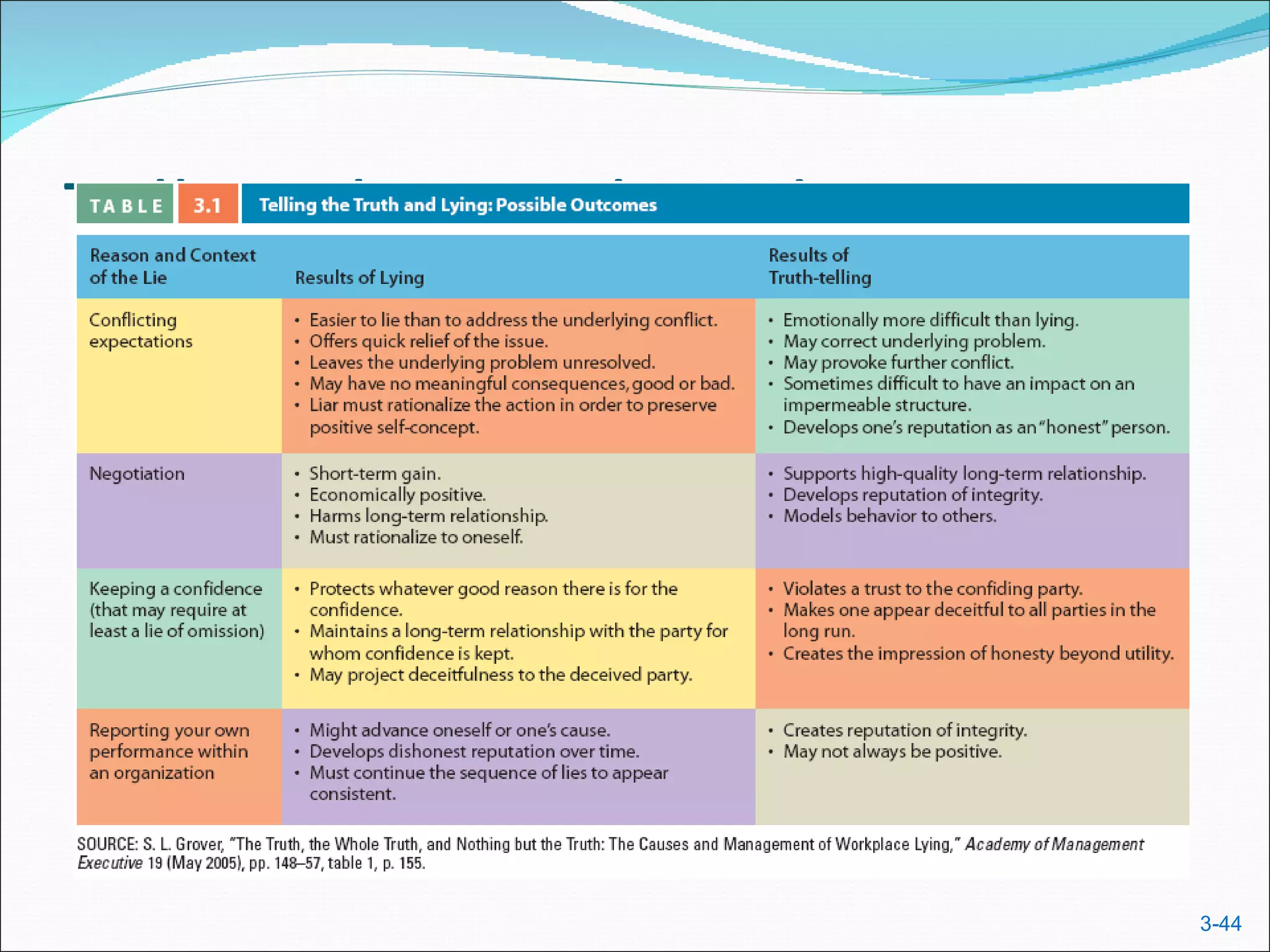
Telling the Truth and Lying


                              3-44
Ethical climate
 Processes by which decisions are evaluated and
 made on the basis of right and wrong.


                                                   3-45
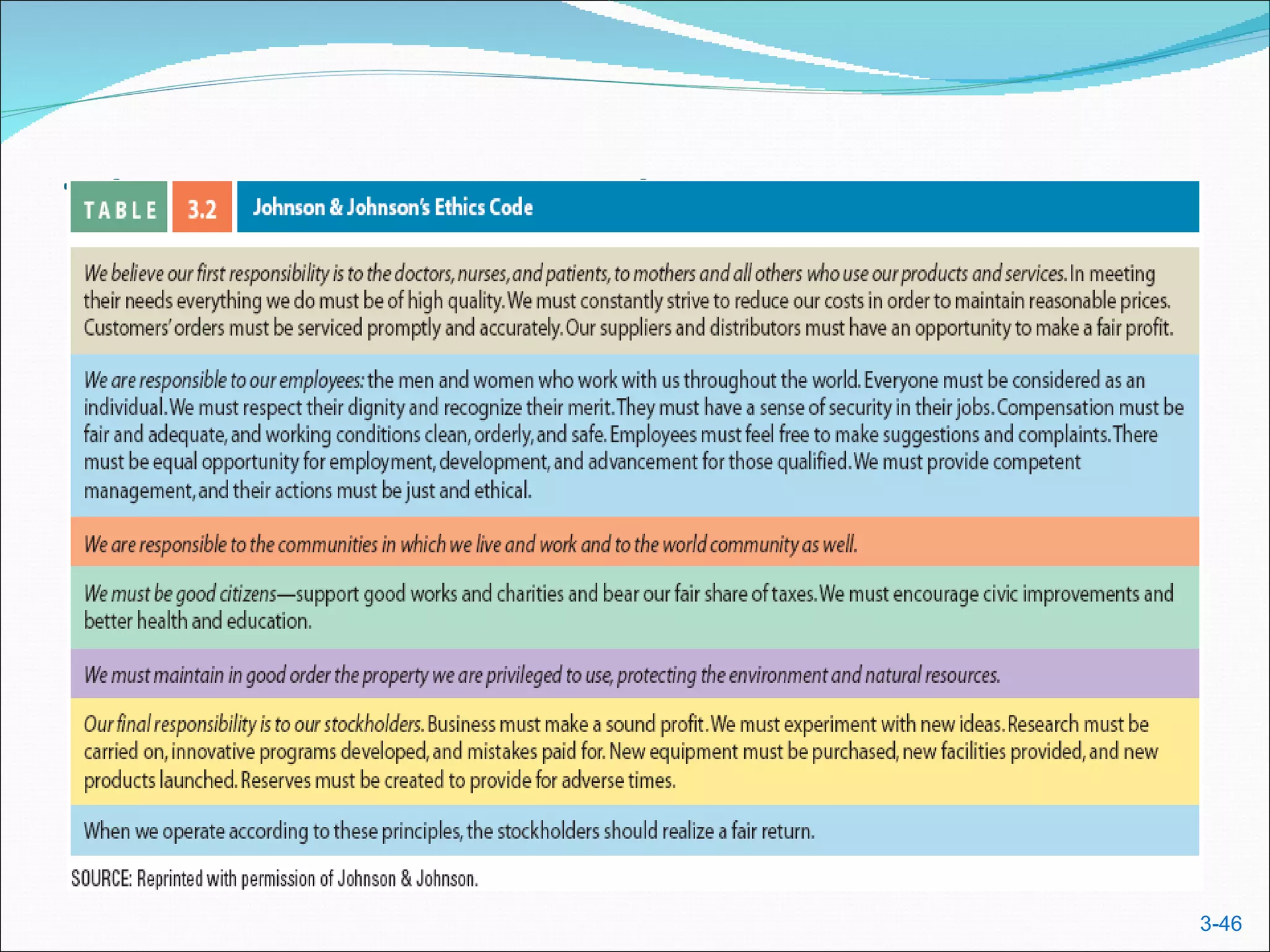
The J & J Example


                    3-46

Chap003 BUS137

  • 1.
    McGraw-Hill/Irwin 3-1 Copyright © 2009 by The McGraw-Hill Companies, Inc. All rights reserved.
  • 2.
    Learning Objectives  L01:Describe how different ethical perspectives guide decision making.  L02: Explain how companies influence their ethics environment.  L03: Outline a process for making ethical decisions. 3-2
  • 3.
    Learning Objectives  L04:Summarize the important issues surrounding corporate social responsibility.  L05: Discuss reasons for businesses’ growing interest in the natural environment.  L06: Identify actions managers can take to manage with the environment in mind. 3-3
  • 4.
    Ethics  The systemof rules that governs the ordering of values. 3-4
  • 5.
    Things to Ponder… What kind of manager do you want to be?  What reputation do you hope to have?  How would you like others to describe your behavior as a manager? 3-5
  • 6.
    •Is it legal? •Isit balanced? •How will I feel about myself (OR what would my mother say if she knew?) 3-6
  • 7.
    Ethics…it’s a bigissue  In a recent survey, more than 1/3 of U.S. adults have observed unethical conduct at work.  In another survey, top justification for unethical behavior was “pressure to meet unrealistic goals and deadlines.” 3-7
  • 8.
    Ethics…it’s a personalissue  Most of us think we are good ethical decision makers, but the fact is, most people are not.  People lie or commit ethical transgressions without realizing the consequences.  Managers often hire people who are like them, think they are immune to conflicts of interest, take more credit than they deserve, and blame others when they deserve some blame themselves 3-8
  • 9.
    Where are theBusiness Ethics?  In a recent survey of 700 employees:  39% said their supervisors sometimes didn’t keep promises  24% said their supervisor had invaded their privacy  23% said their supervisor covered up his or her own mistakes by blaming someone else 3-9
  • 10.
    Ethical Dilemmas YOUmay face  CEO pay  Commercialism in schools  Religion at work  Sweatshops  Wages  Brands 3-10
  • 11.
    Sarbanes-Oxley Act  Anact that established strict accounting and reporting rules to make senior managers more accountable and to improve and maintain investor confidence.  Requires that organizations  Have more independent board directors, not just company insiders  Adhere strictly to accounting rules  Have senior managers personally sign off on financial results 3-11
  • 12.
    Compliance with Sarbanes-OxleyAct  Establish written standards of ethical conduct and controls for enforcing them  Assign responsibility to top managers to ensure that the program is working as intended  Exclude anyone who violates the standards from holding management positions  Provide training in ethics to all employees  Monitor compliance  Give employees incentives for complying and consequences for violating the standards  Respond with consequences and additional preventive measures if criminal conduct comes to light 3-12
  • 13.
    Downside of Sarbanes-Oxley Distracts from real work  Makes executives more risk averse  Costly time and money expenditures for compliance 3-13
  • 14.
    The GE exampleof an ethical climate  Top executives are committed to promoting high levels of integrity without sacrificing the commitment to business results.  Established global standards for behavior to prevent ethical problems.  Managers are expected to consider legal and ethical developments as they monitor the external environment. 3-14
  • 15.
    Ethical Criteria formaking decisions  Why do it?  Good or bad motives?  My responsibility or someone else’s?  Who gets the credit or the blame? 3-15
  • 16.
    What would youdo? You are international vice president of a multinational chemical corporation. Your company is the sole producer of an insecticide that will effectively combat a recent infestation of West African crops. The minister of agriculture in a small, developing African country has put in a large order for your product. Your insecticide is highly toxic and is banned in the United States. You inform the minister of the risks of using your product, but he insists on using it and claims it will be used “intelligently.” The president of your company believes you should fill the order, but decision is ultimately yours. 3-16
  • 17.
    Danger signs  Excessiveemphasis on short-term revenues over longer-term considerations  Failure to establish a written code of ethics  Desire for simple, “quick fix” solutions to ethical problems  Unwillingness to take an ethical stand that may impose financial costs 3-17
  • 18.
    Danger signs (cont’d) Consideration of ethics solely as a legal issue or a public relations tool  Lack of clear procedures for handling ethical problems  Responsiveness to the demands of shareholders at the expense of other constituencies 3-18
  • 19.
    Corporate Ethical Standards Managers formally and informally shape employees’ behavior with money, approval, good job assignments, a positive work environment  Managers must be ethical and lead others to behave ethically  “Set a goal for yourself to be seen by others as both a “moral person” and also as a “moral manager.” 3-19
  • 20.
    Ethical Leader  Onewho is both a moral person and a moral manager influencing others to behave ethically.  Imagine how you would feel if you saw your decision and its consequences on the front page of the newspaper. 3-20
  • 21.
    Writing an EffectiveEthics Code Principles  Involve those who have to live with the code in the development of the code  Focus on real-life situations that employees can relate to  Keep it short and simple, so it is easy to understand and remember  Write about values and shared beliefs that are important and that people can really believe in  Set the tone at the top, having executives talk about and live up to the statement 3-21
  • 22.
    Ethics Programs  Compliance-basedethics programs  company mechanisms typically designed by corporate counsel to prevent, detect and punish legal violations.  Integrity-based ethics programs  company mechanisms designed to instill in people personal responsibility for the ethical behavior. 3-22
  • 23.
    How to makeethical decisions  Moral awareness – realizing the issue has ethical implications  Moral judgment – knowing what actions are morally defensible  Moral character – the strength and persistence to act in accordance with your ethics despite the challenges 3-23
  • 24.
    Process for EthicalDecision Making 3-24
  • 25.
    Excuses for UnethicalBehavior  Denying responsibility  Denying injury  Denying the victim  Social weighting  Appealing to higher loyalties 3-25
  • 26.
    Evaluate your EthicalDuties 1. Would you be proud to see the action widely reported in newspapers? 2. Would it build a sense of community among those involved? 3. Would it generate the greatest social good? 4. Would you be willing to see others take the same action when you might be the victim? 5. Does it harm the “least among us”? 6. Does it interfere with the right of all others to develop their skills to the fullest? 3-26
  • 27.
    Whistleblowing  Telling others,inside or outside the organization, of wrongdoing.  People decide whether to whistleblow based on their perceptions of the wrongful act, their emotions, and a cost-benefit analysis  Can be either an asset or a threat to an organizations depending on the situation  Letter of the Law, WSJ 04 SEP 2008 3-27
  • 28.
    Corporate Social Responsibility Obligationtoward society assumed by business 3-28
  • 29.
    Pyramid of GlobalCorporate Social Responsibility and Performance 3-29
  • 30.
    Global Corporate SocialResponsiblity  Economic responsibility – to produce goods and services that society wants at a price that perpetuates the business and satisfies its obligations to investors.  Legal responsibility – to obey local, state, federal, and relevant international laws.  Ethical responsibility – to meet other societal expectations, not written as law.  Philanthropic responsibility – to behave and act in ways that society finds desirable and valuable. 3-30
  • 31.
    Do businesses reallyhave a social responsibility?agents  Managers act as  Managers should be for shareholders and are motivated by principled obligated to maximize moral reasoning the present value of the  Adam Smith defined firm sympathy as proper  Unethical for business regard for others and the leaders to decide what is basis for a civilized best for society society  Unethical for business  Organizations have a leaders to spend wider range of shareholders’ money on responsibilities beyond projects unconnected to profitability key business interests. 3-31
  • 32.
    Doing well bydoing good  Companies can maximize profits as well as act as good corporate citizens.  Corporate social responsibility can be used as a competitive advantage.  The effects of corporate social responsibility on the bottom line depends on the corporate strategy 3-32
  • 33.
    Environmental consequences ofeconomic activity  Air pollution  Toxic waste sites  Smog  Nuclear hazards  Global warming  Obsolete weapons  Ozone depletion arsenals  Acid rain  Industrial accidents  Hazardous products 3-33
  • 34.
    Biodynamic Wine Discussion Questions 2. Describe how Benziger Family Winery represents sustainable growth practices 3. Review the description of life-cycle analysis in the text. Based on what you know, what are the total inputs and outputs for Benziger Family Winery? For more information visit www.benziger.com 3-34
  • 35.
    YOU should beable to:  L01: Describe how different ethical perspectives guide decision making  L02: Explain how companies influence their ethics environment.  L03: Outline a process for making ethical decisions 3-35
  • 36.
    YOU should beable to:  L04: Summarize the important issues surrounding corporate social responsibility  L05: Discuss reasons for businesses’ growing interest in the natural environment  L06: Identify actions managers can take to manage with the environment in mind. 3-36
  • 37.
    The Nuts andBolts of Ethics Read Sam Colt’s ethical dilemma on page 53. If you were Sam, what would you do? 3-37
  • 38.
    Test Your Knowledge How do the five different ethical perspectives guide decision making? 3-38
  • 39.
    Test Your Knowledge NovaCareand Wetherill Associates are examples of companies with: A) strong integrity-based ethics programs B) strong compliance-based ethics programs C) weak integrity-based ethics programs D) weak compliance-based ethics programs E) none of the above is correct 3-39
  • 40.
    Test your knowledge Outline the process for ethical decision making 3-40
  • 41.
    Test Your Knowledge All About U (AAU) Salon believes in and engages in meeting societal expectations whether or not written as law. AAU can be described as operating at which level of the pyramid of corporate social responsibility? A) Preconventional B) Conventional C) Economic D) Ethical E) Legal 3-41
  • 42.
    The Natural Environment Then: industrial-age systems took a “take-make- waste” approach to the natural environment  Now: organizations are incorporating environmental values into competitive strategies and into the design and manufacturing of products 3-42
  • 43.
    Test Your Knowledge Whatare the reasons for businesses’ growing interest in the natural environment? 3-43
  • 44.
    Telling the Truthand Lying 3-44
  • 45.
    Ethical climate  Processesby which decisions are evaluated and made on the basis of right and wrong. 3-45
  • 46.
    The J &J Example 3-46