© McGraw-Hill Companies, Inc., McGraw-Hill/Irwin
MARKETING ETHICS

    LEARNING OBJECTIVES

   Why do marketers have to worry about ethics?
   What does it take for a firm to be considered
    socially responsible?
   How should a firm make ethically responsible
    decision?
   How can ethics and social responsibility be
    integrated into a firm’s marketing strategy?

    © McGraw-Hill Companies, Inc., McGraw-Hill/Irwin   3-2
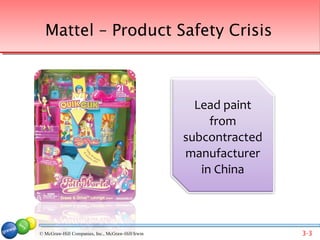
Mattel – Product Safety Crisis


                                                     Lead paint
                                                        from
                                                   subcontracted
                                                   manufacturer
                                                      in China


© McGraw-Hill Companies, Inc., McGraw-Hill/Irwin                   3-3
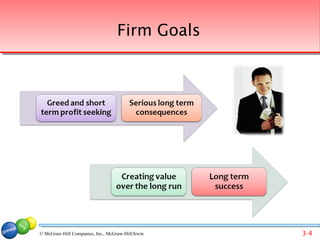
Firm Goals


© McGraw-Hill Companies, Inc., McGraw-Hill/Irwin   3-4
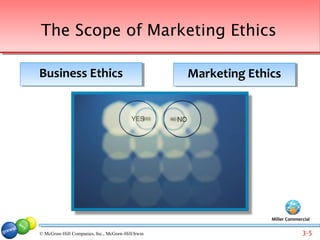
The Scope of Marketing Ethics

Business Ethics
Business Ethics                                    Marketing Ethics
                                                   Marketing Ethics


                                                                 Miller Commercial


© McGraw-Hill Companies, Inc., McGraw-Hill/Irwin                              3-5
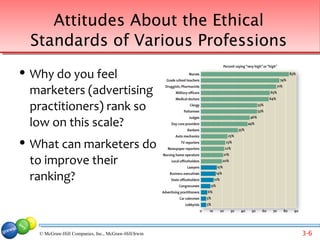
Attitudes About the Ethical
    Standards of Various Professions
   Why do you feel
    marketers (advertising
    practitioners) rank so
    low on this scale?
   What can marketers do
    to improve their
    ranking?


     © McGraw-Hill Companies, Inc., McGraw-Hill/Irwin   3-6
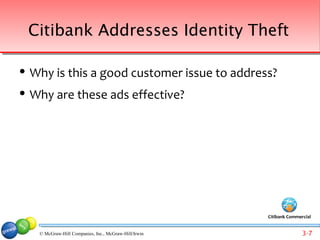
Citibank Addresses Identity Theft

   Why is this a good customer issue to address?
   Why are these ads effective?


                                                        Citibank Commercial


     © McGraw-Hill Companies, Inc., McGraw-Hill/Irwin                  3-7
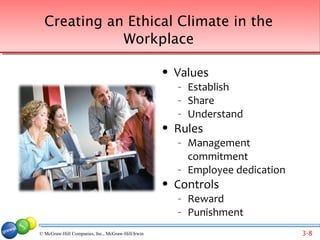
Creating an Ethical Climate in the
             Workplace

                                                      Values
                                                       –   Establish
                                                       –   Share
                                                       –   Understand
                                                      Rules
                                                       –   Management
                                                           commitment
                                                       –   Employee dedication
                                                      Controls
                                                       –   Reward
                                                       –   Punishment
© McGraw-Hill Companies, Inc., McGraw-Hill/Irwin                                 3-8
American Marketing Association
        Code of Ethics


                                                    AMA Website


 © McGraw-Hill Companies, Inc., McGraw-Hill/Irwin          3-9
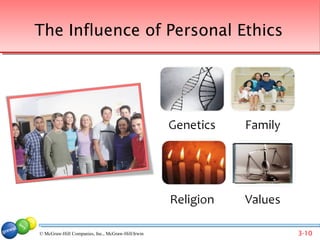
The Influence of Personal Ethics


© McGraw-Hill Companies, Inc., McGraw-Hill/Irwin   3-10
Why People Act Unethically


                                                      Are all the individuals
                                                       Are all the individuals
What makes people take
What makes people take                                     who engage in
                                                           who engage in
 actions that create so
 actions that create so                               questionable behavior
                                                      questionable behavior
      much harm?
      much harm?                                       just plain immoral or
                                                        just plain immoral or
                                                             unethical?
                                                              unethical?


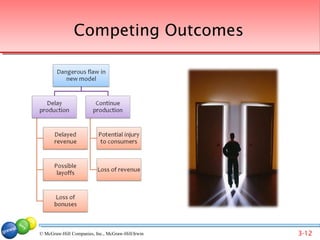
 Decisions often have conflicting outcomes, where both
 Decisions often have conflicting outcomes, where both
   options have positive and negative consequences
   options have positive and negative consequences


   © McGraw-Hill Companies, Inc., McGraw-Hill/Irwin                              3-11
Competing Outcomes


© McGraw-Hill Companies, Inc., McGraw-Hill/Irwin   3-12
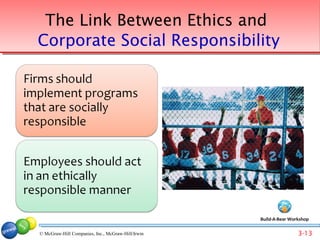
The Link Between Ethics and
Corporate Social Responsibility


                                                   Build-A-Bear Workshop


© McGraw-Hill Companies, Inc., McGraw-Hill/Irwin                   3-13
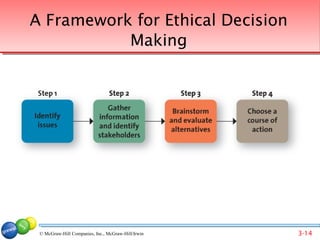
A Framework for Ethical Decision
           Making


 © McGraw-Hill Companies, Inc., McGraw-Hill/Irwin   3-14
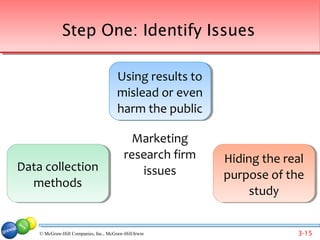
Step One: Identify Issues

                                       Using results to
                                       Using results to
                                       mislead or even
                                       mislead or even
                                       harm the public
                                       harm the public

                                            Marketing
                                          research firm   Hiding the real
                                                          Hiding the real
Data collection
Data collection                              issues       purpose of the
                                                          purpose of the
  methods
   methods
                                                               study
                                                               study


    © McGraw-Hill Companies, Inc., McGraw-Hill/Irwin                   3-15
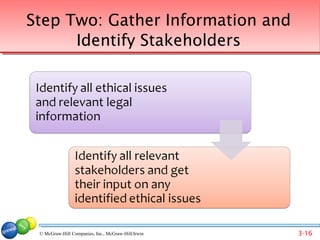
Step Two: Gather Information and
      Identify Stakeholders


 © McGraw-Hill Companies, Inc., McGraw-Hill/Irwin   3-16
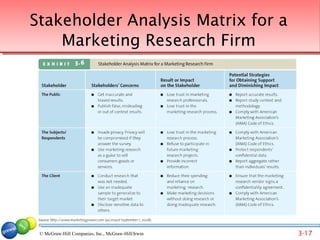
Stakeholder Analysis Matrix for a
    Marketing Research Firm


 © McGraw-Hill Companies, Inc., McGraw-Hill/Irwin   3-17
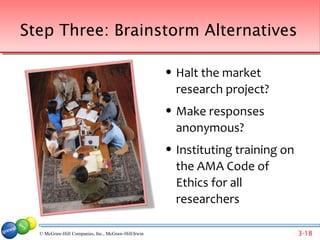
Step Three: Brainstorm Alternatives

                                                        Halt the market
                                                         research project?
                                                        Make responses
                                                         anonymous?
                                                        Instituting training on
                                                         the AMA Code of
                                                         Ethics for all
                                                         researchers

  © McGraw-Hill Companies, Inc., McGraw-Hill/Irwin                                 3-18
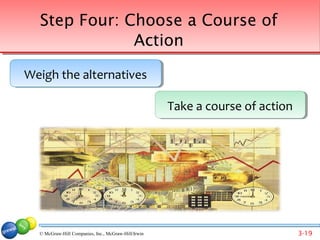
Step Four: Choose a Course of
              Action

Weigh the alternatives

                                                     Take a course of action
                                                     Take a course of action


  © McGraw-Hill Companies, Inc., McGraw-Hill/Irwin                             3-19
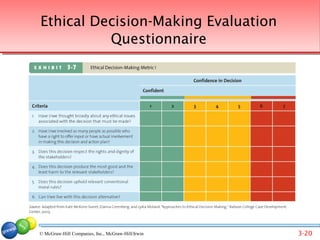
Ethical Decision-Making Evaluation
          Questionnaire


© McGraw-Hill Companies, Inc., McGraw-Hill/Irwin   3-20
Check Yourself


   1.     According to the American marketing
          Association Code of Ethics, what are the
          six ethical values
   2.     Identify the four stages in the ethical
          decision making framework


© McGraw-Hill Companies, Inc., McGraw-Hill/Irwin     3-21
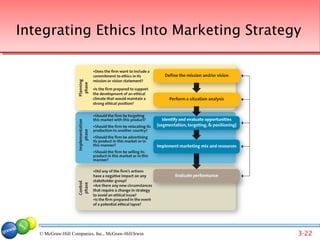
Integrating Ethics Into Marketing Strategy


   © McGraw-Hill Companies, Inc., McGraw-Hill/Irwin   3-22
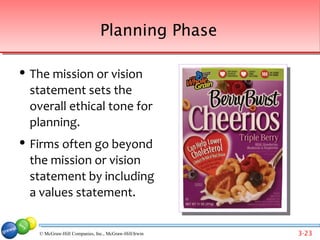
Planning Phase

   The mission or vision
    statement sets the
    overall ethical tone for
    planning.
   Firms often go beyond
    the mission or vision
    statement by including
    a values statement.


     © McGraw-Hill Companies, Inc., McGraw-Hill/Irwin   3-23
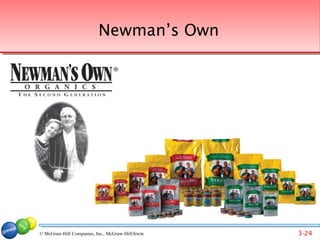
Newman’s Own


                                    Donating over $200 million since 1982


© McGraw-Hill Companies, Inc., McGraw-Hill/Irwin                            3-24
Implementation Stage

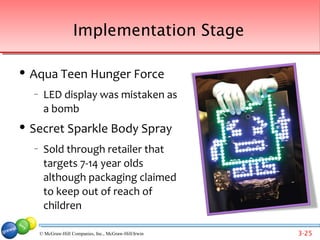
   Aqua Teen Hunger Force
    −    LED display was mistaken as
         a bomb
   Secret Sparkle Body Spray
    −    Sold through retailer that
         targets 7-14 year olds
         although packaging claimed
         to keep out of reach of
         children

        © McGraw-Hill Companies, Inc., McGraw-Hill/Irwin   3-25
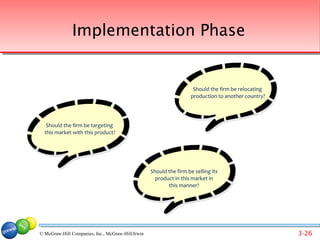
Implementation Phase


                                                                     Should the firm be relocating
                                                                    production to another country?


   Should the firm be targeting
  this market with this product?


                                                   Should the firm be selling its
                                                     product in this market in
                                                          this manner?


© McGraw-Hill Companies, Inc., McGraw-Hill/Irwin                                                     3-26
Control Phase


1.
  1.
       Check successful
        Check successful
       implementation
        implementation
2.
 2.
       React to change
       React to change


© McGraw-Hill Companies, Inc., McGraw-Hill/Irwin   3-27
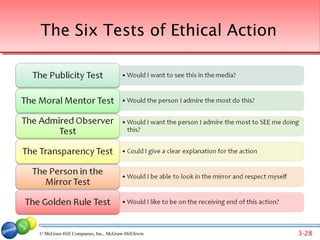
The Six Tests of Ethical Action


© McGraw-Hill Companies, Inc., McGraw-Hill/Irwin   3-28
Check Yourself


   1.     Should a marketing manager insist on
          assessing the ethics of a situation she or
          he is facing?
   2.     Identify one ethical issue you might face
          in each of the three phases of a marketing
          plan


© McGraw-Hill Companies, Inc., McGraw-Hill/Irwin       3-29
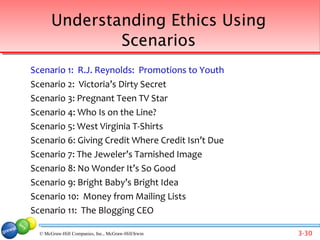
Understanding Ethics Using
               Scenarios
Scenario 1: R.J. Reynolds: Promotions to Youth
Scenario 2: Victoria’s Dirty Secret
Scenario 3: Pregnant Teen TV Star
Scenario 4: Who Is on the Line?
Scenario 5: West Virginia T-Shirts
Scenario 6: Giving Credit Where Credit Isn’t Due
Scenario 7: The Jeweler’s Tarnished Image
Scenario 8: No Wonder It’s So Good
Scenario 9: Bright Baby’s Bright Idea
Scenario 10: Money from Mailing Lists
Scenario 11: The Blogging CEO

  © McGraw-Hill Companies, Inc., McGraw-Hill/Irwin   3-30
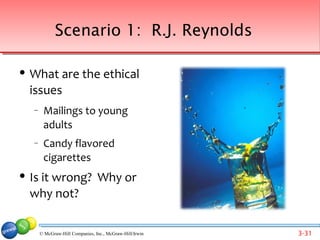
Scenario 1: R.J. Reynolds

   What are the ethical
    issues
    −    Mailings to young
         adults
    −    Candy flavored
         cigarettes
   Is it wrong? Why or
    why not?
         Back to list of scenarios

        © McGraw-Hill Companies, Inc., McGraw-Hill/Irwin   3-31
Scenario 2: Victoria’s Dirty Secret

   What was Victoria’s
    Secret doing?
   Was it wrong?
   Unethical
   How could they fix
    this?


     Back to list of scenarios
     © McGraw-Hill Companies, Inc., McGraw-Hill/Irwin   3-32
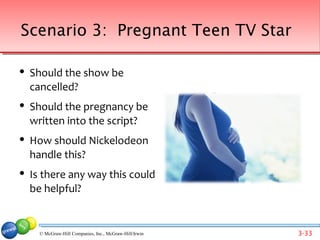
Scenario 3: Pregnant Teen TV Star

   Should the show be
    cancelled?
   Should the pregnancy be
    written into the script?
   How should Nickelodeon
    handle this?
   Is there any way this could
    be helpful?

     Back to list of scenarios
      © McGraw-Hill Companies, Inc., McGraw-Hill/Irwin   3-33
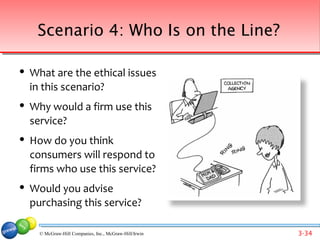
Scenario 4: Who Is on the Line?

   What are the ethical issues
    in this scenario?
   Why would a firm use this
    service?
   How do you think
    consumers will respond to
    firms who use this service?
   Would you advise
    purchasing this service?
     Back to list of scenarios
      © McGraw-Hill Companies, Inc., McGraw-Hill/Irwin   3-34
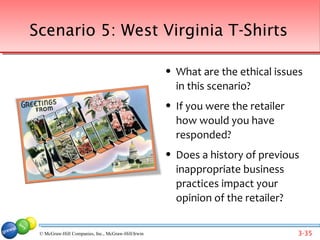
Scenario 5: West Virginia T-Shirts

                                                       What are the ethical issues
                                                        in this scenario?
                                                       If you were the retailer
                                                        how would you have
                                                        responded?
                                                       Does a history of previous
                                                        inappropriate business
                                                        practices impact your
                                                        opinion of the retailer?
 Back to list of scenarios
 © McGraw-Hill Companies, Inc., McGraw-Hill/Irwin                                  3-35
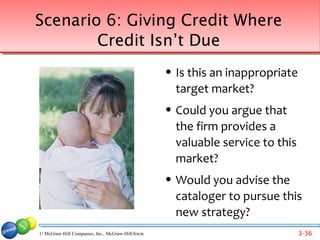
Scenario 6: Giving Credit Where
        Credit Isn’t Due
                                                      Is this an inappropriate
                                                       target market?
                                                      Could you argue that
                                                       the firm provides a
                                                       valuable service to this
                                                       market?
                                                      Would you advise the
                                                       cataloger to pursue this
Back to list of scenarios
                                                       new strategy?
© McGraw-Hill Companies, Inc., McGraw-Hill/Irwin                                  3-36
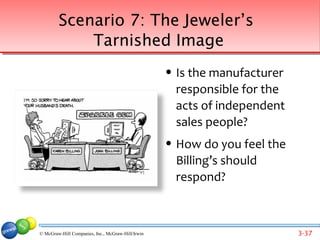
Scenario 7: The Jeweler’s
            Tarnished Image
                                                      Is the manufacturer
                                                       responsible for the
                                                       acts of independent
                                                       sales people?
                                                      How do you feel the
                                                       Billing’s should
                                                       respond?


Back to list of scenarios
© McGraw-Hill Companies, Inc., McGraw-Hill/Irwin                             3-37
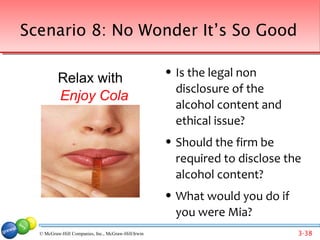
Scenario 8: No Wonder It’s So Good

          Relax with
                                                        Is the legal non
                                                         disclosure of the
          Enjoy Cola
                                                         alcohol content and
                                                         ethical issue?
                                                        Should the firm be
                                                         required to disclose the
                                                         alcohol content?
                                                        What would you do if
  Back to list of scenarios
                                                         you were Mia?
  © McGraw-Hill Companies, Inc., McGraw-Hill/Irwin                              3-38
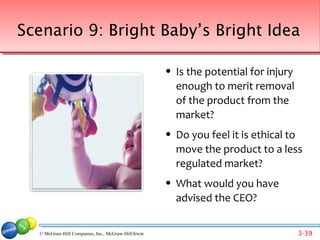
Scenario 9: Bright Baby’s Bright Idea

                                                        Is the potential for injury
                                                         enough to merit removal
                                                         of the product from the
                                                         market?
                                                        Do you feel it is ethical to
                                                         move the product to a less
                                                         regulated market?
                                                        What would you have
                                                         advised the CEO?
  Back to list of scenarios
  © McGraw-Hill Companies, Inc., McGraw-Hill/Irwin                                     3-39
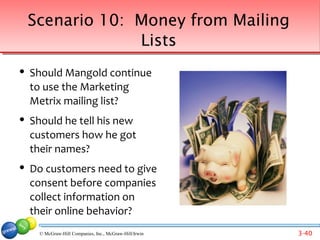
Scenario 10: Money from Mailing
                 Lists
   Should Mangold continue
    to use the Marketing
    Metrix mailing list?
   Should he tell his new
    customers how he got
    their names?
   Do customers need to give
    consent before companies
    collect information on
    their online behavior?
     Back to list of scenarios
      © McGraw-Hill Companies, Inc., McGraw-Hill/Irwin   3-40
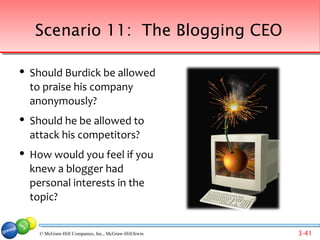
Scenario 11: The Blogging CEO

   Should Burdick be allowed
    to praise his company
    anonymously?
   Should he be allowed to
    attack his competitors?
   How would you feel if you
    knew a blogger had
    personal interests in the
    topic?
     Back to list of scenarios
     © McGraw-Hill Companies, Inc., McGraw-Hill/Irwin   3-41
Glossary

Corporate social responsibility describes the
 voluntary actions taken by a company to address
 the ethical, social, and environmental impacts of
 its business operations and the concerns of its
 stakeholders.


                                                         Return to slide


      © McGraw-Hill Companies, Inc., McGraw-Hill/Irwin              3-42

Chapter 03 MKT120 Ethics

  • 1.
    © McGraw-Hill Companies,Inc., McGraw-Hill/Irwin
  • 2.
    MARKETING ETHICS LEARNING OBJECTIVES  Why do marketers have to worry about ethics?  What does it take for a firm to be considered socially responsible?  How should a firm make ethically responsible decision?  How can ethics and social responsibility be integrated into a firm’s marketing strategy? © McGraw-Hill Companies, Inc., McGraw-Hill/Irwin 3-2
  • 3.
    Mattel – ProductSafety Crisis Lead paint from subcontracted manufacturer in China © McGraw-Hill Companies, Inc., McGraw-Hill/Irwin 3-3
  • 4.
    Firm Goals © McGraw-HillCompanies, Inc., McGraw-Hill/Irwin 3-4
  • 5.
    The Scope ofMarketing Ethics Business Ethics Business Ethics Marketing Ethics Marketing Ethics Miller Commercial © McGraw-Hill Companies, Inc., McGraw-Hill/Irwin 3-5
  • 6.
    Attitudes About theEthical Standards of Various Professions  Why do you feel marketers (advertising practitioners) rank so low on this scale?  What can marketers do to improve their ranking? © McGraw-Hill Companies, Inc., McGraw-Hill/Irwin 3-6
  • 7.
    Citibank Addresses IdentityTheft  Why is this a good customer issue to address?  Why are these ads effective? Citibank Commercial © McGraw-Hill Companies, Inc., McGraw-Hill/Irwin 3-7
  • 8.
    Creating an EthicalClimate in the Workplace  Values – Establish – Share – Understand  Rules – Management commitment – Employee dedication  Controls – Reward – Punishment © McGraw-Hill Companies, Inc., McGraw-Hill/Irwin 3-8
  • 9.
    American Marketing Association Code of Ethics AMA Website © McGraw-Hill Companies, Inc., McGraw-Hill/Irwin 3-9
  • 10.
    The Influence ofPersonal Ethics © McGraw-Hill Companies, Inc., McGraw-Hill/Irwin 3-10
  • 11.
    Why People ActUnethically Are all the individuals Are all the individuals What makes people take What makes people take who engage in who engage in actions that create so actions that create so questionable behavior questionable behavior much harm? much harm? just plain immoral or just plain immoral or unethical? unethical? Decisions often have conflicting outcomes, where both Decisions often have conflicting outcomes, where both options have positive and negative consequences options have positive and negative consequences © McGraw-Hill Companies, Inc., McGraw-Hill/Irwin 3-11
  • 12.
    Competing Outcomes © McGraw-HillCompanies, Inc., McGraw-Hill/Irwin 3-12
  • 13.
    The Link BetweenEthics and Corporate Social Responsibility Build-A-Bear Workshop © McGraw-Hill Companies, Inc., McGraw-Hill/Irwin 3-13
  • 14.
    A Framework forEthical Decision Making © McGraw-Hill Companies, Inc., McGraw-Hill/Irwin 3-14
  • 15.
    Step One: IdentifyIssues Using results to Using results to mislead or even mislead or even harm the public harm the public Marketing research firm Hiding the real Hiding the real Data collection Data collection issues purpose of the purpose of the methods methods study study © McGraw-Hill Companies, Inc., McGraw-Hill/Irwin 3-15
  • 16.
    Step Two: GatherInformation and Identify Stakeholders © McGraw-Hill Companies, Inc., McGraw-Hill/Irwin 3-16
  • 17.
    Stakeholder Analysis Matrixfor a Marketing Research Firm © McGraw-Hill Companies, Inc., McGraw-Hill/Irwin 3-17
  • 18.
    Step Three: BrainstormAlternatives  Halt the market research project?  Make responses anonymous?  Instituting training on the AMA Code of Ethics for all researchers © McGraw-Hill Companies, Inc., McGraw-Hill/Irwin 3-18
  • 19.
    Step Four: Choosea Course of Action Weigh the alternatives Weigh the alternatives Take a course of action Take a course of action © McGraw-Hill Companies, Inc., McGraw-Hill/Irwin 3-19
  • 20.
    Ethical Decision-Making Evaluation Questionnaire © McGraw-Hill Companies, Inc., McGraw-Hill/Irwin 3-20
  • 21.
    Check Yourself 1. According to the American marketing Association Code of Ethics, what are the six ethical values 2. Identify the four stages in the ethical decision making framework © McGraw-Hill Companies, Inc., McGraw-Hill/Irwin 3-21
  • 22.
    Integrating Ethics IntoMarketing Strategy © McGraw-Hill Companies, Inc., McGraw-Hill/Irwin 3-22
  • 23.
    Planning Phase  The mission or vision statement sets the overall ethical tone for planning.  Firms often go beyond the mission or vision statement by including a values statement. © McGraw-Hill Companies, Inc., McGraw-Hill/Irwin 3-23
  • 24.
    Newman’s Own Donating over $200 million since 1982 © McGraw-Hill Companies, Inc., McGraw-Hill/Irwin 3-24
  • 25.
    Implementation Stage  Aqua Teen Hunger Force − LED display was mistaken as a bomb  Secret Sparkle Body Spray − Sold through retailer that targets 7-14 year olds although packaging claimed to keep out of reach of children © McGraw-Hill Companies, Inc., McGraw-Hill/Irwin 3-25
  • 26.
    Implementation Phase Should the firm be relocating production to another country? Should the firm be targeting this market with this product? Should the firm be selling its product in this market in this manner? © McGraw-Hill Companies, Inc., McGraw-Hill/Irwin 3-26
  • 27.
    Control Phase 1. 1. Check successful Check successful implementation implementation 2. 2. React to change React to change © McGraw-Hill Companies, Inc., McGraw-Hill/Irwin 3-27
  • 28.
    The Six Testsof Ethical Action © McGraw-Hill Companies, Inc., McGraw-Hill/Irwin 3-28
  • 29.
    Check Yourself 1. Should a marketing manager insist on assessing the ethics of a situation she or he is facing? 2. Identify one ethical issue you might face in each of the three phases of a marketing plan © McGraw-Hill Companies, Inc., McGraw-Hill/Irwin 3-29
  • 30.
    Understanding Ethics Using Scenarios Scenario 1: R.J. Reynolds: Promotions to Youth Scenario 2: Victoria’s Dirty Secret Scenario 3: Pregnant Teen TV Star Scenario 4: Who Is on the Line? Scenario 5: West Virginia T-Shirts Scenario 6: Giving Credit Where Credit Isn’t Due Scenario 7: The Jeweler’s Tarnished Image Scenario 8: No Wonder It’s So Good Scenario 9: Bright Baby’s Bright Idea Scenario 10: Money from Mailing Lists Scenario 11: The Blogging CEO © McGraw-Hill Companies, Inc., McGraw-Hill/Irwin 3-30
  • 31.
    Scenario 1: R.J.Reynolds  What are the ethical issues − Mailings to young adults − Candy flavored cigarettes  Is it wrong? Why or why not? Back to list of scenarios © McGraw-Hill Companies, Inc., McGraw-Hill/Irwin 3-31
  • 32.
    Scenario 2: Victoria’sDirty Secret  What was Victoria’s Secret doing?  Was it wrong?  Unethical  How could they fix this? Back to list of scenarios © McGraw-Hill Companies, Inc., McGraw-Hill/Irwin 3-32
  • 33.
    Scenario 3: PregnantTeen TV Star  Should the show be cancelled?  Should the pregnancy be written into the script?  How should Nickelodeon handle this?  Is there any way this could be helpful? Back to list of scenarios © McGraw-Hill Companies, Inc., McGraw-Hill/Irwin 3-33
  • 34.
    Scenario 4: WhoIs on the Line?  What are the ethical issues in this scenario?  Why would a firm use this service?  How do you think consumers will respond to firms who use this service?  Would you advise purchasing this service? Back to list of scenarios © McGraw-Hill Companies, Inc., McGraw-Hill/Irwin 3-34
  • 35.
    Scenario 5: WestVirginia T-Shirts  What are the ethical issues in this scenario?  If you were the retailer how would you have responded?  Does a history of previous inappropriate business practices impact your opinion of the retailer? Back to list of scenarios © McGraw-Hill Companies, Inc., McGraw-Hill/Irwin 3-35
  • 36.
    Scenario 6: GivingCredit Where Credit Isn’t Due  Is this an inappropriate target market?  Could you argue that the firm provides a valuable service to this market?  Would you advise the cataloger to pursue this Back to list of scenarios new strategy? © McGraw-Hill Companies, Inc., McGraw-Hill/Irwin 3-36
  • 37.
    Scenario 7: TheJeweler’s Tarnished Image  Is the manufacturer responsible for the acts of independent sales people?  How do you feel the Billing’s should respond? Back to list of scenarios © McGraw-Hill Companies, Inc., McGraw-Hill/Irwin 3-37
  • 38.
    Scenario 8: NoWonder It’s So Good Relax with  Is the legal non disclosure of the Enjoy Cola alcohol content and ethical issue?  Should the firm be required to disclose the alcohol content?  What would you do if Back to list of scenarios you were Mia? © McGraw-Hill Companies, Inc., McGraw-Hill/Irwin 3-38
  • 39.
    Scenario 9: BrightBaby’s Bright Idea  Is the potential for injury enough to merit removal of the product from the market?  Do you feel it is ethical to move the product to a less regulated market?  What would you have advised the CEO? Back to list of scenarios © McGraw-Hill Companies, Inc., McGraw-Hill/Irwin 3-39
  • 40.
    Scenario 10: Moneyfrom Mailing Lists  Should Mangold continue to use the Marketing Metrix mailing list?  Should he tell his new customers how he got their names?  Do customers need to give consent before companies collect information on their online behavior? Back to list of scenarios © McGraw-Hill Companies, Inc., McGraw-Hill/Irwin 3-40
  • 41.
    Scenario 11: TheBlogging CEO  Should Burdick be allowed to praise his company anonymously?  Should he be allowed to attack his competitors?  How would you feel if you knew a blogger had personal interests in the topic? Back to list of scenarios © McGraw-Hill Companies, Inc., McGraw-Hill/Irwin 3-41
  • 42.
    Glossary Corporate social responsibilitydescribes the voluntary actions taken by a company to address the ethical, social, and environmental impacts of its business operations and the concerns of its stakeholders. Return to slide © McGraw-Hill Companies, Inc., McGraw-Hill/Irwin 3-42

Editor's Notes

  • #3 These questions are the learning objectives guiding the chapter and will be explored in more detail in the following slides.
  • #4 In August 2007 several toy manufacturer’s found lead paint in their toys. Mattel recalled 20 million products in 1 month. Ask students - was Mattel at fault for this? Many will think it’s Mattel’s responsibility to micromanage production other students will believe Mattel is not able to follow all their products through all their production stages.
  • #5 Profit is important to the success of the firm. But how the firm makes that profit can have a dramatic impact on the firm’s future.
  • #6 This YouTube video is a Miller ad for responsible drinking (always check YouTube links before class) . Ask students how it compares to other ads they see for drinking. They might note that they use a lighter fear appeal. Ask them if they think Miller is doing their job to promote responsible drinking. Group activity : Ask students to brainstorm the ethical issues unique to marketing. They should start with the marketing mix by proceeding through each of the 4Ps. Each group should write one issue for each element on the board, then discuss what they have produced as a class.
  • #7 Marketing is a very visible part of business. Often practices that are the result of other business functions will be attributed to marketing. Marketers need to stress the good things that they do and the value that the add to society. Also, by policing practitioners and sanctioning those who violate the various codes of ethics, etc. marketers can demonstrate that they are serious about ethical standards.
  • #8 These ads on YouTube (always check YouTube links before class) are part of a campaign Citibank ran for identity theft. They are interesting ads as they show the victim with the voice of the thief talking about the products the thief plans to buy. They are effective because they speak directly to a consumer’s fear of credit card theft and the contrast between the character in the ad and their voice attracts attention.
  • #9 A strong ethical climate requires a commitment from the top down within the firm. Everyone within the firm must agree to a system of controls that rewards appropriate behavior and punishes inappropriate behavior. Ask students about the ethical climate on their campus. Pick a topic such as honor code violations or pledging procedures of sororities and fraternities. Then ask them to evaluate the topic based on values, rules, and controls.
  • #10 Each sub-area within marketing, such as marketing research, advertising, pricing, and so forth, has its own code of ethics that deals with the specific issues that arise when conducting business in those areas. Group activity: Have the students develop a Code of Ethics for their college or university. Ask students : What ethical behaviors should you include? Why are those chosen behaviors important?
  • #11 In many cases, ethics is in the eye of the beholder. Ask students : Think about a time you believed an ethical violation had occurred but a friend of family member did not think it was an ethical issue. What happened?
  • #12 Ask students : Why might a salesperson lie to a young couple about the condition of a new home? This will bring out issues such as self-interest for the welfare of the salesperson and his/her family. Remind students there are no definitive answers to these questions. Ethics is a difficult topic, and many people struggle to find answers to questions such as these.
  • #13 Ask students : Which option would you choose? How do you think various people make such choices?
  • #14 This web link is for the Build-A-Bear Workshop. The page is for their community involvement. Students are probably familiar with the product. Ask students if they were aware that this company was so active in the community. Have students determine which of these corporate giving plans appears to be the most effective? Ask students : Can a firm be socially responsible and not ethical, or ethical and not socially responsible? A firm can give money to charity (socially responsible), but be unethical (engage in deceptive advertising). Ask students : Can you think of a firm that may be either ethical or socially responsible, but not both. Group activity : Students should create a list of firms reputed to be socially responsible. In what ways do these firms demonstrate their commitment? Do the students consider these factors when purchasing goods?
  • #15 This concept is broken down in the next slides
  • #16 In a marketing research firm, ethical issues might include: data collection methods—not informing respondents that they are being observed hiding the true purpose of a study from respondents—telling them they are an independent research company, but actually doing research for a particular politician. using results to mislead or even harm the public—results of a pharmaceutical study. Ask students – why would a company do this?
  • #17 Ask students : What are the ramifications of publishing misleading research findings for a new pharmaceutical product. Answer: there could be real harm to users. Then ask : Why might this happen? Answer: The pharmaceutical industry wants the product to come to market to meet sales goals. They might be paying the researchers to do the project.
  • #18 Ask students : How are stakeholders interrelated? How do the responsibilities of one overlap the other? The stakeholders are interrelated because an ethical violation may impact others. Falsifying results for a new pharmaceutical study will, for instance, impact the researchers, the pharmaceutical company, the legal system, the physicians, and most importantly the patients.
  • #19 The alternative solutions depend on the type of ethical issue and how the stakeholders are affected.
  • #20 Alternatives are then evaluated and a course of action is chosen. The chosen course represents the best solution for the stakeholders using ethical best practices.
  • #21 Group activity: Pose an ethical issue and have the class vote on how they would score each question.
  • #22 Honesty, responsibility, fairness, respect, openness, citizenship Stages in framework: Stages 1: Identify Issues Stages 2: Gather Information and Identify Stakeholders Stages 3: Brainstorm Alternatives Stages 4: Choose a Course of Action
  • #23 Remind students that as marketers, they must ask questions specific to each stage and examine those questions carefully before moving on to the next stage .
  • #24 By incorporating ethics into the firm’s mission statement, the firm sets a standard for its subsequent ethical decision making. The mission statement signals the firm’s strategic priorities.
  • #25 The adding value 3.1 box features Newman’s Own Organics. This is a good opportunity to discuss the firm.
  • #26 Turner Broadcasting wanted to market to its core audience— teenagers who would know exactly what the lighted character represented—but it failed to consider the ramifications of blinking lights and LED displays near public transportation venues in a city that had been touched deeply by the events of 9/11. This promotion to young girls was inappropriate according to P&G’s own labeling and was terminated when the Children’s Advertising Review Unit of the Better Business Bureau stepped in and requested that P&G stop promoting the product to children.
  • #27 Group activity: For each question related to the implementation phase, see if students can think of examples for each of the questions. Many students will use examples such as tobacco, alcohol or other controversial product companies. Point out that other products also encounter the same issues, even if the products themselves seem less controversial.
  • #28 Any plan requires constant evaluation and revision, and this truism applies particularly to the evaluation of ethical issues.
  • #29 Group activity: Divide students into groups, each of which takes one of these tests and then develops an example for the rest of the class.
  • #30 Yes Answers will vary
  • #31 Click on each scenario to bring up the picture and questions.
  • #32 An alcohol company cannot promote excessive drinking but a tobacco company has no such regulation.
  • #33 This is very grey since the company was trying to honestly raise revenues. Students might have additional issues with this company as they promote body images that are hard for many women to maintain.
  • #34 This type of issue can be very emotional for students. Be sure to instruct students to keep their comments on this topic professional. Entertainment companies who decide to stand by their stars when this type of situation happens, may find themselves stuck between strong emotions on both sides.
  • #35 Some states ban such software and require businesses to display a real phone number. But the practice continues. Ask students : Why would firms want to participate in it?
  • #36 The retailer clearly believes that its target market is not offended and has little regard for non-customers who might be. In the long term, this type of indifference may prove problematic, but in the short term, the firm’s attitude might even increase its sales.
  • #37 Lower-income consumers often are denied credit, and when they get credit then pay it off, they build their credit. Rent-to-own and check cashing firms use this argument to justify their exorbitant fees and interest rates. Opponents argue that encouraging non–credit-worthy consumers to take credit cards harms them by making them responsible for debts they likely cannot pay off.
  • #38 When the owners learn about the deception, should they immediately stop using the distributors? Why or why not?
  • #39 Many people believe that legal actions de facto must be ethical, but are they really? If the chance of harm is very low, should the firm disclose the presence of the alcohol to avoid any potential issues?
  • #40 Avoiding a large loss often creates the potential for ethically questionable actions. Would the scenario change if some infants had died from this product?
  • #41 Sports Nostalgia Emporium must weigh the short-term gain of increased sales versus the long-term negative impact of customers who may be upset once they discover that their online behavior is being tracked.
  • #42 Burdick must weigh the short-term impact of his anonymous blogging against the long-term negative impact of customers who may be upset once they discover his relationship with ACME Bubblegum.