
McGraw-Hill/Irwin                                                                         7-1
                    Copyright © 2009 by The McGraw-Hill Companies, Inc. All rights reserved.
Learning Objectives
 L01: HRM & Competitive advantage
 L02: Recruitment - internal and external
   L03: Selection methods
   L04: Training and development
   L05: Appraisal methods
   L06: Reward systems
   L07: Unions and labor laws


                                             7-2
Strategic Human Resources Management
1.   People create value

3.   Talent is rare

5.   A group of well-chosen, motivated people is
     difficult to imitate

7.   People can be organized for success


                                                   7-3
The puzzle of HR
 Attracting talent
 Maintaining a well-trained, highly motivated and
    loyal workforce
   Managing diversity
   Devising effective compensation systems
   Managing layoffs
   Containing health care and pension costs


                                                     7-4
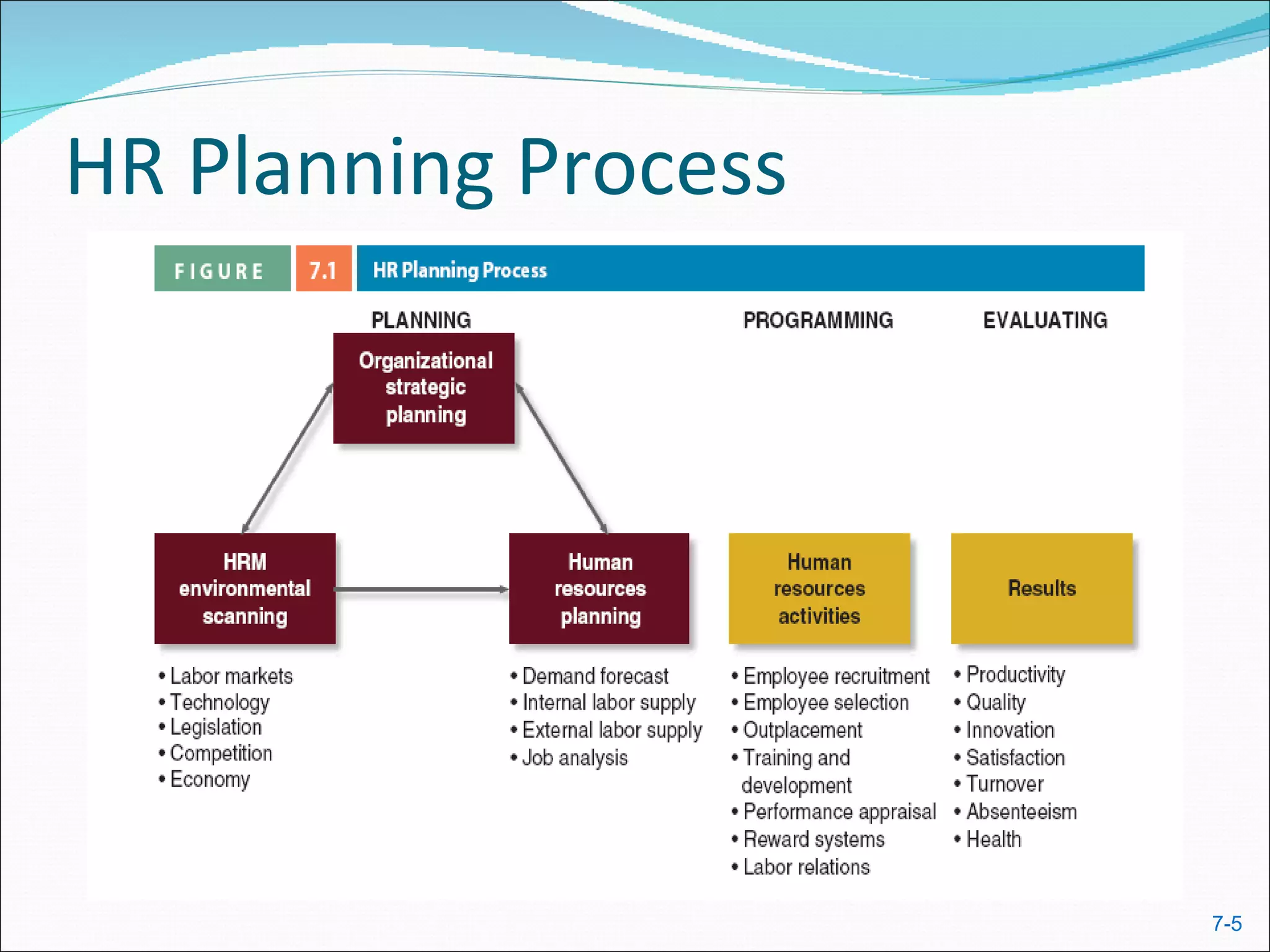
HR Planning Process


                      7-5
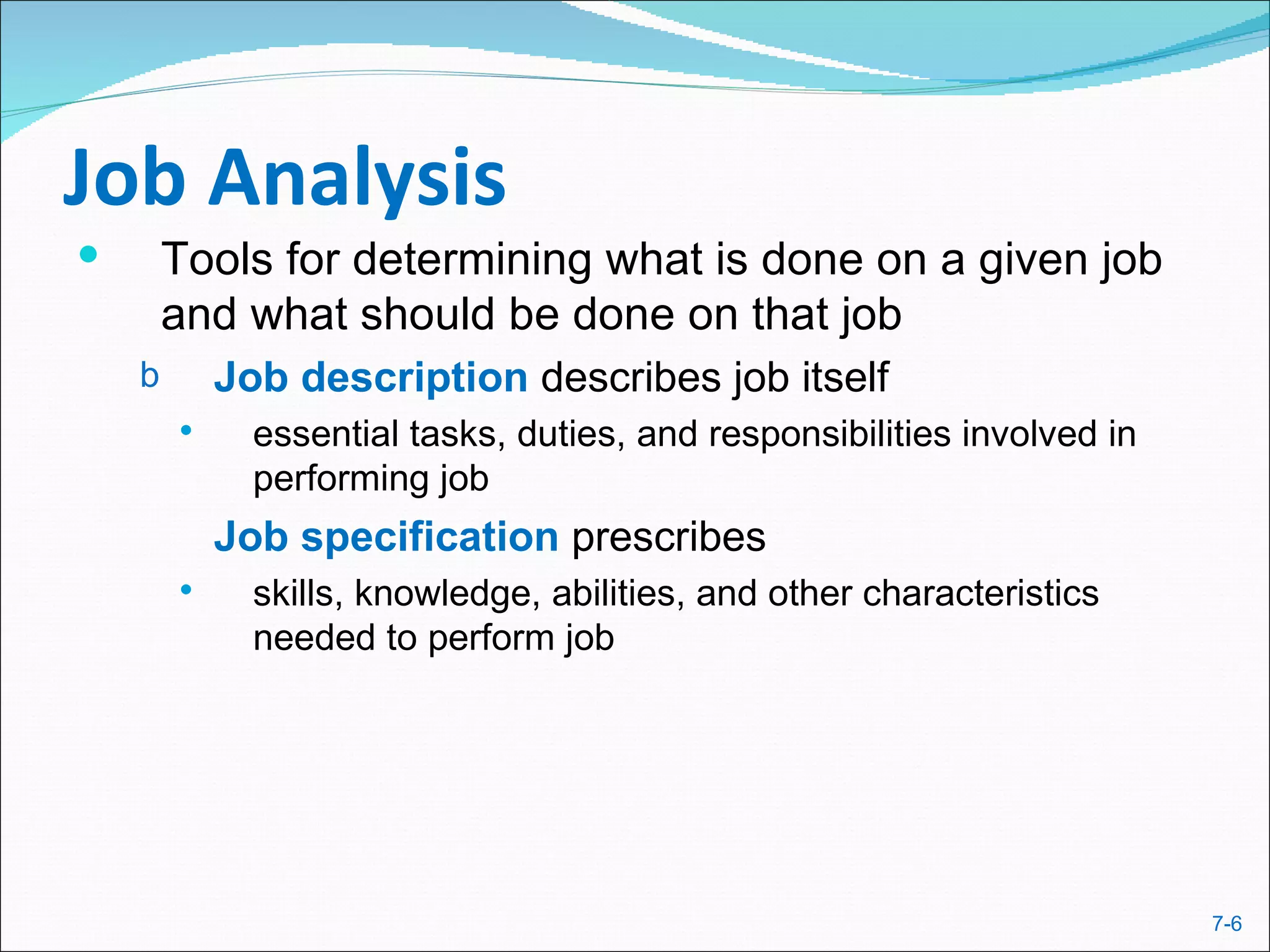
Job Analysis
       Tools for determining what is done on a given job
        and what should be done on that job
    b       Job description describes job itself
             essential tasks, duties, and responsibilities involved in
              performing job
            Job specification prescribes
             skills, knowledge, abilities, and other characteristics
              needed to perform job


                                                                          7-6
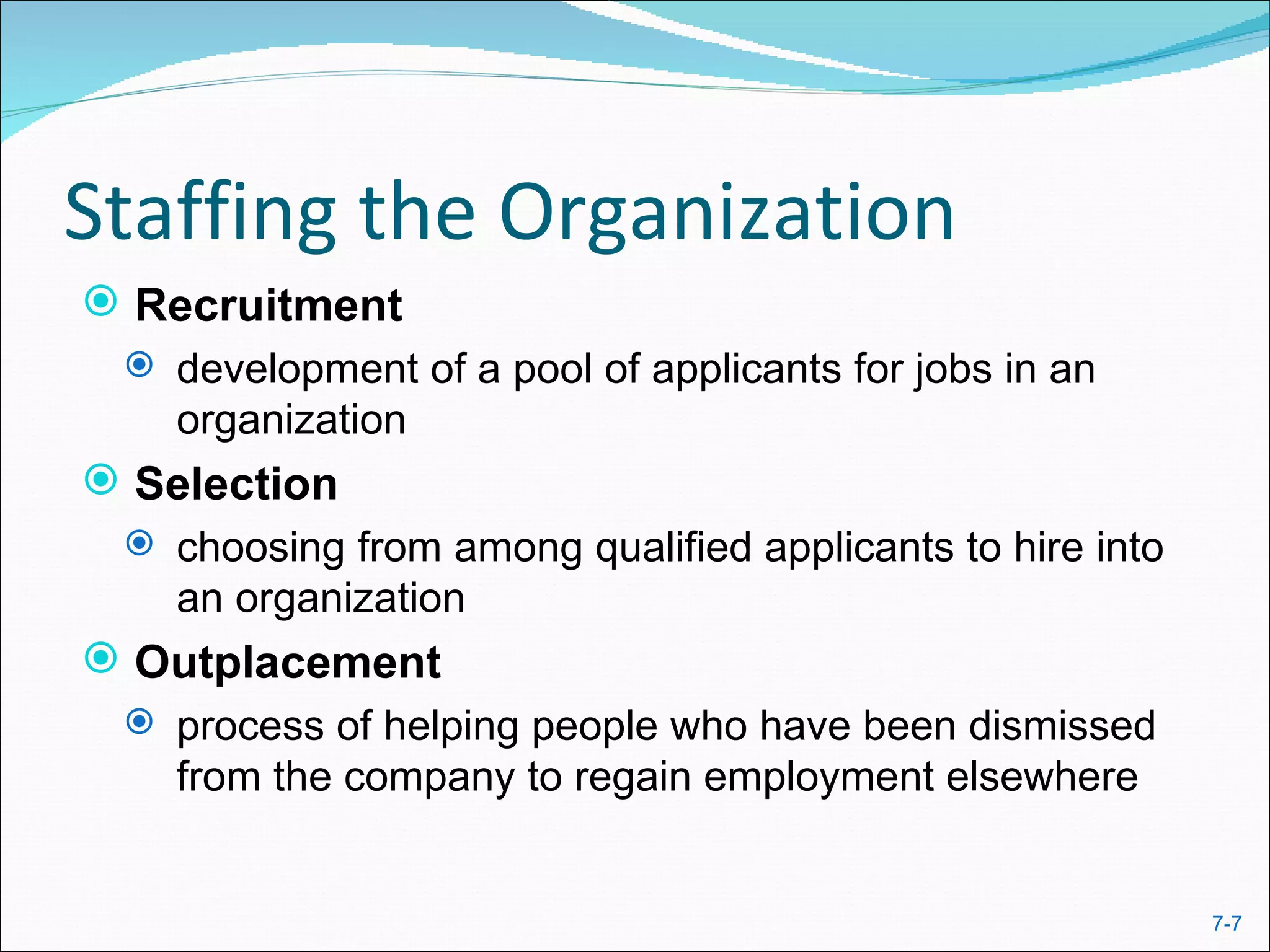
Staffing the Organization
 Recruitment
  development of a pool of applicants for jobs in an
   organization
 Selection
   choosing from among qualified applicants to hire into
    an organization
 Outplacement
  process of helping people who have been dismissed
   from the company to regain employment elsewhere


                                                            7-7
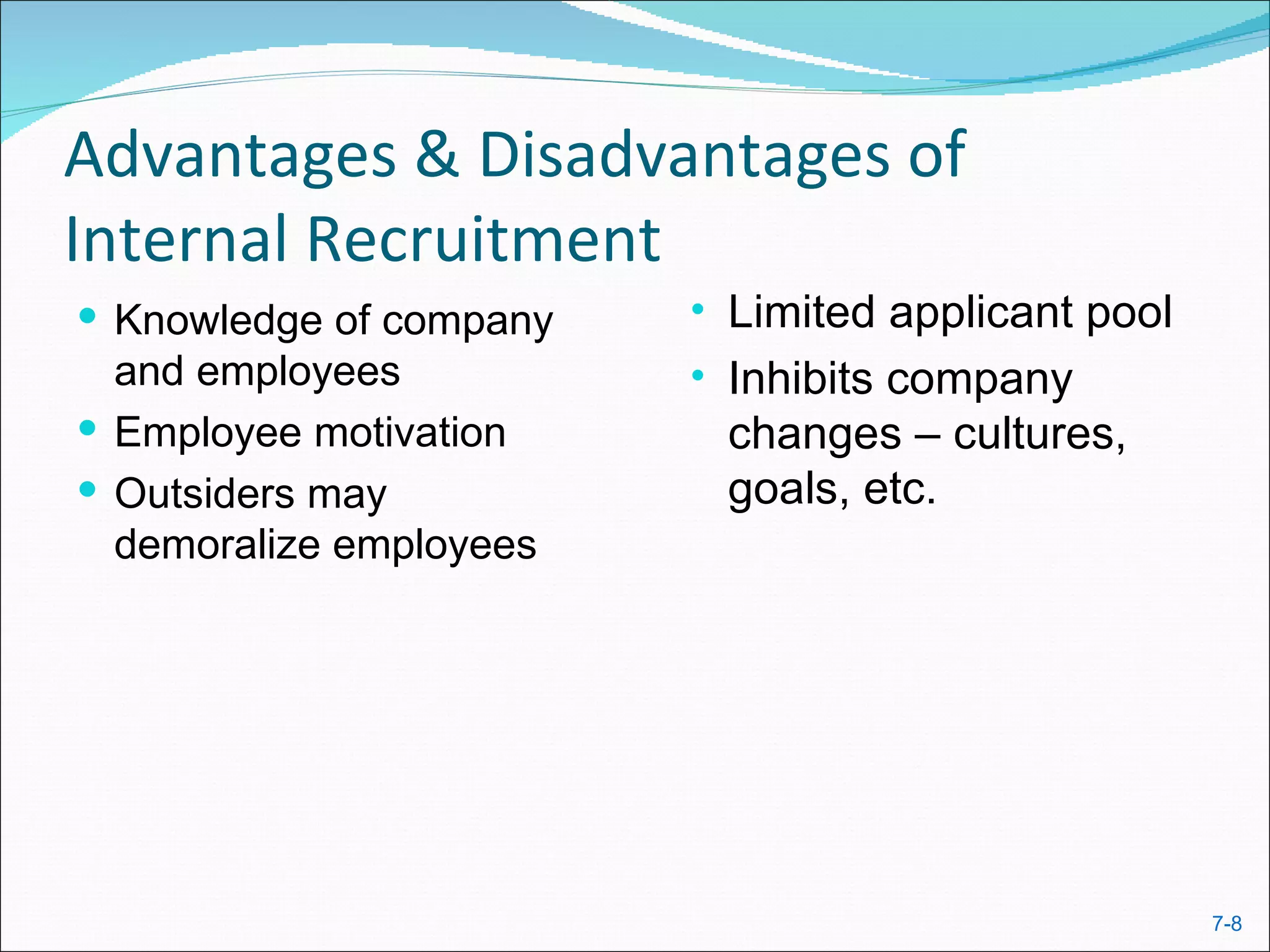
Advantages & Disadvantages of
Internal Recruitment
 Knowledge of company   • Limited applicant pool
  and employees          • Inhibits company
 Employee motivation     changes – cultures,
 Outsiders may           goals, etc.
  demoralize employees


                                                    7-8
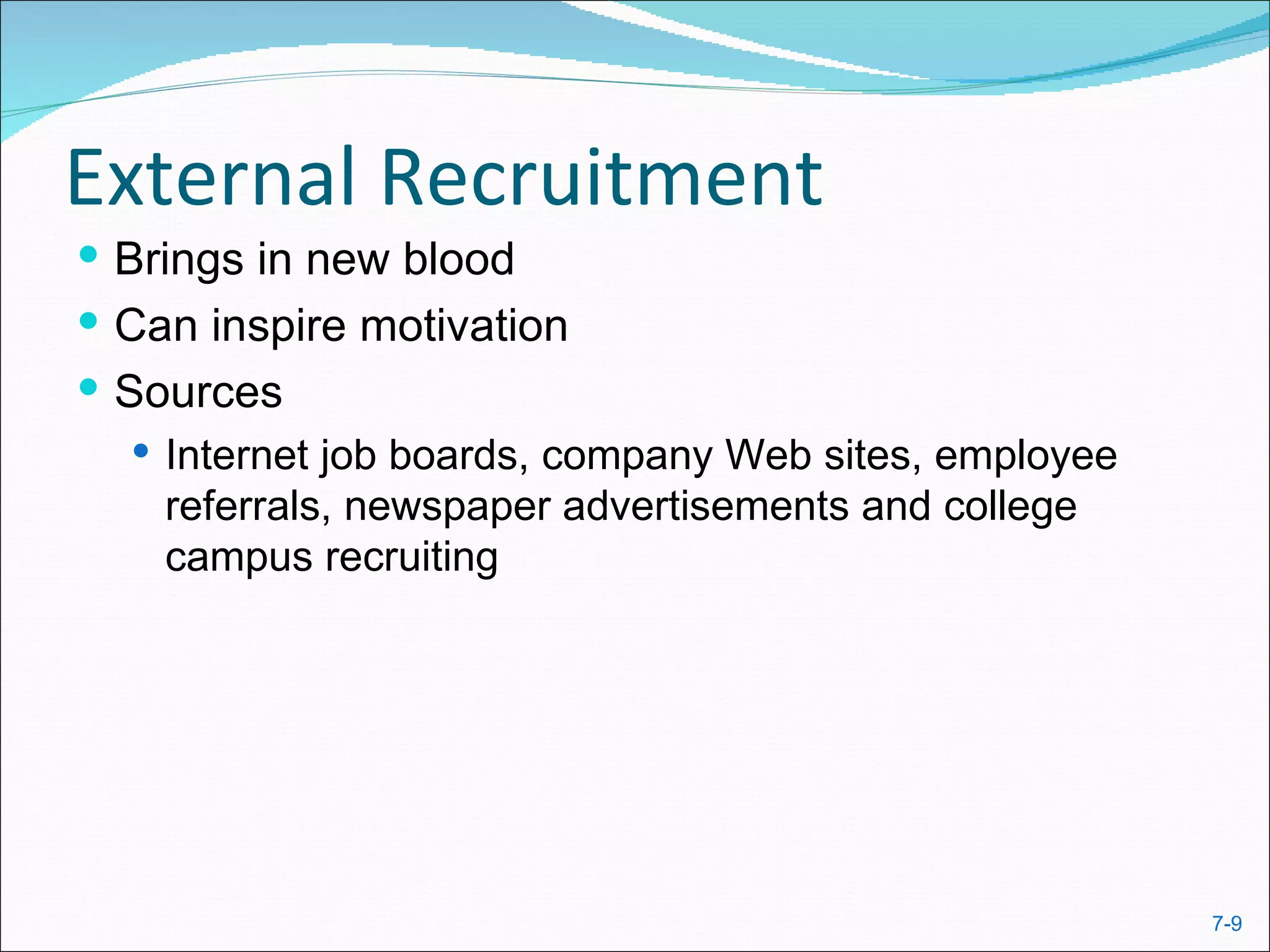
External Recruitment
 Brings in new blood
 Can inspire motivation
 Sources
    Internet job boards, company Web sites, employee
     referrals, newspaper advertisements and college
     campus recruiting


                                                        7-9
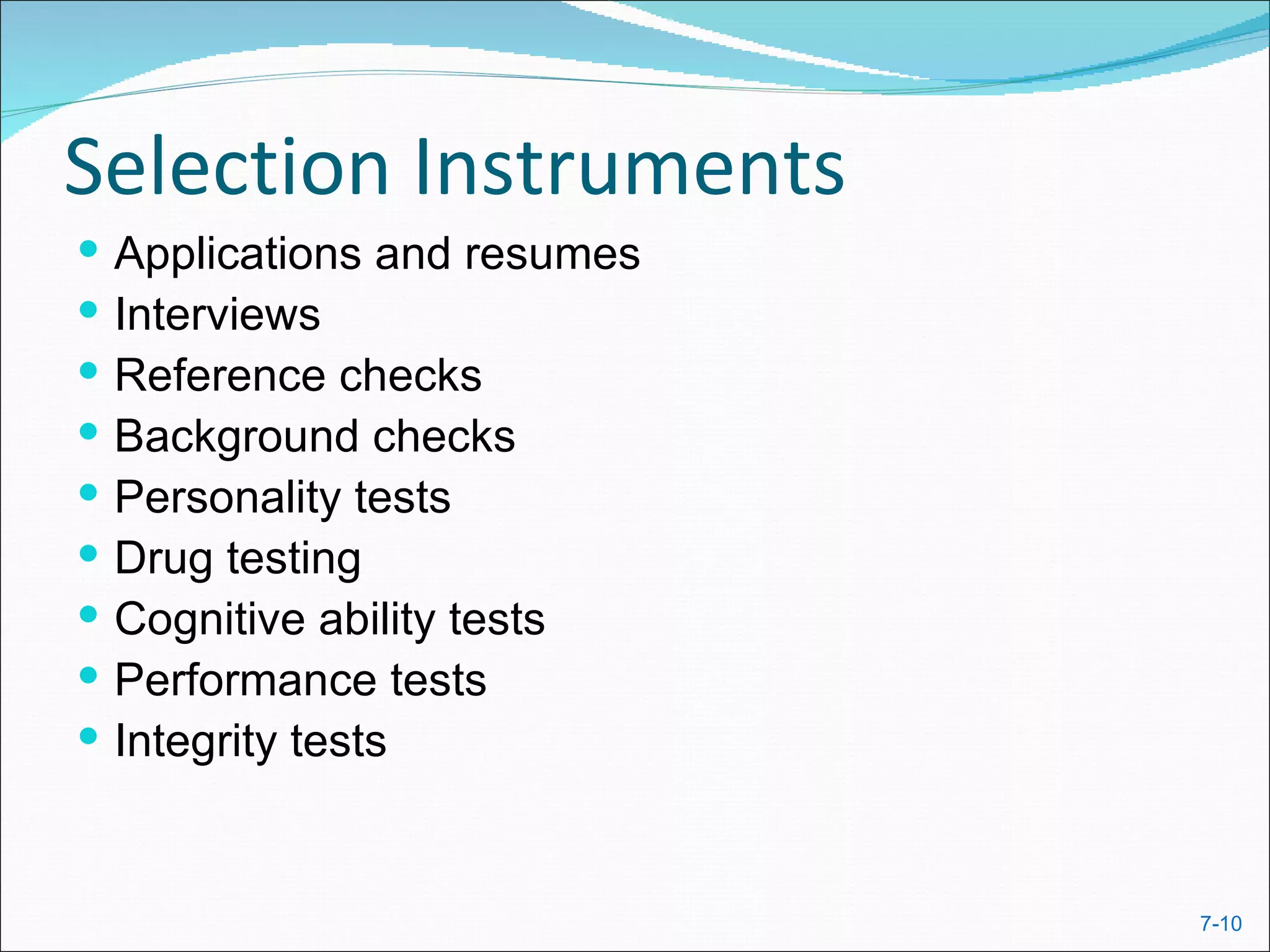
Selection Instruments
   Applications and resumes
   Interviews
   Reference checks
   Background checks
   Personality tests
   Drug testing
   Cognitive ability tests
   Performance tests
   Integrity tests


                               7-10
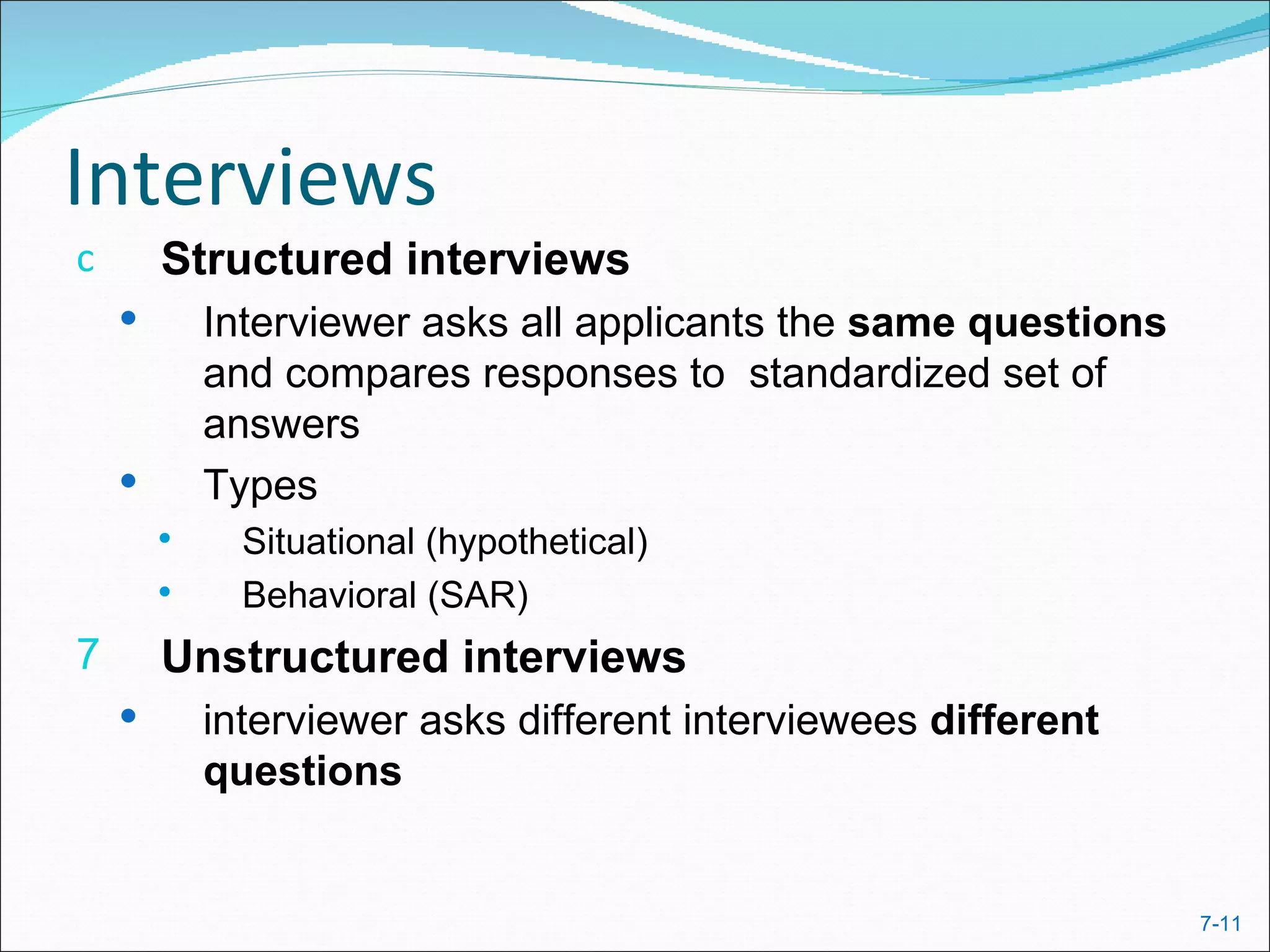
Interviews
c       Structured interviews
           Interviewer asks all applicants the same questions
            and compares responses to standardized set of
            answers
           Types
             Situational (hypothetical)
             Behavioral (SAR)
7       Unstructured interviews
           interviewer asks different interviewees different
            questions


                                                                 7-11
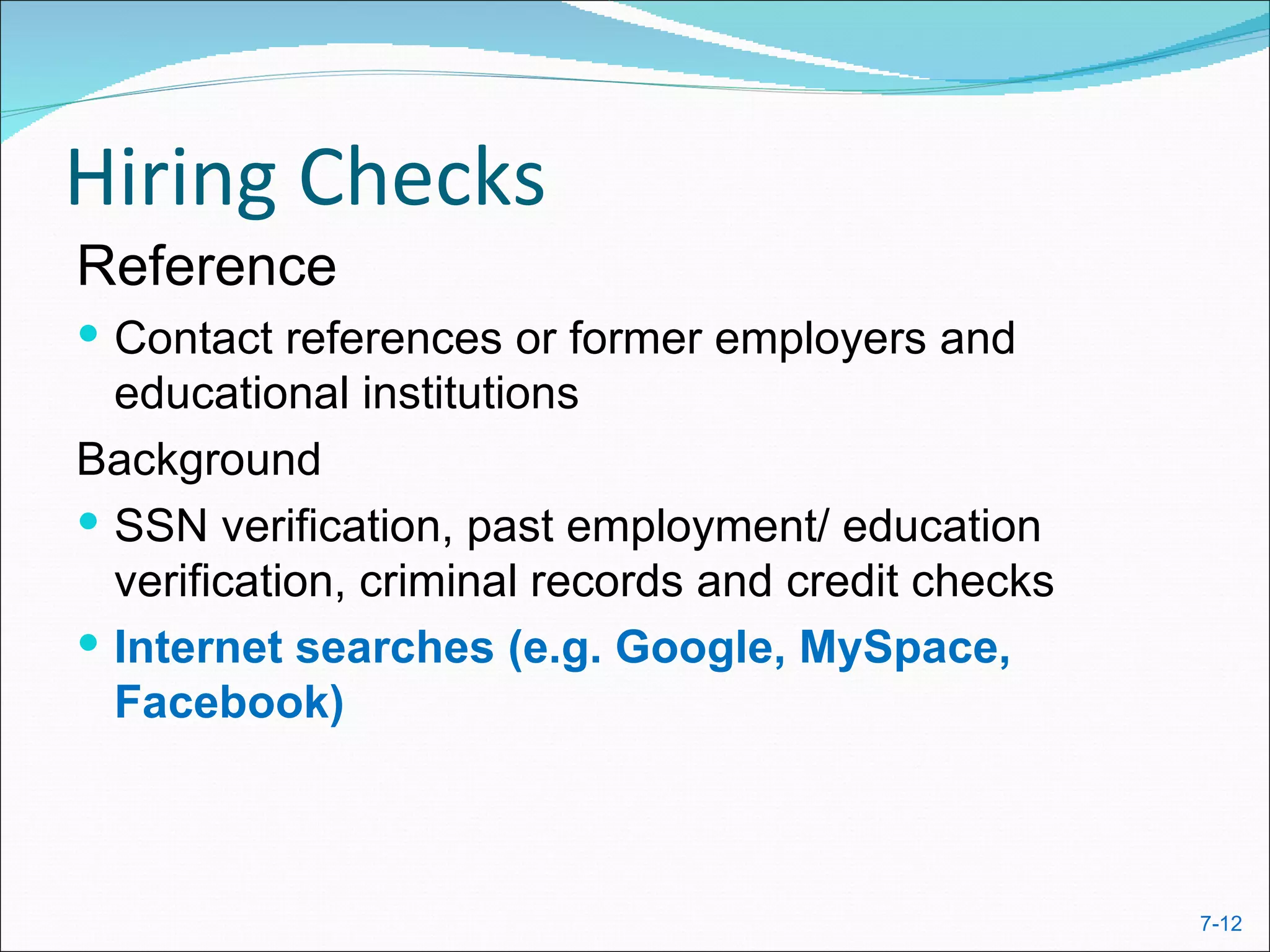
Hiring Checks
Reference
 Contact references or former employers and
  educational institutions
Background
 SSN verification, past employment/ education
  verification, criminal records and credit checks
 Internet searches (e.g. Google, MySpace,
  Facebook)


                                                     7-12
Termination Methods
    Downsizing
      laying off large numbers of managerial and other
       employees
       Termination
         dismissal of employees for poor performance or
          other reasons
       Employment-at-will
         legal concept that an employee may be terminated
          for any reason
       Termination interview
         discussion between a manager and an employee
          about the employee’s dismissal.
                                                             7-13
Termination Interview
Do’s                              Don’ts
-Give as much warning as          -Leave room for confusion
   possible for mass layoffs         when firing
-Sit down one on one with         -Allow time for debate
   the individual, in a private      during a termination
   office                            session
-Complete a termination           -Make personal comments
   session within 15                 when firing someone
   minutes                        -Rush a fired employees
-Be sure the employee                offsite unless security is
   hears about his or her            an issue
   termination from a
   manager, not a
   colleague
                                                                  7-14
Training and Development
 Training
    Teaching lower-level employees how to perform their
     present jobs.
 Development
   teaching managers and professional employees broad
    skills needed for their present and future jobs.


                                                           7-15
Types of Training
 Orientation
   familiarizes new employees with their jobs, work units,
    and organization in general
 Team training
   teaches employees skills they need to work together
    and helps them interact
 Diversity training
   identifying and reducing hidden biases against people
    with differences and developing skills needed to
    manage a diversified workforce
 Management training
   improving managers’ people skills

                                                              7-16
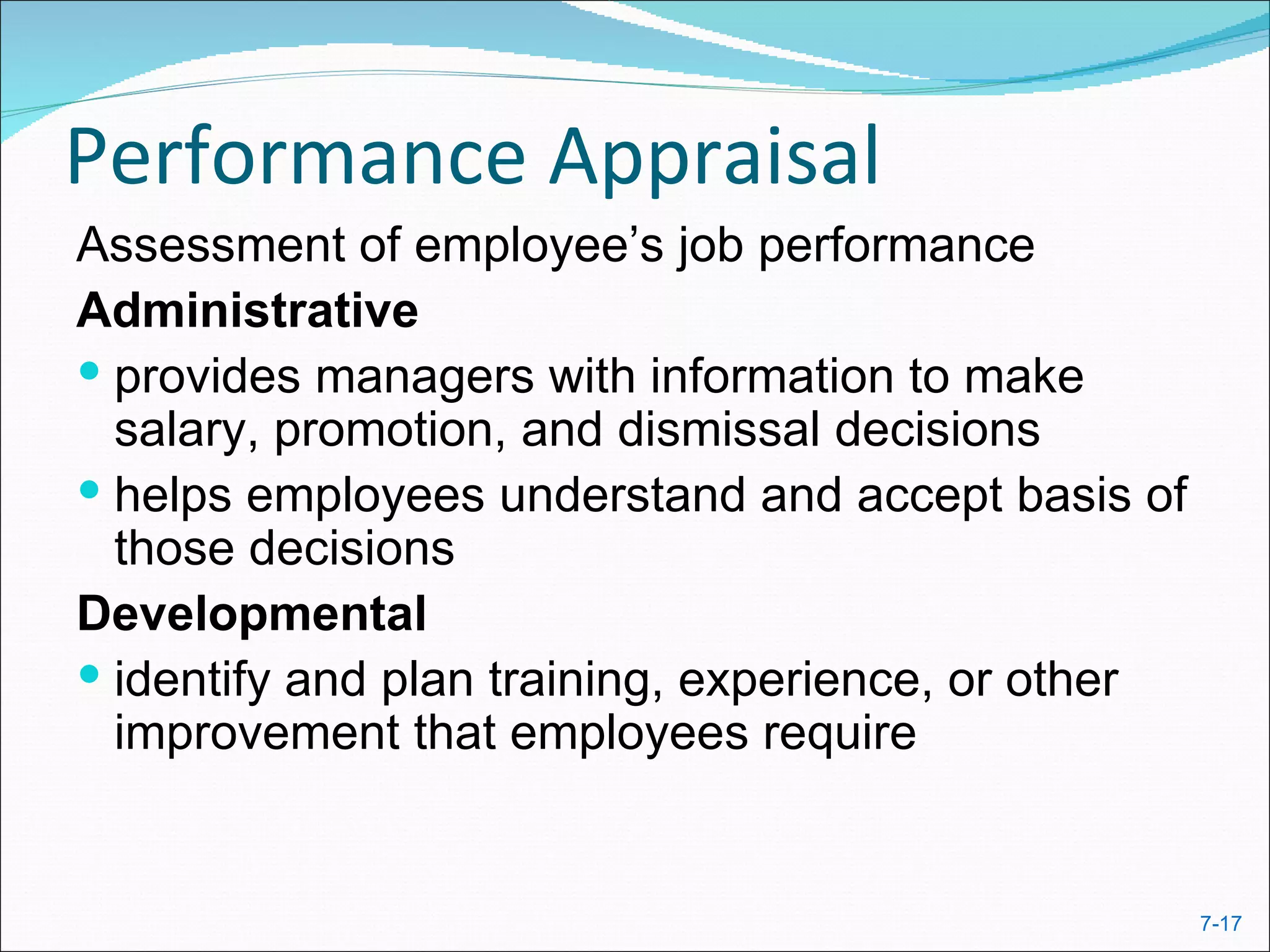
Performance Appraisal
Assessment of employee’s job performance
Administrative
 provides managers with information to make
  salary, promotion, and dismissal decisions
 helps employees understand and accept basis of
  those decisions
Developmental
 identify and plan training, experience, or other
  improvement that employees require


                                                     7-17
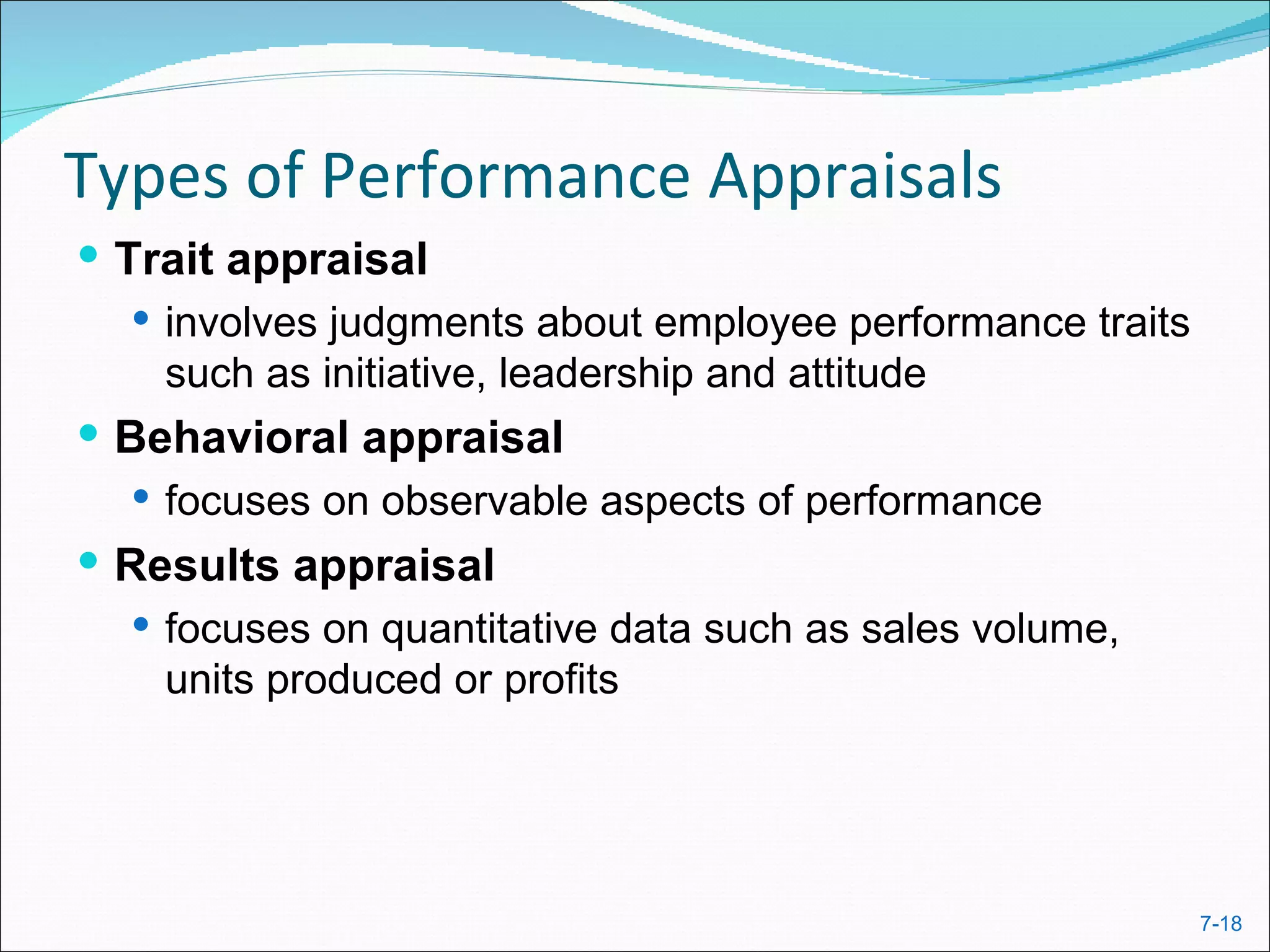
Types of Performance Appraisals
 Trait appraisal
    involves judgments about employee performance traits
     such as initiative, leadership and attitude
 Behavioral appraisal
   focuses on observable aspects of performance
 Results appraisal
    focuses on quantitative data such as sales volume,
     units produced or profits


                                                            7-18
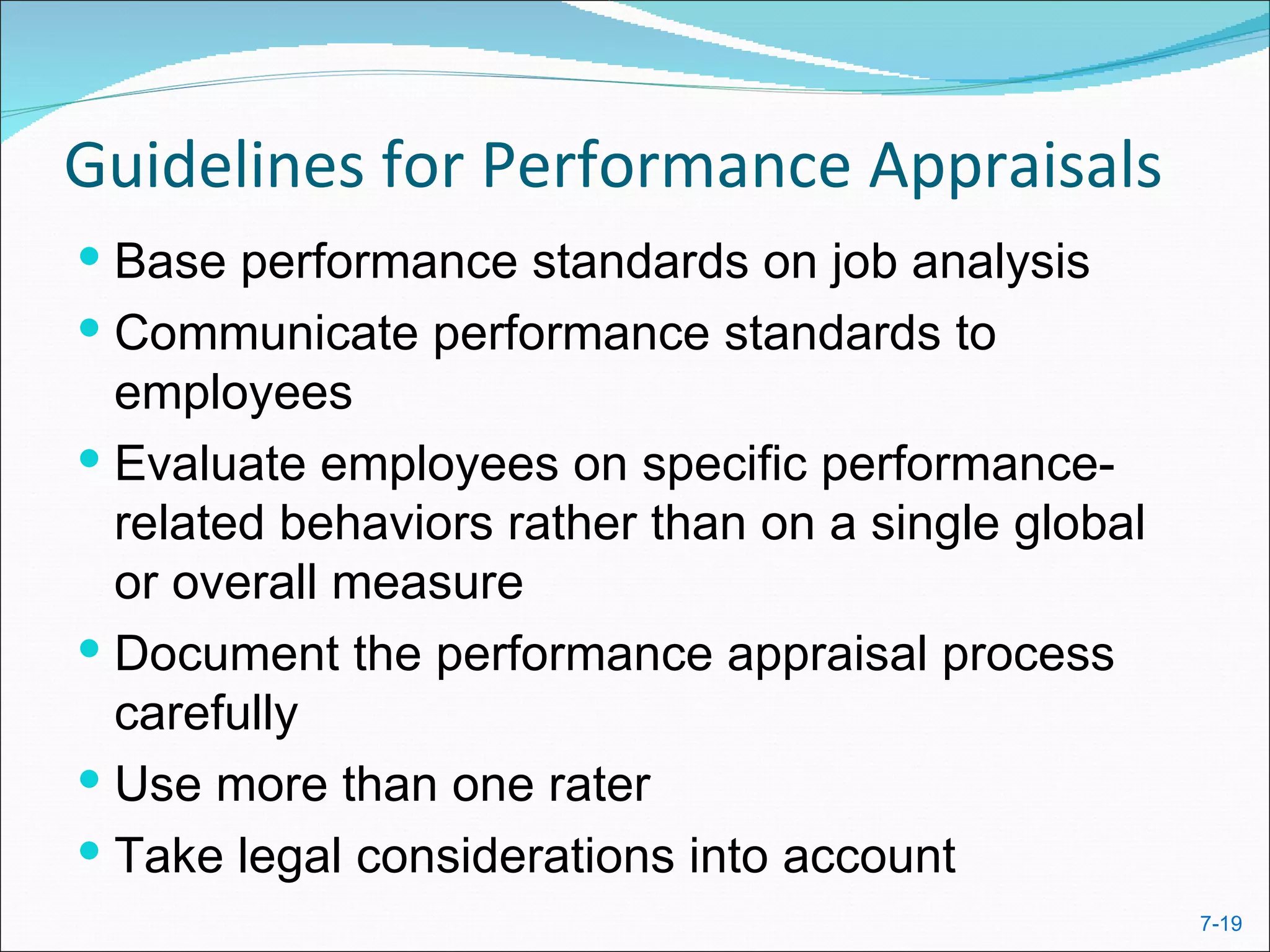
Guidelines for Performance Appraisals
 Base performance standards on job analysis
 Communicate performance standards to
  employees
 Evaluate employees on specific performance-
  related behaviors rather than on a single global
  or overall measure
 Document the performance appraisal process
  carefully
 Use more than one rater
 Take legal considerations into account
                                                     7-19
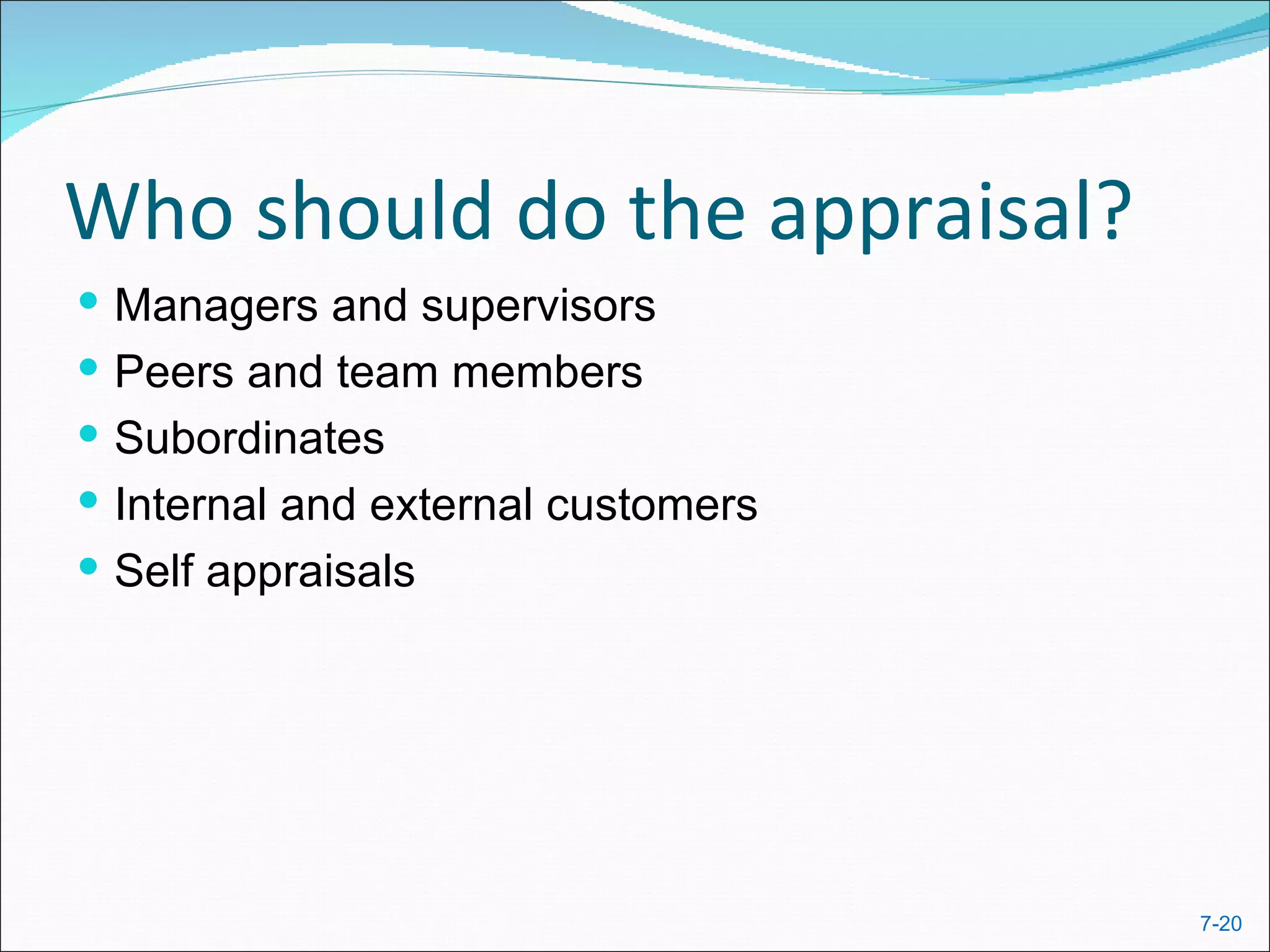
Who should do the appraisal?
 Managers and supervisors
 Peers and team members
 Subordinates
 Internal and external customers
 Self appraisals


                                    7-20
Designing Reward Systems
 Effective reward systems take into account:
    Organization
    Position
    Individual


                                                7-21
Pay Plan Factors
Internal
   organization’s compensation policy, worth of each job,
    employee’s relative worth, and employer’s ability to
    pay
External
   conditions of labor market, area wage rates, cost of
    living, use of collective bargaining (union negotiations)
    and legal requirements


                                                                7-22
Employee Incentives
 Individual incentive plan
    Compares worker’s performance against objective
     standard, with pay determined by employee’s
     performance.
 Group incentive plan
   pay is based on group performance.


                                                       7-23
Group Incentive Plans
 Gainsharing plans
    reward employees for increasing productivity or saving
     money in areas under their direct control.
 Profit-sharing plans
    implemented in division or organization although some
     incentives may be tailored to unit performance
 Merit pay systems
    pay raises and bonuses are based on the merit rating
     received from their boss


                                                              7-24
CEO Pay Controversy
 CEOs earned 500 times the average worker’s pay
 Median salary of $2.5 million for CEOs of companies
  in the Standard and Poor’s stock index
 Stock options are the fastest-growing part of
  executive compensation


                                                        7-25
What do You think?
 Are CEOs paid too much? Why? Why not?


 Should CEOs be given stock options as part of their
 compensation package? Why? Why not?


                                                        7-26
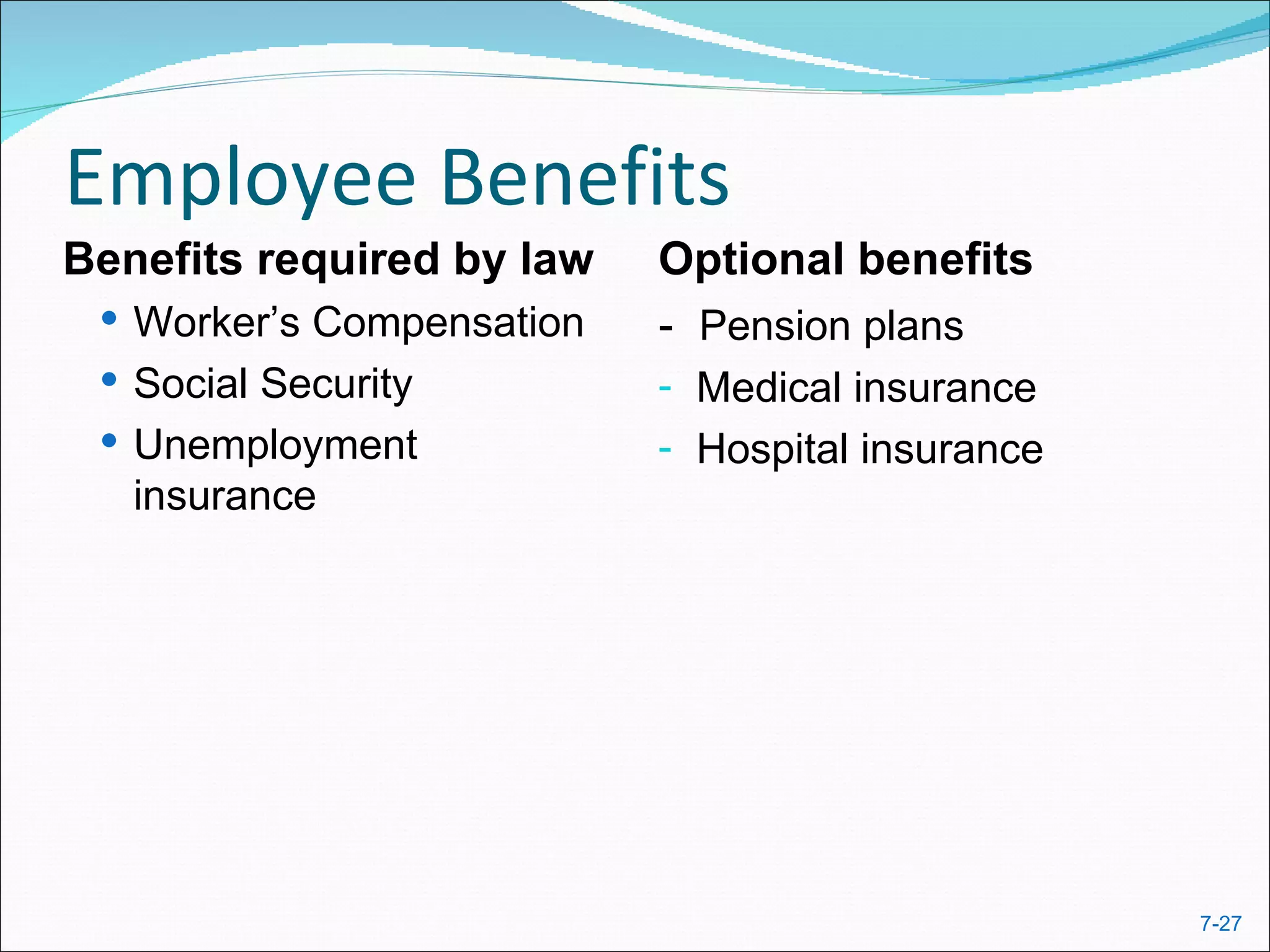
Employee Benefits
Benefits required by law   Optional benefits
  Worker’s Compensation   - Pension plans
  Social Security         - Medical insurance
  Unemployment            - Hospital insurance
   insurance


                                                  7-27
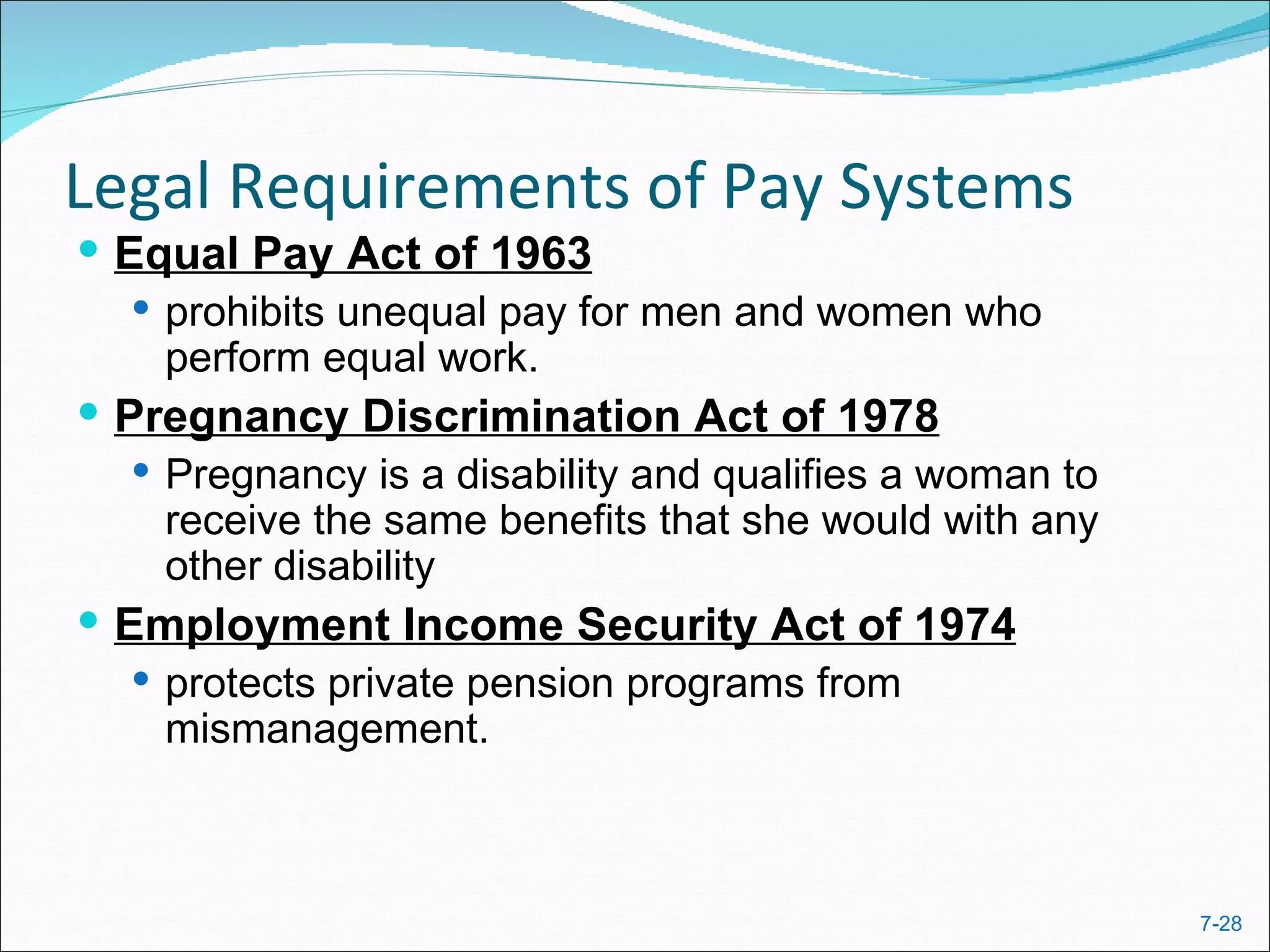
Legal Requirements of Pay Systems
 Equal Pay Act of 1963
    prohibits unequal pay for men and women who
     perform equal work.
 Pregnancy Discrimination Act of 1978
    Pregnancy is a disability and qualifies a woman to
     receive the same benefits that she would with any
     other disability
 Employment Income Security Act of 1974
    protects private pension programs from
     mismanagement.


                                                          7-28
What is OSHA?
 Occupational Safety and Health Act of 1970
   Requires employers to pursue workplace safety
   Employers must maintain records of injuries and
    deaths caused by workplace accidents and submit to
    on-site inspection


                                                         7-29
Labor Relations
 The system of relations between workers and
  management
 Labor unions established to ensure that
  employees are treated fairly with respect to
  wages, working condition, and other issues
 National Labor Relations Act – declared labor
  organizations legal, established five unfair
  employer labor practices, and creating the
  National Labor Relations Board (NLRB)


                                                  7-30
Other Labor Relations Laws
 Labor-Management Relations Act protected
  employers
 Labor-Management Reporting and Disclosure
  Act established a Bill of Rights for union members,
  control over dues increases, and imposed reporting
  requirements for unions.


                                                        7-31
Four factors play a significant role
1.   Economic factors
2.   Job dissatisfaction
3.   Belief that the union has power to obtain desired
     benefits can generate a pro-union vote
4.   The image of the union


                                                         7-32
Collective Bargaining Agreements
 Security clause
 Wage component
 Individual rights
 Grievance procedure


                                   7-33
Review Slides


                7-34
Values for HR Leaders
1.   Strategic

3.   Ethical

5.   Legal

7.   Financial


                        7-35
YOU should be able to
 L01: Discuss how companies use human resources
  management to gain competitive advantage
 L02: Give reasons why companies recruit both
  internally and externally for new hires
 L03: Identify various methods for selecting new
  employees


                                                    7-36
YOU should be able to
 L04: Evaluate the importance of spending on
  training and development
 L05: Explain alternatives for who appraises an
  employee’s performance
 L06: Describe the fundamental aspects of a reward
  system.
 L07: Summarize how unions and labor laws
  influence human resources management


                                                      7-37
Practice and apply your knowledge by going online at
                         www.mhhe.com/batemanM


                                                       7-38
Test Your Knowledge

Which of these methods has been found to be
 the way most job positions get filled?
 A) Want ads
 B) Employee referrals
 C) Private employment agencies
 D) Unions
 E) None of the above.


                                              7-39
Test Your Knowledge

Hammond University requires all applicants to their Masters
 of Business Administration Program to take the G.M.A.T.
 exam. This exam measures the test taker's aptitude for
 management by measuring things like verbal
 comprehension, mathematical calculations, and other
 necessary management skills. This type of test is
 classified as a(n):
 A) personality test.
 B) performance test.
 C) integrity test.
 D) cognitive ability test.
 E) none of the above.
                                                              7-40
Test Your Knowledge

Companies invest in training to enhance
  individual performance and organizational
  productivity. Which of the following is NOT a
  typical training exercise?
  A) Orientation training
  B) Team training
  C) Personality training
  D) Diversity training
  E) All of the above

                                                  7-41
Test Your Knowledge


Explain the alternatives for who should appraise an
 employee’s performance.


                                                      7-42
Test Your Knowledge


 Describe the fundamental aspects of a reward
 system


                                                 7-43
Test Your Knowledge

 Summarize how unions and labor laws
 influence human resources management
   What are the major labor laws that influence
    human resources management?
   How do unions influence human resources
    management?


                                                   7-44

Chap007 BUS137

  • 1.
    McGraw-Hill/Irwin 7-1 Copyright © 2009 by The McGraw-Hill Companies, Inc. All rights reserved.
  • 2.
    Learning Objectives  L01:HRM & Competitive advantage  L02: Recruitment - internal and external  L03: Selection methods  L04: Training and development  L05: Appraisal methods  L06: Reward systems  L07: Unions and labor laws 7-2
  • 3.
    Strategic Human ResourcesManagement 1. People create value 3. Talent is rare 5. A group of well-chosen, motivated people is difficult to imitate 7. People can be organized for success 7-3
  • 4.
    The puzzle ofHR  Attracting talent  Maintaining a well-trained, highly motivated and loyal workforce  Managing diversity  Devising effective compensation systems  Managing layoffs  Containing health care and pension costs 7-4
  • 5.
  • 6.
    Job Analysis  Tools for determining what is done on a given job and what should be done on that job b Job description describes job itself  essential tasks, duties, and responsibilities involved in performing job Job specification prescribes  skills, knowledge, abilities, and other characteristics needed to perform job 7-6
  • 7.
    Staffing the Organization Recruitment  development of a pool of applicants for jobs in an organization  Selection  choosing from among qualified applicants to hire into an organization  Outplacement  process of helping people who have been dismissed from the company to regain employment elsewhere 7-7
  • 8.
    Advantages & Disadvantagesof Internal Recruitment  Knowledge of company • Limited applicant pool and employees • Inhibits company  Employee motivation changes – cultures,  Outsiders may goals, etc. demoralize employees 7-8
  • 9.
    External Recruitment  Bringsin new blood  Can inspire motivation  Sources  Internet job boards, company Web sites, employee referrals, newspaper advertisements and college campus recruiting 7-9
  • 10.
    Selection Instruments  Applications and resumes  Interviews  Reference checks  Background checks  Personality tests  Drug testing  Cognitive ability tests  Performance tests  Integrity tests 7-10
  • 11.
    Interviews c Structured interviews  Interviewer asks all applicants the same questions and compares responses to standardized set of answers  Types  Situational (hypothetical)  Behavioral (SAR) 7 Unstructured interviews  interviewer asks different interviewees different questions 7-11
  • 12.
    Hiring Checks Reference  Contactreferences or former employers and educational institutions Background  SSN verification, past employment/ education verification, criminal records and credit checks  Internet searches (e.g. Google, MySpace, Facebook) 7-12
  • 13.
    Termination Methods Downsizing  laying off large numbers of managerial and other employees  Termination  dismissal of employees for poor performance or other reasons  Employment-at-will  legal concept that an employee may be terminated for any reason  Termination interview  discussion between a manager and an employee about the employee’s dismissal. 7-13
  • 14.
    Termination Interview Do’s Don’ts -Give as much warning as -Leave room for confusion possible for mass layoffs when firing -Sit down one on one with -Allow time for debate the individual, in a private during a termination office session -Complete a termination -Make personal comments session within 15 when firing someone minutes -Rush a fired employees -Be sure the employee offsite unless security is hears about his or her an issue termination from a manager, not a colleague 7-14
  • 15.
    Training and Development Training  Teaching lower-level employees how to perform their present jobs.  Development  teaching managers and professional employees broad skills needed for their present and future jobs. 7-15
  • 16.
    Types of Training Orientation  familiarizes new employees with their jobs, work units, and organization in general  Team training  teaches employees skills they need to work together and helps them interact  Diversity training  identifying and reducing hidden biases against people with differences and developing skills needed to manage a diversified workforce  Management training  improving managers’ people skills 7-16
  • 17.
    Performance Appraisal Assessment ofemployee’s job performance Administrative  provides managers with information to make salary, promotion, and dismissal decisions  helps employees understand and accept basis of those decisions Developmental  identify and plan training, experience, or other improvement that employees require 7-17
  • 18.
    Types of PerformanceAppraisals  Trait appraisal  involves judgments about employee performance traits such as initiative, leadership and attitude  Behavioral appraisal  focuses on observable aspects of performance  Results appraisal  focuses on quantitative data such as sales volume, units produced or profits 7-18
  • 19.
    Guidelines for PerformanceAppraisals  Base performance standards on job analysis  Communicate performance standards to employees  Evaluate employees on specific performance- related behaviors rather than on a single global or overall measure  Document the performance appraisal process carefully  Use more than one rater  Take legal considerations into account 7-19
  • 20.
    Who should dothe appraisal?  Managers and supervisors  Peers and team members  Subordinates  Internal and external customers  Self appraisals 7-20
  • 21.
    Designing Reward Systems Effective reward systems take into account:  Organization  Position  Individual 7-21
  • 22.
    Pay Plan Factors Internal  organization’s compensation policy, worth of each job, employee’s relative worth, and employer’s ability to pay External  conditions of labor market, area wage rates, cost of living, use of collective bargaining (union negotiations) and legal requirements 7-22
  • 23.
    Employee Incentives  Individualincentive plan  Compares worker’s performance against objective standard, with pay determined by employee’s performance.  Group incentive plan  pay is based on group performance. 7-23
  • 24.
    Group Incentive Plans Gainsharing plans  reward employees for increasing productivity or saving money in areas under their direct control.  Profit-sharing plans  implemented in division or organization although some incentives may be tailored to unit performance  Merit pay systems  pay raises and bonuses are based on the merit rating received from their boss 7-24
  • 25.
    CEO Pay Controversy CEOs earned 500 times the average worker’s pay  Median salary of $2.5 million for CEOs of companies in the Standard and Poor’s stock index  Stock options are the fastest-growing part of executive compensation 7-25
  • 26.
    What do Youthink?  Are CEOs paid too much? Why? Why not?  Should CEOs be given stock options as part of their compensation package? Why? Why not? 7-26
  • 27.
    Employee Benefits Benefits requiredby law Optional benefits  Worker’s Compensation - Pension plans  Social Security - Medical insurance  Unemployment - Hospital insurance insurance 7-27
  • 28.
    Legal Requirements ofPay Systems  Equal Pay Act of 1963  prohibits unequal pay for men and women who perform equal work.  Pregnancy Discrimination Act of 1978  Pregnancy is a disability and qualifies a woman to receive the same benefits that she would with any other disability  Employment Income Security Act of 1974  protects private pension programs from mismanagement. 7-28
  • 29.
    What is OSHA? Occupational Safety and Health Act of 1970  Requires employers to pursue workplace safety  Employers must maintain records of injuries and deaths caused by workplace accidents and submit to on-site inspection 7-29
  • 30.
    Labor Relations  Thesystem of relations between workers and management  Labor unions established to ensure that employees are treated fairly with respect to wages, working condition, and other issues  National Labor Relations Act – declared labor organizations legal, established five unfair employer labor practices, and creating the National Labor Relations Board (NLRB) 7-30
  • 31.
    Other Labor RelationsLaws  Labor-Management Relations Act protected employers  Labor-Management Reporting and Disclosure Act established a Bill of Rights for union members, control over dues increases, and imposed reporting requirements for unions. 7-31
  • 32.
    Four factors playa significant role 1. Economic factors 2. Job dissatisfaction 3. Belief that the union has power to obtain desired benefits can generate a pro-union vote 4. The image of the union 7-32
  • 33.
    Collective Bargaining Agreements Security clause  Wage component  Individual rights  Grievance procedure 7-33
  • 34.
  • 35.
    Values for HRLeaders 1. Strategic 3. Ethical 5. Legal 7. Financial 7-35
  • 36.
    YOU should beable to  L01: Discuss how companies use human resources management to gain competitive advantage  L02: Give reasons why companies recruit both internally and externally for new hires  L03: Identify various methods for selecting new employees 7-36
  • 37.
    YOU should beable to  L04: Evaluate the importance of spending on training and development  L05: Explain alternatives for who appraises an employee’s performance  L06: Describe the fundamental aspects of a reward system.  L07: Summarize how unions and labor laws influence human resources management 7-37
  • 38.
    Practice and applyyour knowledge by going online at www.mhhe.com/batemanM 7-38
  • 39.
    Test Your Knowledge Whichof these methods has been found to be the way most job positions get filled? A) Want ads B) Employee referrals C) Private employment agencies D) Unions E) None of the above. 7-39
  • 40.
    Test Your Knowledge HammondUniversity requires all applicants to their Masters of Business Administration Program to take the G.M.A.T. exam. This exam measures the test taker's aptitude for management by measuring things like verbal comprehension, mathematical calculations, and other necessary management skills. This type of test is classified as a(n): A) personality test. B) performance test. C) integrity test. D) cognitive ability test. E) none of the above. 7-40
  • 41.
    Test Your Knowledge Companiesinvest in training to enhance individual performance and organizational productivity. Which of the following is NOT a typical training exercise? A) Orientation training B) Team training C) Personality training D) Diversity training E) All of the above 7-41
  • 42.
    Test Your Knowledge Explainthe alternatives for who should appraise an employee’s performance. 7-42
  • 43.
    Test Your Knowledge Describe the fundamental aspects of a reward system 7-43
  • 44.
    Test Your Knowledge Summarize how unions and labor laws influence human resources management  What are the major labor laws that influence human resources management?  How do unions influence human resources management? 7-44