Introduction to Business 110-4207
   Presentation provided by:
           Susan King
         Kelly Hiltbruner
          Shelby Simon
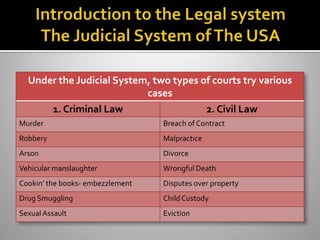
Under the Judicial System, two types of courts try various
                           cases
      1. Criminal Law                   2. Civil Law
Murder                            Breach of Contract
Robbery                           Malpractice
Arson                             Divorce
Vehicular manslaughter            Wrongful Death
Cookin’ the books- embezzlement   Disputes over property
Drug Smuggling                    Child Custody
Sexual Assault                    Eviction
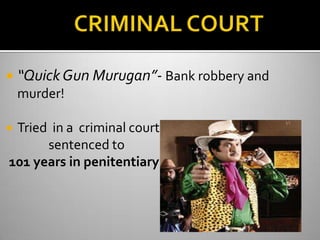
   “Quick Gun Murugan”- Bank robbery and
    murder!

Tried in a criminal court of law-
      sentenced to
101 years in penitentiary
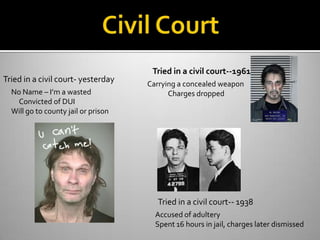
Tried in a civil court--1961
Tried in a civil court- yesterday
                                     Carrying a concealed weapon
  No Name – I’m a wasted                   Charges dropped
   Convicted of DUI
  Will go to county jail or prison


                                       Tried in a civil court-- 1938
                                       Accused of adultery
                                       Spent 16 hours in jail, charges later dismissed
In our class, we are concerned with
            Business Law

The Judicial System oversees and
    governs the activities and
     operations of business.
   In the business world, Business Law refers to rules, statutes, codes
    and regulations for the conduct of business. These laws are
    enforceable by the court system.


   Statutory Law is written law. Most people hire a lawyer to interpret
    these laws as they are very difficult for the average person to
    understand


   Common Law are decisions that have already been set by
    previous court cases. The judge uses these precedents to make
    new rulings

.
Administrative Agencies- oversee business
               Agencies such as;
 Equal Employment Opportunity Commission.

In December 2001, a Federal Express courier
  named Patricia Kennedy filed an EEOC intake
  questionnaire claiming that FedEx was in the
  habit of improperly firing older employees who
  did not meet the company's hourly delivery
  quotas.
   This is a wrongful act that causes harm to a
          persons body, their property, or reputation.
                      A Tort may be intentional, e.g.
   Did the manufacturers of VIOXX and BEXTRA medications
    intentionally withhold information that caused harm to people?


             A Tort may also be unintentional, and also negligent
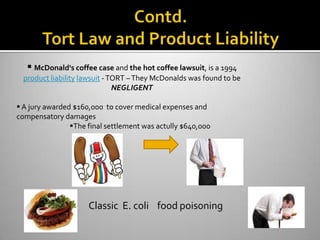
 McDonald's coffee case and the hot coffee lawsuit, is a 1994
  product liability lawsuit - TORT – They McDonalds was found to be
                               NEGLIGENT

 A jury awarded $160,000 to cover medical expenses and
compensatory damages
                The final settlement was actully $640,000


                     Classic E. coli food poisoning
   When a product is inadequate or defective,
           as in the McDonalds coffee cup case,
              or Jack in the box food products
    the company selling the product and the manufacturer
                          may get sued.


   Today, Strict product liability is put on manufacturers
    even if they did not know their product was defective, they
    can still be sued and are still liable to pay damages.
  A patent is the legal document
that states you are the inventor
of a product and have exclusive rights,
for 20 years from the date you filed
 a patent application


   You have the right to sue if someone steals your
    invention, as long as you got the patent!
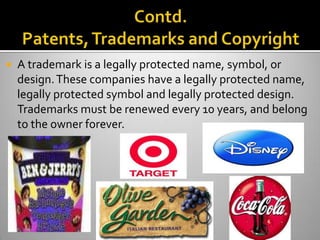
   A trademark is a legally protected name, symbol, or
    design. These companies have a legally protected name,
    legally protected symbol and legally protected design.
    Trademarks must be renewed every 10 years, and belong
    to the owner forever.
   A Copyright is the legal protection of a creator’s rights to
    materials like books, music and cartoons. Filed with the Library
    of Congress, they last for the lifetime of the creator plus 70
    years, and can be passed on to heirs. It is illegal to copy,
    record, or download copyrighted material without
    paying for it, as the creator’s do not get paid.
SALES LAW is UCC
UCC has 11 laws, we will cover two laws
     Article 2- regulation of Warranties
                     And
     Article 3- Negotiable Instruments
                      .
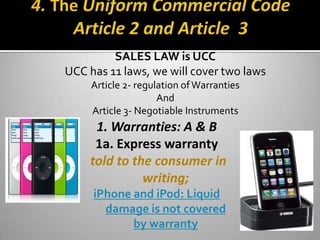
     1. Warranties: A & B
     1a. Express warranty
    told to the consumer in
              writing;
     iPhone and iPod: Liquid
       damage is not covered
            by warranty
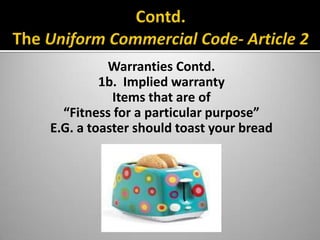
Warranties Contd.
         1b. Implied warranty
           Items that are of
  “Fitness for a particular purpose”
E.G. a toaster should toast your bread
   Negotiable Instruments- Article 3 of UCC
   Checks, transferrable among individuals
    and businesses
   A promise to pay a specific amount
   Contract law IS
   legally enforceable
   Between two or more parties
   Consideration =
    Must be something of value
   If you Breach (or break) that contract for the car;
   You may be sued for specific performance
         AND you may be in for a surprise visit from
                      “Operation Repo”
   You may also be sued for Damages
   What is Antitrust Legislation?


   What are consumer protection laws?
   The government raises money from it’s citizens by charging
     tax on property, vehicles, sales tax on good we buy, and
                 income tax on our paychecks.

     With the money raised, the government builds roads,
    bridges, schools, parks, and provides a military to protect
                            it’s people.

      The government also encourages businesses to hire/
    purchase new equipment and relocate to specific areas by
    offering tax incentives. Which they hope in turn will create
                            employment
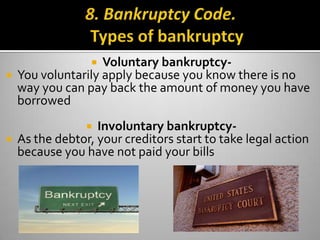
 Voluntary bankruptcy-
 You voluntarily apply because you know there is no
  way you can pay back the amount of money you have
  borrowed
                Involuntary bankruptcy-
 As the debtor, your creditors start to take legal action
  because you have not paid your bills
   Chapter 7, usually filed by private individuals
      Chapter 11, usually by businesses who try to
            reorganize and work off their debt


   Chapter 13, individuals and small business owners
    who pay their debt back over three to five years
   What are Government Regulations?


   What is deregulation, why does the
    Government deregulate, and how
    does this encourage competition?
   At all phases in your professional career, you
    will be faced with issues regarding what you
              can and cannot do legally
   It is vital to understand legal issues within the
                   business environment.
    Once you understand legal issues within the
     business environment, you will know how to
    avoid causing harm to your company, your co-
       workers, your managers and ultimately
                      yourself.

Legal Environment

  • 1.
    Introduction to Business110-4207 Presentation provided by: Susan King Kelly Hiltbruner Shelby Simon
  • 2.
    Under the JudicialSystem, two types of courts try various cases 1. Criminal Law 2. Civil Law Murder Breach of Contract Robbery Malpractice Arson Divorce Vehicular manslaughter Wrongful Death Cookin’ the books- embezzlement Disputes over property Drug Smuggling Child Custody Sexual Assault Eviction
  • 3.
    “Quick Gun Murugan”- Bank robbery and murder! Tried in a criminal court of law- sentenced to 101 years in penitentiary
  • 4.
    Tried in acivil court--1961 Tried in a civil court- yesterday Carrying a concealed weapon No Name – I’m a wasted Charges dropped Convicted of DUI Will go to county jail or prison Tried in a civil court-- 1938 Accused of adultery Spent 16 hours in jail, charges later dismissed
  • 5.
    In our class,we are concerned with Business Law The Judicial System oversees and governs the activities and operations of business.
  • 6.
    In the business world, Business Law refers to rules, statutes, codes and regulations for the conduct of business. These laws are enforceable by the court system.  Statutory Law is written law. Most people hire a lawyer to interpret these laws as they are very difficult for the average person to understand  Common Law are decisions that have already been set by previous court cases. The judge uses these precedents to make new rulings .
  • 7.
    Administrative Agencies- overseebusiness Agencies such as; Equal Employment Opportunity Commission. In December 2001, a Federal Express courier named Patricia Kennedy filed an EEOC intake questionnaire claiming that FedEx was in the habit of improperly firing older employees who did not meet the company's hourly delivery quotas.
  • 8.
    This is a wrongful act that causes harm to a persons body, their property, or reputation. A Tort may be intentional, e.g.  Did the manufacturers of VIOXX and BEXTRA medications intentionally withhold information that caused harm to people?  A Tort may also be unintentional, and also negligent
  • 9.
     McDonald's coffeecase and the hot coffee lawsuit, is a 1994 product liability lawsuit - TORT – They McDonalds was found to be NEGLIGENT  A jury awarded $160,000 to cover medical expenses and compensatory damages The final settlement was actully $640,000 Classic E. coli food poisoning
  • 10.
    When a product is inadequate or defective, as in the McDonalds coffee cup case, or Jack in the box food products the company selling the product and the manufacturer may get sued.  Today, Strict product liability is put on manufacturers even if they did not know their product was defective, they can still be sued and are still liable to pay damages.
  • 11.
     Apatent is the legal document that states you are the inventor of a product and have exclusive rights, for 20 years from the date you filed a patent application  You have the right to sue if someone steals your invention, as long as you got the patent!
  • 12.
    A trademark is a legally protected name, symbol, or design. These companies have a legally protected name, legally protected symbol and legally protected design. Trademarks must be renewed every 10 years, and belong to the owner forever.
  • 13.
    A Copyright is the legal protection of a creator’s rights to materials like books, music and cartoons. Filed with the Library of Congress, they last for the lifetime of the creator plus 70 years, and can be passed on to heirs. It is illegal to copy, record, or download copyrighted material without paying for it, as the creator’s do not get paid.
  • 14.
    SALES LAW isUCC UCC has 11 laws, we will cover two laws Article 2- regulation of Warranties And Article 3- Negotiable Instruments . 1. Warranties: A & B 1a. Express warranty told to the consumer in writing; iPhone and iPod: Liquid damage is not covered by warranty
  • 15.
    Warranties Contd. 1b. Implied warranty Items that are of “Fitness for a particular purpose” E.G. a toaster should toast your bread
  • 16.
    Negotiable Instruments- Article 3 of UCC  Checks, transferrable among individuals and businesses  A promise to pay a specific amount
  • 17.
    Contract law IS  legally enforceable  Between two or more parties  Consideration = Must be something of value
  • 18.
    If you Breach (or break) that contract for the car;  You may be sued for specific performance  AND you may be in for a surprise visit from “Operation Repo”
  • 19.
    You may also be sued for Damages
  • 20.
    What is Antitrust Legislation?  What are consumer protection laws?
  • 21.
    The government raises money from it’s citizens by charging tax on property, vehicles, sales tax on good we buy, and income tax on our paychecks.  With the money raised, the government builds roads, bridges, schools, parks, and provides a military to protect it’s people.  The government also encourages businesses to hire/ purchase new equipment and relocate to specific areas by offering tax incentives. Which they hope in turn will create employment
  • 22.
     Voluntary bankruptcy- You voluntarily apply because you know there is no way you can pay back the amount of money you have borrowed  Involuntary bankruptcy-  As the debtor, your creditors start to take legal action because you have not paid your bills
  • 23.
    Chapter 7, usually filed by private individuals  Chapter 11, usually by businesses who try to reorganize and work off their debt  Chapter 13, individuals and small business owners who pay their debt back over three to five years
  • 24.
    What are Government Regulations?  What is deregulation, why does the Government deregulate, and how does this encourage competition?
  • 25.
    At all phases in your professional career, you will be faced with issues regarding what you can and cannot do legally  It is vital to understand legal issues within the business environment.  Once you understand legal issues within the business environment, you will know how to avoid causing harm to your company, your co- workers, your managers and ultimately yourself.