Copyright © 2017, Elsevier Inc. All Rights Reserved.
Surface and Equipment Asepsis
Chapter 14
1
Copyright © 2017, Elsevier Inc. All Rights Reserved.
Learning Objectives
Surface and Equipment Asepsis
1. Differentiate between clinical contact surfaces
and housekeeping surfaces and determine
which operatory surfaces may be involved in the
patient-to-patient spread of microbes.
2. List the operatory surfaces that should be
covered with barriers before patient care and
describe how to place and remove surface
covers properly.
3. Describe the importance of precleaning before
surface disinfection and describe how to
preclean and disinfect contaminated surfaces
and equipment.
2
Copyright © 2017, Elsevier Inc. All Rights Reserved.
4. Do the following regarding the characteristics
of disinfectants:
• List the types of surface disinfectants and describe
their properties.
• Differentiate between low-, intermediate-, and high-
level disinfectants and give examples when each
should be used.
• Describe why it is important to read disinfectant
labels.
3
Learning Objectives
Surface and Equipment Asepsis (Cont.)
Copyright © 2017, Elsevier Inc. All Rights Reserved.
5. List general considerations for dental
equipment decontamination and management
of high-tech equipment in the dental office.
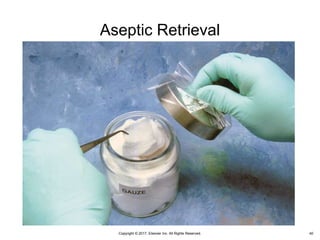
6. Describe how to retrieve and distribute clinical
supply items aseptically.
4
Learning Objectives
Surface and Equipment Asepsis (Cont.)
Copyright © 2017, Elsevier Inc. All Rights Reserved.
Types of Environmental Surfaces
 Two types of dental environmental surfaces
related to disease spread
 Clinical contact surfaces
• Need to be treated before each patient
 Housekeeping surfaces
• Can be treated at the end of each day
5
Copyright © 2017, Elsevier Inc. All Rights Reserved.
Types of Environmental Surfaces
 What are clinical contact surfaces?
 Surfaces that may be touched frequently with
gloved hands during patient care or that may
become contaminated with blood, saliva, or other
potentially infection materials
 What are housekeeping surfaces?
 Surfaces that do not come into contact with hands
or devices used in dental procedures.
 Examples: floors, walls, and sinks
6
Copyright © 2017, Elsevier Inc. All Rights Reserved.
Types of Environmental Surfaces
 What conditions influence the survival time of
microorganisms in the environment?
 Humidity, temperature, the presence of nutrients
in blood or saliva, and the surface properties of
the microorganism
7
Copyright © 2017, Elsevier Inc. All Rights Reserved.
Approaches to Surface Asepsis
 Two general approaches
 Prevent the surface from becoming contaminated
with a surface cover
 Preclean and disinfect the surface after
contamination and before each use
 Each approach has advantages and
disadvantages.
 See Table 14.1 for list of advantages and
disadvantages.
 Most offices use a combination of both
approaches.
8
Copyright © 2017, Elsevier Inc. All Rights Reserved.
Types of Surface Barriers
 Surface barriers should be impervious to
fluids to keep microorganisms in saliva,
blood, or other liquids from soaking through
to contact the surface
 Examples include:
 Clear plastic wrap
 Bags
 Tubes
 Plastic-backed paper
9
Copyright © 2017, Elsevier Inc. All Rights Reserved.
Types of Surface Barriers
 Some plastics are designed specifically for
use as surface covers in the office in that they
have the shape of the item to be covered
(e.g., air/water syringe handle covers, hose
covers, and pen covers).
 Some sheets of plastic also have a slightly
sticky substance on one side to hold them on
the surface.
10
Copyright © 2017, Elsevier Inc. All Rights Reserved.
Types of Surface Barriers
 Some plastic bags are available with
drawstrings that hold the bag around an item
to be protected.
 To reduce costs, one can use thin rather than thick
plastic sheets or bags as long as they are not
punctured by the surface being covered.
 Patient bibs are made of plastic-backed
paper and also can be used to cover flat
operatory surfaces, although thin plastic
sheets may be less expensive.
11
Copyright © 2017, Elsevier Inc. All Rights Reserved.
Use of Surface Barriers
 The sizes and shapes of surfaces to be
covered vary from one office to the next, but
general procedures for use of surface covers
are the same
12
Copyright © 2017, Elsevier Inc. All Rights Reserved.
Use of Surface Barriers
 Procedure 14.1 covers the general
procedures for using surface barriers.
 Clear plastic bags are available in various
sizes and are easy to use.
 For example, if a chair has control buttons on the
side, one can use one bag to cover the headrest
and the buttons.
13
Copyright © 2017, Elsevier Inc. All Rights Reserved.
Use of Surface Barriers
 It’s really not necessary to cover the entire
dental chair, for most of the chair (save the
arm rests) is covered with the patient’s body.
 Wraparound backs of side chairs used by the
dental team may be touched during patient
care and can be covered with a large plastic
bag.
14
Copyright © 2017, Elsevier Inc. All Rights Reserved.
Surface Barriers
15
Copyright © 2017, Elsevier Inc. All Rights Reserved.
Surface Barriers
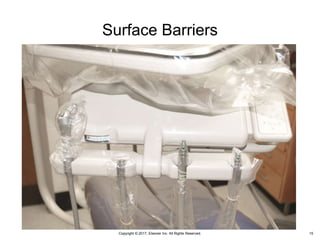
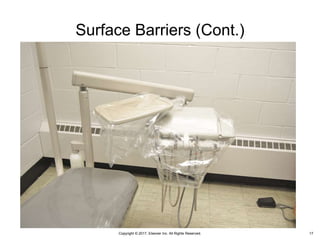
 Figure 14.1 shows surface barriers for
handpieces and air/water connectors and hoses.
 The bracket table is easily covered, and the
handpiece and air/water syringe connectors and
hoses can be covered and secured with rubber
bands.
 Covering the air/water syringe handle with plastic
wrap to prevent contamination is better than
trying to preclean and disinfect properly around
the buttons that tend to retain debris.
16
Copyright © 2017, Elsevier Inc. All Rights Reserved.
Surface Barriers (Cont.)
17
Copyright © 2017, Elsevier Inc. All Rights Reserved.
Surface Barriers (Cont.)
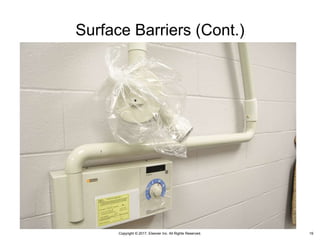
 Figure 14.2 shows the surface barrier for a
control unit and instrument tray holder.
 If units are set up the night before, a large
bag can give overnight dust protection to the
bracket table and handpiece unit.
18
Copyright © 2017, Elsevier Inc. All Rights Reserved.
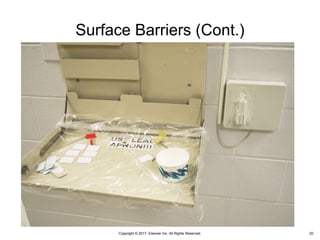
Surface Barriers (Cont.)
19
Copyright © 2017, Elsevier Inc. All Rights Reserved.
Surface Barriers (Cont.)
20
Copyright © 2017, Elsevier Inc. All Rights Reserved.
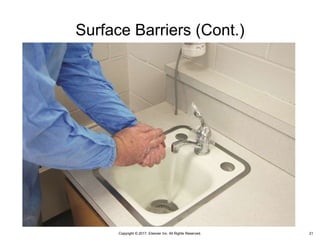
Surface Barriers (Cont.)
21
Copyright © 2017, Elsevier Inc. All Rights Reserved.
Surface Barriers (Cont.)
 Figure 14.5 shows a surface barrier for a sink
faucet.
 If the water at sinks is not controlled by elbow
levers, foot pedals, or automatic devices, the
faucet handles can be covered with plastic
bags.
22
Copyright © 2017, Elsevier Inc. All Rights Reserved.
Precleaning and Disinfection
 Precleaning reduces the number of
contaminating microorganisms and the
presence of bioburden
 Precleaning and disinfection work best on
nonelectric surfaces that are smooth and
easily accessible
 Procedure 14.2 describes general procedures
for precleaning and disinfecting surfaces.
23
Copyright © 2017, Elsevier Inc. All Rights Reserved.
Approaches to Precleaning
and Disinfection
 Spray-wipe-spray
 Using a liquid disinfectant/cleaner
 Wipe-discard-wipe
 Using a disinfectant towelette
24
Copyright © 2017, Elsevier Inc. All Rights Reserved.
Approaches to Precleaning
and Disinfection
 Disinfectant is used for both steps.
 Using a disinfectant for the precleaning step
starts the killing process early and reduces
the chances of spreading the contamination
to adjacent surfaces.
 If it is difficult to remove all of the bioburden
from a given surface, then consider protecting
it with a surface cover during future use.
25
Copyright © 2017, Elsevier Inc. All Rights Reserved.
Characteristics of Disinfectants
 The Centers for Disease Control and
Prevention has categorized disinfectants
based on their microbial spectrum of activity.
 Four general types of antimicrobial chemicals
 Antibiotics
• Kills microorganisms in or on the body
 Antiseptics
• Kills microorganisms on the skin
 Disinfectants
• Kills microorganism on environmental/inanimate surfaces
 Sterilants
• Kills microorganisms on inanimate objects
26
Copyright © 2017, Elsevier Inc. All Rights Reserved.
Categories of Disinfecting/
Sterilizing Chemicals
 High-level disinfectant (sterilant)
 Kills all microorganisms on submerged, inanimate,
heat-sensitive objects
 Intermediate-level disinfectant
 Kills vegetative bacteria, most fungi, viruses, and
Mycobacterium tuberculosis var. bovis
 Low-level disinfectant
 Kills most vegetative bacteria, some fungi, and
some viruses
27
Copyright © 2017, Elsevier Inc. All Rights Reserved.
Labeling on Antimicrobial Products
 Labels commonly include the type of
antimicrobial agent (active ingredients) and
general properties such as:
 Virucidal: Kills at least some viruses
 Bactericidal: Kills at least some bacteria
 Fungicidal: Kills at least some fungi
 Tuberculocidal: Kills the Mycobacterium
tuberculosis var. bovis bacterium
 Sporicidal: Kills bacterial spores, which means it is
a sterilant
28
Copyright © 2017, Elsevier Inc. All Rights Reserved.
Labeling on Antimicrobial Products
 Labels also commonly include the specific
microorganisms shown to be killed, directions
for use of the product, how to handle the
product, warnings for use, and how to store
the product.
 No perfect disinfectant exists that will kill all
types of disease-producing microorganisms
rapidly.
29
Copyright © 2017, Elsevier Inc. All Rights Reserved.
Ingredients in Surface Disinfectants
 Chlorine
 Iodophors
 Alcohols
 Synthetic phenolics
 Quaternary ammonium compounds
30
Copyright © 2017, Elsevier Inc. All Rights Reserved.
Ingredients in Surface Disinfectants
 Gloves, protective eyewear, a mask, and
protective clothing should be worn when using
any disinfectant.
 Chlorine compounds are intermediate-level
disinfectants that kill a wide variety of
microorganisms and are tuberculocidal.
 Iodophors are intermediate-level but less
corrosive and less irritating to tissues.
 Phenol was the first disinfectant used in hospitals.
 See Tables 14.3 and 14.4.
31
Copyright © 2017, Elsevier Inc. All Rights Reserved.
Equipment Decontamination
 In general, one should try to prevent the
equipment from becoming contaminated in
the first place
 If not possible, choose heat sterilization first
32
Copyright © 2017, Elsevier Inc. All Rights Reserved.
Equipment Decontamination
 If the equipment cannot be heat sterilized,
then use a liquid sterilant or an appropriate
disinfectant for decontamination. Following
the manufacturer’s directions for preventing
contamination or for cleaning, sterilization, or
disinfection of dental equipment is important.
 If the item is disposable, one should dispose
of it properly after use on one patient.
33
Copyright © 2017, Elsevier Inc. All Rights Reserved.
Equipment Decontamination
 If the item is reusable, one should cover the
parts that may become contaminated with an
impervious barrier to prevent contamination.
 If the item is not disposable, cannot be
covered completely, and becomes
contaminated, one should clean it, package it,
and heat sterilize it.
34
Copyright © 2017, Elsevier Inc. All Rights Reserved.
Management of High-Tech Equipment
 Some technologies may present special
infection control challenges
 Computers
 Cameras
 Digital x-ray sensors
35
Copyright © 2017, Elsevier Inc. All Rights Reserved.
Management of High-Tech
Equipment
 For computers, one should avoid their
contamination by performing hand hygiene
before use.
 Care should be taken that disinfectant wipes
used do not contain excess fluid that might enter
the base of the keyboard.
 Protective covers for the keyboard are available
as well as antimicrobial keyboards.
36
Copyright © 2017, Elsevier Inc. All Rights Reserved.
Aseptic Retrieval of Dental Supplies
 Numerous supplies are used for patient care,
and their storage and distribution present a
major challenge to infection control
 Aseptic retrieval
 Unit dosing
37
Copyright © 2017, Elsevier Inc. All Rights Reserved.
Aseptic Retrieval of Dental Supplies
 Examples of such items include cotton balls
and rolls, gauze pads, floss, articulating
paper, retraction cord, orthodontic wire, and
tubes or bottles of dental materials, to
mention only a few.
 When storing supply items in bulk, such as a
container of cotton rolls, one must use an
aseptic retrieval system to avoid
contamination of unused items in the
container.
38
Copyright © 2017, Elsevier Inc. All Rights Reserved.
Aseptic Retrieval of Dental Supplies
 Storing supplies in drawers at chairside lends
itself to cross-contamination of the drawer
handle (if not covered or precleaned and
disinfected) or of bulk items inside (if aseptic
retrieval is not used).
39
Copyright © 2017, Elsevier Inc. All Rights Reserved.
Aseptic Retrieval
40
Copyright © 2017, Elsevier Inc. All Rights Reserved.
Unit-Dosing
 Many types of disposable supplies can be
unit dosed, which means that the supplies are
distributed or packaged in small numbers
 This helps solve some cross-contamination
problems
41
Copyright © 2017, Elsevier Inc. All Rights Reserved.
Unit-Dosing
 You can protect supply containers, bottles,
and tubes of materials used at chairside on
more than one patient (multidose containers)
with a surface cover for each patient or in
some instances may preclean and disinfect
these between patients.
 Some supplies are unit dosed by the
manufacturers, saving office staff time.
 Unit dosing can be expensive and wasteful if
not organized properly.
42

Chapter 14: Surface and Equipment Asepsis

  • 1.
    Copyright © 2017,Elsevier Inc. All Rights Reserved. Surface and Equipment Asepsis Chapter 14 1
  • 2.
    Copyright © 2017,Elsevier Inc. All Rights Reserved. Learning Objectives Surface and Equipment Asepsis 1. Differentiate between clinical contact surfaces and housekeeping surfaces and determine which operatory surfaces may be involved in the patient-to-patient spread of microbes. 2. List the operatory surfaces that should be covered with barriers before patient care and describe how to place and remove surface covers properly. 3. Describe the importance of precleaning before surface disinfection and describe how to preclean and disinfect contaminated surfaces and equipment. 2
  • 3.
    Copyright © 2017,Elsevier Inc. All Rights Reserved. 4. Do the following regarding the characteristics of disinfectants: • List the types of surface disinfectants and describe their properties. • Differentiate between low-, intermediate-, and high- level disinfectants and give examples when each should be used. • Describe why it is important to read disinfectant labels. 3 Learning Objectives Surface and Equipment Asepsis (Cont.)
  • 4.
    Copyright © 2017,Elsevier Inc. All Rights Reserved. 5. List general considerations for dental equipment decontamination and management of high-tech equipment in the dental office. 6. Describe how to retrieve and distribute clinical supply items aseptically. 4 Learning Objectives Surface and Equipment Asepsis (Cont.)
  • 5.
    Copyright © 2017,Elsevier Inc. All Rights Reserved. Types of Environmental Surfaces  Two types of dental environmental surfaces related to disease spread  Clinical contact surfaces • Need to be treated before each patient  Housekeeping surfaces • Can be treated at the end of each day 5
  • 6.
    Copyright © 2017,Elsevier Inc. All Rights Reserved. Types of Environmental Surfaces  What are clinical contact surfaces?  Surfaces that may be touched frequently with gloved hands during patient care or that may become contaminated with blood, saliva, or other potentially infection materials  What are housekeeping surfaces?  Surfaces that do not come into contact with hands or devices used in dental procedures.  Examples: floors, walls, and sinks 6
  • 7.
    Copyright © 2017,Elsevier Inc. All Rights Reserved. Types of Environmental Surfaces  What conditions influence the survival time of microorganisms in the environment?  Humidity, temperature, the presence of nutrients in blood or saliva, and the surface properties of the microorganism 7
  • 8.
    Copyright © 2017,Elsevier Inc. All Rights Reserved. Approaches to Surface Asepsis  Two general approaches  Prevent the surface from becoming contaminated with a surface cover  Preclean and disinfect the surface after contamination and before each use  Each approach has advantages and disadvantages.  See Table 14.1 for list of advantages and disadvantages.  Most offices use a combination of both approaches. 8
  • 9.
    Copyright © 2017,Elsevier Inc. All Rights Reserved. Types of Surface Barriers  Surface barriers should be impervious to fluids to keep microorganisms in saliva, blood, or other liquids from soaking through to contact the surface  Examples include:  Clear plastic wrap  Bags  Tubes  Plastic-backed paper 9
  • 10.
    Copyright © 2017,Elsevier Inc. All Rights Reserved. Types of Surface Barriers  Some plastics are designed specifically for use as surface covers in the office in that they have the shape of the item to be covered (e.g., air/water syringe handle covers, hose covers, and pen covers).  Some sheets of plastic also have a slightly sticky substance on one side to hold them on the surface. 10
  • 11.
    Copyright © 2017,Elsevier Inc. All Rights Reserved. Types of Surface Barriers  Some plastic bags are available with drawstrings that hold the bag around an item to be protected.  To reduce costs, one can use thin rather than thick plastic sheets or bags as long as they are not punctured by the surface being covered.  Patient bibs are made of plastic-backed paper and also can be used to cover flat operatory surfaces, although thin plastic sheets may be less expensive. 11
  • 12.
    Copyright © 2017,Elsevier Inc. All Rights Reserved. Use of Surface Barriers  The sizes and shapes of surfaces to be covered vary from one office to the next, but general procedures for use of surface covers are the same 12
  • 13.
    Copyright © 2017,Elsevier Inc. All Rights Reserved. Use of Surface Barriers  Procedure 14.1 covers the general procedures for using surface barriers.  Clear plastic bags are available in various sizes and are easy to use.  For example, if a chair has control buttons on the side, one can use one bag to cover the headrest and the buttons. 13
  • 14.
    Copyright © 2017,Elsevier Inc. All Rights Reserved. Use of Surface Barriers  It’s really not necessary to cover the entire dental chair, for most of the chair (save the arm rests) is covered with the patient’s body.  Wraparound backs of side chairs used by the dental team may be touched during patient care and can be covered with a large plastic bag. 14
  • 15.
    Copyright © 2017,Elsevier Inc. All Rights Reserved. Surface Barriers 15
  • 16.
    Copyright © 2017,Elsevier Inc. All Rights Reserved. Surface Barriers  Figure 14.1 shows surface barriers for handpieces and air/water connectors and hoses.  The bracket table is easily covered, and the handpiece and air/water syringe connectors and hoses can be covered and secured with rubber bands.  Covering the air/water syringe handle with plastic wrap to prevent contamination is better than trying to preclean and disinfect properly around the buttons that tend to retain debris. 16
  • 17.
    Copyright © 2017,Elsevier Inc. All Rights Reserved. Surface Barriers (Cont.) 17
  • 18.
    Copyright © 2017,Elsevier Inc. All Rights Reserved. Surface Barriers (Cont.)  Figure 14.2 shows the surface barrier for a control unit and instrument tray holder.  If units are set up the night before, a large bag can give overnight dust protection to the bracket table and handpiece unit. 18
  • 19.
    Copyright © 2017,Elsevier Inc. All Rights Reserved. Surface Barriers (Cont.) 19
  • 20.
    Copyright © 2017,Elsevier Inc. All Rights Reserved. Surface Barriers (Cont.) 20
  • 21.
    Copyright © 2017,Elsevier Inc. All Rights Reserved. Surface Barriers (Cont.) 21
  • 22.
    Copyright © 2017,Elsevier Inc. All Rights Reserved. Surface Barriers (Cont.)  Figure 14.5 shows a surface barrier for a sink faucet.  If the water at sinks is not controlled by elbow levers, foot pedals, or automatic devices, the faucet handles can be covered with plastic bags. 22
  • 23.
    Copyright © 2017,Elsevier Inc. All Rights Reserved. Precleaning and Disinfection  Precleaning reduces the number of contaminating microorganisms and the presence of bioburden  Precleaning and disinfection work best on nonelectric surfaces that are smooth and easily accessible  Procedure 14.2 describes general procedures for precleaning and disinfecting surfaces. 23
  • 24.
    Copyright © 2017,Elsevier Inc. All Rights Reserved. Approaches to Precleaning and Disinfection  Spray-wipe-spray  Using a liquid disinfectant/cleaner  Wipe-discard-wipe  Using a disinfectant towelette 24
  • 25.
    Copyright © 2017,Elsevier Inc. All Rights Reserved. Approaches to Precleaning and Disinfection  Disinfectant is used for both steps.  Using a disinfectant for the precleaning step starts the killing process early and reduces the chances of spreading the contamination to adjacent surfaces.  If it is difficult to remove all of the bioburden from a given surface, then consider protecting it with a surface cover during future use. 25
  • 26.
    Copyright © 2017,Elsevier Inc. All Rights Reserved. Characteristics of Disinfectants  The Centers for Disease Control and Prevention has categorized disinfectants based on their microbial spectrum of activity.  Four general types of antimicrobial chemicals  Antibiotics • Kills microorganisms in or on the body  Antiseptics • Kills microorganisms on the skin  Disinfectants • Kills microorganism on environmental/inanimate surfaces  Sterilants • Kills microorganisms on inanimate objects 26
  • 27.
    Copyright © 2017,Elsevier Inc. All Rights Reserved. Categories of Disinfecting/ Sterilizing Chemicals  High-level disinfectant (sterilant)  Kills all microorganisms on submerged, inanimate, heat-sensitive objects  Intermediate-level disinfectant  Kills vegetative bacteria, most fungi, viruses, and Mycobacterium tuberculosis var. bovis  Low-level disinfectant  Kills most vegetative bacteria, some fungi, and some viruses 27
  • 28.
    Copyright © 2017,Elsevier Inc. All Rights Reserved. Labeling on Antimicrobial Products  Labels commonly include the type of antimicrobial agent (active ingredients) and general properties such as:  Virucidal: Kills at least some viruses  Bactericidal: Kills at least some bacteria  Fungicidal: Kills at least some fungi  Tuberculocidal: Kills the Mycobacterium tuberculosis var. bovis bacterium  Sporicidal: Kills bacterial spores, which means it is a sterilant 28
  • 29.
    Copyright © 2017,Elsevier Inc. All Rights Reserved. Labeling on Antimicrobial Products  Labels also commonly include the specific microorganisms shown to be killed, directions for use of the product, how to handle the product, warnings for use, and how to store the product.  No perfect disinfectant exists that will kill all types of disease-producing microorganisms rapidly. 29
  • 30.
    Copyright © 2017,Elsevier Inc. All Rights Reserved. Ingredients in Surface Disinfectants  Chlorine  Iodophors  Alcohols  Synthetic phenolics  Quaternary ammonium compounds 30
  • 31.
    Copyright © 2017,Elsevier Inc. All Rights Reserved. Ingredients in Surface Disinfectants  Gloves, protective eyewear, a mask, and protective clothing should be worn when using any disinfectant.  Chlorine compounds are intermediate-level disinfectants that kill a wide variety of microorganisms and are tuberculocidal.  Iodophors are intermediate-level but less corrosive and less irritating to tissues.  Phenol was the first disinfectant used in hospitals.  See Tables 14.3 and 14.4. 31
  • 32.
    Copyright © 2017,Elsevier Inc. All Rights Reserved. Equipment Decontamination  In general, one should try to prevent the equipment from becoming contaminated in the first place  If not possible, choose heat sterilization first 32
  • 33.
    Copyright © 2017,Elsevier Inc. All Rights Reserved. Equipment Decontamination  If the equipment cannot be heat sterilized, then use a liquid sterilant or an appropriate disinfectant for decontamination. Following the manufacturer’s directions for preventing contamination or for cleaning, sterilization, or disinfection of dental equipment is important.  If the item is disposable, one should dispose of it properly after use on one patient. 33
  • 34.
    Copyright © 2017,Elsevier Inc. All Rights Reserved. Equipment Decontamination  If the item is reusable, one should cover the parts that may become contaminated with an impervious barrier to prevent contamination.  If the item is not disposable, cannot be covered completely, and becomes contaminated, one should clean it, package it, and heat sterilize it. 34
  • 35.
    Copyright © 2017,Elsevier Inc. All Rights Reserved. Management of High-Tech Equipment  Some technologies may present special infection control challenges  Computers  Cameras  Digital x-ray sensors 35
  • 36.
    Copyright © 2017,Elsevier Inc. All Rights Reserved. Management of High-Tech Equipment  For computers, one should avoid their contamination by performing hand hygiene before use.  Care should be taken that disinfectant wipes used do not contain excess fluid that might enter the base of the keyboard.  Protective covers for the keyboard are available as well as antimicrobial keyboards. 36
  • 37.
    Copyright © 2017,Elsevier Inc. All Rights Reserved. Aseptic Retrieval of Dental Supplies  Numerous supplies are used for patient care, and their storage and distribution present a major challenge to infection control  Aseptic retrieval  Unit dosing 37
  • 38.
    Copyright © 2017,Elsevier Inc. All Rights Reserved. Aseptic Retrieval of Dental Supplies  Examples of such items include cotton balls and rolls, gauze pads, floss, articulating paper, retraction cord, orthodontic wire, and tubes or bottles of dental materials, to mention only a few.  When storing supply items in bulk, such as a container of cotton rolls, one must use an aseptic retrieval system to avoid contamination of unused items in the container. 38
  • 39.
    Copyright © 2017,Elsevier Inc. All Rights Reserved. Aseptic Retrieval of Dental Supplies  Storing supplies in drawers at chairside lends itself to cross-contamination of the drawer handle (if not covered or precleaned and disinfected) or of bulk items inside (if aseptic retrieval is not used). 39
  • 40.
    Copyright © 2017,Elsevier Inc. All Rights Reserved. Aseptic Retrieval 40
  • 41.
    Copyright © 2017,Elsevier Inc. All Rights Reserved. Unit-Dosing  Many types of disposable supplies can be unit dosed, which means that the supplies are distributed or packaged in small numbers  This helps solve some cross-contamination problems 41
  • 42.
    Copyright © 2017,Elsevier Inc. All Rights Reserved. Unit-Dosing  You can protect supply containers, bottles, and tubes of materials used at chairside on more than one patient (multidose containers) with a surface cover for each patient or in some instances may preclean and disinfect these between patients.  Some supplies are unit dosed by the manufacturers, saving office staff time.  Unit dosing can be expensive and wasteful if not organized properly. 42