11/30/2016 DR.ASHRAF SELIM 1
DR. Ashraf Selim
Consultant of Oral Surgery
Infection Preventionist
Member in APIC , WFHSS , IFIC , ESIC ,ICAN
ashrafoodo2@gmail.com
New Technologies for Surfaces Disinfection
Introduction
The relationship of environmental surface contamination
and HAI has become more defined especially the direct
relationship between contaminated high touch surfaces
and poor hand hygiene practices
11/30/2016 DR.ASHRAF SELIM 2
• A number of studies have shown that when a patient is
admitted into a room in which the prior occupant had an
infection, the entering patient has a significantly higher
chance of coming down with that same infection. ( Journal of
Hospital Infection 86S1 (2014) S1–S70
• This “prior occupant risk” has been linked to a four-fold
increase in infection risk.
• In other words, a person’s risk for a hospital acquired
infection (HAI) is partially determined by room into which
they are admitted.
• ( Infection control today/articles/2012/08/environmental-hygiene-what-we-
know-from-scientific-studies )
11/30/2016 DR.ASHRAF SELIM 3
Relation between HAI and contaminated surfaces
Novel Methods
To improve disinfection of environmental surfaces and decrease
recontamination in hospital rooms these methods includes:
 “No-touch” disinfection technologies.
 Self-disinfecting surfaces
These methods intended for use as supplement to routine cleaning
and disinfection procedures rather than as an alternative or
replacement for traditional cleaning and disinfection methods.
• After Patients Are Discharged ( Terminal Disinfection)
• Outbreak Management
11/30/2016 DR.ASHRAF SELIM 4
No-Touch Room Disinfection Systems
It includes but not limited to
• Hydrogen Peroxide Systems
• Ultraviolet lights
• Ozone Gas
• Chlorine Dioxide fogging
• Steam Vapor
11/30/2016 DR.ASHRAF SELIM 5
Hydrogen Peroxide Systems
1- Hydrogen Peroxide Vapor (HPV)
Vaporized HP ( Dry Gas ) 35 %
Vaporized HP ( Wet Gas / Micro condensation) 35 %
2- Dry Mist Aerosol HP 5 %
3- Dry Fog Aerosol HP 6 %
11/30/2016 DR.ASHRAF SELIM 6
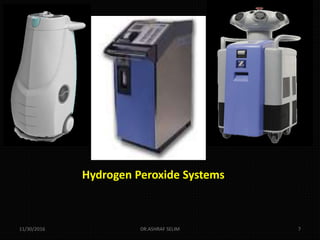
Hydrogen Peroxide Systems
11/30/2016 DR.ASHRAF SELIM 7
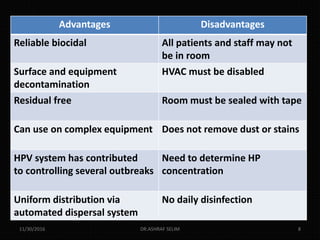
Advantages Disadvantages
Reliable biocidal All patients and staff may not
be in room
Surface and equipment
decontamination
HVAC must be disabled
Residual free Room must be sealed with tape
Can use on complex equipment Does not remove dust or stains
HPV system has contributed
to controlling several outbreaks
Need to determine HP
concentration
Uniform distribution via
automated dispersal system
No daily disinfection
11/30/2016 DR.ASHRAF SELIM 8
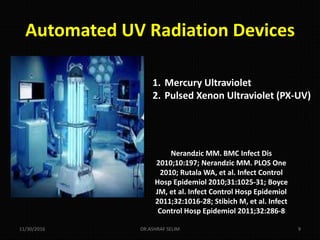
Automated UV Radiation Devices
1. Mercury Ultraviolet
2. Pulsed Xenon Ultraviolet (PX-UV)
11/30/2016 DR.ASHRAF SELIM 9
Nerandzic MM. BMC Infect Dis
2010;10:197; Nerandzic MM. PLOS One
2010; Rutala WA, et al. Infect Control
Hosp Epidemiol 2010;31:1025-31; Boyce
JM, et al. Infect Control Hosp Epidemiol
2011;32:1016-28; Stibich M, et al. Infect
Control Hosp Epidemiol 2011;32:286-8
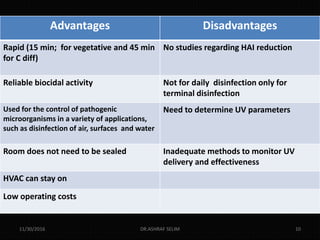
Advantages Disadvantages
Rapid (15 min; for vegetative and 45 min
for C diff)
No studies regarding HAI reduction
Reliable biocidal activity Not for daily disinfection only for
terminal disinfection
Used for the control of pathogenic
microorganisms in a variety of applications,
such as disinfection of air, surfaces and water
Need to determine UV parameters
Room does not need to be sealed Inadequate methods to monitor UV
delivery and effectiveness
HVAC can stay on
Low operating costs
11/30/2016 DR.ASHRAF SELIM 10
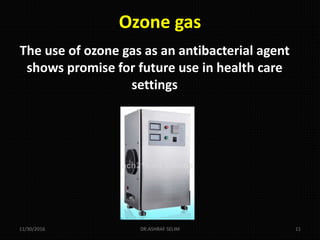
Ozone gas
The use of ozone gas as an antibacterial agent
shows promise for future use in health care
settings
11/30/2016 DR.ASHRAF SELIM 11
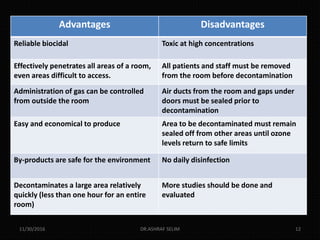
Advantages Disadvantages
Reliable biocidal Toxic at high concentrations
Effectively penetrates all areas of a room,
even areas difficult to access.
All patients and staff must be removed
from the room before decontamination
Administration of gas can be controlled
from outside the room
Air ducts from the room and gaps under
doors must be sealed prior to
decontamination
Easy and economical to produce Area to be decontaminated must remain
sealed off from other areas until ozone
levels return to safe limits
By-products are safe for the environment No daily disinfection
Decontaminates a large area relatively
quickly (less than one hour for an entire
room)
More studies should be done and
evaluated
11/30/2016 DR.ASHRAF SELIM 12
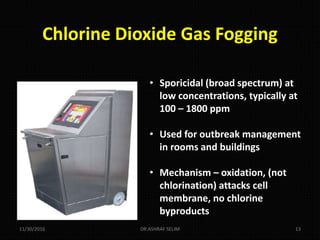
Chlorine Dioxide Gas Fogging
• Sporicidal (broad spectrum) at
low concentrations, typically at
100 – 1800 ppm
• Used for outbreak management
in rooms and buildings
• Mechanism – oxidation, (not
chlorination) attacks cell
membrane, no chlorine
byproducts
11/30/2016 DR.ASHRAF SELIM 13
Self Disinfecting Surfaces
• Self-disinfecting surfaces can be created by impregnating or
coating surfaces with heavy metals (e.g., silver or copper) or light-
activated antimicrobials).
• In health care, there has been interest in treating surfaces around
patients with materials that retard bacterial growth
11/30/2016 DR.ASHRAF SELIM 14
Objective To Minimize Rapid Recontamination
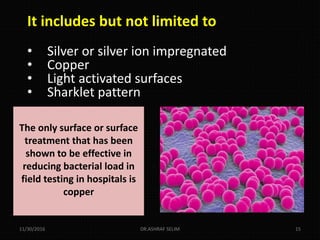
It includes but not limited to
• Silver or silver ion impregnated
• Copper
• Light activated surfaces
• Sharklet pattern
The only surface or surface
treatment that has been
shown to be effective in
reducing bacterial load in
field testing in hospitals is
copper
11/30/2016 DR.ASHRAF SELIM 15
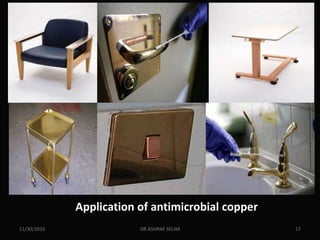
Copper
• Copper is considered a broad-spectrum antimicrobial including
activity against bacterial endospores such as C difficile
• There is considerable scientific evidence indicating that copper
alloy surfaces, when maintained and regularly cleaned, exhibit
an antimicrobial effect on various microorganisms, particularity
those commonly implicated in patient infections.
• We can use copper and copper alloy surfaces or embedded
within a surface like plastic or polymer
• Additionally copper are registered with the EPA as solid
antimicrobial materials.
11/30/2016 DR.ASHRAF SELIM 16
Application of antimicrobial copper
11/30/2016 DR.ASHRAF SELIM 17
11/30/2016 DR.ASHRAF SELIM 18
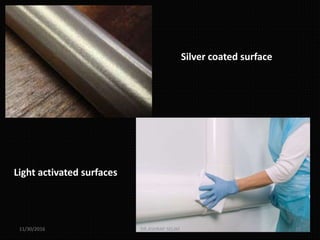
Silver
• Silver releases ionic free radicals that react with cell DNA and
disrupt the critical life processes of the cell.
• Incorporation of silver into various materials and surface
coatings have been shown to be effective in reducing
microbial surface counts
• A new coating that contains silver nanoparticles does appear
to reduce the number of germs that survive on surfaces
Light activated surfaces
Using Titanium dioxide damage cell wall and cause cell to die
Silver coated surface
Light activated surfaces
11/30/2016 DR.ASHRAF SELIM 19
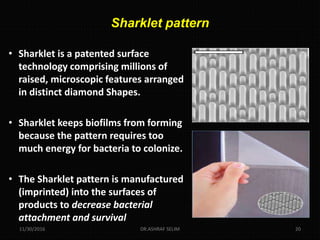
Sharklet pattern
• Sharklet is a patented surface
technology comprising millions of
raised, microscopic features arranged
in distinct diamond Shapes.
• Sharklet keeps biofilms from forming
because the pattern requires too
much energy for bacteria to colonize.
• The Sharklet pattern is manufactured
(imprinted) into the surfaces of
products to decrease bacterial
attachment and survival
11/30/2016 DR.ASHRAF SELIM 20
11/30/2016 DR.ASHRAF SELIM 21

New technologies for surfaces disinfection

  • 1.
    11/30/2016 DR.ASHRAF SELIM1 DR. Ashraf Selim Consultant of Oral Surgery Infection Preventionist Member in APIC , WFHSS , IFIC , ESIC ,ICAN ashrafoodo2@gmail.com
  • 2.
    New Technologies forSurfaces Disinfection Introduction The relationship of environmental surface contamination and HAI has become more defined especially the direct relationship between contaminated high touch surfaces and poor hand hygiene practices 11/30/2016 DR.ASHRAF SELIM 2
  • 3.
    • A numberof studies have shown that when a patient is admitted into a room in which the prior occupant had an infection, the entering patient has a significantly higher chance of coming down with that same infection. ( Journal of Hospital Infection 86S1 (2014) S1–S70 • This “prior occupant risk” has been linked to a four-fold increase in infection risk. • In other words, a person’s risk for a hospital acquired infection (HAI) is partially determined by room into which they are admitted. • ( Infection control today/articles/2012/08/environmental-hygiene-what-we- know-from-scientific-studies ) 11/30/2016 DR.ASHRAF SELIM 3 Relation between HAI and contaminated surfaces
  • 4.
    Novel Methods To improvedisinfection of environmental surfaces and decrease recontamination in hospital rooms these methods includes:  “No-touch” disinfection technologies.  Self-disinfecting surfaces These methods intended for use as supplement to routine cleaning and disinfection procedures rather than as an alternative or replacement for traditional cleaning and disinfection methods. • After Patients Are Discharged ( Terminal Disinfection) • Outbreak Management 11/30/2016 DR.ASHRAF SELIM 4
  • 5.
    No-Touch Room DisinfectionSystems It includes but not limited to • Hydrogen Peroxide Systems • Ultraviolet lights • Ozone Gas • Chlorine Dioxide fogging • Steam Vapor 11/30/2016 DR.ASHRAF SELIM 5
  • 6.
    Hydrogen Peroxide Systems 1-Hydrogen Peroxide Vapor (HPV) Vaporized HP ( Dry Gas ) 35 % Vaporized HP ( Wet Gas / Micro condensation) 35 % 2- Dry Mist Aerosol HP 5 % 3- Dry Fog Aerosol HP 6 % 11/30/2016 DR.ASHRAF SELIM 6
  • 7.
  • 8.
    Advantages Disadvantages Reliable biocidalAll patients and staff may not be in room Surface and equipment decontamination HVAC must be disabled Residual free Room must be sealed with tape Can use on complex equipment Does not remove dust or stains HPV system has contributed to controlling several outbreaks Need to determine HP concentration Uniform distribution via automated dispersal system No daily disinfection 11/30/2016 DR.ASHRAF SELIM 8
  • 9.
    Automated UV RadiationDevices 1. Mercury Ultraviolet 2. Pulsed Xenon Ultraviolet (PX-UV) 11/30/2016 DR.ASHRAF SELIM 9 Nerandzic MM. BMC Infect Dis 2010;10:197; Nerandzic MM. PLOS One 2010; Rutala WA, et al. Infect Control Hosp Epidemiol 2010;31:1025-31; Boyce JM, et al. Infect Control Hosp Epidemiol 2011;32:1016-28; Stibich M, et al. Infect Control Hosp Epidemiol 2011;32:286-8
  • 10.
    Advantages Disadvantages Rapid (15min; for vegetative and 45 min for C diff) No studies regarding HAI reduction Reliable biocidal activity Not for daily disinfection only for terminal disinfection Used for the control of pathogenic microorganisms in a variety of applications, such as disinfection of air, surfaces and water Need to determine UV parameters Room does not need to be sealed Inadequate methods to monitor UV delivery and effectiveness HVAC can stay on Low operating costs 11/30/2016 DR.ASHRAF SELIM 10
  • 11.
    Ozone gas The useof ozone gas as an antibacterial agent shows promise for future use in health care settings 11/30/2016 DR.ASHRAF SELIM 11
  • 12.
    Advantages Disadvantages Reliable biocidalToxic at high concentrations Effectively penetrates all areas of a room, even areas difficult to access. All patients and staff must be removed from the room before decontamination Administration of gas can be controlled from outside the room Air ducts from the room and gaps under doors must be sealed prior to decontamination Easy and economical to produce Area to be decontaminated must remain sealed off from other areas until ozone levels return to safe limits By-products are safe for the environment No daily disinfection Decontaminates a large area relatively quickly (less than one hour for an entire room) More studies should be done and evaluated 11/30/2016 DR.ASHRAF SELIM 12
  • 13.
    Chlorine Dioxide GasFogging • Sporicidal (broad spectrum) at low concentrations, typically at 100 – 1800 ppm • Used for outbreak management in rooms and buildings • Mechanism – oxidation, (not chlorination) attacks cell membrane, no chlorine byproducts 11/30/2016 DR.ASHRAF SELIM 13
  • 14.
    Self Disinfecting Surfaces •Self-disinfecting surfaces can be created by impregnating or coating surfaces with heavy metals (e.g., silver or copper) or light- activated antimicrobials). • In health care, there has been interest in treating surfaces around patients with materials that retard bacterial growth 11/30/2016 DR.ASHRAF SELIM 14 Objective To Minimize Rapid Recontamination
  • 15.
    It includes butnot limited to • Silver or silver ion impregnated • Copper • Light activated surfaces • Sharklet pattern The only surface or surface treatment that has been shown to be effective in reducing bacterial load in field testing in hospitals is copper 11/30/2016 DR.ASHRAF SELIM 15
  • 16.
    Copper • Copper isconsidered a broad-spectrum antimicrobial including activity against bacterial endospores such as C difficile • There is considerable scientific evidence indicating that copper alloy surfaces, when maintained and regularly cleaned, exhibit an antimicrobial effect on various microorganisms, particularity those commonly implicated in patient infections. • We can use copper and copper alloy surfaces or embedded within a surface like plastic or polymer • Additionally copper are registered with the EPA as solid antimicrobial materials. 11/30/2016 DR.ASHRAF SELIM 16
  • 17.
    Application of antimicrobialcopper 11/30/2016 DR.ASHRAF SELIM 17
  • 18.
    11/30/2016 DR.ASHRAF SELIM18 Silver • Silver releases ionic free radicals that react with cell DNA and disrupt the critical life processes of the cell. • Incorporation of silver into various materials and surface coatings have been shown to be effective in reducing microbial surface counts • A new coating that contains silver nanoparticles does appear to reduce the number of germs that survive on surfaces Light activated surfaces Using Titanium dioxide damage cell wall and cause cell to die
  • 19.
    Silver coated surface Lightactivated surfaces 11/30/2016 DR.ASHRAF SELIM 19
  • 20.
    Sharklet pattern • Sharkletis a patented surface technology comprising millions of raised, microscopic features arranged in distinct diamond Shapes. • Sharklet keeps biofilms from forming because the pattern requires too much energy for bacteria to colonize. • The Sharklet pattern is manufactured (imprinted) into the surfaces of products to decrease bacterial attachment and survival 11/30/2016 DR.ASHRAF SELIM 20
  • 21.