INFECTION CONTROL IN
DENTISTRY
PRESENTED BY: SHUBHRA BARDHAR (JAIPUR DENTAL COLLEGE)
FINAL YEAR - BDS
CONTENTS
*INFECTION
 DEFINITION
 MODES OF TRANSMISSION
 EXPOSURE RISK IN DENTAL OPERATORY
 CHAIN OF INFECTION
 COMMON INFECTION CONCERN IN DENTISTRY
*INFECTION CONTROL IN DENTISTRY
 CATEGORIES OF TASK IN RELATION TO RISK
 EXPOSURE CONTROL PLAN BY OSHA
 PERSONAL BARRIER TECHNIQUE FOR INFECTION CONTROL
 USE AND CARE OF SHARP INSTRUMENTS
 STERILIZATION AND DISINFECTION
 CLASSIFICATION OF INSTRUMENTS ON RISK OF TRANSMITTING INFECTION
INFECTION
The invasion and multiplication of microorganisms such
as bacteria, viruses and parasites that are not normally
present within the body.
 MODES OF TRANSMISSION
*DIRECT CONTACT-with blood and any body fluids.
*INDIRECT CONTACT- with contaminated instruments or
surface contact of mucosa of the eyes, nose and mouth
with droplets or spatter.
*INHALATION- of airborne micro-organisms.
EXPOSURE RISK IN DENTAL
OPERATORY
 AIRBORNE CONTAMINATION
Through aerosol, droplets and spatter
 HAND TO SURFACE CONTAMINATION
With saliva contaminated hands the dentist could repeatedly contact or handle
unprotected operatory surfaces during treatment if not careful
 CROSS INFECTION
The transmission of infectious agent between patients and staff within a clinical
environment
 PATIENTS VULNERABILITY
Dentist to patient transmission of infection
 PERSONAL VULNERABILITY/ DENTIST VULNERABILITY
When dentist experience exposure to saliva ,blood, injury from sharp instruments
while treating patients, they are vulnerable to infections if they have not had
proper immunization and protective barrier’s
CHAIN OF INFECTION
COMMON INFECTION CONCERN
IN DENTISTRY
TRANSMITTED BY
INHALATION
*VARICELLA VIRUS
-Measles and Mumps
*RHINO/ADENO VIRUS
-Common Cold
*MYOBACTERIUM
-Tuberculosis
*CANDIDA SPECIES
-Candidiasis
TRANSMITTED BY
INOCULATION
*HEPATITIS B,C,
-Hepatitis
* HERPES SIMPLEX
-Herpes
* HIV
- AIDS
*TREPONEMA PALLIDUM
- Syphilis
COMMON INFECTIOUS AGENT
PRESENT IN ORAL CAVITY
 Streptococcus mutans
 Streptococcus sobrinus
 Lacto bacilli
 Actinomyces species
Contributes in dental carries and other oral
infections.
INFECTION CONTROL IN DENTISTRY
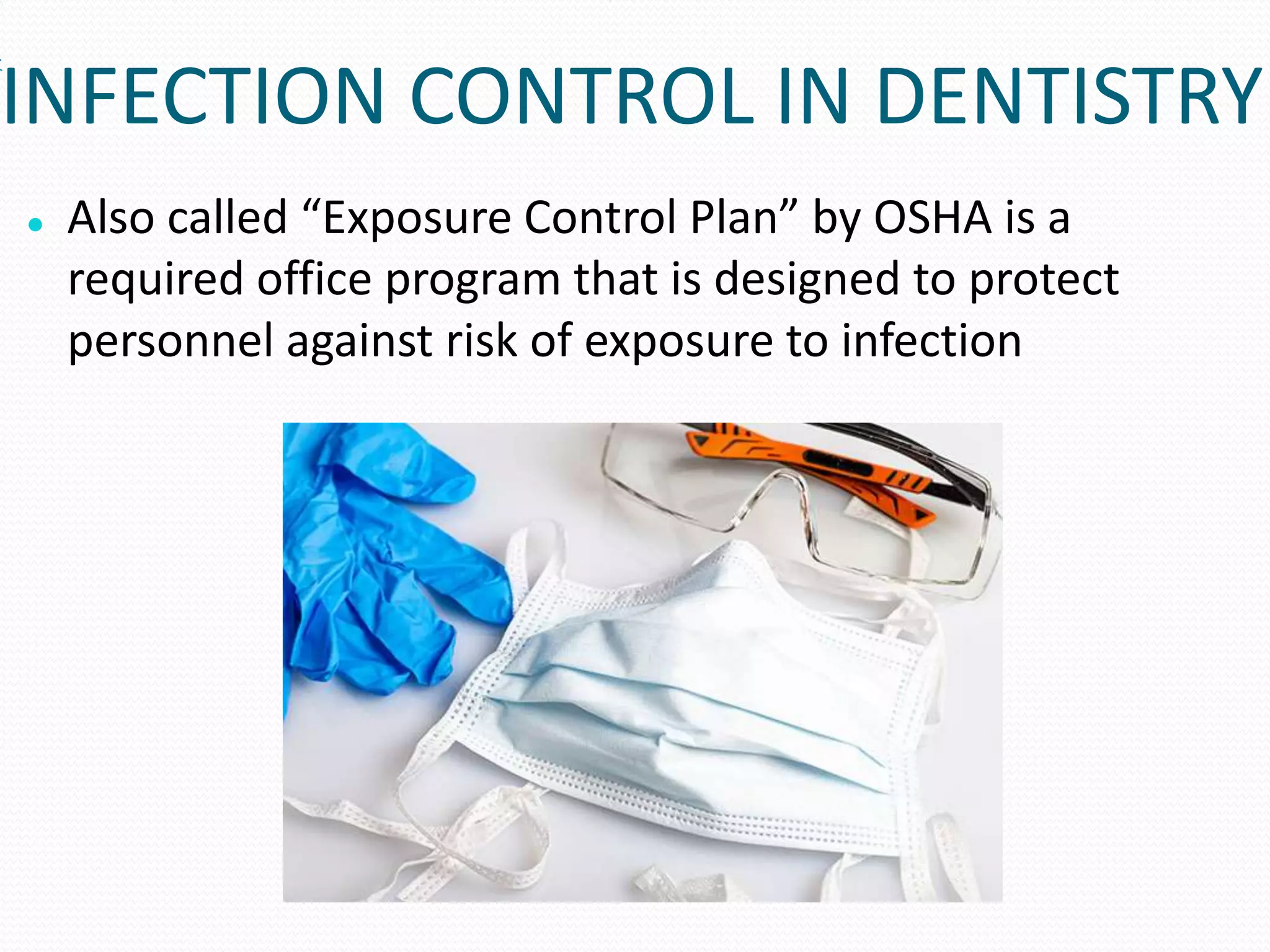
 Also called “Exposure Control Plan” by OSHA is a
required office program that is designed to protect
personnel against risk of exposure to infection
CATEGORIES OF TASK IN RELATION
TO RISK
*AMERICAN DENTAL ASSOCIATION-OCCUPATION SAFETY AND HEALTH ACT
Guidelines advise that all under category I and II be trained in infection control to protect
themselves and their patients.
EXPOSURE CONTROL PLAN BY OSHA
 Use of universal precaution
 Required use of personal protective equipment
 Laundry of contaminated protective clothing
 Policy on general waste disposal
 Standardized hand washing protocol
 Hepatitis B virus vaccination
 Post exposure evaluation and medical follow up
STANDARDIZED HAND WASHING
PROTOCOL
PERSONAL BARRIER TECHNIQUE
FOR INFECTION CONTROL
*WASHING AND CARE OF HANDS
 DHCWs should wash their hands before and after
treating each patient
 For routine dental examination procedures -
 The purpose of surgical hand antisepsis is to eliminate
transient flora and reduce resident flora to prevent
introduction of organisms in the operative wound if loves
become punctured or torn
 Hand cleansers are also available such as chlorhexidine
based, povidine iodine, alcohol hand rubs etc
*GLOVES
For protection of personal and patients in dental care
setting , medical gloves (latex or vinyl) always must be
worn – when their is potential for contacting blood,
blood contaminated saliva or mucous membrane
 Non sterile gloves – appropriate for examination and non
surgical procedures
 Sterile gloves – used for surgical procedures
*GOWNS
REUSABLE
 Reusable protective clothing should be washed using a
normal laundry cycle.
 It should be changed daily
DISPOSABLE
 Should be disposed after single use.
REUSABLE DISPOSABLE
 *MASKS/ PROTECTIVE EYE WEAR
 Plastic face shields or surgical mask and protective eye
wear should be worn when splashing or spattering of
blood or other body fluid is likely common in dentistry
 Mask should be changed for every patient eye wear
should be cleaned with cleaning agents
USE AND CARE OF SHARP
INSTRUMENTS
 Sharp items (needles, scalpel,blades,wires) contaminated
with patients blood and saliva should be considered as
potentially infective and handled with care to prevent
injuries
 Used disposable syringes and needles ,scalpel blades and
other sharp items should be placed in appropriate
puncture resistant containers
PUNCTURE RESISTANT CONTAINER
STERILIZATION AND DISINFECTION
 STERILIZATION- use of a physical or chemical
procedure to destroy all micro-organisms
including resistant bacterial spores
 DISINFECTION-destruction of all pathogenic
micro-organisms by physical or chemical
means except bacterial spores or inanimate
objects
CLASSIFICATION OF INSTRUMENTS ON
RISK OF TRANSMITTING INFECTION
All critical and semi critical dental instruments that are
heat stable should be sterilized by common methods like
 AUTOCLAVE – Reliable and rapid method ,all living
organisms are destroyed at 121 degree Celsius
temperature and 15 IBS pressure -15 minutes
 DRY HEAT STERILIZER/ HOT AIR OVEN
*320 degree F - Exposure time- 60 to 120 minutes.
*375 degree F - 6 minutes for wrapped instruments
- 12 minutes for unwrapped instruments
AUTOCLAVE HOT AIR OVEN
REFERENCE
• Essentials of public health dentistry (fifth edition)
by – Soben Peter
• www.mouthhealthy.org/infection-control
• wikipedia
Infection control in dentistry

Infection control in dentistry

  • 1.
    INFECTION CONTROL IN DENTISTRY PRESENTEDBY: SHUBHRA BARDHAR (JAIPUR DENTAL COLLEGE) FINAL YEAR - BDS
  • 2.
    CONTENTS *INFECTION  DEFINITION  MODESOF TRANSMISSION  EXPOSURE RISK IN DENTAL OPERATORY  CHAIN OF INFECTION  COMMON INFECTION CONCERN IN DENTISTRY *INFECTION CONTROL IN DENTISTRY  CATEGORIES OF TASK IN RELATION TO RISK  EXPOSURE CONTROL PLAN BY OSHA  PERSONAL BARRIER TECHNIQUE FOR INFECTION CONTROL  USE AND CARE OF SHARP INSTRUMENTS  STERILIZATION AND DISINFECTION  CLASSIFICATION OF INSTRUMENTS ON RISK OF TRANSMITTING INFECTION
  • 3.
    INFECTION The invasion andmultiplication of microorganisms such as bacteria, viruses and parasites that are not normally present within the body.  MODES OF TRANSMISSION *DIRECT CONTACT-with blood and any body fluids. *INDIRECT CONTACT- with contaminated instruments or surface contact of mucosa of the eyes, nose and mouth with droplets or spatter. *INHALATION- of airborne micro-organisms.
  • 4.
    EXPOSURE RISK INDENTAL OPERATORY  AIRBORNE CONTAMINATION Through aerosol, droplets and spatter  HAND TO SURFACE CONTAMINATION With saliva contaminated hands the dentist could repeatedly contact or handle unprotected operatory surfaces during treatment if not careful  CROSS INFECTION The transmission of infectious agent between patients and staff within a clinical environment  PATIENTS VULNERABILITY Dentist to patient transmission of infection  PERSONAL VULNERABILITY/ DENTIST VULNERABILITY When dentist experience exposure to saliva ,blood, injury from sharp instruments while treating patients, they are vulnerable to infections if they have not had proper immunization and protective barrier’s
  • 5.
  • 6.
    COMMON INFECTION CONCERN INDENTISTRY TRANSMITTED BY INHALATION *VARICELLA VIRUS -Measles and Mumps *RHINO/ADENO VIRUS -Common Cold *MYOBACTERIUM -Tuberculosis *CANDIDA SPECIES -Candidiasis TRANSMITTED BY INOCULATION *HEPATITIS B,C, -Hepatitis * HERPES SIMPLEX -Herpes * HIV - AIDS *TREPONEMA PALLIDUM - Syphilis
  • 7.
    COMMON INFECTIOUS AGENT PRESENTIN ORAL CAVITY  Streptococcus mutans  Streptococcus sobrinus  Lacto bacilli  Actinomyces species Contributes in dental carries and other oral infections.
  • 8.
    INFECTION CONTROL INDENTISTRY  Also called “Exposure Control Plan” by OSHA is a required office program that is designed to protect personnel against risk of exposure to infection
  • 9.
    CATEGORIES OF TASKIN RELATION TO RISK *AMERICAN DENTAL ASSOCIATION-OCCUPATION SAFETY AND HEALTH ACT Guidelines advise that all under category I and II be trained in infection control to protect themselves and their patients.
  • 10.
    EXPOSURE CONTROL PLANBY OSHA  Use of universal precaution  Required use of personal protective equipment  Laundry of contaminated protective clothing  Policy on general waste disposal  Standardized hand washing protocol  Hepatitis B virus vaccination  Post exposure evaluation and medical follow up
  • 11.
  • 12.
    PERSONAL BARRIER TECHNIQUE FORINFECTION CONTROL *WASHING AND CARE OF HANDS  DHCWs should wash their hands before and after treating each patient  For routine dental examination procedures -  The purpose of surgical hand antisepsis is to eliminate transient flora and reduce resident flora to prevent introduction of organisms in the operative wound if loves become punctured or torn  Hand cleansers are also available such as chlorhexidine based, povidine iodine, alcohol hand rubs etc
  • 13.
    *GLOVES For protection ofpersonal and patients in dental care setting , medical gloves (latex or vinyl) always must be worn – when their is potential for contacting blood, blood contaminated saliva or mucous membrane  Non sterile gloves – appropriate for examination and non surgical procedures  Sterile gloves – used for surgical procedures
  • 14.
    *GOWNS REUSABLE  Reusable protectiveclothing should be washed using a normal laundry cycle.  It should be changed daily DISPOSABLE  Should be disposed after single use. REUSABLE DISPOSABLE
  • 15.
     *MASKS/ PROTECTIVEEYE WEAR  Plastic face shields or surgical mask and protective eye wear should be worn when splashing or spattering of blood or other body fluid is likely common in dentistry  Mask should be changed for every patient eye wear should be cleaned with cleaning agents
  • 16.
    USE AND CAREOF SHARP INSTRUMENTS  Sharp items (needles, scalpel,blades,wires) contaminated with patients blood and saliva should be considered as potentially infective and handled with care to prevent injuries  Used disposable syringes and needles ,scalpel blades and other sharp items should be placed in appropriate puncture resistant containers PUNCTURE RESISTANT CONTAINER
  • 17.
    STERILIZATION AND DISINFECTION STERILIZATION- use of a physical or chemical procedure to destroy all micro-organisms including resistant bacterial spores  DISINFECTION-destruction of all pathogenic micro-organisms by physical or chemical means except bacterial spores or inanimate objects
  • 18.
    CLASSIFICATION OF INSTRUMENTSON RISK OF TRANSMITTING INFECTION
  • 19.
    All critical andsemi critical dental instruments that are heat stable should be sterilized by common methods like  AUTOCLAVE – Reliable and rapid method ,all living organisms are destroyed at 121 degree Celsius temperature and 15 IBS pressure -15 minutes  DRY HEAT STERILIZER/ HOT AIR OVEN *320 degree F - Exposure time- 60 to 120 minutes. *375 degree F - 6 minutes for wrapped instruments - 12 minutes for unwrapped instruments
  • 20.
  • 21.
    REFERENCE • Essentials ofpublic health dentistry (fifth edition) by – Soben Peter • www.mouthhealthy.org/infection-control • wikipedia