Introduction to
Endodontics
History scope, basic principles and
advancement
For undergraduates

By
Ahmed Shteiwi
Main source of this lecture
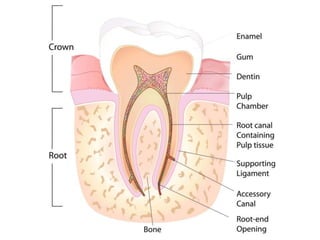
What is Endodontics ?
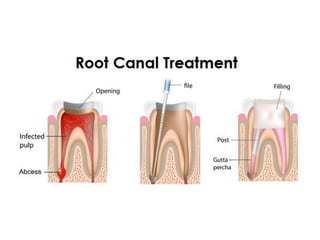
Root Canal Treatment (RCT)
• Is removal of vital or necrotic pulp tissue from
pulp chamber and root canal by cleaning
and shaping process
• Then the chamber and canal cavities must be
blocked by suitable sealing materials to not
become a shelter of pathogens “hermetic
seal”
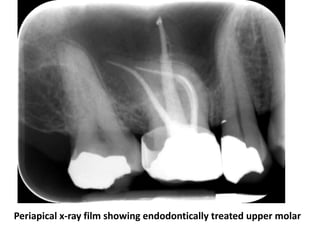
Periapical x-ray film showing endodontically treated upper molar
Why RCT ?
• Pulp injury ..
• Prosthetic treatment ..
Next lectures..
History
• 1687 the aim of Endodontics has been to
relieve pain, maintain exposed pulp, and
preserve teeth. Often, these attempts were
successful.
Fauchard (1678-1761), considered the founder
of modern dentistry, who in his textbook “Le
chirurgien dentiste” precisely described the
dental pulp 3 and dispelled the legend of the
“tooth worm,” which had been considered the
cause of caries and toothaches since the time of
the Assyrians.
• 1725, Lazare Riviere introduced the use of oil
of cloves for its sedative properties.
• 1746, Pierre Fauchard described the removal
of pulp tissue.
• 1820, Leonard Koecker cauterized exposed
pulp with a heated instrument and protected
it with lead foil.
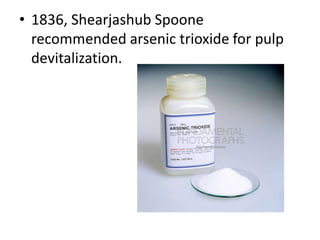
• 1836, Shearjashub Spoone
recommended arsenic trioxide for pulp
devitalization.
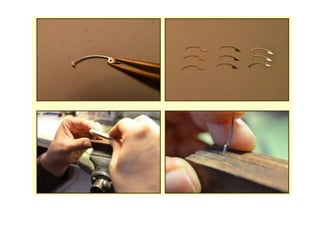
1838, Edwin Maynard of Washington,
D.C. introduced the first root canal
instrument, which he created by filing
a watch spring
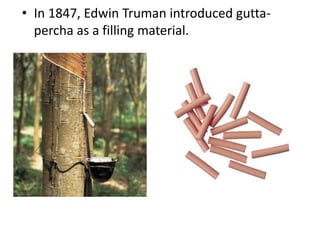
• In 1847, Edwin Truman introduced gutta-
percha as a filling material.
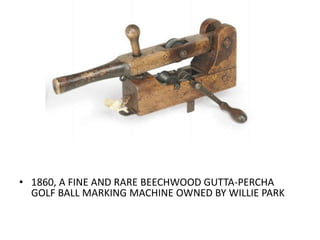
• 1860, A FINE AND RARE BEECHWOOD GUTTA-PERCHA
GOLF BALL MARKING MACHINE OWNED BY WILLIE PARK
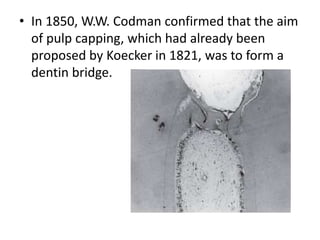
• In 1850, W.W. Codman confirmed that the aim
of pulp capping, which had already been
proposed by Koecker in 1821, was to form a
dentin bridge.
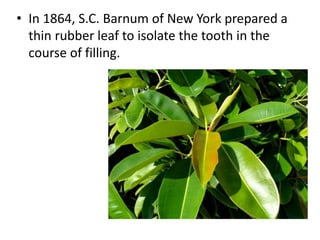
• In 1864, S.C. Barnum of New York prepared a
thin rubber leaf to isolate the tooth in the
course of filling.
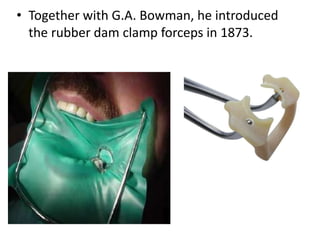
• Together with G.A. Bowman, he introduced
the rubber dam clamp forceps in 1873.
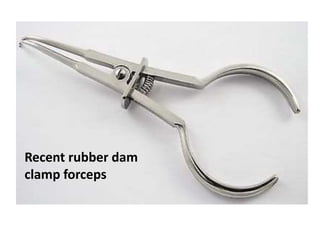
Recent rubber dam
clamp forceps
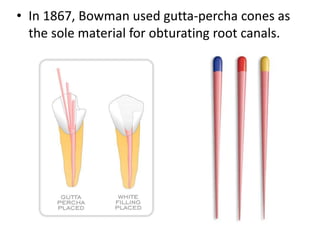
• In 1867, Bowman used gutta-percha cones as
the sole material for obturating root canals.
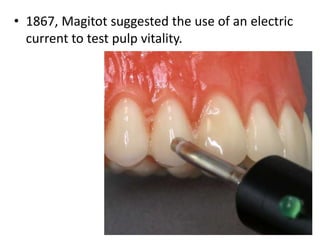
• 1867, Magitot suggested the use of an electric
current to test pulp vitality.
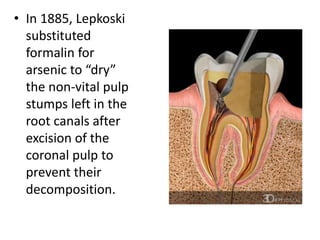
• In 1885, Lepkoski
substituted
formalin for
arsenic to “dry”
the non-vital pulp
stumps left in the
root canals after
excision of the
coronal pulp to
prevent their
decomposition.
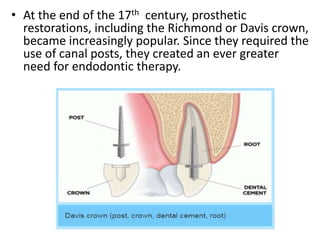
• At the end of the 17th century, prosthetic
restorations, including the Richmond or Davis crown,
became increasingly popular. Since they required the
use of canal posts, they created an ever greater
need for endodontic therapy.
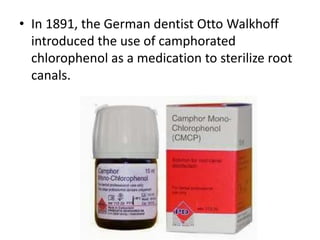
• In 1891, the German dentist Otto Walkhoff
introduced the use of camphorated
chlorophenol as a medication to sterilize root
canals.
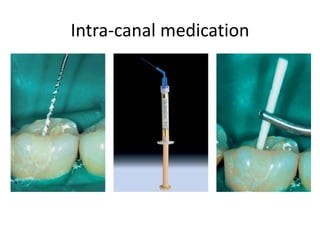
Intra-canal medication
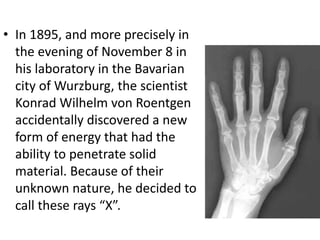
• In 1895, and more precisely in
the evening of November 8 in
his laboratory in the Bavarian
city of Wurzburg, the scientist
Konrad Wilhelm von Roentgen
accidentally discovered a new
form of energy that had the
ability to penetrate solid
material. Because of their
unknown nature, he decided to
call these rays “X”.
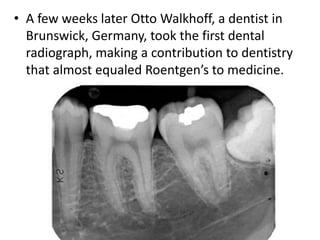
• A few weeks later Otto Walkhoff, a dentist in
Brunswick, Germany, took the first dental
radiograph, making a contribution to dentistry
that almost equaled Roentgen’s to medicine.
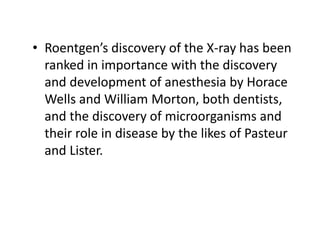
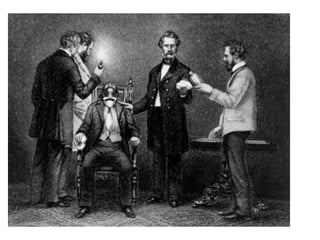
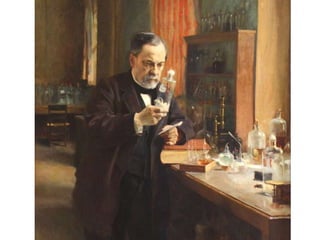
• Roentgen’s discovery of the X-ray has been
ranked in importance with the discovery
and development of anesthesia by Horace
Wells and William Morton, both dentists,
and the discovery of microorganisms and
their role in disease by the likes of Pasteur
and Lister.
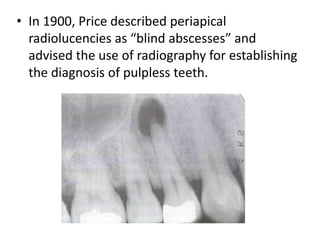
• In 1900, Price described periapical
radiolucencies as “blind abscesses” and
advised the use of radiography for establishing
the diagnosis of pulpless teeth.
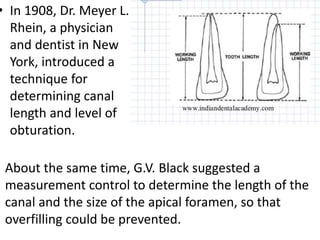
• In 1908, Dr. Meyer L.
Rhein, a physician
and dentist in New
York, introduced a
technique for
determining canal
length and level of
obturation.
About the same time, G.V. Black suggested a
measurement control to determine the length of the
canal and the size of the apical foramen, so that
overfilling could be prevented.
• In 1904, Frank Billings directed the attention
of dentistry and medicine to the apparent
relationship between oral sepsis and bacterial
endocarditis.
• 1909, Mayrhofer published a work linking the
nature of pulpal infection with specific
microorganisms. The results indicated that
streptococ-ci were present in about 96% of
the cases studied.
• A wrong believe that the pulpless teeth can
cause dangerous infection to the whole body
because it has a septic foci introduced by
William Hunter, an English physician and
pathologist , and there is no benefit from
treating pulpless teeth , this believe make the
dentists to extract any pulpless teeth
• This cause a stop in developing of root canal
treatment for 40 years !
• Coolidge, Johnson, Reihn, Callahan, Grove,
Prinz, and others. Mainly because of their
efforts, the principle of preserving the
pulpless tooth survived, they improve their
current procedures by using aseptic
techniques, bacteriological and histological
methods, and X-rays for diagnostic purposes.
• It was not until the late 1940s or early 1950s
that the cumulative laboratory research and
clinical evidence was sufficient to confirm that
the devitalized tooth did not play a role in the
causation of systemic disease. Thus the
theory of focal infection fell and faith was
restored in endodontic treatment.
Nowadays
A quick tour ..
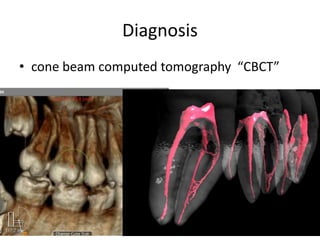
Diagnosis
• cone beam computed tomography “CBCT”
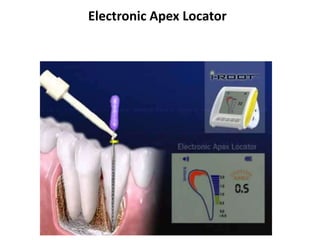
Electronic Apex Locator
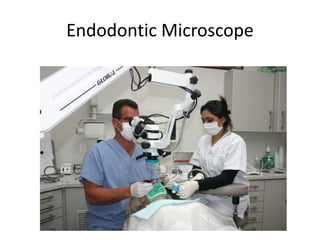
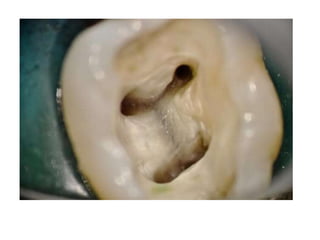
Endodontic Microscope
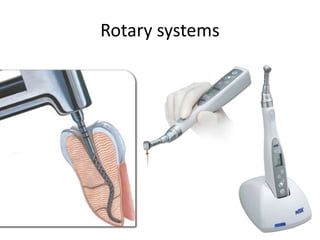
Rotary systems
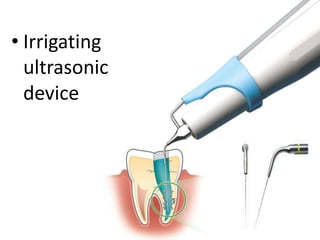
• Irrigating
ultrasonic
device
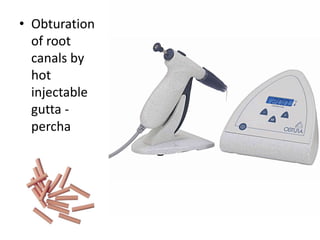
• Obturation
of root
canals by
hot
injectable
gutta -
percha
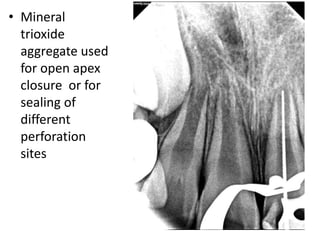
Mineral trioxide aggregate
• Mineral
trioxide
aggregate used
for open apex
closure or for
sealing of
different
perforation
sites
Biodentin sealer
References
• A Brief History of Endodontics : CASTELLUCCI ,ARNALDO ,Endodontics v2 : IL TRIDENTE
EDIZIONI ODONTOIATRICHE 2005
• Italo Medeiros Faraco Junior, Roberto HOLLAND : Histomorphological Response of Dogs’
Dental Pulp Capped with White Mineral Trioxide Aggregate : Braz Dent J (2004) 15(2): 104-
108
• http://dentalwisdom.com/myoralhealth/printables/roottreatmentp/rootrp.html
• http://www.public.asu.edu/~camartin/plants/Plant%20html%20files/ficuselastica.html
• http://www.christies.com/lotfinder/lot/a-fine-and-rare-beechwood-gutta-percha-golf-
5557844-details.aspx
• http://www.cornehl-watches.com/en/services/making-of-clocks-and-
watches/collection.html
• http://fphoto.photoshelter.com/image/I0000zX74rFlpDwM
• http://surreyhills.dental/services/root-canal-treatment/
• http://dentallecnotes.blogspot.com/2011/08/note-on-rubber-dam-isolationwith.html
• https://www.meyersmedmal.com/failure-to-use-dental-dam-malpractice/
• http://www.kerrdental.eu/AccessoriesForFillingMaterials/Sundries/SoftClampUniv
ersalRubberDamClamp
• http://www.terapeak.com/worth/dental-stoke-ivory-rubber-dam-clamp-forcep-
orthodontic-instruments-stainless/151983890611/
• https://parkell.cdeworld.com/courses/4462-assessment-and-diagnosis-of-pulp-
vitality-the-role-of-electric-pulp-testing
• https://commons.wikimedia.org/wiki/File:Electric_pulp_testing_tooth.jpg
• http://drstonedds.com/what-is-a-dental-post/
• http://worldofdent.blogspot.com/2013/09/camphor-mono-chlorophenol-
cmcp.html
• http://www.radiologyinfo.org/en/info.cfm?pg=bonerad
• https://dentalefficiency.wordpress.com/tag/dental-x-ray/
• http://pocketdentistry.com/11-applied-anatomy/
• https://en.wikipedia.org/wiki/Louis_Pasteur
• https://www.studyblue.com/notes/note/n/inflammatory-periapical-
lesions/deck/2237028
• http://www.slideshare.net/indiandentalacademy/working-length-in-root-canal-
treatment-rotary-endodontic-courses-by-indian-dental-academy
• http://www.microdontics.com/blog/
• https://www.youtube.com/watch?v=eTPpomuQrAk
• http://liderdis.com.tr/index.php?route=product/category&path=213
• http://aparat.rasanetv.ir/page-885499.html
• http://drgaryglassman.blogspot.com/2012_02_01_archive.html
• http://drpratibhadentalblog.blogspot.com/2012/06/design-principle-for-access-
cavity.html
• http://www.dentalproductshopper.com/canalpro-ultrasonic-irrigator
• http://www.pure-newtron.com/Endo-files-17.html
• https://www.dentaltix.com/sybronendo/obtura-iii-max
• https://www.youtube.com/watch?v=ITu8ZsN9Z_o
• http://micro-mega.com/en/mm-mta/
• https://endodonticspecialists.wordpress.com/
• https://www.pinterest.com/pin/368098969514593776/

Introduction to Endodontics

  • 1.
    Introduction to Endodontics History scope,basic principles and advancement For undergraduates By Ahmed Shteiwi
  • 2.
    Main source ofthis lecture
  • 3.
    What is Endodontics? Root Canal Treatment (RCT) • Is removal of vital or necrotic pulp tissue from pulp chamber and root canal by cleaning and shaping process • Then the chamber and canal cavities must be blocked by suitable sealing materials to not become a shelter of pathogens “hermetic seal”
  • 6.
    Periapical x-ray filmshowing endodontically treated upper molar
  • 7.
    Why RCT ? •Pulp injury .. • Prosthetic treatment .. Next lectures..
  • 9.
    History • 1687 theaim of Endodontics has been to relieve pain, maintain exposed pulp, and preserve teeth. Often, these attempts were successful.
  • 10.
    Fauchard (1678-1761), consideredthe founder of modern dentistry, who in his textbook “Le chirurgien dentiste” precisely described the dental pulp 3 and dispelled the legend of the “tooth worm,” which had been considered the cause of caries and toothaches since the time of the Assyrians.
  • 11.
    • 1725, LazareRiviere introduced the use of oil of cloves for its sedative properties. • 1746, Pierre Fauchard described the removal of pulp tissue. • 1820, Leonard Koecker cauterized exposed pulp with a heated instrument and protected it with lead foil.
  • 12.
    • 1836, ShearjashubSpoone recommended arsenic trioxide for pulp devitalization.
  • 13.
    1838, Edwin Maynardof Washington, D.C. introduced the first root canal instrument, which he created by filing a watch spring
  • 15.
    • In 1847,Edwin Truman introduced gutta- percha as a filling material.
  • 16.
    • 1860, AFINE AND RARE BEECHWOOD GUTTA-PERCHA GOLF BALL MARKING MACHINE OWNED BY WILLIE PARK
  • 17.
    • In 1850,W.W. Codman confirmed that the aim of pulp capping, which had already been proposed by Koecker in 1821, was to form a dentin bridge.
  • 18.
    • In 1864,S.C. Barnum of New York prepared a thin rubber leaf to isolate the tooth in the course of filling.
  • 19.
    • Together withG.A. Bowman, he introduced the rubber dam clamp forceps in 1873.
  • 20.
  • 21.
    • In 1867,Bowman used gutta-percha cones as the sole material for obturating root canals.
  • 22.
    • 1867, Magitotsuggested the use of an electric current to test pulp vitality.
  • 23.
    • In 1885,Lepkoski substituted formalin for arsenic to “dry” the non-vital pulp stumps left in the root canals after excision of the coronal pulp to prevent their decomposition.
  • 24.
    • At theend of the 17th century, prosthetic restorations, including the Richmond or Davis crown, became increasingly popular. Since they required the use of canal posts, they created an ever greater need for endodontic therapy.
  • 25.
    • In 1891,the German dentist Otto Walkhoff introduced the use of camphorated chlorophenol as a medication to sterilize root canals.
  • 26.
  • 27.
    • In 1895,and more precisely in the evening of November 8 in his laboratory in the Bavarian city of Wurzburg, the scientist Konrad Wilhelm von Roentgen accidentally discovered a new form of energy that had the ability to penetrate solid material. Because of their unknown nature, he decided to call these rays “X”.
  • 28.
    • A fewweeks later Otto Walkhoff, a dentist in Brunswick, Germany, took the first dental radiograph, making a contribution to dentistry that almost equaled Roentgen’s to medicine.
  • 29.
    • Roentgen’s discoveryof the X-ray has been ranked in importance with the discovery and development of anesthesia by Horace Wells and William Morton, both dentists, and the discovery of microorganisms and their role in disease by the likes of Pasteur and Lister.
  • 32.
    • In 1900,Price described periapical radiolucencies as “blind abscesses” and advised the use of radiography for establishing the diagnosis of pulpless teeth.
  • 33.
    • In 1908,Dr. Meyer L. Rhein, a physician and dentist in New York, introduced a technique for determining canal length and level of obturation. About the same time, G.V. Black suggested a measurement control to determine the length of the canal and the size of the apical foramen, so that overfilling could be prevented.
  • 34.
    • In 1904,Frank Billings directed the attention of dentistry and medicine to the apparent relationship between oral sepsis and bacterial endocarditis. • 1909, Mayrhofer published a work linking the nature of pulpal infection with specific microorganisms. The results indicated that streptococ-ci were present in about 96% of the cases studied.
  • 35.
    • A wrongbelieve that the pulpless teeth can cause dangerous infection to the whole body because it has a septic foci introduced by William Hunter, an English physician and pathologist , and there is no benefit from treating pulpless teeth , this believe make the dentists to extract any pulpless teeth • This cause a stop in developing of root canal treatment for 40 years !
  • 36.
    • Coolidge, Johnson,Reihn, Callahan, Grove, Prinz, and others. Mainly because of their efforts, the principle of preserving the pulpless tooth survived, they improve their current procedures by using aseptic techniques, bacteriological and histological methods, and X-rays for diagnostic purposes.
  • 37.
    • It wasnot until the late 1940s or early 1950s that the cumulative laboratory research and clinical evidence was sufficient to confirm that the devitalized tooth did not play a role in the causation of systemic disease. Thus the theory of focal infection fell and faith was restored in endodontic treatment.
  • 38.
  • 39.
    Diagnosis • cone beamcomputed tomography “CBCT”
  • 40.
  • 41.
  • 43.
  • 45.
  • 46.
    • Obturation of root canalsby hot injectable gutta - percha
  • 47.
  • 48.
    • Mineral trioxide aggregate used foropen apex closure or for sealing of different perforation sites
  • 49.
  • 50.
    References • A BriefHistory of Endodontics : CASTELLUCCI ,ARNALDO ,Endodontics v2 : IL TRIDENTE EDIZIONI ODONTOIATRICHE 2005 • Italo Medeiros Faraco Junior, Roberto HOLLAND : Histomorphological Response of Dogs’ Dental Pulp Capped with White Mineral Trioxide Aggregate : Braz Dent J (2004) 15(2): 104- 108 • http://dentalwisdom.com/myoralhealth/printables/roottreatmentp/rootrp.html • http://www.public.asu.edu/~camartin/plants/Plant%20html%20files/ficuselastica.html • http://www.christies.com/lotfinder/lot/a-fine-and-rare-beechwood-gutta-percha-golf- 5557844-details.aspx • http://www.cornehl-watches.com/en/services/making-of-clocks-and- watches/collection.html • http://fphoto.photoshelter.com/image/I0000zX74rFlpDwM • http://surreyhills.dental/services/root-canal-treatment/ • http://dentallecnotes.blogspot.com/2011/08/note-on-rubber-dam-isolationwith.html • https://www.meyersmedmal.com/failure-to-use-dental-dam-malpractice/
  • 51.
    • http://www.kerrdental.eu/AccessoriesForFillingMaterials/Sundries/SoftClampUniv ersalRubberDamClamp • http://www.terapeak.com/worth/dental-stoke-ivory-rubber-dam-clamp-forcep- orthodontic-instruments-stainless/151983890611/ •https://parkell.cdeworld.com/courses/4462-assessment-and-diagnosis-of-pulp- vitality-the-role-of-electric-pulp-testing • https://commons.wikimedia.org/wiki/File:Electric_pulp_testing_tooth.jpg • http://drstonedds.com/what-is-a-dental-post/ • http://worldofdent.blogspot.com/2013/09/camphor-mono-chlorophenol- cmcp.html • http://www.radiologyinfo.org/en/info.cfm?pg=bonerad • https://dentalefficiency.wordpress.com/tag/dental-x-ray/ • http://pocketdentistry.com/11-applied-anatomy/ • https://en.wikipedia.org/wiki/Louis_Pasteur • https://www.studyblue.com/notes/note/n/inflammatory-periapical- lesions/deck/2237028 • http://www.slideshare.net/indiandentalacademy/working-length-in-root-canal- treatment-rotary-endodontic-courses-by-indian-dental-academy • http://www.microdontics.com/blog/
  • 52.
    • https://www.youtube.com/watch?v=eTPpomuQrAk • http://liderdis.com.tr/index.php?route=product/category&path=213 •http://aparat.rasanetv.ir/page-885499.html • http://drgaryglassman.blogspot.com/2012_02_01_archive.html • http://drpratibhadentalblog.blogspot.com/2012/06/design-principle-for-access- cavity.html • http://www.dentalproductshopper.com/canalpro-ultrasonic-irrigator • http://www.pure-newtron.com/Endo-files-17.html • https://www.dentaltix.com/sybronendo/obtura-iii-max • https://www.youtube.com/watch?v=ITu8ZsN9Z_o • http://micro-mega.com/en/mm-mta/ • https://endodonticspecialists.wordpress.com/ • https://www.pinterest.com/pin/368098969514593776/