PROMOTION
MANAGEMENT
UNIT - III
DEFINITION OF PROMOTION :
“ The promotion mix consists of the specific blend of
advertising, sales promotion, public relations, personal selling &
direct marketing tools that a company uses to pursue its
advertising & marketing objectives”
- Philip Kotler
PROMOTION MIX :
Combination of various promotional tools used to create,
maintain and increase demand.
PROMOTION BLEND :
Promotion includes 3 types of sales activities:

• Mass impersonal selling methods [advertising]
• Face to face or personal selling [ sales manship]
• Activities other than personal selling and advertising such as
pop [point –of- purchase] display, shows, exhibitions,
demonstration etc…
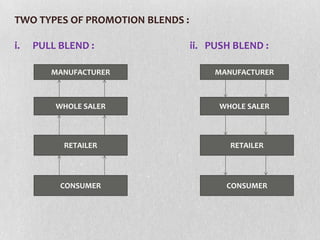
TWO TYPES OF PROMOTION BLENDS :
i.

PULL BLEND :

ii. PUSH BLEND :

MANUFACTURER

MANUFACTURER

WHOLE SALER

WHOLE SALER

RETAILER

RETAILER

CONSUMER

CONSUMER
OBJECTIVES OF PROMOTION :
• To communicate
• To convince
• To compete in the market
FACTORS EFFECTING PROMOTION MIX :
1.
2.
3.
4.
5.
6.
7.

Nature of the product
Nature of the market
Stage of PLC [product life cycle]
Availability of funds
Nature of techniques of promotion
Promotional strategy
Readiness of buyer
KINDS OF PROMOTION :
1. Informative promotion – e.g: medicines

2. Persuasive promotion – e.g: kinder joy
3. Reminder promotion - e.g: offer ends on… , polio
4. Buyer behaviour modification promotion – e.g: idea, odonil
ELEMENTS OF PROMOTION :
I.

ADVERTISING:

DEFINITION:
Acc. To American marketing association [AMA] “ Any paid form
of non – personal presentation and promotion of goods &
services or ideas by an identified sponsor ’’
OBJECTIVES OF ADVERTISING :
•
•
•
•
•

To make an immediate sale
To built primary demand
To introduce price deal
To inform about a product availability
To build brand recognition or brand insistence
• To help sales men by building an awareness of a product among
retailers
• To create a reputation for services reliability or research
strength.
• To increase market share
• To modify existing product appeals & buying motives
• To inform about new product features
• To increase the frequency of use of a product
• To increase the number or quality of retail outlets
• To built overall company image
• To effect immediate buying action
• To reach new areas or new segments of population within
existing areas
• To develop overseas market
KINDS/ TYPES OF ADVERTISING :
1.
2.
3.
4.
5.
6.
7.
8.




9.
10.

Product advertising
Institutional advertising
Primary demand advertising
Selective / competitive advertising
Comparative advertising
Shortage advertising
Co – operative advertisement
Commercial advertising
Industrial advertising
Trade advertising
Professional advertising
Farm advertising
Non – commercial advertising
Direct – action advertising
ADVERTISING BUDGET :
I. METHODS : [SELECTION]









Market share approach
Arbitrary allocation
% of sales method
Task and objective method
Competitive / comparison method
Funds available method
Incremental method
Fixed sum per unit method

II. EVALUATING MEDIA ALTERNATIVES:
 Cost per contact
 Duplication
 Market selectivity
III. MEDIA SCHEDULING
IV. DETERMINATION TH SIZE AND TIMING OF ADVERTISING
MESSAGES
V. MESSAGE DECISIONS
VI.
a)



MEASURING EFFECTIVENESS
Pre – test :
Readability test
Eye – movement analysis

b)




Post – test :
Recall test
Recognition test
Concurrent test
VII. KEYING THE ADVERTISEMENT
VIII. FOLLOW – UP SYSTEM IN ADVERTISEMENTS
II. SALES PROMOTION:
Sales promotion originated from Latin word “promo verse’’
to move forward.
DEFINITION :
“ Sales promotion in a specific sense refers to those sales
activities that supplement both personal selling and advertising
and co – ordinate them and help to make them effective such as
displays, shows and expositions, demonstrations and other
non- recurrent selling efforts not in ordinary routine ’’ .
FUNCTIONS OF SALES PROMOTION :
•
•
•
•

Low unit cost
Effective sales support
Increased speed of product acceptance
Better control

METHODS [ LEVEL OF SALES PROMOTION]

1.






Sales promotion at dealers level [retail]
Advertising material
Store demonstration
Special displays and shows
Dealer contest
Dealer premium
2.








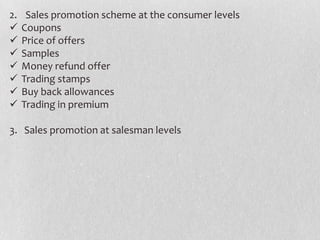
Sales promotion scheme at the consumer levels
Coupons
Price of offers
Samples
Money refund offer
Trading stamps
Buy back allowances
Trading in premium

3. Sales promotion at salesman levels
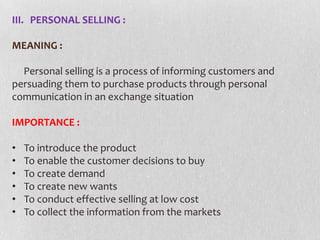
III. PERSONAL SELLING :
MEANING :
Personal selling is a process of informing customers and
persuading them to purchase products through personal
communication in an exchange situation
IMPORTANCE :
•
•
•
•
•
•

To introduce the product
To enable the customer decisions to buy
To create demand
To create new wants
To conduct effective selling at low cost
To collect the information from the markets
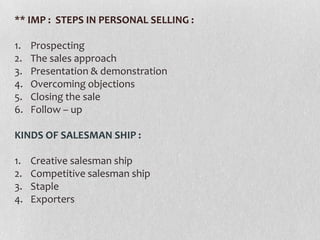
** IMP : STEPS IN PERSONAL SELLING :
1.
2.
3.
4.
5.
6.

Prospecting
The sales approach
Presentation & demonstration
Overcoming objections
Closing the sale
Follow – up

KINDS OF SALESMAN SHIP :
1.
2.
3.
4.

Creative salesman ship
Competitive salesman ship
Staple
Exporters
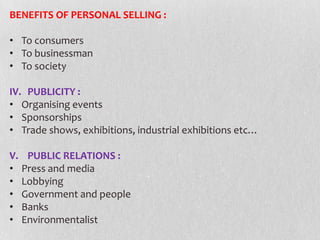
BENEFITS OF PERSONAL SELLING :
• To consumers
• To businessman
• To society

IV. PUBLICITY :
• Organising events
• Sponsorships
• Trade shows, exhibitions, industrial exhibitions etc…
V. PUBLIC RELATIONS :
• Press and media
• Lobbying
• Government and people
• Banks
• Environmentalist
IMPORTANT Q’S :
1. Explain the role of promotion in marketing mix ?
2. What is personal selling & list out the steps in personal selling ?

3. Explain briefly the tools of sales promotion ?
4. What is advertising and explain the process of preparation of
advertising budget ? [steps]

Promotion management

  • 1.
  • 2.
    DEFINITION OF PROMOTION: “ The promotion mix consists of the specific blend of advertising, sales promotion, public relations, personal selling & direct marketing tools that a company uses to pursue its advertising & marketing objectives” - Philip Kotler PROMOTION MIX : Combination of various promotional tools used to create, maintain and increase demand.
  • 3.
    PROMOTION BLEND : Promotionincludes 3 types of sales activities: • Mass impersonal selling methods [advertising] • Face to face or personal selling [ sales manship] • Activities other than personal selling and advertising such as pop [point –of- purchase] display, shows, exhibitions, demonstration etc…
  • 4.
    TWO TYPES OFPROMOTION BLENDS : i. PULL BLEND : ii. PUSH BLEND : MANUFACTURER MANUFACTURER WHOLE SALER WHOLE SALER RETAILER RETAILER CONSUMER CONSUMER
  • 5.
    OBJECTIVES OF PROMOTION: • To communicate • To convince • To compete in the market FACTORS EFFECTING PROMOTION MIX : 1. 2. 3. 4. 5. 6. 7. Nature of the product Nature of the market Stage of PLC [product life cycle] Availability of funds Nature of techniques of promotion Promotional strategy Readiness of buyer
  • 6.
    KINDS OF PROMOTION: 1. Informative promotion – e.g: medicines 2. Persuasive promotion – e.g: kinder joy 3. Reminder promotion - e.g: offer ends on… , polio 4. Buyer behaviour modification promotion – e.g: idea, odonil
  • 7.
    ELEMENTS OF PROMOTION: I. ADVERTISING: DEFINITION: Acc. To American marketing association [AMA] “ Any paid form of non – personal presentation and promotion of goods & services or ideas by an identified sponsor ’’ OBJECTIVES OF ADVERTISING : • • • • • To make an immediate sale To built primary demand To introduce price deal To inform about a product availability To build brand recognition or brand insistence
  • 8.
    • To helpsales men by building an awareness of a product among retailers • To create a reputation for services reliability or research strength. • To increase market share • To modify existing product appeals & buying motives • To inform about new product features • To increase the frequency of use of a product • To increase the number or quality of retail outlets • To built overall company image • To effect immediate buying action • To reach new areas or new segments of population within existing areas • To develop overseas market
  • 9.
    KINDS/ TYPES OFADVERTISING : 1. 2. 3. 4. 5. 6. 7. 8.     9. 10. Product advertising Institutional advertising Primary demand advertising Selective / competitive advertising Comparative advertising Shortage advertising Co – operative advertisement Commercial advertising Industrial advertising Trade advertising Professional advertising Farm advertising Non – commercial advertising Direct – action advertising
  • 10.
    ADVERTISING BUDGET : I.METHODS : [SELECTION]         Market share approach Arbitrary allocation % of sales method Task and objective method Competitive / comparison method Funds available method Incremental method Fixed sum per unit method II. EVALUATING MEDIA ALTERNATIVES:  Cost per contact  Duplication  Market selectivity
  • 11.
    III. MEDIA SCHEDULING IV.DETERMINATION TH SIZE AND TIMING OF ADVERTISING MESSAGES V. MESSAGE DECISIONS VI. a)   MEASURING EFFECTIVENESS Pre – test : Readability test Eye – movement analysis b)    Post – test : Recall test Recognition test Concurrent test
  • 12.
    VII. KEYING THEADVERTISEMENT VIII. FOLLOW – UP SYSTEM IN ADVERTISEMENTS II. SALES PROMOTION: Sales promotion originated from Latin word “promo verse’’ to move forward. DEFINITION : “ Sales promotion in a specific sense refers to those sales activities that supplement both personal selling and advertising and co – ordinate them and help to make them effective such as displays, shows and expositions, demonstrations and other non- recurrent selling efforts not in ordinary routine ’’ .
  • 13.
    FUNCTIONS OF SALESPROMOTION : • • • • Low unit cost Effective sales support Increased speed of product acceptance Better control METHODS [ LEVEL OF SALES PROMOTION] 1.      Sales promotion at dealers level [retail] Advertising material Store demonstration Special displays and shows Dealer contest Dealer premium
  • 14.
    2.        Sales promotion schemeat the consumer levels Coupons Price of offers Samples Money refund offer Trading stamps Buy back allowances Trading in premium 3. Sales promotion at salesman levels
  • 15.
    III. PERSONAL SELLING: MEANING : Personal selling is a process of informing customers and persuading them to purchase products through personal communication in an exchange situation IMPORTANCE : • • • • • • To introduce the product To enable the customer decisions to buy To create demand To create new wants To conduct effective selling at low cost To collect the information from the markets
  • 16.
    ** IMP :STEPS IN PERSONAL SELLING : 1. 2. 3. 4. 5. 6. Prospecting The sales approach Presentation & demonstration Overcoming objections Closing the sale Follow – up KINDS OF SALESMAN SHIP : 1. 2. 3. 4. Creative salesman ship Competitive salesman ship Staple Exporters
  • 17.
    BENEFITS OF PERSONALSELLING : • To consumers • To businessman • To society IV. PUBLICITY : • Organising events • Sponsorships • Trade shows, exhibitions, industrial exhibitions etc… V. PUBLIC RELATIONS : • Press and media • Lobbying • Government and people • Banks • Environmentalist
  • 18.
    IMPORTANT Q’S : 1.Explain the role of promotion in marketing mix ? 2. What is personal selling & list out the steps in personal selling ? 3. Explain briefly the tools of sales promotion ? 4. What is advertising and explain the process of preparation of advertising budget ? [steps]