GROUP MEMBERS
CAROLYN
PRANJALI
KAVERI
POOJA.S
PRATIK
JITEN
INTRODUCTION

      Product development means making changes in
the size, design, color, shape, characteristics, packing
etc. of the product. It may include addition of a new
product line, addition of a new product item in a
particular product line, elimination of existing product
or product line & changes in the size, color, design,
packing, characteristics, and prices of the product &
discontinuation of the unprofitable item or product
line.
      A new product is any product which is perceived by
the customer as being new.
REASONS FOR NEW PRODUCTS

     There are at least 3 reasons for which new
 products should be developed.

     1st, new products become necessary for meeting
 the changes in consumer needs.
     2nd, new products become necessary for making
 new profits.
     3rd, new products become necessary for combating
 environmental threats.
FACTORS OF NEW PRODUCT DEVELOPMENT:

      New product development is a continuous function of
   marketing management in the present day highly competitive
   environment. In the process of new product development, a
   company should keep in mind the following considerations:
Adequate market demand.
The product should fit into company’s present market
 structure.
The idea should fit into the company’s present
 production structure.
The product should fit as per the financial resources
 available.
Adequate distribution in depth & breadth.
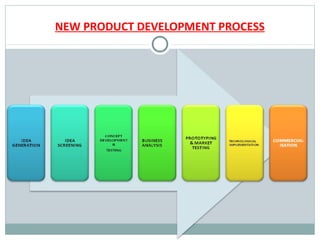
NEW PRODUCT DEVELOPMENT PROCESS
STEP 1:IDEA GENERATION

      The new product development process starts with the
search for ideas. Consumer’s problems are the most fertile
ground for the generation of new product ideas. New
product ideas come from interacting with various groups &
from using creativity generation techniques like
BRAINSTORMING, SYNECTICS etc.
BRAINSTORMING is a process, where a small group of
people are encouraged to came up with their ideas on a
specified problem.
Whereas in SYNECTICS, the real problem is kept away
initially from the group & only a broader framework of the
problem is given to them. The group is encouraged to think
in all possible dimensions and slowly the problem will be
made clear to them, & their ideas would get refined.
STEP 2: IDEA SCREENING

     The purpose of screening stage is to drop poor ideas as
early as possible. Thus an idea committee is formed to
classify the proposed ideas into 3 categories, such as:
promising, marginal & rejects. Every promising idea is kept
together for rigorous screening by product evaluation
committee.
     In screening ideas, the companies normally face 2
serious errors & they must try to avoid these mistakes as
far as possible, those 2 serious errors are: DROP ERROR &
GO ERROR. Let’s clarify:
DROP ERROR: error which occurs when the company
rejects one really good idea having potential.
GO ERROR: error which occurs, when the company permits
& facilitates a poor idea to move onto further development
stages & commercialization.
STEP 3:CONCEPT DEVELOPMENT & TESTING

       A concept is an elaborated version of a product idea
  expressed in meaningful consumer terms. Example: a leading soft
  drink company, if wants to add a new product, i.e. fruit juice to its
  product lines, then the following concepts can came across:
CONCEPT 1: FRUIT JUICE FOR YOUNG & GROWN UPS AS A FUNNY
  THIRST QUENCHING ITEM.
CONCEPT 2: FRUIT JUICE FOR CHILDREN AS A HEALTH SUPPLEMENTS.
CONCEPT 3: FOR ADULTS AS A NUTRITIONAL ENERGY SUPPLEMENTS.
       From the above 3 concepts, the 1st one looks to be attractive &
  promising.
       After the product concept has been developed, the stage is
  now set for testing them. It is here the prospective consumer
  understand the product idea. Here whether they are receptive
  towards the idea & their willingness to try out such product is
  tested.
STEP 4: BUSINESS ANALYSIS

     This stage will decide whether from financial as
well as marketing point of view, the project is beneficial
or not. The projects overall impact on the corporation’s
financial position with & without the new product are
estimated & compared.
     Here management needs to prepare sales as well
as cost & profit projections to determine whether they
satisfy company objectives.
STEP 5: PROTOTYPING & MARKET TESTING
      At this stage the company will determine whether
 the product idea can be translated into technically &
 commercially feasible product. Its goal is to find a
 prototype that consists the key attributes described in
 the product concept & that performs safely under
 normal use & conditions and that can be produced
 within the budgeted cost.
      Here the companies conduct 2 types of major
 testing’s, such as: ALPHA TESTING & BETA TESTING.
ALPHA TESTING: testing within the firm to see its
 function.
BETA TESTING: It includes listing a set of customers to
 use the prototype & give feedback.
MARKET TESTING:

      The product here is actually tested in the selected
 market segments. Based on the outcomes of the test
 marketing, the marketer lunches large scale
 manufacture of the new product. It is a controlled
 marketing experiment to decide the soundness &
 feasibility of fully fledged marketing of the product.
STEP 6: TECHNOLOGICAL
             IMPLEMANTATION

It involves technical feasibility, search for new
  available technologies & its economic alternatives
  if available. It also includes the technological
  relevance of current technologies, the firm’s
  knowledge & experience of the techniques,
  manpower in handling those technologies etc.
STEP 7: COMMERCIALISATION

At this stage the company takes decision to go in for large scale
  production & marketing of the new product. Various marketing
  strategies are employed by the company at this stage, when it
  starts commercialization of a new product idea.
        The important factors to which strategists should focus
  here are:
 Market entry timing period.
 Whether to lunch the product in a single locality, a region,
  several regions, nationally or internationally, i.e. geographic
  strategy.
 To whom the new product should target for i.e. targeting &
  segmenting.
CONCLUSION

Every year millions of rupees are being spent on R&D for new
  products development. Such a huge investment is necessary as
  new products are the only means of survival of a firm.
         New product development provides a number of
  advantages to the enterprise.
 It helps in producing goods & services of best quality.
 It helps in providing maximum customer satisfaction, because
  it is developed in the view of customer specification.
 It helps in expanding the market of the products of the
  enterprise.
 It helps in achieving stability in product demand.
THANK YOU

new product developement process

  • 2.
  • 3.
    INTRODUCTION Product development means making changes in the size, design, color, shape, characteristics, packing etc. of the product. It may include addition of a new product line, addition of a new product item in a particular product line, elimination of existing product or product line & changes in the size, color, design, packing, characteristics, and prices of the product & discontinuation of the unprofitable item or product line. A new product is any product which is perceived by the customer as being new.
  • 4.
    REASONS FOR NEWPRODUCTS There are at least 3 reasons for which new products should be developed.  1st, new products become necessary for meeting the changes in consumer needs.  2nd, new products become necessary for making new profits.  3rd, new products become necessary for combating environmental threats.
  • 5.
    FACTORS OF NEWPRODUCT DEVELOPMENT: New product development is a continuous function of marketing management in the present day highly competitive environment. In the process of new product development, a company should keep in mind the following considerations: Adequate market demand. The product should fit into company’s present market structure. The idea should fit into the company’s present production structure. The product should fit as per the financial resources available. Adequate distribution in depth & breadth.
  • 6.
  • 7.
    STEP 1:IDEA GENERATION The new product development process starts with the search for ideas. Consumer’s problems are the most fertile ground for the generation of new product ideas. New product ideas come from interacting with various groups & from using creativity generation techniques like BRAINSTORMING, SYNECTICS etc. BRAINSTORMING is a process, where a small group of people are encouraged to came up with their ideas on a specified problem. Whereas in SYNECTICS, the real problem is kept away initially from the group & only a broader framework of the problem is given to them. The group is encouraged to think in all possible dimensions and slowly the problem will be made clear to them, & their ideas would get refined.
  • 8.
    STEP 2: IDEASCREENING The purpose of screening stage is to drop poor ideas as early as possible. Thus an idea committee is formed to classify the proposed ideas into 3 categories, such as: promising, marginal & rejects. Every promising idea is kept together for rigorous screening by product evaluation committee. In screening ideas, the companies normally face 2 serious errors & they must try to avoid these mistakes as far as possible, those 2 serious errors are: DROP ERROR & GO ERROR. Let’s clarify: DROP ERROR: error which occurs when the company rejects one really good idea having potential. GO ERROR: error which occurs, when the company permits & facilitates a poor idea to move onto further development stages & commercialization.
  • 9.
    STEP 3:CONCEPT DEVELOPMENT& TESTING A concept is an elaborated version of a product idea expressed in meaningful consumer terms. Example: a leading soft drink company, if wants to add a new product, i.e. fruit juice to its product lines, then the following concepts can came across: CONCEPT 1: FRUIT JUICE FOR YOUNG & GROWN UPS AS A FUNNY THIRST QUENCHING ITEM. CONCEPT 2: FRUIT JUICE FOR CHILDREN AS A HEALTH SUPPLEMENTS. CONCEPT 3: FOR ADULTS AS A NUTRITIONAL ENERGY SUPPLEMENTS. From the above 3 concepts, the 1st one looks to be attractive & promising. After the product concept has been developed, the stage is now set for testing them. It is here the prospective consumer understand the product idea. Here whether they are receptive towards the idea & their willingness to try out such product is tested.
  • 10.
    STEP 4: BUSINESSANALYSIS This stage will decide whether from financial as well as marketing point of view, the project is beneficial or not. The projects overall impact on the corporation’s financial position with & without the new product are estimated & compared. Here management needs to prepare sales as well as cost & profit projections to determine whether they satisfy company objectives.
  • 11.
    STEP 5: PROTOTYPING& MARKET TESTING At this stage the company will determine whether the product idea can be translated into technically & commercially feasible product. Its goal is to find a prototype that consists the key attributes described in the product concept & that performs safely under normal use & conditions and that can be produced within the budgeted cost. Here the companies conduct 2 types of major testing’s, such as: ALPHA TESTING & BETA TESTING. ALPHA TESTING: testing within the firm to see its function. BETA TESTING: It includes listing a set of customers to use the prototype & give feedback.
  • 12.
    MARKET TESTING: The product here is actually tested in the selected market segments. Based on the outcomes of the test marketing, the marketer lunches large scale manufacture of the new product. It is a controlled marketing experiment to decide the soundness & feasibility of fully fledged marketing of the product.
  • 13.
    STEP 6: TECHNOLOGICAL IMPLEMANTATION It involves technical feasibility, search for new available technologies & its economic alternatives if available. It also includes the technological relevance of current technologies, the firm’s knowledge & experience of the techniques, manpower in handling those technologies etc.
  • 14.
    STEP 7: COMMERCIALISATION Atthis stage the company takes decision to go in for large scale production & marketing of the new product. Various marketing strategies are employed by the company at this stage, when it starts commercialization of a new product idea. The important factors to which strategists should focus here are:  Market entry timing period.  Whether to lunch the product in a single locality, a region, several regions, nationally or internationally, i.e. geographic strategy.  To whom the new product should target for i.e. targeting & segmenting.
  • 15.
    CONCLUSION Every year millionsof rupees are being spent on R&D for new products development. Such a huge investment is necessary as new products are the only means of survival of a firm. New product development provides a number of advantages to the enterprise.  It helps in producing goods & services of best quality.  It helps in providing maximum customer satisfaction, because it is developed in the view of customer specification.  It helps in expanding the market of the products of the enterprise.  It helps in achieving stability in product demand.
  • 16.