Week 7
Chapter 13
Employee Safety, Healthy and Wellness
Daw Htay Htay (AP)
Business and Economic Department
NMDC
1. Nature and Role of Safety, Health, and Wellness
Many workplaces have features that could threaten the safety and
health of employees if not managed properly.
Safety involves protecting employees from injuries caused by work-
related accident.
Health refers to employees’ freedom from physical or emotional
illness.
 HR professionals play a crucial role in promoting a safe and healthful
work environment and addressing ways to support physical and
mental wellness.
The role of promoting occupational safety and health is mandated by
the Occupational Safety and Health Act of 1970.
2. Occupational Safety and Health Administration(OSHA)-1
 The Occupational Safety and Health Act of 1970 created the OSHA.
 The purpose of OSHA is to ensure worker safety and health by working with
employers and employees to create better working environments.
 The act requires employers to provide employees a safe and healthy place to
work and this responsibility extends to providing safe employees.
 Employers have a responsibility under the general duty clause of the
Occupational Safety and Health Act to furnish a workplace free from recognized
hazards.
Violation of the general duty clause
OSHA has to demonstrate
1. That a condition or activity in the workplace presented a hazard,
2. That the employer or its industry recognized this hazard,
3. That the hazard was likely to cause death or serious physical harm,
4. That a feasible and effective means existed to eliminate or materially reduce the hazard.
continue . . .
Occupational Safety and Health Administration(OSHA)-2
 Employers process other rights and responsibilities under OSHA.
 Likewise, employees possess rights and responsibilities.
 The mission of OSHA is to promote and ensure workplace safety and health and to reduce workplace fatalities,
injuries, and illnesses.
 Addressing safety and health issues in the workplace also saves the employer money and adds value to the
business.
 Even though OSHA would like a successful partnership relationship to exist, at time penalties must be given.
 Financial penalties serve as reminders to companies of the benefits of maintaining safe and healthy working
conditions.
 OSHA has implemented the Severe Violator Enforcement Program.
continue . . .
4. OSHA and the Small Business
 The guide is intended to help small business employers meet the legal requirements imposed by OSHA.
 It covers the basics of an occupational safety and health plan for small business owners.
 The guide tips on how to self-assess the workplace, employee training strategies, and more.
 It also has an on-site consultation service.
 Small businesses that participate can qualify for a one-year exemption from routine OSHA inspections.
5. Safety : The Economic Impact
 Job-related deaths and injuries of all type extract a high toll not only in human misery but also in economic
loss.
 The leading cause of workplace injuries and their associated costs are overexertion (Example, lifting ,
carrying, pushing , pulling , etc)
 Safety risks can be significant for employers.
 Safety professionals strive for lower workers’ compensation costs, ass do insurance companies.
6. Focus of Safety Programs
 Every employer needs to have a comprehensive safety program.
 Safety programs may accomplish their purpose in to primary ways focusing on unsafe employee actions and
the other on unsafe working conditions.
 Unsafe Employee Actions
 Training and orientation of new employees emphasizing safety is especially important.
 The first approach in a safety program is to create a psychological environment and employee attitudes that
promote safety.
 A corporate culture needs to exist in which employees are involved and engaged and have the opportunity to
provide input on changes to their workplace.
 Studies show a positive link between employee engagement and involvement and safety performance.
 Accident rates decline when workers consciously or subconsciously think about safety.
 Although there is danger that everyone’s responsibility will become no one’s responsibility, a truly safe
environment takes the effort of everyone from top management to the lowest-level employee.
 Management’s unique role is clear because OSHA places primary responsibility for employee safety on the
employer.
continue . . .
 Unsafe Working Conditions
 The Second approach to safety program design is to develop and maintain a safe physical working environment.
 Altering the environment becomes be focus for preventing accidents.
 Developing Safety Program
Lost productivity
Compensation costs
Job hazard analysis(JHA)
Superfund Amendments Reauthorization Act (SARA)
Employee Involvement
Safety Engineer
Accident Investigation
Evaluation of Safety Programs
continue . . .
10. Employee Wellness
 Wellness programs are designed to promote the mental and physical well-being of employees and family
members.
 Employers create employee assistance programs as a structure within which to offer wellness initiatives.
 Employee assistance programs help employees cope with personal problems that may impair their personal
lives or job performance.
Social Networking and Wellness
 Employers increasingly are adopting social networking to strengthen the success of their wellness programs.
 Social Networking
- brings employees together and works to increase peer support.
- generates participation rates higher than any traditional form of wellness initiative.
continue. . .
11. Nature of Stress
 Stress is the body’s nonspecific reaction to any demand made on it.
 It affects people in different ways and therefore is highly individualized.
 Not always negative.
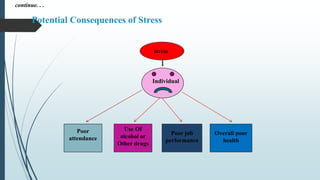
Potential Consequences of Stress
stress
Individual
Poor
attendance
Use Of
alcohol or
Other drugs
Poor job
performance
Overall poor
health
Individual
continue. . .
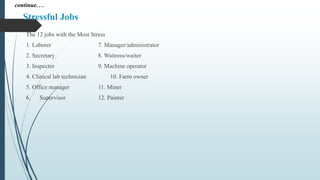
Stressful Jobs
The 12 jobs with the Most Stress
1. Laborer 7. Manager/administrator
2. Secretary 8. Waitress/waiter
3. Inspector 9. Machine operator
4. Clinical lab technician 10. Farm owner
5. Office manager 11. Miner
6. Supervisor 12. Painter
continue. . .
12. Physical Fitness Programs
 Involve efforts to promote exercise and fitness
 Consider the results of physical inactivity
 Provide a safe and healthy work environment improves worker productivity
Substance Abuse
 Use of illegal substances or the misuse of controlled substances such as alcohol and drugs
 Alcoholism – medical disease characterized by uncontrolled and compulsive drinking that interferes with
normal living patterns
 Stress play an important role to become an alcoholic
 Affect people at every level of society
14. Employee Assistance Programs (EAP)
 A comprehensive approach that many organizations have taken to deal with numerous problem areas such as
burnout, alcohol and drug abuse, and other emotional disturbances
 To provide assistance with managing critical events in the workplace
 Include a response to personal psychological problems
 Getting employees to use the program
15. Health Care in the Global Environment
 Safety and healthy laws and regulations vary from country to country
 Health care facilities across the globe vary in their state of modernization
 Medical evacuation can be an essential benefit for overseas workers
HRM Chapter 13.pptx

HRM Chapter 13.pptx

  • 1.
    Week 7 Chapter 13 EmployeeSafety, Healthy and Wellness Daw Htay Htay (AP) Business and Economic Department NMDC
  • 2.
    1. Nature andRole of Safety, Health, and Wellness Many workplaces have features that could threaten the safety and health of employees if not managed properly. Safety involves protecting employees from injuries caused by work- related accident. Health refers to employees’ freedom from physical or emotional illness.  HR professionals play a crucial role in promoting a safe and healthful work environment and addressing ways to support physical and mental wellness. The role of promoting occupational safety and health is mandated by the Occupational Safety and Health Act of 1970.
  • 3.
    2. Occupational Safetyand Health Administration(OSHA)-1  The Occupational Safety and Health Act of 1970 created the OSHA.  The purpose of OSHA is to ensure worker safety and health by working with employers and employees to create better working environments.  The act requires employers to provide employees a safe and healthy place to work and this responsibility extends to providing safe employees.  Employers have a responsibility under the general duty clause of the Occupational Safety and Health Act to furnish a workplace free from recognized hazards.
  • 4.
    Violation of thegeneral duty clause OSHA has to demonstrate 1. That a condition or activity in the workplace presented a hazard, 2. That the employer or its industry recognized this hazard, 3. That the hazard was likely to cause death or serious physical harm, 4. That a feasible and effective means existed to eliminate or materially reduce the hazard. continue . . .
  • 5.
    Occupational Safety andHealth Administration(OSHA)-2  Employers process other rights and responsibilities under OSHA.  Likewise, employees possess rights and responsibilities.  The mission of OSHA is to promote and ensure workplace safety and health and to reduce workplace fatalities, injuries, and illnesses.  Addressing safety and health issues in the workplace also saves the employer money and adds value to the business.  Even though OSHA would like a successful partnership relationship to exist, at time penalties must be given.  Financial penalties serve as reminders to companies of the benefits of maintaining safe and healthy working conditions.  OSHA has implemented the Severe Violator Enforcement Program. continue . . .
  • 6.
    4. OSHA andthe Small Business  The guide is intended to help small business employers meet the legal requirements imposed by OSHA.  It covers the basics of an occupational safety and health plan for small business owners.  The guide tips on how to self-assess the workplace, employee training strategies, and more.  It also has an on-site consultation service.  Small businesses that participate can qualify for a one-year exemption from routine OSHA inspections.
  • 7.
    5. Safety :The Economic Impact  Job-related deaths and injuries of all type extract a high toll not only in human misery but also in economic loss.  The leading cause of workplace injuries and their associated costs are overexertion (Example, lifting , carrying, pushing , pulling , etc)  Safety risks can be significant for employers.  Safety professionals strive for lower workers’ compensation costs, ass do insurance companies.
  • 8.
    6. Focus ofSafety Programs  Every employer needs to have a comprehensive safety program.  Safety programs may accomplish their purpose in to primary ways focusing on unsafe employee actions and the other on unsafe working conditions.  Unsafe Employee Actions  Training and orientation of new employees emphasizing safety is especially important.  The first approach in a safety program is to create a psychological environment and employee attitudes that promote safety.
  • 9.
     A corporateculture needs to exist in which employees are involved and engaged and have the opportunity to provide input on changes to their workplace.  Studies show a positive link between employee engagement and involvement and safety performance.  Accident rates decline when workers consciously or subconsciously think about safety.  Although there is danger that everyone’s responsibility will become no one’s responsibility, a truly safe environment takes the effort of everyone from top management to the lowest-level employee.  Management’s unique role is clear because OSHA places primary responsibility for employee safety on the employer. continue . . .
  • 10.
     Unsafe WorkingConditions  The Second approach to safety program design is to develop and maintain a safe physical working environment.  Altering the environment becomes be focus for preventing accidents.  Developing Safety Program Lost productivity Compensation costs Job hazard analysis(JHA) Superfund Amendments Reauthorization Act (SARA) Employee Involvement Safety Engineer Accident Investigation Evaluation of Safety Programs continue . . .
  • 11.
    10. Employee Wellness Wellness programs are designed to promote the mental and physical well-being of employees and family members.  Employers create employee assistance programs as a structure within which to offer wellness initiatives.  Employee assistance programs help employees cope with personal problems that may impair their personal lives or job performance.
  • 12.
    Social Networking andWellness  Employers increasingly are adopting social networking to strengthen the success of their wellness programs.  Social Networking - brings employees together and works to increase peer support. - generates participation rates higher than any traditional form of wellness initiative. continue. . .
  • 13.
    11. Nature ofStress  Stress is the body’s nonspecific reaction to any demand made on it.  It affects people in different ways and therefore is highly individualized.  Not always negative.
  • 14.
    Potential Consequences ofStress stress Individual Poor attendance Use Of alcohol or Other drugs Poor job performance Overall poor health Individual continue. . .
  • 15.
    Stressful Jobs The 12jobs with the Most Stress 1. Laborer 7. Manager/administrator 2. Secretary 8. Waitress/waiter 3. Inspector 9. Machine operator 4. Clinical lab technician 10. Farm owner 5. Office manager 11. Miner 6. Supervisor 12. Painter continue. . .
  • 16.
    12. Physical FitnessPrograms  Involve efforts to promote exercise and fitness  Consider the results of physical inactivity  Provide a safe and healthy work environment improves worker productivity Substance Abuse  Use of illegal substances or the misuse of controlled substances such as alcohol and drugs  Alcoholism – medical disease characterized by uncontrolled and compulsive drinking that interferes with normal living patterns  Stress play an important role to become an alcoholic  Affect people at every level of society
  • 17.
    14. Employee AssistancePrograms (EAP)  A comprehensive approach that many organizations have taken to deal with numerous problem areas such as burnout, alcohol and drug abuse, and other emotional disturbances  To provide assistance with managing critical events in the workplace  Include a response to personal psychological problems  Getting employees to use the program 15. Health Care in the Global Environment  Safety and healthy laws and regulations vary from country to country  Health care facilities across the globe vary in their state of modernization  Medical evacuation can be an essential benefit for overseas workers