THE STRUCTURE & EVOLUTION
OF OCEAN BASIN
EARTH AND LIFE SCIENCE
QUARTER I
DEPARTMENT OF EDUCATION
Learning Competency:
• The learners describe the structure
and evolution of ocean basins
S11/12ES-Id-24
2
DEPARTMENT OF EDUCATION
OCEANVISION!
Activity:
1.Imagine that you have the power to have a
tour underwater.
2.Think about how the depths of the ocean
look like.
3.In a sheet of paper illustrate the significant
features you have seen in your imagination.
4.Label it and show it to your classmates.
3
DEPARTMENT OF EDUCATION
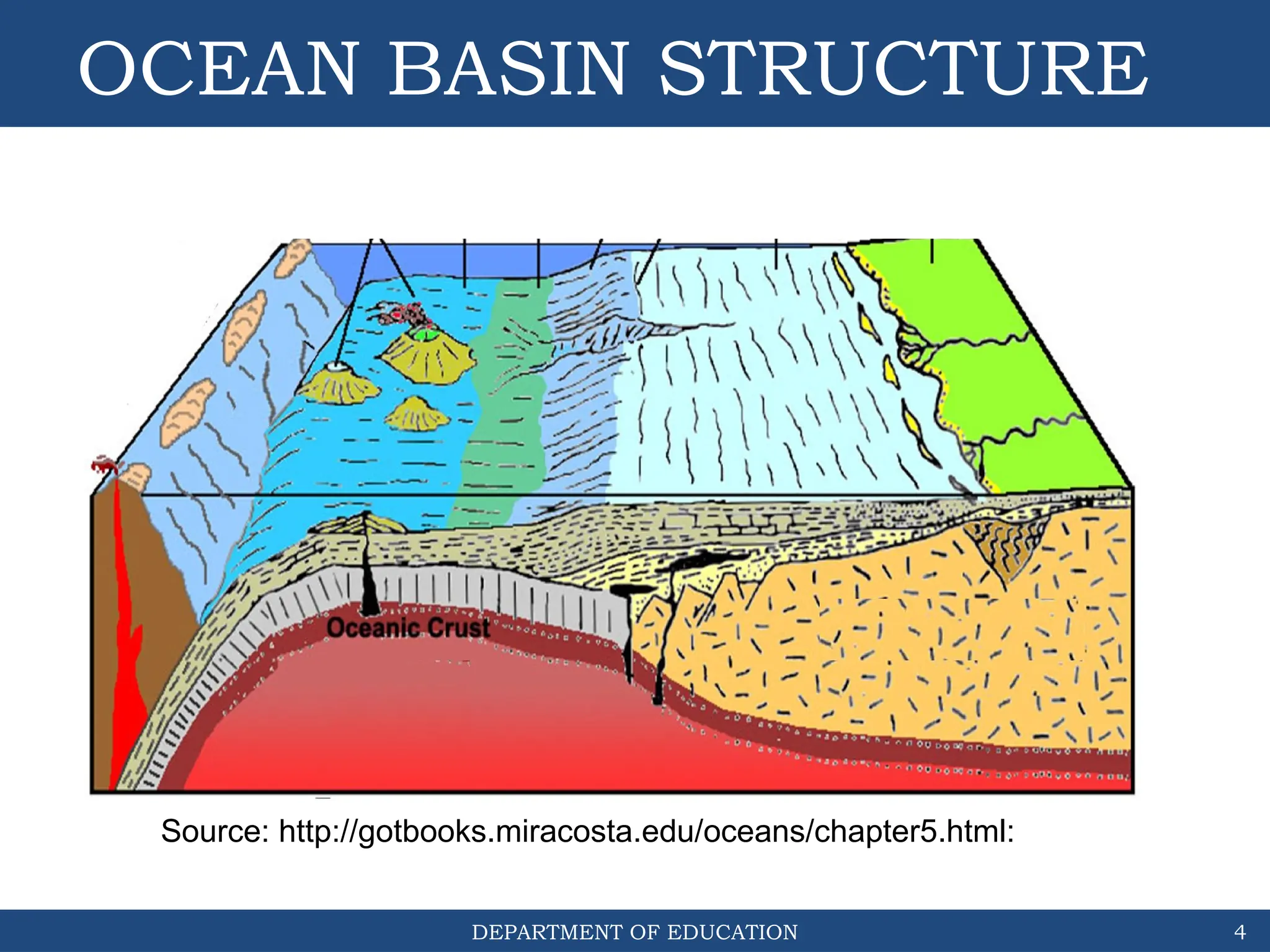
OCEAN BASIN STRUCTURE
4
Source: http://gotbooks.miracosta.edu/oceans/chapter5.html:
DEPARTMENT OF EDUCATION
OCEAN BASIN STRUCTURE
5
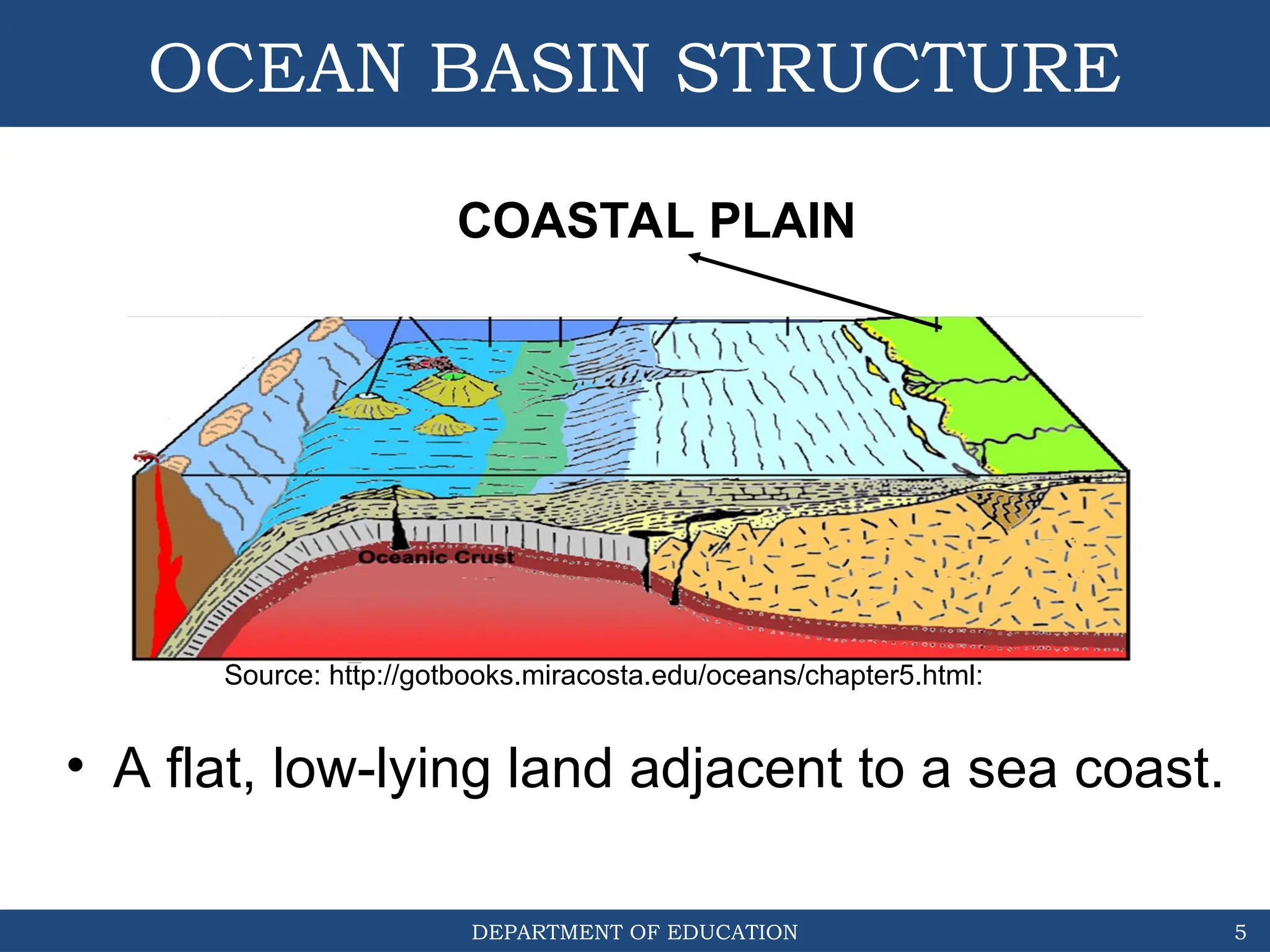
COASTAL PLAIN
• A flat, low-lying land adjacent to a sea coast.
Source: http://gotbooks.miracosta.edu/oceans/chapter5.html:
DEPARTMENT OF EDUCATION
OCEAN BASIN STRUCTURE
6
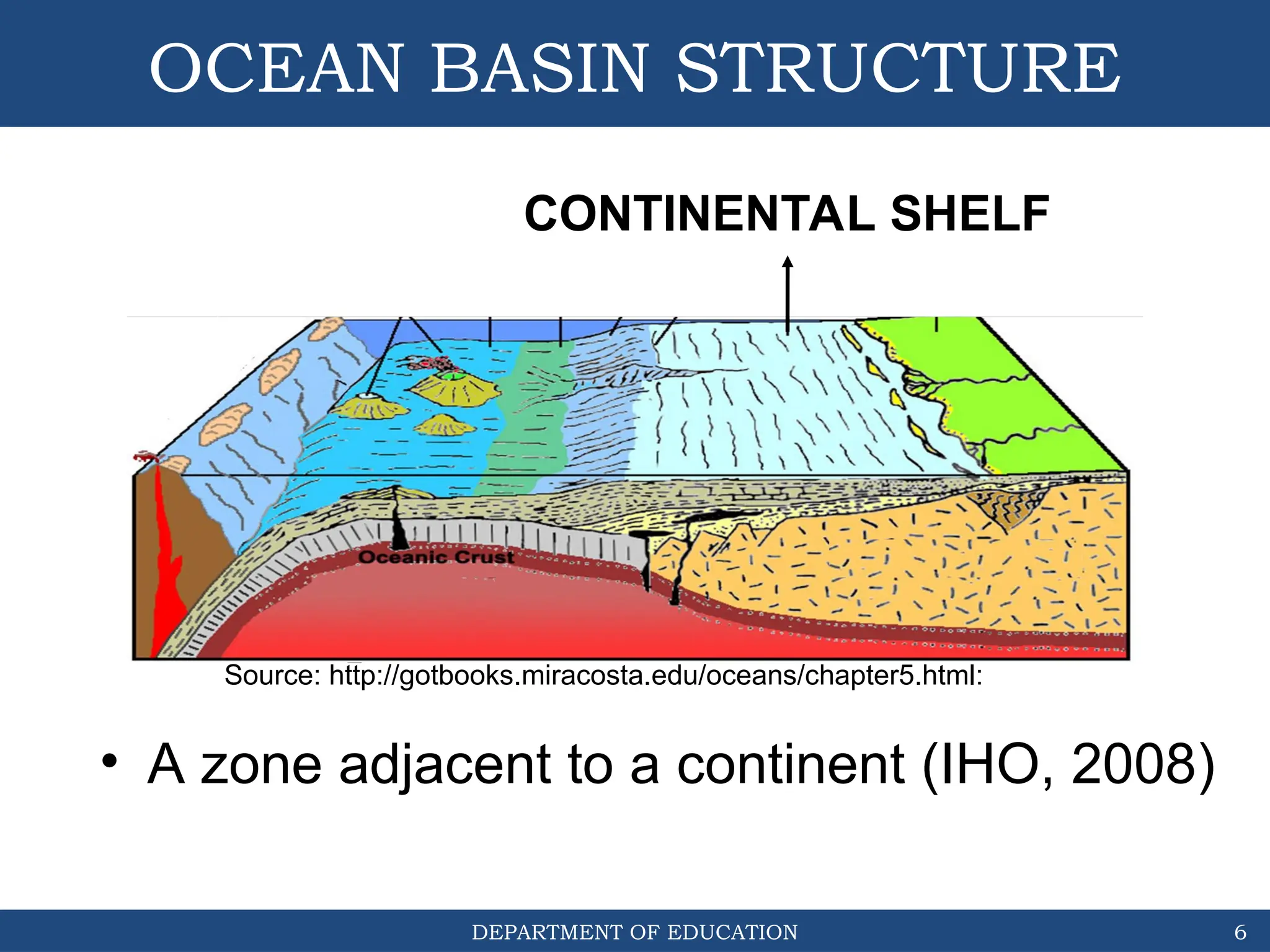
CONTINENTAL SHELF
• A zone adjacent to a continent (IHO, 2008)
Source: http://gotbooks.miracosta.edu/oceans/chapter5.html:
DEPARTMENT OF EDUCATION
OCEAN BASIN STRUCTURE
7
CONTINENTAL SLOPE
• It is between the outer edge of the
continental shelf and the deep ocean floor.
Source: http://gotbooks.miracosta.edu/oceans/chapter5.html:
DEPARTMENT OF EDUCATION
OCEAN BASIN STRUCTURE
8
CONTINENTAL BREAK
• A boundary between the continental slope
and shelf.
Source: http://gotbooks.miracosta.edu/oceans/chapter5.html:
DEPARTMENT OF EDUCATION
OCEAN BASIN STRUCTURE
9
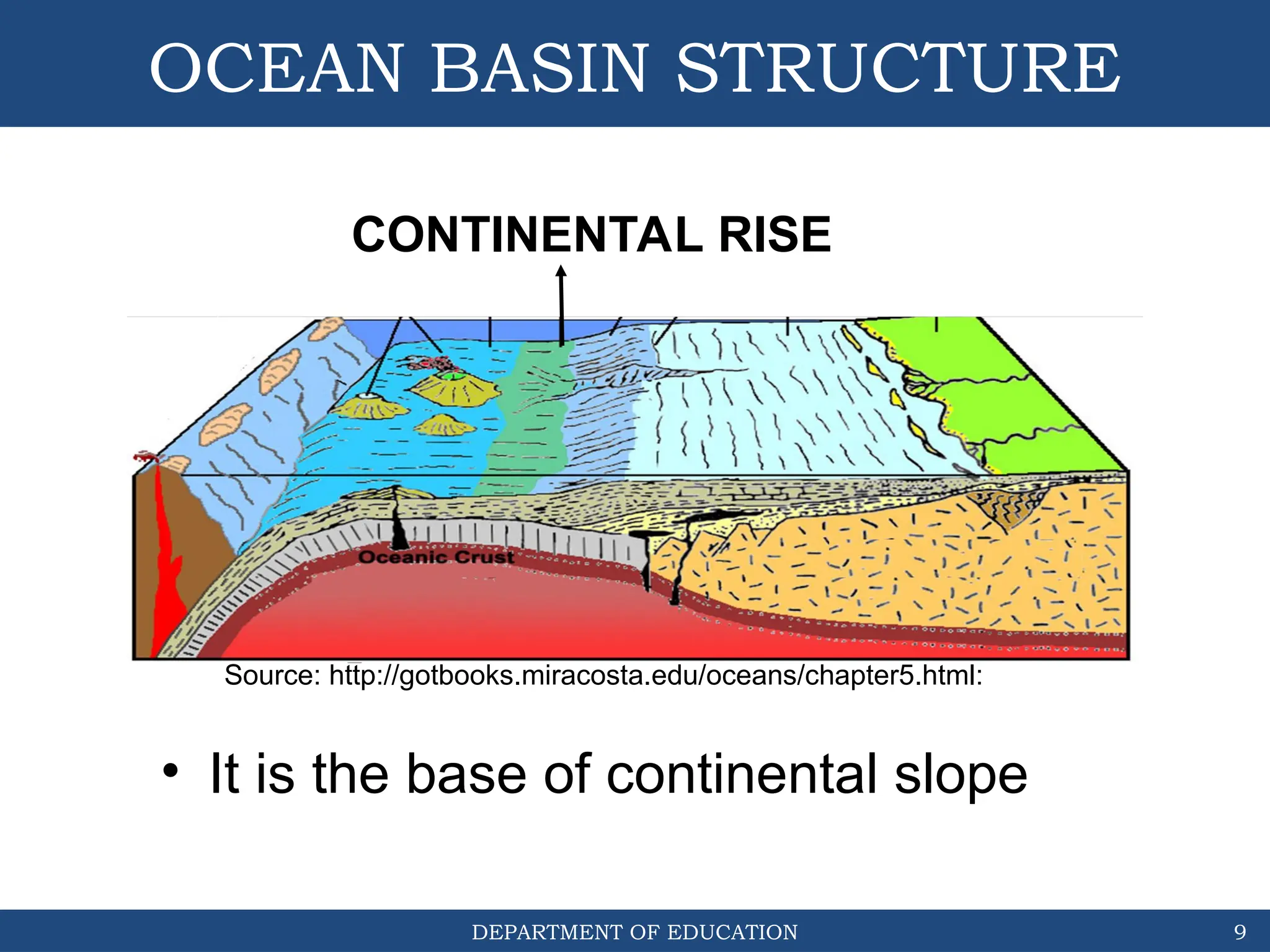
CONTINENTAL RISE
• It is the base of continental slope
Source: http://gotbooks.miracosta.edu/oceans/chapter5.html:
DEPARTMENT OF EDUCATION
OCEAN BASIN STRUCTURE
10
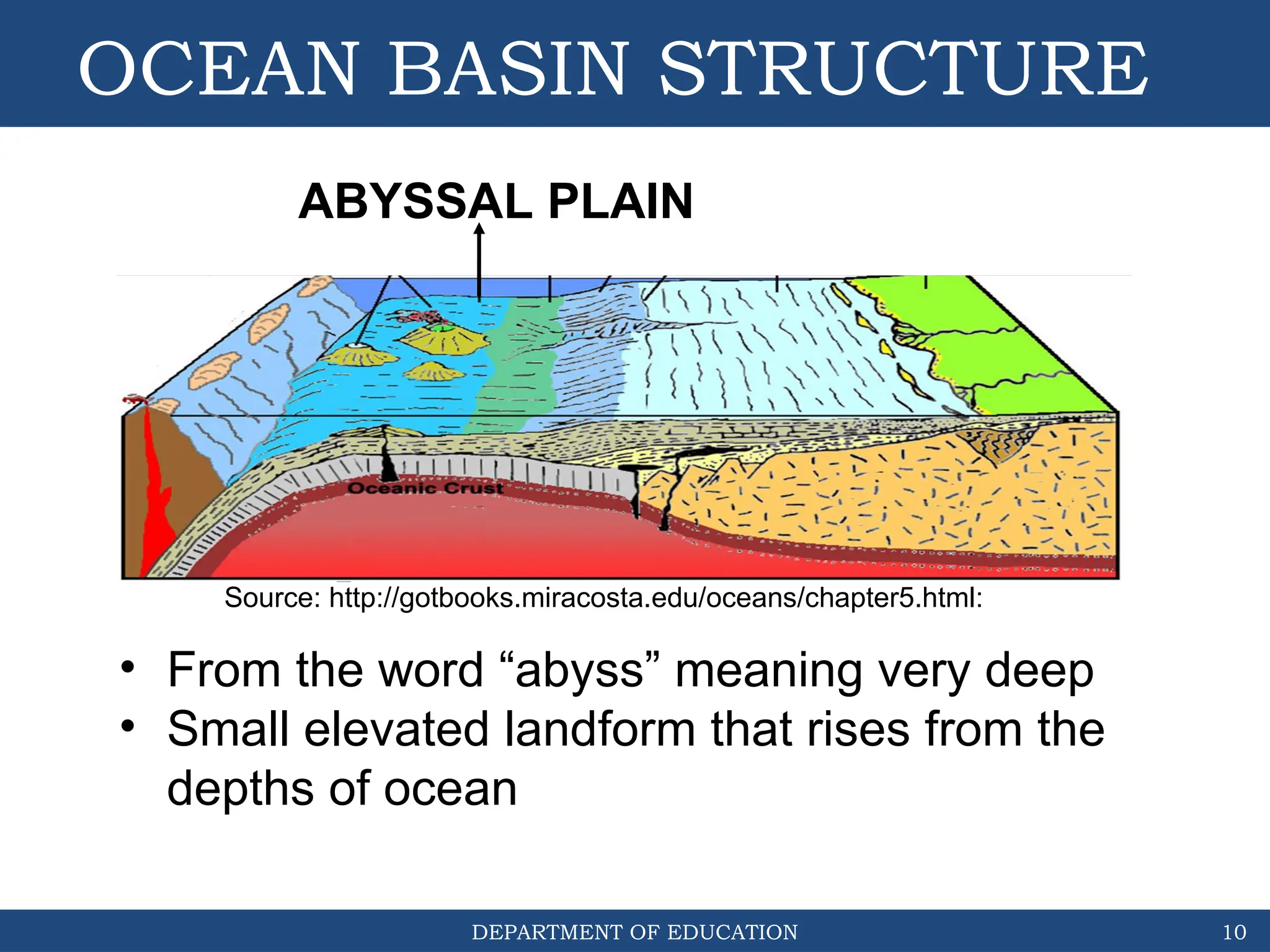
ABYSSAL PLAIN
• From the word “abyss” meaning very deep
• Small elevated landform that rises from the
depths of ocean
Source: http://gotbooks.miracosta.edu/oceans/chapter5.html:
DEPARTMENT OF EDUCATION
OCEAN BASIN STRUCTURE
11
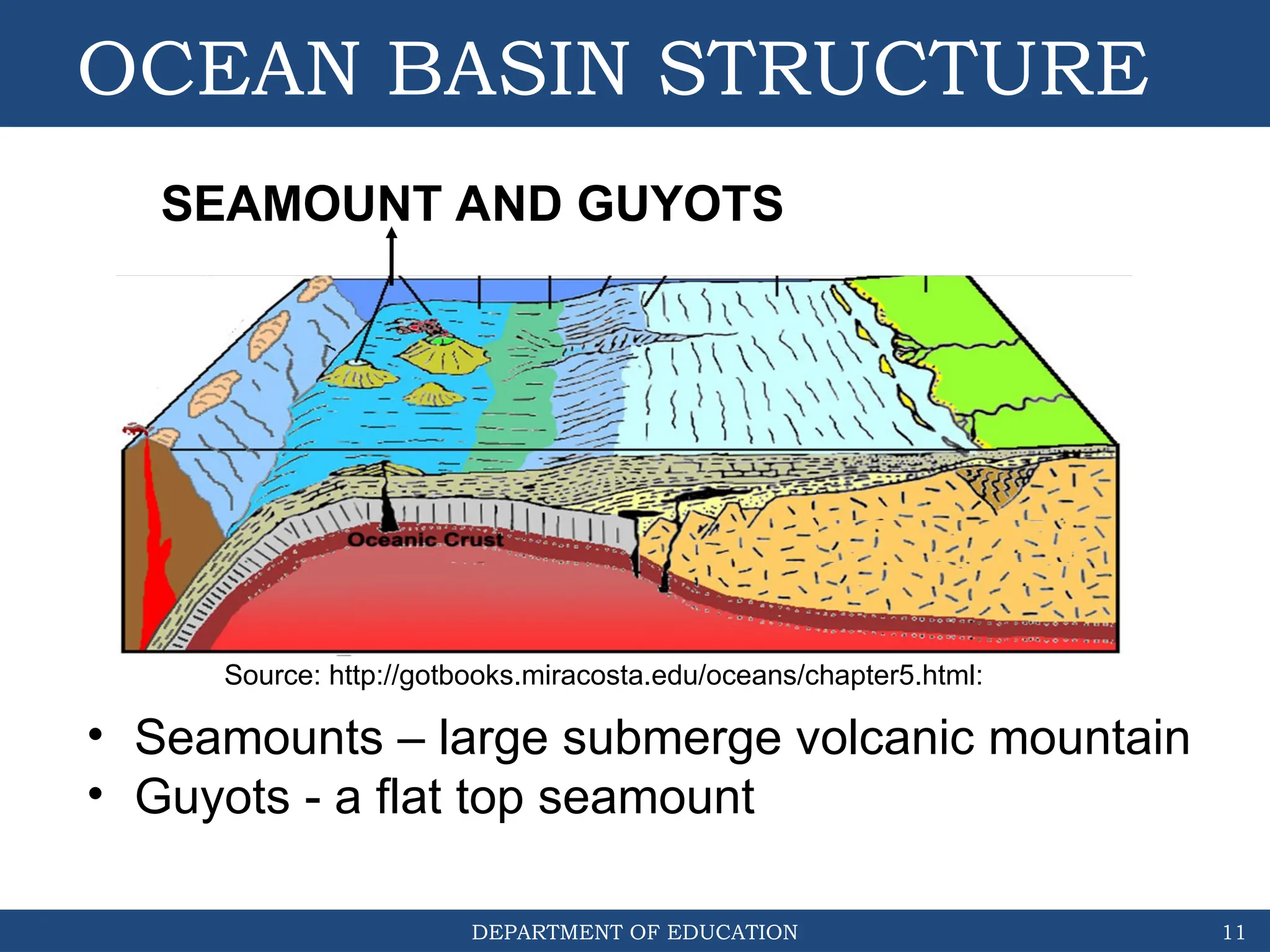
SEAMOUNT AND GUYOTS
• Seamounts – large submerge volcanic mountain
• Guyots - a flat top seamount
Source: http://gotbooks.miracosta.edu/oceans/chapter5.html:
DEPARTMENT OF EDUCATION
OCEAN BASIN STRUCTURE
12
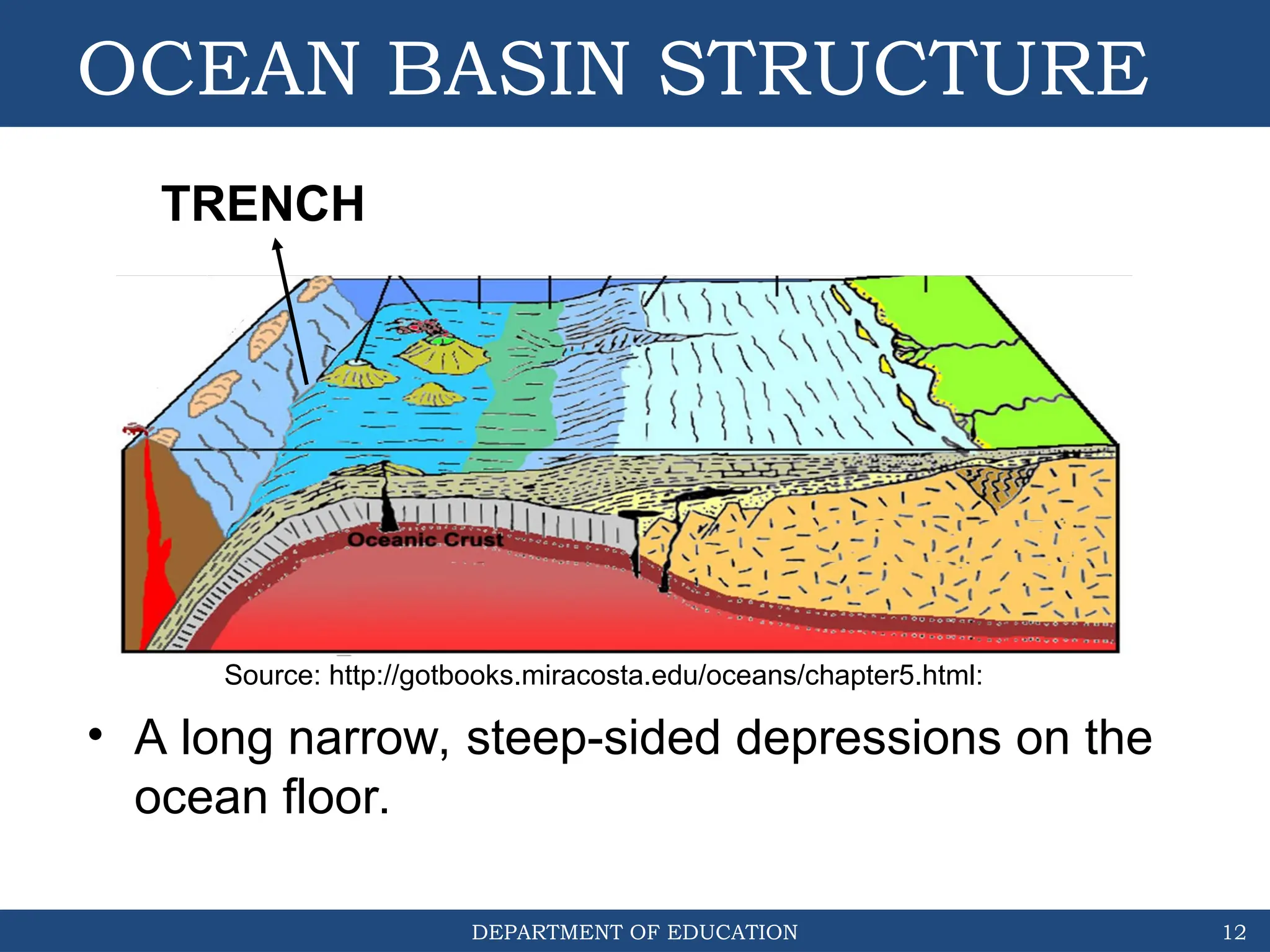
TRENCH
• A long narrow, steep-sided depressions on the
ocean floor.
Source: http://gotbooks.miracosta.edu/oceans/chapter5.html:
DEPARTMENT OF EDUCATION
OCEAN BASIN STRUCTURE
13
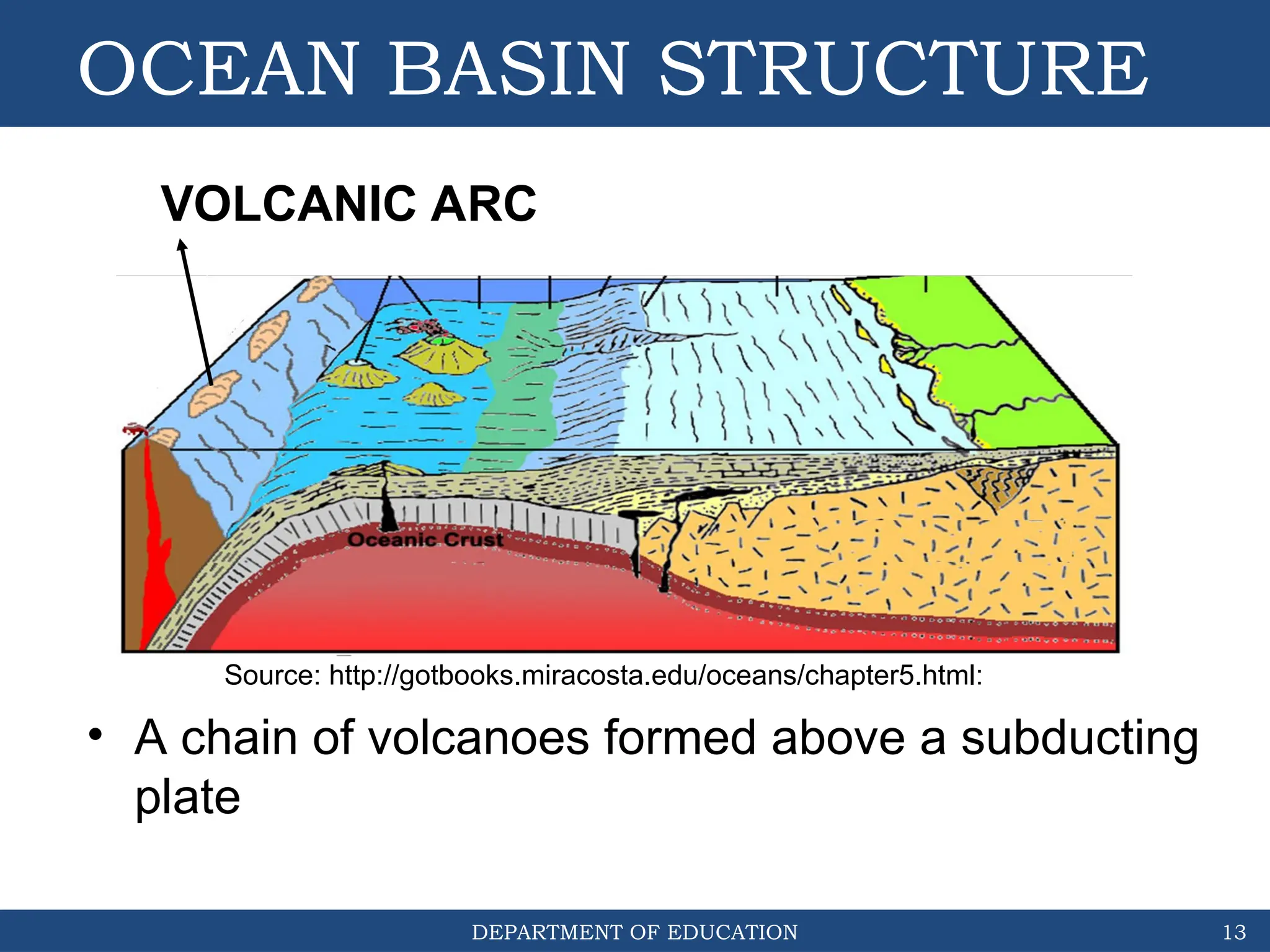
VOLCANIC ARC
• A chain of volcanoes formed above a subducting
plate
Source: http://gotbooks.miracosta.edu/oceans/chapter5.html:
DEPARTMENT OF EDUCATION
OCEAN BASIN STRUCTURE
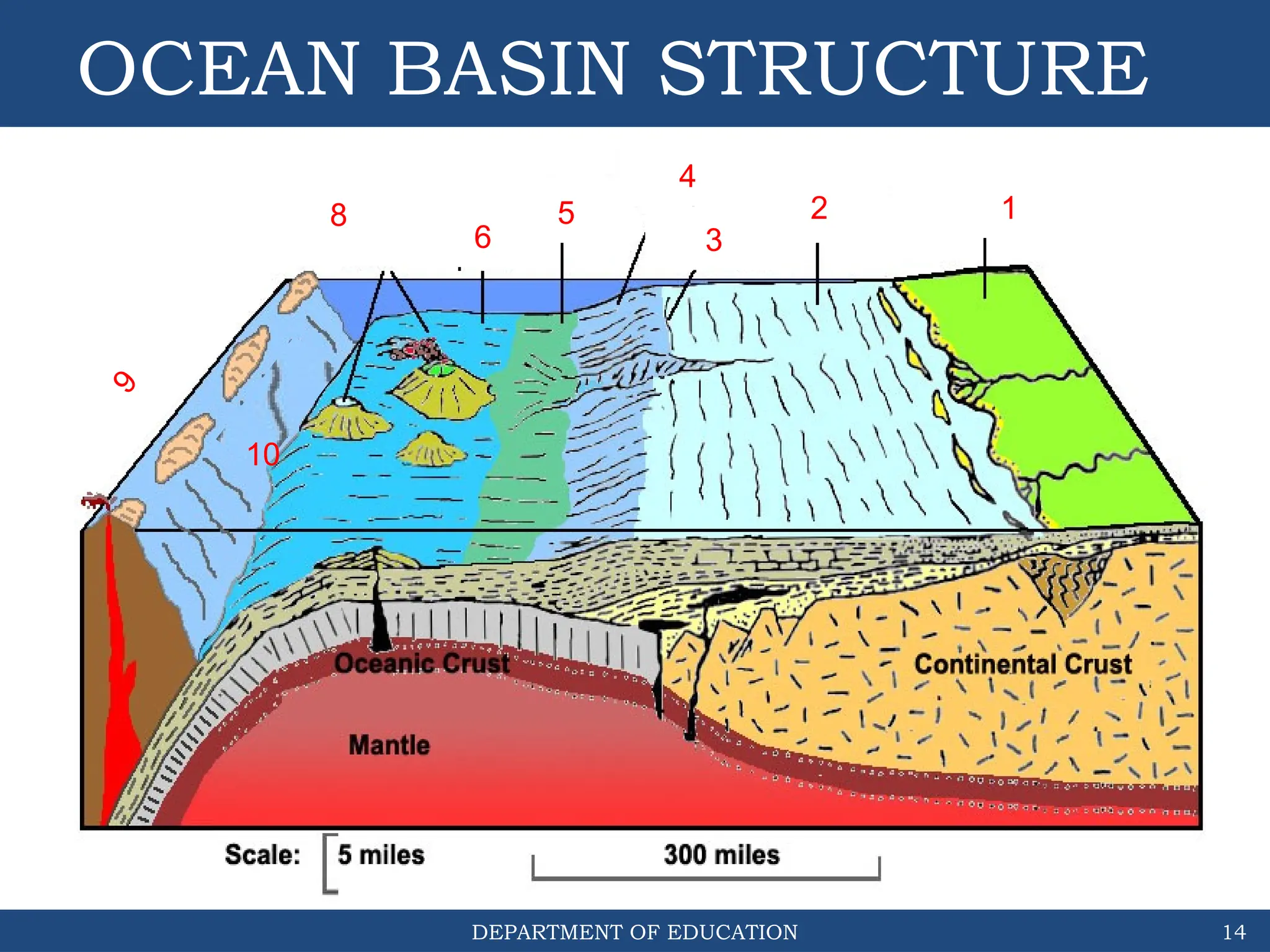
14
8
9
6
5
4
3
2 1
10
DEPARTMENT OF EDUCATION 15
OCEAN BASINS
of
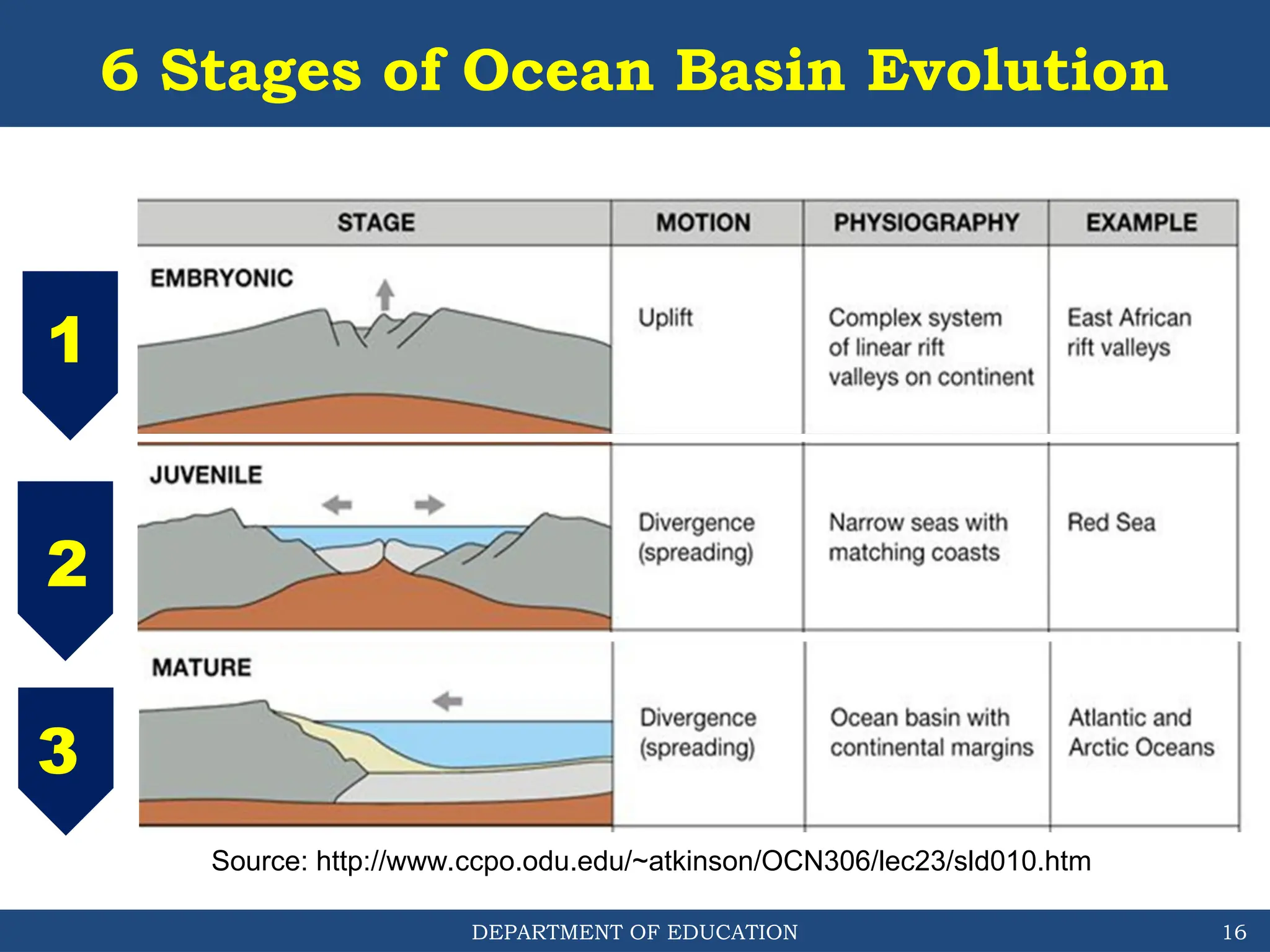
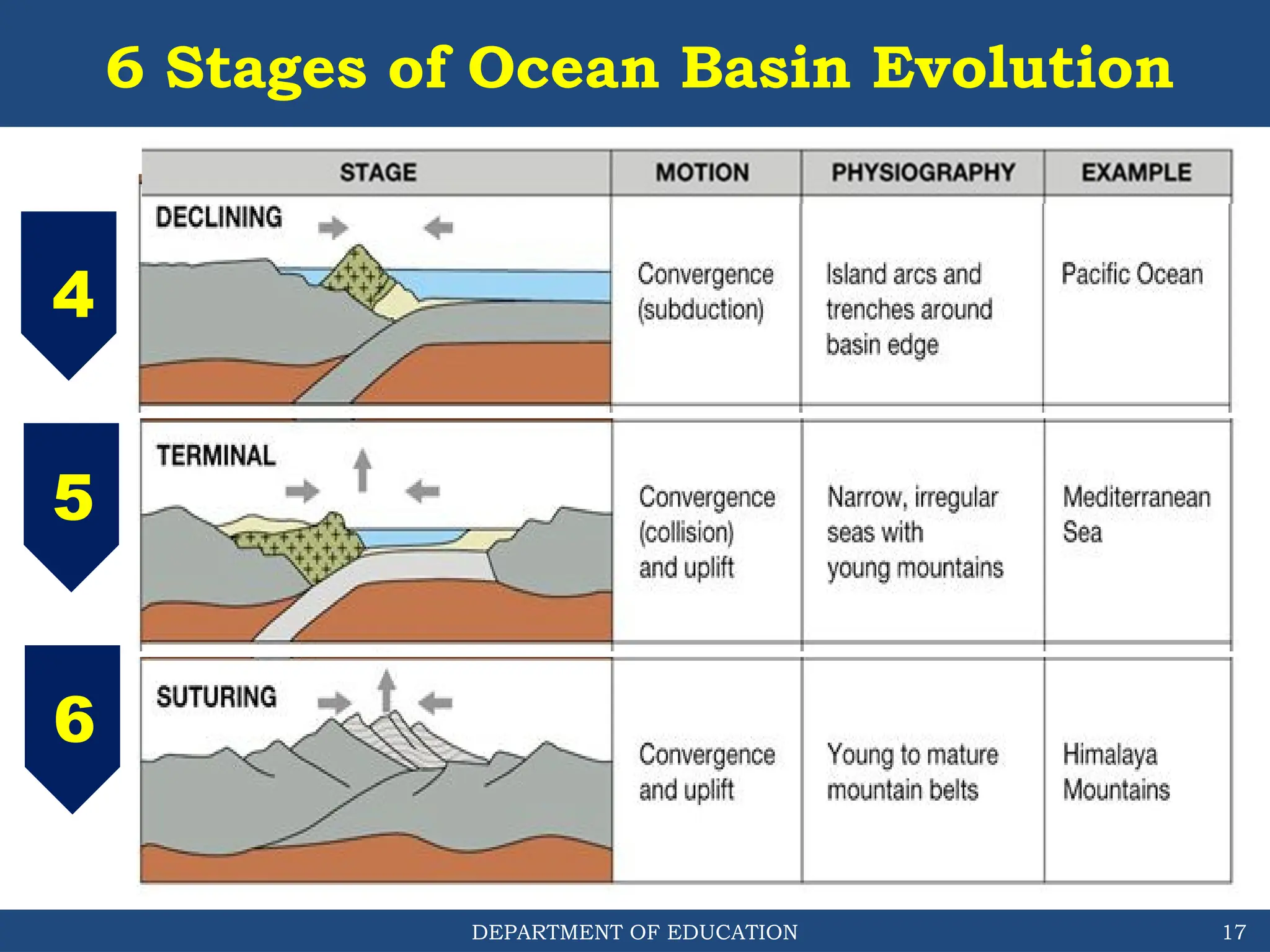
• It is a cycle of opening and closing ocean basins.
• It uses plate tectonic process to show the
development of ocean basin.
• It has six stages.
The Wilson Cycle
DEPARTMENT OF EDUCATION 16
6 Stages of Ocean Basin Evolution
1
2
3
Source: http://www.ccpo.odu.edu/~atkinson/OCN306/lec23/sld010.htm
DEPARTMENT OF EDUCATION
6 Stages of Ocean Basin Evolution
17
4
5
6
Source: http://www.ccpo.odu.edu/~atkinson/OCN306/lec23/sld010.htm
DEPARTMENT OF EDUCATION
BRING IT ON!
• As a student, how can you
contribute in taking care of our
ocean basin?
18
DEPARTMENT OF EDUCATION
THINK IT OVER AGAIN!
1. Make an illustration describing the
structure of the ocean basin.
2. Describe the evolution of the ocean basin
using a flow chart.
19

OCEAN BASIN - its structure and evolution.

  • 1.
    THE STRUCTURE &EVOLUTION OF OCEAN BASIN EARTH AND LIFE SCIENCE QUARTER I
  • 2.
    DEPARTMENT OF EDUCATION LearningCompetency: • The learners describe the structure and evolution of ocean basins S11/12ES-Id-24 2
  • 3.
    DEPARTMENT OF EDUCATION OCEANVISION! Activity: 1.Imaginethat you have the power to have a tour underwater. 2.Think about how the depths of the ocean look like. 3.In a sheet of paper illustrate the significant features you have seen in your imagination. 4.Label it and show it to your classmates. 3
  • 4.
    DEPARTMENT OF EDUCATION OCEANBASIN STRUCTURE 4 Source: http://gotbooks.miracosta.edu/oceans/chapter5.html:
  • 5.
    DEPARTMENT OF EDUCATION OCEANBASIN STRUCTURE 5 COASTAL PLAIN • A flat, low-lying land adjacent to a sea coast. Source: http://gotbooks.miracosta.edu/oceans/chapter5.html:
  • 6.
    DEPARTMENT OF EDUCATION OCEANBASIN STRUCTURE 6 CONTINENTAL SHELF • A zone adjacent to a continent (IHO, 2008) Source: http://gotbooks.miracosta.edu/oceans/chapter5.html:
  • 7.
    DEPARTMENT OF EDUCATION OCEANBASIN STRUCTURE 7 CONTINENTAL SLOPE • It is between the outer edge of the continental shelf and the deep ocean floor. Source: http://gotbooks.miracosta.edu/oceans/chapter5.html:
  • 8.
    DEPARTMENT OF EDUCATION OCEANBASIN STRUCTURE 8 CONTINENTAL BREAK • A boundary between the continental slope and shelf. Source: http://gotbooks.miracosta.edu/oceans/chapter5.html:
  • 9.
    DEPARTMENT OF EDUCATION OCEANBASIN STRUCTURE 9 CONTINENTAL RISE • It is the base of continental slope Source: http://gotbooks.miracosta.edu/oceans/chapter5.html:
  • 10.
    DEPARTMENT OF EDUCATION OCEANBASIN STRUCTURE 10 ABYSSAL PLAIN • From the word “abyss” meaning very deep • Small elevated landform that rises from the depths of ocean Source: http://gotbooks.miracosta.edu/oceans/chapter5.html:
  • 11.
    DEPARTMENT OF EDUCATION OCEANBASIN STRUCTURE 11 SEAMOUNT AND GUYOTS • Seamounts – large submerge volcanic mountain • Guyots - a flat top seamount Source: http://gotbooks.miracosta.edu/oceans/chapter5.html:
  • 12.
    DEPARTMENT OF EDUCATION OCEANBASIN STRUCTURE 12 TRENCH • A long narrow, steep-sided depressions on the ocean floor. Source: http://gotbooks.miracosta.edu/oceans/chapter5.html:
  • 13.
    DEPARTMENT OF EDUCATION OCEANBASIN STRUCTURE 13 VOLCANIC ARC • A chain of volcanoes formed above a subducting plate Source: http://gotbooks.miracosta.edu/oceans/chapter5.html:
  • 14.
    DEPARTMENT OF EDUCATION OCEANBASIN STRUCTURE 14 8 9 6 5 4 3 2 1 10
  • 15.
    DEPARTMENT OF EDUCATION15 OCEAN BASINS of • It is a cycle of opening and closing ocean basins. • It uses plate tectonic process to show the development of ocean basin. • It has six stages. The Wilson Cycle
  • 16.
    DEPARTMENT OF EDUCATION16 6 Stages of Ocean Basin Evolution 1 2 3 Source: http://www.ccpo.odu.edu/~atkinson/OCN306/lec23/sld010.htm
  • 17.
    DEPARTMENT OF EDUCATION 6Stages of Ocean Basin Evolution 17 4 5 6 Source: http://www.ccpo.odu.edu/~atkinson/OCN306/lec23/sld010.htm
  • 18.
    DEPARTMENT OF EDUCATION BRINGIT ON! • As a student, how can you contribute in taking care of our ocean basin? 18
  • 19.
    DEPARTMENT OF EDUCATION THINKIT OVER AGAIN! 1. Make an illustration describing the structure of the ocean basin. 2. Describe the evolution of the ocean basin using a flow chart. 19

Editor's Notes

  • #4 Let us now unravel the depths of the Earth as we unfold the structure of the ocean basin. Ask the students: Do you have similar illustration as the picture on screen? What are the significant feature you have seen?
  • #16 1. Embryonic First up we have the embryonic stage. Just like its name, embryonic is the first stage of ocean basin evolution. In this stage the rift valley is formed while the continent is begins to split. However, before that the ocean basin is experience the rifting and also volcanic at the beginning. The movement that appears in this stage is the uplift of the bottom part of the ocean. This kind of movement that allows the formed of rift valley and the splitting of the continent. On the other hand, there are some example for the embryonic stage such as the Great Rift Valley, southern Red Sea, and Eastern Africa. What you need to know is that in this very first stage you can see a complex system that is marked by the linear rift valley and or the continents. rift valley forms as continent begins to split Great Rift Valley, Eastern Africa 2. Juvenile After the embryonic stage, we have the juvenile stage. In this stage, the movement that appears and happens is the subsidence of the ocean bottom and it will spread. The subsidence and the spreading will create the deviation of the continent. And because of the diverge, the seafloor basalt will be created. So basically, when the separation happens, the gap is filled with the basalt and that is how the basalt is created. Meanwhile, Juvenile stage makes the existence of oceanic crust occur below the sea level with the shape of thin and dense. And example of the juvenile stage is the Red Sea. And also in this stage you can see that the narrow seas will match the coast perfectly.sea-floor basalts begin forming as continental sections diverge  Red Sea 3. Mature Next up, after the juvenile stage of ocean basin revolution we have the mature stage. For the mature stage, the ocean basin experience the widening, trench developing, and the start of subduction. An example for the mature stage is the Atlantic Ocean. Then, to know either the stage of the ocean basin evolution is in the mature stage or not there is a characteristic that you can know. The characteristic is the existence of the continental margins in the ocean seafloor that creates the ocean basin. -broad ocean basin widens, trenches develop and subduction begins   Atlantic Ocean
  • #17 4. Declining In the declining stage, the movement that appear and happens is the continuous of the sub-duction. And because of this, the ocean seafloor and also the ocean ridge is being eliminated. There is one example of the declining stage which is the Pacific Ocean. To know either the ocean basin is in the declining stage or not there is a character that differentiate this stage from another stages. In addition, usually the geologist will see either there is a island arcs and the island trenches around the basin edge or not. If there is, then the ocean basin is in the stage of declining -subduction eliminates much of sea floor and oceanic ridge Pacific Ocean 5. Terminal And in the terminal stage the movement that appears and happens are the uplift and the converge. The uplift and the convergence that is experienced by the ocean basin creating the ocean basin become narrow. The narrow ocean basin may be caused by sediment input that make the young mountain exist along and around the flanks. And in the terminal stage the ocean basin that has been created is shallow. Meanwhile, to let you know which ocean is in the terminal stage or not you can see the existence of the young mountains in the ocean. If the ocean or the seas are narrow, irregular, and exist the young mountains there it means that the oceans and or the seas are in the terminal stage. An example of the sea that is in the terminal stage is the Mediterranean Sea. Another example of the terminal stage is the Persian Gulf. - narrow ocean basin, possibly shallowing because of sediment input -young mountain ranges along flanks - Mediterranean Sea, Persian Gulf 6.Suturing or Continental Collision And now, we have continental collision as the last stage of ocean basin evolution. Many people also known the continental collision stage as the suturing stage. In this stage the movement that appears and happens kind of the same with the mature stage which are the uplift and the convergence. Then, what make it different from the mature stage is that in the continental collision the young mountain will grow and become the mature mountains. The changes from the young mountains become mature mountains is being caused by the collide of continents. After the elimination of seafloor and the collide of continents there will be created and or the forming of the continental mountains chain. The examples of the continental collision are the Himalaya and Tibetan Plateau.last of the sea floor is eliminated and continents collide, - forming a continental mountain chain. Himalayas and Tibetan Plateau