
ENERGY AND CHEMICAL CHANGES
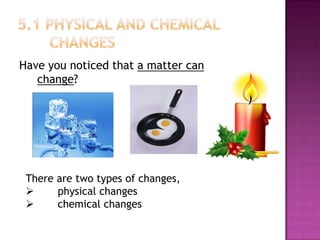
Have you noticed that a matter can
change?

There are two types of changes,

physical changes

chemical changes
a)

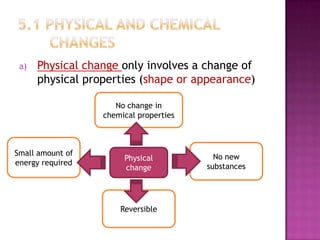
Physical change only involves a change of
physical properties (shape or appearance)
No change in
chemical properties

Small amount of
energy required

Physical
change

Reversible

No new
substances
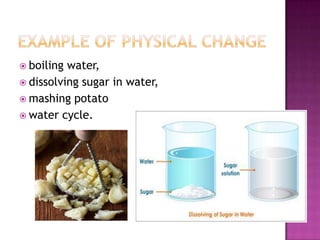
 boiling

water,
 dissolving sugar in water,
 mashing potato
 water cycle.
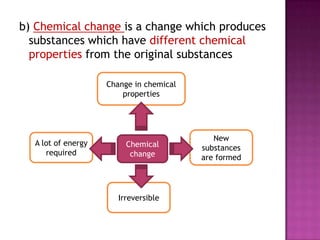
b) Chemical change is a change which produces
substances which have different chemical
properties from the original substances
Change in chemical
properties

A lot of energy
required

Chemical
change

Irreversible

New
substances
are formed
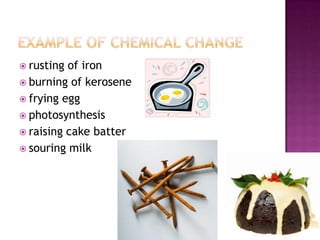
 rusting

of iron
 burning of kerosene
 frying egg
 photosynthesis
 raising cake batter
 souring milk
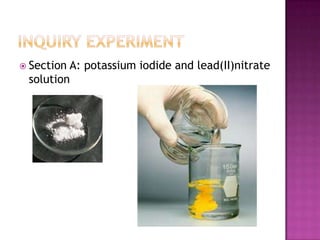
 Section

A: potassium iodide and lead(II)nitrate
solution
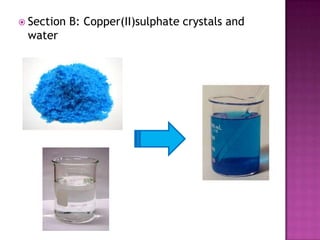
 Section

water

B: Copper(II)sulphate crystals and
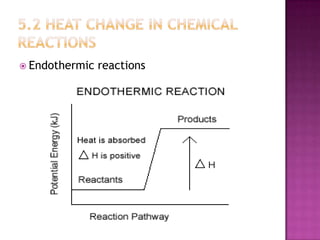
 Endothermic

reactions
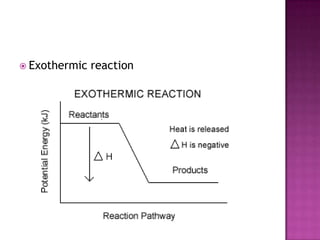
 Exothermic

reaction
 Aim:

to study exothermic and endothermic
reactions
 Hypothesis: different types of chemical reactions
cause different changes in temperature
 Variables:
constant variables: volume of distilled water
manipulated variable: type of substance
responding variable: final temperature
 Materials and apparatus:sodium hydroxide,
Ammonium chloride, distilled water, test tube,
thermometer, spatula


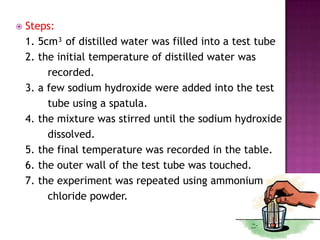
Steps:
1. 5cm³ of distilled water was filled into a test tube
2. the initial temperature of distilled water was
recorded.
3. a few sodium hydroxide were added into the test
tube using a spatula.
4. the mixture was stirred until the sodium hydroxide
dissolved.
5. the final temperature was recorded in the table.
6. the outer wall of the test tube was touched.
7. the experiment was repeated using ammonium
chloride powder.


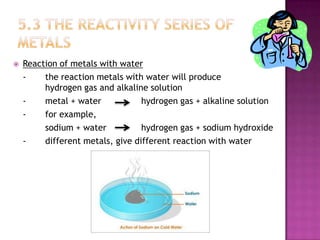
Reaction of metals with water
the reaction metals with water will produce
hydrogen gas and alkaline solution
metal + water
hydrogen gas + alkaline solution
for example,
sodium + water
hydrogen gas + sodium hydroxide
different metals, give different reaction with water


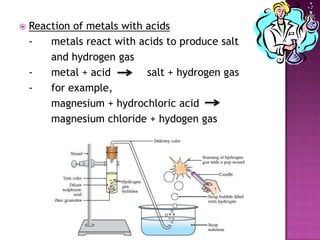
Reaction of metals with acids
metals react with acids to produce salt
and hydrogen gas
metal + acid
salt + hydrogen gas
for example,
magnesium + hydrochloric acid
magnesium chloride + hydogen gas


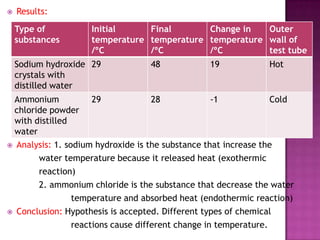
Results:
Type of
substances

Initial
Final
Change in
Outer
temperature temperature temperature wall of
/ºC
/ºC
/ºC
test tube

Sodium hydroxide 29
crystals with
distilled water

48

19

Hot

Ammonium
29
28
-1
Cold
chloride powder
with distilled
water
 Analysis: 1. sodium hydroxide is the substance that increase the
water temperature because it released heat (exothermic
reaction)
2. ammonium chloride is the substance that decrease the water
temperature and absorbed heat (endothermic reaction)
 Conclusion: Hypothesis is accepted. Different types of chemical
reactions cause different change in temperature.
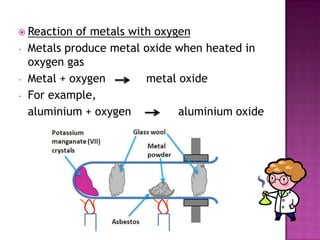
 Reaction
-

of metals with oxygen
Metals produce metal oxide when heated in
oxygen gas
Metal + oxygen
metal oxide
For example,
aluminium + oxygen
aluminium oxide
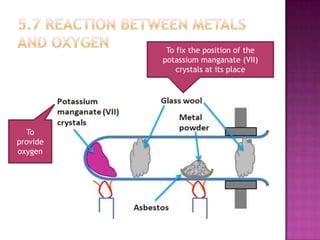
To fix the position of the
potassium manganate (VII)
crystals at its place

To
provide
oxygen
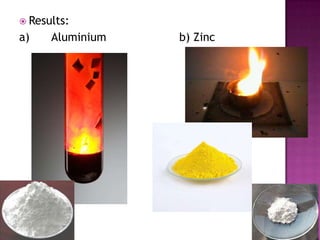
 Results:

a)

Aluminium

b) Zinc
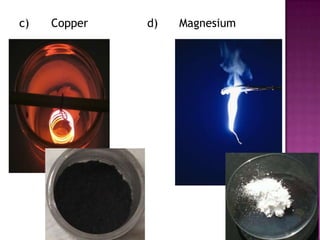
c)

Copper

d)

Magnesium


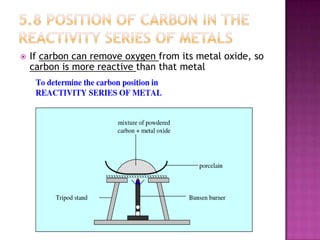
If carbon can remove oxygen from its metal oxide, so
carbon is more reactive than that metal
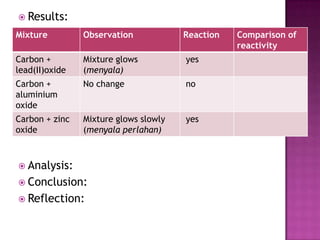
 Results:

Mixture

Observation

Reaction

Carbon +
lead(II)oxide

Mixture glows
(menyala)

yes

Carbon +
aluminium
oxide

No change

no

Carbon + zinc
oxide

Mixture glows slowly
(menyala perlahan)

yes

 Analysis:
 Conclusion:
 Reflection:

Comparison of
reactivity
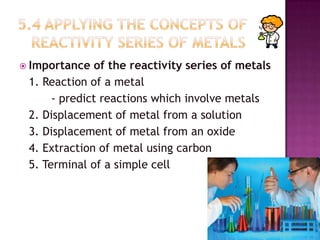
 Importance

of the reactivity series of metals
1. Reaction of a metal
- predict reactions which involve metals
2. Displacement of metal from a solution
3. Displacement of metal from an oxide
4. Extraction of metal using carbon
5. Terminal of a simple cell
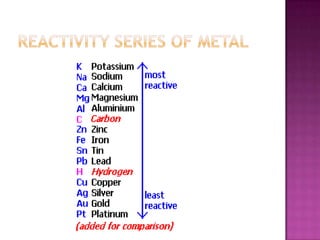
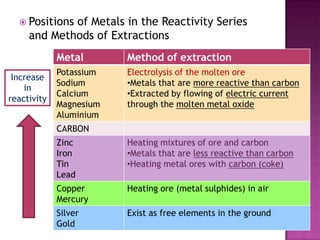
 Positions

of Metals in the Reactivity Series
and Methods of Extractions
Metal

Increase
in
reactivity

Method of extraction

Potassium
Sodium
Calcium
Magnesium
Aluminium

Electrolysis of the molten ore
•Metals that are more reactive than carbon
•Extracted by flowing of electric current
through the molten metal oxide

CARBON
Zinc
Iron
Tin
Lead

Heating mixtures of ore and carbon
•Metals that are less reactive than carbon
•Heating metal ores with carbon (coke)

Copper
Mercury

Heating ore (metal sulphides) in air

Silver
Gold

Exist as free elements in the ground
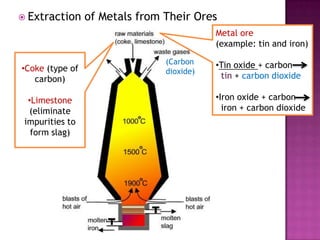
 Extraction

of Metals from Their Ores
Metal ore
(example: tin and iron)

•Coke (type of
carbon)
•Limestone
(eliminate
impurities to
form slag)

(Carbon
dioxide)

•Tin oxide + carbon
tin + carbon dioxide
•Iron oxide + carbon
iron + carbon dioxide
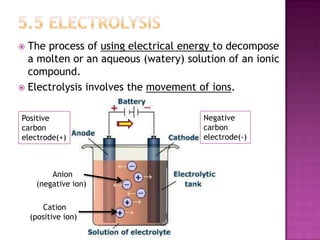
The process of using electrical energy to decompose
a molten or an aqueous (watery) solution of an ionic
compound.
 Electrolysis involves the movement of ions.


Positive
carbon
electrode(+)

Anion
(negative ion)
Cation
(positive ion)

Negative
carbon
electrode(-)
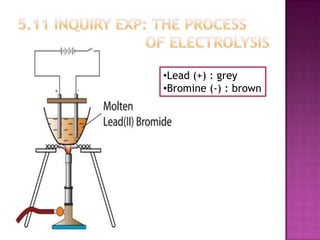
•Lead (+) : grey
•Bromine (-) : brown
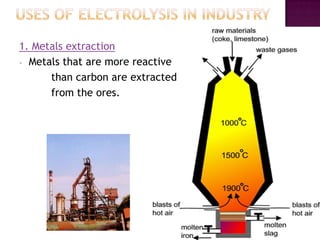
1. Metals extraction
- Metals that are more reactive
than carbon are extracted
from the ores.
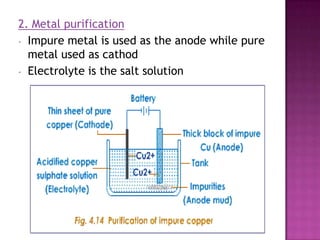
2. Metal purification
- Impure metal is used as the anode while pure
metal used as cathod
- Electrolyte is the salt solution
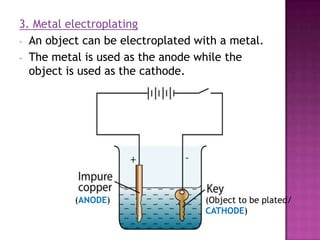
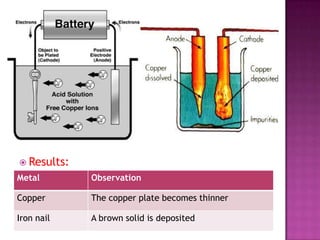
3. Metal electroplating
- An object can be electroplated with a metal.
- The metal is used as the anode while the
object is used as the cathode.

(ANODE)

(Object to be plated/
CATHODE)
 Aim:

to study the electroplating of objects
made of iron with copper
 Hypothesis: copper deposites as a thin layer
on the iron nail
 Variables:
a) Constant variable:
b) Manipulated variable:
c) Responding variable:
 Materials and apparatus:
Steps:
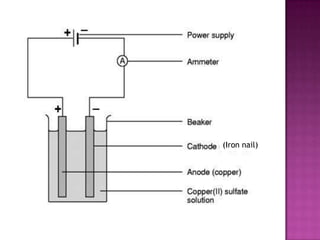
1. A beaker was filled with copper(II)sulphate solution.
2. The apparatus for the electrolysis was set up as
shown in diagram.
3. The copper plate was used as the anode whereas
the iron nail was used as the cathode.
4. The switch was turned on and a current of 0.5A
flowed through the circuit for 10 minutes.
5. The switch was turned off and the iron nail was
taken out.
6. Observation of the products at both electrodes were
recorded.

(Iron nail)
 Results:

Metal
 Analysis:

Observation

 Conclusion: The copper plate becomes thinner
Copper

Iron nail

A brown solid is deposited

-

-

-

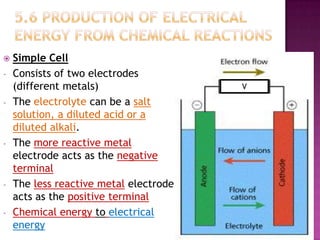
Simple Cell
Consists of two electrodes
(different metals)
The electrolyte can be a salt
solution, a diluted acid or a
diluted alkali.
The more reactive metal
electrode acts as the negative
terminal
The less reactive metal electrode
acts as the positive terminal
Chemical energy to electrical
energy

V
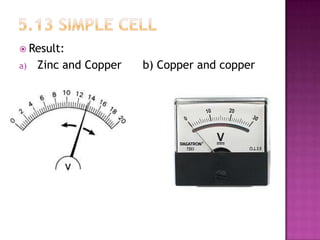
 Result:
a)

Zinc and Copper

b) Copper and copper
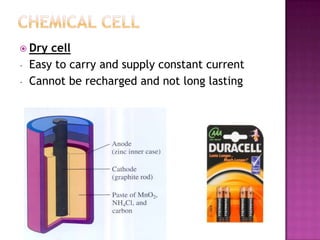
 Dry
-

cell
Easy to carry and supply constant current
Cannot be recharged and not long lasting
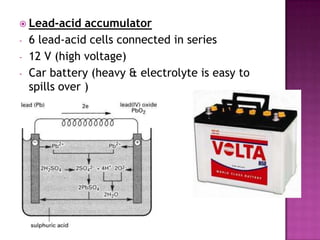
 Lead-acid
-

accumulator
6 lead-acid cells connected in series
12 V (high voltage)
Car battery (heavy & electrolyte is easy to
spills over )
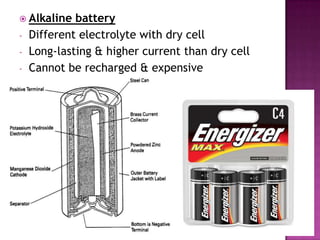
 Alkaline
-

battery
Different electrolyte with dry cell
Long-lasting & higher current than dry cell
Cannot be recharged & expensive
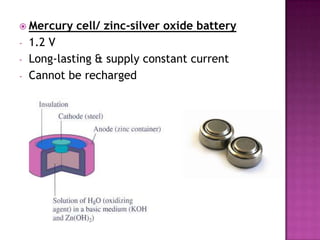
 Mercury
-

cell/ zinc-silver oxide battery

1.2 V
Long-lasting & supply constant current
Cannot be recharged
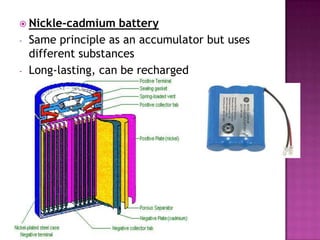
 Nickle-cadmium
-

battery
Same principle as an accumulator but uses
different substances
Long-lasting, can be recharged
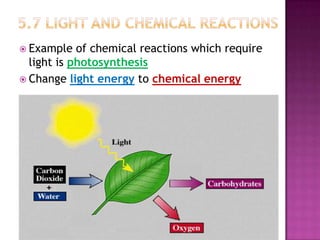
 Example

of chemical reactions which require
light is photosynthesis
 Change light energy to chemical energy
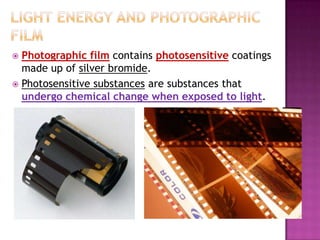
Photographic film contains photosensitive coatings
made up of silver bromide.
 Photosensitive substances are substances that
undergo chemical change when exposed to light.

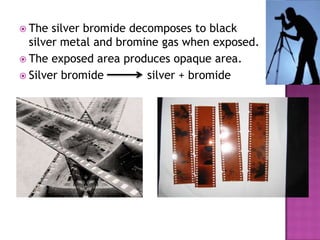
 The

silver bromide decomposes to black
silver metal and bromine gas when exposed.
 The exposed area produces opaque area.
 Silver bromide
silver + bromide
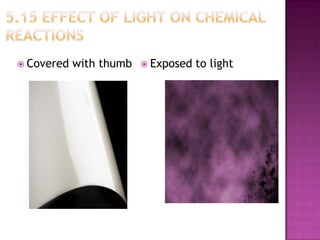
 Covered

with thumb

 Exposed

to light
Chapter 5 chemical changes

Chapter 5 chemical changes

  • 1.
  • 2.
    Have you noticedthat a matter can change? There are two types of changes,  physical changes  chemical changes
  • 3.
    a) Physical change onlyinvolves a change of physical properties (shape or appearance) No change in chemical properties Small amount of energy required Physical change Reversible No new substances
  • 4.
     boiling water,  dissolvingsugar in water,  mashing potato  water cycle.
  • 5.
    b) Chemical changeis a change which produces substances which have different chemical properties from the original substances Change in chemical properties A lot of energy required Chemical change Irreversible New substances are formed
  • 6.
     rusting of iron burning of kerosene  frying egg  photosynthesis  raising cake batter  souring milk
  • 7.
     Section A: potassiumiodide and lead(II)nitrate solution
  • 8.
  • 9.
  • 10.
  • 11.
     Aim: to studyexothermic and endothermic reactions  Hypothesis: different types of chemical reactions cause different changes in temperature  Variables: constant variables: volume of distilled water manipulated variable: type of substance responding variable: final temperature  Materials and apparatus:sodium hydroxide, Ammonium chloride, distilled water, test tube, thermometer, spatula
  • 12.
     Steps: 1. 5cm³ ofdistilled water was filled into a test tube 2. the initial temperature of distilled water was recorded. 3. a few sodium hydroxide were added into the test tube using a spatula. 4. the mixture was stirred until the sodium hydroxide dissolved. 5. the final temperature was recorded in the table. 6. the outer wall of the test tube was touched. 7. the experiment was repeated using ammonium chloride powder.
  • 13.
     Reaction of metalswith water the reaction metals with water will produce hydrogen gas and alkaline solution metal + water hydrogen gas + alkaline solution for example, sodium + water hydrogen gas + sodium hydroxide different metals, give different reaction with water
  • 14.
     Reaction of metalswith acids metals react with acids to produce salt and hydrogen gas metal + acid salt + hydrogen gas for example, magnesium + hydrochloric acid magnesium chloride + hydogen gas
  • 15.
     Results: Type of substances Initial Final Change in Outer temperaturetemperature temperature wall of /ºC /ºC /ºC test tube Sodium hydroxide 29 crystals with distilled water 48 19 Hot Ammonium 29 28 -1 Cold chloride powder with distilled water  Analysis: 1. sodium hydroxide is the substance that increase the water temperature because it released heat (exothermic reaction) 2. ammonium chloride is the substance that decrease the water temperature and absorbed heat (endothermic reaction)  Conclusion: Hypothesis is accepted. Different types of chemical reactions cause different change in temperature.
  • 16.
     Reaction - of metalswith oxygen Metals produce metal oxide when heated in oxygen gas Metal + oxygen metal oxide For example, aluminium + oxygen aluminium oxide
  • 17.
    To fix theposition of the potassium manganate (VII) crystals at its place To provide oxygen
  • 18.
  • 19.
  • 20.
     If carbon canremove oxygen from its metal oxide, so carbon is more reactive than that metal
  • 21.
     Results: Mixture Observation Reaction Carbon + lead(II)oxide Mixtureglows (menyala) yes Carbon + aluminium oxide No change no Carbon + zinc oxide Mixture glows slowly (menyala perlahan) yes  Analysis:  Conclusion:  Reflection: Comparison of reactivity
  • 23.
     Importance of thereactivity series of metals 1. Reaction of a metal - predict reactions which involve metals 2. Displacement of metal from a solution 3. Displacement of metal from an oxide 4. Extraction of metal using carbon 5. Terminal of a simple cell
  • 24.
     Positions of Metalsin the Reactivity Series and Methods of Extractions Metal Increase in reactivity Method of extraction Potassium Sodium Calcium Magnesium Aluminium Electrolysis of the molten ore •Metals that are more reactive than carbon •Extracted by flowing of electric current through the molten metal oxide CARBON Zinc Iron Tin Lead Heating mixtures of ore and carbon •Metals that are less reactive than carbon •Heating metal ores with carbon (coke) Copper Mercury Heating ore (metal sulphides) in air Silver Gold Exist as free elements in the ground
  • 25.
     Extraction of Metalsfrom Their Ores Metal ore (example: tin and iron) •Coke (type of carbon) •Limestone (eliminate impurities to form slag) (Carbon dioxide) •Tin oxide + carbon tin + carbon dioxide •Iron oxide + carbon iron + carbon dioxide
  • 26.
    The process ofusing electrical energy to decompose a molten or an aqueous (watery) solution of an ionic compound.  Electrolysis involves the movement of ions.  Positive carbon electrode(+) Anion (negative ion) Cation (positive ion) Negative carbon electrode(-)
  • 27.
    •Lead (+) :grey •Bromine (-) : brown
  • 28.
    1. Metals extraction -Metals that are more reactive than carbon are extracted from the ores.
  • 29.
    2. Metal purification -Impure metal is used as the anode while pure metal used as cathod - Electrolyte is the salt solution
  • 30.
    3. Metal electroplating -An object can be electroplated with a metal. - The metal is used as the anode while the object is used as the cathode. (ANODE) (Object to be plated/ CATHODE)
  • 31.
     Aim: to studythe electroplating of objects made of iron with copper  Hypothesis: copper deposites as a thin layer on the iron nail  Variables: a) Constant variable: b) Manipulated variable: c) Responding variable:  Materials and apparatus:
  • 32.
    Steps: 1. A beakerwas filled with copper(II)sulphate solution. 2. The apparatus for the electrolysis was set up as shown in diagram. 3. The copper plate was used as the anode whereas the iron nail was used as the cathode. 4. The switch was turned on and a current of 0.5A flowed through the circuit for 10 minutes. 5. The switch was turned off and the iron nail was taken out. 6. Observation of the products at both electrodes were recorded. 
  • 33.
  • 34.
     Results: Metal  Analysis: Observation Conclusion: The copper plate becomes thinner Copper Iron nail A brown solid is deposited
  • 35.
     - - - Simple Cell Consists oftwo electrodes (different metals) The electrolyte can be a salt solution, a diluted acid or a diluted alkali. The more reactive metal electrode acts as the negative terminal The less reactive metal electrode acts as the positive terminal Chemical energy to electrical energy V
  • 36.
     Result: a) Zinc andCopper b) Copper and copper
  • 37.
     Dry - cell Easy tocarry and supply constant current Cannot be recharged and not long lasting
  • 38.
     Lead-acid - accumulator 6 lead-acidcells connected in series 12 V (high voltage) Car battery (heavy & electrolyte is easy to spills over )
  • 39.
     Alkaline - battery Different electrolytewith dry cell Long-lasting & higher current than dry cell Cannot be recharged & expensive
  • 40.
     Mercury - cell/ zinc-silveroxide battery 1.2 V Long-lasting & supply constant current Cannot be recharged
  • 41.
     Nickle-cadmium - battery Same principleas an accumulator but uses different substances Long-lasting, can be recharged
  • 42.
     Example of chemicalreactions which require light is photosynthesis  Change light energy to chemical energy
  • 43.
    Photographic film containsphotosensitive coatings made up of silver bromide.  Photosensitive substances are substances that undergo chemical change when exposed to light. 
  • 44.
     The silver bromidedecomposes to black silver metal and bromine gas when exposed.  The exposed area produces opaque area.  Silver bromide silver + bromide
  • 45.