© 2016 Cengage Learning. All Rights Reserved.
The Water-Soluble
Vitamins: B
Vitamins and
Vitamin C
Chapter 10
© 2016 Cengage Learning. All Rights Reserved.
The Vitamins – An Overview
• Support nutritional health
• Differences from energy-yielding nutrients
• Structure
• Individual units
• Function
• No energy yielded
• Food contents
• Similarities with energy-yielding nutrients
© 2016 Cengage Learning. All Rights Reserved.
Bioavailability
• Amount absorbed and used by body
• Differs from amount in food
• Factors influencing bioavailability
• Efficiency of digestion
• Nutrition status
• Method of food preparation
• Source of nutrient
• Other foods consumed at same time
© 2016 Cengage Learning. All Rights Reserved.
Precursors (Provitamins)
• Inactive forms of vitamins
• Converted to active form in body
• Organic
• Can be destroyed during storage or cooking
• Solubility
• Affects absorption, transport, and excretion
• Toxicity
• More is not necessarily better
• Levels higher than UL
© 2016 Cengage Learning. All Rights Reserved.
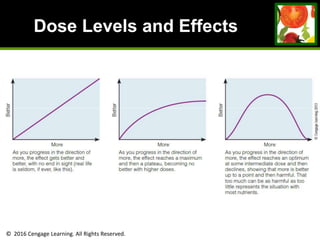
Dose Levels and Effects
© 2016 Cengage Learning. All Rights Reserved.
The B Vitamins
• Without B vitamins, the body would lack
energy
• Help body use macronutrients for fuel
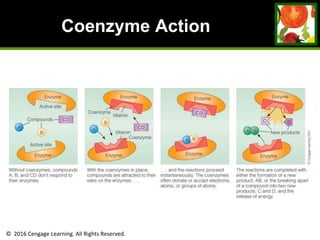
• Coenzymes
• Assist enzymes with energy release
• Without coenzyme, enzyme cannot function
• RDAs
• AIs
© 2016 Cengage Learning. All Rights Reserved.
Coenzyme Action
© 2016 Cengage Learning. All Rights Reserved.
Thiamin
• Part of coenzyme thiamin pyrophosphate
(TPP)
• Assists in energy metabolism
• Conversion of pyruvate to acetyl CoA
• TCA cycle
• Nerve activity and muscle activity
• Average intake meets or exceeds
recommendations
© 2016 Cengage Learning. All Rights Reserved.
Thiamin Deficiency and
Toxicity
• Malnourished and alcoholics
• Beriberi
• Dry – affects nervous system
• Wet – affects cardiovascular system
• Toxicity
• No adverse effects
• No UL
© 2016 Cengage Learning. All Rights Reserved.
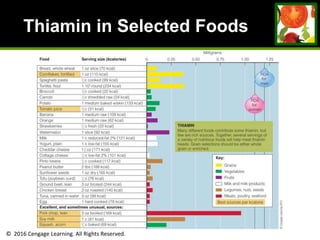
Thiamin in Selected Foods
Food
(Best Source per
kclalorie)
Serving Size (kcalories) Food Group Approximate Amount
of Thiamin (milligrams)
Bread, whole wheat 1 oz slice (70 kcal) Grains 0.10
Cornflakes, fortified 1 oz (110 kcal) Grains 0.35
Spaghetti pasta ½ c cooked (99 kcal) Grains 0.12
Tortilla, flour 1 10"-round (234 kcal) Grains 0.35
Broccoli ½ c cooked (22 kcal) Vegetables 0.05
Carrots ½ c shredded raw (24 kcal) Vegetables 0.06
Potato 1 medium baked w/skin (133 kcal) Vegetables 0.15
Tomato juice ¾ c (31 kcal) Vegetables 0.10
Banana 1 medium raw (109 kcal) Fruits 0.07
Orange 1 medium raw (62 kcal) Fruits 0.12
Strawberries ½ c fresh (22 kcal) Fruits 0.01
Watermelon 1 slice (92 kcal) Fruits 0.23
Milk 1 c reduced-fat 2% (121 kcal) Milk and milk products 0.12
Yogurt, plain 1 c low-fat (155 kcal) Milk and milk products 0.13
Cheddar cheese 1½ oz (171 kcal) Milk and milk products 0.01
Cottage cheese ½ c low-fat 2% (101 kcal) Milk and milk products 0.03
Pinto beans ½ c cooked (117 kcal) Legumes, nuts, seeds 0.18
Peanut butter 2 tbs (188 kcal) Legumes, nuts, seeds 0.05
Sunflower seeds 1 oz dry (165 kcal) Legumes, nuts, seeds 0.04
Tofu (soybean curd) ½ c (76 kcal) Legumes, nuts, seeds 0.07
Ground beef, lean 3 oz broiled (244 kcal) Meats, poultry, seafood 0.04
Chicken breast 3 oz roasted (140 kcal) Meats, poultry, seafood 0.07
Tuna, canned in water 3 oz (99 kcal) Meats, poultry, seafood 0.04
Egg 1 hard cooked (78 kcal) Meats, poultry, seafood 0.04
Excellent, and sometimes unusual, sources:
Pork chop, lean 3 oz broiled (169 kcal) Meats, poultry, seafood 0.96
Soy milk 1 c (81 kcal) Legumes, nuts, seeds 0.40
Squash, acorn ½ c baked (69 kcal) Vegetables 0.20
© 2016 Cengage Learning. All Rights Reserved.
Riboflavin
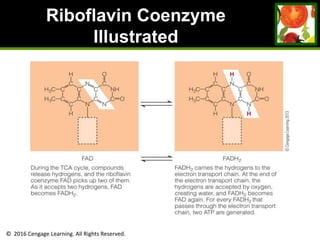
• Serves as coenzyme in energy metabolism
• Flavin mononucleotide (FMN)
• Flavin adenine dinucleotide (FAD)
• Recommendations
• Deficiency
• Inflammation of membranes
• Destroyed by ultraviolet light and irradiation
• Toxicity
• No UL
© 2016 Cengage Learning. All Rights Reserved.
Riboflavin Coenzyme
Illustrated
© 2016 Cengage Learning. All Rights Reserved.
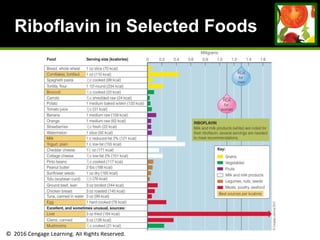
Riboflavin in Selected Foods
Food
(Best Source per
kclalorie)
Serving Size (kcalories) Food Group Approximate Amount
of Riboflavin
(milligrams)
Bread, whole wheat 1 oz slice (70 kcal) Grains 0.05
Cornflakes, fortified 1 oz (110 kcal) Grains 0.43
Spaghetti pasta ½ c cooked (99 kcal) Grains 0.06
Tortilla, flour 1 10"-round (234 kcal) Grains 0.21
Broccoli ½ c cooked (22 kcal) Vegetables 0.09
Carrots ½ c shredded raw (24 kcal) Vegetables 0.03
Potato 1 medium baked w/skin (133 kcal) Vegetables 0.04
Tomato juice ¾ c (31 kcal) Vegetables 0.05
Banana 1 medium raw (109 kcal) Fruits 0.12
Orange 1 medium raw (62 kcal) Fruits 0.06
Strawberries ½ c fresh (22 kcal) Fruits 0.06
Watermelon 1 slice (92 kcal) Fruits 0.07
Milk 1 c reduced-fat 2% (121 kcal) Milk and milk products 0.40
Yogurt, plain 1 c low-fat (155 kcal) Milk and milk products 0.53
Cheddar cheese 1½ oz (171 kcal) Milk and milk products 0.18
Cottage cheese ½ c low-fat 2% (101 kcal) Milk and milk products 0.21
Pinto beans ½ c cooked (117 kcal) Legumes, nuts, seeds 0.09
Peanut butter 2 tbs (188 kcal) Legumes, nuts, seeds 0.08
Sunflower seeds 1 oz dry (165 kcal) Legumes, nuts, seeds 0.06
Tofu (soybean curd) ½ c (76 kcal) Legumes, nuts, seeds 0.03
Ground beef, lean 3 oz broiled (244 kcal) Meats, poultry, seafood 0.15
Chicken breast 3 oz roasted (140 kcal) Meats, poultry, seafood 0.12
Tuna, canned in water 3 oz (99 kcal) Meats, poultry, seafood 0.07
Egg 1 hard cooked (78 kcal) Meats, poultry, seafood 0.26
Excellent, and sometimes unusual, sources:
Liver 3 oz fried (184 kcal) Meats, poultry, seafood 1.70+
Clams, canned 3 oz (126 kcal) Meats, poultry, seafood 0.34
Mushrooms ½ c cooked (21 kcal) Vegetables 0.23
© 2016 Cengage Learning. All Rights Reserved.
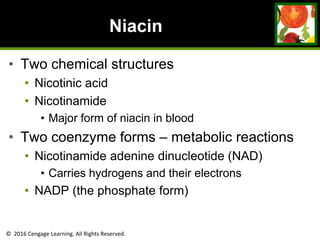
Niacin
• Two chemical structures
• Nicotinic acid
• Nicotinamide
• Major form of niacin in blood
• Two coenzyme forms – metabolic reactions
• Nicotinamide adenine dinucleotide (NAD)
• Carries hydrogens and their electrons
• NADP (the phosphate form)
© 2016 Cengage Learning. All Rights Reserved.
Niacin Needs and Results of
Deficiency
• Recommendations
• RDA stated in niacin equivalents (NE)
• Body manufactures from tryptophan
• Only occurs after protein synthesis needs have
been met
• Deficiency
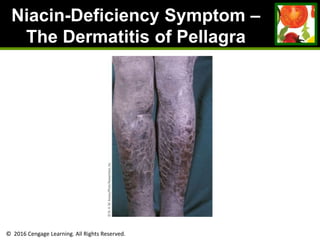
• Pellagra
• Symptoms
• Caused deaths in the U.S. south in the early 1900s
© 2016 Cengage Learning. All Rights Reserved.
Niacin-Deficiency Symptom –
The Dermatitis of Pellagra
© 2016 Cengage Learning. All Rights Reserved.
Niacin Toxicity
• Naturally occurring sources
• No harm
• Supplements or drugs
• “Niacin flush”
• Potential health benefits of large doses of
nicotinic acid
• Food sources
• Less vulnerable to food preparation losses than
other vitamins
© 2016 Cengage Learning. All Rights Reserved.
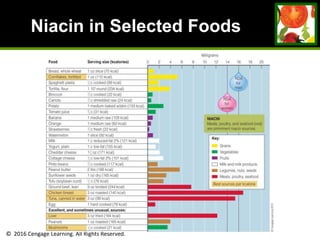
Niacin in Selected Foods
Food
(Best Source per
kclalorie)
Serving Size (kcalories) Food Group Approximate Amount
of Niacin (milligrams)
Bread, whole wheat 1 oz slice (70 kcal) Grains 1.1
Cornflakes, fortified 1 oz (110 kcal) Grains 5.1
Spaghetti pasta ½ c cooked (99 kcal) Grains 1.9
Tortilla, flour 1 10"-round (234 kcal) Grains 3.9
Broccoli ½ c cooked (22 kcal) Vegetables 0.8
Carrots ½ c shredded raw (24 kcal) Vegetables 0.5
Potato 1 medium baked w/skin (133 kcal) Vegetables 2.8
Tomato juice ¾ c (31 kcal) Vegetables 1.3
Banana 1 medium raw (109 kcal) Fruits 0.9
Orange 1 medium raw (62 kcal) Fruits 0.5
Strawberries ½ c fresh (22 kcal) Fruits 0.2
Watermelon 1 slice (92 kcal) Fruits 1.0
Milk 1 c reduced-fat 2% (121 kcal) Milk and milk products 2.0
Yogurt, plain 1 c low-fat (155 kcal) Milk and milk products 1.4
Cheddar cheese 1½ oz (171 kcal) Milk and milk products 2.1
Cottage cheese ½ c low-fat 2% (101 kcal) Milk and milk products 2.8
Pinto beans ½ c cooked (117 kcal) Legumes, nuts, seeds 1.8
Peanut butter 2 tbs (188 kcal) Legumes, nuts, seeds 5.7
Sunflower seeds 1 oz dry (165 kcal) Legumes, nuts, seeds 3.2
Tofu (soybean curd) ½ c (76 kcal) Legumes, nuts, seeds 2.8
Ground beef, lean 3 oz broiled (244 kcal) Meats, poultry, seafood 7.6
Chicken breast 3 oz roasted (140 kcal) Meats, poultry, seafood 16.7
Tuna, canned in water 3 oz (99 kcal) Meats, poultry, seafood 15.4
Egg 1 hard cooked (78 kcal) Meats, poultry, seafood 1.3
Excellent, and sometimes unusual, sources:
Liver 3 oz fried (184 kcal) Meats, poultry, seafood 12.2
Peanuts 1 oz roasted (165 kcal) Legumes, nuts, seeds 4.0
Mushrooms ½ c cooked (21 kcal) Vegetables 3.5
© 2016 Cengage Learning. All Rights Reserved.
Biotin
• Coenzyme that carries activated carbon
dioxide
• Critical in TCA cycle
• Delivers carbon to pyruvate to form oxaloacetate
• Gluconeogenesis and fatty acid synthesis
• Breakdown of fatty acids and amino acids
• Widespread in food sources
• Toxicity
• No UL
© 2016 Cengage Learning. All Rights Reserved.
Pantothenic Acid
• Part of chemical structure of coenzyme A
• Roles in body
• Recommendations
• AI has been established
• Widespread in foods
• Readily destroyed by freezing, canning, and
refining processes
• Deficiency
• Rare
© 2016 Cengage Learning. All Rights Reserved.
Vitamin B6
• Three forms
• Pyridoxal, pyridoxine, and pyridoxamine
• Conversion to coenzyme PLP
• Amino acid metabolism
• Carbohydrate and fatty acid metabolism
• Conversion of tryptophan to niacin or serotonin
• Synthesis of heme, nucleic acids, and lecithin
• Stored exclusively in muscle tissue
© 2016 Cengage Learning. All Rights Reserved.
More Facts About B6
• Deficiency
• Symptoms
• Alcohol and isoniazid function as B6 antagonists
• Toxicity
• Neurological damage
• Food sources
© 2016 Cengage Learning. All Rights Reserved.
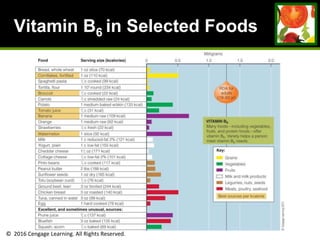
Vitamin B6 in Selected Foods
Food
(Best Source per
kclalorie)
Serving Size (kcalories) Food Group Approximate Amount
of Vitamin B6
(milligrams)
Bread, whole wheat 1 oz slice (70 kcal) Grains 0.05
Cornflakes, fortified 1 oz (110 kcal) Grains 0.51
Spaghetti pasta ½ c cooked (99 kcal) Grains 0.01
Tortilla, flour 1 10"-round (234 kcal) Grains 0.03
Broccoli ½ c cooked (22 kcal) Vegetables 0.10
Carrots ½ c shredded raw (24 kcal) Vegetables 0.08
Potato 1 medium baked w/skin (133 kcal) Vegetables 0.42
Tomato juice ¾ c (31 kcal) Vegetables 0.20
Banana 1 medium raw (109 kcal) Fruits 0.70
Orange 1 medium raw (62 kcal) Fruits 0.08
Strawberries ½ c fresh (22 kcal) Fruits 0.04
Watermelon 1 slice (92 kcal) Fruits 0.41
Milk 1 c reduced-fat 2% (121 kcal) Milk and milk products 0.10
Yogurt, plain 1 c low-fat (155 kcal) Milk and milk products 0.12
Cheddar cheese 1½ oz (171 kcal) Milk and milk products 0.03
Cottage cheese ½ c low-fat 2% (101 kcal) Milk and milk products 0.09
Pinto beans ½ c cooked (117 kcal) Legumes, nuts, seeds 0.14
Peanut butter 2 tbs (188 kcal) Legumes, nuts, seeds 0.15
Sunflower seeds 1 oz dry (165 kcal) Legumes, nuts, seeds 0.24
Tofu (soybean curd) ½ c (76 kcal) Legumes, nuts, seeds 0.07
Ground beef, lean 3 oz broiled (244 kcal) Meats, poultry, seafood 0.21
Chicken breast 3 oz roasted (140 kcal) Meats, poultry, seafood 0.52
Tuna, canned in water 3 oz (99 kcal) Meats, poultry, seafood 0.30
Egg 1 hard cooked (78 kcal) Meats, poultry, seafood 0.05
Excellent, and sometimes unusual, sources:
Prune juice ¾ c (137 kcal) Fruits 0.42
Bluefish 3 o z baked (135 kcal) Meats, poultry, seafood 0.41
Squash, acorn ½ c baked (69 kcal) Vegetables 0.25
© 2016 Cengage Learning. All Rights Reserved.
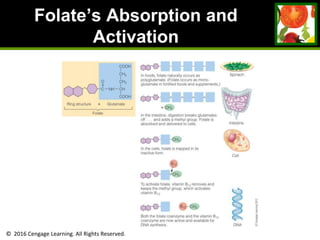
Folate
• Also known as folacin or folic acid
• Primary coenzyme form – THF
(tetrahydrofolate)
• Transfers 1-carbon compounds during
metabolism
• Converts vitamin B12 to coenzyme form
• Synthesizes DNA
• Regenerates methionine from homocysteine
© 2016 Cengage Learning. All Rights Reserved.
Folate’s Absorption and
Activation
© 2016 Cengage Learning. All Rights Reserved.
More Facts About Folate
• Bioavailability ranges from 50 to 100 percent
• Differences between food sources and
supplements
• Increased need during pregnancy
• Folate disposal
• Secretion by liver into bile
• Enterohepatic circulation
• GI tract injuries hinder absorption
© 2016 Cengage Learning. All Rights Reserved.
Effects of Folate Deficiency
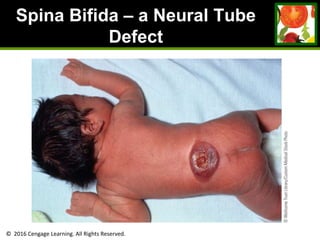
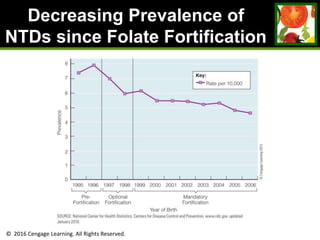
• Neural tube defects
• Supplement use during pregnancy
• One month before conception
• Through first trimester
• Fortified grain products
• Congenital birth defects
• Folate plays a role in protecting against heart
disease
• Some cancers
© 2016 Cengage Learning. All Rights Reserved.
Spina Bifida – a Neural Tube
Defect
© 2016 Cengage Learning. All Rights Reserved.
Decreasing Prevalence of
NTDs since Folate Fortification
© 2016 Cengage Learning. All Rights Reserved.
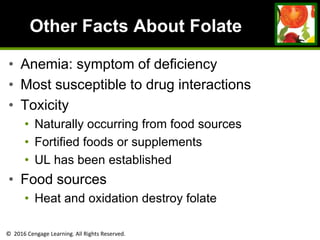
Other Facts About Folate
• Anemia: symptom of deficiency
• Most susceptible to drug interactions
• Toxicity
• Naturally occurring from food sources
• Fortified foods or supplements
• UL has been established
• Food sources
• Heat and oxidation destroy folate
© 2016 Cengage Learning. All Rights Reserved.
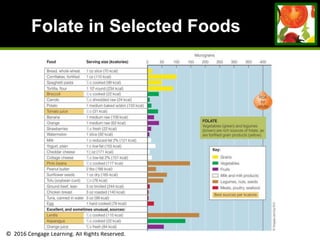
Folate in Selected Foods
Food
(Best Source per
kclalorie)
Serving Size (kcalories) Food Group Approximate Amount
of Folate (micrograms)
Bread, whole wheat 1 oz slice (70 kcal) Grains 15
Cornflakes, fortified 1 oz (110 kcal) Grains 100
Spaghetti pasta ½ c cooked (99 kcal) Grains 49
Tortilla, flour 1 10"-round (234 kcal) Grains 85
Broccoli ½ c cooked (22 kcal) Vegetables 40
Carrots ½ c shredded raw (24 kcal) Vegetables 10
Potato 1 medium baked w/skin (133 kcal) Vegetables 15
Tomato juice ½ c (31 kcal) Vegetables 38
Banana 1 medium raw (109 kcal) Fruits 23
Orange 1 medium raw (62 kcal) Fruits 40
Strawberries ½ c fresh (22 kcal) Fruits 15
Watermelon 1 slice (92 kcal) Fruits 8
Milk 1 c reduced-fat 2% (121 kcal) Milk and milk products 15
Yogurt, plain 1 c low-fat (155 kcal) Milk and milk products 25
Cheddar cheese 1½ oz (171 kcal) Milk and milk products 10
Cottage cheese ½ c low-fat 2% (101 kcal) Milk and milk products 15
Pinto beans ½ c cooked (117 kcal) Legumes, nuts, seeds 158
Peanut butter 2 tbs (188 kcal) Legumes, nuts, seeds 30
Sunflower seeds 1 oz dry (165 kcal) Legumes, nuts, seeds 70
Tofu (soybean curd) ½ c (76 kcal) Legumes, nuts, seeds 55
Ground beef, lean 3 oz broiled (244 kcal) Meats, poultry, seafood 10
Chicken breast 3 oz roasted (140 kcal) Meats, poultry, seafood 5
Tuna, canned in water 3 oz (99 kcal) Meats, poultry, seafood 5
Egg 1 hard cooked (78 kcal) Meats, poultry, seafood 20
Excellent, and sometimes unusual, sources:
Lentils ½ c cooked (115 kcal) Legumes, nuts, seeds 180
Asparagus ½ c cooked (22 kcal) Vegetables 130
Orange juice ¾ c fresh (84 kcal) Fruits 56
© 2016 Cengage Learning. All Rights Reserved.
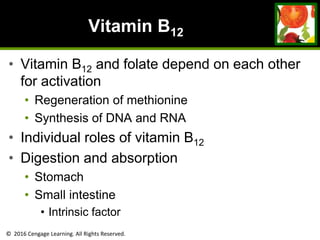
Vitamin B12
• Vitamin B12 and folate depend on each other
for activation
• Regeneration of methionine
• Synthesis of DNA and RNA
• Individual roles of vitamin B12
• Digestion and absorption
• Stomach
• Small intestine
• Intrinsic factor
© 2016 Cengage Learning. All Rights Reserved.
Transportation of Vitamin B12
• Transported in blood by specific binding
proteins
• Enterohepatic pathway
• Deficiency common among elderly
• Most due to inadequate absorption
• Pernicious anemia
• Added risk from vegetarian diets
• Anemia of folate deficiency
• Folate masks symptoms of vitamin B12 deficiency
© 2016 Cengage Learning. All Rights Reserved.
Sources of Vitamin B12
• Food sources
• Found almost exclusively from animal products
• Bioavailability
• Fish and milk
• Toxicity
• No adverse effects
• No UL
• Destruction
© 2016 Cengage Learning. All Rights Reserved.
Choline
• Essential nutrient
• Commonly grouped with B vitamins
• Used to make lecithin and acetylcholine
• Manufactured from methionine in body
• Conditionally essential nutrient
• Adequate intake (AI)
• Common sources
• Impact of deficiency not fully understood
© 2016 Cengage Learning. All Rights Reserved.
Nonvitamins
• Inositol
• Part of cell membrane structures
• Carnitine
• Transports long-chain fatty acids for oxidation
• PABA
• Bioflavanoids
• Others
© 2016 Cengage Learning. All Rights Reserved.
B Vitamin Interactions
• Each B vitamin coenzyme is involved in
energy metabolism
• Directly
• Indirectly
• Deficiencies
• B vitamin deficiencies seldom show up in isolation
• Beriberi and pellagra
© 2016 Cengage Learning. All Rights Reserved.
The B Vitamins In Concert
• Toxicities
• Excess eliminated through urine excretion
• Homeostasis disruption
• Toxicities develop
• Food sources
• First choice should be foods rather than
supplements
© 2016 Cengage Learning. All Rights Reserved.
Vitamin C as an Antioxidant
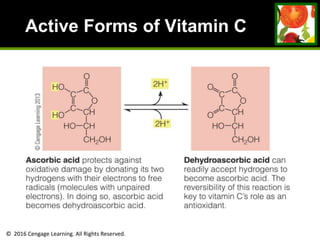
• Defends against free radicals
• Loses electrons easily
• Vitamin C recycling
• Protects tissues from oxidative stress
• Disease prevention
• Enhances iron absorption
© 2016 Cengage Learning. All Rights Reserved.
Active Forms of Vitamin C
© 2016 Cengage Learning. All Rights Reserved.
Vitamin C as a Cofactor
• Cofactor in collagen formation
• Matrix for bone and tooth formation
• Conversion of proline to hydroxyproline
• Cofactor in other reactions
• Hydroxylation of carnitine
• Conversion of tryptophan to serotonin
• Conversion of tyrosine to norepinephrine
• Making hormones
© 2016 Cengage Learning. All Rights Reserved.
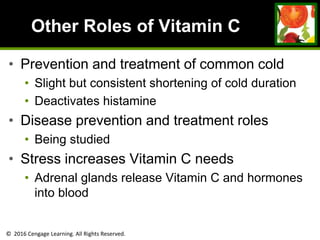
Other Roles of Vitamin C
• Prevention and treatment of common cold
• Slight but consistent shortening of cold duration
• Deactivates histamine
• Disease prevention and treatment roles
• Being studied
• Stress increases Vitamin C needs
• Adrenal glands release Vitamin C and hormones
into blood
© 2016 Cengage Learning. All Rights Reserved.
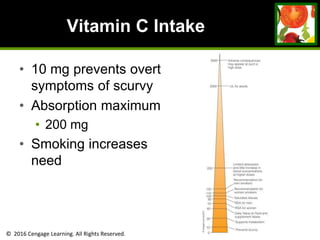
Vitamin C Intake
• 10 mg prevents overt
symptoms of scurvy
• Absorption maximum
• 200 mg
• Smoking increases
need
© 2016 Cengage Learning. All Rights Reserved.
Vitamin C Deficiency
• Notable signs of deficiency
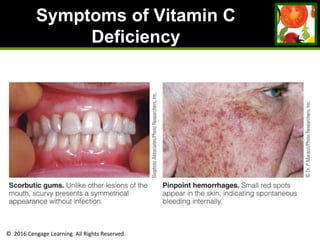
• Gums bleed easily around teeth
• Capillaries under skin break spontaneously
• Scurvy
• Other physical signs
• Psychological signs
• Sudden death from massive internal bleeding
© 2016 Cengage Learning. All Rights Reserved.
Symptoms of Vitamin C
Deficiency
© 2016 Cengage Learning. All Rights Reserved.
Vitamin C Toxicity
• Supplementation side effects
• Diarrhea
• GI distress
• UL
• Interference with medical regimens
• High doses not recommended with certain
medical conditions
© 2016 Cengage Learning. All Rights Reserved.
Food Sources of Vitamin C
• Abundant in fruits and vegetables
• Potatoes
• Vulnerable to heat and oxygen
• Used as antioxidant by food manufacturers
© 2016 Cengage Learning. All Rights Reserved.
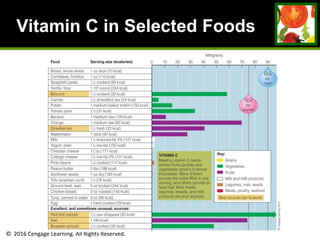
Vitamin C in Selected Foods
Food
(Best Source per
kclalorie)
Serving Size (kcalories) Food Group Approximate Amount
of Vitamin C
(milligrams)
Bread, whole wheat 1 oz slice (70 kcal) Grains 0
Cornflakes, fortified 1 oz (110 kcal) Grains 0
Spaghetti pasta ½ c cooked (99 kcal) Grains 0
Tortilla, flour 1 10"-round (234 kcal) Grains 0
Broccoli ½ c cooked (22 kcal) Vegetables 58
Carrots ½ c shredded raw (24 kcal) Vegetables 5
Potato 1 medium baked w/skin (133 kcal) Vegetables 15
Tomato juice ¾ c (31 kcal) Vegetables 33
Banana 1 medium raw (109 kcal) Fruits 11
Orange 1 medium raw (62 kcal) Fruits 70
Strawberries ½ c fresh (22 kcal) Fruits 41
Watermelon 1 slice (92 kcal) Fruits 28
Milk 1 c reduced-fat 2% (121 kcal) Milk and milk products 3
Yogurt, plain 1 c low-fat (155 kcal) Milk and milk products 2
Cheddar cheese 1½ oz (171 kcal) Milk and milk products 0
Cottage cheese ½ c low-fat 2% (101 kcal) Milk and milk products 0
Pinto beans ½ c cooked (117 kcal) Legumes, nuts, seeds 2
Peanut butter 2 tbs (188 kcal) Legumes, nuts, seeds 0.5
Sunflower seeds 1 oz dry (165 kcal) Legumes, nuts, seeds 0.5
Tofu (soybean curd) ½ c (76 kcal) Legumes, nuts, seeds 0
Ground beef, lean 3 oz broiled (244 kcal) Meats, poultry, seafood 0
Chicken breast 3 oz roasted (140 kcal) Meats, poultry, seafood 0
Tuna, canned in water 3 oz (99 kcal) Meats, poultry, seafood 0
Egg 1 hard cooked (78 kcal) Meats, poultry, seafood 0
Excellent, and sometimes unusual, sources:
Red bell pepper ½ c raw chopped (20 kcal) Vegetables 90+
Kiwi 1 (46 kcal) Fruits 74
Brussels sprouts ½ c cooked (30 kcal) Vegetables 47
© 2016 Cengage Learning. All Rights Reserved.
Vitamin and
Mineral
Supplements
Highlight 10
© 2016 Cengage Learning. All Rights Reserved.
Vitamin and Mineral
Supplements, continued
• $24 billion a year industry in United States
• Taken as dietary insurance
• Costly but harmless practice
• Costly and harmful to health practice
• Mostly self-prescribed
• Physician recommendation
• Improving food choices
• Preferred course of action
© 2016 Cengage Learning. All Rights Reserved.
Arguments for Supplements
• Correct overt deficiencies
• Support increased nutrient needs
• Certain life stages
• Improve nutrition status
• Improve body defenses
• Reduce disease risks
© 2016 Cengage Learning. All Rights Reserved.
Arguments Against
Supplements
• Toxicity
• Supplement users more likely to have excessive
intakes
• May be unrecognized and unreported
• Life-threatening misinformation
• No guarantee of supplement effectiveness
• Unknown needs
• False sense of security
© 2016 Cengage Learning. All Rights Reserved.
Arguments Against
Supplements, continued
• Other invalid reasons
• Today’s health problems
• Overnutrition
• Poor lifestyle choices
• Bioavailability and antagonistic actions
• Nutrients may interfere with one another’s action
• Make dietary modifications first
© 2016 Cengage Learning. All Rights Reserved.
Selection of Supplements
• Follow directions carefully
• Single, balanced vitamin-mineral supplement
• U.S. Pharmacopeia (USP) logo
• Logo assurances
• Two basic questions
• Form
• Contents
© 2016 Cengage Learning. All Rights Reserved.
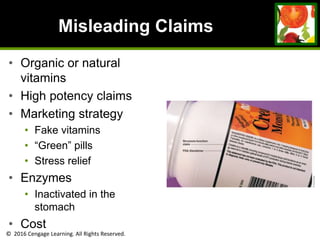
Misleading Claims
• Organic or natural
vitamins
• High potency claims
• Marketing strategy
• Fake vitamins
• “Green” pills
• Stress relief
• Enzymes
• Inactivated in the
stomach
• Cost
© 2016 Cengage Learning. All Rights Reserved.
Regulation of Supplements
• Food and Drug Administration (FDA)
• Dietary Supplement Health and Education Act
of 1994
• Enable consumers to make informed choices
• Same general labeling requirements as foods
• Net effect: deregulation of supplement industry
© 2016 Cengage Learning. All Rights Reserved.
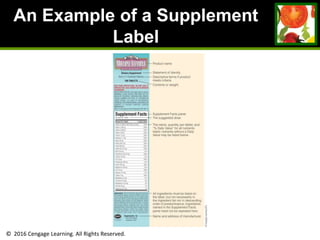
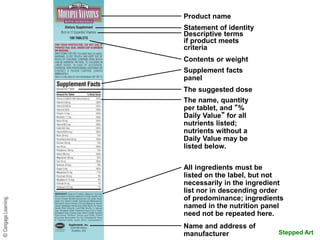
An Example of a Supplement
Label
Stepped Art
Product name
Statement of identity
Descriptive terms
if product meets
criteria
Contents or weight
Supplement facts
panel
The suggested dose
The name, quantity
per tablet, and “%
Daily Value” for all
nutrients listed;
nutrients without a
Daily Value may be
listed below.
All ingredients must be
listed on the label, but not
necessarily in the ingredient
list nor in descending order
of predominance; ingredients
named in the nutrition panel
need not be repeated here.
Name and address of
manufacturer

Chapter 10 Water Soluble Vitamins

  • 1.
    © 2016 CengageLearning. All Rights Reserved. The Water-Soluble Vitamins: B Vitamins and Vitamin C Chapter 10
  • 2.
    © 2016 CengageLearning. All Rights Reserved. The Vitamins – An Overview • Support nutritional health • Differences from energy-yielding nutrients • Structure • Individual units • Function • No energy yielded • Food contents • Similarities with energy-yielding nutrients
  • 3.
    © 2016 CengageLearning. All Rights Reserved. Bioavailability • Amount absorbed and used by body • Differs from amount in food • Factors influencing bioavailability • Efficiency of digestion • Nutrition status • Method of food preparation • Source of nutrient • Other foods consumed at same time
  • 4.
    © 2016 CengageLearning. All Rights Reserved. Precursors (Provitamins) • Inactive forms of vitamins • Converted to active form in body • Organic • Can be destroyed during storage or cooking • Solubility • Affects absorption, transport, and excretion • Toxicity • More is not necessarily better • Levels higher than UL
  • 5.
    © 2016 CengageLearning. All Rights Reserved. Dose Levels and Effects
  • 6.
    © 2016 CengageLearning. All Rights Reserved. The B Vitamins • Without B vitamins, the body would lack energy • Help body use macronutrients for fuel • Coenzymes • Assist enzymes with energy release • Without coenzyme, enzyme cannot function • RDAs • AIs
  • 7.
    © 2016 CengageLearning. All Rights Reserved. Coenzyme Action
  • 8.
    © 2016 CengageLearning. All Rights Reserved. Thiamin • Part of coenzyme thiamin pyrophosphate (TPP) • Assists in energy metabolism • Conversion of pyruvate to acetyl CoA • TCA cycle • Nerve activity and muscle activity • Average intake meets or exceeds recommendations
  • 9.
    © 2016 CengageLearning. All Rights Reserved. Thiamin Deficiency and Toxicity • Malnourished and alcoholics • Beriberi • Dry – affects nervous system • Wet – affects cardiovascular system • Toxicity • No adverse effects • No UL
  • 10.
    © 2016 CengageLearning. All Rights Reserved. Thiamin in Selected Foods Food (Best Source per kclalorie) Serving Size (kcalories) Food Group Approximate Amount of Thiamin (milligrams) Bread, whole wheat 1 oz slice (70 kcal) Grains 0.10 Cornflakes, fortified 1 oz (110 kcal) Grains 0.35 Spaghetti pasta ½ c cooked (99 kcal) Grains 0.12 Tortilla, flour 1 10"-round (234 kcal) Grains 0.35 Broccoli ½ c cooked (22 kcal) Vegetables 0.05 Carrots ½ c shredded raw (24 kcal) Vegetables 0.06 Potato 1 medium baked w/skin (133 kcal) Vegetables 0.15 Tomato juice ¾ c (31 kcal) Vegetables 0.10 Banana 1 medium raw (109 kcal) Fruits 0.07 Orange 1 medium raw (62 kcal) Fruits 0.12 Strawberries ½ c fresh (22 kcal) Fruits 0.01 Watermelon 1 slice (92 kcal) Fruits 0.23 Milk 1 c reduced-fat 2% (121 kcal) Milk and milk products 0.12 Yogurt, plain 1 c low-fat (155 kcal) Milk and milk products 0.13 Cheddar cheese 1½ oz (171 kcal) Milk and milk products 0.01 Cottage cheese ½ c low-fat 2% (101 kcal) Milk and milk products 0.03 Pinto beans ½ c cooked (117 kcal) Legumes, nuts, seeds 0.18 Peanut butter 2 tbs (188 kcal) Legumes, nuts, seeds 0.05 Sunflower seeds 1 oz dry (165 kcal) Legumes, nuts, seeds 0.04 Tofu (soybean curd) ½ c (76 kcal) Legumes, nuts, seeds 0.07 Ground beef, lean 3 oz broiled (244 kcal) Meats, poultry, seafood 0.04 Chicken breast 3 oz roasted (140 kcal) Meats, poultry, seafood 0.07 Tuna, canned in water 3 oz (99 kcal) Meats, poultry, seafood 0.04 Egg 1 hard cooked (78 kcal) Meats, poultry, seafood 0.04 Excellent, and sometimes unusual, sources: Pork chop, lean 3 oz broiled (169 kcal) Meats, poultry, seafood 0.96 Soy milk 1 c (81 kcal) Legumes, nuts, seeds 0.40 Squash, acorn ½ c baked (69 kcal) Vegetables 0.20
  • 11.
    © 2016 CengageLearning. All Rights Reserved. Riboflavin • Serves as coenzyme in energy metabolism • Flavin mononucleotide (FMN) • Flavin adenine dinucleotide (FAD) • Recommendations • Deficiency • Inflammation of membranes • Destroyed by ultraviolet light and irradiation • Toxicity • No UL
  • 12.
    © 2016 CengageLearning. All Rights Reserved. Riboflavin Coenzyme Illustrated
  • 13.
    © 2016 CengageLearning. All Rights Reserved. Riboflavin in Selected Foods Food (Best Source per kclalorie) Serving Size (kcalories) Food Group Approximate Amount of Riboflavin (milligrams) Bread, whole wheat 1 oz slice (70 kcal) Grains 0.05 Cornflakes, fortified 1 oz (110 kcal) Grains 0.43 Spaghetti pasta ½ c cooked (99 kcal) Grains 0.06 Tortilla, flour 1 10"-round (234 kcal) Grains 0.21 Broccoli ½ c cooked (22 kcal) Vegetables 0.09 Carrots ½ c shredded raw (24 kcal) Vegetables 0.03 Potato 1 medium baked w/skin (133 kcal) Vegetables 0.04 Tomato juice ¾ c (31 kcal) Vegetables 0.05 Banana 1 medium raw (109 kcal) Fruits 0.12 Orange 1 medium raw (62 kcal) Fruits 0.06 Strawberries ½ c fresh (22 kcal) Fruits 0.06 Watermelon 1 slice (92 kcal) Fruits 0.07 Milk 1 c reduced-fat 2% (121 kcal) Milk and milk products 0.40 Yogurt, plain 1 c low-fat (155 kcal) Milk and milk products 0.53 Cheddar cheese 1½ oz (171 kcal) Milk and milk products 0.18 Cottage cheese ½ c low-fat 2% (101 kcal) Milk and milk products 0.21 Pinto beans ½ c cooked (117 kcal) Legumes, nuts, seeds 0.09 Peanut butter 2 tbs (188 kcal) Legumes, nuts, seeds 0.08 Sunflower seeds 1 oz dry (165 kcal) Legumes, nuts, seeds 0.06 Tofu (soybean curd) ½ c (76 kcal) Legumes, nuts, seeds 0.03 Ground beef, lean 3 oz broiled (244 kcal) Meats, poultry, seafood 0.15 Chicken breast 3 oz roasted (140 kcal) Meats, poultry, seafood 0.12 Tuna, canned in water 3 oz (99 kcal) Meats, poultry, seafood 0.07 Egg 1 hard cooked (78 kcal) Meats, poultry, seafood 0.26 Excellent, and sometimes unusual, sources: Liver 3 oz fried (184 kcal) Meats, poultry, seafood 1.70+ Clams, canned 3 oz (126 kcal) Meats, poultry, seafood 0.34 Mushrooms ½ c cooked (21 kcal) Vegetables 0.23
  • 14.
    © 2016 CengageLearning. All Rights Reserved. Niacin • Two chemical structures • Nicotinic acid • Nicotinamide • Major form of niacin in blood • Two coenzyme forms – metabolic reactions • Nicotinamide adenine dinucleotide (NAD) • Carries hydrogens and their electrons • NADP (the phosphate form)
  • 15.
    © 2016 CengageLearning. All Rights Reserved. Niacin Needs and Results of Deficiency • Recommendations • RDA stated in niacin equivalents (NE) • Body manufactures from tryptophan • Only occurs after protein synthesis needs have been met • Deficiency • Pellagra • Symptoms • Caused deaths in the U.S. south in the early 1900s
  • 16.
    © 2016 CengageLearning. All Rights Reserved. Niacin-Deficiency Symptom – The Dermatitis of Pellagra
  • 17.
    © 2016 CengageLearning. All Rights Reserved. Niacin Toxicity • Naturally occurring sources • No harm • Supplements or drugs • “Niacin flush” • Potential health benefits of large doses of nicotinic acid • Food sources • Less vulnerable to food preparation losses than other vitamins
  • 18.
    © 2016 CengageLearning. All Rights Reserved. Niacin in Selected Foods Food (Best Source per kclalorie) Serving Size (kcalories) Food Group Approximate Amount of Niacin (milligrams) Bread, whole wheat 1 oz slice (70 kcal) Grains 1.1 Cornflakes, fortified 1 oz (110 kcal) Grains 5.1 Spaghetti pasta ½ c cooked (99 kcal) Grains 1.9 Tortilla, flour 1 10"-round (234 kcal) Grains 3.9 Broccoli ½ c cooked (22 kcal) Vegetables 0.8 Carrots ½ c shredded raw (24 kcal) Vegetables 0.5 Potato 1 medium baked w/skin (133 kcal) Vegetables 2.8 Tomato juice ¾ c (31 kcal) Vegetables 1.3 Banana 1 medium raw (109 kcal) Fruits 0.9 Orange 1 medium raw (62 kcal) Fruits 0.5 Strawberries ½ c fresh (22 kcal) Fruits 0.2 Watermelon 1 slice (92 kcal) Fruits 1.0 Milk 1 c reduced-fat 2% (121 kcal) Milk and milk products 2.0 Yogurt, plain 1 c low-fat (155 kcal) Milk and milk products 1.4 Cheddar cheese 1½ oz (171 kcal) Milk and milk products 2.1 Cottage cheese ½ c low-fat 2% (101 kcal) Milk and milk products 2.8 Pinto beans ½ c cooked (117 kcal) Legumes, nuts, seeds 1.8 Peanut butter 2 tbs (188 kcal) Legumes, nuts, seeds 5.7 Sunflower seeds 1 oz dry (165 kcal) Legumes, nuts, seeds 3.2 Tofu (soybean curd) ½ c (76 kcal) Legumes, nuts, seeds 2.8 Ground beef, lean 3 oz broiled (244 kcal) Meats, poultry, seafood 7.6 Chicken breast 3 oz roasted (140 kcal) Meats, poultry, seafood 16.7 Tuna, canned in water 3 oz (99 kcal) Meats, poultry, seafood 15.4 Egg 1 hard cooked (78 kcal) Meats, poultry, seafood 1.3 Excellent, and sometimes unusual, sources: Liver 3 oz fried (184 kcal) Meats, poultry, seafood 12.2 Peanuts 1 oz roasted (165 kcal) Legumes, nuts, seeds 4.0 Mushrooms ½ c cooked (21 kcal) Vegetables 3.5
  • 19.
    © 2016 CengageLearning. All Rights Reserved. Biotin • Coenzyme that carries activated carbon dioxide • Critical in TCA cycle • Delivers carbon to pyruvate to form oxaloacetate • Gluconeogenesis and fatty acid synthesis • Breakdown of fatty acids and amino acids • Widespread in food sources • Toxicity • No UL
  • 20.
    © 2016 CengageLearning. All Rights Reserved. Pantothenic Acid • Part of chemical structure of coenzyme A • Roles in body • Recommendations • AI has been established • Widespread in foods • Readily destroyed by freezing, canning, and refining processes • Deficiency • Rare
  • 21.
    © 2016 CengageLearning. All Rights Reserved. Vitamin B6 • Three forms • Pyridoxal, pyridoxine, and pyridoxamine • Conversion to coenzyme PLP • Amino acid metabolism • Carbohydrate and fatty acid metabolism • Conversion of tryptophan to niacin or serotonin • Synthesis of heme, nucleic acids, and lecithin • Stored exclusively in muscle tissue
  • 22.
    © 2016 CengageLearning. All Rights Reserved. More Facts About B6 • Deficiency • Symptoms • Alcohol and isoniazid function as B6 antagonists • Toxicity • Neurological damage • Food sources
  • 23.
    © 2016 CengageLearning. All Rights Reserved. Vitamin B6 in Selected Foods Food (Best Source per kclalorie) Serving Size (kcalories) Food Group Approximate Amount of Vitamin B6 (milligrams) Bread, whole wheat 1 oz slice (70 kcal) Grains 0.05 Cornflakes, fortified 1 oz (110 kcal) Grains 0.51 Spaghetti pasta ½ c cooked (99 kcal) Grains 0.01 Tortilla, flour 1 10"-round (234 kcal) Grains 0.03 Broccoli ½ c cooked (22 kcal) Vegetables 0.10 Carrots ½ c shredded raw (24 kcal) Vegetables 0.08 Potato 1 medium baked w/skin (133 kcal) Vegetables 0.42 Tomato juice ¾ c (31 kcal) Vegetables 0.20 Banana 1 medium raw (109 kcal) Fruits 0.70 Orange 1 medium raw (62 kcal) Fruits 0.08 Strawberries ½ c fresh (22 kcal) Fruits 0.04 Watermelon 1 slice (92 kcal) Fruits 0.41 Milk 1 c reduced-fat 2% (121 kcal) Milk and milk products 0.10 Yogurt, plain 1 c low-fat (155 kcal) Milk and milk products 0.12 Cheddar cheese 1½ oz (171 kcal) Milk and milk products 0.03 Cottage cheese ½ c low-fat 2% (101 kcal) Milk and milk products 0.09 Pinto beans ½ c cooked (117 kcal) Legumes, nuts, seeds 0.14 Peanut butter 2 tbs (188 kcal) Legumes, nuts, seeds 0.15 Sunflower seeds 1 oz dry (165 kcal) Legumes, nuts, seeds 0.24 Tofu (soybean curd) ½ c (76 kcal) Legumes, nuts, seeds 0.07 Ground beef, lean 3 oz broiled (244 kcal) Meats, poultry, seafood 0.21 Chicken breast 3 oz roasted (140 kcal) Meats, poultry, seafood 0.52 Tuna, canned in water 3 oz (99 kcal) Meats, poultry, seafood 0.30 Egg 1 hard cooked (78 kcal) Meats, poultry, seafood 0.05 Excellent, and sometimes unusual, sources: Prune juice ¾ c (137 kcal) Fruits 0.42 Bluefish 3 o z baked (135 kcal) Meats, poultry, seafood 0.41 Squash, acorn ½ c baked (69 kcal) Vegetables 0.25
  • 24.
    © 2016 CengageLearning. All Rights Reserved. Folate • Also known as folacin or folic acid • Primary coenzyme form – THF (tetrahydrofolate) • Transfers 1-carbon compounds during metabolism • Converts vitamin B12 to coenzyme form • Synthesizes DNA • Regenerates methionine from homocysteine
  • 25.
    © 2016 CengageLearning. All Rights Reserved. Folate’s Absorption and Activation
  • 26.
    © 2016 CengageLearning. All Rights Reserved. More Facts About Folate • Bioavailability ranges from 50 to 100 percent • Differences between food sources and supplements • Increased need during pregnancy • Folate disposal • Secretion by liver into bile • Enterohepatic circulation • GI tract injuries hinder absorption
  • 27.
    © 2016 CengageLearning. All Rights Reserved. Effects of Folate Deficiency • Neural tube defects • Supplement use during pregnancy • One month before conception • Through first trimester • Fortified grain products • Congenital birth defects • Folate plays a role in protecting against heart disease • Some cancers
  • 28.
    © 2016 CengageLearning. All Rights Reserved. Spina Bifida – a Neural Tube Defect
  • 29.
    © 2016 CengageLearning. All Rights Reserved. Decreasing Prevalence of NTDs since Folate Fortification
  • 30.
    © 2016 CengageLearning. All Rights Reserved. Other Facts About Folate • Anemia: symptom of deficiency • Most susceptible to drug interactions • Toxicity • Naturally occurring from food sources • Fortified foods or supplements • UL has been established • Food sources • Heat and oxidation destroy folate
  • 31.
    © 2016 CengageLearning. All Rights Reserved. Folate in Selected Foods Food (Best Source per kclalorie) Serving Size (kcalories) Food Group Approximate Amount of Folate (micrograms) Bread, whole wheat 1 oz slice (70 kcal) Grains 15 Cornflakes, fortified 1 oz (110 kcal) Grains 100 Spaghetti pasta ½ c cooked (99 kcal) Grains 49 Tortilla, flour 1 10"-round (234 kcal) Grains 85 Broccoli ½ c cooked (22 kcal) Vegetables 40 Carrots ½ c shredded raw (24 kcal) Vegetables 10 Potato 1 medium baked w/skin (133 kcal) Vegetables 15 Tomato juice ½ c (31 kcal) Vegetables 38 Banana 1 medium raw (109 kcal) Fruits 23 Orange 1 medium raw (62 kcal) Fruits 40 Strawberries ½ c fresh (22 kcal) Fruits 15 Watermelon 1 slice (92 kcal) Fruits 8 Milk 1 c reduced-fat 2% (121 kcal) Milk and milk products 15 Yogurt, plain 1 c low-fat (155 kcal) Milk and milk products 25 Cheddar cheese 1½ oz (171 kcal) Milk and milk products 10 Cottage cheese ½ c low-fat 2% (101 kcal) Milk and milk products 15 Pinto beans ½ c cooked (117 kcal) Legumes, nuts, seeds 158 Peanut butter 2 tbs (188 kcal) Legumes, nuts, seeds 30 Sunflower seeds 1 oz dry (165 kcal) Legumes, nuts, seeds 70 Tofu (soybean curd) ½ c (76 kcal) Legumes, nuts, seeds 55 Ground beef, lean 3 oz broiled (244 kcal) Meats, poultry, seafood 10 Chicken breast 3 oz roasted (140 kcal) Meats, poultry, seafood 5 Tuna, canned in water 3 oz (99 kcal) Meats, poultry, seafood 5 Egg 1 hard cooked (78 kcal) Meats, poultry, seafood 20 Excellent, and sometimes unusual, sources: Lentils ½ c cooked (115 kcal) Legumes, nuts, seeds 180 Asparagus ½ c cooked (22 kcal) Vegetables 130 Orange juice ¾ c fresh (84 kcal) Fruits 56
  • 32.
    © 2016 CengageLearning. All Rights Reserved. Vitamin B12 • Vitamin B12 and folate depend on each other for activation • Regeneration of methionine • Synthesis of DNA and RNA • Individual roles of vitamin B12 • Digestion and absorption • Stomach • Small intestine • Intrinsic factor
  • 33.
    © 2016 CengageLearning. All Rights Reserved. Transportation of Vitamin B12 • Transported in blood by specific binding proteins • Enterohepatic pathway • Deficiency common among elderly • Most due to inadequate absorption • Pernicious anemia • Added risk from vegetarian diets • Anemia of folate deficiency • Folate masks symptoms of vitamin B12 deficiency
  • 34.
    © 2016 CengageLearning. All Rights Reserved. Sources of Vitamin B12 • Food sources • Found almost exclusively from animal products • Bioavailability • Fish and milk • Toxicity • No adverse effects • No UL • Destruction
  • 35.
    © 2016 CengageLearning. All Rights Reserved. Choline • Essential nutrient • Commonly grouped with B vitamins • Used to make lecithin and acetylcholine • Manufactured from methionine in body • Conditionally essential nutrient • Adequate intake (AI) • Common sources • Impact of deficiency not fully understood
  • 36.
    © 2016 CengageLearning. All Rights Reserved. Nonvitamins • Inositol • Part of cell membrane structures • Carnitine • Transports long-chain fatty acids for oxidation • PABA • Bioflavanoids • Others
  • 37.
    © 2016 CengageLearning. All Rights Reserved. B Vitamin Interactions • Each B vitamin coenzyme is involved in energy metabolism • Directly • Indirectly • Deficiencies • B vitamin deficiencies seldom show up in isolation • Beriberi and pellagra
  • 38.
    © 2016 CengageLearning. All Rights Reserved. The B Vitamins In Concert • Toxicities • Excess eliminated through urine excretion • Homeostasis disruption • Toxicities develop • Food sources • First choice should be foods rather than supplements
  • 39.
    © 2016 CengageLearning. All Rights Reserved. Vitamin C as an Antioxidant • Defends against free radicals • Loses electrons easily • Vitamin C recycling • Protects tissues from oxidative stress • Disease prevention • Enhances iron absorption
  • 40.
    © 2016 CengageLearning. All Rights Reserved. Active Forms of Vitamin C
  • 41.
    © 2016 CengageLearning. All Rights Reserved. Vitamin C as a Cofactor • Cofactor in collagen formation • Matrix for bone and tooth formation • Conversion of proline to hydroxyproline • Cofactor in other reactions • Hydroxylation of carnitine • Conversion of tryptophan to serotonin • Conversion of tyrosine to norepinephrine • Making hormones
  • 42.
    © 2016 CengageLearning. All Rights Reserved. Other Roles of Vitamin C • Prevention and treatment of common cold • Slight but consistent shortening of cold duration • Deactivates histamine • Disease prevention and treatment roles • Being studied • Stress increases Vitamin C needs • Adrenal glands release Vitamin C and hormones into blood
  • 43.
    © 2016 CengageLearning. All Rights Reserved. Vitamin C Intake • 10 mg prevents overt symptoms of scurvy • Absorption maximum • 200 mg • Smoking increases need
  • 44.
    © 2016 CengageLearning. All Rights Reserved. Vitamin C Deficiency • Notable signs of deficiency • Gums bleed easily around teeth • Capillaries under skin break spontaneously • Scurvy • Other physical signs • Psychological signs • Sudden death from massive internal bleeding
  • 45.
    © 2016 CengageLearning. All Rights Reserved. Symptoms of Vitamin C Deficiency
  • 46.
    © 2016 CengageLearning. All Rights Reserved. Vitamin C Toxicity • Supplementation side effects • Diarrhea • GI distress • UL • Interference with medical regimens • High doses not recommended with certain medical conditions
  • 47.
    © 2016 CengageLearning. All Rights Reserved. Food Sources of Vitamin C • Abundant in fruits and vegetables • Potatoes • Vulnerable to heat and oxygen • Used as antioxidant by food manufacturers
  • 48.
    © 2016 CengageLearning. All Rights Reserved. Vitamin C in Selected Foods Food (Best Source per kclalorie) Serving Size (kcalories) Food Group Approximate Amount of Vitamin C (milligrams) Bread, whole wheat 1 oz slice (70 kcal) Grains 0 Cornflakes, fortified 1 oz (110 kcal) Grains 0 Spaghetti pasta ½ c cooked (99 kcal) Grains 0 Tortilla, flour 1 10"-round (234 kcal) Grains 0 Broccoli ½ c cooked (22 kcal) Vegetables 58 Carrots ½ c shredded raw (24 kcal) Vegetables 5 Potato 1 medium baked w/skin (133 kcal) Vegetables 15 Tomato juice ¾ c (31 kcal) Vegetables 33 Banana 1 medium raw (109 kcal) Fruits 11 Orange 1 medium raw (62 kcal) Fruits 70 Strawberries ½ c fresh (22 kcal) Fruits 41 Watermelon 1 slice (92 kcal) Fruits 28 Milk 1 c reduced-fat 2% (121 kcal) Milk and milk products 3 Yogurt, plain 1 c low-fat (155 kcal) Milk and milk products 2 Cheddar cheese 1½ oz (171 kcal) Milk and milk products 0 Cottage cheese ½ c low-fat 2% (101 kcal) Milk and milk products 0 Pinto beans ½ c cooked (117 kcal) Legumes, nuts, seeds 2 Peanut butter 2 tbs (188 kcal) Legumes, nuts, seeds 0.5 Sunflower seeds 1 oz dry (165 kcal) Legumes, nuts, seeds 0.5 Tofu (soybean curd) ½ c (76 kcal) Legumes, nuts, seeds 0 Ground beef, lean 3 oz broiled (244 kcal) Meats, poultry, seafood 0 Chicken breast 3 oz roasted (140 kcal) Meats, poultry, seafood 0 Tuna, canned in water 3 oz (99 kcal) Meats, poultry, seafood 0 Egg 1 hard cooked (78 kcal) Meats, poultry, seafood 0 Excellent, and sometimes unusual, sources: Red bell pepper ½ c raw chopped (20 kcal) Vegetables 90+ Kiwi 1 (46 kcal) Fruits 74 Brussels sprouts ½ c cooked (30 kcal) Vegetables 47
  • 49.
    © 2016 CengageLearning. All Rights Reserved. Vitamin and Mineral Supplements Highlight 10
  • 50.
    © 2016 CengageLearning. All Rights Reserved. Vitamin and Mineral Supplements, continued • $24 billion a year industry in United States • Taken as dietary insurance • Costly but harmless practice • Costly and harmful to health practice • Mostly self-prescribed • Physician recommendation • Improving food choices • Preferred course of action
  • 51.
    © 2016 CengageLearning. All Rights Reserved. Arguments for Supplements • Correct overt deficiencies • Support increased nutrient needs • Certain life stages • Improve nutrition status • Improve body defenses • Reduce disease risks
  • 52.
    © 2016 CengageLearning. All Rights Reserved. Arguments Against Supplements • Toxicity • Supplement users more likely to have excessive intakes • May be unrecognized and unreported • Life-threatening misinformation • No guarantee of supplement effectiveness • Unknown needs • False sense of security
  • 53.
    © 2016 CengageLearning. All Rights Reserved. Arguments Against Supplements, continued • Other invalid reasons • Today’s health problems • Overnutrition • Poor lifestyle choices • Bioavailability and antagonistic actions • Nutrients may interfere with one another’s action • Make dietary modifications first
  • 54.
    © 2016 CengageLearning. All Rights Reserved. Selection of Supplements • Follow directions carefully • Single, balanced vitamin-mineral supplement • U.S. Pharmacopeia (USP) logo • Logo assurances • Two basic questions • Form • Contents
  • 55.
    © 2016 CengageLearning. All Rights Reserved. Misleading Claims • Organic or natural vitamins • High potency claims • Marketing strategy • Fake vitamins • “Green” pills • Stress relief • Enzymes • Inactivated in the stomach • Cost
  • 56.
    © 2016 CengageLearning. All Rights Reserved. Regulation of Supplements • Food and Drug Administration (FDA) • Dietary Supplement Health and Education Act of 1994 • Enable consumers to make informed choices • Same general labeling requirements as foods • Net effect: deregulation of supplement industry
  • 57.
    © 2016 CengageLearning. All Rights Reserved. An Example of a Supplement Label
  • 58.
    Stepped Art Product name Statementof identity Descriptive terms if product meets criteria Contents or weight Supplement facts panel The suggested dose The name, quantity per tablet, and “% Daily Value” for all nutrients listed; nutrients without a Daily Value may be listed below. All ingredients must be listed on the label, but not necessarily in the ingredient list nor in descending order of predominance; ingredients named in the nutrition panel need not be repeated here. Name and address of manufacturer