
MMMMM DELICIOUS FOOD!

Food
Dietary habits
Pyramid
   FOOD is any substance, usually comprised primarily of
    carbohydrates, fats, water and/or proteins that can be
    eaten or drunk by animals (including humans) for
    nutrition and/or pleasure.
Foods are substances from animal and
     plant sources that yield heat and energy when
           ingested and absorbed by the body.
             Food nutrients build and renew
      tissues and regulate the body processes.
                           The unit
       commonly used for describing energy
    intake and energy expenditure is the calorie.
   Good food sources contain substantial amounts of
           nutrients in relation to caloric content
PROTEIN
  S
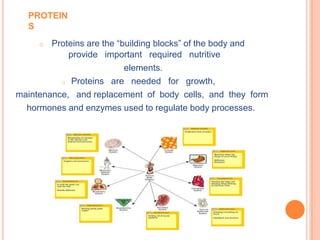
     o  Proteins are the “building blocks” of the body and
            provide important required nutritive
                           elements.
          o Proteins are needed for growth,

maintenance, and replacement of body cells, and they form
  hormones and enzymes used to regulate body processes.
o    Extra protein is either used to supply energy or is
                 changed into body fat.
o    Found in both the animal and plant kingdoms.
      o all proteins are composed of amino acids.


     Proteins play an important role in recovering from
             fractures, burns, and infections.
                      They are also
    important in healing wounds and recovering from
                    surgical procedures.
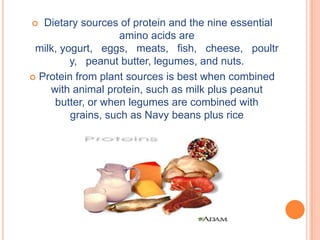
  Dietary sources of protein and the nine essential
                    amino acids are
 milk, yogurt, eggs, meats, fish, cheese, poultr
         y, peanut butter, legumes, and nuts.
 Protein from plant sources is best when combined
    with animal protein, such as milk plus peanut
     butter, or when legumes are combined with
         grains, such as Navy beans plus rice
FATS
The chief functions of fats are to supply energy and
            transport fat-soluble vitamins.
 Each gram of fat yields 9 calories. Fats provide
            the most concentrated source
 of calories (and, therefore, energy) of all the fo
                     od nutrients.
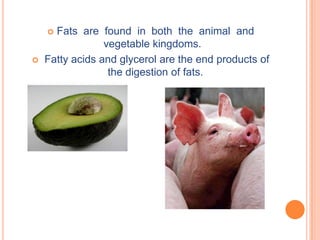
 Fats are found in both the animal and
                 vegetable kingdoms.
   Fatty acids and glycerol are the end products of
                  the digestion of fats.
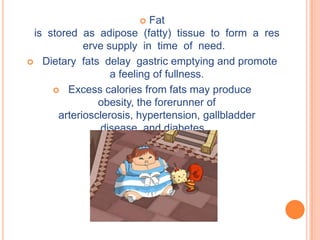
    Fat
 is stored as adipose (fatty) tissue to form a res
            erve supply in time of need.
 Dietary fats delay gastric emptying and promote
                  a feeling of fullness.
      Excess calories from fats may produce
               obesity, the forerunner of
      arteriosclerosis, hypertension, gallbladder
               disease, and diabetes.
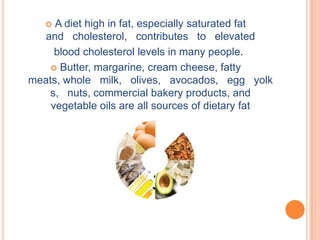
 A diet high in fat, especially saturated fat
   and cholesterol, contributes to elevated
     blood cholesterol levels in many people.
     Butter, margarine, cream cheese, fatty
meats, whole milk, olives, avocados, egg yolk
    s, nuts, commercial bakery products, and
    vegetable oils are all sources of dietary fat
CARBOHYDRATES
 Carbohydrates   (sugar and starches) are
the most efficient sources of energy and are
         known as the “fuel of life.”
 They are abundantly found in most plant
                food sources.
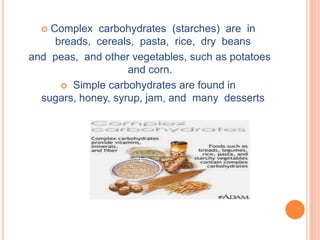
 Complex carbohydrates (starches) are in
     breads, cereals, pasta, rice, dry beans
and peas, and other vegetables, such as potatoes
                    and corn.
       Simple carbohydrates are found in
  sugars, honey, syrup, jam, and many desserts
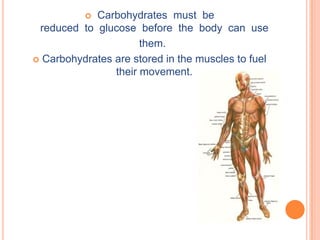
 Carbohydrates must be
 reduced to glucose before the body can use
                      them.
 Carbohydrates are stored in the muscles to fuel
                their movement.
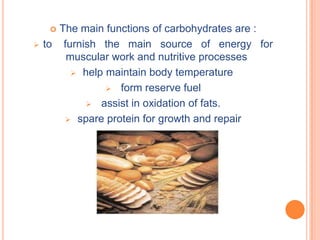
 The main functions of carbohydrates are :
   to furnish the main source of energy for
        muscular work and nutritive processes
          help maintain body temperature

                 form reserve fuel

             assist in oxidation of fats.

         spare protein for growth and repair
MINERALS
These essential inorganic elements contribute
  overwhelmingly to the skeletal framework of the
                       body
and teeth, and they are an essential part o
           f many organic compounds.
 Minerals form an integral part of basic cell
    structure and circulate in body fluids.
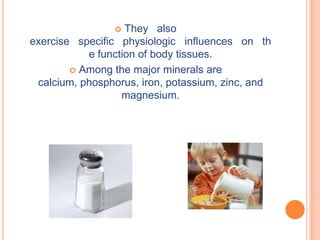
  They also
exercise specific physiologic influences on th
           e function of body tissues.
         Among the major minerals are
 calcium, phosphorus, iron, potassium, zinc, and
                  magnesium.
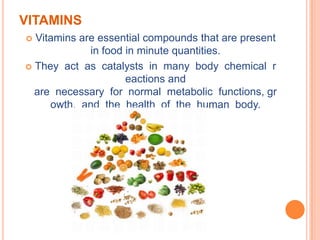
VITAMINS
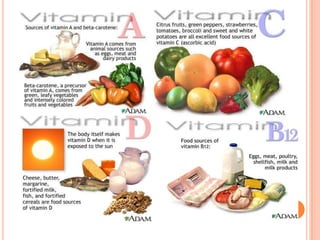
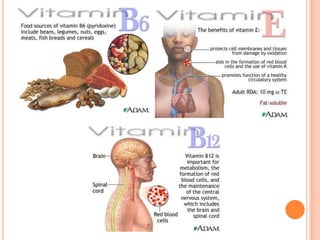
 Vitamins are essential compounds that are present
             in food in minute quantities.
 They act as catalysts in many body chemical r
                     eactions and
  are necessary for normal metabolic functions, gr
     owth, and the health of the human body.
 Vitamins are so widely distributed in food that a
     properly prepared normal diet usually
        provides an adequate amount.
       Vitamins can be destroyed during
the preparation or preservation of certain fo
                       ods.
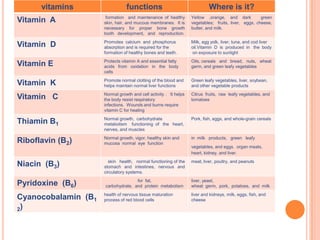
vitamins                  functions                                  Where is it?
                      formation and maintenance of healthy        Yellow ,orange, and dark           green
Vitamin A            skin, hair, and mucous membranes. It is      vegetables; fruits, liver, eggs, cheese,
                     necessary for proper bone growth             butter, and milk.
                     tooth development, and reproduction.
                     Promotes calcium and phosphorus              Milk, egg yolk, liver, tuna, and cod liver
Vitamin D            absorption and is required for the           oil.Vitamin D is produced in the body
                     formation of healthy bones and teeth.        on exposure to sunlight
                     Protects vitamin A and essential fatty       Oils, cereals and bread, nuts, wheat
Vitamin E            acids from oxidation in the body             germ, and green leafy vegetables
                     cells
                     Promote normal clotting of the blood and     Green leafy vegetables, liver, soybean,
Vitamin K            helps maintain normal liver functions        and other vegetable products
                     Normal growth and cell activity . It helps   Citrus fruits, raw leafy vegetables, and
Vitamin C            the body resist respiratory                  tomatoes
                     infections. Wounds and burns require
                     vitamin C for healing
                     Normal growth, carbohydrate                  Pork, fish, eggs, and whole-grain cereals
Thiamin B1           metabolism functioning of the heart,
                     nerves, and muscles
                     Normal growth, vigor, healthy skin and       in milk products, green leafy
Riboflavin (B2)      mucosa normal eye function
                                                                  vegetables, and eggs. organ meats,
                                                                  heart, kidney, and liver.
                       skin health, normal functioning of the     meat, liver, poultry, and peanuts
Niacin (B3)          stomach and intestines, nervous and
                     circulatory systems.
                                    for fat,                      liver, yeast,
Pyridoxine (B6)      carbohydrate, and protein metabolism         wheat germ, pork, potatoes, and milk
                     health of nervous tissue maturation          liver and kidneys, milk, eggs, fish, and
Cyanocobalamin (B1   process of red blood cells                   cheese

2)
WATER
 Water is often called the “forgotten nutrient.” Water
  is needed to replace body fluids lost primarily in
  urine and sweat.
 A person can survive weeks without food but only
  days without water.
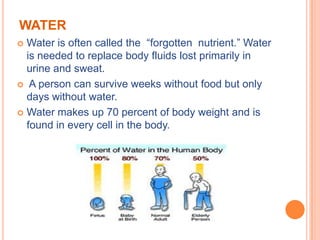
 Water makes up 70 percent of body weight and is
  found in every cell in the body.
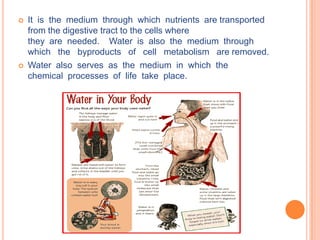
   It is the medium through which nutrients are transported
    from the digestive tract to the cells where
    they are needed. Water is also the medium through
    which the byproducts of cell metabolism are removed.
   Water also serves as the medium in which the
    chemical processes of life take place.
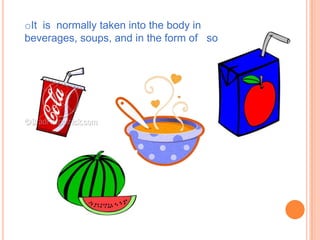
oIt is normally taken into the body in
beverages, soups, and in the form of solid foods.
DIETARY HABITS
   Dietary habits are the habitual decisions an individual
    or culture makes when choosing what foods to eat.
    Although humans are omnivores, each culture holds
    some food preferences and some food taboos. Dietary
    choices can also define cultures and play a role in
    religion.
 Many   individuals choose to limit what foods
  eat for reasons of health, morality, or other
  factors. For instance vegetarians choose to
  forget food from animal sources to varying
  degrees. Others choose a healthier
  diet, avoiding sugars or animal fats and
  increasing consumption of dietary fiber and
  antioxidants.
 People in each country, city or town eat the
  food they have according the landforms
  and the climate.
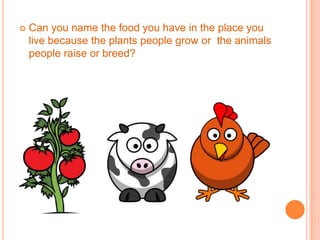
   Can you name the food you have in the place you
    live because the plants people grow or the animals
    people raise or breed?
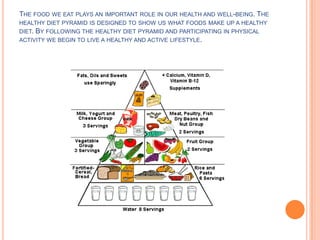
THE FOOD WE EAT PLAYS AN IMPORTANT ROLE IN OUR HEALTH AND WELL-BEING. THE
HEALTHY DIET PYRAMID IS DESIGNED TO SHOW US WHAT FOODS MAKE UP A HEALTHY
DIET. BY FOLLOWING THE HEALTHY DIET PYRAMID AND PARTICIPATING IN PHYSICAL
ACTIVITY WE BEGIN TO LIVE A HEALTHY AND ACTIVE LIFESTYLE.
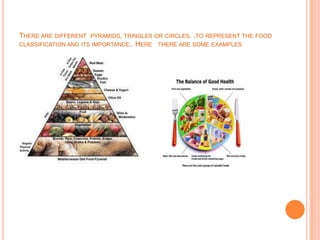
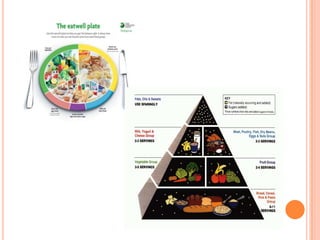
THERE ARE DIFFERENT PYRAMIDS, TRINGLES OR CIRCLES. .TO REPRESENT THE FOOD
CLASSIFICATION AND ITS IMPORTANCE.. HERE THERE ARE SOME EXAMPLES
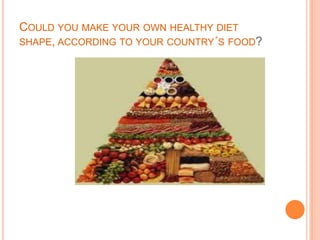
COULD YOU MAKE YOUR OWN HEALTHY DIET
SHAPE, ACCORDING TO YOUR COUNTRY´S FOOD?
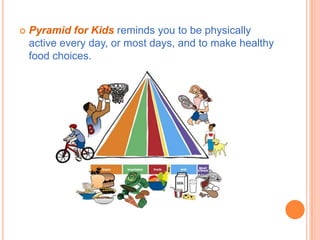
   Pyramid for Kids reminds you to be physically
    active every day, or most days, and to make healthy
    food choices.
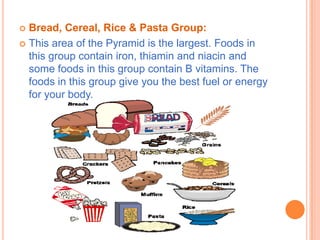
 Bread, Cereal, Rice & Pasta Group:
 This area of the Pyramid is the largest. Foods in
  this group contain iron, thiamin and niacin and
  some foods in this group contain B vitamins. The
  foods in this group give you the best fuel or energy
  for your body.
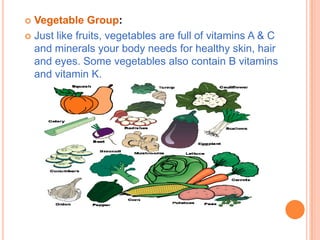
 Vegetable Group:
 Just like fruits, vegetables are full of vitamins A & C
  and minerals your body needs for healthy skin, hair
  and eyes. Some vegetables also contain B vitamins
  and vitamin K.
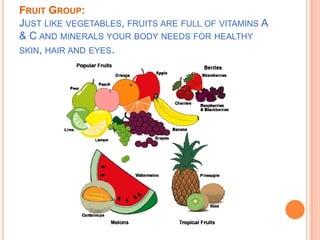
FRUIT GROUP:
JUST LIKE VEGETABLES, FRUITS ARE FULL OF VITAMINS A
& C AND MINERALS YOUR BODY NEEDS FOR HEALTHY
SKIN, HAIR AND EYES.
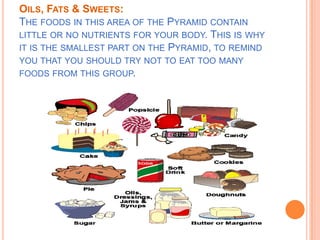
OILS, FATS & SWEETS:
THE FOODS IN THIS AREA OF THE PYRAMID CONTAIN
LITTLE OR NO NUTRIENTS FOR YOUR BODY. THIS IS WHY
IT IS THE SMALLEST PART ON THE PYRAMID, TO REMIND
YOU THAT YOU SHOULD TRY NOT TO EAT TOO MANY
FOODS FROM THIS GROUP.
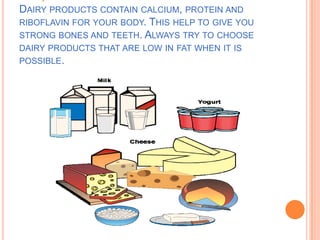
DAIRY PRODUCTS CONTAIN CALCIUM, PROTEIN AND
RIBOFLAVIN FOR YOUR BODY. THIS HELP TO GIVE YOU
STRONG BONES AND TEETH. ALWAYS TRY TO CHOOSE
DAIRY PRODUCTS THAT ARE LOW IN FAT WHEN IT IS
POSSIBLE.
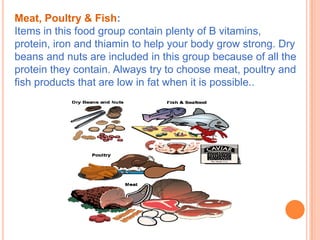
Meat, Poultry & Fish:
Items in this food group contain plenty of B vitamins,
protein, iron and thiamin to help your body grow strong. Dry
beans and nuts are included in this group because of all the
protein they contain. Always try to choose meat, poultry and
fish products that are low in fat when it is possible..
A lot of the time you will find that the meals you eat are made
up of parts from more than one food group. Let's take a look
at some examples:
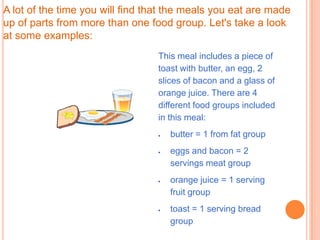
                                 This meal includes a piece of
                                 toast with butter, an egg, 2
                                 slices of bacon and a glass of
                                 orange juice. There are 4
                                 different food groups included
                                 in this meal:
                                    butter = 1 from fat group
                                    eggs and bacon = 2
                                    servings meat group
                                    orange juice = 1 serving
                                    fruit group
                                    toast = 1 serving bread
                                    group
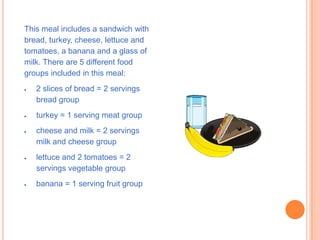
This meal includes a sandwich with
bread, turkey, cheese, lettuce and
tomatoes, a banana and a glass of
milk. There are 5 different food
groups included in this meal:
   2 slices of bread = 2 servings
   bread group
   turkey = 1 serving meat group
   cheese and milk = 2 servings
   milk and cheese group
   lettuce and 2 tomatoes = 2
   servings vegetable group
   banana = 1 serving fruit group
COULD YOU WRITE A TYPICAL DISH FOR
LUNCH AND EXPLAIN THE COMPONENTS?

Mmmmm delicious food!

  • 1.
  • 2.
    FOOD is any substance, usually comprised primarily of carbohydrates, fats, water and/or proteins that can be eaten or drunk by animals (including humans) for nutrition and/or pleasure.
  • 3.
    Foods are substancesfrom animal and plant sources that yield heat and energy when ingested and absorbed by the body.  Food nutrients build and renew tissues and regulate the body processes.  The unit commonly used for describing energy intake and energy expenditure is the calorie.  Good food sources contain substantial amounts of nutrients in relation to caloric content
  • 4.
    PROTEIN S o Proteins are the “building blocks” of the body and provide important required nutritive elements. o Proteins are needed for growth, maintenance, and replacement of body cells, and they form hormones and enzymes used to regulate body processes.
  • 5.
    o Extra protein is either used to supply energy or is changed into body fat. o Found in both the animal and plant kingdoms. o all proteins are composed of amino acids.  Proteins play an important role in recovering from fractures, burns, and infections.  They are also important in healing wounds and recovering from surgical procedures.
  • 6.
     Dietarysources of protein and the nine essential amino acids are milk, yogurt, eggs, meats, fish, cheese, poultr y, peanut butter, legumes, and nuts.  Protein from plant sources is best when combined with animal protein, such as milk plus peanut butter, or when legumes are combined with grains, such as Navy beans plus rice
  • 7.
    FATS The chief functionsof fats are to supply energy and transport fat-soluble vitamins.  Each gram of fat yields 9 calories. Fats provide the most concentrated source of calories (and, therefore, energy) of all the fo od nutrients.
  • 8.
     Fats arefound in both the animal and vegetable kingdoms.  Fatty acids and glycerol are the end products of the digestion of fats.
  • 9.
    Fat is stored as adipose (fatty) tissue to form a res erve supply in time of need.  Dietary fats delay gastric emptying and promote a feeling of fullness.  Excess calories from fats may produce obesity, the forerunner of arteriosclerosis, hypertension, gallbladder disease, and diabetes.
  • 10.
     A diethigh in fat, especially saturated fat and cholesterol, contributes to elevated blood cholesterol levels in many people.  Butter, margarine, cream cheese, fatty meats, whole milk, olives, avocados, egg yolk s, nuts, commercial bakery products, and vegetable oils are all sources of dietary fat
  • 11.
    CARBOHYDRATES  Carbohydrates (sugar and starches) are the most efficient sources of energy and are known as the “fuel of life.”  They are abundantly found in most plant food sources.
  • 12.
     Complex carbohydrates(starches) are in breads, cereals, pasta, rice, dry beans and peas, and other vegetables, such as potatoes and corn.  Simple carbohydrates are found in sugars, honey, syrup, jam, and many desserts
  • 13.
     Carbohydrates mustbe reduced to glucose before the body can use them.  Carbohydrates are stored in the muscles to fuel their movement.
  • 14.
     The mainfunctions of carbohydrates are :  to furnish the main source of energy for muscular work and nutritive processes  help maintain body temperature  form reserve fuel  assist in oxidation of fats.  spare protein for growth and repair
  • 15.
    MINERALS These essential inorganicelements contribute overwhelmingly to the skeletal framework of the body and teeth, and they are an essential part o f many organic compounds.  Minerals form an integral part of basic cell structure and circulate in body fluids.
  • 16.
     Theyalso exercise specific physiologic influences on th e function of body tissues.  Among the major minerals are calcium, phosphorus, iron, potassium, zinc, and magnesium.
  • 17.
    VITAMINS  Vitamins areessential compounds that are present in food in minute quantities.  They act as catalysts in many body chemical r eactions and are necessary for normal metabolic functions, gr owth, and the health of the human body.
  • 18.
     Vitamins areso widely distributed in food that a properly prepared normal diet usually provides an adequate amount.  Vitamins can be destroyed during the preparation or preservation of certain fo ods.
  • 19.
    vitamins functions Where is it? formation and maintenance of healthy Yellow ,orange, and dark green Vitamin A skin, hair, and mucous membranes. It is vegetables; fruits, liver, eggs, cheese, necessary for proper bone growth butter, and milk. tooth development, and reproduction. Promotes calcium and phosphorus Milk, egg yolk, liver, tuna, and cod liver Vitamin D absorption and is required for the oil.Vitamin D is produced in the body formation of healthy bones and teeth. on exposure to sunlight Protects vitamin A and essential fatty Oils, cereals and bread, nuts, wheat Vitamin E acids from oxidation in the body germ, and green leafy vegetables cells Promote normal clotting of the blood and Green leafy vegetables, liver, soybean, Vitamin K helps maintain normal liver functions and other vegetable products Normal growth and cell activity . It helps Citrus fruits, raw leafy vegetables, and Vitamin C the body resist respiratory tomatoes infections. Wounds and burns require vitamin C for healing Normal growth, carbohydrate Pork, fish, eggs, and whole-grain cereals Thiamin B1 metabolism functioning of the heart, nerves, and muscles Normal growth, vigor, healthy skin and in milk products, green leafy Riboflavin (B2) mucosa normal eye function vegetables, and eggs. organ meats, heart, kidney, and liver. skin health, normal functioning of the meat, liver, poultry, and peanuts Niacin (B3) stomach and intestines, nervous and circulatory systems. for fat, liver, yeast, Pyridoxine (B6) carbohydrate, and protein metabolism wheat germ, pork, potatoes, and milk health of nervous tissue maturation liver and kidneys, milk, eggs, fish, and Cyanocobalamin (B1 process of red blood cells cheese 2)
  • 22.
    WATER  Water isoften called the “forgotten nutrient.” Water is needed to replace body fluids lost primarily in urine and sweat.  A person can survive weeks without food but only days without water.  Water makes up 70 percent of body weight and is found in every cell in the body.
  • 23.
    It is the medium through which nutrients are transported from the digestive tract to the cells where they are needed. Water is also the medium through which the byproducts of cell metabolism are removed.  Water also serves as the medium in which the chemical processes of life take place.
  • 24.
    oIt is normallytaken into the body in beverages, soups, and in the form of solid foods.
  • 25.
    DIETARY HABITS  Dietary habits are the habitual decisions an individual or culture makes when choosing what foods to eat. Although humans are omnivores, each culture holds some food preferences and some food taboos. Dietary choices can also define cultures and play a role in religion.
  • 26.
     Many individuals choose to limit what foods eat for reasons of health, morality, or other factors. For instance vegetarians choose to forget food from animal sources to varying degrees. Others choose a healthier diet, avoiding sugars or animal fats and increasing consumption of dietary fiber and antioxidants.  People in each country, city or town eat the food they have according the landforms and the climate.
  • 27.
    Can you name the food you have in the place you live because the plants people grow or the animals people raise or breed?
  • 28.
    THE FOOD WEEAT PLAYS AN IMPORTANT ROLE IN OUR HEALTH AND WELL-BEING. THE HEALTHY DIET PYRAMID IS DESIGNED TO SHOW US WHAT FOODS MAKE UP A HEALTHY DIET. BY FOLLOWING THE HEALTHY DIET PYRAMID AND PARTICIPATING IN PHYSICAL ACTIVITY WE BEGIN TO LIVE A HEALTHY AND ACTIVE LIFESTYLE.
  • 29.
    THERE ARE DIFFERENTPYRAMIDS, TRINGLES OR CIRCLES. .TO REPRESENT THE FOOD CLASSIFICATION AND ITS IMPORTANCE.. HERE THERE ARE SOME EXAMPLES
  • 31.
    COULD YOU MAKEYOUR OWN HEALTHY DIET SHAPE, ACCORDING TO YOUR COUNTRY´S FOOD?
  • 32.
    Pyramid for Kids reminds you to be physically active every day, or most days, and to make healthy food choices.
  • 33.
     Bread, Cereal,Rice & Pasta Group:  This area of the Pyramid is the largest. Foods in this group contain iron, thiamin and niacin and some foods in this group contain B vitamins. The foods in this group give you the best fuel or energy for your body.
  • 34.
     Vegetable Group: Just like fruits, vegetables are full of vitamins A & C and minerals your body needs for healthy skin, hair and eyes. Some vegetables also contain B vitamins and vitamin K.
  • 35.
    FRUIT GROUP: JUST LIKEVEGETABLES, FRUITS ARE FULL OF VITAMINS A & C AND MINERALS YOUR BODY NEEDS FOR HEALTHY SKIN, HAIR AND EYES.
  • 36.
    OILS, FATS &SWEETS: THE FOODS IN THIS AREA OF THE PYRAMID CONTAIN LITTLE OR NO NUTRIENTS FOR YOUR BODY. THIS IS WHY IT IS THE SMALLEST PART ON THE PYRAMID, TO REMIND YOU THAT YOU SHOULD TRY NOT TO EAT TOO MANY FOODS FROM THIS GROUP.
  • 37.
    DAIRY PRODUCTS CONTAINCALCIUM, PROTEIN AND RIBOFLAVIN FOR YOUR BODY. THIS HELP TO GIVE YOU STRONG BONES AND TEETH. ALWAYS TRY TO CHOOSE DAIRY PRODUCTS THAT ARE LOW IN FAT WHEN IT IS POSSIBLE.
  • 38.
    Meat, Poultry &Fish: Items in this food group contain plenty of B vitamins, protein, iron and thiamin to help your body grow strong. Dry beans and nuts are included in this group because of all the protein they contain. Always try to choose meat, poultry and fish products that are low in fat when it is possible..
  • 39.
    A lot ofthe time you will find that the meals you eat are made up of parts from more than one food group. Let's take a look at some examples: This meal includes a piece of toast with butter, an egg, 2 slices of bacon and a glass of orange juice. There are 4 different food groups included in this meal: butter = 1 from fat group eggs and bacon = 2 servings meat group orange juice = 1 serving fruit group toast = 1 serving bread group
  • 40.
    This meal includesa sandwich with bread, turkey, cheese, lettuce and tomatoes, a banana and a glass of milk. There are 5 different food groups included in this meal: 2 slices of bread = 2 servings bread group turkey = 1 serving meat group cheese and milk = 2 servings milk and cheese group lettuce and 2 tomatoes = 2 servings vegetable group banana = 1 serving fruit group
  • 41.
    COULD YOU WRITEA TYPICAL DISH FOR LUNCH AND EXPLAIN THE COMPONENTS?