Nutritional Screening and Assessment
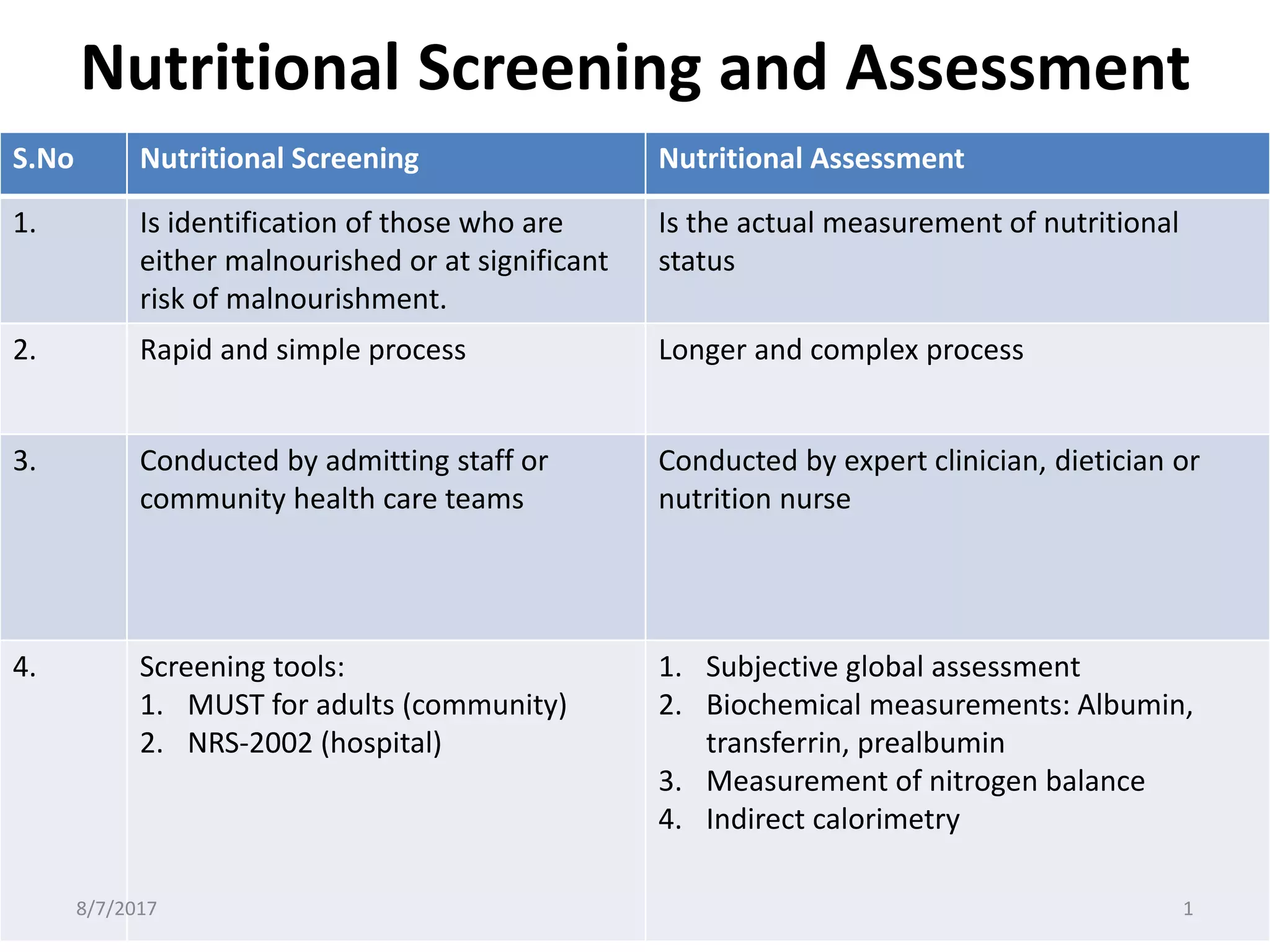
S.No Nutritional Screening Nutritional Assessment
1. Is identification of those who are
either malnourished or at significant
risk of malnourishment.
Is the actual measurement of nutritional
status
2. Rapid and simple process Longer and complex process
3. Conducted by admitting staff or
community health care teams
Conducted by expert clinician, dietician or
nutrition nurse
4. Screening tools:
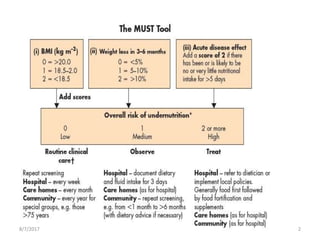
1. MUST for adults (community)
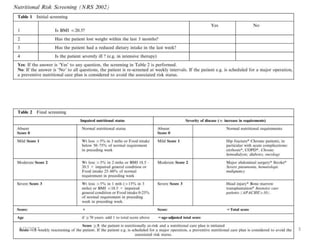
2. NRS-2002 (hospital)
1. Subjective global assessment
2. Biochemical measurements: Albumin,
transferrin, prealbumin
3. Measurement of nitrogen balance
4. Indirect calorimetry
8/7/2017 1
8/7/2017 2
8/7/2017 3
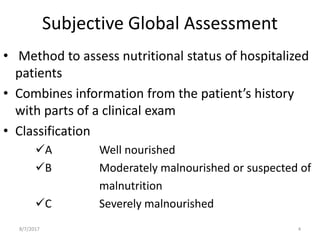
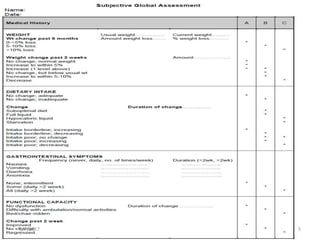
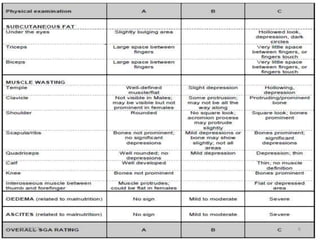
Subjective Global Assessment
• Method to assess nutritional status of hospitalized
patients
• Combines information from the patient’s history
with parts of a clinical exam
• Classification
A Well nourished
B Moderately malnourished or suspected of
malnutrition
C Severely malnourished
8/7/2017 4
8/7/2017 5
8/7/2017 6
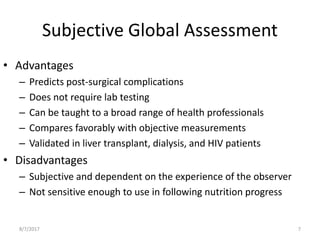
Subjective Global Assessment
• Advantages
– Predicts post-surgical complications
– Does not require lab testing
– Can be taught to a broad range of health professionals
– Compares favorably with objective measurements
– Validated in liver transplant, dialysis, and HIV patients
• Disadvantages
– Subjective and dependent on the experience of the observer
– Not sensitive enough to use in following nutrition progress
8/7/2017 7
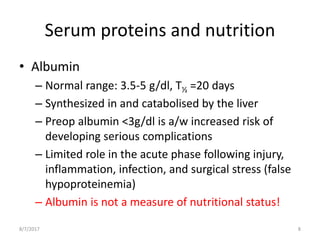
Serum proteins and nutrition
• Albumin
– Normal range: 3.5-5 g/dl, T½ =20 days
– Synthesized in and catabolised by the liver
– Preop albumin ˂3g/dl is a/w increased risk of
developing serious complications
– Limited role in the acute phase following injury,
inflammation, infection, and surgical stress (false
hypoproteinemia)
– Albumin is not a measure of nutritional status!
8/7/2017 8
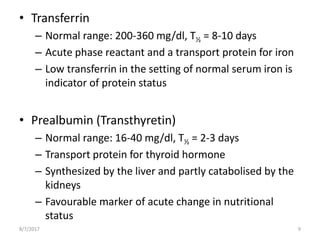
• Transferrin
– Normal range: 200-360 mg/dl, T½ = 8-10 days
– Acute phase reactant and a transport protein for iron
– Low transferrin in the setting of normal serum iron is
indicator of protein status
• Prealbumin (Transthyretin)
– Normal range: 16-40 mg/dl, T½ = 2-3 days
– Transport protein for thyroid hormone
– Synthesized by the liver and partly catabolised by the
kidneys
– Favourable marker of acute change in nutritional
status
8/7/2017 9
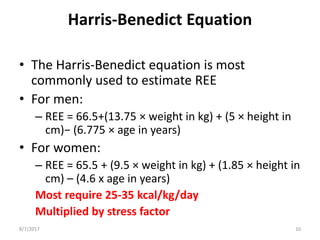
Harris-Benedict Equation
• The Harris-Benedict equation is most
commonly used to estimate REE
• For men:
– REE = 66.5+(13.75 × weight in kg) + (5 × height in
cm)− (6.775 × age in years)
• For women:
– REE = 65.5 + (9.5 × weight in kg) + (1.85 × height in
cm) – (4.6 x age in years)
Most require 25-35 kcal/kg/day
Multiplied by stress factor
8/7/2017 10
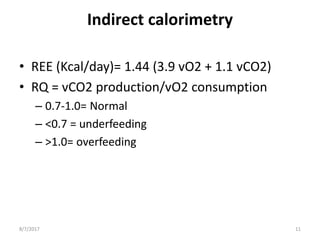
Indirect calorimetry
• REE (Kcal/day)= 1.44 (3.9 vO2 + 1.1 vCO2)
• RQ = vCO2 production/vO2 consumption
– 0.7-1.0= Normal
– <0.7 = underfeeding
– >1.0= overfeeding
8/7/2017 11
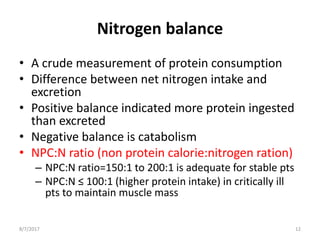
Nitrogen balance
• A crude measurement of protein consumption
• Difference between net nitrogen intake and
excretion
• Positive balance indicated more protein ingested
than excreted
• Negative balance is catabolism
• NPC:N ratio (non protein calorie:nitrogen ration)
– NPC:N ratio=150:1 to 200:1 is adequate for stable pts
– NPC:N ≤ 100:1 (higher protein intake) in critically ill
pts to maintain muscle mass
8/7/2017 12

Nutrition screening and assessment drved

  • 1.
    Nutritional Screening andAssessment S.No Nutritional Screening Nutritional Assessment 1. Is identification of those who are either malnourished or at significant risk of malnourishment. Is the actual measurement of nutritional status 2. Rapid and simple process Longer and complex process 3. Conducted by admitting staff or community health care teams Conducted by expert clinician, dietician or nutrition nurse 4. Screening tools: 1. MUST for adults (community) 2. NRS-2002 (hospital) 1. Subjective global assessment 2. Biochemical measurements: Albumin, transferrin, prealbumin 3. Measurement of nitrogen balance 4. Indirect calorimetry 8/7/2017 1
  • 2.
  • 3.
  • 4.
    Subjective Global Assessment •Method to assess nutritional status of hospitalized patients • Combines information from the patient’s history with parts of a clinical exam • Classification A Well nourished B Moderately malnourished or suspected of malnutrition C Severely malnourished 8/7/2017 4
  • 5.
  • 6.
  • 7.
    Subjective Global Assessment •Advantages – Predicts post-surgical complications – Does not require lab testing – Can be taught to a broad range of health professionals – Compares favorably with objective measurements – Validated in liver transplant, dialysis, and HIV patients • Disadvantages – Subjective and dependent on the experience of the observer – Not sensitive enough to use in following nutrition progress 8/7/2017 7
  • 8.
    Serum proteins andnutrition • Albumin – Normal range: 3.5-5 g/dl, T½ =20 days – Synthesized in and catabolised by the liver – Preop albumin ˂3g/dl is a/w increased risk of developing serious complications – Limited role in the acute phase following injury, inflammation, infection, and surgical stress (false hypoproteinemia) – Albumin is not a measure of nutritional status! 8/7/2017 8
  • 9.
    • Transferrin – Normalrange: 200-360 mg/dl, T½ = 8-10 days – Acute phase reactant and a transport protein for iron – Low transferrin in the setting of normal serum iron is indicator of protein status • Prealbumin (Transthyretin) – Normal range: 16-40 mg/dl, T½ = 2-3 days – Transport protein for thyroid hormone – Synthesized by the liver and partly catabolised by the kidneys – Favourable marker of acute change in nutritional status 8/7/2017 9
  • 10.
    Harris-Benedict Equation • TheHarris-Benedict equation is most commonly used to estimate REE • For men: – REE = 66.5+(13.75 × weight in kg) + (5 × height in cm)− (6.775 × age in years) • For women: – REE = 65.5 + (9.5 × weight in kg) + (1.85 × height in cm) – (4.6 x age in years) Most require 25-35 kcal/kg/day Multiplied by stress factor 8/7/2017 10
  • 11.
    Indirect calorimetry • REE(Kcal/day)= 1.44 (3.9 vO2 + 1.1 vCO2) • RQ = vCO2 production/vO2 consumption – 0.7-1.0= Normal – <0.7 = underfeeding – >1.0= overfeeding 8/7/2017 11
  • 12.
    Nitrogen balance • Acrude measurement of protein consumption • Difference between net nitrogen intake and excretion • Positive balance indicated more protein ingested than excreted • Negative balance is catabolism • NPC:N ratio (non protein calorie:nitrogen ration) – NPC:N ratio=150:1 to 200:1 is adequate for stable pts – NPC:N ≤ 100:1 (higher protein intake) in critically ill pts to maintain muscle mass 8/7/2017 12