CASE STUDY 1:

  Group members:
  Nor Faezah Baba            0914092
  Nor Zawani Nor Adnan       0917466
  Nur Syazana Mohd Zahir
        0918594
  Siti Rokiah Mohamad Hadzri
        0911724
  Nur Syahidatul Aswani Mohd Rozin
        0913604
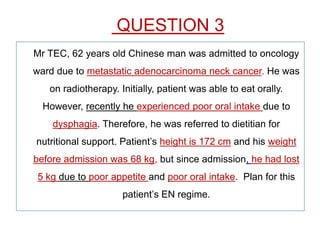
QUESTION 3
Mr TEC, 62 years old Chinese man was admitted to oncology
ward due to metastatic adenocarcinoma neck cancer. He was
   on radiotherapy. Initially, patient was able to eat orally.
  However, recently he experienced poor oral intake due to
    dysphagia. Therefore, he was referred to dietitian for
nutritional support. Patient’s height is 172 cm and his weight
before admission was 68 kg, but since admission, he had lost
5 kg due to poor appetite and poor oral intake. Plan for this
                     patient’s EN regime.
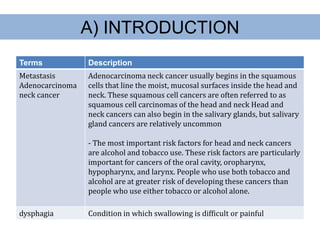
A) INTRODUCTION
Terms            Description
Metastasis       Adenocarcinoma neck cancer usually begins in the squamous
Adenocarcinoma   cells that line the moist, mucosal surfaces inside the head and
neck cancer      neck. These squamous cell cancers are often referred to as
                 squamous cell carcinomas of the head and neck Head and
                 neck cancers can also begin in the salivary glands, but salivary
                 gland cancers are relatively uncommon

                 - The most important risk factors for head and neck cancers
                 are alcohol and tobacco use. These risk factors are particularly
                 important for cancers of the oral cavity, oropharynx,
                 hypopharynx, and larynx. People who use both tobacco and
                 alcohol are at greater risk of developing these cancers than
                 people who use either tobacco or alcohol alone.

dysphagia        Condition in which swallowing is difficult or painful
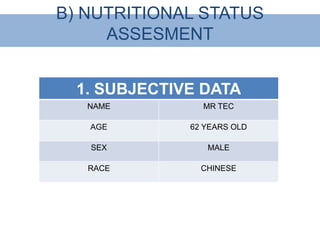
B) NUTRITIONAL STATUS
     ASSESMENT


  1. SUBJECTIVE DATA
   NAME         MR TEC

   AGE        62 YEARS OLD

   SEX           MALE

   RACE         CHINESE
B) NUTRITIONAL STATUS
      ASSESMENT

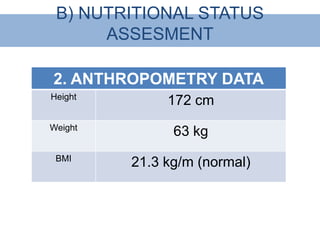
2. ANTHROPOMETRY DATA
Height
              172 cm
Weight
               63 kg
 BMI
         21.3 kg/m (normal)
B) NUTRITIONAL STATUS
                     ASSESMENT
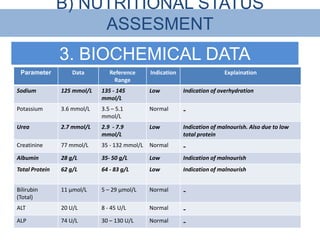
                3. BIOCHEMICAL DATA
 Parameter          Data        Reference      Indication                   Explaination
                                 Range
Sodium          125 mmol/L   135 - 145         Low          Indication of overhydration
                             mmol/L
Potassium       3.6 mmol/L   3.5 – 5.1         Normal       -
                             mmol/L
Urea            2.7 mmol/L   2.9 - 7.9         Low          Indication of malnourish. Also due to low
                             mmol/L                         total protein
Creatinine      77 mmol/L    35 - 132 mmol/L   Normal       -
Albumin         28 g/L       35- 50 g/L        Low          Indication of malnourish
Total Protein   62 g/L       64 - 83 g/L       Low          Indication of malnourish


Bilirubin       11 μmol/L    5 – 29 μmol/L     Normal       -
(Total)
ALT             20 U/L       8 - 45 U/L        Normal       -
ALP             74 U/L       30 – 130 U/L      Normal       -
B) NUTRITIONAL STATUS
     ASSESMENT
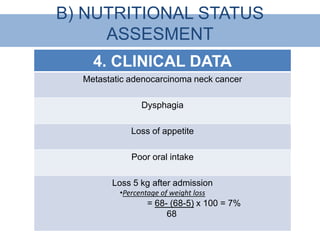
    4. CLINICAL DATA
  Metastatic adenocarcinoma neck cancer

                Dysphagia

             Loss of appetite

             Poor oral intake

        Loss 5 kg after admission
          •Percentage of weight loss
                  = 68- (68-5) x 100 = 7%
                       68
B) NUTRITIONAL STATUS
     ASSESMENT


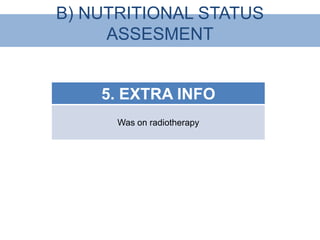
    5. EXTRA INFO
      Was on radiotherapy
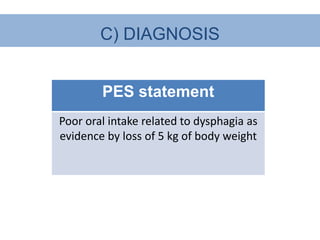
C) DIAGNOSIS


        PES statement
Poor oral intake related to dysphagia as
evidence by loss of 5 kg of body weight
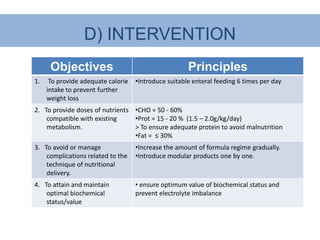
D) INTERVENTION
      Objectives                                      Principles
1.    To provide adequate calorie   •Introduce suitable enteral feeding 6 times per day
     intake to prevent further
     weight loss
2. To provide doses of nutrients •CHO = 50 - 60%
    compatible with existing     •Prot = 15 - 20 % (1.5 – 2.0g/kg/day)
    metabolism.                  > To ensure adequate protein to avoid malnutrition
                                 •Fat = ≤ 30%
3. To avoid or manage               •Increase the amount of formula regime gradually.
    complications related to the    •Introduce modular products one by one.
    technique of nutritional
    delivery.
4. To attain and maintain           • ensure optimum value of biochemical status and
    optimal biochemical             prevent electrolyte imbalance
    status/value
D) INTERVENTION
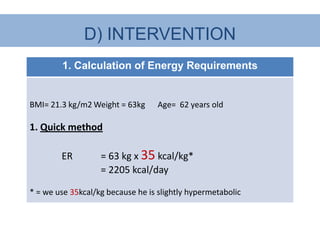
        1. Calculation of Energy Requirements


BMI= 21.3 kg/m2 Weight = 63kg      Age= 62 years old

1. Quick method

        ER         = 63 kg x 35 kcal/kg*
                   = 2205 kcal/day

* = we use 35kcal/kg because he is slightly hypermetabolic
D) INTERVENTION
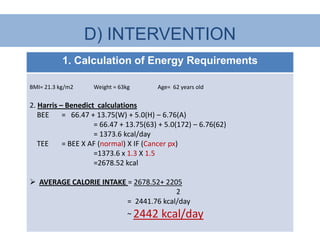
           1. Calculation of Energy Requirements

BMI= 21.3 kg/m2    Weight = 63kg       Age= 62 years old


2. Harris – Benedict calculations
   BEE     = 66.47 + 13.75(W) + 5.0(H) – 6.76(A)
                    = 66.47 + 13.75(63) + 5.0(172) – 6.76(62)
                    = 1373.6 kcal/day
   TEE     = BEE X AF (normal) X IF (Cancer px)
                    =1373.6 x 1.3 X 1.5
                    =2678.52 kcal

 AVERAGE CALORIE INTAKE = 2678.52+ 2205
                                       2
                         = 2441.76 kcal/day
                               ~ 2442   kcal/day
D) INTERVENTION

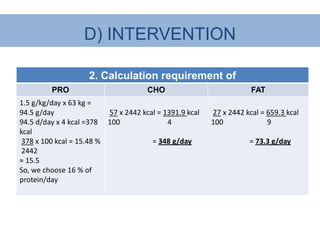
                    2. Calculation requirement of
         PRO                          CHO                            FAT
1.5 g/kg/day x 63 kg =
94.5 g/day                57 x 2442 kcal = 1391.9 kcal   27 x 2442 kcal = 659.3 kcal
94.5 d/day x 4 kcal =378 100                4            100              9
kcal
 378 x 100 kcal = 15.48 %              = 348 g/day                  = 73.3 g/day
 2442
≈ 15.5
So, we choose 16 % of
protein/day
D) INTERVENTION
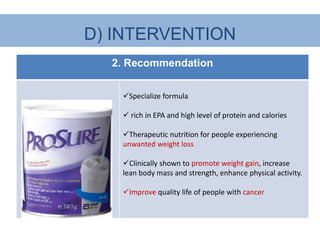
  2. Recommendation


   Specialize formula

    rich in EPA and high level of protein and calories

   Therapeutic nutrition for people experiencing
   unwanted weight loss

   Clinically shown to promote weight gain, increase
   lean body mass and strength, enhance physical activity.

   Improve quality life of people with cancer
D) INTERVENTION
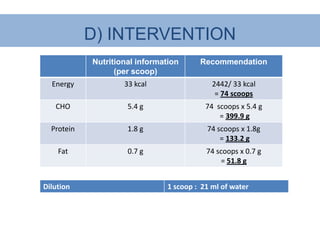
            Nutritional information      Recommendation
                  (per scoop)
  Energy            33 kcal                  2442/ 33 kcal
                                              = 74 scoops
   CHO               5.4 g                 74 scoops x 5.4 g
                                               = 399.9 g
  Protein            1.8 g                 74 scoops x 1.8g
                                               = 133.2 g
    Fat              0.7 g                 74 scoops x 0.7 g
                                               = 51.8 g


Dilution                        1 scoop : 21 ml of water
D) INTERVENTION
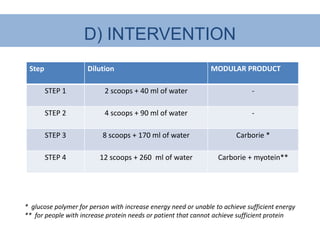
 Step                Dilution                                   MODULAR PRODUCT

        STEP 1             2 scoops + 40 ml of water                          -

        STEP 2             4 scoops + 90 ml of water                          -

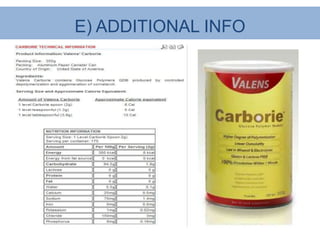
        STEP 3            8 scoops + 170 ml of water                    Carborie *

        STEP 4           12 scoops + 260 ml of water              Carborie + myotein**


* glucose polymer for person with increase energy need or unable to achieve sufficient energy
** for people with increase protein needs or patient that cannot achieve sufficient protein
D) INTERVENTION
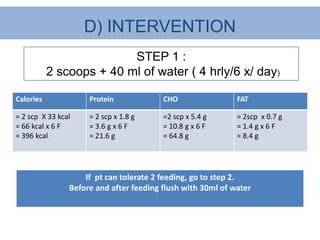
                          STEP 1 :
           2 scoops + 40 ml of water ( 4 hrly/6 x/ day)

Calories             Protein             CHO                 FAT

= 2 scp X 33 kcal    = 2 scp x 1.8 g     =2 scp x 5.4 g      = 2scp x 0.7 g
= 66 kcal x 6 F      = 3.6 g x 6 F       = 10.8 g x 6 F      = 1.4 g x 6 F
= 396 kcal           = 21.6 g            = 64.8 g            = 8.4 g


                    If pt can tolerate 2 feeding, go to step 2.
                Before and after feeding flush with 30ml of water
D) INTERVENTION
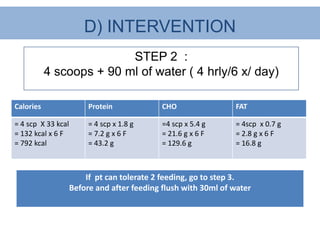
                          STEP 2 :
           4 scoops + 90 ml of water ( 4 hrly/6 x/ day)

Calories                 Protein             CHO                FAT

= 4 scp X 33 kcal        = 4 scp x 1.8 g     =4 scp x 5.4 g     = 4scp x 0.7 g
= 132 kcal x 6 F         = 7.2 g x 6 F       = 21.6 g x 6 F     = 2.8 g x 6 F
= 792 kcal               = 43.2 g            = 129.6 g          = 16.8 g


                        If pt can tolerate 2 feeding, go to step 3.
                    Before and after feeding flush with 30ml of water
D) INTERVENTION
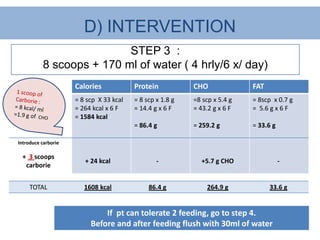
                          STEP 3 :
          8 scoops + 170 ml of water ( 4 hrly/6 x/ day)
                     Calories            Protein           CHO              FAT
                     = 8 scp X 33 kcal   = 8 scp x 1.8 g   =8 scp x 5.4 g   = 8scp x 0.7 g
                     = 264 kcal x 6 F    = 14.4 g x 6 F    = 43.2 g x 6 F   = 5.6 g x 6 F
                     = 1584 kcal
                                         = 86.4 g          = 259.2 g        = 33.6 g

Introduce carborie

 + 3 scoops
                        + 24 kcal                -           +5.7 g CHO                -
  carborie


     TOTAL              1608 kcal             86.4 g           264.9 g            33.6 g


                              If pt can tolerate 2 feeding, go to step 4.
                          Before and after feeding flush with 30ml of water
STEP 4 :
          12 scoops + 260 ml of water ( 4 hrly/6 x/ day
                     Calories             Protein            CHO               FAT

                     = 12 scp X 33 kcal   = 12 scp x 1.8 g   =12 scp x 5.4 g   = 12 scp x 0.7 g
                     = 396 kcal x 6 F     = 21.6 g x 6 F     = 64.8 g x 6 F    = 8.4 g x 6 F

                     = 2376 kcal
                                          = 129.6 g          = 388.8 g         = 50.4 g

Introduce
1.+ 4 scoops
 carborie            + 32 kcal            -                  +7.6 CHO          -

2. +2 tbsp myotein   + 38.2 kcal          6.0 g              -                 -

TOTAL                2376 + 32+ 38.2      129.6 + 3.0        388.8 + 7.6
                     =2446.2 kcal         = 132.6 g          = 396.4 g         = 50.4 g

GOAL                 2442 kcal                133.2 g            399.9 g       51.8 g
D) INTERVENTION


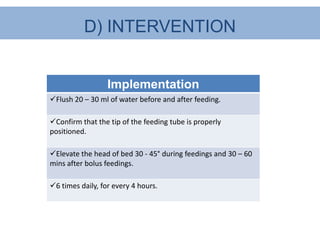
                  Implementation
Flush 20 – 30 ml of water before and after feeding.

Confirm that the tip of the feeding tube is properly
positioned.

Elevate the head of bed 30 - 45° during feedings and 30 – 60
mins after bolus feedings.

6 times daily, for every 4 hours.
E) ADDITIONAL INFO

case study 1 (Q3)

  • 1.
    CASE STUDY 1: Group members: Nor Faezah Baba 0914092 Nor Zawani Nor Adnan 0917466 Nur Syazana Mohd Zahir 0918594 Siti Rokiah Mohamad Hadzri 0911724 Nur Syahidatul Aswani Mohd Rozin 0913604
  • 2.
    QUESTION 3 Mr TEC,62 years old Chinese man was admitted to oncology ward due to metastatic adenocarcinoma neck cancer. He was on radiotherapy. Initially, patient was able to eat orally. However, recently he experienced poor oral intake due to dysphagia. Therefore, he was referred to dietitian for nutritional support. Patient’s height is 172 cm and his weight before admission was 68 kg, but since admission, he had lost 5 kg due to poor appetite and poor oral intake. Plan for this patient’s EN regime.
  • 3.
    A) INTRODUCTION Terms Description Metastasis Adenocarcinoma neck cancer usually begins in the squamous Adenocarcinoma cells that line the moist, mucosal surfaces inside the head and neck cancer neck. These squamous cell cancers are often referred to as squamous cell carcinomas of the head and neck Head and neck cancers can also begin in the salivary glands, but salivary gland cancers are relatively uncommon - The most important risk factors for head and neck cancers are alcohol and tobacco use. These risk factors are particularly important for cancers of the oral cavity, oropharynx, hypopharynx, and larynx. People who use both tobacco and alcohol are at greater risk of developing these cancers than people who use either tobacco or alcohol alone. dysphagia Condition in which swallowing is difficult or painful
  • 4.
    B) NUTRITIONAL STATUS ASSESMENT 1. SUBJECTIVE DATA NAME MR TEC AGE 62 YEARS OLD SEX MALE RACE CHINESE
  • 5.
    B) NUTRITIONAL STATUS ASSESMENT 2. ANTHROPOMETRY DATA Height 172 cm Weight 63 kg BMI 21.3 kg/m (normal)
  • 6.
    B) NUTRITIONAL STATUS ASSESMENT 3. BIOCHEMICAL DATA Parameter Data Reference Indication Explaination Range Sodium 125 mmol/L 135 - 145 Low Indication of overhydration mmol/L Potassium 3.6 mmol/L 3.5 – 5.1 Normal - mmol/L Urea 2.7 mmol/L 2.9 - 7.9 Low Indication of malnourish. Also due to low mmol/L total protein Creatinine 77 mmol/L 35 - 132 mmol/L Normal - Albumin 28 g/L 35- 50 g/L Low Indication of malnourish Total Protein 62 g/L 64 - 83 g/L Low Indication of malnourish Bilirubin 11 μmol/L 5 – 29 μmol/L Normal - (Total) ALT 20 U/L 8 - 45 U/L Normal - ALP 74 U/L 30 – 130 U/L Normal -
  • 7.
    B) NUTRITIONAL STATUS ASSESMENT 4. CLINICAL DATA Metastatic adenocarcinoma neck cancer Dysphagia Loss of appetite Poor oral intake Loss 5 kg after admission •Percentage of weight loss = 68- (68-5) x 100 = 7% 68
  • 8.
    B) NUTRITIONAL STATUS ASSESMENT 5. EXTRA INFO Was on radiotherapy
  • 9.
    C) DIAGNOSIS PES statement Poor oral intake related to dysphagia as evidence by loss of 5 kg of body weight
  • 10.
    D) INTERVENTION Objectives Principles 1. To provide adequate calorie •Introduce suitable enteral feeding 6 times per day intake to prevent further weight loss 2. To provide doses of nutrients •CHO = 50 - 60% compatible with existing •Prot = 15 - 20 % (1.5 – 2.0g/kg/day) metabolism. > To ensure adequate protein to avoid malnutrition •Fat = ≤ 30% 3. To avoid or manage •Increase the amount of formula regime gradually. complications related to the •Introduce modular products one by one. technique of nutritional delivery. 4. To attain and maintain • ensure optimum value of biochemical status and optimal biochemical prevent electrolyte imbalance status/value
  • 11.
    D) INTERVENTION 1. Calculation of Energy Requirements BMI= 21.3 kg/m2 Weight = 63kg Age= 62 years old 1. Quick method ER = 63 kg x 35 kcal/kg* = 2205 kcal/day * = we use 35kcal/kg because he is slightly hypermetabolic
  • 12.
    D) INTERVENTION 1. Calculation of Energy Requirements BMI= 21.3 kg/m2 Weight = 63kg Age= 62 years old 2. Harris – Benedict calculations BEE = 66.47 + 13.75(W) + 5.0(H) – 6.76(A) = 66.47 + 13.75(63) + 5.0(172) – 6.76(62) = 1373.6 kcal/day TEE = BEE X AF (normal) X IF (Cancer px) =1373.6 x 1.3 X 1.5 =2678.52 kcal  AVERAGE CALORIE INTAKE = 2678.52+ 2205 2 = 2441.76 kcal/day ~ 2442 kcal/day
  • 13.
    D) INTERVENTION 2. Calculation requirement of PRO CHO FAT 1.5 g/kg/day x 63 kg = 94.5 g/day 57 x 2442 kcal = 1391.9 kcal 27 x 2442 kcal = 659.3 kcal 94.5 d/day x 4 kcal =378 100 4 100 9 kcal 378 x 100 kcal = 15.48 % = 348 g/day = 73.3 g/day 2442 ≈ 15.5 So, we choose 16 % of protein/day
  • 14.
    D) INTERVENTION 2. Recommendation Specialize formula  rich in EPA and high level of protein and calories Therapeutic nutrition for people experiencing unwanted weight loss Clinically shown to promote weight gain, increase lean body mass and strength, enhance physical activity. Improve quality life of people with cancer
  • 15.
    D) INTERVENTION Nutritional information Recommendation (per scoop) Energy 33 kcal 2442/ 33 kcal = 74 scoops CHO 5.4 g 74 scoops x 5.4 g = 399.9 g Protein 1.8 g 74 scoops x 1.8g = 133.2 g Fat 0.7 g 74 scoops x 0.7 g = 51.8 g Dilution 1 scoop : 21 ml of water
  • 16.
    D) INTERVENTION Step Dilution MODULAR PRODUCT STEP 1 2 scoops + 40 ml of water - STEP 2 4 scoops + 90 ml of water - STEP 3 8 scoops + 170 ml of water Carborie * STEP 4 12 scoops + 260 ml of water Carborie + myotein** * glucose polymer for person with increase energy need or unable to achieve sufficient energy ** for people with increase protein needs or patient that cannot achieve sufficient protein
  • 17.
    D) INTERVENTION STEP 1 : 2 scoops + 40 ml of water ( 4 hrly/6 x/ day) Calories Protein CHO FAT = 2 scp X 33 kcal = 2 scp x 1.8 g =2 scp x 5.4 g = 2scp x 0.7 g = 66 kcal x 6 F = 3.6 g x 6 F = 10.8 g x 6 F = 1.4 g x 6 F = 396 kcal = 21.6 g = 64.8 g = 8.4 g If pt can tolerate 2 feeding, go to step 2. Before and after feeding flush with 30ml of water
  • 18.
    D) INTERVENTION STEP 2 : 4 scoops + 90 ml of water ( 4 hrly/6 x/ day) Calories Protein CHO FAT = 4 scp X 33 kcal = 4 scp x 1.8 g =4 scp x 5.4 g = 4scp x 0.7 g = 132 kcal x 6 F = 7.2 g x 6 F = 21.6 g x 6 F = 2.8 g x 6 F = 792 kcal = 43.2 g = 129.6 g = 16.8 g If pt can tolerate 2 feeding, go to step 3. Before and after feeding flush with 30ml of water
  • 19.
    D) INTERVENTION STEP 3 : 8 scoops + 170 ml of water ( 4 hrly/6 x/ day) Calories Protein CHO FAT = 8 scp X 33 kcal = 8 scp x 1.8 g =8 scp x 5.4 g = 8scp x 0.7 g = 264 kcal x 6 F = 14.4 g x 6 F = 43.2 g x 6 F = 5.6 g x 6 F = 1584 kcal = 86.4 g = 259.2 g = 33.6 g Introduce carborie + 3 scoops + 24 kcal - +5.7 g CHO - carborie TOTAL 1608 kcal 86.4 g 264.9 g 33.6 g If pt can tolerate 2 feeding, go to step 4. Before and after feeding flush with 30ml of water
  • 20.
    STEP 4 : 12 scoops + 260 ml of water ( 4 hrly/6 x/ day Calories Protein CHO FAT = 12 scp X 33 kcal = 12 scp x 1.8 g =12 scp x 5.4 g = 12 scp x 0.7 g = 396 kcal x 6 F = 21.6 g x 6 F = 64.8 g x 6 F = 8.4 g x 6 F = 2376 kcal = 129.6 g = 388.8 g = 50.4 g Introduce 1.+ 4 scoops carborie + 32 kcal - +7.6 CHO - 2. +2 tbsp myotein + 38.2 kcal 6.0 g - - TOTAL 2376 + 32+ 38.2 129.6 + 3.0 388.8 + 7.6 =2446.2 kcal = 132.6 g = 396.4 g = 50.4 g GOAL 2442 kcal 133.2 g 399.9 g 51.8 g
  • 21.
    D) INTERVENTION Implementation Flush 20 – 30 ml of water before and after feeding. Confirm that the tip of the feeding tube is properly positioned. Elevate the head of bed 30 - 45° during feedings and 30 – 60 mins after bolus feedings. 6 times daily, for every 4 hours.
  • 22.