Price Strategy
CH 11
PRICE STRATEGY
CH 11.1
 Identify factors that affect price strategy.
 Explain the marketing objectives related
to pricing.
 Describe the components that go into
making price strategy decisions.
PRICE STRATEGY
Developing an effective price strategy is an
important part of a marketing plan.
It enables you to set prices consistent with
your objectives and appropriate for your
target market.
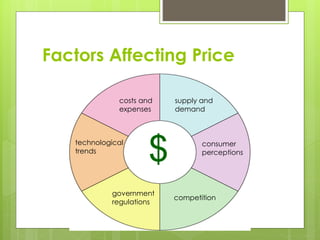
Factors Affecting Price
$
costs and
expenses
supply and
demand
consumer
perceptions
competition
government
regulations
technological
trends
Costs and Expenses
Fixed costs and expenses, such as rent, utilities, and
insurance premiums, affect price.
fixed costs and expenses that are not subject to
change depending on the number of units sold
Costs and Expenses
Variable costs and expenses, such as the cost of
goods or services, sales commissions, delivery
charges, and advertising, also affect price.
variable costs and expenses that are subject to
change depending on the number of units sold
Costs and Expenses
If you are selling goods, their costs are affected by the
pricing structure in the channel of distribution.
Each channel member has to make a profit to make
handling the goods worthwhile. Their cost and profit
together is your cost.
Supply and Demand
The law of supply and demand also affects price.
When the demand for a product is high and supply
is low, you can command a high price.
When the demand for a product is low and supply
is high, you must set lower prices.
Consumer Perception
The price of your products helps create your
image in the minds of customers.
If your prices are too low, customers may consider
your products inferior.
If your prices are too high, you may turn some
customers away.
Competition
Competition can affect pricing when the target
market is price conscious because competitors’
pricing may determine your pricing.
Businesses can charge higher prices than
competitors if they offer added value, such as
personal attention, credit, and warranties.
Government Regulations
Be fair to customers and familiarize yourself with
federal and state laws that address pricing,
including:
price gouging
price fixing
resale price maintenance
unit pricing
bait-and switch advertising
Government Regulations
A company that
engages in price
gouging or price fixing is
violating federal and
state laws.
price gouging an
illegal practice in
which competing
companies agree,
formally or informally,
to restrict prices within
a specified range
price fixing pricing
above the market
when no other retailer
is available
Government Regulations
Resale price
maintenance is illegal.
unit pricing the pricing
of goods on the basis of
cost per unit of measure,
such as a pound or an
ounce, in addition to the
price per item
Unit pricing is required
by law.
resale price maintenance
price fixing imposed by a
manufacturer on wholesale
or retail resellers of its
products to deter
price-based competition
Government Regulations
Unethical practices, such
as bait and switch, are not
only illegal but also unfair
to customers.
bait and switch a
deceptive method of
selling in which a
customer, attracted to a
store by a sale-priced
item, is told either that
the advertised item is
unavailable or that it is
inferior to a higher-
priced item that is
available
Technological Trends
The Internet and technological trends affect price
strategy.
Adapting to technological changes can give an
entrepreneur a competitive edge; not adapting can
cause some businesses to become obsolete.
Technological Trends
Before setting prices, consider the following
objectives:
obtaining a target return on investment
obtaining market share
social and ethical concerns
meeting the competition’s prices and
establishing an image
survival
sometimes maintaining the status quo
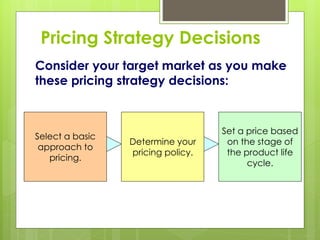
Pricing Strategy Decisions
Set a price based
on the stage of
the product life
cycle.
Determine your
pricing policy.
Select a basic
approach to
pricing.
Consider your target market as you make
these pricing strategy decisions:
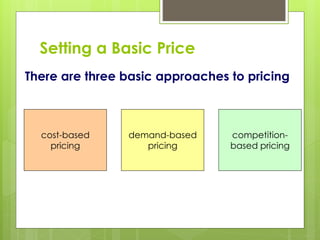
Setting a Basic Price
competition-
based pricing
demand-based
pricing
cost-based
pricing
There are three basic approaches to pricing
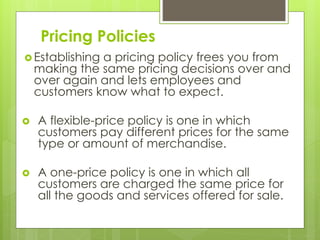
Pricing Policies
 Establishing a pricing policy frees you from
making the same pricing decisions over and
over again and lets employees and
customers know what to expect.
 A flexible-price policy is one in which
customers pay different prices for the same
type or amount of merchandise.
 A one-price policy is one in which all
customers are charged the same price for
all the goods and services offered for sale.
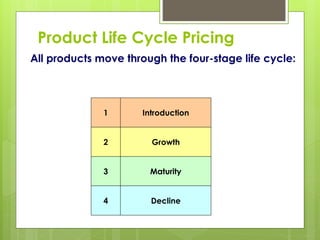
Product Life Cycle Pricing
1
2
3
4
Introduction
Growth
Maturity
Decline
All products move through the four-stage life cycle:
Product Life Cycle Pricing
Price skimming is commonly used when
introducing a product.
price skimming the practice of charging a high price
on a new product or service in order to recover costs and
maximize profits as quickly as possible; the price is then
dropped when the product or service is no longer unique
Penetration pricing is also commonly used when
introducing a product.
penetration pricing a method used to build sales by
charging a low initial price to keep unit costs to
customers as low as possible
Pricing Technique
Once you have introduced
your new product through
penetration pricing or price
skimming, you need to adjust
your prices so they are more
attractive to customers by
using psychological pricing.
psychological pricing
a pricing technique, most
often used by retail
businesses, that is based
on the belief that
customers’ perceptions of
a product are strongly
influenced by price; it
includes prestige pricing,
odd/even pricing, price
lining, promotional pricing,
multiple-unit pricing, and
bundle pricing
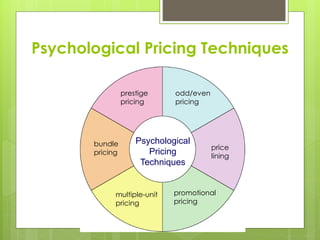
Psychological Pricing Techniques
Psychological
Pricing
Techniques
prestige
pricing
odd/even
pricing
price
lining
promotional
pricing
multiple-unit
pricing
bundle
pricing
A business may use prestige pricing to
foster a high-end image.
prestige pricing a pricing technique in
which higher-than-average prices are used
to suggest status and prestige to the
customer
Pricing Technique
When a business uses odd/even pricing,
customers may think they are getting a
bargain.
odd/even pricing a pricing technique in
which odd-numbered prices are used to
suggest bargains, such as $19.99
Pricing Technique
A store that sells all its jeans at $20, $40, and
$60 is using price lining.
price lining a pricing technique in which
items in a certain quality category are
priced the same
Pricing Technique
A new restaurant that offers “1950s prices
for three days only” is using promotional
pricing, a temporary pricing technique.
promotional pricing a pricing technique in
which lower prices are offered for a limited
period of time to stimulate sales
Pricing Technique
When a store sells three pairs of socks for
$10, it is using multiple-unit pricing.
multiple-unit pricing a pricing technique in
which items are priced in multiples, such as
3 items for 99 cents
Pricing Technique
Businesses that sell computer hardware
often use bundle pricing to sell software
that may not have sold otherwise.
bundle pricing a pricing technique in
which several complementary products are
sold at a single price, which is lower than
the price would be if each item was
purchased separately
Pricing Technique
Discount pricing is used by all types of
businesses to encourage customers to buy.
discount pricing a pricing technique that
offers customers reductions from the regular
price; some reductions are basic
percentage-off discounts and others are
specialized discounts
Pricing Technique
 Businesses that purchase or manufacture
goods for resale use markup pricing
based on the cost of the item.
 markup the amount added to the cost
of an item to cover expenses and ensure
a profit
MARK UP
MARKDOWN
Entrepreneurs may use markdown pricing
to tempt shoppers to buy in order to
reduce inventory.
markdown the amount of money taken
off an original price
DISCOUNTS
A discount is a reduction in price to the
customer.
 multiply the item price by the discount
percentage
 then subtract the discount dollars from
the price
REACTING TO MARKET PRICES
As part of ongoing market research keep an
eye on current market prices for your products.
If competitors’ prices fall, you will lose customers
if you do not lower prices.
If competitors’ prices rise, it is important to your
business’s financial health to raise prices
REVISING TERMS OF SALE
Another way to change your pricing
strategy is to revise the terms of sale, such
as
 changing credit policies
 introducing discounts
 offering leasing
 arranging financing
E-Commerce Payment Methods
After creating an inviting e-commerce environment
for shoppers, you will want to be sure they can
easily and quickly pay for their purchases.
Consumers can pay for online purchases using
credit cards, debit cards, e-cash, smart cards, and
e-wallets.
E-Commerce Payment Methods
 debit card a card issued by a financial institution than
can be used as an alternative to cash; purchase
amounts on a debit card are withdrawn directly from
the purchaser’s checking or savings account
 e-cash a legal form of electronic money transfer used
in e-commerce and transacted via the Internet
 e-wallet a software application that stores a
customer’s data, such as name, address, and credit
card number, for easy retrieval during online
purchases
E-Commerce Payment Methods
 merchant account a bank account that enables
a business to receive the proceeds of credit card
purchases
 return on investment (ROI) the amount earned as
a result of an investment
 selling price the actual or projected price per
unit
 smart card an electronic prepaid cash card that
includes a computer chip that can store data;
used to make purchases or financial transactions
over the Internet

PRICE STRATEGY.pdf

  • 1.
  • 2.
    PRICE STRATEGY CH 11.1 Identify factors that affect price strategy.  Explain the marketing objectives related to pricing.  Describe the components that go into making price strategy decisions.
  • 3.
    PRICE STRATEGY Developing aneffective price strategy is an important part of a marketing plan. It enables you to set prices consistent with your objectives and appropriate for your target market.
  • 4.
    Factors Affecting Price $ costsand expenses supply and demand consumer perceptions competition government regulations technological trends
  • 5.
    Costs and Expenses Fixedcosts and expenses, such as rent, utilities, and insurance premiums, affect price. fixed costs and expenses that are not subject to change depending on the number of units sold
  • 6.
    Costs and Expenses Variablecosts and expenses, such as the cost of goods or services, sales commissions, delivery charges, and advertising, also affect price. variable costs and expenses that are subject to change depending on the number of units sold
  • 7.
    Costs and Expenses Ifyou are selling goods, their costs are affected by the pricing structure in the channel of distribution. Each channel member has to make a profit to make handling the goods worthwhile. Their cost and profit together is your cost.
  • 8.
    Supply and Demand Thelaw of supply and demand also affects price. When the demand for a product is high and supply is low, you can command a high price. When the demand for a product is low and supply is high, you must set lower prices.
  • 9.
    Consumer Perception The priceof your products helps create your image in the minds of customers. If your prices are too low, customers may consider your products inferior. If your prices are too high, you may turn some customers away.
  • 10.
    Competition Competition can affectpricing when the target market is price conscious because competitors’ pricing may determine your pricing. Businesses can charge higher prices than competitors if they offer added value, such as personal attention, credit, and warranties.
  • 11.
    Government Regulations Be fairto customers and familiarize yourself with federal and state laws that address pricing, including: price gouging price fixing resale price maintenance unit pricing bait-and switch advertising
  • 12.
    Government Regulations A companythat engages in price gouging or price fixing is violating federal and state laws. price gouging an illegal practice in which competing companies agree, formally or informally, to restrict prices within a specified range price fixing pricing above the market when no other retailer is available
  • 13.
    Government Regulations Resale price maintenanceis illegal. unit pricing the pricing of goods on the basis of cost per unit of measure, such as a pound or an ounce, in addition to the price per item Unit pricing is required by law. resale price maintenance price fixing imposed by a manufacturer on wholesale or retail resellers of its products to deter price-based competition
  • 14.
    Government Regulations Unethical practices,such as bait and switch, are not only illegal but also unfair to customers. bait and switch a deceptive method of selling in which a customer, attracted to a store by a sale-priced item, is told either that the advertised item is unavailable or that it is inferior to a higher- priced item that is available
  • 15.
    Technological Trends The Internetand technological trends affect price strategy. Adapting to technological changes can give an entrepreneur a competitive edge; not adapting can cause some businesses to become obsolete.
  • 16.
    Technological Trends Before settingprices, consider the following objectives: obtaining a target return on investment obtaining market share social and ethical concerns meeting the competition’s prices and establishing an image survival sometimes maintaining the status quo
  • 17.
    Pricing Strategy Decisions Seta price based on the stage of the product life cycle. Determine your pricing policy. Select a basic approach to pricing. Consider your target market as you make these pricing strategy decisions:
  • 18.
    Setting a BasicPrice competition- based pricing demand-based pricing cost-based pricing There are three basic approaches to pricing
  • 19.
    Pricing Policies  Establishinga pricing policy frees you from making the same pricing decisions over and over again and lets employees and customers know what to expect.  A flexible-price policy is one in which customers pay different prices for the same type or amount of merchandise.  A one-price policy is one in which all customers are charged the same price for all the goods and services offered for sale.
  • 20.
    Product Life CyclePricing 1 2 3 4 Introduction Growth Maturity Decline All products move through the four-stage life cycle:
  • 21.
    Product Life CyclePricing Price skimming is commonly used when introducing a product. price skimming the practice of charging a high price on a new product or service in order to recover costs and maximize profits as quickly as possible; the price is then dropped when the product or service is no longer unique Penetration pricing is also commonly used when introducing a product. penetration pricing a method used to build sales by charging a low initial price to keep unit costs to customers as low as possible
  • 22.
    Pricing Technique Once youhave introduced your new product through penetration pricing or price skimming, you need to adjust your prices so they are more attractive to customers by using psychological pricing. psychological pricing a pricing technique, most often used by retail businesses, that is based on the belief that customers’ perceptions of a product are strongly influenced by price; it includes prestige pricing, odd/even pricing, price lining, promotional pricing, multiple-unit pricing, and bundle pricing
  • 23.
  • 24.
    A business mayuse prestige pricing to foster a high-end image. prestige pricing a pricing technique in which higher-than-average prices are used to suggest status and prestige to the customer Pricing Technique
  • 25.
    When a businessuses odd/even pricing, customers may think they are getting a bargain. odd/even pricing a pricing technique in which odd-numbered prices are used to suggest bargains, such as $19.99 Pricing Technique
  • 26.
    A store thatsells all its jeans at $20, $40, and $60 is using price lining. price lining a pricing technique in which items in a certain quality category are priced the same Pricing Technique
  • 27.
    A new restaurantthat offers “1950s prices for three days only” is using promotional pricing, a temporary pricing technique. promotional pricing a pricing technique in which lower prices are offered for a limited period of time to stimulate sales Pricing Technique
  • 28.
    When a storesells three pairs of socks for $10, it is using multiple-unit pricing. multiple-unit pricing a pricing technique in which items are priced in multiples, such as 3 items for 99 cents Pricing Technique
  • 29.
    Businesses that sellcomputer hardware often use bundle pricing to sell software that may not have sold otherwise. bundle pricing a pricing technique in which several complementary products are sold at a single price, which is lower than the price would be if each item was purchased separately Pricing Technique
  • 30.
    Discount pricing isused by all types of businesses to encourage customers to buy. discount pricing a pricing technique that offers customers reductions from the regular price; some reductions are basic percentage-off discounts and others are specialized discounts Pricing Technique
  • 31.
     Businesses thatpurchase or manufacture goods for resale use markup pricing based on the cost of the item.  markup the amount added to the cost of an item to cover expenses and ensure a profit MARK UP
  • 32.
    MARKDOWN Entrepreneurs may usemarkdown pricing to tempt shoppers to buy in order to reduce inventory. markdown the amount of money taken off an original price
  • 33.
    DISCOUNTS A discount isa reduction in price to the customer.  multiply the item price by the discount percentage  then subtract the discount dollars from the price
  • 34.
    REACTING TO MARKETPRICES As part of ongoing market research keep an eye on current market prices for your products. If competitors’ prices fall, you will lose customers if you do not lower prices. If competitors’ prices rise, it is important to your business’s financial health to raise prices
  • 35.
    REVISING TERMS OFSALE Another way to change your pricing strategy is to revise the terms of sale, such as  changing credit policies  introducing discounts  offering leasing  arranging financing
  • 36.
    E-Commerce Payment Methods Aftercreating an inviting e-commerce environment for shoppers, you will want to be sure they can easily and quickly pay for their purchases. Consumers can pay for online purchases using credit cards, debit cards, e-cash, smart cards, and e-wallets.
  • 37.
    E-Commerce Payment Methods debit card a card issued by a financial institution than can be used as an alternative to cash; purchase amounts on a debit card are withdrawn directly from the purchaser’s checking or savings account  e-cash a legal form of electronic money transfer used in e-commerce and transacted via the Internet  e-wallet a software application that stores a customer’s data, such as name, address, and credit card number, for easy retrieval during online purchases
  • 38.
    E-Commerce Payment Methods merchant account a bank account that enables a business to receive the proceeds of credit card purchases  return on investment (ROI) the amount earned as a result of an investment  selling price the actual or projected price per unit  smart card an electronic prepaid cash card that includes a computer chip that can store data; used to make purchases or financial transactions over the Internet