Case Studies in Biblical Leaders
Gunelius says business leaders can be
divided into two groups: idealists and
pragmatists. Most people have a little of
both, but tend to toward one or the
other.
Pragmatic leaders focus on the
practical, “how do we get this done,” side
of any task, initiative or goal. They can
erroneously be viewed as negative in
their approach when in fact they simply
view the entire picture (roadblocks
included) to get to the end result. It’s a
linear, practical way of thinking and
“doing.”
Idealist leaders focus on the visionary,
big ideas. It could be argued that they
focus more on the end result than the
path to get there, and they can
erroneously be viewed as looking
through rose-colored glasses when, in
fact, they simply “see” the end goal and
truly believe there is a way to get there.
People can be divided into three groups:
1. Those who make things happen
2. Those who watch things happen
3. Those who wonder what happened
The pragmatic leader does whatever
he/she can to make things happen. They
focus on results first, “what works?”
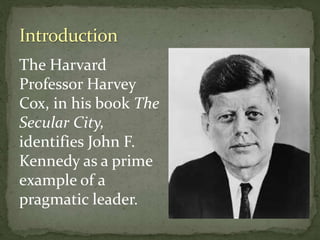
The Harvard
Professor Harvey
Cox, in his book The
Secular City,
identifies John F.
Kennedy as a prime
example of a
pragmatic leader.
 In business pragmatic leaders are
troubleshooters called in to resolve a
problem
 In cultural institutions they are
involved in the marketing aspects of
institutions
 In ministry they rebuild declining
ministries or establish new ones.
Jacob exemplifies the pragmatic
approach in that he sees a problem or
challenge as an opportunity and he
logically applies a plan of action to
achieve his desired outcome.
Sometimes he focuses so much on the
moment and the issue at hand that he
fails to see the long term implications.
Genesis 30, NKJV
25 And it came to pass, when Rachel had borne
Joseph, that Jacob said to Laban, “Send me
away, that I may go to my own place and to my
country. 26 Give me my wives and my children
for whom I have served you, and let me go; for
you know my service which I have done for
you.”
27 And Laban said to him, “Please stay, if I
have found favor in your eyes, for I have
learned by experience that the LORD has
blessed me for your sake.” 28 Then he said,
“Name me your wages, and I will give it.”
29 So Jacob said to him, “You know how I have
served you and how your livestock has been
with me. 30 For what you had before I came
was little, and it has increased to a great
amount; the LORD has blessed you since my
coming. And now, when shall I also provide
for my own house?”
31 So he said, “What shall I give you?”
And Jacob said, “You shall not give me
anything. If you will do this thing for me, I
will again feed and keep your flocks: 32 Let me
pass through all your flock today, removing
from there all the speckled and spotted sheep,
and all the brown ones among the lambs, and
the spotted and speckled among the goats;
and these shall be my wages.
34 And Laban said, “Oh, that it were according
to your word!” 35 So he removed that day the
male goats that were speckled and spotted, all
the female goats that were speckled and
spotted, every one that had some white in it,
and all the brown ones among the lambs, and
gave them into the hand of his sons. 36 Then
he put three days’ journey between himself
and Jacob, and Jacob fed the rest of Laban’s
flocks.
37 Now Jacob took for himself rods of green
poplar and of the almond and chestnut trees,
peeled white strips in them, and exposed the
white which was in the rods. 38 And the rods
which he had peeled, he set before the flocks
in the gutters, in the watering troughs where
the flocks came to drink, so that they should
conceive when they came to drink.
39 So the flocks conceived before the rods, and
the flocks brought forth streaked, speckled,
and spotted. 40 Then Jacob separated the
lambs, and made the flocks face toward the
streaked and all the brown in the flock of
Laban; but he put his own flocks by
themselves and did not put them with Laban’s
flock.
41 And it came to pass, whenever the stronger
livestock conceived, that Jacob placed the
rods before the eyes of the livestock in the
gutters, that they might conceive among the
rods. 42 But when the flocks were feeble, he
did not put them in; so the feebler were
Laban’s and the stronger Jacob’s. 43 Thus the
man became exceedingly prosperous, and had
large flocks, female and male servants, and
camels and donkeys.
33 So my righteousness will answer for me in
time to come, when the subject of my wages
comes before you: every one that is not
speckled and spotted among the goats, and
brown among the lambs, will be considered
stolen, if it is with me.”
. . . can be strong leaders
. . . focus on current issues
. . . are functional problem solvers
. . . influence targeted toward elite
individuals invested in the problem
. . . are troubleshooters
Their strength (focus on problem
solving) can also become their weakness:
 Can be manipulative
 Ends justify the means
 Feel boxed in by existing policies
 Sometimes so project oriented that
they fail to recognize the value of the
people they need to accomplish the
task
 May be frustrated by those committed
to the existing processes
 Sometimes find existing committees
hard to work with
 Are not good at maintaining an
existing ministry
 May create problems as they try to force
previous solutions on new situations
 Risk losing followers by not involving
them
 Their pragmatism may hide a serious
character flaw
 May act too quickly without taking
time to evaluate the strategy
 May win a battle and lose the war
 Not good at building loyalty
Need to . . .
1. Know how to get things done
2. Need to make healthy compromises to
achieve noble goals without sacrificing
their integrity
3. Need to be able to fix some problems
quickly
4. Need to appreciate the ability of others
5. Need to be able to spot those who are
pragmatic in a negative sense and protect
followers from manipulative people.
 Sometimes, the way to evaluate leaders is to
find out what it takes to stop them.
 Emerson said, “difficulties exist to be
surmounted.”
 Thomas Fuller said, “All things are difficult
before they ae easy.”
 Someone said, “Be thankful for problems.
They were less difficult, someone with les
ability might have your job.”
 Stephen Leacock claimed, “I am a firm
believer in luck and find the harder I
work, the more I have of it.”
 With Laban, Jacob’s plan was successful.
It resolved his problem and reversed his
fortune. However, his pragmatic actions
with Esau had unintended long-term
effects.
 Some people have a personality type
that naturally inclines them to look at
life pragmatically. For others, it is not a
part of their natural approach.
 Yet, all leaders will encounter situations
that require a “hard-nosed” approach.
 There needs to be a blend of the best
aspects of pragmatism and avoid the
weaknesses.
 Begin by recognizing the wrong in your
world and committing yourself to do
right anyway.
 Learn to discern the right things to do,
then do them.
 Build your credibility as a leader by
demonstrating that you know how to
solve the problem
 Measure and report on your progress to
strengthen the resolve of your followers
 Adjust the plan as needed
Pragmatic leaders recognize the problem,
understand the potential for disaster,
have a plan to deal with the problems,
and have the courage to lead in the most
difficult contexts.
https://www.youtube.com/watch?feature=player_detailpage&v=sO4WdSLX-Hg
https://www.youtube.com/watch?feature=player_detailpage&v=hrfi6Bi0K-4

Chapter3

  • 1.
    Case Studies inBiblical Leaders
  • 2.
    Gunelius says businessleaders can be divided into two groups: idealists and pragmatists. Most people have a little of both, but tend to toward one or the other.
  • 3.
    Pragmatic leaders focuson the practical, “how do we get this done,” side of any task, initiative or goal. They can erroneously be viewed as negative in their approach when in fact they simply view the entire picture (roadblocks included) to get to the end result. It’s a linear, practical way of thinking and “doing.”
  • 4.
    Idealist leaders focuson the visionary, big ideas. It could be argued that they focus more on the end result than the path to get there, and they can erroneously be viewed as looking through rose-colored glasses when, in fact, they simply “see” the end goal and truly believe there is a way to get there.
  • 5.
    People can bedivided into three groups: 1. Those who make things happen 2. Those who watch things happen 3. Those who wonder what happened The pragmatic leader does whatever he/she can to make things happen. They focus on results first, “what works?”
  • 6.
    The Harvard Professor Harvey Cox,in his book The Secular City, identifies John F. Kennedy as a prime example of a pragmatic leader.
  • 7.
     In businesspragmatic leaders are troubleshooters called in to resolve a problem  In cultural institutions they are involved in the marketing aspects of institutions  In ministry they rebuild declining ministries or establish new ones.
  • 8.
    Jacob exemplifies thepragmatic approach in that he sees a problem or challenge as an opportunity and he logically applies a plan of action to achieve his desired outcome. Sometimes he focuses so much on the moment and the issue at hand that he fails to see the long term implications.
  • 9.
    Genesis 30, NKJV 25And it came to pass, when Rachel had borne Joseph, that Jacob said to Laban, “Send me away, that I may go to my own place and to my country. 26 Give me my wives and my children for whom I have served you, and let me go; for you know my service which I have done for you.”
  • 10.
    27 And Labansaid to him, “Please stay, if I have found favor in your eyes, for I have learned by experience that the LORD has blessed me for your sake.” 28 Then he said, “Name me your wages, and I will give it.”
  • 11.
    29 So Jacobsaid to him, “You know how I have served you and how your livestock has been with me. 30 For what you had before I came was little, and it has increased to a great amount; the LORD has blessed you since my coming. And now, when shall I also provide for my own house?”
  • 12.
    31 So hesaid, “What shall I give you?” And Jacob said, “You shall not give me anything. If you will do this thing for me, I will again feed and keep your flocks: 32 Let me pass through all your flock today, removing from there all the speckled and spotted sheep, and all the brown ones among the lambs, and the spotted and speckled among the goats; and these shall be my wages.
  • 13.
    34 And Labansaid, “Oh, that it were according to your word!” 35 So he removed that day the male goats that were speckled and spotted, all the female goats that were speckled and spotted, every one that had some white in it, and all the brown ones among the lambs, and gave them into the hand of his sons. 36 Then he put three days’ journey between himself and Jacob, and Jacob fed the rest of Laban’s flocks.
  • 14.
    37 Now Jacobtook for himself rods of green poplar and of the almond and chestnut trees, peeled white strips in them, and exposed the white which was in the rods. 38 And the rods which he had peeled, he set before the flocks in the gutters, in the watering troughs where the flocks came to drink, so that they should conceive when they came to drink.
  • 15.
    39 So theflocks conceived before the rods, and the flocks brought forth streaked, speckled, and spotted. 40 Then Jacob separated the lambs, and made the flocks face toward the streaked and all the brown in the flock of Laban; but he put his own flocks by themselves and did not put them with Laban’s flock.
  • 16.
    41 And itcame to pass, whenever the stronger livestock conceived, that Jacob placed the rods before the eyes of the livestock in the gutters, that they might conceive among the rods. 42 But when the flocks were feeble, he did not put them in; so the feebler were Laban’s and the stronger Jacob’s. 43 Thus the man became exceedingly prosperous, and had large flocks, female and male servants, and camels and donkeys.
  • 17.
    33 So myrighteousness will answer for me in time to come, when the subject of my wages comes before you: every one that is not speckled and spotted among the goats, and brown among the lambs, will be considered stolen, if it is with me.”
  • 18.
    . . .can be strong leaders . . . focus on current issues . . . are functional problem solvers . . . influence targeted toward elite individuals invested in the problem . . . are troubleshooters
  • 19.
    Their strength (focuson problem solving) can also become their weakness:  Can be manipulative  Ends justify the means  Feel boxed in by existing policies  Sometimes so project oriented that they fail to recognize the value of the people they need to accomplish the task
  • 20.
     May befrustrated by those committed to the existing processes  Sometimes find existing committees hard to work with  Are not good at maintaining an existing ministry  May create problems as they try to force previous solutions on new situations
  • 21.
     Risk losingfollowers by not involving them  Their pragmatism may hide a serious character flaw  May act too quickly without taking time to evaluate the strategy  May win a battle and lose the war  Not good at building loyalty
  • 22.
    Need to .. . 1. Know how to get things done 2. Need to make healthy compromises to achieve noble goals without sacrificing their integrity 3. Need to be able to fix some problems quickly 4. Need to appreciate the ability of others 5. Need to be able to spot those who are pragmatic in a negative sense and protect followers from manipulative people.
  • 23.
     Sometimes, theway to evaluate leaders is to find out what it takes to stop them.  Emerson said, “difficulties exist to be surmounted.”  Thomas Fuller said, “All things are difficult before they ae easy.”  Someone said, “Be thankful for problems. They were less difficult, someone with les ability might have your job.”
  • 24.
     Stephen Leacockclaimed, “I am a firm believer in luck and find the harder I work, the more I have of it.”  With Laban, Jacob’s plan was successful. It resolved his problem and reversed his fortune. However, his pragmatic actions with Esau had unintended long-term effects.
  • 25.
     Some peoplehave a personality type that naturally inclines them to look at life pragmatically. For others, it is not a part of their natural approach.  Yet, all leaders will encounter situations that require a “hard-nosed” approach.  There needs to be a blend of the best aspects of pragmatism and avoid the weaknesses.
  • 26.
     Begin byrecognizing the wrong in your world and committing yourself to do right anyway.  Learn to discern the right things to do, then do them.  Build your credibility as a leader by demonstrating that you know how to solve the problem
  • 27.
     Measure andreport on your progress to strengthen the resolve of your followers  Adjust the plan as needed Pragmatic leaders recognize the problem, understand the potential for disaster, have a plan to deal with the problems, and have the courage to lead in the most difficult contexts.
  • 28.
  • 29.