Authors: ERIK W. LARSON
CLIFFORD F. GRAY
CHAPTER ONE
MODERN PROJECT MANAGEMENT
Chapter Outline
1. What is Project
2. Current Drivers of Project Management
3. Project Governance
4. Project Management Today – Socio-Technical
Approach
Learning Objectives
LO1. Understand why Project Management is crucial in
today’s world.
LO2. Distinguish a project from routine operations.
LO3. Identify the different stages of a project life cycle.
LO4. Understand the importance of projects in
implementing organization strategy.
LO5. Understand that managing projects involve balancing
the technical and sociocultural dimensions of the
project.
Project Management
Project Management
• Business leaders and experts have proclaimed that project
management is critical to sustainable economic growth. New jobs
and competitive advantage are achieved by constant innovation,
developing new products and services, and improving both
productivity and quality of work.
• This is the world of project management. Project management
provides people with a powerful set of tools that improves their
ability to plan, implement, and manage activities to accomplish
specific objectives. But project management is more than just a
set of tools; it is a results-oriented management style that places a
premium on building collaborative relationships among a diverse
cast of characters.
LO1
1.1 What is a Project?
• Project Defined
A complex, nonroutine, one-time effort limited by time, budget, resources,
and performance specifications designed to meet customer needs.
Projects are initiated to achieve a specific goal or address a particular need,
such as developing a new product, implementing a system upgrade, or
organizing an event.
• Major Characteristics of a Project
• 1. Has an established objective.
• 2. Has a defined life span with a beginning and an end.
• 3. Requires across-the-organizational participation.
• 4. Involves doing something never been done before.
• 5. Has specific time, cost, and performance requirements.
SOME EXAMPLE OF A PROJECT
• The construction of homes, establishment, roads, and buildings;
• developing software;
• conducting research;
• Organizing an Event;
SOME examples of small projects includes:
• Developing a training course.
•Implementing a project office.
•Implementing a purchased software
application.
•Enhancing an existing information system.
•Developing a website.
•Evaluating an existing practice.
•Developing a strategy.
•Developing a project proposal.
SOME examples of Big projects includes:
•Construction of Establishments
•Video game development and customized
Software Application
•Enhancing an existing information system.
•Natural disaster relief efforts.
What a Project is Not
• Projects should not be confused with everyday work. A project is not
routine, repetitive work! Ordinary daily work typically requires doing
the same or similar work over and over, while a project is done only
once; a new product or service exists when the project is completed.
LO2
Program vs Project
• Program Defined
- A series of coordinated, related, multiple projects that
continue over an extended time and are intended to
achieve a goal.
- A higher level group of projects targeted at a common
goal.
- The major differences between Program & Project lie in
scale and time span.
Example:
Project: completion of a required course in project
management
Project Life Cycle
• Another way of illustrating the
unique nature of project work
is in terms of the project life
cycle.
• Some project managers find it
useful to use the project life
cycle as the cornerstone for
managing projects.
• The life cycle recognizes that
projects have a limited life
span and that there are
predictable changes in level of
effort and focus over the life of
the project.
LO3
The Project Manager
• The Project Manager
- Manages temporary, non-repetitive activities and
frequently acts independently of the formal organization.
• Marshals resources for the project.
• Is linked directly to the customer interface.
• Provides direction, coordination, and integration to the project
team.
• Is responsible for performance and success of the project.
- Must induce the right people at the right time to address
the right issues and make the right decisions.
Being Part of a Project Team
Project members:
• Will experience people issue
• Are expected to use project management tools and concepts.
• They develop or are given a project charter or scope statement
that defines the objectives and parameters of the project.
• They work with others to create a project schedule and budget
that will guide project execution.
• They need to understand project priorities so they can make
independent decisions.
• They must know how to monitor and report project progress.
1.2 Current Drivers of Project
Management
Factors leading to the increased use of project
management:
• –Compression of the product life cycle
• –Knowledge explosion
• –Triple bottom line (people, planet, profit)
• –Corporate downsizing
• –Increased customer focus
• –Small projects represent big problems
1.3 Project Governance
• Governance is designed to improve project management
in the whole organization over the long haul. The rationale
for integration (centralization) of project management was
to provide senior management with:
• ∙An overview of all project management activities;
• ∙A big picture of how organizational resources are being used;
• ∙An assessment of the risk their portfolio of projects represents;
• A rough metric for measuring the improvement of managing
projects relative to others in the industry;
• Linkages of senior management with actual project execution
management.
Alignment of Projects with Organizational
Strategy
• Today, projects are the modus
operandi for implementing strategy.
• Since projects are the modus
operandi, strategic alignment of
projects is of major importance to
conserving and effective use of
organization resources.
• Selection criteria need to ensure
each project is prioritized and
contributes to strategic goals.
Anything less is a waste of scarce
organizational resources—people,
capital, and equipment.
LO4
Major Functions of Portfolio
Management
Oversee project selection.
• Monitor aggregate resource levels and skills.
• Encourage use of best practices.
• Balance projects in the portfolio in order to represent a
risk level appropriate to the organization.
• Improve communication among all stakeholders.
• Create a total organization perspective that goes beyond
silo thinking.
• Improve overall management of projects over time.
1.4 Project Management Today:
A Socio-Technical Approach
• Managing a project is a multidimensional
process
• The first dimension is the technical side of the
management process, which consists of the
formal, disciplined, purely logical parts of the
process. This technical dimension includes
planning, scheduling, and controlling projects.
• The second and opposing dimension is the
sociocultural side of project management. In
contrast to the orderly world of project
planning, this dimension involves the much
messier, often contradictory and paradoxical
world of implementation. It centers on creating
a temporary social system within a larger
organizational environment that combines the
talents of a divergent set of professionals
working to complete the project.
A Socio-Technical Approach to Project
LO5
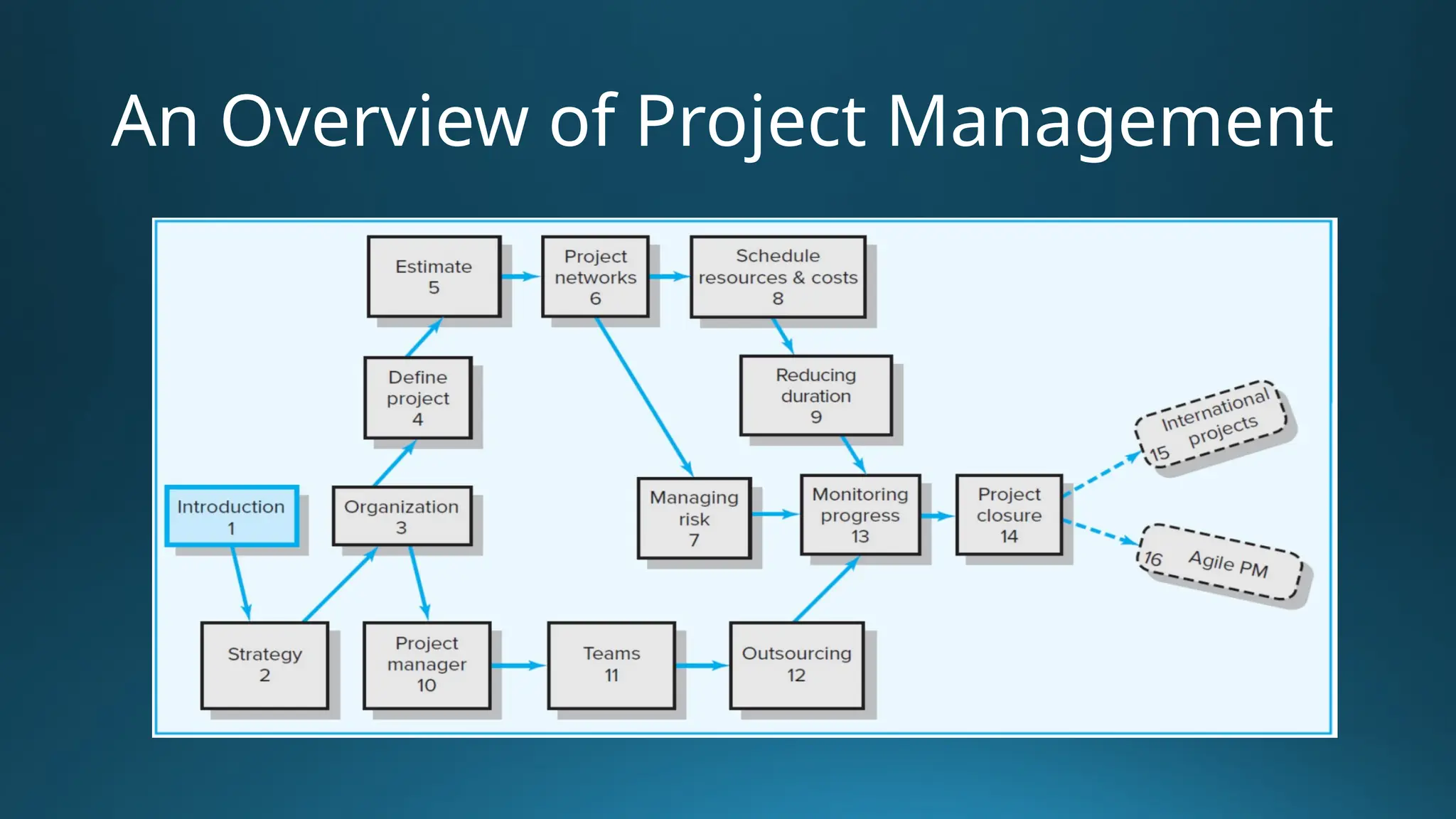
An Overview of Project Management
Key Term
•Program
•Project
•Project Life Cycle
•Project Management Professional (PMP)
•Sociotechnical Perspective
- END OF PRESENTATION
Please Scan Code for your activity…

Chapter-1-Modern-Project-Management (1).pptx

  • 1.
    Authors: ERIK W.LARSON CLIFFORD F. GRAY CHAPTER ONE MODERN PROJECT MANAGEMENT
  • 2.
    Chapter Outline 1. Whatis Project 2. Current Drivers of Project Management 3. Project Governance 4. Project Management Today – Socio-Technical Approach
  • 3.
    Learning Objectives LO1. Understandwhy Project Management is crucial in today’s world. LO2. Distinguish a project from routine operations. LO3. Identify the different stages of a project life cycle. LO4. Understand the importance of projects in implementing organization strategy. LO5. Understand that managing projects involve balancing the technical and sociocultural dimensions of the project.
  • 4.
  • 5.
    Project Management • Businessleaders and experts have proclaimed that project management is critical to sustainable economic growth. New jobs and competitive advantage are achieved by constant innovation, developing new products and services, and improving both productivity and quality of work. • This is the world of project management. Project management provides people with a powerful set of tools that improves their ability to plan, implement, and manage activities to accomplish specific objectives. But project management is more than just a set of tools; it is a results-oriented management style that places a premium on building collaborative relationships among a diverse cast of characters. LO1
  • 6.
    1.1 What isa Project? • Project Defined A complex, nonroutine, one-time effort limited by time, budget, resources, and performance specifications designed to meet customer needs. Projects are initiated to achieve a specific goal or address a particular need, such as developing a new product, implementing a system upgrade, or organizing an event. • Major Characteristics of a Project • 1. Has an established objective. • 2. Has a defined life span with a beginning and an end. • 3. Requires across-the-organizational participation. • 4. Involves doing something never been done before. • 5. Has specific time, cost, and performance requirements.
  • 7.
    SOME EXAMPLE OFA PROJECT • The construction of homes, establishment, roads, and buildings; • developing software; • conducting research; • Organizing an Event; SOME examples of small projects includes: • Developing a training course. •Implementing a project office. •Implementing a purchased software application. •Enhancing an existing information system. •Developing a website. •Evaluating an existing practice. •Developing a strategy. •Developing a project proposal. SOME examples of Big projects includes: •Construction of Establishments •Video game development and customized Software Application •Enhancing an existing information system. •Natural disaster relief efforts.
  • 8.
    What a Projectis Not • Projects should not be confused with everyday work. A project is not routine, repetitive work! Ordinary daily work typically requires doing the same or similar work over and over, while a project is done only once; a new product or service exists when the project is completed. LO2
  • 9.
    Program vs Project •Program Defined - A series of coordinated, related, multiple projects that continue over an extended time and are intended to achieve a goal. - A higher level group of projects targeted at a common goal. - The major differences between Program & Project lie in scale and time span. Example: Project: completion of a required course in project management
  • 10.
    Project Life Cycle •Another way of illustrating the unique nature of project work is in terms of the project life cycle. • Some project managers find it useful to use the project life cycle as the cornerstone for managing projects. • The life cycle recognizes that projects have a limited life span and that there are predictable changes in level of effort and focus over the life of the project. LO3
  • 11.
    The Project Manager •The Project Manager - Manages temporary, non-repetitive activities and frequently acts independently of the formal organization. • Marshals resources for the project. • Is linked directly to the customer interface. • Provides direction, coordination, and integration to the project team. • Is responsible for performance and success of the project. - Must induce the right people at the right time to address the right issues and make the right decisions.
  • 12.
    Being Part ofa Project Team Project members: • Will experience people issue • Are expected to use project management tools and concepts. • They develop or are given a project charter or scope statement that defines the objectives and parameters of the project. • They work with others to create a project schedule and budget that will guide project execution. • They need to understand project priorities so they can make independent decisions. • They must know how to monitor and report project progress.
  • 13.
    1.2 Current Driversof Project Management Factors leading to the increased use of project management: • –Compression of the product life cycle • –Knowledge explosion • –Triple bottom line (people, planet, profit) • –Corporate downsizing • –Increased customer focus • –Small projects represent big problems
  • 14.
    1.3 Project Governance •Governance is designed to improve project management in the whole organization over the long haul. The rationale for integration (centralization) of project management was to provide senior management with: • ∙An overview of all project management activities; • ∙A big picture of how organizational resources are being used; • ∙An assessment of the risk their portfolio of projects represents; • A rough metric for measuring the improvement of managing projects relative to others in the industry; • Linkages of senior management with actual project execution management.
  • 15.
    Alignment of Projectswith Organizational Strategy • Today, projects are the modus operandi for implementing strategy. • Since projects are the modus operandi, strategic alignment of projects is of major importance to conserving and effective use of organization resources. • Selection criteria need to ensure each project is prioritized and contributes to strategic goals. Anything less is a waste of scarce organizational resources—people, capital, and equipment. LO4
  • 16.
    Major Functions ofPortfolio Management Oversee project selection. • Monitor aggregate resource levels and skills. • Encourage use of best practices. • Balance projects in the portfolio in order to represent a risk level appropriate to the organization. • Improve communication among all stakeholders. • Create a total organization perspective that goes beyond silo thinking. • Improve overall management of projects over time.
  • 17.
    1.4 Project ManagementToday: A Socio-Technical Approach • Managing a project is a multidimensional process • The first dimension is the technical side of the management process, which consists of the formal, disciplined, purely logical parts of the process. This technical dimension includes planning, scheduling, and controlling projects. • The second and opposing dimension is the sociocultural side of project management. In contrast to the orderly world of project planning, this dimension involves the much messier, often contradictory and paradoxical world of implementation. It centers on creating a temporary social system within a larger organizational environment that combines the talents of a divergent set of professionals working to complete the project. A Socio-Technical Approach to Project LO5
  • 18.
    An Overview ofProject Management
  • 19.
    Key Term •Program •Project •Project LifeCycle •Project Management Professional (PMP) •Sociotechnical Perspective
  • 20.
    - END OFPRESENTATION Please Scan Code for your activity…

Editor's Notes

  • #6 Established objectives – projects typically have defined objectives giving them singular purpose which when contrasted with daily organizational life, the workers perform repetitive operations each day Defined life span with beginning and end – since it has a defined purpose, the project has a definite timeframe of completion. Once a project is completed the team moves on to other projects. Participation among several departments and professional – project requires combined efforts of a variety of specialists, under the supervision of a project manager to complete the project Something never done before – project is nonroutine and has some unique elements, requires solving previously unsolved problems and using breakthrough technology Specific time, cost, and performance reqts – these are constraints that bind projects, these three highlights the balancing and trade-offs among the three
  • #10 1. Defining stage: Specifications of the project are defined; project objectives are established; teams are formed; major responsibilities are assigned. 2. Planning stage: The level of effort increases, and plans are developed to determine what the project will entail, when it will be scheduled, whom it will benefit, what quality level should be maintained, and what the budget will be. 3. Executing stage: A major portion of the project work takes place—both physical and mental. The physical product is produced (a bridge, a report, a software program). Time, cost, and specification measures are used for control. Is the project on schedule, on budget, and meeting specifications? What are the forecasts of each of these measures? What revisions/changes are necessary? 4. Closing stage: Closing includes three activities: delivering the project product to the customer, redeploying project resources, and post-project review. Delivery of the project might include customer training and transferring documents. Redeployment usually involves releasing project equipment/materials to other projects and finding new assignments for team members. Post-project reviews include not only assessing performance but also capturing lessons learned.
  • #14 Competing in a global market influenced by rapid change, innovation, and time to market means organizations manage more and more projects. Some means for coordinating and managing projects in this changing environment is needed. Centralization of project management processes and practices has been the practical outcome. Full insight of all components of the organization is crucial for aligning internal business resources with the requirements of the changing environment. Governance enables management to have greater flexibility and better control of all project management activities.
  • #15 Ensuring alignment requires a selection process that is systematic, open, consistent, and balanced. All of the projects selected become part of a project portfolio that balances the total risk for the organization. Management of the project portfolio ensures that only the most valuable projects are approved and managed across the entire organization.
  • #17 Technical Clear project scope statements are written to link the project and customer and to facilitate planning and control. Creation of the deliverables and work breakdown structures facilitates planning and monitoring the progress of the project. The work breakdown structure serves as a database that links all levels in the organization, major deliverables, and all work—right down to the tasks in a work package. Effects of project changes are documented and traceable. Thus, any change in one part of the project is traceable to the source by the integrated linkages of the system. Sociocultural Project managers must shape a project culture that stimulates teamwork and high levels of personal motivation as well as a capacity to quickly identify and resolve problems that threaten project work. Things rarely go as planned and project managers must be able to steer the project back on track or alter directions when necessary.
  • #18 Chapter 1 - The text focuses both on the science of project management and the art of managing projects. Chapter 2 focuses on how organizations go about evaluating and selecting projects. Special attention is devoted to the importance of aligning project selection to the mission and strategy of the firm. The organizational environment in which projects are implemented is the focus of Chapter 3. The discussion of matrix management and other organizational forms is augmented by a discussion of the role the culture of an organization plays in the implementation of projects. The next six chapters focus on developing a plan for the project; after all, project success begins with a good plan. Chapter 4 deals with defining the scope of the project and developing a work breakdown structure (WBS). The challenge of formulating cost and time estimates is the subject of Chapter 5. Chapter 6 focuses on utilizing the information from the WBS to create a project plan in the form of a timed and sequenced network of activities. Risks are a potential threat to every project, and Chapter 7 examines how organizations and managers identify and manage risks associated with project work. Resource allocation is added to the plan in Chapter 8 with special attention devoted to how resource limitations impact the project schedule. After a resource schedule is established, a project time-phased budget is developed. Finally, Chapter 9 examines strategies for reducing (“crashing”) project time either prior to the initiation of the project or in response to problems or new demands placed on the project. Chapters 10 through 12 focus on project implementation and the sociocultural side of project management, beginning with Chapter 10, which focuses on the role of the project manager as a leader and stresses the importance of managing project stakeholders within the organization. Chapter 11 focuses on the core project team; it combines the latest information on team dynamics with leadership skills/techniques for developing a high-performance project team. Chapter 12 continues the theme of managing project stakeholders by discussing how to outsource project work and negotiate with contractors, customers, and suppliers. Chapter 13 focuses on the kinds of information managers use to monitor project progress, with special attention devoted to the key concept of earned value. The project life cycle is completed with Chapter 14, which covers closing out a project and the important assessment of performance and lessons learned. Two “supplemental” chapters are included to augment the project management core. Working on international projects across cultures is the focus of Chapter 15. Agile project management, a more flexible approach to managing projects where requirements cannot be clearly defined, is the subject of Chapter 16.