Key Concepts 
& 
Organization Influences 
Project Management Framework 
PMBOK 5th edition 
Hossam Maghrabi, PMP
Key Concepts 
What is the Project ? 
What is Project Management? 
Relationships Between 
- Portfolio Management - Program Management - Project Management - Organizational Project Management 
Relationships Between 
- Project Management - Operations Management - Organizational Strategy 
Business Value. 
Role of the Project Manager.
It’s a temporary endeavor undertaken to create a unique Product, Service or Result. 
Projects have a specific purpose and definite beginning and end point Note: The operation goes on continuously . 
When the end of a project is reached? 
– The project's objectives have been achieved. 
–The organization terminate the project because, 
 Its objectives will not or cannot be met, 
The need for the project no longer exists 
–A project may also be terminated if the client (customer, sponsor, or champion) wishes to terminate it. 
Every project creates a unique product, service, or result. 
Examples of Projects ….. 
What is a Project?
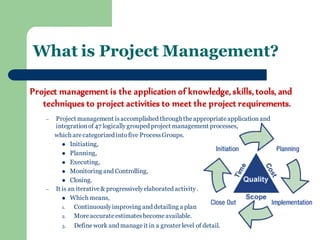
Project management is the application of knowledge, skills, tools, and techniques to project activities to meet the project requirements. 
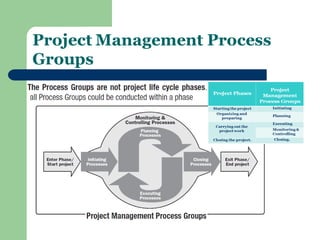
–Project management is accomplished through the appropriate application and integration of 47 logically grouped project management processes, 
which are categorized into five Process Groups. 
Initiating, 
Planning, 
Executing, 
Monitoring and Controlling, 
Closing. 
–It is an iterative & progressively elaborated activity . 
Which means, 
1.Continuously improving and detailing a plan 
2.More accurate estimates become available. 
3.Define work and manage it in a greater level of detail. 
What is Project Management?
Relationship Portfolio, Program & Project
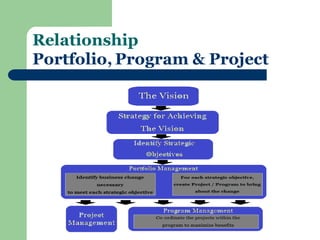
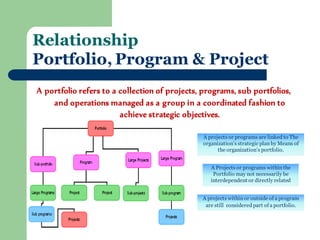
A portfolio refers to a collection of projects, programs, sub portfolios, and operations managed as a group in a coordinated fashion to achieve strategic objectives. 
Relationship Portfolio, Program & Project 
A projects or programs are linked to The organization’s strategic plan by Means of the organization’s portfolio. 
A Projects or programs within the Portfolio may not necessarily be interdependent or directly related 
A projects within or outside of a program are still considered part of a portfolio.
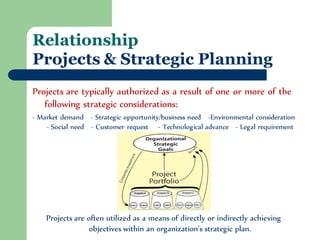
Projects are typically authorized as a result of one or more of the following strategic considerations: 
- Market demand - Strategic opportunity/business need -Environmental consideration - Social need - Customer request - Technological advance - Legal requirement 
Projects are often utilized as a means of directly or indirectly achieving objectives within an organization’s strategic plan. 
Relationship Projects & Strategic Planning
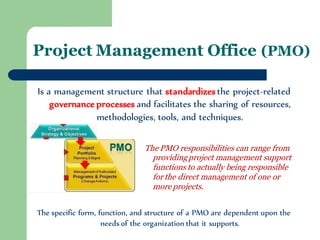
Is a management structure that standardizes the project-related governance processes and facilitates the sharing of resources, methodologies, tools, and techniques. 
The PMO responsibilities can range from providing project management support functions to actually being responsible for the direct management of one or more projects. 
The specific form, function, and structure of a PMO are dependent upon the needs of the organization that it supports. 
Project Management Office (PMO)
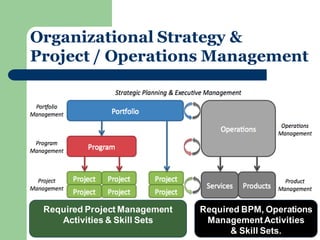
Required BPM, Operations Management Activities & Skill Sets. 
Required Project Management Activities & Skill Sets 
Organizational Strategy & Project / Operations Management
Projects Vs. Operational Work ( Intersection ) 
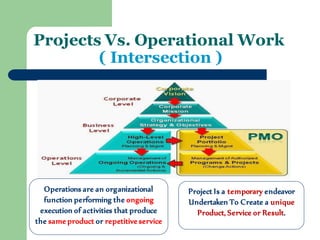
Operations are an organizational function performing the ongoing execution of activities that produce the same product or repetitive service 
Project Is a temporary endeavor 
Undertaken To Create a unique 
Product, Service or Result.
Role of the Project Manager 
A project manager is the person assigned by the performing organization to achieve the project objectives through overall responsibility for the successful initiation, planning, execution, monitoring, controlling and closure of a project. 
Effective Project Manager requires 
1.Understanding and applying the knowledge, tools and techniques recognized as goodpractice 
2.Possessing the needed characteristics of: 
1. Knowledge 
2. Performance 
3. Personal (APPENDIX X3 in PMBOOK)
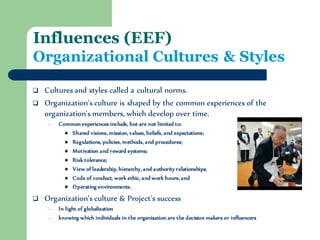
Influences (EEF) Organizational Cultures & Styles 
Cultures and styles called a cultural norms. 
Organization’s culture is shaped by the common experiences of the organization's members, which develop over time. 
–Common experiences include, but are not limited to: 
Shared visions, mission, values, beliefs, and expectations; 
Regulations, policies, methods, and procedures; 
Motivation and reward systems; 
Risk tolerance; 
View of leadership, hierarchy, and authority relationships; 
Code of conduct, work ethic, and work hours; and 
Operating environments. 
Organization’s culture & Project's success 
–In light of globalization 
–knowing which individuals in the organization are the decision makers or influencers
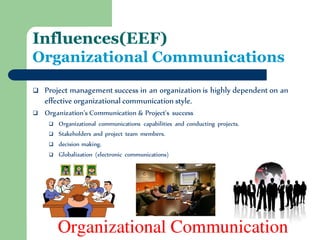
Influences(EEF) Organizational Communications 
Project management success in an organization is highly dependent on an effective organizational communication style. 
Organization’s Communication & Project's success 
Organizational communications capabilities and conducting projects. 
Stakeholders and project team members. 
decision making. 
Globalization (electronic communications)
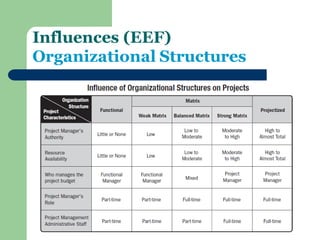
Influences (EEF) Organizational Structures
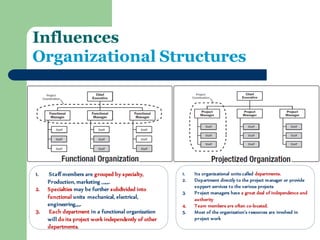
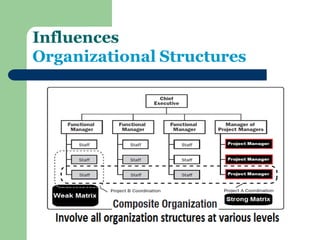
Influences Organizational Structures 
1. Staff members are grouped by specialty, Production, marketing ,,,,,,. 
2.Specialties may be further subdivided into functional units mechanical, electrical, engineering,,,,. 
3. Each department in a functional organization will do its project work independently of other departments. 
1.Its organizational units called departments. 
2.Department directly to the project manager or provide support services to the various projects 
3.Project managers have a great deal of independence and authority 
4.Team members are often co-located. 
5.Most of the organization’s resources are involved in project work
Influences Organizational Structures 
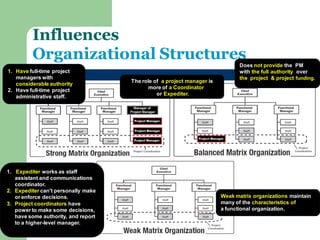
1. Expediter works as staff assistant and communications coordinator. 
2.Expediter can't personally make or enforce decisions. 
3.Project coordinators have power to make some decisions, have some authority, and report to a higher-level manager. 
The role of a project manager is more of a Coordinator 
or Expediter. 
Weak matrix organizations maintain many of the characteristics of 
a functional organization. 
Does not provide the PM with the full authority over the project & project funding. 
1.Have full-time project managers with considerable authority 
2.Have full-time project administrative staff.
Influences Organizational Structures
Influences Organizational Process Assets 
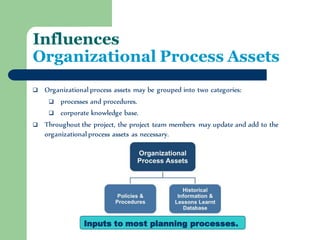
Organizational process assets may be grouped into two categories: 
processes and procedures. 
corporate knowledge base. 
Throughout the project, the project team members may update and add to the organizational process assets as necessary. 
Inputs to most planning processes.
Influences Enterprise Environmental Factors 
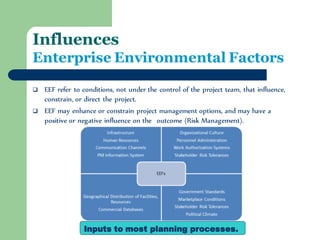
EEF refer to conditions, not under the control of the project team, that influence, constrain, or direct the project. 
EEF may enhance or constrain project management options, and may have a positive or negative influence on the outcome (Risk Management). 
Inputs to most planning processes.
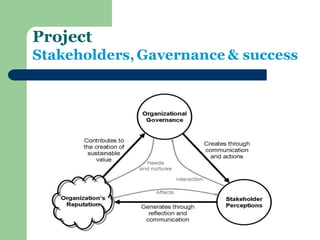
Project Stakeholders, Gavernance & success
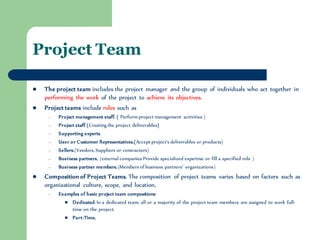
Project Team 
The project team includes the project manager and the group of individuals who act together in performing the work of the project to achieve its objectives. 
Project teams include roles such as 
–Project management staff. ( Perform project management activities ) 
–Project staff (Creating the project deliverables) 
–Supporting experts 
–User or Customer Representatives.(Accept project‘s deliverables or products) 
–Sellers.(Vendors, Suppliers or contractors) 
–Business partners. (external companies Provide specialized expertise or fill a specified role ) 
–Business partner members.(Members of business partners’ organizations) 
Composition of Project Teams. The composition of project teams varies based on factors such as organizational culture, scope, and location. 
–Examples of basic project team compositions 
Dedicated. In a dedicated team, all or a majority of the project team members are assigned to work full- time on the project. 
Part-Time.
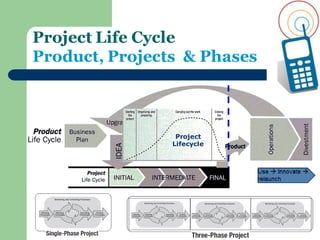
Project Life Cycle Product, Projects & Phases 
Project Lifecycle
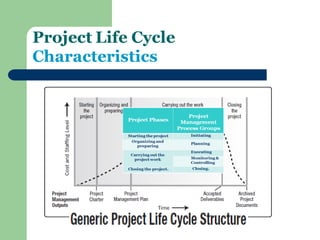
Project Life Cycle Characteristics
Project Life Cycle Characteristics 
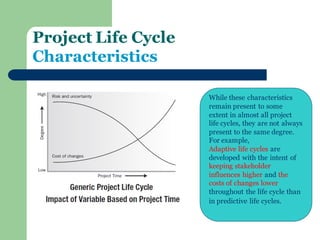
While these characteristics remain present to some extent in almost all project life cycles, they are not always present to the same degree. For example, Adaptive life cycles are developed with the intent of keeping stakeholder influences higher and the costs of changes lower throughout the life cycle than in predictive life cycles.
Project Life Cycle Characteristics & Project Phases 
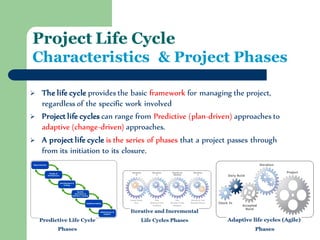
The life cycle provides the basic framework for managing the project, regardless of the specific work involved 
Project life cycles can range from Predictive (plan-driven) approaches to adaptive (change-driven) approaches. 
A project life cycle is the series of phases that a project passes through from its initiation to its closure.
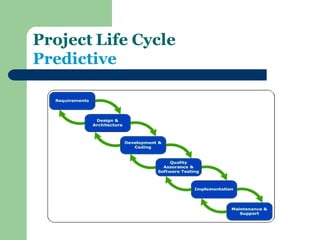
Project Life Cycle Predictive
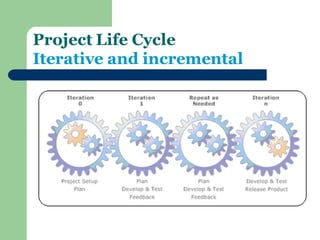
Project Life Cycle Iterative and incremental
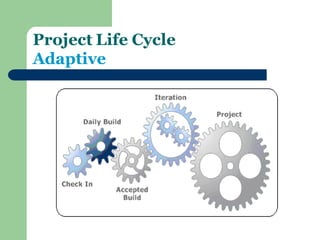
Project Life Cycle Adaptive
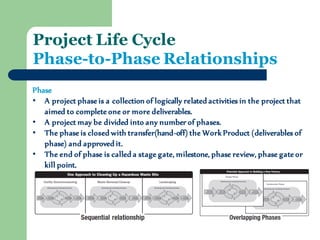
Project Life Cycle Phase-to-Phase Relationships 
Phase 
•A project phase is a collection of logically related activities in the project that aimed to complete one or more deliverables. 
•A project may be divided into any number of phases. 
•The phase is closed with transfer(hand-off) the Work Product (deliverables of phase) and approved it. 
•The end of phase is called a stage gate, milestone, phase review, phase gate or kill point.
Project Management Process Groups
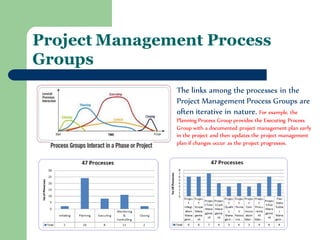
Project Management Process Groups 
The links among the processes in the Project Management Process Groups are often iterative in nature. For example, the Planning Process Group provides the Executing Process Group with a documented project management plan early in the project and then updates the project management plan if changes occur as the project progresses.
Project Information 
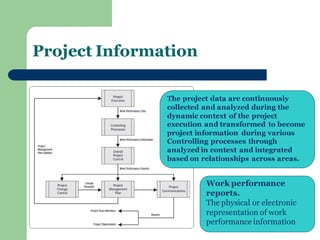
The project data are continuously collected and analyzed during the dynamic context of the project execution and transformed to become project information during various Controlling processes through analyzed in context and integrated based on relationships across areas. 
Work performance reports. 
The physical or electronic representation of work performance information

PMBOK_5th_Project Management Framework

  • 1.
    Key Concepts & Organization Influences Project Management Framework PMBOK 5th edition Hossam Maghrabi, PMP
  • 2.
    Key Concepts Whatis the Project ? What is Project Management? Relationships Between - Portfolio Management - Program Management - Project Management - Organizational Project Management Relationships Between - Project Management - Operations Management - Organizational Strategy Business Value. Role of the Project Manager.
  • 3.
    It’s a temporaryendeavor undertaken to create a unique Product, Service or Result. Projects have a specific purpose and definite beginning and end point Note: The operation goes on continuously . When the end of a project is reached? – The project's objectives have been achieved. –The organization terminate the project because,  Its objectives will not or cannot be met, The need for the project no longer exists –A project may also be terminated if the client (customer, sponsor, or champion) wishes to terminate it. Every project creates a unique product, service, or result. Examples of Projects ….. What is a Project?
  • 4.
    Project management isthe application of knowledge, skills, tools, and techniques to project activities to meet the project requirements. –Project management is accomplished through the appropriate application and integration of 47 logically grouped project management processes, which are categorized into five Process Groups. Initiating, Planning, Executing, Monitoring and Controlling, Closing. –It is an iterative & progressively elaborated activity . Which means, 1.Continuously improving and detailing a plan 2.More accurate estimates become available. 3.Define work and manage it in a greater level of detail. What is Project Management?
  • 5.
  • 6.
    A portfolio refersto a collection of projects, programs, sub portfolios, and operations managed as a group in a coordinated fashion to achieve strategic objectives. Relationship Portfolio, Program & Project A projects or programs are linked to The organization’s strategic plan by Means of the organization’s portfolio. A Projects or programs within the Portfolio may not necessarily be interdependent or directly related A projects within or outside of a program are still considered part of a portfolio.
  • 7.
    Projects are typicallyauthorized as a result of one or more of the following strategic considerations: - Market demand - Strategic opportunity/business need -Environmental consideration - Social need - Customer request - Technological advance - Legal requirement Projects are often utilized as a means of directly or indirectly achieving objectives within an organization’s strategic plan. Relationship Projects & Strategic Planning
  • 8.
    Is a managementstructure that standardizes the project-related governance processes and facilitates the sharing of resources, methodologies, tools, and techniques. The PMO responsibilities can range from providing project management support functions to actually being responsible for the direct management of one or more projects. The specific form, function, and structure of a PMO are dependent upon the needs of the organization that it supports. Project Management Office (PMO)
  • 9.
    Required BPM, OperationsManagement Activities & Skill Sets. Required Project Management Activities & Skill Sets Organizational Strategy & Project / Operations Management
  • 10.
    Projects Vs. OperationalWork ( Intersection ) Operations are an organizational function performing the ongoing execution of activities that produce the same product or repetitive service Project Is a temporary endeavor Undertaken To Create a unique Product, Service or Result.
  • 11.
    Role of theProject Manager A project manager is the person assigned by the performing organization to achieve the project objectives through overall responsibility for the successful initiation, planning, execution, monitoring, controlling and closure of a project. Effective Project Manager requires 1.Understanding and applying the knowledge, tools and techniques recognized as goodpractice 2.Possessing the needed characteristics of: 1. Knowledge 2. Performance 3. Personal (APPENDIX X3 in PMBOOK)
  • 12.
    Influences (EEF) OrganizationalCultures & Styles Cultures and styles called a cultural norms. Organization’s culture is shaped by the common experiences of the organization's members, which develop over time. –Common experiences include, but are not limited to: Shared visions, mission, values, beliefs, and expectations; Regulations, policies, methods, and procedures; Motivation and reward systems; Risk tolerance; View of leadership, hierarchy, and authority relationships; Code of conduct, work ethic, and work hours; and Operating environments. Organization’s culture & Project's success –In light of globalization –knowing which individuals in the organization are the decision makers or influencers
  • 13.
    Influences(EEF) Organizational Communications Project management success in an organization is highly dependent on an effective organizational communication style. Organization’s Communication & Project's success Organizational communications capabilities and conducting projects. Stakeholders and project team members. decision making. Globalization (electronic communications)
  • 14.
  • 15.
    Influences Organizational Structures 1. Staff members are grouped by specialty, Production, marketing ,,,,,,. 2.Specialties may be further subdivided into functional units mechanical, electrical, engineering,,,,. 3. Each department in a functional organization will do its project work independently of other departments. 1.Its organizational units called departments. 2.Department directly to the project manager or provide support services to the various projects 3.Project managers have a great deal of independence and authority 4.Team members are often co-located. 5.Most of the organization’s resources are involved in project work
  • 16.
    Influences Organizational Structures 1. Expediter works as staff assistant and communications coordinator. 2.Expediter can't personally make or enforce decisions. 3.Project coordinators have power to make some decisions, have some authority, and report to a higher-level manager. The role of a project manager is more of a Coordinator or Expediter. Weak matrix organizations maintain many of the characteristics of a functional organization. Does not provide the PM with the full authority over the project & project funding. 1.Have full-time project managers with considerable authority 2.Have full-time project administrative staff.
  • 17.
  • 18.
    Influences Organizational ProcessAssets Organizational process assets may be grouped into two categories: processes and procedures. corporate knowledge base. Throughout the project, the project team members may update and add to the organizational process assets as necessary. Inputs to most planning processes.
  • 19.
    Influences Enterprise EnvironmentalFactors EEF refer to conditions, not under the control of the project team, that influence, constrain, or direct the project. EEF may enhance or constrain project management options, and may have a positive or negative influence on the outcome (Risk Management). Inputs to most planning processes.
  • 20.
  • 21.
    Project Team Theproject team includes the project manager and the group of individuals who act together in performing the work of the project to achieve its objectives. Project teams include roles such as –Project management staff. ( Perform project management activities ) –Project staff (Creating the project deliverables) –Supporting experts –User or Customer Representatives.(Accept project‘s deliverables or products) –Sellers.(Vendors, Suppliers or contractors) –Business partners. (external companies Provide specialized expertise or fill a specified role ) –Business partner members.(Members of business partners’ organizations) Composition of Project Teams. The composition of project teams varies based on factors such as organizational culture, scope, and location. –Examples of basic project team compositions Dedicated. In a dedicated team, all or a majority of the project team members are assigned to work full- time on the project. Part-Time.
  • 22.
    Project Life CycleProduct, Projects & Phases Project Lifecycle
  • 23.
    Project Life CycleCharacteristics
  • 24.
    Project Life CycleCharacteristics While these characteristics remain present to some extent in almost all project life cycles, they are not always present to the same degree. For example, Adaptive life cycles are developed with the intent of keeping stakeholder influences higher and the costs of changes lower throughout the life cycle than in predictive life cycles.
  • 25.
    Project Life CycleCharacteristics & Project Phases The life cycle provides the basic framework for managing the project, regardless of the specific work involved Project life cycles can range from Predictive (plan-driven) approaches to adaptive (change-driven) approaches. A project life cycle is the series of phases that a project passes through from its initiation to its closure.
  • 26.
  • 27.
    Project Life CycleIterative and incremental
  • 28.
  • 29.
    Project Life CyclePhase-to-Phase Relationships Phase •A project phase is a collection of logically related activities in the project that aimed to complete one or more deliverables. •A project may be divided into any number of phases. •The phase is closed with transfer(hand-off) the Work Product (deliverables of phase) and approved it. •The end of phase is called a stage gate, milestone, phase review, phase gate or kill point.
  • 30.
  • 31.
    Project Management ProcessGroups The links among the processes in the Project Management Process Groups are often iterative in nature. For example, the Planning Process Group provides the Executing Process Group with a documented project management plan early in the project and then updates the project management plan if changes occur as the project progresses.
  • 32.
    Project Information Theproject data are continuously collected and analyzed during the dynamic context of the project execution and transformed to become project information during various Controlling processes through analyzed in context and integrated based on relationships across areas. Work performance reports. The physical or electronic representation of work performance information