Project Management
Tran VanLy
Industrial and Systems Engineering
International University
Email: tvly@hcmiu.edu.vn
1
Lesson 1: An introduction
to Project Management
2.
Learning Objectives
• Courseintroduction
• Introduction of project
management
• The project life cycle and
organization
2
3.
What is aproject?
• A project is a temporary endeavor undertaken
to create a unique product, service, or result
(Project Management Institute 2008)
– Temporary nature of projects indicates a definite
beginning and end
– Temporary does not generally apply to the
product, service or result created by the project
4.
What is aproject?
• Every project creates a unique product,
service, or result
5.
What is aproject?
• A project can create:
– A product that can be either a component of
another item or an end item in itself
– A capacity to perform a service (e.g., a business
function that supports production or distribution), or
– A result such as an outcome or document (e.g.,
research project that develops knowledge that can
be used to determine whether a trend is present or
a new process will benefit society)
6.
What is aproject?
• Examples of projects include, but are not limited
to:
– Developing a new product or service
– Effecting a change in the structure, staffing, or style of
an organization,
– Developing or acquiring a new or modified information
system
– Constructing a building or infrastructure, or
– Implementing a new business process or procedure
What is projectmanagement?
• Project management is the application of knowledge, skill,
tools, and techniques to project activities to meet the
project requirements.
• Project management processes comprising the 5 process
groups
– Initiating
– Planning
– Executing
– Monitoring and controlling, and
– Closing
9.
What is projectmanagement?
• Managing a project typically includes:
– Identifying requirement
– Addressing the various needs, concerns, and expectations of the
stakeholders as the project is planned and carried out
– Balancing the competing project constraints including but not limited
to
• Scope
• Quality
• Schedule
• Budget
• Resources, and
• Risk
10.
What is projectmanagement?
• Example
– Shortened schedule often requires
increasing in budget to add additional
resources to complete the same amount of
work in less time
– No budget added scope or quality may be
reduced to deliver a product in less time for
the same budget
11.
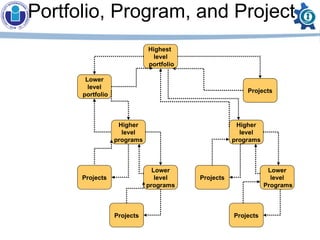
Portfolio, Program, andProject
• Portfolio
– Refers to a collection of projects or programs
and other work that are grouped together to
facilitate effective management of that work to
meet strategic business objectives
– The projects or programs of the portfolio may
not necessarily be interdependent or directly
related
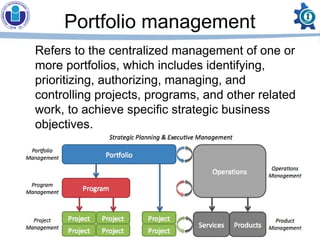
Portfolio management
Refers tothe centralized management of one or
more portfolios, which includes identifying,
prioritizing, authorizing, managing, and
controlling projects, programs, and other related
work, to achieve specific strategic business
objectives.
14.
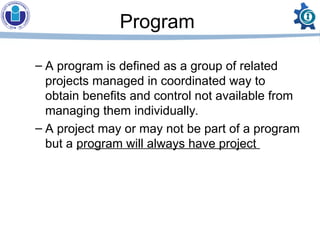
Program
– A programis defined as a group of related
projects managed in coordinated way to
obtain benefits and control not available from
managing them individually.
– A project may or may not be part of a program
but a program will always have project
15.
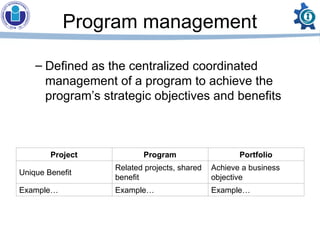
Program management
– Definedas the centralized coordinated
management of a program to achieve the
program’s strategic objectives and benefits
Project Program Portfolio
Unique Benefit
Related projects, shared
benefit
Achieve a business
objective
Example… Example… Example…
16.
Project & Program
•Project are often utilized as a means of
achieving an organization’s strategic plan
• Project, within programs or portfolios, are
a means of achieving organizational goals
and objectives, often in the context of
strategic plan.
17.
Project Life Cycle
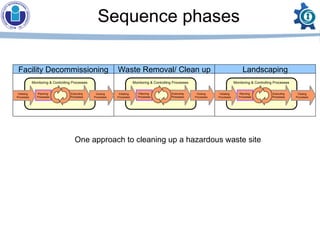
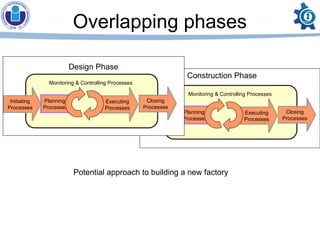
•A project life cycle is
– a collection of generally sequential and sometimes
overlapping project phases
– names and number of phases are determined by
• the management and control needs of the organization or
organizations involved in the project
• the nature of the project itself
• area of application.
• The life cycle provides the basic framework for
managing the project, regardless of the specific
work involved
18.
Characteristics of theProject
Life Cycle
• Projects vary in size and complexity. No matter
how large or small, simple or complex, all
projects can be mapped to the following life
cycle structure:
– Starting the project
– Organizing and preparing
– Carrying out the project work, and
– Closing the project
19.
Characteristics of theProject
Life Cycle
Project
charter
Project
management
plan
Accepted
Deliverables
Archived
project
documents
Project
Management
Outputs
Time
Staffing
the
project
Organizing
and
preparing
Carrying out the work Closing
the
project
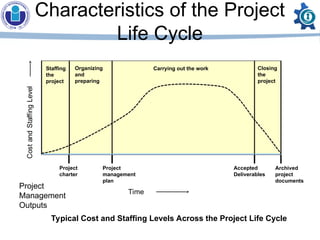
Typical Cost and Staffing Levels Across the Project Life Cycle
20.
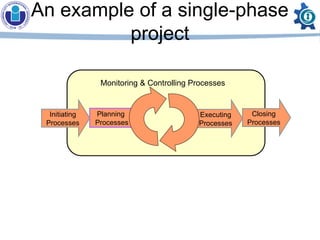
An example ofa single-phase
project
Planning
Processes
Initiating
Processes
Executing
Processes
Closing
Processes
Monitoring & Controlling Processes
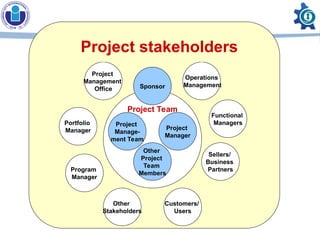
Stakeholders
• Stakeholders arepersons or organizations (e.g.,
customers, sponsors, the performing
organization, or the public), who are actively
involved in the project or whose interests may
be positively or negatively affected by the
performance or completion of the project.
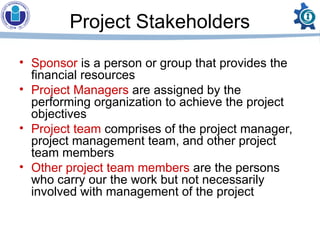
Project Stakeholders
• Sponsoris a person or group that provides the
financial resources
• Project Managers are assigned by the
performing organization to achieve the project
objectives
• Project team comprises of the project manager,
project management team, and other project
team members
• Other project team members are the persons
who carry our the work but not necessarily
involved with management of the project
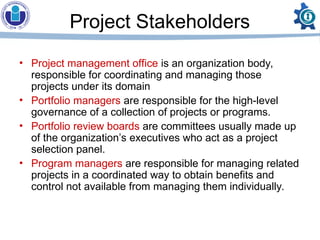
26.
Project Stakeholders
• Projectmanagement office is an organization body,
responsible for coordinating and managing those
projects under its domain
• Portfolio managers are responsible for the high-level
governance of a collection of projects or programs.
• Portfolio review boards are committees usually made up
of the organization’s executives who act as a project
selection panel.
• Program managers are responsible for managing related
projects in a coordinated way to obtain benefits and
control not available from managing them individually.
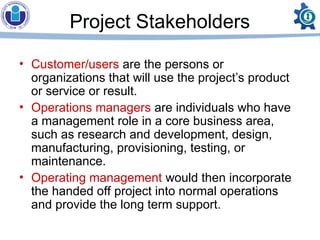
27.
Project Stakeholders
• Customer/usersare the persons or
organizations that will use the project’s product
or service or result.
• Operations managers are individuals who have
a management role in a core business area,
such as research and development, design,
manufacturing, provisioning, testing, or
maintenance.
• Operating management would then incorporate
the handed off project into normal operations
and provide the long term support.
28.
Project Stakeholders
• Functionalmanagers are key individuals who
play a management role within an administrative
or functional area of the business, such as
human resources, finance, accounting, or
procurement.
• Sellers/business partners/ vendors/ suppliers/
contractors are external companies that enter
into a contractual agreement to provide
components or service necessary for the project.
29.
Functional Organization
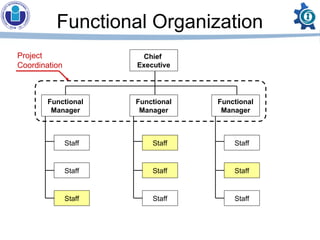
• Staffmembers are grouped by specialty,
such as production, marketing,
engineering, and accounting at the top
level.
• Each department in a functional
organization will do its project work
independent of other departments
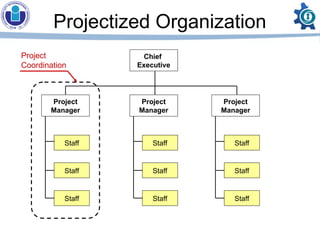
Projectized organization
• Ina projectized organization, team
members are often co-located
• Project managers have a great deal of
independence and authority
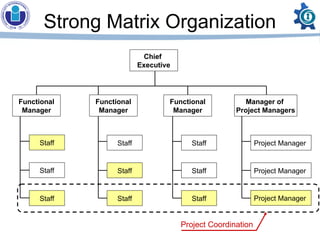
Matrix organization
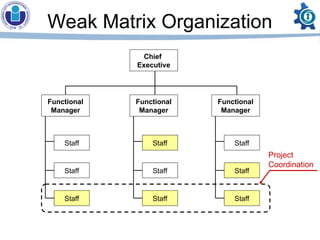
• Matrixorganizations are blend of
functional and projectized characteristics.
– Weak matrices maintain many of the
characteristics of a functional organization
– The project manager role is more of a
coordinator or expediter than that of a true
project manager
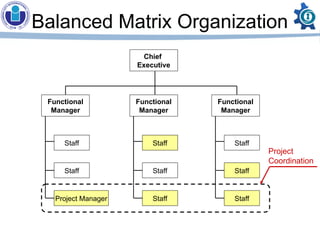
Matrix Organization
– Strongmatrices have many of the
characteristics of the projectized organization
– Project manager can have considerable
authority
– Strong matrices can have full-time project
administrative staff
– Balanced matrix organization recognizes the
need for a project manager
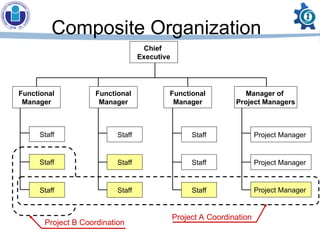
Composite organization
• Manyorganizations involve all these structures
at various levels
• Functional organization may create a project
team having characteristic of projectized
organization to handle a critical project
• Project team may involve full-time staff from
different functional department.
40.
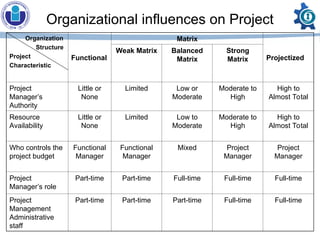
Organizational influences onProject
Organization
Structure
Project
Characteristic
Functional
Matrix
Projectized
Weak Matrix Balanced
Matrix
Strong
Matrix
Project
Manager’s
Authority
Little or
None
Limited Low or
Moderate
Moderate to
High
High to
Almost Total
Resource
Availability
Little or
None
Limited Low to
Moderate
Moderate to
High
High to
Almost Total
Who controls the
project budget
Functional
Manager
Functional
Manager
Mixed Project
Manager
Project
Manager
Project
Manager’s role
Part-time Part-time Full-time Full-time Full-time
Project
Management
Administrative
staff
Part-time Part-time Part-time Full-time Full-time
41.
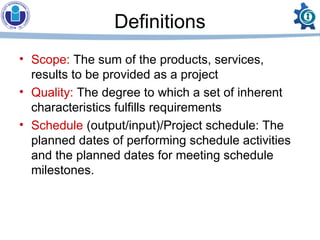
Definitions
• Scope: Thesum of the products, services,
results to be provided as a project
• Quality: The degree to which a set of inherent
characteristics fulfills requirements
• Schedule (output/input)/Project schedule: The
planned dates of performing schedule activities
and the planned dates for meeting schedule
milestones.
42.
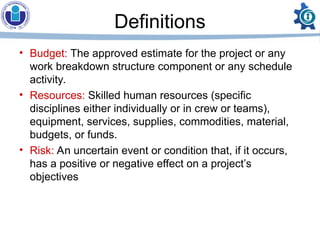
Definitions
• Budget: Theapproved estimate for the project or any
work breakdown structure component or any schedule
activity.
• Resources: Skilled human resources (specific
disciplines either individually or in crew or teams),
equipment, services, supplies, commodities, material,
budgets, or funds.
• Risk: An uncertain event or condition that, if it occurs,
has a positive or negative effect on a project’s
objectives
#3 The end is reached when the project’s objectives have been achieved or when the project is terminated because its objectives will not or cannot be met, or when the need for the project no longer exists. Temporary does not mean short in duration.
Most project are undertaken to create a lasting outcome. For example, a project to build a highway will create a result expected to last for a decade, or a project to build a national monument will create a result expected to last centuries.
Project can also create social, economic, and environmental impacts that far outlast the projects themselves.
#4 Although repetitive elements may be present in some project deliverable, this repetition does not change the fundamental uniqueness of the project work. For example, office buildings are constructed with the same or similar materials or by the same team, but each location is unique – with different design, different circumstances, different contractors, and so on.
#5 Although repetitive elements may be present in some project deliverable, this repetition does not change the fundamental uniqueness of the project work. For example, office buildings are constructed with the same or similar materials or by the same team, but each location is unique – with different design, different circumstances, different contractors, and so on.
#7 Why almost the course includes “project/asignment”
#8 Initiating processes: those processes performed to define a new project or a new phase of an existing project by obtaining authorization to start the project or phase
Planning: The process performed to establish the total scope of the effort, define and refine the objectives, and develop the course of action required to attain those objectives
Executing: Those processes performed to complete the work defined in the project management plan to satisfy the project objectives
Monitoring and controlling: those processes required to track, review, and regulate the progress and performance of the project, identify any areas in which changes to the plan are required and initiate the corresponding changes
Closing: Those processes performed to finalize all activities across all Project Management Process Groups to formally close the project or phase
#9 The specific project will influence the constraints on which the project manager needs to focus
The relationship among these factors is such that if any one factor changes, at least one other factor is likely to be affected. For example, if the schedule is shortened, often the budget needs to be increased to add additional resources to complete the same amount of work in less time. If a budget increase is not possible, the scope or quality may be reduced to deliver a product in less time for the same budget. Project stakeholders may have differing ideas as to which factors are the most important, creating an even greater challenge. Changing the project requirements may create additional risks. The project team must be able to assess the situation and balance the demands in order to deliver a successful project.
#25 Project managers are the people responsible for implementing the project plans
Project managers often manage project resources, including budgets and people related to the project, even though they seldom have direct authority over the people engaged in the project.
#26 Program managers interact with each project manager to provide support and guidance on individual projects
#27 Customers/users may be internal and/or external to the performing organization
For example: the users of bio lab can include lecturers who use it for lecturing, lab supervisors who help and guide student how to run the test and students who are using the lab for learning purposes.
The customers for a new pharmaceutical product can be the doctors who prescribe it, the patients who use it and the insurers who pay for it.


![Project management [module 1]](https://cdn.slidesharecdn.com/ss_thumbnails/projectmanagementmodule1-200621144500-thumbnail.jpg?width=640&height=640&fit=bounds)


