Project Management:
A Managerial Approach 4/e
By Jack R. Meredith and Samuel J. Mantel, Jr.
Published by John Wiley & Sons, Inc.
Presentation prepared by RTBM WebGroup
Project Management
A Managerial Approach
Chapter 1
Projects in Contemporary
Organizations
Projects in Contemporary
Organizations
Project Management has emerged
because the characteristics of our turn-of-
the-century society demands the
development of new methods of
management
Many forces have fostered the emergence
and expansion of Project Management
Chapter 1-1
Forces Of Project
Management
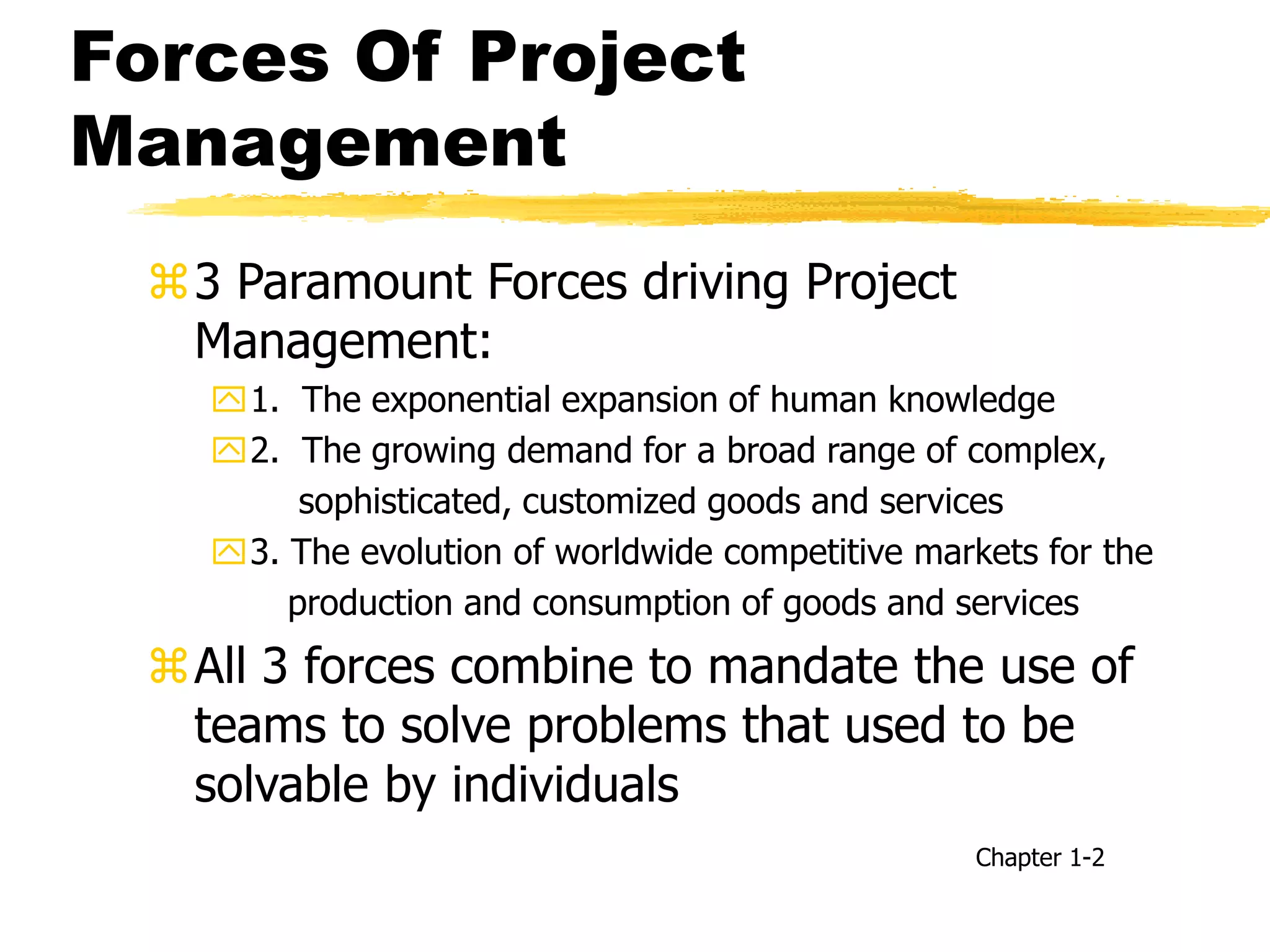
3 Paramount Forces driving Project
Management:
1. The exponential expansion of human knowledge
2. The growing demand for a broad range of complex,
sophisticated, customized goods and services
3. The evolution of worldwide competitive markets for the
production and consumption of goods and services
All 3 forces combine to mandate the use of
teams to solve problems that used to be
solvable by individuals
Chapter 1-2
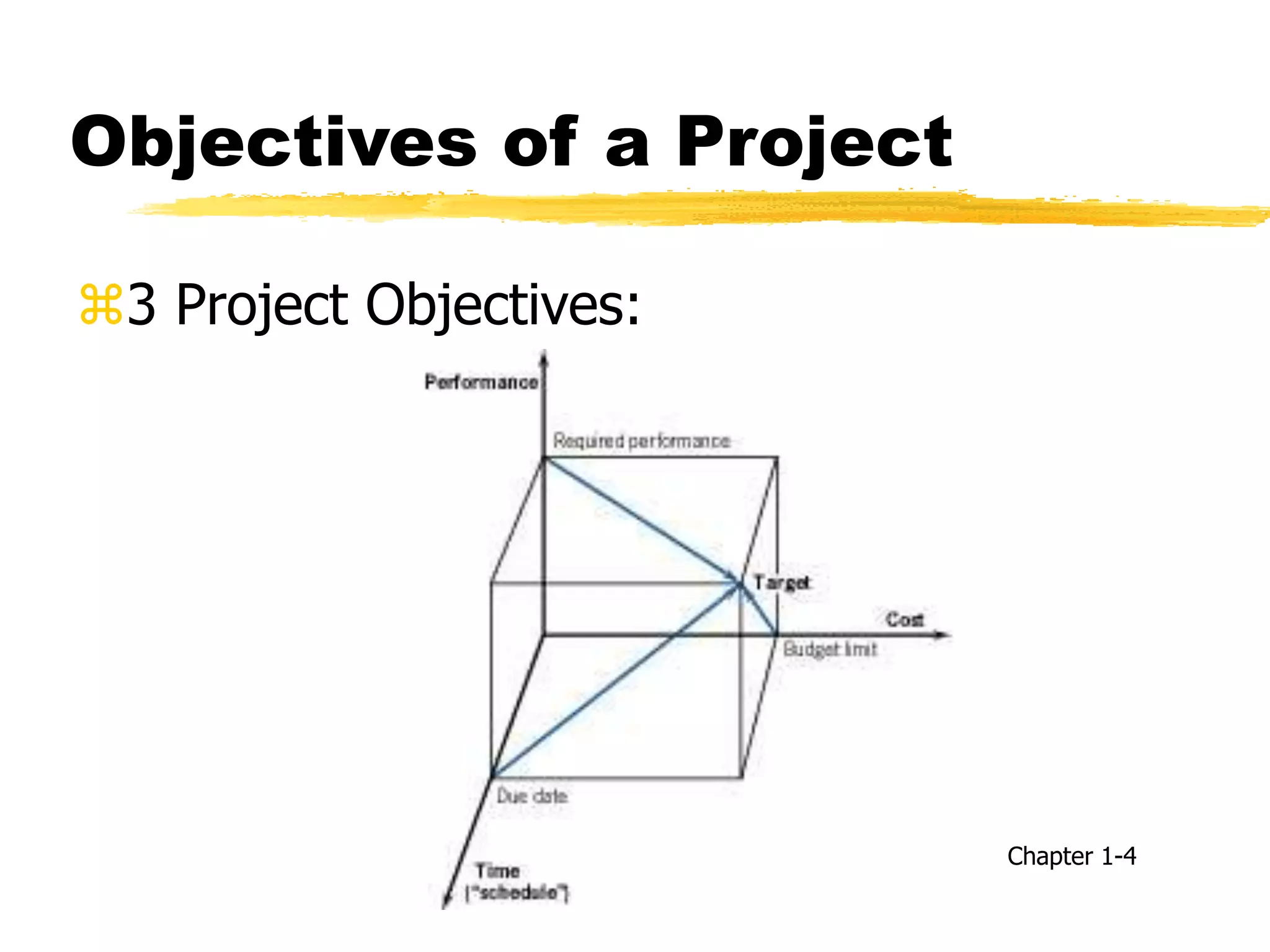
Objectives of a Project
3 Project Objectives:
Performance
Time
Cost
Expectations of clients are not an
additional target, but an inherent part of
the project specifications
Chapter 1-3
Objectives of a Project
3 Project Objectives:
Chapter 1-4
The Professionalism of
Project Management
 Complexity of problems facing the project manager
 Growth in number of project oriented organizations
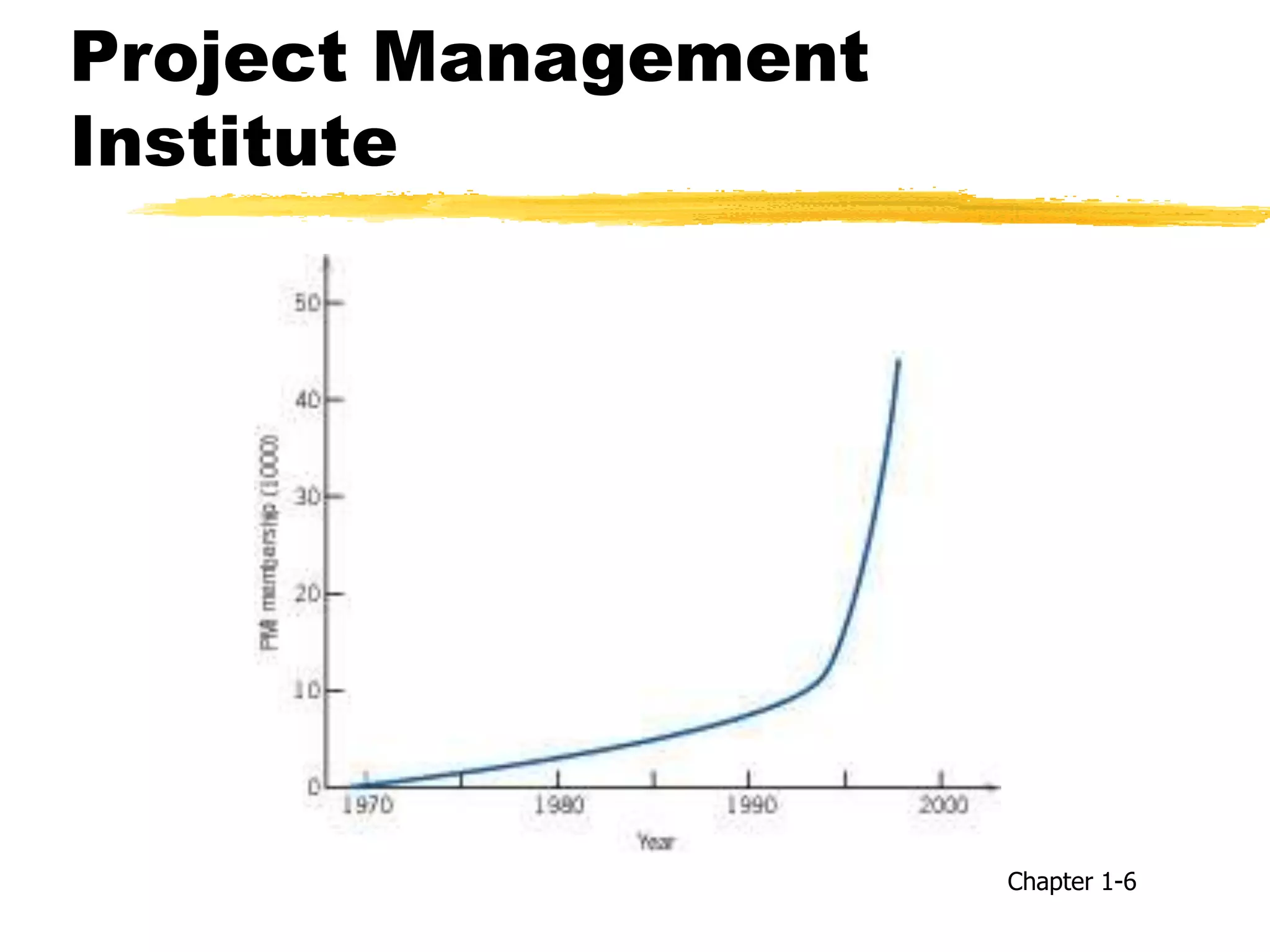
The Project Management Institute (PMI) was established in
1969
By 1990 it had 7,500 members
5 years later, over 17,000 members
And by 1998, it had exploded to over 44,000 members
 This exponential growth is indicative of the rapid growth
in the use of projects
 Also reflects the importance of PMI as a force in the
development of project management as a profession
Chapter 1-5
Project Management
Institute
Chapter 1-6
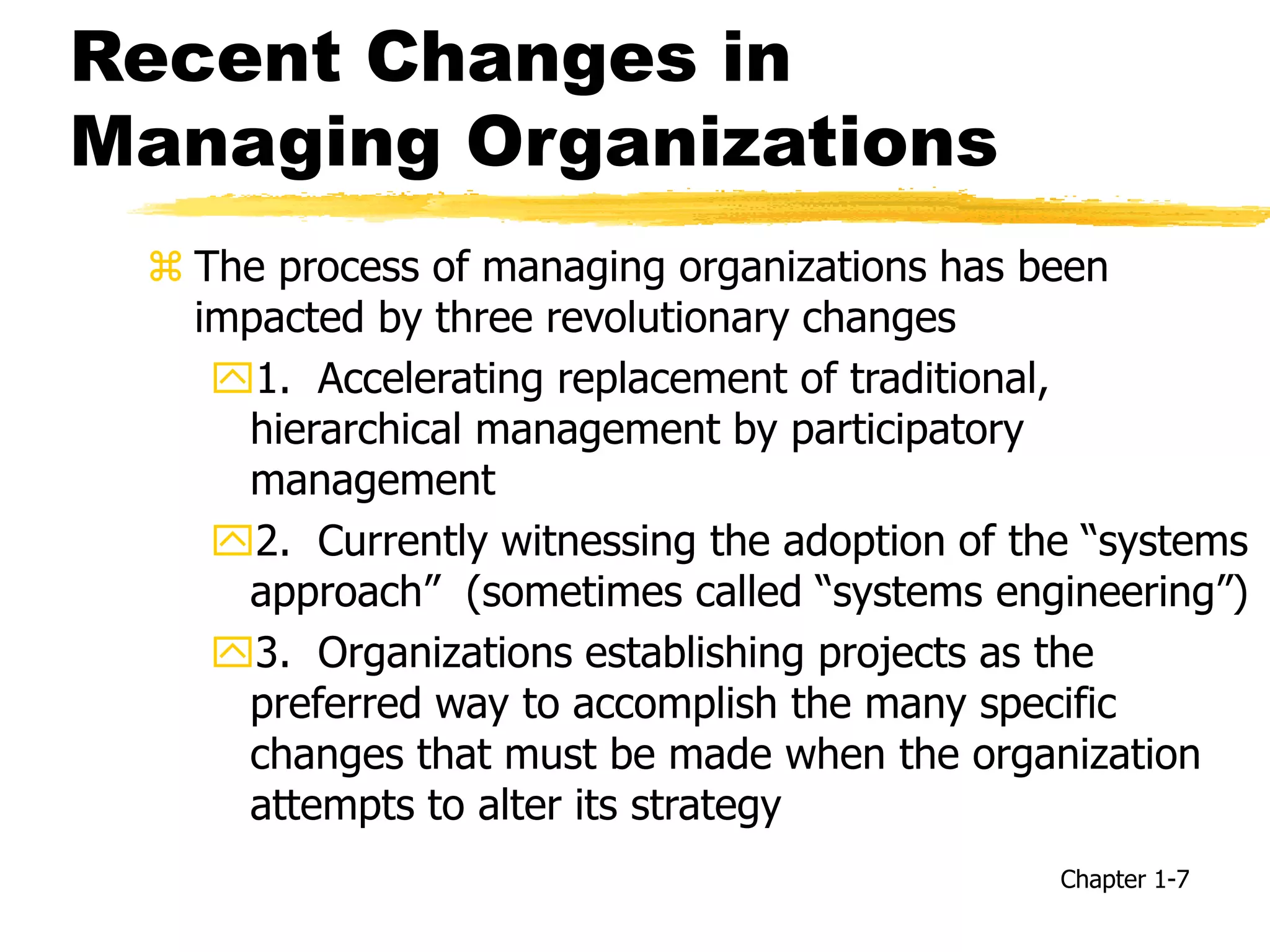
Recent Changes in
Managing Organizations
 The process of managing organizations has been
impacted by three revolutionary changes
1. Accelerating replacement of traditional,
hierarchical management by participatory
management
2. Currently witnessing the adoption of the “systems
approach” (sometimes called “systems engineering”)
3. Organizations establishing projects as the
preferred way to accomplish the many specific
changes that must be made when the organization
attempts to alter its strategy
Chapter 1-7
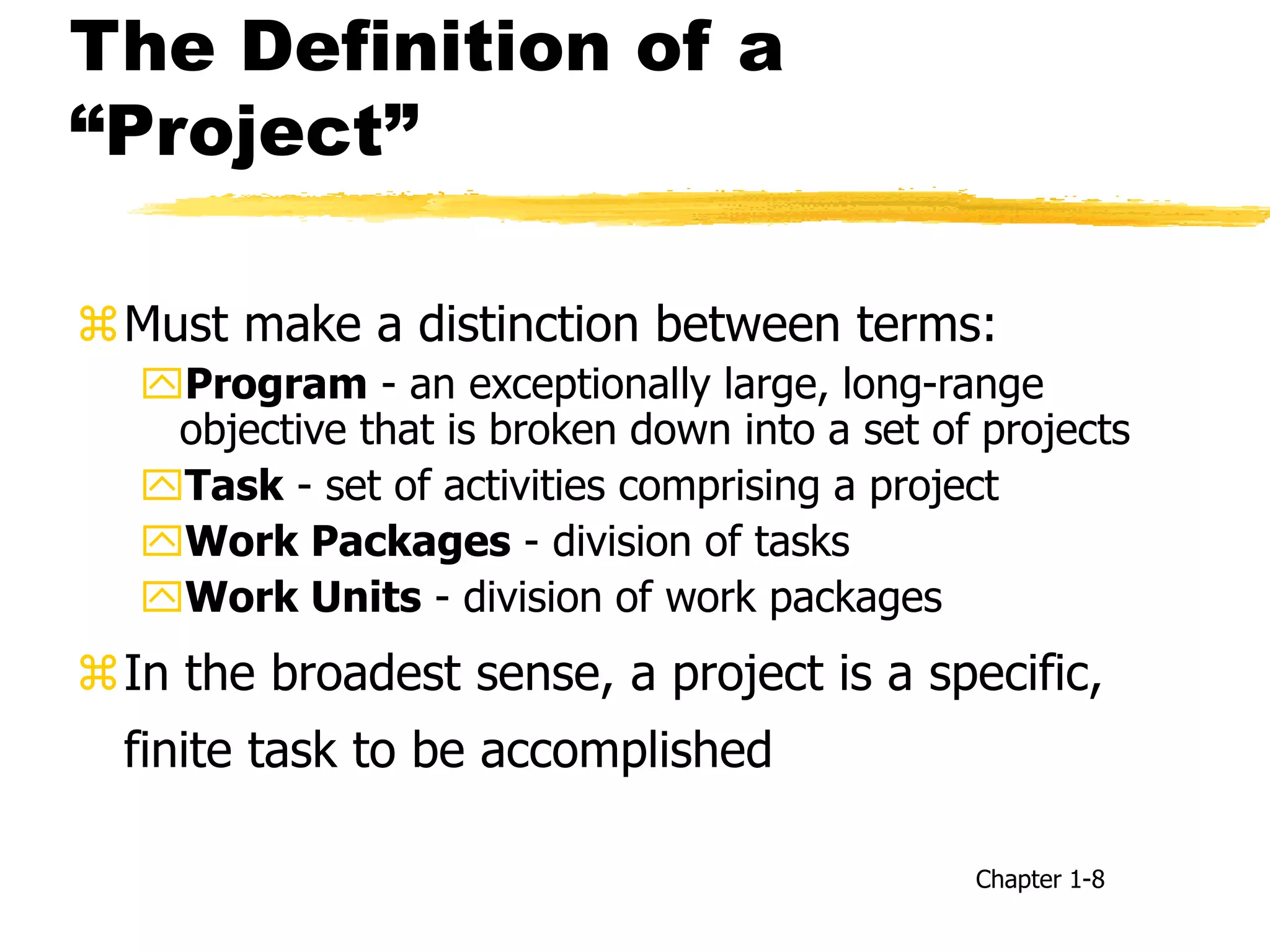
The Definition of a
“Project”
Must make a distinction between terms:
Program - an exceptionally large, long-range
objective that is broken down into a set of projects
Task - set of activities comprising a project
Work Packages - division of tasks
Work Units - division of work packages
In the broadest sense, a project is a specific,
finite task to be accomplished
Chapter 1-8
Characteristics of a
Project
Have a purpose
Have a life cycle
Interdependencies
Uniqueness
Conflict
Chapter 1-9
Why Project Management?
Companies have experienced:
Better control
Better customer relations
Shorter development times
Lower costs
Higher quality and reliability
Higher profit margins
Sharper orientation toward results
Better interdepartmental coordination
Higher worker morale
Chapter 1-10
Why Project Management?
Companies have also experienced some
negatives:
Greater organizational complexity
Increased likelihood of organizational policy
violations
Higher costs
More management difficulties
Low personnel utilization
Chapter 1-11
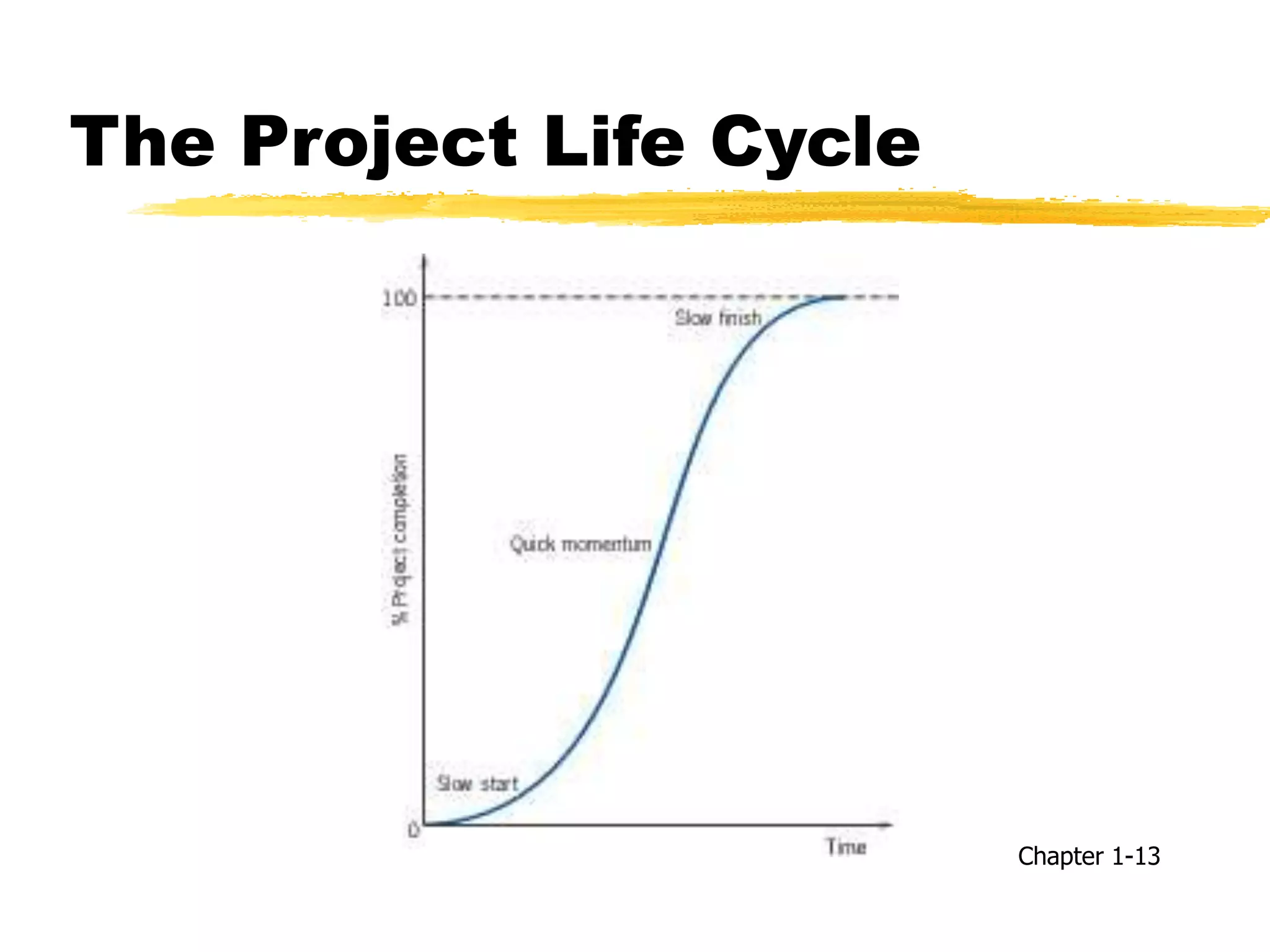
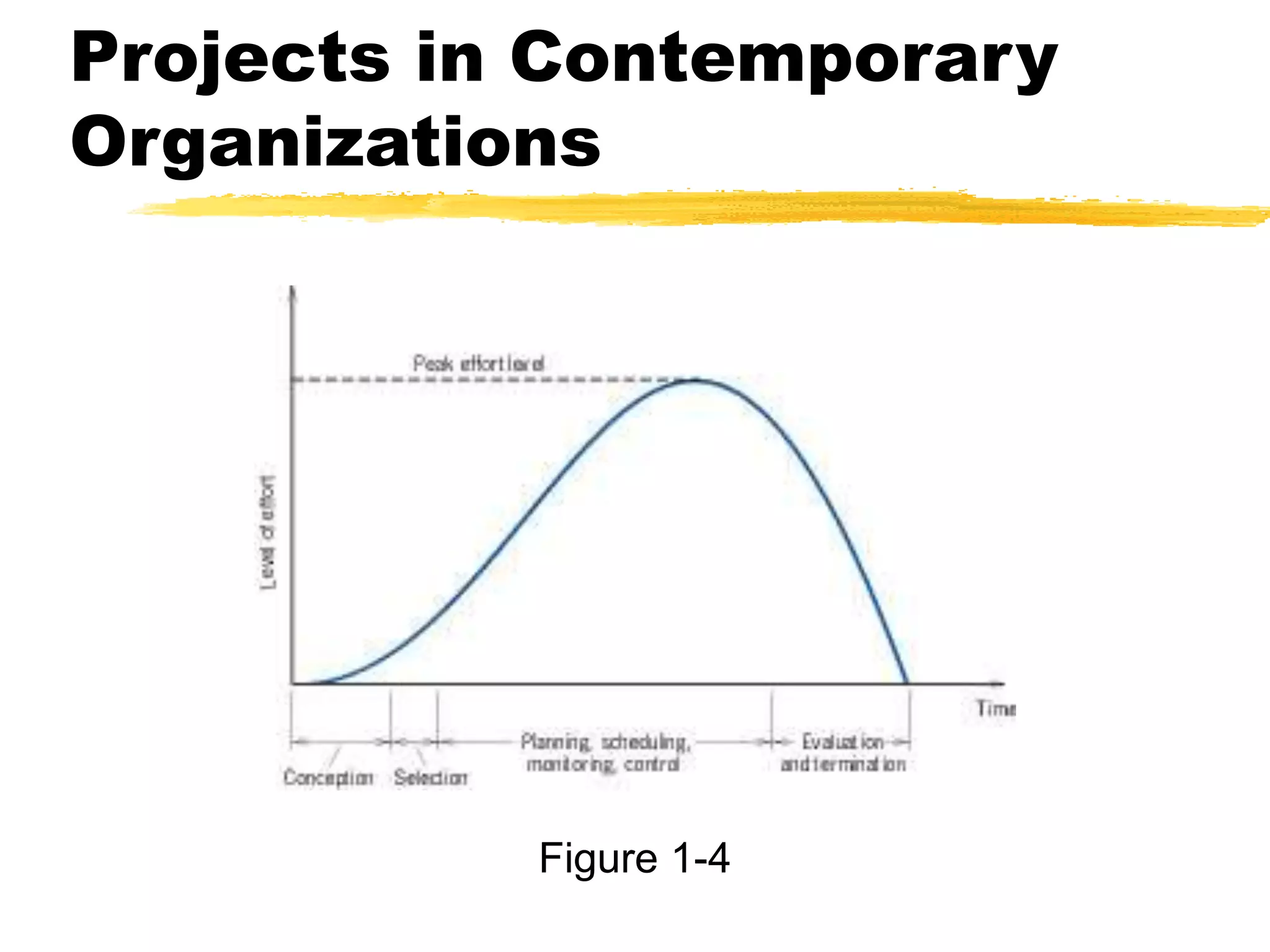
The Project Life Cycle
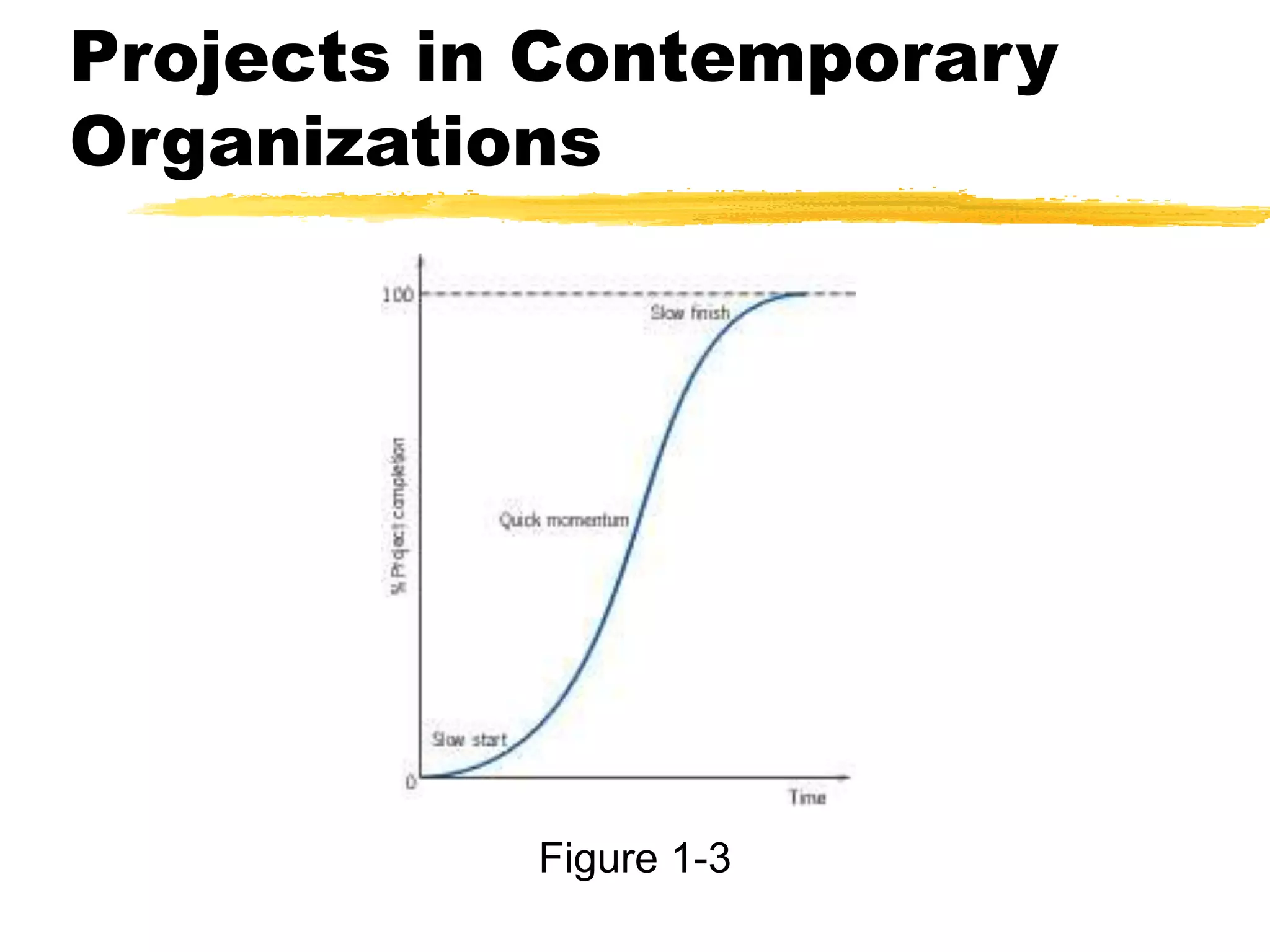
Stages of a Conventional Project:
Slow beginning
Buildup of size
Peak
Begin a decline
Termination
Chapter 1-12
The Project Life Cycle
Chapter 1-13
The Project Life Cycle
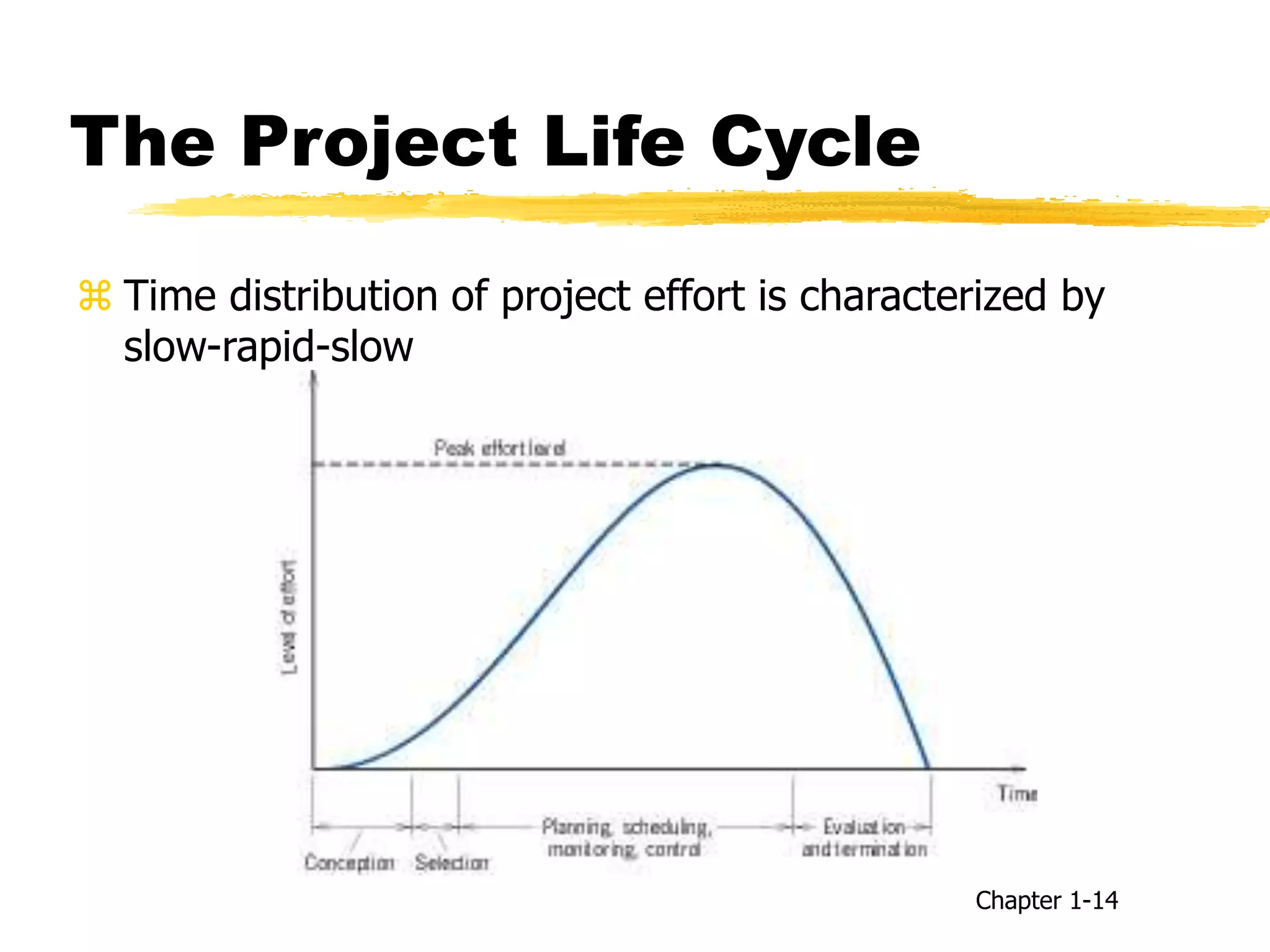
 Time distribution of project effort is characterized by
slow-rapid-slow
Chapter 1-14
The Project Life Cycle
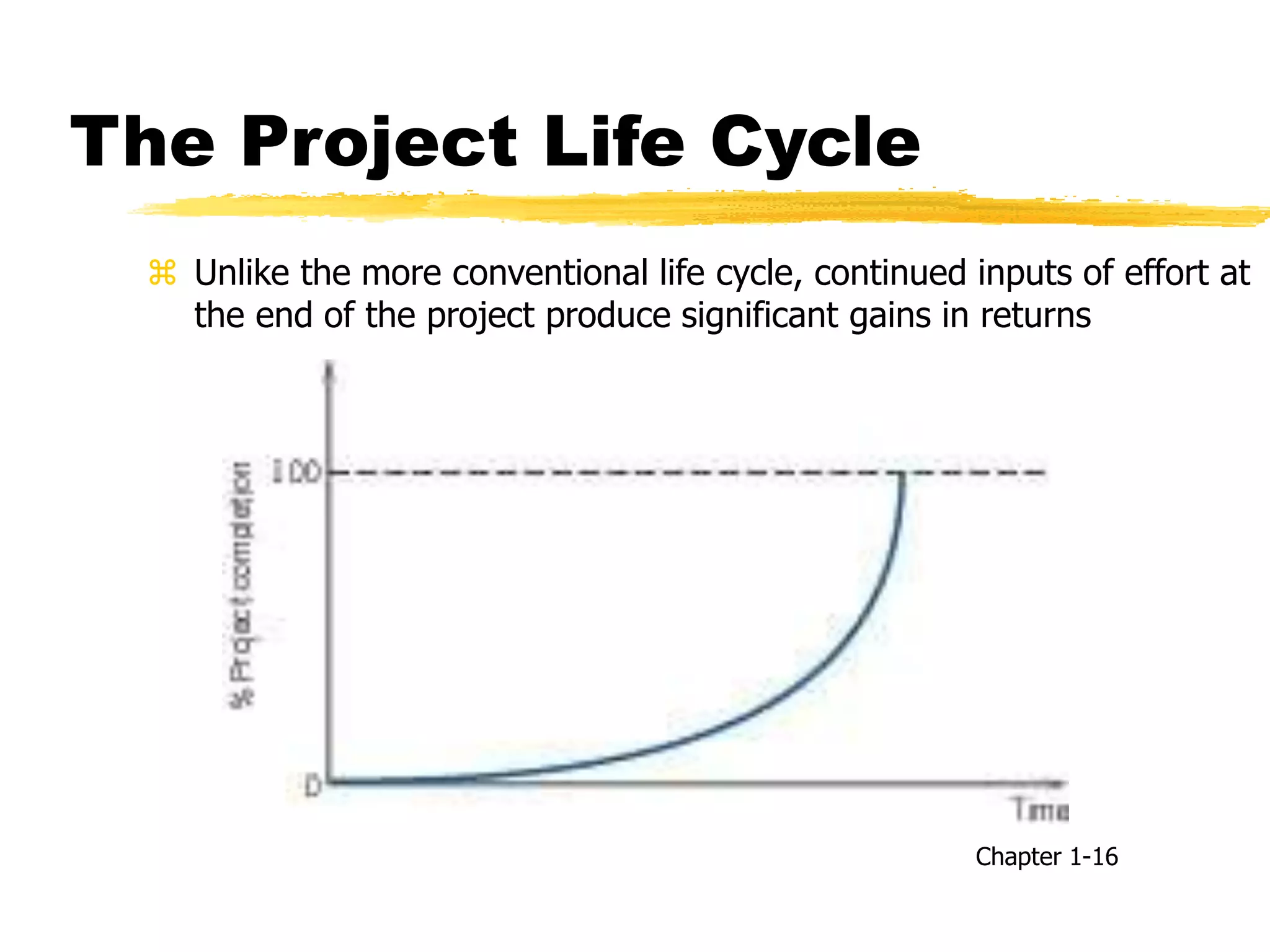
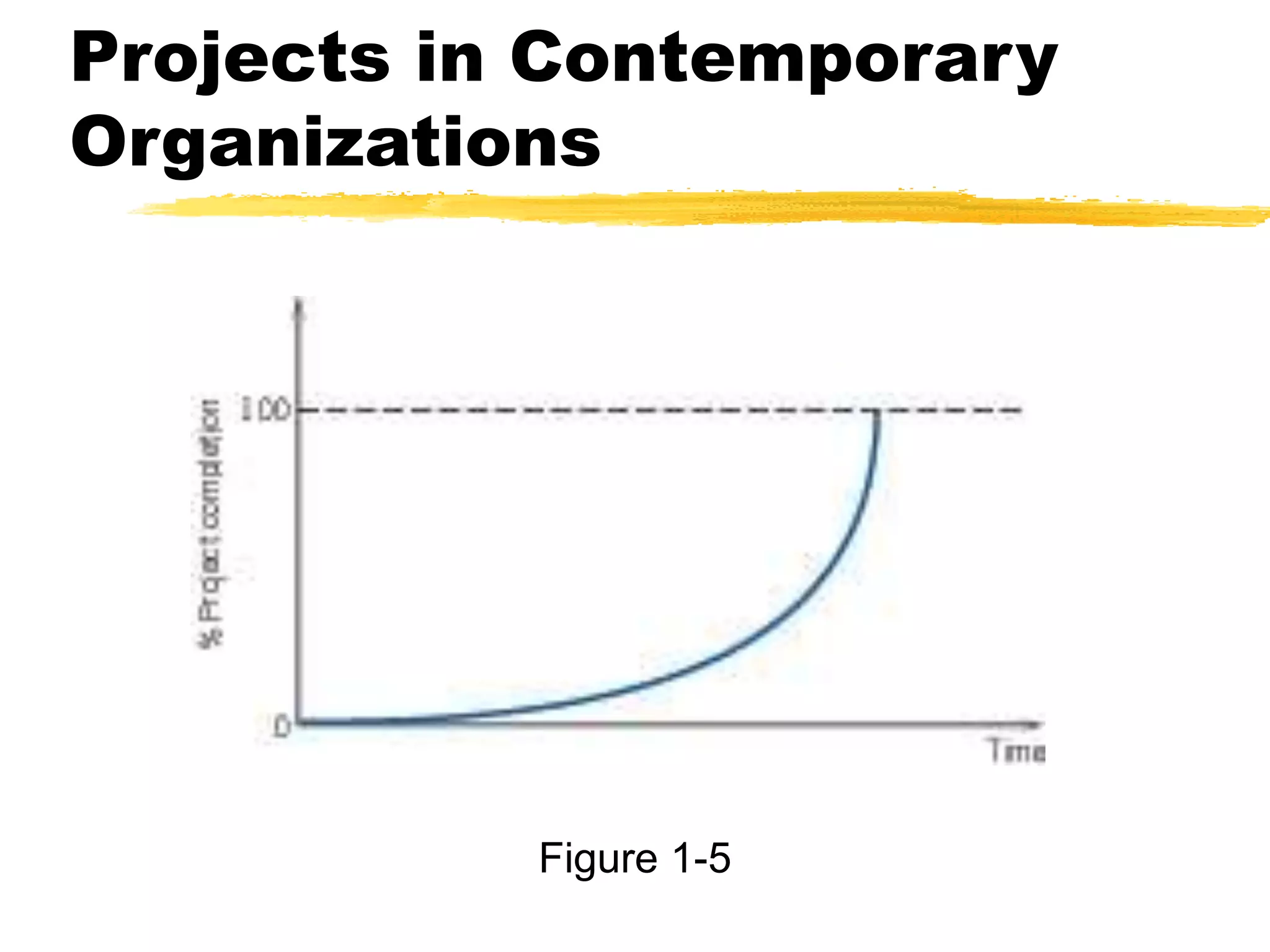
Other projects also exist which do not
follow the conventional project life cycle
These projects are comprised of subunits
that have little use as a stand alone unit,
yet become useful when put together
Chapter 1-15
The Project Life Cycle
 Unlike the more conventional life cycle, continued inputs of effort at
the end of the project produce significant gains in returns
Chapter 1-16
The Project Life Cycle
It is essential for the Project Manager to
understand the characteristics of the life
cycle curve for his project
The distinction between the two life cycles
plays a critical role in the development of
budgets and schedules for the project
Chapter 1-17
The Project Life Cycle
Risk during project life cycle
With most projects there is some uncertainty
about the ability to meet project goals
Uncertainty of outcome is greatest at the
start of a project
Uncertainty decreases as the project moves
toward completion
Chapter 1-18
Risk During Project Life
Cycle
 Uncertainty decreases as the project moves toward
completion
Chapter 1-19
Textbook Structure
Structure of the text follows the life cycle
of projects
Text divided into 3 main sections:
Part I - Project Initiation
Part II - Project Implementation
Part III - Project Termination
Chapter 1-20
Summary
The Project Management Institute (PMI) was
founded in 1969 to foster the growth and
professionalism of project management
Project management is now being recognized as
a valuable “career path” in many organizations,
as well as a way to gain valuable experience
within the organization
Chapter 1-21
Summary
The three primary forces behind project
management are:
1. The growing demand for complex,
customized goods and services
2. The exponential expansion of human
knowledge
3. The global production-consumption
environment
Chapter 1-22
Summary
The three prime objectives of project
management are:
1. To meet specified performance
2. To do it within specified costs
3. Complete on schedule
Terminology follows in this order:
program, project, task, work package,
work unit
Chapter 1-23
Summary
Projects are characterized by a singleness
of purpose, a definite life cycle, complex
interdependencies, some or all unique
elements, and an environment of conflict
Project management, though not
problem-free, is the best way to
accomplish certain goals
Chapter 1-24
Summary
Projects often start slow, build up speed
while using considerable resources, and
then slow down as completion nears
This text is organized along the project
life cycle concept:
Project Initiation (Chapters 2-6)
Project Implementation (Chapters 7-11)
Project Termination (Chapters 12-13)
Chapter 1-25
Projects in Contemporary
Organizations
Questions?
Chapter 1-26
Projects in Contemporary
Organizations
Picture Files
Projects in Contemporary
Organizations
Figure 1-1
Projects in Contemporary
Organizations
Figure 1-2
Projects in Contemporary
Organizations
Figure 1-3
Projects in Contemporary
Organizations
Figure 1-4
Projects in Contemporary
Organizations
Figure 1-5
Projects in Contemporary
Organizations
Figure 1-6
Copyright © 2000 John Wiley & Sons, Inc. All rights
reserved. Reproduction or translation of this work
beyond that permitted in Section 117 of the 1976 United
States Copyright Act without the express written
permission of the copyright owner is unlawful. Request
for further information should be addressed to the
Permissions Department, John Wiley & Sons, Inc. The
purchaser may make back-up copies for his/her own use
only and not for distribution or resale. The Publisher
assumes no responsibility for errors, omissions, or
damages, caused by the use of these programs or from
the use of the information contained herein.

Ch01.ppt

  • 1.
    Project Management: A ManagerialApproach 4/e By Jack R. Meredith and Samuel J. Mantel, Jr. Published by John Wiley & Sons, Inc. Presentation prepared by RTBM WebGroup
  • 2.
    Project Management A ManagerialApproach Chapter 1 Projects in Contemporary Organizations
  • 3.
    Projects in Contemporary Organizations ProjectManagement has emerged because the characteristics of our turn-of- the-century society demands the development of new methods of management Many forces have fostered the emergence and expansion of Project Management Chapter 1-1
  • 4.
    Forces Of Project Management 3Paramount Forces driving Project Management: 1. The exponential expansion of human knowledge 2. The growing demand for a broad range of complex, sophisticated, customized goods and services 3. The evolution of worldwide competitive markets for the production and consumption of goods and services All 3 forces combine to mandate the use of teams to solve problems that used to be solvable by individuals Chapter 1-2
  • 5.
    Objectives of aProject 3 Project Objectives: Performance Time Cost Expectations of clients are not an additional target, but an inherent part of the project specifications Chapter 1-3
  • 6.
    Objectives of aProject 3 Project Objectives: Chapter 1-4
  • 7.
    The Professionalism of ProjectManagement  Complexity of problems facing the project manager  Growth in number of project oriented organizations The Project Management Institute (PMI) was established in 1969 By 1990 it had 7,500 members 5 years later, over 17,000 members And by 1998, it had exploded to over 44,000 members  This exponential growth is indicative of the rapid growth in the use of projects  Also reflects the importance of PMI as a force in the development of project management as a profession Chapter 1-5
  • 8.
  • 9.
    Recent Changes in ManagingOrganizations  The process of managing organizations has been impacted by three revolutionary changes 1. Accelerating replacement of traditional, hierarchical management by participatory management 2. Currently witnessing the adoption of the “systems approach” (sometimes called “systems engineering”) 3. Organizations establishing projects as the preferred way to accomplish the many specific changes that must be made when the organization attempts to alter its strategy Chapter 1-7
  • 10.
    The Definition ofa “Project” Must make a distinction between terms: Program - an exceptionally large, long-range objective that is broken down into a set of projects Task - set of activities comprising a project Work Packages - division of tasks Work Units - division of work packages In the broadest sense, a project is a specific, finite task to be accomplished Chapter 1-8
  • 11.
    Characteristics of a Project Havea purpose Have a life cycle Interdependencies Uniqueness Conflict Chapter 1-9
  • 12.
    Why Project Management? Companieshave experienced: Better control Better customer relations Shorter development times Lower costs Higher quality and reliability Higher profit margins Sharper orientation toward results Better interdepartmental coordination Higher worker morale Chapter 1-10
  • 13.
    Why Project Management? Companieshave also experienced some negatives: Greater organizational complexity Increased likelihood of organizational policy violations Higher costs More management difficulties Low personnel utilization Chapter 1-11
  • 14.
    The Project LifeCycle Stages of a Conventional Project: Slow beginning Buildup of size Peak Begin a decline Termination Chapter 1-12
  • 15.
    The Project LifeCycle Chapter 1-13
  • 16.
    The Project LifeCycle  Time distribution of project effort is characterized by slow-rapid-slow Chapter 1-14
  • 17.
    The Project LifeCycle Other projects also exist which do not follow the conventional project life cycle These projects are comprised of subunits that have little use as a stand alone unit, yet become useful when put together Chapter 1-15
  • 18.
    The Project LifeCycle  Unlike the more conventional life cycle, continued inputs of effort at the end of the project produce significant gains in returns Chapter 1-16
  • 19.
    The Project LifeCycle It is essential for the Project Manager to understand the characteristics of the life cycle curve for his project The distinction between the two life cycles plays a critical role in the development of budgets and schedules for the project Chapter 1-17
  • 20.
    The Project LifeCycle Risk during project life cycle With most projects there is some uncertainty about the ability to meet project goals Uncertainty of outcome is greatest at the start of a project Uncertainty decreases as the project moves toward completion Chapter 1-18
  • 21.
    Risk During ProjectLife Cycle  Uncertainty decreases as the project moves toward completion Chapter 1-19
  • 22.
    Textbook Structure Structure ofthe text follows the life cycle of projects Text divided into 3 main sections: Part I - Project Initiation Part II - Project Implementation Part III - Project Termination Chapter 1-20
  • 23.
    Summary The Project ManagementInstitute (PMI) was founded in 1969 to foster the growth and professionalism of project management Project management is now being recognized as a valuable “career path” in many organizations, as well as a way to gain valuable experience within the organization Chapter 1-21
  • 24.
    Summary The three primaryforces behind project management are: 1. The growing demand for complex, customized goods and services 2. The exponential expansion of human knowledge 3. The global production-consumption environment Chapter 1-22
  • 25.
    Summary The three primeobjectives of project management are: 1. To meet specified performance 2. To do it within specified costs 3. Complete on schedule Terminology follows in this order: program, project, task, work package, work unit Chapter 1-23
  • 26.
    Summary Projects are characterizedby a singleness of purpose, a definite life cycle, complex interdependencies, some or all unique elements, and an environment of conflict Project management, though not problem-free, is the best way to accomplish certain goals Chapter 1-24
  • 27.
    Summary Projects often startslow, build up speed while using considerable resources, and then slow down as completion nears This text is organized along the project life cycle concept: Project Initiation (Chapters 2-6) Project Implementation (Chapters 7-11) Project Termination (Chapters 12-13) Chapter 1-25
  • 28.
  • 29.
  • 30.
  • 31.
  • 32.
  • 33.
  • 34.
  • 35.
  • 36.
    Copyright © 2000John Wiley & Sons, Inc. All rights reserved. Reproduction or translation of this work beyond that permitted in Section 117 of the 1976 United States Copyright Act without the express written permission of the copyright owner is unlawful. Request for further information should be addressed to the Permissions Department, John Wiley & Sons, Inc. The purchaser may make back-up copies for his/her own use only and not for distribution or resale. The Publisher assumes no responsibility for errors, omissions, or damages, caused by the use of these programs or from the use of the information contained herein.