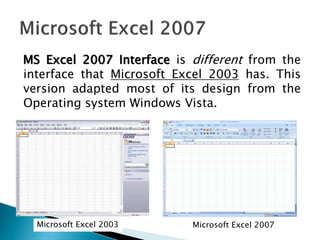
MS Excel 2007 Interface is different from the
interface that Microsoft Excel 2003 has. This
version adapted most of its design from the
Operating system Windows Vista.
Microsoft Excel 2003 Microsoft Excel 2007
Graphical User Interface abbreviated as GUI
pronounced as “gooey.” GUI allows the users to
interact with the machine’s program/s.
It uses:
 windows
 icons
 pull-down menus and
 it allows users to also use the mouse for
navigation and control.
 It is defined as a file that has one or more
worksheets in it.
 It is the working area. It contains many cells
and columns rows.
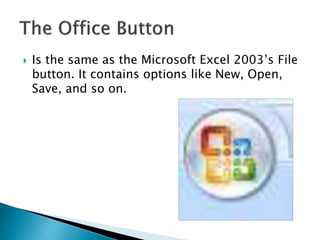
 Is the same as the Microsoft Excel 2003’s File
button. It contains options like New, Open,
Save, and so on.
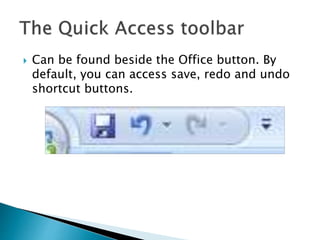
 Can be found beside the Office button. By
default, you can access save, redo and undo
shortcut buttons.
 Display the File name, format, mode and
name of application.
EXAMPLE
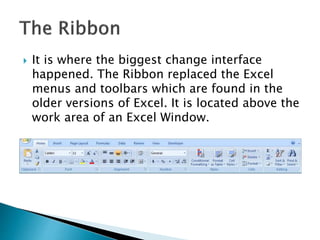
 It is where the biggest change interface
happened. The Ribbon replaced the Excel
menus and toolbars which are found in the
older versions of Excel. It is located above the
work area of an Excel Window.
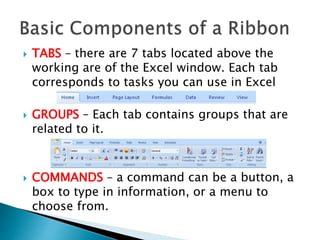
 TABS – there are 7 tabs located above the
working are of the Excel window. Each tab
corresponds to tasks you can use in Excel
 GROUPS – Each tab contains groups that are
related to it.
 COMMANDS – a command can be a button, a
box to type in information, or a menu to
choose from.
 HELP BUTTON – it opens the window where you
may find, navigate and search for “how-to’s” for
Microsoft Excel 2007.
 MINIMIZE BUTTON – reduces the whole Microsoft
Excel 2007’s window to a button on the taskbar.
 MAXIMIZE BUTTON – it expands the Microsoft
Excel 2007’s window to its normal size or to its
biggest size that will fit in your computer screen.
 CLOSE BUTTON – is simply to let you, the user to
close the program.
 The Name box –holds the address
or the coordinates of the active cell
 Formula bar buttons
◦ The CIRCLE used to adjust the size of
the Name box.
◦ The (X) symbol is used as cancel.
◦ The CHECK Mark is used as enter.
◦ The Label (fx) is function wizard
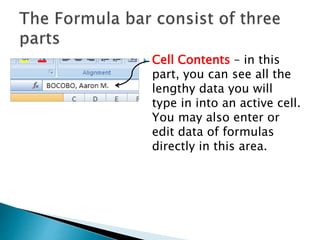
 Cell Contents – in this
part, you can see all the
lengthy data you will
type in into an active cell.
You may also enter or
edit data of formulas
directly in this area.
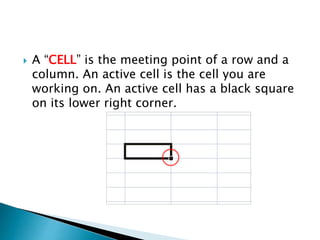
 A “CELL” is the meeting point of a row and a
column. An active cell is the cell you are
working on. An active cell has a black square
on its lower right corner.
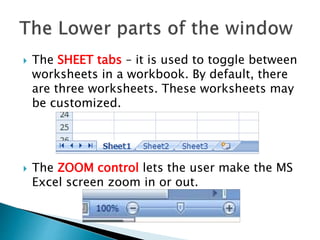
 The SHEET tabs – it is used to toggle between
worksheets in a workbook. By default, there
are three worksheets. These worksheets may
be customized.
 The ZOOM control lets the user make the MS
Excel screen zoom in or out.
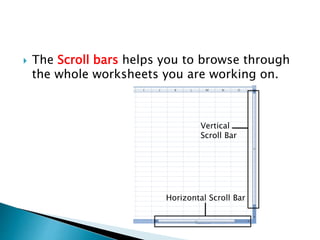
 The Scroll bars helps you to browse through
the whole worksheets you are working on.
Vertical
Scroll Bar
Horizontal Scroll Bar
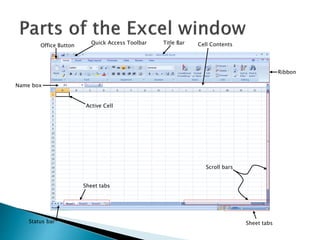
Office Button
Name box
Quick Access Toolbar Title Bar Cell Contents
Ribbon
Active Cell
Status bar
Sheet tabs
Sheet tabs
Scroll bars
Answer pages 25-27
“Let’s Answer This!”

Chapter 1 lesson 2 MS Excel and its Interface

  • 2.
    MS Excel 2007Interface is different from the interface that Microsoft Excel 2003 has. This version adapted most of its design from the Operating system Windows Vista. Microsoft Excel 2003 Microsoft Excel 2007
  • 3.
    Graphical User Interfaceabbreviated as GUI pronounced as “gooey.” GUI allows the users to interact with the machine’s program/s. It uses:  windows  icons  pull-down menus and  it allows users to also use the mouse for navigation and control.
  • 4.
     It isdefined as a file that has one or more worksheets in it.
  • 5.
     It isthe working area. It contains many cells and columns rows.
  • 6.
     Is thesame as the Microsoft Excel 2003’s File button. It contains options like New, Open, Save, and so on.
  • 7.
     Can befound beside the Office button. By default, you can access save, redo and undo shortcut buttons.
  • 8.
     Display theFile name, format, mode and name of application. EXAMPLE
  • 9.
     It iswhere the biggest change interface happened. The Ribbon replaced the Excel menus and toolbars which are found in the older versions of Excel. It is located above the work area of an Excel Window.
  • 11.
     TABS –there are 7 tabs located above the working are of the Excel window. Each tab corresponds to tasks you can use in Excel  GROUPS – Each tab contains groups that are related to it.  COMMANDS – a command can be a button, a box to type in information, or a menu to choose from.
  • 12.
     HELP BUTTON– it opens the window where you may find, navigate and search for “how-to’s” for Microsoft Excel 2007.  MINIMIZE BUTTON – reduces the whole Microsoft Excel 2007’s window to a button on the taskbar.  MAXIMIZE BUTTON – it expands the Microsoft Excel 2007’s window to its normal size or to its biggest size that will fit in your computer screen.  CLOSE BUTTON – is simply to let you, the user to close the program.
  • 13.
     The Namebox –holds the address or the coordinates of the active cell  Formula bar buttons ◦ The CIRCLE used to adjust the size of the Name box. ◦ The (X) symbol is used as cancel. ◦ The CHECK Mark is used as enter. ◦ The Label (fx) is function wizard
  • 14.
     Cell Contents– in this part, you can see all the lengthy data you will type in into an active cell. You may also enter or edit data of formulas directly in this area.
  • 15.
     A “CELL”is the meeting point of a row and a column. An active cell is the cell you are working on. An active cell has a black square on its lower right corner.
  • 16.
     The SHEETtabs – it is used to toggle between worksheets in a workbook. By default, there are three worksheets. These worksheets may be customized.  The ZOOM control lets the user make the MS Excel screen zoom in or out.
  • 17.
     The Scrollbars helps you to browse through the whole worksheets you are working on. Vertical Scroll Bar Horizontal Scroll Bar
  • 18.
    Office Button Name box QuickAccess Toolbar Title Bar Cell Contents Ribbon Active Cell Status bar Sheet tabs Sheet tabs Scroll bars
  • 19.